




Abstract
In an in-house third-year social work research placement, a duo-ethnography showed that the student–supervisor relationship had far more impact on transformative learning than the assigned placement tasks. A model for co-creating an environment of transformative learning is described, putting student learning and growth at the center. Attributes that contributed to a transformative learning environment included being Trustworthy, Respectful, Engaging, Caring, and Humble. A range of actions within each of these attributes is described. The findings showed that in this context, a crisis-type of disorienting dilemma did not occur. Rather, transformation evolved as part of a learning outcome that included the development of a professional identity as a social worker. Findings suggested the need for further exploration of the role that humility plays in reducing the power imbalance in the student–supervisor relationship. The importance of addressing self-care and avoiding models that risk perpetuating patriarchy in the student-supervisor relationship were highlighted.
Keywords
Social work as a profession is inherently about transformation related to social justice, social action, and reducing power-imbalances and oppression. A core learning objective identified by social work accreditors (e.g., Canadian Association of Social Work Education [CASWE], 2021; Council on Social Work Education [CSWE], 2015) includes social work identity building through critical thinking, self-reflection, critical discourse, and adoption of the values of the profession. In particular, field education is considered to be the “signature pedagogy” of social work education, where students practice and develop skills, values, and a sense of professional identity (Bogo, 2015; CSWE, 2015, p. 12). In Canada, 700 field placement hours are required at the undergraduate level and 450 hours at the master’s level (CASWE, 2021). With these foundational principles of the profession, using transformative education approaches intuitively seems to be a natural fit for social work education. However, little has been written that connects social work education and transformative education (Jones, 2009). This article contributes to filling this gap.
Since there is wide recognition that the student-supervisor relationship is key to social work student learning (Bogo, 2015; Coohey & Landsman, 2020), social work programs in Canada are required to “provide formal preparation and orientation of new field instructors/supervisors” (CASWE, 2021, p. 10). Typically, this orientation includes content such as: supervisor roles and responsibilities; a review of adult learning styles; identification of learning opportunities and ways to integrate theory and practice; professionalism and ethics; reminders of a focus on social justice, equity, and inclusion; and suggestions for addressing challenges that may arise (CASWE, 2019). Much of what is in current training and in the literature covers what supervisors need to do while little has been written about supervisors’ attributes (who they need to be) that contribute to the transformational learning environment that is so important for social work professional identity development. This article contributes to the literature with a focus on being from both a student and a supervisor perspective.
Models of Transformational Learning
Mezirow (1978) refers to perspective transformation as including “a structural change in the way we see ourselves and our relationships” (p. 100). According to Mezirow (1981), the process of perspective transformation starts with a disorienting dilemma and requires self-examination, critical assessment of one’s assumptions, and connecting one’s reaction to others’ experiences or social issues. The initial steps after the disorienting dilemma are followed by an exploration of options for adopting a new perspective or new behaviors, building confidence, action planning, developing the knowledge and skills to implement the plan, implementing the plan and assessing feedback, and moving forward after having adopted a new worldview.
Many theorists and researchers have critiqued and have contributed to further development of Mezirow’s model. For example, Cranton (2002) described teaching strategies that can be used to achieve Mezirow’s steps such as: exposing students to varying perspectives; explicitly stating assumptions, including the use of autobiographies; engaging the student in critical self-reflection, including the use of reflective journals; creating safety by being open to students’ viewpoints; engaging in discourse that is open, free of judgment, well-informed, and critical; being supportive and linking students with each other and with other supports; creating opportunities for experiential learning; and engaging in discussions about an action plan.
Similar to Mezirow’s (1981) model, Kolb (1984) presented a four-stage learning cycle consisting of a concrete experience, reflection, generalization and abstract conceptualization, and active experimentation (testing the hypothesis). In the context of social work, Bogo and Vayda (1989) adapted Kolb’s theory to create an “integration loop” model consisting of retrieval (facts), reflection (including feedback from one’s supervisor), linkage (theoretical analysis), and professional response (action plan). Although not framed in the context of transformative learning, this model continues to be used by social workers today. In the context of social work field placements, Bennett and Saks (2006) adapted Marvin et al.'s (2002) circle of security, which is based on Bowlby’s attachment theories, and emphasized that, “it is the supervisor’s responsibility to provide a ‘secure base’ for the students’ learning, and in such an environment the student becomes free to explore the professional world” (p. 671).
Like social work field-instructor training in Canada, all of these theories focus on what the supervisor should do rather than on what Mälkki and Green (2014) advocate for, which is about how to be. Being genuine, passionate, approachable, open to communication, a role model, engaged, and caring, are some initial results about how the supervisor should be from the student perspective (Damianakis et al., 2019). However, the literature on the students’ and supervisors’ reciprocal perspective on how student and supervisor should be to co-create an environment of transformative learning remains in its infancy.
Study Design and Context
Due to a shortage of social work field placements during the COVID-19 pandemic, the first author developed an in-house 12-week placement for a student to conduct qualitative data analysis of interview transcripts from another study. Given that the social work program accreditors (CASWE, 2021) require a practice component and the development of transferable social work skills in placements, a considerable amount of strategizing occurred during the planning and implementation of the placement to ensure the placement was more than just a research assistant position focused on data analysis. As described in detail in Calderwood and Rizzo (2022), core outcomes such as the student’s development of a professional social work identity, reflective practice, generalist practice skills, and increased understanding of diversity and social justice considerations were expected.
In Calderwood and Rizzo (2022), the following aspects of the program expectations and placement were described. The placement consisted of 240 hours, scheduled 3 days a week, 7 hours a day, over approximately 12 weeks. The primary task for the student was to conduct open and axial coding of transcript data, attend research team meetings with her supervisor and another co-investigator, present the findings to the board of the organization where the research was conducted, attend weekly one-to three-hour supervision meetings with her supervisor (the first author; officially referred to as a “Field Instructor”), and attend weekly student support meetings with six other social work students who also had in-house placements but with other supervisors.
Our research question was, “what are the experiences of a social work student and supervisor (second and first author, respectively) in an in-house social work third-year research placement?” (Calderwood & Rizzo, 2022, p. 2). We used a duo-ethnographic methodology: we journaled our reflections throughout the placement, spending one to 2 hours each week documenting our experience and learning in the placement (23 entries [17 single-spaced pages] by the student and 13 entries plus appendixes [22 pages] by the supervisor); in the last week of the placement, we shared our journals and responded in writing to each other’s entries using color codes to identify the author of each excerpt; we emailed our journals back and forth six times, adding responses to each other’s responses until neither one of us had anything more to add (expanding the journals to 38 and 45 pages for the student and supervisor, respectively); we reviewed our own journal (including the other’s responses to our entries) and highlighted what we considered to be the most meaningful text during the placement; the supervisor extracted all of the data that were considered by either herself or the student as meaningful and grouped the content into similar content areas to arrive at themes (Calderwood & Rizzo, 2022). Both authors met numerous times to finalize the groupings, discuss the meaning of the findings, and decide how we could depict our collective experience as a model.
Situating the Researchers/Participants
Student
I am a cis-gendered, Caucasian, Canadian woman in my early 20s. I entered university directly after high school and am now finishing the fourth year of an Honors Bachelor of Social Work program. For my entire university experience, I have enrolled in a full course load of five courses per semester, focusing on Social Work and Psychology but also including some Anthropology, Nursing, Women’s Studies and Indigenous Studies. For 8 years, I have been active in my community, volunteering for various grassroots organizations mainly in mentorship and leadership roles. My work in healthcare has primarily included assisting Deafblind people with maximizing their independence through the development of social and living skills and working in an intensive care unit in a retirement home. My developing social work and professional identity centralizes feminism, anti-oppression, a structuralist perspective, and pursuing social justice. Although the supervisor of this third-year placement had been my instructor for an introductory research methods course in the semester previous to the placement, it was not her that drew me to this in-house research placement but the focus on research and the flexibility of being able to complete the placement from home during the COVID-19 pandemic.
Supervisor
I am a Caucasian, middle-aged, Canadian woman who has been working as an Assistant/Associate Professor in Social Work for 20 years. I have taught 30 undergraduate level courses and 28 master’s courses. I have supervised close to 30 research and teaching assistants, but this placement was only my second time being a field placement supervisor. I have mentored over 25 new faculty and countless students and have attended numerous teaching and learning presentations and workshops about teaching, mentorship, and learning. Prior to becoming a professor, I was exposed to and highly valued Paulo Freire’s (1997) work as shown in his seminal book, Pedagogy of the Oppressed, and bell hooks's (1994) Teaching to Transgress: Education as the Practice of Freedom. Aligned with our social work code of ethics (CASW, 2005), my values reflect social justice, equity, empowerment, a strengths-perspective, respect for diversity, and dignity and worth. I strive to be aware of and reduce power-imbalances. I have always brought these principles and values to my teaching.
Ethics Review
Since duo-ethnographies inherently reveal the name of the research participant(s), our Research Ethics Board required that we put steps in place to minimize any risk of jeopardizing the student’s future. As described in more detail in Calderwood and Rizzo (2022), we created guidelines for writing and sharing our journals to address this concern—before exchanging our journals with each other, we followed these guidelines, reviewed our respective journals, and removed any data that we thought did not align with the research question or might put us at risk if it were to be published. In addition, we had two consent forms, one to agree to participate in the duo-ethnography and a later one to agree to the content that might be included in a publication (Calderwood & Rizzo, 2022). We continually discussed our comfort level regarding the content of what was being included in the manuscript and ensured that neither one of us was uncomfortable with any aspect of the process or what was being disclosed.
Findings
Described in Calderwood and Rizzo (2022), there were a range of findings related to the completion of tasks assigned, aligning accomplishments with accreditor expectations in such an unconventional placement, and working from home during the pandemic. What is described in this article is the theme that unexpectedly stood out most across both journals—the value of the student-supervisor relationship: “The biggest thing that I think that I am taking away from this placement that means a lot to me is the mentorship that I received from (Supervisor)” (Calderwood & Rizzo, 2022, p. 5). This finding confirms what we state in the literature review above that the student–supervisor relationship is a primary influential factor in the success of student learning in social work. Consistent with Damianakis et al.'s (2019) findings, our journals reflected: respect, genuineness, passion, openness to a “free flow of ideas” (p. 9) and to being challenged, the instructor modeling who the student wants to be, engagement, care, welcoming, taking time to connect, seeing the student as unique, and trust. Our findings were also consistent with Archer-Kuhn et al.’s (2021) report of instructors being accessible, supportive, engaged in critical dialogue, and providing students with opportunities to address dilemmas and tensions. And our findings were aligned with Coohey and Landsman's (2020) findings: listening, open to questions and feedback, an environment conducive to open and safe discussions, encouragement, support, critical thinking, opportunities to work independently, challenges to explore options for professional growth, asking about learning style, clear expectations, sufficient direction, regular supervision, ensuring the majority of the time is spent on professional social work activities, and manageable workload. However, as described in the eight broad themes below, additional nuances about being (rather than doing), from both a student and instructor perspective, led to our creation of an initial model for the student–supervisor relationship, placing learning and growth at the center.
The Transformative Approach of the Supervisor Greatly Enhanced the Student Learning
In this study, both the student and the supervisor identified that a transformative education approach was beneficial. Student: (Supervisor) is excellent at making me feel comfortable to contradict, contrast, and explore in my learning process. (She) actively listens to what I am saying, processes it and finds a way to integrate her own and my ideas into the placement learning. (Supervisor) always builds off my questions and ideas and I feel this contributes greatly to my learning. Supervisor: I think all of this speaks to a relatively new concept that I think aligns well with my approach–“trans”formational leadership… When we share ideas, it is more than just you saying one thing and me saying something else, but instead we both build on what each other is saying and land in a new and more advanced place.
Both student and instructor indicated that the relationship seemed to have been informed by Paulo Freire's (1997) theories and led to a climate of co-learning. Student: In my Community Development in Canada textbook by Brown and Hannis (2012), Paulo Freire is discussed as one of the most interesting figures in adult education in the developing world: “If students are to be equally liberated, educators need to establish a climate for learning where learners do not become docile listeners, but rather partner with their teachers to become critical co-learners in search of answers” (p. 26). This quote struck me so much because it perfectly describes the working relationship I have with (Supervisor). She makes me feel like I am equal, worthy and competent. She also values what I am saying and has provided me with so much confidence in what I am doing. I have some self-doubts, but I always feel secure to extend my issues, concerns, thoughts, (and) ideas to (Supervisor) and know I will get a positive supportive response. This entire research project we are doing together has made me feel exactly that “learners do not become docile learners.” I feel like an engaged learner with a valuable role in the project.
When the above quote was reviewed at the end of the placement, the following dialogue ensued. Student: I think that this is my most interesting journal reflection so far because it is very interesting to me how much this adult learning and theory from Paulo Freire relates and connects to how I feel about this placement. Looking back, I still feel the same about it. Supervisor: I also find this journal reflection to be the most interesting so far. I studied Paulo Friere’s Pedagogy of the Oppressed during my PhD program.… I was drawn to everything you have quoted above and seriously took it to heart…. it is interesting that you have picked up on this exact thing as part of my style. Nice for me to hear that not only did I learn about Paulo Freire, but I have sufficiently integrated his teachings to the point where a student picks up on it.
Student Learning Was Central
Several of the student journal entries indicated a recognition that her learning and growth was central to the placement. Student: I feel that (Supervisor) is very aware and (I) feel very involved in the decision-making process and felt that she is very focused on my learning and growth…. (Supervisor) provides a lot of time for me to add my own opinions and add to the conversation what I think is important. (She) also integrates my interests in the way she speaks about the work, and this identifies for me that (Supervisor) is always thinking about my growth in a personal and professional manner. (Supervisor’s) demeanor demonstrates true interest about our work together. I don’t feel like a burdensome student trying to catch up. I feel that I can go at my own pace and take extra time to get things done in a way that both meets expectations and is supported by (Supervisor).
Part of this centrality included indicators that the student’s learning and growth was a priority. Student: I think that other students are not getting the same experience that I am, for two reasons. The first one is that I think like you mentioned from a conversation with …, field instructors treat their placement students as employees. They don’t get the same level of concern for their learning. They are often thrown into things without direction. Secondly, my experience being in this placement has been that you care so much about students’ learning that it is a priority, I don’t think that every field instructor or even every teacher has that as a priority. A massive thing to consider too is that a lot of profs/teachers etc. think we don’t know a lot and just want to dump content into our minds. Someone like myself needs more than that.
The student acknowledged that making the student learning central takes time, flexibility, and support. Student: (Supervisor) made me feel supported and did not disregard any of my thoughts or questions. I think an important part of in-house placements is to have a flexible and supportive field instructor. I also think it requires time and dedication to keep the learning momentum going for the student.
Trust and Rapport Were Important Components of the Learning
Trust and rapport were considered to be key elements that contributed to a safer environment, critical thinking, exploration, and transformative learning. One supervisor attribute that contributed to trust was showing an interest in the student’s academic interests and future goals right from the first interview contact. Student: During this supervision meeting, I noticed that (Supervisor) hinted at the trust and rapport developing between us in a professional and mentorship way. I felt kind of relieved about this because I feel the same way and have often discussed that in my journal…. Supervisor: … I think one of the key points here is that it does take time to build trust in a relationship. I would not have had the same confidence that any student could trust me (being the one in the position of more power) early on in the relationship. It takes time of getting to know each other before that trust can be built. I think it requires steps in showing one has the other’s back. Student: I definitely feel we have developed trust and I have felt that way from the start. Supervisor: Hmm if you felt that way from the start, what did I do to gain your trust? Was the fact that I was your instructor last term a contributing factor? Student: I think that our initial interview had a lot to do with feeling trust…. The initial interview not only got me inspired and excited for the placement, I also immediately saw how interested you were in my learning and your investment in me made me feel trust. Supervisor: Can you say what I said or did that led you to see how interested I was in your learning? And what led to the trust? Student: Asking about my academic interests and future goals. I cannot recall exactly what you said. I am not sure exactly what led to trust, maybe part of it is that you’re my professor as well?
Another attribute that conveys trust is having confidence in the student’s abilities and supporting her in working independently. Student: I think that given the placement in general I have a lot of independence, and this allows me to structure my own day. Instances where I am working on a project I usually have a process and can estimate my time, but if I need longer I know when I tell you what I need you are receptive to that. The way that you speak to me is not in a way that makes me feel like I am [in]capable of monitoring my progress and you seem to trust that I will get the work done … I also think that because of your true interest you do not treat me as just a person to get work done. You are considerate of what I am learning and the time I need to get the hang of things.
Students Should Not be Protected but Should be Trusted and Supported in Risk-Taking
Also related to trust (and to some extent power), the findings showed that the supervisor should not protect the student. The following example is in the context of the student having a difference of opinion with a peer. Student: I was reflecting on something that my (supervisor) said when we were discussing (the difference of opinion) …. (Supervisor) said that she felt protective of me. I kind of thought of this in a positive way at the moment but there were some underlying feelings that came up when that was said. I wonder if that meant that I was being too passive? Supervisor: Thank you for raising this…. I remember in my first placement, my supervisor did something with the purpose of protecting me, and I was quite upset about it. I felt that it showed a lack of trust on her part regarding my ability to handle a difficult situation. You would think I would have learned from that to not do the same but maybe I didn’t learn it well enough—not sure. I think what I meant by it came from a place of being sensitive to the fact that the placement is not an agency placement. I wanted you to have as enriching an experience as possible and it saddened me to think that [a change might be made that would reduce your opportunities with] something that I thought you were thinking was one of the few real-life type experiences you were having in the placement. So, maybe my wording was incorrect. It was not so much “protecting you” but instead I was wanting to “protect the integrity of the placement.” Student: I think that I now pick up what you’re saying and see it in the context that you have described…. However, it was definitely a learning experience for me to experience a challenge … with another student and navigate how to deal with situations when they arise…. Supervisor: … I think the “protector” role is an important topic for discussion in a student-[supervisor] situation. Since the department is the one that places you, I feel some responsibility to ensure the placement goes well. I think I am also very sensitive about this topic because I have been witness to situations when agencies have exploited students and/or have not been supportive.
This theme of the supervisor not being a protector aligns with Mälkki and Green's (2014) suggestion that the supervisor avoid doing the work for the student and instead offer acceptance and support. This theme also aligns with Damianakis et al.’s (2019) finding that students did not want to be “coddled” (p. 15). Similarly, Carroll (2009) indicated a shift away from supervisor-led supervision to student-led supervision, putting more responsibility on the student to contribute to the transformative learning environment. These points contradict Bennett and Saks's (2006) circle of security model where the supervisor is responsible for creating a safe and secure environment for the student. We suggest that by putting the onus on the supervisor alone for creating a safer space disempowers the student and perpetuates the patriarchy we are trying to eliminate in a transformative learning environment. Moreover, research is beginning to show that instructors too are vulnerable and at risk in the social work learning environment (e.g., Hillock, in press), further confirming the need for a safer environment that is co-constructed by both the student and the supervisor so that both parties feel an increase in safety. We suggest that students and supervisors be encouraged to work on becoming “comfortable with being uncomfortable” (CBU)—an acronym the first author has created to encourage professional risk-taking and to ease student anxiety as they take on new challenges throughout their social work program.
Respect Played an Important Role in the Student-Supervisor Relationship
The concept of mutual respect was threaded throughout the journals. A sample dialogue included the following. Supervisor: Highly influenced by Paolo Freire’s work and bell hooks, I always come from a framework where I assume the student has knowledge and a sense of their learning goals. I believe the best learning occurs through experience, asking questions, and integration of actions and reflection. So, it is important to me that any social work education that I am leading, the context allows for this integration and mutual respect. Student: I find it very interesting that when I came across Paolo Freire’s adult teaching philosophy, I thought of you and felt it was incredibly accurate. It’s interesting to see that you are highly influenced by his work. Supervisor: The Paulo Freire discussion is an important awareness: respect, partnership, mentorship, meeting “your” “learning” needs as a priority.
This respect led to increased openness and confidence. Student: (Supervisor) is very good at building a relationship that facilitates learning by being open-minded and considerate. I personally feel excited each time I meet with (Supervisor), especially making me feel that I am doing something that is going to give me better opportunities and confidence in my professionalism.
Respect also extended to respecting each other’s privacy. Supervisor: I require all my students in the seminar course to indicate that they will be developing a self-care plan. I think it is important to respect the student’s privacy regarding what they do for self-care. So, I require that they say they are doing a self-care plan but don’t ask for the details. And then each week, I ask how their self-care plan is coming along.
The theme regarding respect also included role modeling respect. Student: I also enjoyed watching (Supervisor) and (Co-investigator) debate about whether I should be doing a literature review on presence, particularly because I was watching the process of how they decide the research path and the pros and cons. I also liked this because it was a good example of two academics debating about the quality of research and what direction they would like to go. Supervisor: I am glad that you appreciated watching (Co-Investigator) and I together. It was my intent for you to witness us being two academics, challenging each other but in a respectful way. Student: I loved it. It taught me how to present your ideas in a way that is meaningful and powerful but also receptive to others’ thoughts.
Engaging in discussions of how placement tasks relate to one another, how they are important to the project, and how they contribute to long-term and transferable personal growth were important to solidify the learning
This duo-ethnography showed that an important way to strengthen learning and growth is to engage in discussions about how tasks relate to one another and are important to the project, and to adopt a mentorship stance, including how the tasks contribute to long-term and transferable personal growth. Student: One of the greatest things about having a field instructor that is also a Professor is that they know how to teach, and as simple as that sounds it makes the whole experience so much better because like I mention here, (Supervisor) reviews and explains things in a way that solidifies my thinking. Supervisor: I really agree with you here. From some feedback I have heard from other students and other supervisors, I think sometimes people are taking for granted what the term Field Instructor actually means. The role is supposed to be that of an Instructor. So, I saw my role in this placement as actually teaching something and providing opportunities for learning, not just giving tasks and getting work done. Student: I definitely feel that I got a learning experience. I don’t feel like I was just assigned tasks with no meaning. I knew how to relate each thing to what I was doing before and the importance of each thing. I definitely felt that I had that instructor experience but also you went above that to be a mentor.
The Supervisor Showing They Care is Important
Consistent with some other transformative learning research in the social work context (e.g., Damianakis et al., 2019), we found that the supervisor showing they care was an important component of learning and growth. In particular, knowing that self-care is an important learning goal in social work, we added the topic of self-care as a running agenda item for all our supervision meetings. Given that this placement occurred during the COVID-19 pandemic, there was no in-person contact and both the student and supervisor were working from home environments that had not been ergonomically created to ensure health and safety measures were met. We identified the importance of assessing the student’s physical workspace. The supervisor forwarded emails that had been sent to all University employees about the ergonomics of their work setting. Other topics such as structuring time, exercise, mental health, and setting boundaries around work hours were addressed. Student: Today was definitely more productive as I did not have any meetings. I found that today I took a lot of mini breaks because reading on my laptop strains my eyes. I am also feeling a bit of isolation and loneliness in general because of the pandemic and I was thinking about how yesterday I felt a connection and it kind of made me feel less lonely. Soon my roommate is moving out and I will be on my own, I am thinking that these supervision and team meetings will also be beneficial for my mental health and I will have some social interaction as well …. I think that I need more exercise to boost my energy and physical wellness. I think this will help with my foggy brain and make me feel less contained to my desk. Starting earlier will allow me to exercise at night. That’s one thing that’s difficult when you are not in a physical workspace such as a separate office. I’m just in my room and I find that I need a routine to keep on task. Lately it has been mentally hard to separate my work mode … from my relaxed mode. However, with self-discipline and following my schedule I have set out for myself has helped. Supervisor: I think this is an important point. If we are going to have in-house placements where students work remotely, we should be discussing with them how they will structure their days and ensure self-care. You and I did the self-care piece, but I’m not sure I ever took an interest in how you structured your day, number of breaks, hours you were working, beyond me being sure to not email you during off-hours. I was allowing you to work independently so left it up to you, but in hindsight, maybe you would have appreciated me checking in about it. Student: There are definitely some people who would need a strict schedule and need to be checked in on. I think that there were times that I felt either I was working too long or felt I haven’t accomplished much (in reality it just took me longer to accomplish something). Having a set schedule, especially being online, is super important. I definitely had days where I took more breaks and just extended my day and times when I took no or little breaks and plowed through my work. I liked the flexibility and independence overall and I think because of who I am it worked out well.
Humility Was an Important Factor That Contributed to a Reduction in the Student-Supervisor Power Imbalance
Like Watkins (2020), we are aware that, “Humility has been increasingly recognized and elaborated upon as a critical variable for effective supervision practice.” However, little has been written explicitly about the role humility plays in transformative education. Carroll (2009) for example, does not explicitly use the word “humility” but describes supervisors acknowledging their limitations: “Supervisors move beyond their embarrassments and are able to admit their limitations, their not-knowing, their being lost, and, like supervisees, being transparent and honest” (p. 218). Archer-Kuhn et al. (2021) describe students coping with disorienting dilemmas by “being honest with their emotions, their role, limitations, and vulnerabilities” (p. 10). Only a few authors (e.g., Watkins, 2020) make the connection between humility and the role it plays in addressing power-differentials. This was an important component of our experience. Supervisor: Already in the first week, I am feeling like I am learning from my student. I find it humbling to work with her. I’m not really sure what I mean by that but this is what came to mind. Working with her (and the other in-house students) is forcing me to put my head space back to a time when I did not have all the 20 years of experience in academia and 30+ years doing research. This is not easy to do, and I am enjoying the challenge. I have to think of how to explain things, and how to assign tasks that are at a beginner level. This is great because it helps me to dissect what we do and think about “why” we do things the way we do; e.g., I have already learned some new things about Robert’s Rules of Order even though I have been using the Rules for over a decade…. This is different than classroom/course teaching, and perhaps will make me a better classroom/course instructor. Here there is no textbook, slides, or specific content that must be covered. This is a “real world” context where we have no idea what the learning will look like and how it will evolve. And the learning is sooo focused on one individual (the student) rather than meeting the collective needs of an entire classroom. I like anything that is more about depth than breadth, and this is a good example: one student but learning in-depth.
The student also made comments relating to the supervisor’s humility. Student: In this meeting, (Supervisor) brought up something that I found intriguing. She mentioned that I should not take everything she says as right. This is something not traditionally taught to students. Often, we are taught not to confront or question those with more power than us/ in positions of teachers, parents, and authoritative positions. It was pretty ingrained in my thinking to not directly challenge anyone. Supervisor: This is aligned with your earlier comments about me being influenced by Paulo Freire. It is also about transformational leadership and “humility.”
The student went on to say the following, linking humility to a reduction in power-imbalances. Student: (Being given permission to challenge my supervisor) really challenged me to challenge myself to question everything that I think and what I am being taught. It also pushed me to think about how I need to be more critical of those who are in positions of authority and think about their guidance as equal to my own control of learning. Interestingly, I think that (Supervisor) saying this actively switched my mindset and equalized our positions as student and field instructor. In social work we talk a lot about the power that comes with holding knowledge and what standards we hold our ethics. Who decides? Whose input is more valuable? Whose thoughts are more dominant? Making the conscious effort to remind me to take each thing I learn with a critical and ambiguous lens is something very important to social work.
Co-Creating a Transformational Learning Environment
Based on these findings and what is in the literature, we developed the model in Figure 1 demonstrating how the student-supervisor relationship contributed to the co-creation of a transformational learning environment. Aligned with the findings of this and other studies, we put learning and growth in the center. We considered all of the attributes that we felt contributed to the learning and growth in this placement experience and grouped them together under five ways of being: Trustworthy, Respectful, Engaging, Caring, and Humble. These headings could be viewed as forming the acronym TRECH, a revised spelling of the word “Trek,” meaning a trip or movement especially when involving difficulties or complex organization (Merriam-Webster, n.d.). Co-creating a transformational learning environment.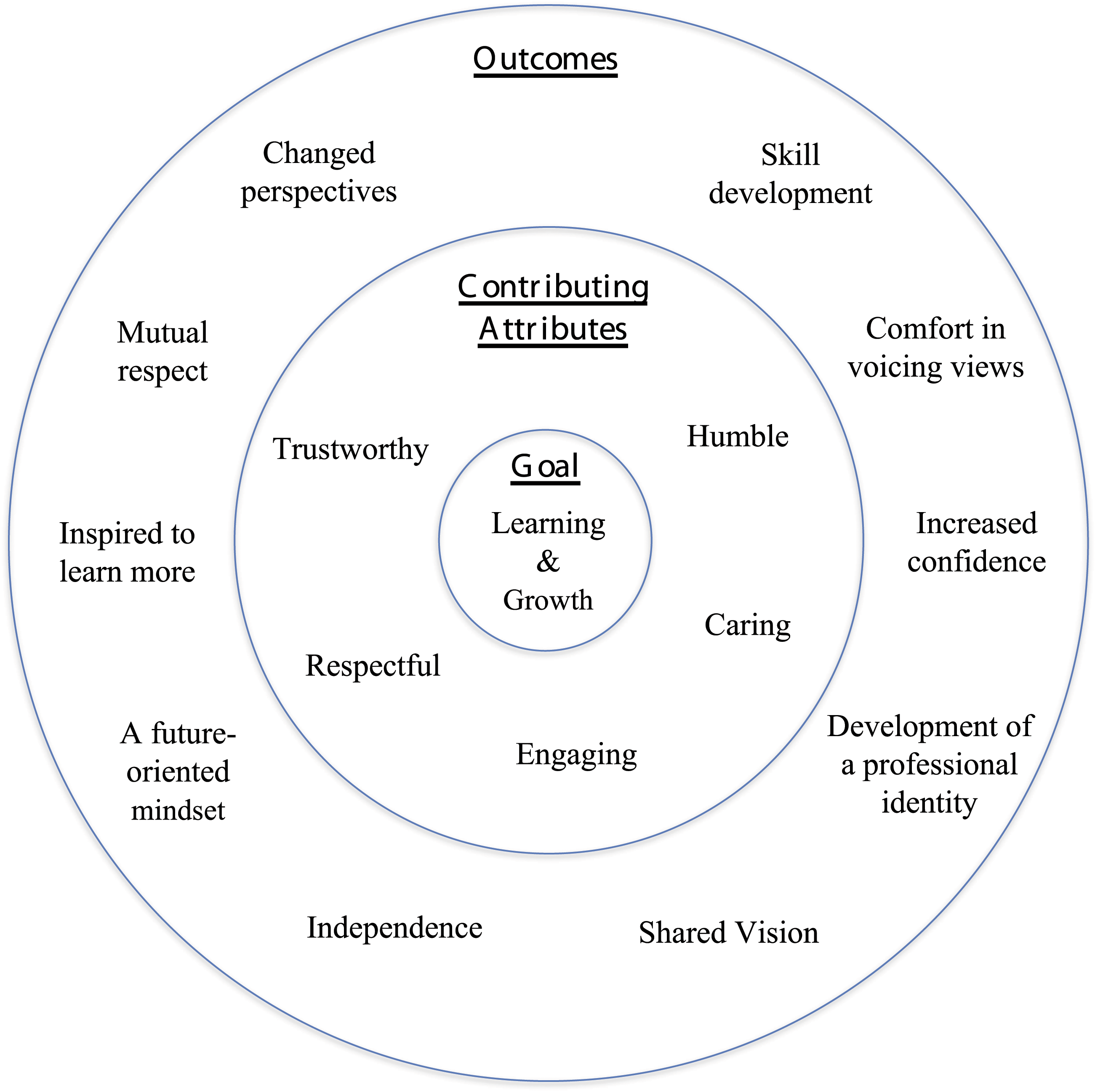
Although the words “trust,” “respect,” “engagement,” “care,” and “humility” are all found in the transformative learning literature, they typically are undefined. In discussions about our findings, we explored a range of definitions and considered Merriam-Webster’s (n.d.) dictionary definitions to be most closely aligned with our experience in the context of the student-supervisor relationship. Merriam-Webster (n.d.) defines trustworthiness as “worthy of confidence: dependable.” What contributed to building trust in our study included transparency, maintaining confidentiality, honesty, showing integrity and competence, appropriate use of language, consistency, empowerment and allowing for independence and risk-taking, and being approachable. Being respectful refers to showing “particular attention: consideration” (Merriam-Webster, n.d.) and “having a good opinion of someone’s character or ideas” (Collins, n.d.). Related actions from this study included: recognizing that students come with previous knowledge and experience; an openness to, valuing, and being non-judgemental about students’ previous knowledge, experience, culture, environment, and viewpoints; and showing high regard in feedback and in sharing successes with others (e.g., nominate for reward and writing reference letters). Engaging refers to “drawing favorable attention or interest” (Merriam-Webster, n.d.).
Actions related to engagement in our study included being passionate, positive, and present; being ready for change; making time to be available; active listening; encouraging; showing interest in educational tasks but also in other aspects of the other’s personal growth and future professional development; providing constructive feedback; engaging in critical reflection; and challenging ideas. Caring refers to “feeling or showing concern for or kindness to others” (Merriam-Webster, n.d.). We identified three areas of care: 1) caring to make connections regarding the relevance of the tasks to external contexts such as the student’s other life contexts and to the future; 2) caring about each other’s self-care, including setting boundaries, being supportive of steps to achieve physical health and wellness, and support in creating a healthy work/life balance; and 3) care in providing constructive feedback and being supportive. To be humble is to “not [be] proud or haughty: not arrogant or assertive.” Relating to power, the verb “to humble” adds “to destroy the power, independence, or prestige of” (Merriam-Webster, n.d.). The actions we noted in the placement relating to being humble included: being genuine; showing and discussing awareness of power-differentials; openness to being challenged; curiosity about and interest in others’ viewpoints; showing a commitment to life-long learning; acknowledging vulnerability and being open to taking risks; recognizing that the student comes with previous knowledge and experience, and valuing that background; and engaging in critical self-reflection. We completed the model in Figure 1 by surrounding the contributing attributes with an outer circle demonstrating the transformative outcomes we experienced as a result of the placement transformative process.
What seems to be particularly underdeveloped in the literature is the role humility plays in reducing the student-supervisor power differential, and the importance of supporting students in their self-care (particularly with an increase in online education). We were careful to leave out of the model anything about being protective, and instead strived to frame the whole model to indicate that the attributes apply to both the student and supervisor as they co-create a safer environment. Although Mezirow (1981) indicates that “the traumatic severity of the disorienting dilemma is clearly a factor in establishing the probability of a transformation” (p. 7), in this study we were unable to identify any crisis-oriented disorienting dilemma such as the losses, life changes, betrayal, and rejection described by Mezirow (1978). Rather, in our context as part of a social work practicum where the purpose was inherently about development of a professional identity and growth, our transformation consisted more of what is described by Nohl (2015) as part of a process with a “nondetermining start” (p. 39) and by Patton et al. (2021) as part of the phases of student development in post-secondary education.
Conclusion
Although recognizing that a duo-ethnography is limited to only the experience of two people, a strength of the model that emerged is that it captures reciprocal views, rather than what is dominant in the current literature—views from the student perspective. We present attributes that contribute more to states of being in the student-supervisory relationship, rather than solely focusing on the doing, as most other studies do. We recommend that future theorizing and research further explore the role of humility in impacting the power imbalance in the student-supervisor relationship. We recommend that as our understanding of transformative learning evolves, future models continue to start with student learning and growth in the center and include the importance of addressing self-care within the transformative learning process. We challenge the necessity for a “disorienting dilemma” to initiate transformative learning, as described by Mezirow (1978), and suggest that transformative learning can also occur as part of a naturally evolving learning process, particularly in the context of student development theories as described in Patton et al. (2021). Rather than perpetuating power-imbalances by focusing on attachment and security, we recommend a more emancipatory approach where the student and supervisor co-create a safer environment where they mutually experience learning and growth.
Footnotes
Acknowledgments
This project received Research Ethics approval from Trent University.
Declaration of Conflicting Interests
The author(s) declared no potential conflicts of interest with respect to the research, authorship, and/or publication of this article.
