




Abstract
Paraeducators often work with special education teachers and school teams to support students with disabilities who have complex communication needs (CCN), including students who use augmentative and alternative communication (AAC) such as speech-generating devices. This study involved surveying 258 paraeducators working with students with disabilities who had CCN (grades PreK–12, along with community-based transition classrooms). Social network analysis was used to examine paraeducators’ professional networks and collaboration patterns, along with how paraeducator professional network size related to their self-efficacy beliefs about working with students with CCN. Findings revealed wide variability in the size and function of paraeducators’ professional networks and their self-efficacy beliefs. Paraeducators generally reported few mutual collaborative relationships with other professionals, receiving support more than they gave support. Many had small networks with few trusted collaborators. Paraeducators’ network size was the strongest predictor of self-efficacy beliefs, beyond their personal characteristics and whether they received AAC-related training. This study informs future research and practice by underscoring the need for paraeducators to work within well-connected teams, and by revealing ways social network analysis can be used to examine issues related to self-efficacy and collaboration.
Paraeducators assist in providing support to students with disabilities under the supervision of teachers or other licensed professionals. Paraeducator utilization to support students with disabilities has risen and remained high over the last few decades. With more than 450,000 full-time equivalent (FTE) paraeducators employed to provide special education services, paraeducators outnumber special education teachers at a ratio of roughly 4:3 (U.S. Department of Education, 2021). In fact, paraeducators have been so-often utilized to support students with disabilities that Giangreco (2021) labeled reliance on paraeducator utilization as Maslow’s Hammer–the tool schools rely on and consistently turn to because it is so familiar–especially to support students who have extensive support needs. Students with disabilities who have extensive support needs require significant supports across settings and domains (e.g., behavior, communication, academic, and daily living supports) and are typically eligible for alternate assessment on alternate achievement standards (AA-AAS) because they have a significant cognitive disability (Taub et al., 2017).
Many students with extensive support needs also have complex communication needs (CCN), which means they are unable to use speech alone to be heard and understood. Overall, approximately one in every 150 (0.5%–0.7%) preschool and school-age students have CCN, including many students with autism, Down syndrome, cerebral palsy, and other intellectual and developmental disabilities (Beukelman & Light, 2020). Students with CCN benefit from augmentative and alternative communication (AAC), which includes both unaided modes (e.g., facial expressions, gestures, and signs) and aided modes such as picture symbols or speech-generating devices (Beukelman & Light, 2020; Light et al., 2019).
Paraeducators can be effective at providing communication support for students learning to use AAC when they are given support and training. In fact, a growing body of literature demonstrates paraeducators learning to effectively implement several different evidence-based AAC strategies, including utilizing aided language modeling (i.e., modeling use of AAC in natural interactions; Kashinath et al., 2022), supporting communication opportunities (Andzik et al., 2021; Douglas et al., 2013; Wermer et al., 2018), providing systematic instruction (Andzik et al., 2021; Brock et al., 2017; Walker et al., 2020; Wermer et al., 2018), providing functional communication training (Walker et al., 2021), and supporting positive interactions and relationships with peers (Biggs et al., 2017, 2018; Herbert et al., 2020; Trausch et al., 2022). Paraeducators benefit from close collaboration with other educational team members to implement evidence-based practices. In the research literature, effective collaboration has involved paraeducators receiving and giving different supports within collaborative relationships, including informational support (e.g., receiving in-person training, observing strategies being modeled, and giving information about students), emotional and esteem-related support (e.g., receiving positive encouragement), and tangible support (e.g., co-creating written intervention plans; Biggs et al., 2017; Brock et al., 2017; Douglas et al., 2013; Walker et al., 2020).
Yet, collaboration with paraprofessionals is rarely as strong in everyday practice as it is in intervention research (Douglas et al., 2016; Fisher & Pleasants, 2012; Mason et al., 2021). Federal law requires paraeducators be supervised by a certified staff member such as a special education teacher, but teachers themselves report they are insufficiently prepared for their roles working with paraeducators (Biggs et al., 2019; Douglas et al., 2016). For more than two decades, researchers have voiced concerns that paraeducators work closely with the students who have the most extensive learning needs, and that they do so with high levels of autonomy and little collaboration, often taking on responsibilities that are inappropriate given their lack of training and support (Douglas et al., 2016; Giangreco, 2021; Giangreco & Doyle, 2002).
Paraeducator Self-Efficacy
Self-efficacy refers to someone’s perception about their own capacities to act successfully in a specific situation (Bandura, 1977, 1997). Teacher self-efficacy is closely tied to teaching effectiveness and student achievement (Klassen & Tze, 2014; Love et al., 2020). Paraeducator self-efficacy also matters for student outcomes, even though research on paraeducator self-efficacy is more limited (Mason et al., 2021). Bandura (1977) first defined self-efficacy as being comprised of (a) a general outcome expectancy, that actions will lead to desired outcomes, and (b) a belief in oneself, that one has the skills and knowledge to bring about those outcomes. Soto and Goetz (1998) suggested that perceptions of student abilities are important to educators’ self-efficacy when working with students with CCN. Thus, higher self-efficacy for working with students with CCN means paraeducators would expect positive outcomes from their efforts, view their own skills and knowledge positively, and believe in their students’ capabilities to learn–affirming that all students, regardless of the severity of their disability, can communicate, learn, and contribute meaningfully to their environment (Soto, 1997; Soto & Goetz, 1998).
Paraeducators’ self-efficacy is likely shaped by the nature and quality of their collaborative relationships. Through interviews with paraeducators who worked with students with CCN, Biggs and Hacker (2021a, 2021b) found that paraeducators said their confidence supporting AAC implementation depended on whether they felt supported as part of a collaborative team. Although some paraeducators felt well-supported, others felt disrespected and frustrated by a lack of collaboration. One paraeducator described her experiences as if she and other team members were “in a canoe” (Biggs & Hacker, 2021a, p. 270), but all rowing in different directions and at different speeds. Similarly, in a multiple case study, Cole-Lade and Bailey (2020) found that paraeducators’ confidence working with students with CCN varied based on whether they were working as part of an integrated team or making decisions by themselves.
Paraeducator Professional Networks
The connection between team collaboration and paraeducator self-efficacy is substantiated by social network theory, which posits that people’s actions and beliefs are influenced by their relationships with others (Carolan, 2013). Social network analysis is a practical approach to measuring relationships within a person’s network. Although researchers have not leveraged social network analysis to examine questions related to paraeducator collaboration, they have for other educators, such as to examine how teachers’ social networks relate to student outcomes (Moolenaar et al., 2014), how general educators’ positions in their social networks impact their beliefs and practices related to inclusion (Sannen et al., 2021), and the nature of the interprofessional networks of secondary-level special education teachers (Bumble et al., 2021). These studies provide examples of two different approaches to measuring educator social networks: whole network analysis (i.e., examining the relationships between all individuals in a network) and egocentric analysis (i.e., examining relationships from the perspective of one individual; Perry et al., 2018). Egocentric analysis uniquely allows for predicting individual outcomes from the characteristics of their social network (e.g., using network size to predict teacher or paraeducator self-efficacy).
Looking to the broader literature, researchers have identified links between teachers’ social networks and their self-efficacy beliefs (de Jong et al., 2016; Liou & Daly, 2018). For example, Liou and Daly (2018) found preservice teachers had higher self-efficacy when they exchanged ideas within their social networks, which included both seeking out and providing ideas about teaching. The importance of support exchanged in a network – including both the giving and receiving of support – is something which is established by social resource theory (Lin, 1999). Social resource theory explains that people have resources within their social networks that can be leveraged and mobilized to achieve positive effects, particularly the giving and receiving of informational, tangible, and emotional support (Lin, 1999). Yet, the different structural and functional characteristics of paraeducators’ social networks (including supports exchanged) have not been studied.
Purpose of This Study
The purpose of this study was to examine the self-efficacy and professional networks of paraeducators working with students with CCN. As part of a larger project, this study built on prior work examining the professional networks of special education teachers and school-based speech-language pathologists (SLPs) who work with students with CCN (Biggs et al., 2023). In this study, we use the term “professional network” to describe a paraeducator’s social network comprised of individuals from the school system and broader community that they communicate or collaborate with directly related to their work with students with CCN. We addressed the following research questions: (RQ1) What is the nature of paraeducators’ self-efficacy beliefs related to working with students with CCN? (RQ2) How do paraeducators rate their skills and knowledge for supporting students with CCN across different domains? (RQ3) What are the characteristics of paraeducators’ professional networks? (RQ4) Does the size of paraeducators’ professional network predict their self-efficacy beliefs, particularly when controlling for other professional characteristics potentially associated with self-efficacy? For RQ3, we were particularly interested in determining (a) who paraeducators reported collaborating with related to their work with students with CCN, (b) how often they communicated with various partners, (c) whether relationships were characterized as support-giving, support-receiving, or mutual, and (d) types of support exchanged within these relationships. For RQ4, we anticipated network size (i.e., number of people paraeducators reported collaborating with across different roles) would predict self-efficacy above and beyond having a college degree, training in AAC, and more years of experience. We also wanted to understand whether working with students with high-tech AAC (e.g., speech-generating devices) was related to higher or lower self-efficacy, but we did not predict the direction of this potential relation.
Method
Participants
Participants were 258 paraeducators working with students with intellectual and developmental disabilities (e.g., autism, intellectual disability, multiple disabilities, developmental delay, cerebral palsy) who had CCN and who used forms of AAC. We conceptualized our population of interest as being paraeducators from Tennessee so that we could recruit systematically from a defined population. Paraeducators had to: (a) work in a Pre-K–12 public school in Tennessee and (b) work with at least one student with CCN who used any form of AAC as a primary communication mode. We defined AAC as being both unaided and aided, giving participants examples of each (e.g., nonword vocalizations, touch or body movements, facial expressions, signs, picture symbols, speech-generating devices). Participants represented 46 of the state’s 148 total school districts (31.1%), distributed equally across all geographic regions of the state.
In online survey research, it is important to prevent invalid responses, such as from “bots.” To address this need, we used established methods to prevent bots (e.g., CAPTCHA) then applied additional steps to detect and remove responses that were likely invalid (Teitcher et al., 2015). Although 356 paraeducators accessed the survey, we excluded cases when (a) survey items were not completed related to network size (n = 93 excluded) or (b) responses raised questions about authenticity (e.g., age less than 18 years, inconsistent responses on similar questions; n = 5). This resulted in 258 respondents who were included in the final sample.
The majority of the 258 participating paraeducators were female (92.2%), 7% were male, and 0.8% were non-binary. Age ranged from 20–73 years (M = 45). Using non-mutually exclusive categories, participants identified as being White (66.7%), Black or African American (27.1%), Hispanic or Latino (3.5%), Native American (1.2%), Asian (1.2%), Hawaiian or Pacific Islander (0.4%), and other or preferred not to describe (2.7%). Related to highest level of education, 9.3% held a high school diploma or a GED, 25.2% had attended some college, 18.2% held an Associate’s degree, 36% held a Bachelor’s degree, and 11.2% held a Master’s degree. Years of experience as a paraeducator with students with CCN ranged from 1 to 35 years (M = 6.3 years). Over half (53.9%) reported they had never received training from their school or district on AAC or students with CCN; just over one-third (37.6%) reported training in the last 3 years. Most reported they had never completed coursework related to AAC (83.3%); only 20 had taken coursework within the last 3 years (7.8%). Just over half of paraeducators (55.4%) reported participating in some other form of professional development related to AAC or students with CCN, such as attending a presentation, viewing a webinar, participating in a learning community, or receiving mentorship. Table 1 displays additional characteristics about participants and their students with CCN.
Percentage of Participating Paraeducators Reporting Various Characteristics About Their School and the Students They Work with Who Have Complex Communication Needs.
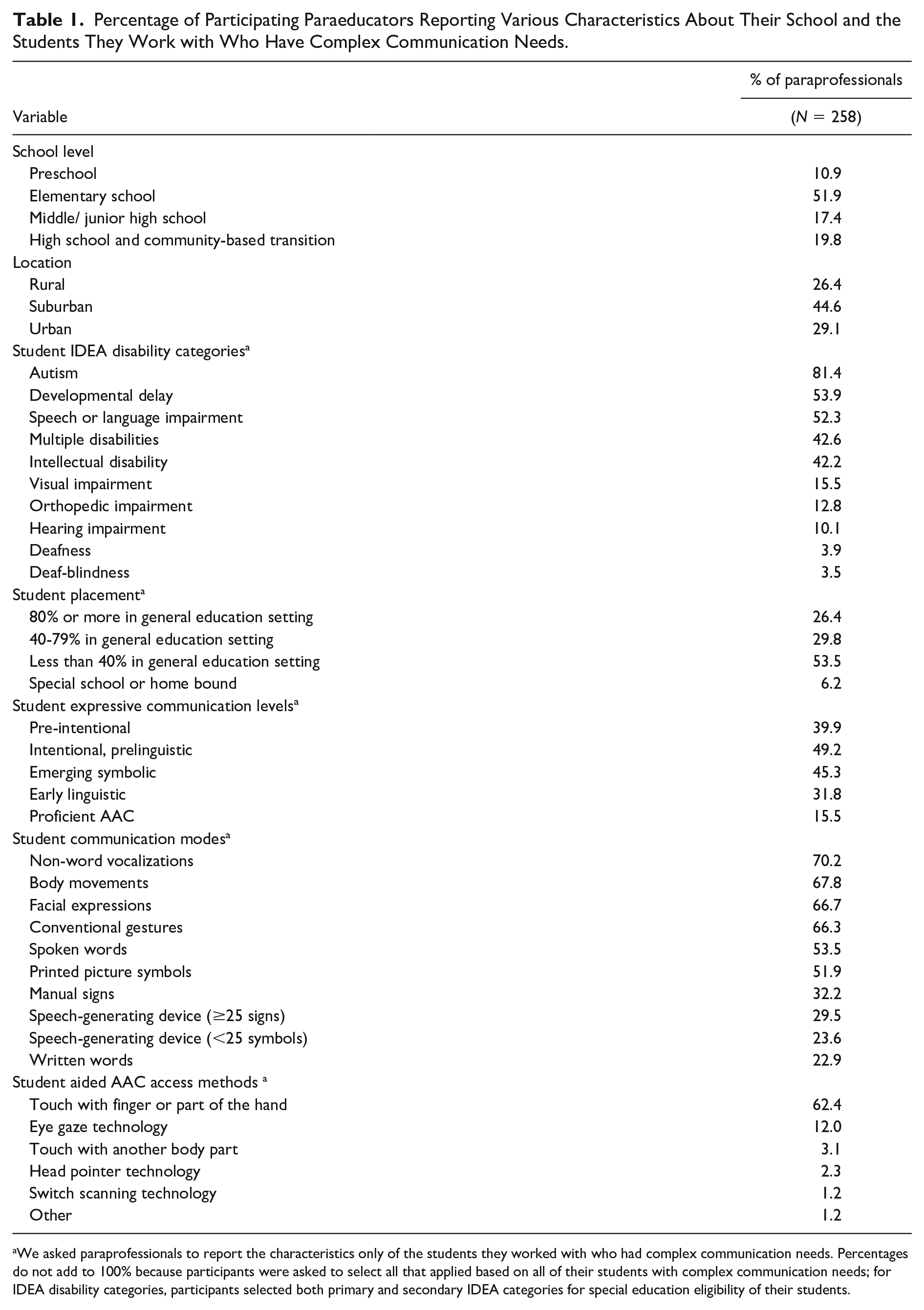
We asked paraprofessionals to report the characteristics only of the students they worked with who had complex communication needs. Percentages do not add to 100% because participants were asked to select all that applied based on all of their students with complex communication needs; for IDEA disability categories, participants selected both primary and secondary IDEA categories for special education eligibility of their students.
Finally, because a sizable portion of respondents needed to be excluded from the sample due to incomplete data (i.e., the 93 respondents who did not complete items related to network size), we wanted to determine whether the 258 included participants were systematically different in their characteristics from the 93 respondents who did not complete the required items. Using chi-square analyses, we found that included participants (vs. excluded respondents with incomplete data) were less likely to be Black (p = .02), more likely to be White (p = .03), and less likely to have reported receiving school/district professional development on AAC (p = .03); no other differences were detected.
Procedures
This study was conducted as part of a larger project focused on the collaboration and self-efficacy of special education teachers, speech-language pathologists, and paraeducators working with students with CCN (Biggs et al., 2023). The researcher-created survey was developed collaboratively by the first three authors, hosted on REDCap as a secure online platform (Harris et al., 2009), and took 20–30 min to complete. We developed the survey using careful consideration of the research questions, prior research literature about AAC-related collaboration, and established methods for collecting network data from similar studies (e.g., Bumble et al., 2021). We also piloted the survey and solicited expert feedback from eight individuals (five practitioners and three other researchers). Their feedback resulted in minor edits to the wording of a few survey items.
After obtaining Institutional Review Board (IRB) approval, we recruited participants by (a) distributing information through district-level administrators, (b) sending information through listservs and community partners, and (c) posting information on social media. Five randomly selected participants received a US$100 gift card. Additional details about survey development and recruitment are reported in Biggs et al. (2023). We were unable to estimate or calculate a response rate for the survey due to the multi-pronged recruitment approach and because the state department of education does not have an estimate of the number of special education paraeducators working in the state.
Measures
Participant Characteristics
Four variables related to paraeducator characteristics were examined as potential predictors of self-efficacy: (a) working with students using high-tech AAC (1 = worked with at least one student who used a dynamic display SGD or switch access, eye gaze, or head tracking technologies to access aided AAC; 0 = did not work with students who used these types of AAC), (b) having a bachelor’s degree or higher (1 = bachelor’s or graduate degree; 0 = no bachelor’s or graduate degree), (c) having recent AAC-related training (1 = any coursework, training, or professional development related to AAC in the last 3 years; 0 = no coursework, training, or professional development related to AAC in the last 3 years), and (d) years of experience working with students with CCN.
Self-Efficacy Beliefs
The research team developed a Self-Efficacy Belief Scale focused on working with students with CCN. Paraeducators’ self-efficacy beliefs were defined as being comprised of their: (a) perceptions of student abilities, (b) belief in their own ability to teach, and (c) teaching outcome expectancy. The full scale consisted of 17 items across the three dimensions; responses were provided on a six-point scale from 1 = Strongly disagree to 6 = Strongly agree. Several items were worded negatively and reverse-scored. We created a sum score, with higher scores reflecting stronger self-efficacy beliefs.
For perceptions of student abilities, five items were taken verbatim from a pre-existing scale (Soto, 1997) which addressed expectations about students and their capabilities to learn, particularly in the area of communication (e.g., “All students regardless of the severity of their disability have the potential to learn how to communicate more effectively”). For the other two dimensions (i.e., belief in ability to teach and outcome expectancy), items were adapted from previous self-efficacy scales (Enochs & Riggs, 1990; Gibson & Dembo, 1984; Tschannen-Moran & Johnson, 2011). For example, an item related to belief in ability to teach was adapted to indicate, “I often do not know what to do to effectively teach students who use AAC” (reverse scored). An example item related to outcome expectancy was “When students who use AAC make progress, it is most often because someone has found an effective way to teach them.” Internal reliability of the Self-Efficacy Belief Scale was strong (Cronbach’s alpha = .86).
Ratings of Confidence in Skills and Knowledge
We also measured how paraeducators reported their confidence across items within six support domains for students with CCN (i.e., communication, social skills, self-determination and behavior, academics, play and recreation, inclusion). We worded the survey directions: “How confident do you feel in your skills and knowledge providing effective instruction and support across each of the following areas to students with CCN? Be sure to think about your skills and knowledge in light of your expected role, including with the support and supervision you receive, such as from a special education teacher.” Paraeducators were then asked to rate their confidence using a six-point scale from 1 = Not at all confident to 6 = Completely confident. To identify the items and domains, we relied on a previous study which examined key goal areas for students with CCN (Biggs & Hacker, 2021b). Each item and domain are displayed in Figure 1.
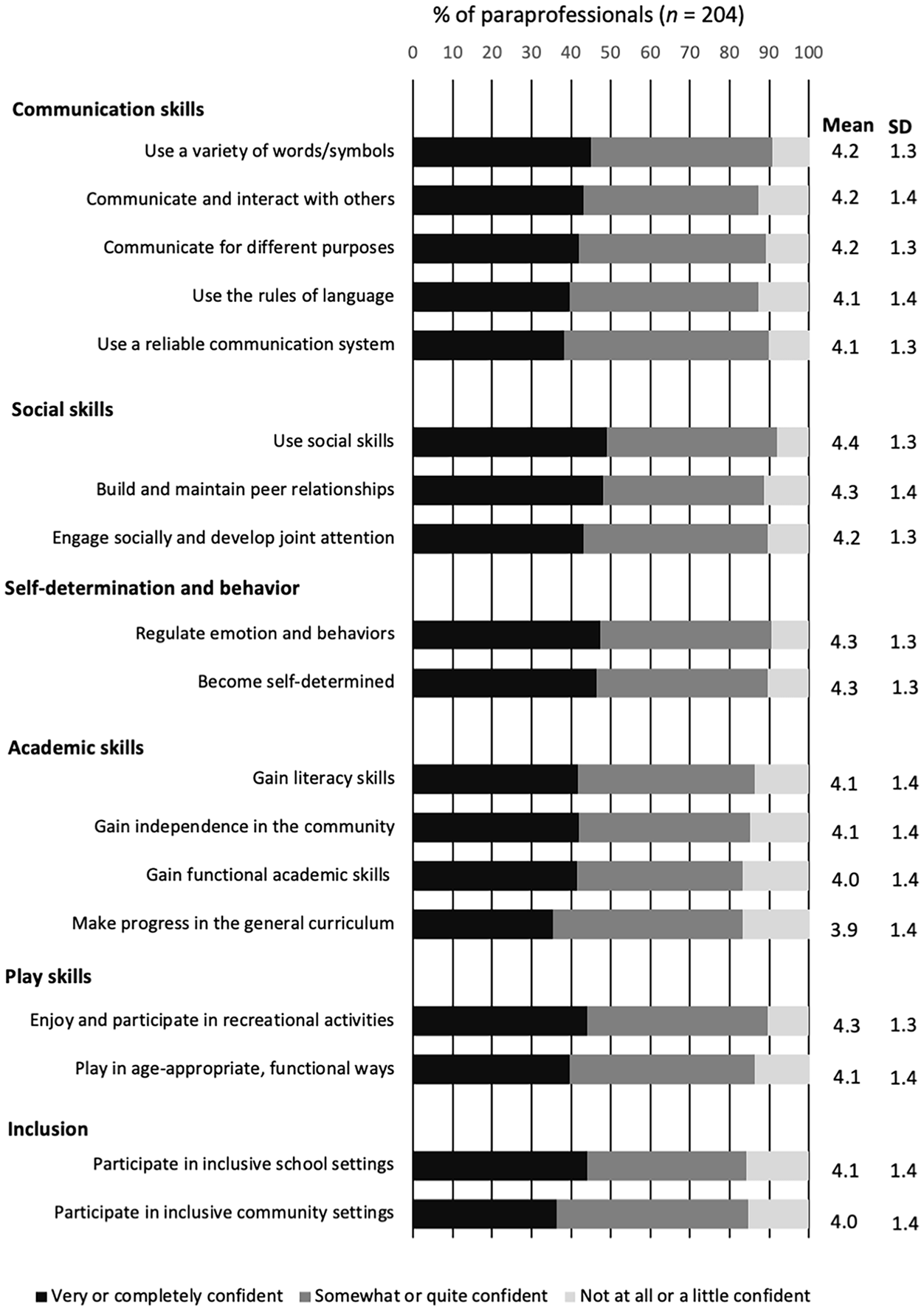
Paraeducators’ Confidence Ratings Across Different Domains and Items Related to Providing Support to Students with Complex Communication Needs.
Professional Networks
As described in Biggs et al. (2023), we collected network data using a fixed roster of 23 roles drawn from three subnetworks: the school/district, students’ families, and the community (we referred to the family and community subnetworks together as the out-of-school-network; see Figure 2 and Table 3 for a list of roles). A fixed roster simplified the collection of network data by asking the participant to report their association with each person on a list, rather than relying on free recall (Marsden, 2011). In this study, paraeducators reported whether they collaborated with someone in each role by selecting one of the three options for each role on the fixed roster: (a) “I don’t know anyone in this role,” (b) “I know someone in this role but have not collaborated with them in the last two school years about a student with complex communication needs,” or (c) “I know someone in this role and have collaborated with them in the last two school years about a student with complex communication needs.” We defined collaboration as anyone they communicated with, gave support to, or received support from, and the number of roles that paraeducators reported collaborating with from the fixed roster was used as a proxy for network size (i.e., indicating both size and diversity).
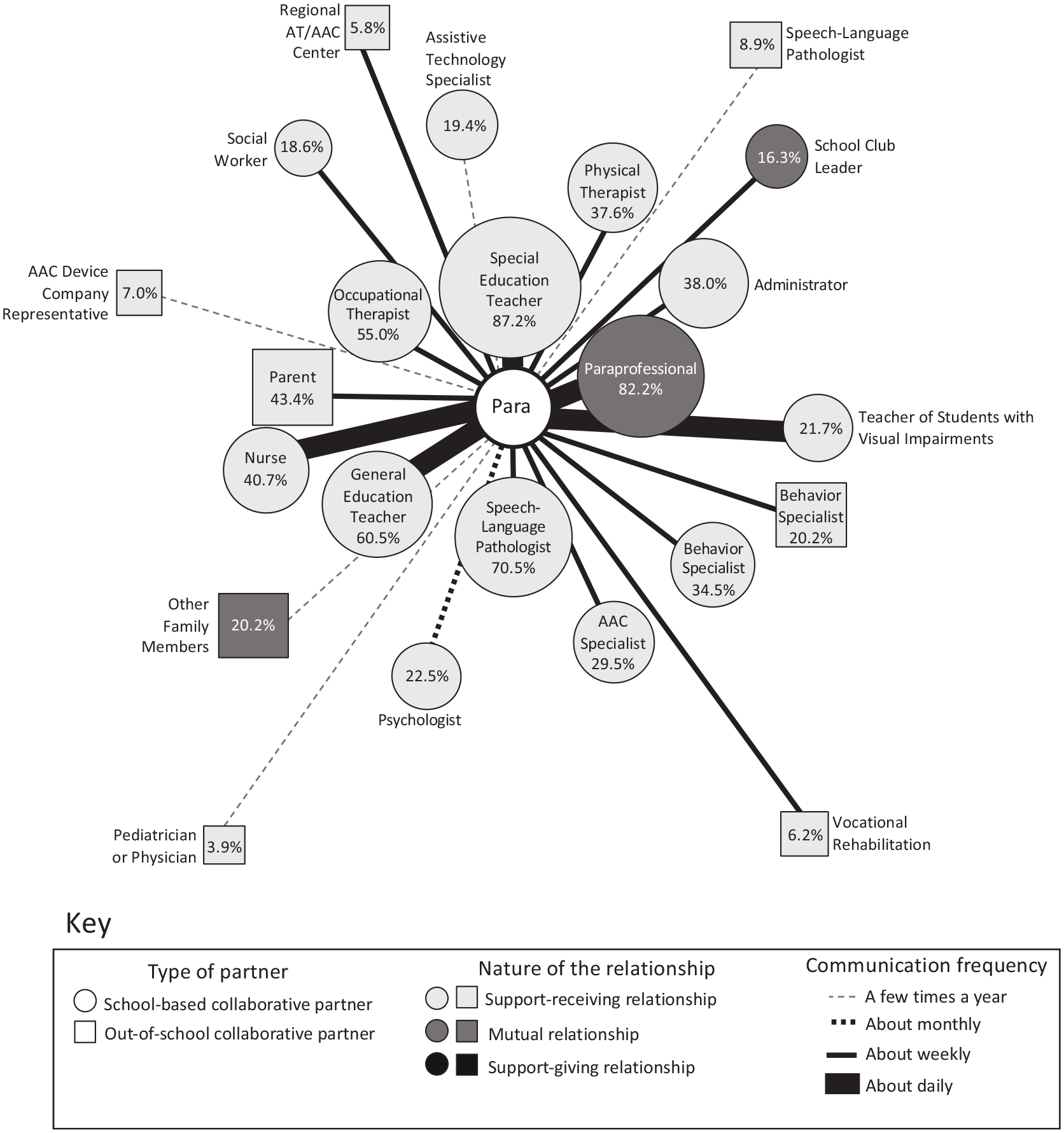
Social Network Diagram Showing the Professional Networks of Paraeducators Related to Their Work with Students with Complex Communication Needs.
Because paraeducators could collaborate with more than one person in each role, we asked them to identify (using initials or a pseudonym) who they collaborated with most in that role, and then we asked follow-up questions about that person. The follow-up questions for each role asked: (a) whether that person was someone they could “depend on and trust” (i.e., a 6-point scale from 1 = strongly disagree to 6 = strongly agree), (b) communication frequency with that person (i.e., 1 = a few times per year to 4 = nearly every day), (c) the extent to which they received or gave support to that person (i.e., mutually exclusive categories of usually give support, give and receive support about equally, usually receive support), and (d) whether specific categories of support were given or received at all–specifically informational supports (e.g., information about students, advice, training), tangible supports (e.g., help with collecting data, laminating and creating picture symbols, programming vocabulary on an AAC device), and emotional supports (e.g., encouragement, empathy).
Data Analysis
We analyzed data using IBM SPSS Statistics (Version 28). We conducted descriptive statistics for the first three research questions and used network diagramming (Figure 2) to illustrate features of paraeducators’ networks. The diagram represents (a) the percentage of paraeducators who collaborated with a person in each role from the fixed roster, (b) if the partner was in the in-school or out-of-school network, (c) the most commonly reported communication frequency (i.e., statistical mode), and (d) the statistical mode of the nature of the relationship (i.e., support-giving, support-receiving, mutual). We used the mode as the measure of central tendency because the response options were categorical (McCluskey & Lalkhen, 2007).
We used ordinary least squares (OLS) regression to investigate whether hypothesized factors predicted paraeducators’ self-efficacy beliefs (RQ4). A Shapiro–Wilks’ test and a visual inspection of a histogram, normal Q-Q plot, and box plot showed that self-efficacy ratings were normally distributed after excluding two extremely low outliers (p = .07). We also examined bivariate Pearson’s correlations among all variables prior to fitting the model to ensure there was no indication of multicollinearity. We used a hierarchical approach given our interest in understanding the predictive value of professional network size on self-efficacy, above and beyond other factors. This means we first examined a model to test whether other paraeducator characteristics predicated self-efficacy (i.e., working with students with high-tech AAC, having a Bachelor’s degree or higher, having any AAC training in the last 3 years, number of years of experience). We then tested a second model which added paraeducator network size after controlling for those other factors.
Results
Self-Efficacy Beliefs
Table 2 displays paraeducators’ self-efficacy ratings across the three dimensions (i.e., perception of student abilities, belief in ability to teach, outcome expectancy). The highest rated self-efficacy belief was in the area of outcome expectancy, specifically that “educators can positively impact the social and communicative skills of students who use AAC” (91.9% agreed or strongly agreed with this statement). Conversely, the lowest rated belief related to perception of student abilities, specifically that “some students do not show any motivation and/or interest in communicating” (34.9% agreed or strongly agreed with this reverse-coded statement). Paraeducators tended to provide higher ratings on items of outcome expectancy and lower ratings on items of their belief in their ability to teach and their perceptions of student abilities.
Self-Efficacy Beliefs of Paraeducators Working with Students with Complex Communication Needs Across the Three Dimensions of Self-Efficacy.
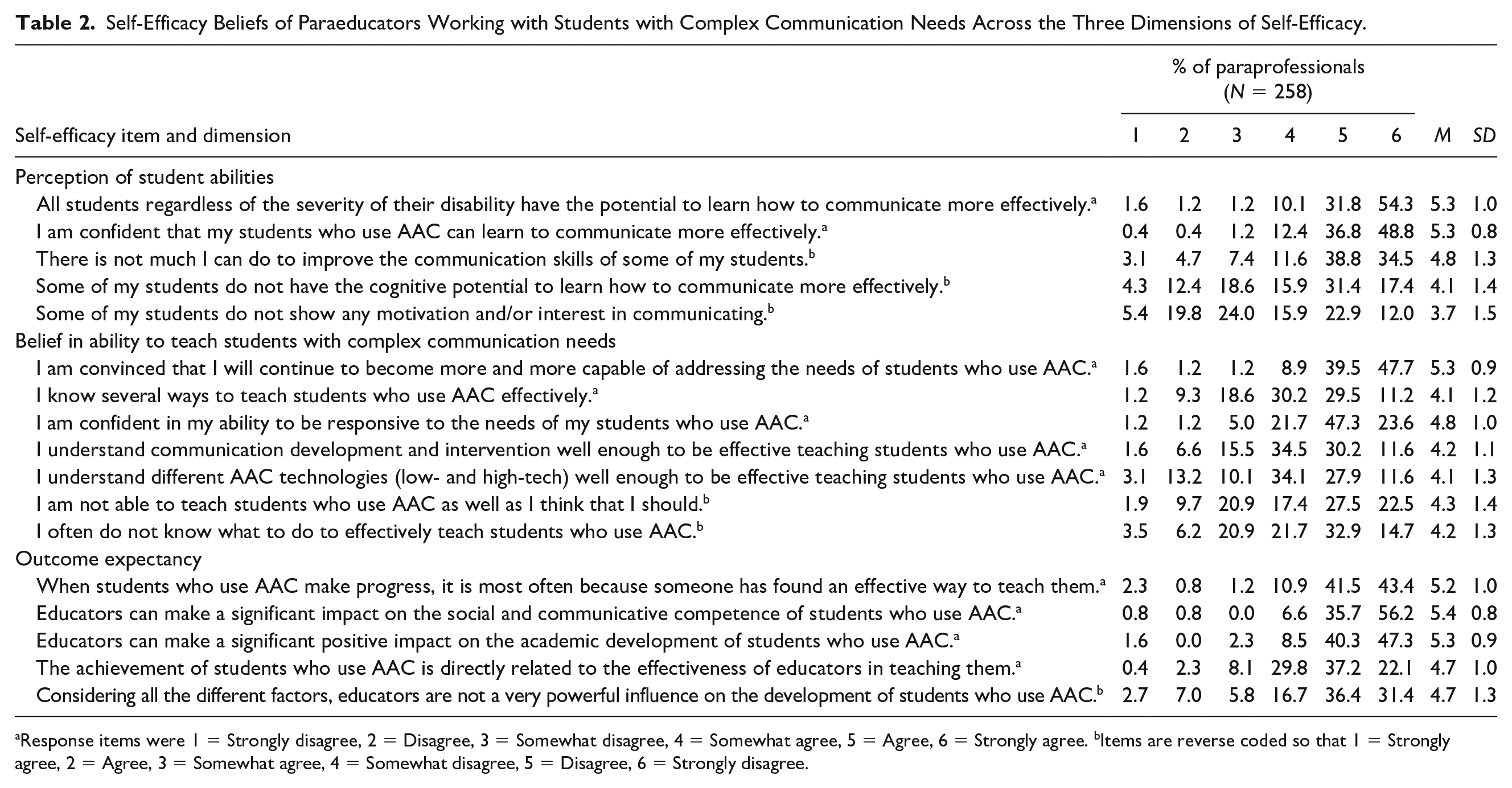
Response items were 1 = Strongly disagree, 2 = Disagree, 3 = Somewhat disagree, 4 = Somewhat agree, 5 = Agree, 6 = Strongly agree. bItems are reverse coded so that 1 = Strongly agree, 2 = Agree, 3 = Somewhat agree, 4 = Somewhat disagree, 5 = Disagree, 6 = Strongly disagree.
Self-Ratings of Confidence in Knowledge and Skills Across Domains
Figure 1 displays paraeducators’ confidence ratings for their roles providing support across different domains to students with CCN. Most ratings were moderate with averages generally between 4.1 and 4.3, which corresponded roughly to the response item of being quite confident. However, 10% to 15% of paraeducators rated themselves as being not at all or only a little confident across all items (Figure 1). Relative to other areas, paraeducators had lower confidence ratings for supporting students with CCN in academics and for inclusion in school and community settings.
Professional Characteristics for Paraeducators
Figure 2 displays a network diagram of reported collaborations. Paraeducators reported collaborating with an average of 7.5 people across different roles, but this was highly variable, ranging from 0 to 23 collaborators (SD = 5.1). On average, paraeducators reported 6.3 collaborators in the school subnetwork (range, 0–15; SD = 4) and only 1.2 collaborators in the out-of-school network (range, 0–8; SD = 1.6). They most often reported collaborating with special education teachers (87.2% of paraeducators), other paraeducators (82.2%), and school-based SLPs (70.5%). A total of 60.5% of paraeducators reported collaborating with any general educators. Less than half (43.4%) reported collaborating with students’ parents or guardians, and 20.2% with other family members. Few paraeducators (29.5%) reported collaborating with any community-based professionals, which varied across the different roles of community-based professionals (i.e., 3.9% to 20.2%).
Trusted Partners and Communication Frequency
We defined a trusted partner as when a paraeducator agreed or strongly agreed with the statement that the collaborator was “someone I can depend on and trust.” On average, paraeducators reported that 73.3% of people in their professional network were trusted partners, but this varied widely across paraeducators (range, 0% to 100%; SD = 37.7%). Table 3 displays the percentage of paraeducators who reported collaborating with each role and the percentage who reported that a person in each role was a trusted partner (i.e., for both, the percentage out of the full sample). For each role, many paraeducators reported their relationships were not marked by trust. For instance, 43.4% of all paraeducators reported collaborating with a student’s parent, but only 33.5% of all paraeducators reported the student’s parent was a trusted partner. When examining trust as a percentage out of people with a collaborative relationship, paraeducators were most likely to report special education teachers as being trusted partner (90.7% of paraeducators who collaborated with a special education teacher), and least likely to characterize private-practice behavior specialists as being trusted partners (70%).
Professional Network Characteristics of Paraeducators as a Percentage of All Participating Paraeducators.
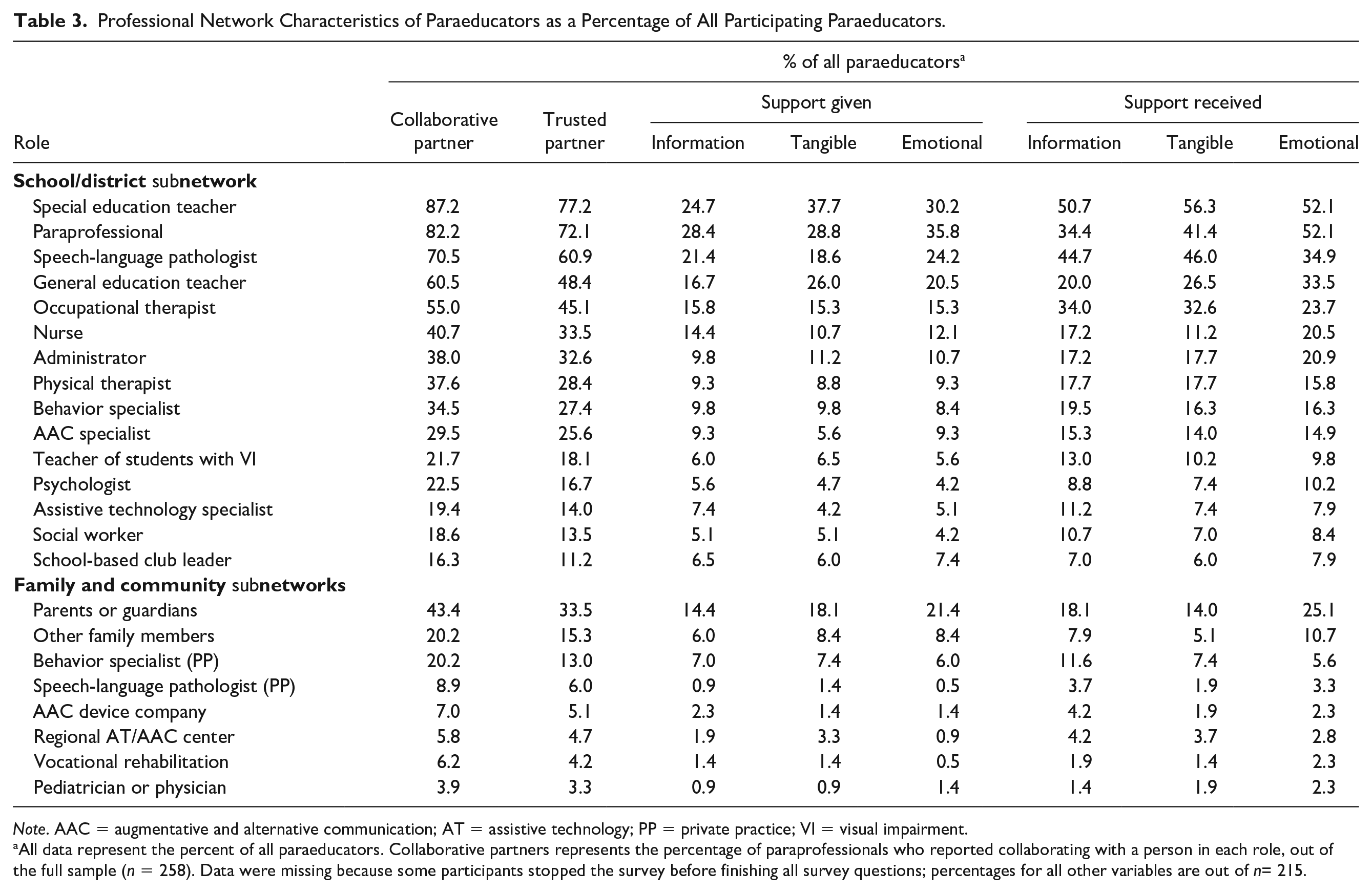
Note. AAC = augmentative and alternative communication; AT = assistive technology; PP = private practice; VI = visual impairment.
All data represent the percent of all paraeducators. Collaborative partners represents the percentage of paraprofessionals who reported collaborating with a person in each role, out of the full sample (n = 258). Data were missing because some participants stopped the survey before finishing all survey questions; percentages for all other variables are out of n= 215.
Communication frequency varied across roles (see Figure 2). Most paraeducators who collaborated with special education teachers reported they communicated about daily (82.5%), and they also often reported daily communication with other paraeducators (81.6%) and general educators (57.1%). Many paraeducators reported weekly communication with school-based service providers, including occupational therapists (53.5%), physical therapists (52.8%), and SLPs (50%). Communication with parents varied widely, with 33.3% reporting they communicated with parents about daily, 33.3% about weekly, 10% about monthly, and 23.3% a few times per year. Paraeducators most often reported communicating with community-based professionals either about weekly or a few times per year.
Supports Exchanged
Figure 2 also displays information about whether paraeducators felt they mostly gave support, received support, or mutually gave and received support with partners in each role. Support-receiving relationships were most common, with paraeducators on average reporting 3.2 support-receiving relationships (range, 0–23; SD = 4.6). Support-giving relationships were least common, with paraeducators on average reporting 1 support-giving relationships (range, 0–15; SD = 2.1). When support-giving relationships were reported, they were most often with general education teachers, school-based club leaders, and parents or guardians. On average, paraeducators reported having 2.1 mutual relationships (range, 0–18; SD = 3.2), which were most commonly reported to be with other paraeducators.
Even when paraeducators reported collaborating with someone in a particular role, informational, tangible, and emotional supports were not consistently exchanged (see Table 3). For example, 87.2% of paraeducators reported collaborating with a special education teacher, but only 50.7% (of paraeducators in the total sample) reported receiving information from the teacher and only 24.7% reported giving information to them. As another example, 70.5% of paraeducators reported having an SLP as a collaborator, but only 44.7% reported receiving information and 21.4% reported giving information. More than one out of every three paraeducators reported they did not receive a particular category of support from any collaborative partners (i.e., 38.4% reported they did not receive information from anyone, 31% did not receive tangible support, 35.3% did not receive emotional support). Approximately one out of every two paraeducators reported they did not give support within a particular category to anyone (i.e., 57% did not give information to anyone, 48.8% did not give tangible support, and 46.9% did not give emotional support).
Predictors of Self-Efficacy
Table 4 displays results from the hierarchical regression model predicting self-efficacy. In the first model (Step 1), we included predictors related to whether paraeducators (a) worked with students with high-tech AAC, (b) had a bachelor’s degree or higher, (c) had received any AAC-related training in the last 3 years, and (d) their number of years of experience working with students with CCN. This regression model only accounted for about 3% of the variance in self-efficacy (adjusted R2 = .03), F(4, 251) = 2.89, p < .05. Only AAC training was a significant positive predictor of self-efficacy (p < .01). In the second model (Step 2), we retained all the predictors and added professional network size. This model accounted for four times the amount of variance (adjusted R2 = .12), F(5, 250) = 7.95, p < .001. AAC training was no longer a significant predictor of self-efficacy (p = .19); instead, only professional network size significantly predicted self-efficacy when controlling for the other variables (β = .32, p < .001).
Hierarchical Multiple Regression Analysis Predicting Paraeducator Self-Efficacy (N = 256).
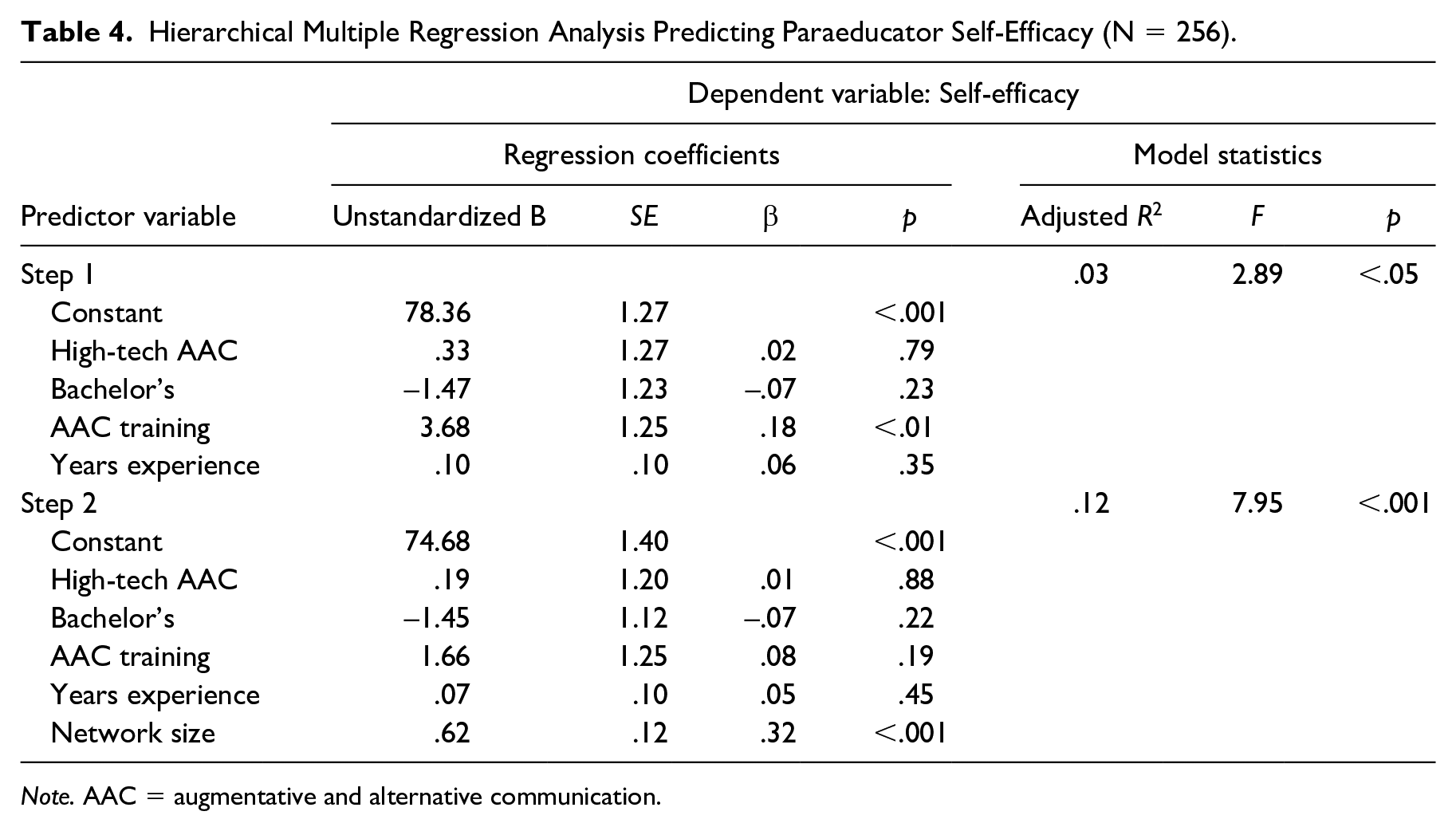
Note. AAC = augmentative and alternative communication.
Discussion
Prior to this study, little was known about the nature of paraeducators’ professional networks and self-efficacy, even though they work regularly with special education teachers and other team members to support students with CCN. Importantly, the findings of this study revealed that a non-trivial minority of paraeducators had strikingly low beliefs in their students’ capabilities, in their own skills and knowledge, and that their efforts would lead to desired outcomes. Paraeducators spend substantial time supporting and working with students with CCN (Biggs & Hacker, 2021a; Cole-Lade & Bailey, 2020), and self-efficacy predicts educator behavior, effectiveness, and student outcomes (Bandura, 1977; Herman et al., 2018; Mason et al., 2021; Soto & Goetz, 1998). Therefore, the portion of paraeducators who had low self-efficacy beliefs is concerning, particularly when they had low perceptions of student capabilities. In the findings of the present study, more than 25% of paraeducators believed their students did not show motivation or interest in communicating, and more than 15% believed their students did not have the cognitive potential to learn how to communicate more effectively. This is similar to other researchers who have found that problematic myths persist related to AAC and people with CCN, such as the unsubstantiated myth that some people have disabilities too severe to improve their language and communication skills (Sevcik et al., 2022). These negative perceptions of student capabilities likely shape the quality of instruction and educational opportunities that students receive, including access to aided AAC and to meaningful participation in general education settings and curriculum with neurotypical peers (Ruppar et al., 2015).
This study also contributes to existing knowledge by using social network analysis to determine the nature of paraeducators’ collaboration patterns related to their work with students with CCN. Network characteristics varied widely, but most paraeducators had fairly small networks with few mutual relationships, and where supports were not very frequently exchanged–suggesting many paraeducators are not receiving the support and supervision expected by law (Individuals with Disabilities Education Improvement Act, 2004). We think it is especially important to notice the roles that many paraeducators reported not collaborating or communicating with at all. For instance, fewer than one-third (29.5%) reported collaborating with any community-based professional such as an AAC device company representative, a representative from a regional AT/AAC center, or other specialist in the community (e.g., behavior specialist, SLP). We did not explore the reasons why this might be the case, but we imagine there might be many factors at play, including time, resources, school or district policy, and the roles and policies of outside agencies or outside professionals. In addition, we wonder if it might be that–implicitly or explicitly–other team members such as SLPs or teachers play a “gatekeeping” role. In social network analysis, a gatekeeper is not always a bad thing, but it is a term used to refer to a person who controls the flow of outside information into an organization or network (Lu, 2007). Gatekeepers can prevent access to collaborators, but–importantly–they can also facilitate such access. Future research might examine ways that SLPs and special education teachers could effectively support strong connections for paraeducators with other professionals. Yet, it is also important to recognize that the professional networks of SLPs and special education teachers working with students with CCN are themselves incredibly variable and often limited. In prior research, some SLPs and teachers were found to be well-networked–including with community-based partners–but many others were found to have small or fragmented professional networks, with few trusted partnerships and little exchange of supports (Biggs et al., 2023). Therefore, it is important that future efforts seek to foster meaningful connections among all team members serving students with CCN, not just paraeducators.
Another important consideration is that most paraeducators reported having either zero or just one mutual relationship, and that these were almost always with other paraeducators, rather than special education teachers, general education teachers, or SLPs. At first glance, the predominance of support-receiving relationships is not surprising. Paraeducators are mandated by law to play an assisting role, and they have less formal training than other team members such as SLPs or teachers (Giangreco, 2021; Giangreco & Doyle, 2002). Yet, even within an assisting role, there are many possible ways that paraeducators could give, not just receive support. Teams benefit when paraeducators give informational support (e.g., telling a teacher about a student’s behavior or learning that they observed, sharing their perspective about student support needs), give tangible support (e.g., collecting data for a teacher; assisting a teacher in creating visual supports), and give emotional support (e.g., encouraging other team members) within mutual relationships. Thus, it is important to understand how greater reciprocity in relationships can be fostered for paraeducators working with students with CCN.
Finally, and perhaps most importantly, we found that professional network size (specifically measured as the number of roles present in paraeducators’ professional networks) significantly and positively predicted paraeducator self-efficacy. Interestingly, other variables– such as whether paraeducators had received AAC-related training and their years of experience–were relatively poor predictors of self-efficacy; in fact, when network size was added to the model, neither of these characteristics were significant predictors. Before dismissing years of experience and AAC training as being unimportant, a few important things should be considered. Our measure of AAC training was not as strong as our measure of paraeducators’ professional networks. For instance, we did not collect specific information on the nature of training, hours or training, or quality of training. Furthermore, we reduced AAC training to a dichotomous variable based on whether they had or had not participated in training in the last 3 years. Other research, particularly from experimental single-case design studies, is clear that high-quality training is needed for paraeducators to use evidence-based practices and improve outcomes for students with CCN (Andzik et al., 2021; Biggs et al., 2017; Brock et al., 2017; Douglas et al., 2013; Kashinath et al., 2022; Walker et al., 2021; Wermer et al., 2018). Importantly, high-quality training in the literature has involved close collaboration and the exchange of many different types of support within relationships (e.g., describing and modeling strategies, listening to concerns, offering positive encouragement, co-creating written intervention plans). Therefore, a reasonable inference is not that training does not matter, but that the most effective training will strengthen paraeducators’ collaborative relationships with other team members, including the way that supports are exchanged within these relationships. This finding complements the growing body of research that has examined the importance of teachers’ relationships (Yoon & Baker-Doyle, 2018), and it also suggests the need for innovative, relationship-based ways to build paraeducators’ capabilities and self-efficacy.
Limitations and Directions for Future Research
Limitations should be considered. First, we did not manipulate any variables in this study, and so it is not appropriate to assume causal relations. Further, our study was cross-sectional, and so future experimental and/or longitudinal approaches could be useful for a number of other research questions such as to examine how professional networks change over time (with or without intervention) or how paraeducator networks relate to their practices with students and student outcomes. Second, approximately 25% of potential participants were excluded because they exited the survey before providing survey responses that would allow us to calculate their network size. This large proportion of non-completers was likely due to the length of the survey. Although we found few differences between survey completers and non-completers, this missingness poses limitations. Third, we focused on paraeducators within a single state so that we could approach recruitment more systematically. But, the self-efficacy beliefs and collaboration patterns of paraeducators in other states could look different. Fourth, we used a fixed roster because it aligned with our goal to understand the full range of paraeducators’ collaborative partners; however, this approach did not allow for paraeducators to report on multiple partners within a specific role (e.g., if they collaborated with or received support from multiple other paraeducators). Other researchers could use a name-generator approach, which involves asking paraeducators to list all of their collaborators, and then describe their role and other characteristics. Name generators would allow for determining “true” network size and whether paraeducators might be receiving a bulk of support from different people in one role (e.g., other paraeducators). This would also allow paraeducators to provide insight into collaborators who might not have been listed on our fixed roster.
One of the questions that our data cannot answer is why paraeducator network size predicted self-efficacy–that is, what about these networks of relationships is most important? Social capital theory (Leana & Pil, 2006) explains that three primary facets of social capital are built through social networks: structural, relational, and cognitive (Leana & Pil, 2006). Structural social capital refers to the actual presence of social connections within the network, including (a) the number of people, (b) how diverse the network is (such as diversity in professional roles or other characteristics), and (c) the extent to which supports are exchanged across network members (Leana & Pil, 2006). Our hypothesis addressed an aspect of structural social capital–does network size predict self-efficacy? Yet, to better understand the implications for improving practice, the other aspects of social capital are important for future researchers to examine further, including relational social capital (e.g., the quality of relationships and including the level of trust) and cognitive social capital (e.g., the extent to which network members share language, values, beliefs, and attitudes).
Implications for Practice
This research is exploratory, and so it is important that future research builds further on these early findings to inform how to best support positive change on practice. For example, research focused on understanding which network partners, supports, or aspects of social capital contribute most to paraeducator self-efficacy (or their work with students, or student outcomes, etc.) would provide critical insight for developing and tailoring interventions to help paraeducators build social relationships and collaboration patterns that lead to desired outcomes. Yet, there are some actionable implications of the findings of the present study, particularly for educational leaders who directly or indirectly support and supervise paraeducators (e.g., special education teachers, principals, special education coordinators, or directors).
Specifically, findings from this study offer an explanation for some of the problems in practice related to paraeducator utilization to support students with CCN: Paraeducators’ professional networks matter deeply, and yet many paraeducators have limited networks marked by few collaborative partners, limited trust, inconsistent exchange of support, and a lack of reciprocity in how support is exchanged. Paraeducator roles need to be clearly defined and need to be distinct from those of licensed special education teachers and other educational team members. Yet, distinction in roles should not prevent the development of mutual relationships among paraeducators and other team members–including special education teachers, general education teachers, SLPs, students’ family members, community-based professionals with specialized expertise, and others. Improving the ways that paraeducators are connected to and work within a broader team could have an important impact on their own experiences and on their work with students with disabilities, including students with CCN.
Footnotes
Declaration of Conflicting Interests
The author(s) declared no potential conflicts of interest with respect to the research, authorship, and/or publication of this article.
Funding
The author(s) received no financial support for the research, authorship, and/or publication of this article.

Editor-in-Charge: Robert Pennington