




Abstract
The COVID-19 pandemic disproportionately and negatively impacted many underserved populations in the United States, including the Hispanic community (Garcini et al., 2022). Data collected from the U.S. COVID-19 Vaccination Program revealed that only 6% of the initial vaccine recipients were Hispanic, compared to 60.4% who identified as White (Painter et al., 2021). Nearly one-third of the Hispanic population was hesitant to receive the COVID-19 vaccine (Khubchandani & Macias, 2021). In order to better understand the barriers to COVID-19 vaccine uptake at the local level, this qualitative study was conducted in December 2021 by members of the Kansas City Chapter of the National Association of Hispanic Nurses (NAHN) in one Midwestern community. Zip codes with a higher number of Hispanic residents and the lowest vaccination rates in the community were targeted for recruitment
Interview Questions Guided by the Theory of Planned Behavior (Ajzen, 1985).
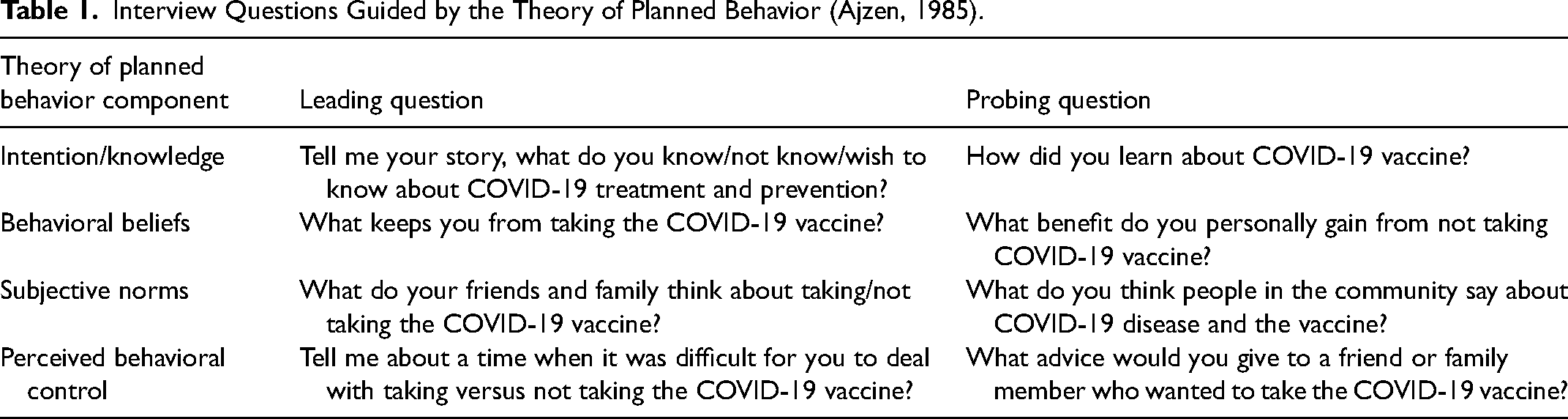
Procedures/Data Analysis
The study was approved by the University of Missouri IRB. Hispanic adults who had not received a COVID-19 vaccine were invited to participate via electronic flyers posted on social media and on local Hispanic serving organizations’ websites. Interested individuals were asked to contact a study member by phone. Data collection was completed from October 2021 through January 2022. One researcher conducted the individual interviews, which were offered either in-person, by phone, or via Zoom. However, only two participants did the interview in person. Participants received a $50 gift card for their participation in one interview, which lasted approximately one hour. Data was analyzed in Spanish by two bilingual (Spanish/English) bicultural nurse researchers. Qualitative conventional content analysis was used to identify common themes (Hsieh & Shannon, 2005; Gutterman et al., 2018; Vaismoradi et al., 2013). The researchers independently analyzed the data and then collaborated to discuss their analysis and examine any discrepancies in coding (Gutterman et al., 2018). After the researchers had reached an agreement about the initial analysis, exemplary quotes were selected and translated into English for publication purposes.
Results
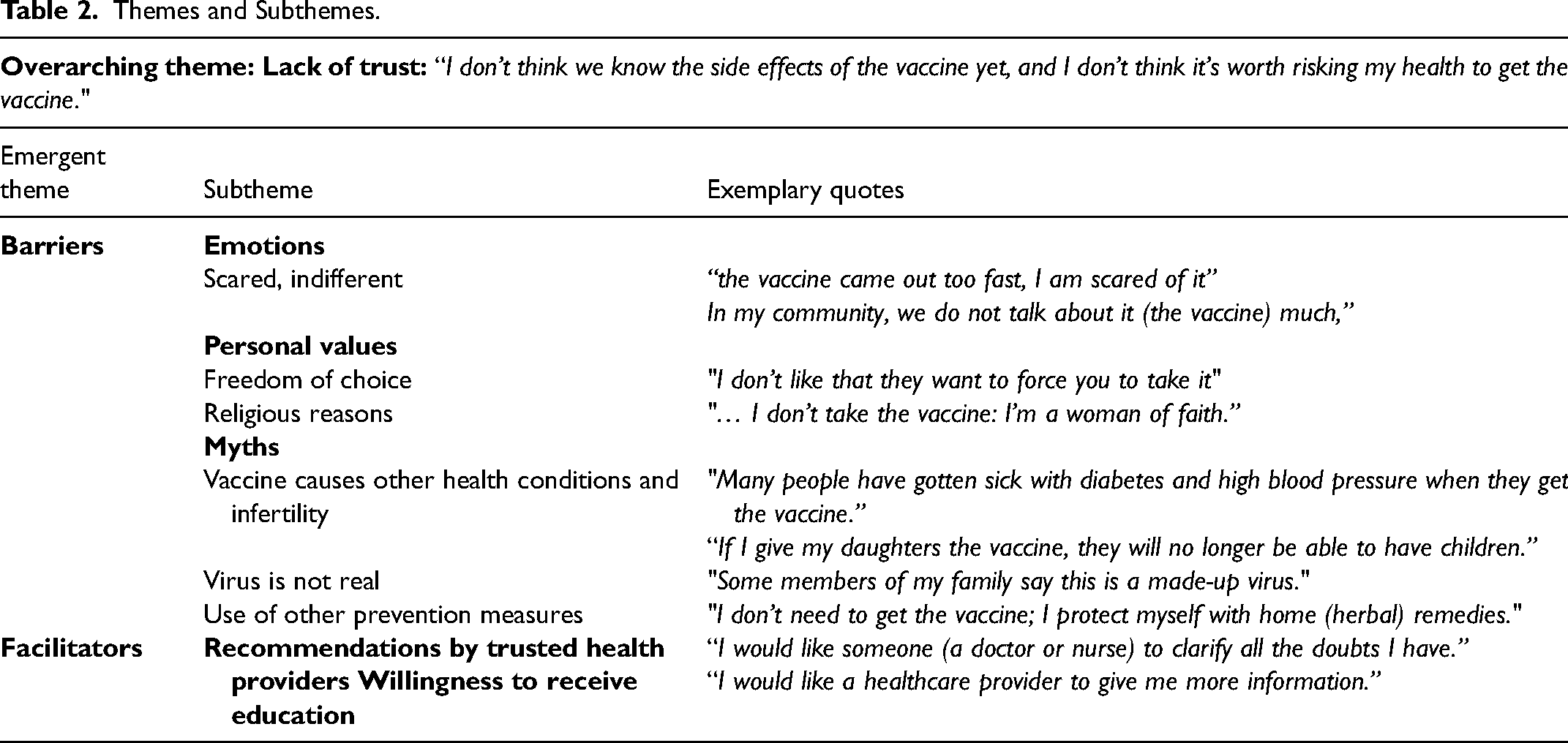
Participants (n = 20) were Hispanic adults (male = 5; female = 15). One overarching theme, lack of trust, emerged from the data as well as several perceived barriers to vaccination and two facilitators to vaccination. Themes and subthemes with exemplary quotes are seen in Table 2.
Themes and Subthemes.
Discussion
This qualitative research study served to better understand perceived barriers to and facilitators of COVID-19 vaccination among Hispanic adults living in zip codes with low vaccination rates in one large Midwestern metropolitan community. Several barriers to COVID-19 vaccination were identified and some were potentially modifiable: Of note, the study identified the willingness to receive education as a facilitator to change perceptions of COVID-19 and vaccine uptake. Based on these findings, members of the Kansas City Chapter of NAHN, engaged in several strategies to enhance vaccine confidence in their local Hispanic community. Chapter members went door to door providing information in Spanish about COVID-19 and upcoming vaccination clinics held in local neighborhood settings (i.e., schools and community service organization buildings). Bilingual/bicultural NAHN members were present at vaccine clinics, sponsored by the local health department, to engage in educational conversations about COVID-19, in addition to administering vaccines. At the vaccine clinics, community members received a small bag of produce for engaging in the education sessions and those who received a COVID-19 vaccine were also given a $15 Walmart gift card. Over 400 children and adults were vaccinated because of the chapter's efforts and its partnership with the local health department and the Guadalupe Centers.
The study had limitations that must be considered when interpreting the findings. This small qualitative study was conducted in one community and the findings are not generalizable.
Despite its limitations, findings suggest that there are opportunities to enhance vaccine confidence in the Hispanic population. The community-partnered approach and the use of bilingual/bicultural nurses as interviewers, and as providers during the vaccine clinics likely enhanced engagement in the study and the subsequent vaccine clinics (Akintobi et al., 2018; de las Nueces et al., 2012; Tremblay et al., 2018).
Conclusion
The COVID-19 pandemic has negatively impacted the health of the Hispanic population in the United States (Garcini et al., 2022). This study demonstrated that grassroots efforts by members of a local chapter of NAHN helped to enhance COVID-19 vaccine uptake: over 400 individuals received the vaccine during a 4-month period in early 2022. Implications for future research and practice in the Hispanic population include using a community-partnered approach that involves key stakeholders when engaging in efforts to enhance health outcomes. Such strategies may contribute to eliminating health disparities in Hispanic communities.
Footnotes
Declaration of Conflicting Interests
The authors declared no potential conflicts of interest with respect to the research, authorship, and/or publication of this article.
Funding
The authors disclosed receipt of the following financial support for the research, authorship, and/or publication of this article: This work was supported by the Kansas City Missouri Health Department by a grant awarded to the Guadalupe Centers.

Correction (December 2023):
This article has been updated with changes replacing XXXXX since its original publication.