



Abstract
This study examines how public service motivation (PSM) influences job performance, with organizational citizenship behavior (OCB) as a mediating factor and the COVID-19 pandemic as a moderating factor. It intends to revisit the relevance of PSM in the Korean public sector, particularly focusing on trends observed before and after the pandemic. Using 19,700 observations from South Korea’s public employee perception surveys (2017–2021), this study employs a mediation regression model with the moderating impact of the pandemic, while controlling for variables related to administrative routines and workplace environments. The results found that PSM positively influences job performance through OCB; however, the pandemic insignificantly moderates the PSM-job performance link. With a deeper understanding of the recent dynamics of the PSM-OCB-job performance sequence in the Korean public sector, this study implies that strengthening motivational constructs can consistently drive sustained improvements in job performance, even in the face of external disruptions.
Introduction
Public service motivation (PSM) has long been recognized as a fundamental catalyst for attracting individuals to careers in the public sector by emphasizing the underlying value and societal significance of public services (Campbell, 2024; H. J. Lee et al., 2020; M. Park & Lee, 2023; Perry, 1996; Perry & Wise, 1990; Vandenabeele, 2009). By highlighting these aspects, PSM compensates for the relative lack of incentives in government positions, motivating public employees to perform better in their responsibilities. While the theoretical and operational pillars of PSM originated in the United States (Perry, 1996; Perry & Wise, 1990), the rationale behind PSM has gained significant global attention, particularly in Asian countries, due to the prevalent inclination toward public service commitment. In Korean society, where public service is traditionally held in high reputation and respect, PSM serves as a compelling framework for understanding public employees’ commitment to excellence in their sustained efforts to achieve better outcomes. Over the past two decades, PSM has consistently remained a central research focus in Korea, reflecting its significance and continued relevance in the field (S. Kim, 2006; M. Park & Lee, 2023). Several studies have examined the significant impacts of PSM across various societal contexts. For example, in Korean context, research has explored the rile of PSM in shaping career choices (G. Lee & Choi, 2016) and promoting volunteering behaviors (H. J. Lee et al., 2020). As a result, PSM has garnered a solid reputation for its direct contributions to enhancing job performance in this specific context, supported by both theoretical perspectives (Perry & Wise, 1990; Perry et al., 2010) and empirical evidence derived from rigorous methodologies, such as regression models (Brewer & Selden, 2000) and mediation analyses (Vandenabeele, 2009).
While the majority of studies have empirically demonstrated a positive effect of PSM on job performance, the connection between PSM and job performance has yielded inconsistent results due to various contextual factors (e.g. Alonso & Lewis, 2001; Brewer, 2008; Cheng, 2015; Ritz et al., 2016). Perry (2000) also acknowledged that while employees’ intrinsic motivation plays a significant role, it may not fully account for improvements in job performance. Are there missing puzzles that can interact with PSM and job performance to strengthen the effects of PSM or mitigate its limitations? Recent studies have argued that public sector employees with high PSM are more inclined to engage in extra-role behaviors that extend beyond their formal job responsibilities for contributing to organizational effectiveness (Karolidis & Vouzas, 2019). The concept of organizational citizenship behavior (OCB) refers to discretionary actions that encourage employees to extra work toward the organization’s collective self-interest (Organ, 1988). Recent research in public administration has increasingly recognized the close relationship between PSM and OCB. However, empirical evidence remains limited regarding how these constructs jointly contribute to performance improvement mechanisms in the public sector (Campbell, 2024; Campbell & Im, 2016; Chiang & Hsieh, 2012). Addressing this gap is essential for deepening our understanding of the dynamic interplay between motivation, behavior, and job performance.
The COVID-19 pandemic has profoundly affected various societal dimensions, significantly highlighting the important roles of the public sector (Dwivedi et al., 2020). This unprecedented crisis has reinforced public employees’ sense of responsibility and motivation to commit to public service delivery (Berry et al., 2024). At the same time, however, the pandemic has imposed challenges, including increased workloads and reduced resources, which have negatively impacted public employees’ service motivation and job performance (S. Lee & Na, 2024). Given these mixed effects, understanding the pandemic’s influence is critical when addressing whether PSM can continue to pull job performance in the public sector.
As contradictory debates about the relationship between PSM and job performance have been presented, this connection could be contingent upon other factors and its practical implications. Building on these contexts, this study aims to empirically gain a deeper theoretical and practical understanding of a dynamic relational chain of PSM and job performance, considering the interacting impacts of OCB as a mediator and the COVID-19 outbreak as a moderator in the current Korean public sector. This study employs a mediation regression analysis with moderating impact of the pandemic, using data from the public employee perception survey conducted by the Korea Institute of Public Administration from 2017 to 2021. Through a reexamination of the legacy of PSM amid a period of ongoing transition in the public sector, this study sheds light on reaffirming the PSM-job performance link. It achieves this by contextualizing the analysis within the specific dynamics of the contemporary South Korean public sector, emphasizing the promotion of proactive OCB and addressing the historical context of these issues in South Korea.
Theoretical framework and hypothesis development
PSM and job performance
PSM has taken a central position in public administration theory due to its purported role to increase individual performance. Amidst the steady decline in public trust in government and increasingly negative perceptions of public employees in the 1980s (Miller & Borrelli, 1991), PSM offered a compelling rationale for enhancing a committed and high-performing public workforce (Perry & Wise, 1990). It also provides convincing explanations for why individuals choose to enter and remain in public sector careers despite the comparatively lower incentives offered by the private sector. This theoretical framework is critical to understanding not only career choice motivations but also the intrinsic motivation that drives public employees to maintain commitment and job performance (Brewer, 2008). The concept of PSM is central to this reasoning, as it emphasizes the intrinsic, non-monetary values that drive individuals to pursue careers in the public sector. Rooted in its influence on both organizational and individual performance, PSM suggests that public employees with high levels of motivation are more dedicated, put greater effort, and maintain a stronger focus on achieving improved performance outcomes.
As highlighted in seminal studies (Brewer, 2008; Perry & Wise, 1990), employees with high levels of PSM are more likely to demonstrate greater dedication and improved performance in public sector environments. Bellé (2013) also argued that interventions targeting beneficiary use and self-persuasion significantly improved the persistence, output, and productivity of public employees. Lynggaard et al. (2018) further noted that from an organizational perspective, PSM improves performance through increased work autonomy and improved capacity of service users. M. Park and Lee (2023) not only confirmed that PSM leads to better job satisfaction and organizational commitment but also demonstrated different effects of PSM in the public and private sectors. Vandenabeele (2009) observed that PSM positively influences job performance, with job satisfaction and organizational commitment acting as essential mediators. As such, extensive research across countries in the public sector has found PSM’s positive impact on various performance-related variables (Leisink & Steijn, 2009; Miao et al., 2019, Wan-Ling, 2019). However, despite these affirmations, Jin et al. (2018) noted that the impact of PSM can vary depending on the conceptualization and measurement of performance related to PSM.
Given the inconsistent findings in existing literature, this study posits that PSM positively influences job performance by encouraging more efforts and alignment with organizational goals. This rationale is supported by theoretical perspectives, which argue that intrinsic motivation fosters sustained commitment and improved performance in public service contexts. Accordingly, this study hypothesizes:
H1: PSM is positively associated with job performance.
Mediating influence of OCB in the performance-job performance continuum
The relationship between PSM and OCB has been researched, with findings indicating that public employees with high PSM exhibit strong citizenship behaviors (S. Kim, 2006; Pandey et al., 2008; Shim & Faerman, 2017). Empirical studies confirmed that PSM was a significant factor influencing OCB in South Korean and Greek public agencies (Campbell & Im, 2016; Karolidis & Vouzas, 2019). In the South Korean context, while the four-factor structure of PSM proposed by Perry is generally applicable, the “attraction to policy making” (APM) factor may not be valid. This is because the rational motives associated with APM might not align with the cultural and institutional characteristics of PSM in South Korea (S. Kim, 2009). By recognizing this contextual distinction, the study argues the need to adapt theoretical frameworks to account for local aspects in understanding PSM.
Similarly, Gnankob et al. (2022) identified a positive relationship between PSM and OCB among employees of the metropolitan assemblies in Ghana, demonstrating that OCB mediated the association between servant leadership and PSM. Focusing on interpersonal citizenship behaviors at the personal behavioral level, Pandey et al. (2008) found that PSM positively affected routine aspects of citizen behaviors to achieve organizational goals in U.S. state public agencies. Piatak and Holt (2020) further distinguished PSM from altruism to examine its direct impact on motivating the altruistic dimensions of OCB using data from the 2016 Cooperative Congressional Election Study in the U.S. Drawing on these perspectives, this study hypothesizes:
H2a: PSM is positively associated with OCB.
OCB refers to voluntary actions undertaken by individuals within an organization that are not explicitly rewarded by the official incentive system but, when aggregated, can contribute to enhancing the organization’s effectiveness and performance (Organ, 1988). Existing studies have extensively investigated the relationship between OCB and organizational performance, with findings demonstrating its impact at different levels. For example, Bommer et al. (2007) found that OCB at the individual level has a stronger influence on job performance compared to OCB at the group level. Hermawan et al. (2020) further emphasized the critical role of OCB in influencing individual job performance, while Indarti et al. (2017) identified that OCB affected performance through mediating factors such as personality, organizational commitment, and job satisfaction applying structural equation modeling. Mallick et al. (2014) found that OCB improved job performance and revealed that altruistic behaviors positively impacted organizational outcomes. Finally, Podsakoff et al. (2009), in a meta-analysis, confirmed that OCB had a substantial impact on both individual and organizational performance. Given that existing studies assert the impact of OCB on job performance, this study proposes:
H2b: OCB is positively related to job performance.
The mediating effect of OCB on job performance has been identified as a significant factor in existing studies. For example, Chiang and Hsieh (2012) suggested that perceived organizational support and psychological empowerment mediate OCB, affecting job performance. Indarti et al. (2017) illustrated, through structural equation modeling with a sample of 295 participants, that personality, organizational commitment, and job satisfaction not only contribute to performance improvement but are also further augmented through the practice of OCB. Mostafa and Leon-Cazares (2016) verified that PSM influences perceptual performance, mediating OCB using Mexican data. Previous studies have used OCB as a mediating variable, assuming that an individual’s intrinsic motivation or a company’s structural system and environment mediate OCB to impact performance. This study posits that an individual’s intrinsic motivation is largely translated into observable behavior through OCB, leading to the following hypothesis.
H2c: OCB mediates the relationship between PSM and job performance.
The moderating role of COVID-19 pandemic on the relationship between
The recent COVID-19 pandemic has caused severe challenges for governments, leading to significant changes in public service operations and working environments. As the pandemic has disrupted operational routines, prioritized urgent tasks and necessitated rapid adaptation, often at the expense of regular work responsibilities. This has resulted in conflicting views regarding the impact of the pandemic on job performance in the public sector. On the one end, the job performance of public employees, similar to their counterparts in the private sector, has been decreased due to increased workloads, lacked resources, and heighted stress levels for responding promptly and efficiently (Bakker, 2015). Based on the job demands-resources theory, increased work intensity negatively impacts public employees’ attitudes and motivation, potentially leading to decreased job performance.
On the other hand, job performance has been improved due to the adoption of flexible work schedules and the integration of innovative digital applications during the pandemic. In particular, public employees tend to exhibit increased levels of altruism and duty in the face of crises (Mehmood et al., 2024), which aligns with the intrinsic motives underlying PSM (Perry & Wise, 1990). The urgency could elevate public employees’ sense of public service roles and accomplishment, enabling them to respond more effectively to resolving challenges and reinforcing their commitment to serving the public good, particularly in the Korean public sector. Previous research has argued that the increased work intensity resulting from the COVID-19 pandemic positively impacts PSM and job satisfaction, with organizational support acting as a mediating factor in this relationship (S. Lee & Na, 2024). Additionally, PSM and job satisfaction have been shown to influence employees’ readiness for change, with this effect moderated by self-efficacy and job satisfaction (Yang et al., 2024). Furthermore, social support has been identified as a crucial role in enhancing job satisfaction during times of crises (Rollnik-Sadowska et al., 2023). However, these divergent perspectives of the pandemic on public employees’ job performance, in connection with PSM, have yet to be empirically validated. The lack of empirical studies examining how the COVID-19 pandemic impacts job performance through its influence on employees’ motivation and attitudes makes it challenging to draw definitive conclusions about the relationship between crises and job performance in the public sector. From this research gap, the COVID-19 pandemic may serve as a moderating factor that reinforces the relationship between PSM and job performance positively. This study posits the following hypothesis:
H3: The COVID-19 pandemic positively moderates the relationship between PSM and job performance.
Methods
Data
This study used data from the annual Public Employee Perception Survey conducted by the Korea Institute of Public Administration (KIPA) between 2017 and 2021. The survey data were accessed through KIPA’s Data Archive, available at www.kipa.re.kr. Each year, the survey was administered online during the period from August to September. The survey collected a wide range of organizational and individual aspects about government organizations and public employees, including work environment, public management, organizational culture, and personal motivation and behavior. Both the 2020 and 2021 surveys included information on the impact of COVID-19 on the public sector.
The participants in the surveys were selected using a multi-stratification probability sample approach from all 46 central governments and 17 metropolitan-local governments, with exception of the 2021 survey, which included all 47 central governments and the same number of metropolitan-local governments. The valid sample sizes for each year were as follows: 3,177 respondents in 2017, 4,000 respondents in 2018, 4,111 respondents in 2019, 4,339 respondents in 2020, and 4,113 respondents in 2021, resulting in a total sample size of 19,700 over the 5-year period. Each respondent rated the survey items on a 5-point Likert scale ranging from 1 (strongly disagree) to 5 (strongly agree).
Measurements
Our study focuses on the mechanisms between job performance, PSM, and OCB, but the empirical model includes other administrative routines and work environments, as the body of literature identified the critical roles of these features in shaping job performance. These organizational and managerial drivers are discretion (e.g. Judge & Zapata, 2015; Kwon, 2014; Yoon & Miller, 2002), goal clarity (Chun & Rainey, 2005), and leadership (Schwarz et al., 2020). Judge and Zapata (2015) found that discretion promoted the predictability of job performance, while Chun and Rainey (2005) indicated that goal ambiguity negatively affected job performance in U.S. federal agencies. Additionally, Schwarz et al. (2020) provided evidence from China showing that network governance leadership elevated individual job performance. Moreover, we control for work environments as they can significantly influence job performance, such as performance feedback (Whitaker & Levy, 2012), merit-based rewards (Froese et al., 2019), job stress (Bjaalid et al., 2020; Jamal, 2011; Nisar & Rasheed, 2020), and workplace benefits (Iqbal et al., 2017). Whitaker and Levy (2012) argued that the quality of performance feedback can improve job performance. Froese et al. (2019) found that in Japan, merit-based rewards positively influenced job performance. Nisar and Rasheed (2020) demonstrated that occupational stress, paradoxically, enhanced job performance among police officers. Iqbal et al. (2017) argued that benefits are crucial for job performance and play a significant role in employee retention at the organizational level.
Job performance, the dependent variable, was measured using three items designed to construct how effectively individuals accomplish their projected performance, fulfills job duties, and meets the required performance set by relevant organizations and stakeholders. The inclusion of these items was guided by their alignment with key dimensions of performance that are central to the purpose of this study. Incorporating three items enhances the reliability of measurement by ensuring a more representative assessment of job performance. The reliability of these measures was confirmed by a Cronbach’s alpha coefficient of .893. Respondents rated the items on a 5-point Likert scale.
The independent variable, PSM, was operationalized using a set of six items derived from the validated international measurement scale proposed by S. Kim et al. (2013). These items were more appropriate to explain public service-related motivations on an international scale and covered four types of typical motivations, namely compassion, attraction to public service, commitment to public values, and self-sacrifice. The items included in this study measured an individual’s motivation and inclination to serve the country and people, willingness to advocate for the rights of others despite potential ridicule, preference for bringing about societal change over personal success, willingness to make substantial sacrifices for the betterment of society, awareness of interdependence through daily life, and a deep sense of satisfaction derived from participating in the policy process and undertaking socially meaningful work. The Cronbach’s alpha of .892 validated the reliable construction of the measure.
The mediating variable, OCB, was constructed by five items. These items were designed to measure individuals’ willingness to voluntarily support absent or overloaded colleagues, attentively listen to colleagues’ difficulties and concerns, present a sense of ownership by treating the organization’s property as their own, address complaints about colleagues through direct communication rather than engaging in gossip, and participate in non-mandatory meetings. The reliability of these items was assessed using Cronbach’s alpha, which yielded a coefficient of .779, indicating satisfactory internal consistency.
This study controlled the influences of performance feedback, goal clarity, discretion, merit-based rewards, workplace benefits, and job stress that have been identified as potential drivers of job performance in previous studies (e.g. Anderson & Stritch, 2016; Gellatly & Irving, 2001; Herman and Chiu, 2014; van Acker & Bouckaert, 2018). By including these factors as control variables, this study provides more relevant estimates of the mediating path of OCB on the relationship between PSM and job performance. We incorporated COVID-19 as a dummy variable in the research model to assess its impact on job performance. Specifically, the pre-pandemic period from 2017 to 2019 was coded as one category, while the post-pandemic period from 2020 to 2021 was coded as another. This categorization allows for a clear comparison of job performance between the pre-pandemic and post-pandemic periods, offering valuable insights into the pandemic’s impact on performance trends.
Additionally, this study also controlled for socio-demographic characteristics, including gender and educational attainment. Gender was coded as 0 for female and 1 for male. The education attainment was coded as 0 for individuals with a high school diploma or below and 1 for individuals with a college degree and higher.
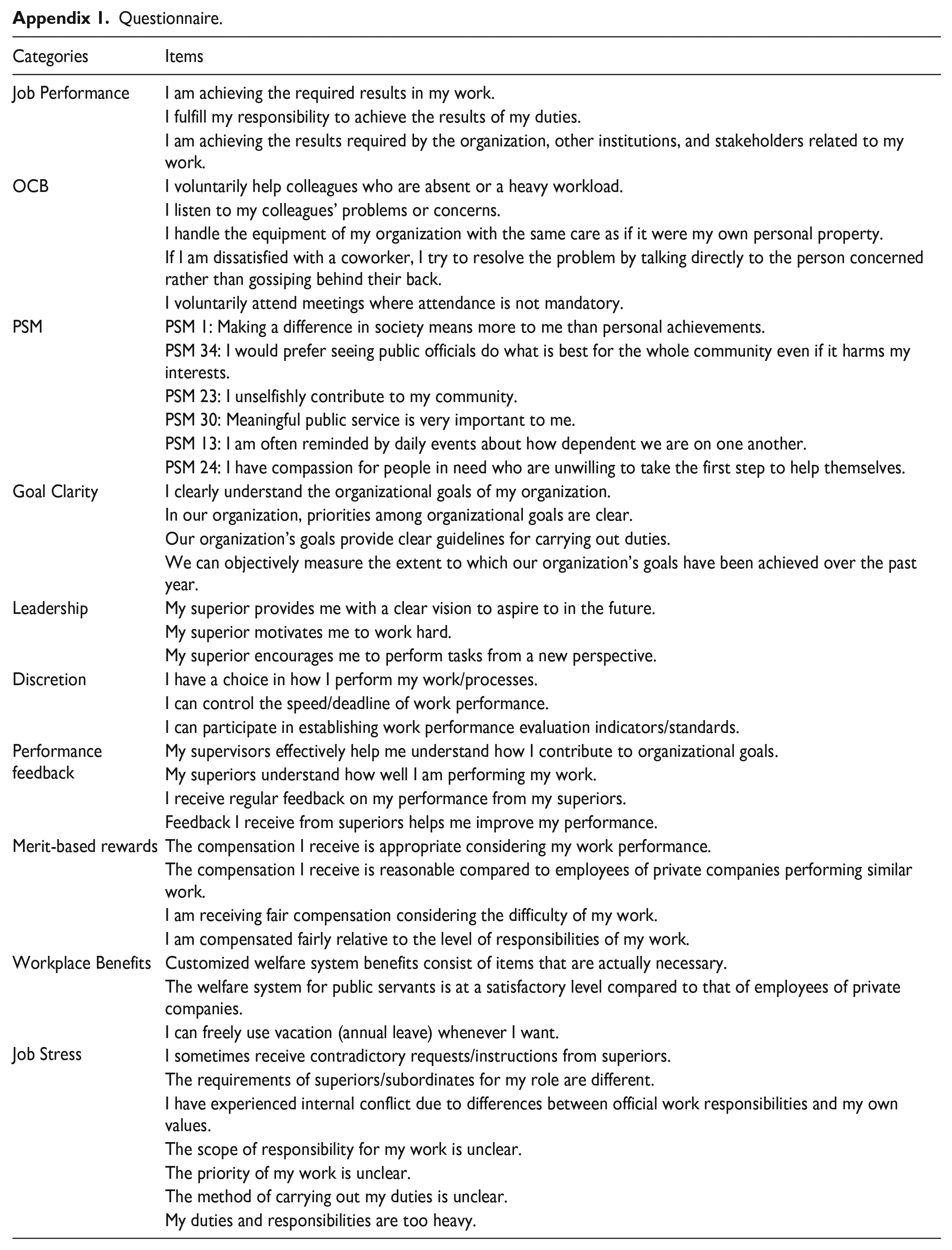
Table 1 presents the descriptive statistics for the variables used in this study. All variance inflation factors (VIFs) were well below 5, raining from 1.02 to 2.75, confirming absence of multicollinearity. Job performance has a mean score of 3.71, indicating, on average, a slightly higher than a mid-point of the moderate level of job performance (see detailed items in Appendix 1). Similarly, OCB and PSM yielded mean scores of 3.513 and 3.45 respectively. On the other hand, merit-based rewards, job stress, and workplace benefits were relatively lower mean scores than the others. These results can be attributed to the characteristics of the public sector (West and West, 1989). Regarding gender distribution, the majority of participants, 60.7% was male. More than 90% of the participants held at least a college degree.
Descriptive statistics of variables.
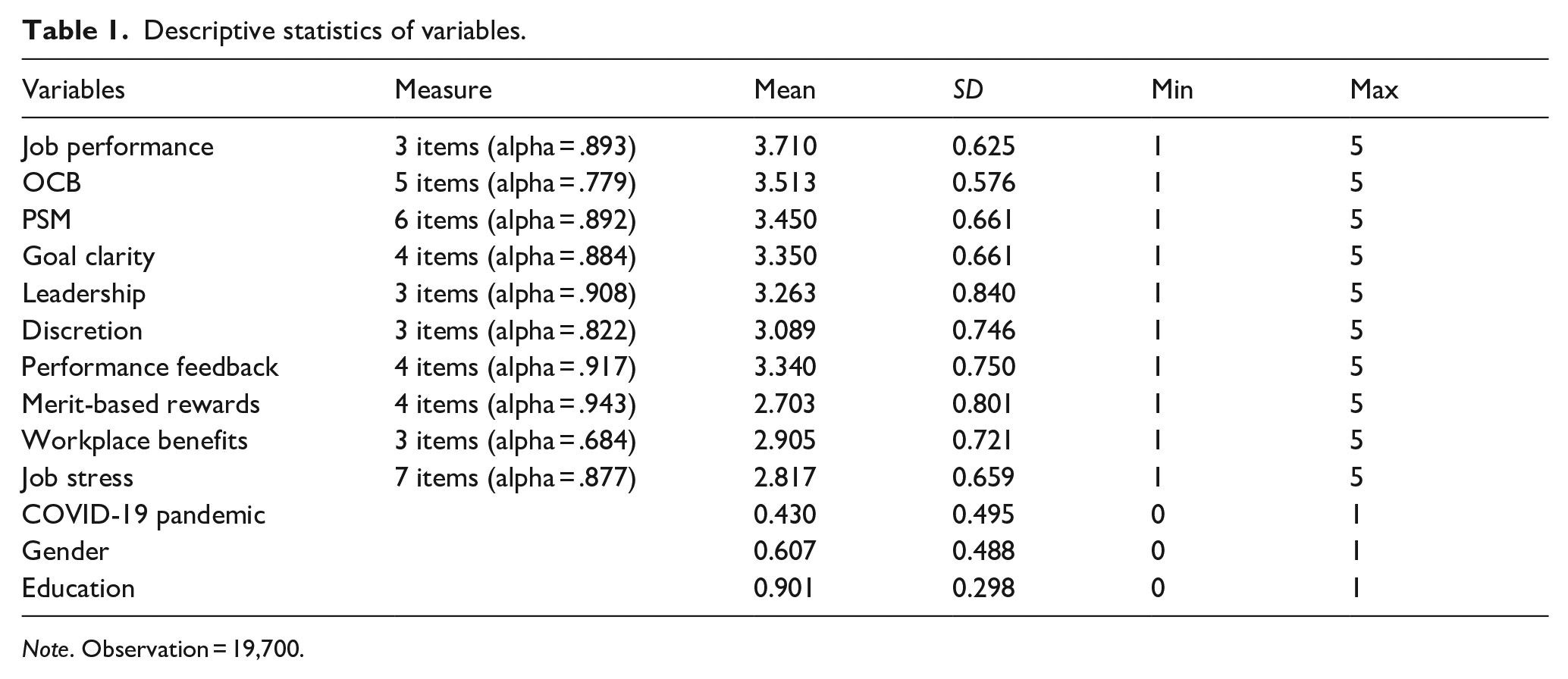
Note. Observation = 19,700.
Analytical modeling
This study employed a mediation regression analysis, based on the approach outlined by Tingley et al. (2014), to explain the mediating role of OCB in the relationship between PSM and job performance. This procedure enables the mediator’s degree of a mediating effect on the interaction between explanatory variables and a dependent variable by modifying the statistical limitations of the classic mediation approach proposed by Baron and Kenny (1986) in testing a direct mediation effect (Tingley et al., 2014). The mediation analysis in this study was structured as a three-step process to establish a mediation model. In the first step, the relationship between PSM and job performance was estimated using the equation Y = b0 + b1X + e. In the second step, the effect of PSM on OCB was examined (M = b0 + b2X + e), treating the mediator of OCB as a dependent variable. In the final step, a regression model was constructed to predict job performance incorporating both PSM and the previously derived OCB (Y = b0 + b4X + b3M + e). This third step evaluated the potential mediating effect of OCB, which was assessed as either b1 − b4 or b2 × b3. To ensure the validity of regression analysis, assumptions required for ordinary least squares regression were tested and no issues were detected.
Additionally, the model included year-fixed effects to account for temporal variations. Recognizing the impact of the COVID-19 pandemic on organizational dynamics is acknowledged, we incorporated both the COVID-19 variable and an interaction term between PSM and the pandemic. This approach allows us to capture the moderating impact of the pandemic on the PSM-job performance relationship.
Results
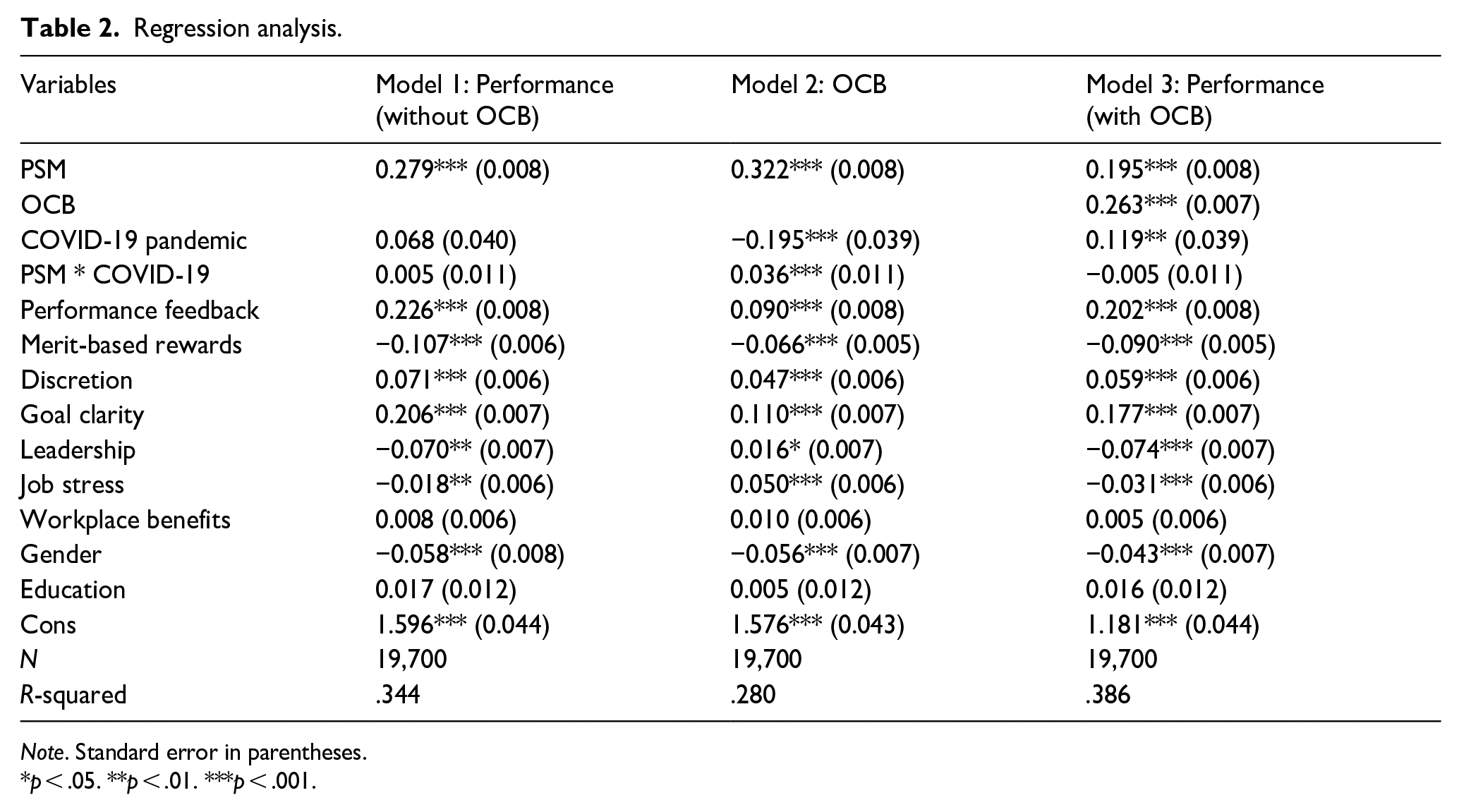
Table 2 presents the results of the regression analysis. Model 1 identifies job performance as the dependent variable and includes PSM as the primary independent variable alongside the control variables. Consistent with previous studies (Bellé, 2013; J. Park & Lee, 2020; Stefurak et al., 2020), PSM is positively associated with job performance, providing further evidence that the alignment between organizational and individual objectives enhances job performance. Despite the positive direction, the impact of the COVID-19 pandemic, including its interaction term with PSM, did not have statistical significance.
Regression analysis.
Note. Standard error in parentheses.
p < .05. **p < .01. ***p < .001.
Among the control variables, job stress is negatively related to job performance, confirming the findings of previous studies that have documented its adverse impact (Bjaalid et al., 2020; Jamal, 2011; Nisar & Rasheed, 2020). However, caution should be advised in interpreting this variable, as moderate levels of job-related stress have been shown to positively correlate with performance (Jamal, 2011). Merit-based rewards appear to negatively impact job performance in the public sector, as public sector employees are primarily motivated by non-financial compensation, such as the fulfillment and satisfaction derived from contributing to society rather than simply pursuing personal profit (Choi & Whitford, 2017). This misalignment between financial incentives and the motivations of public employees can result in unintended consequences, such as a reduction in intrinsic motivation—a phenomenon explained in motivational theory as the crowding-out effect. From this perspective, external financial rewards may undermine internal drives to perform well, potentially leading to a decline in job performance. These findings align with the theoretical framework of PSM, which highlights the importance of tailoring motivational strategies to the distinct value orientations of public sector employees.
Discretion is recognized as a critical factor in enhancing job performance among Korean civil servants (Kwon, 2014; Yoon & Miller, 2002). It enables public officials to provide efficient public services and allows citizens to receive them in a timely and effective manner (Fernandez & Moldogaziev, 2011; Langbein, 2000). In the context of the heavily regulated Korean administration, where formal regulations often constrain decision-making, discretion is considered an essential means of improving job performance. Therefore, it is widely acknowledged that discretion is a key factor in achieving successful outcomes in public service delivery in Korea. It has been shown that workplace benefits can enhance job performance. As discussed in previous studies, the various conveniences employers provide in the workplace improve employees’ job performance (Iqbal et al., 2017). Goal clarity is also known to have a positive impact on job performance. This result is in line with previous research, which indicates that individuals perform better when they work in organizations with clear goals.
Furthermore, empirical evidence confirmed that leadership is positively associated with job performance. The presence of leadership, which provides clear direction and organizational goals, improves individual job performance (Schwarz et al., 2020). Regarding performance feedback, the results indicated a positive impact on job performance, asserting that public employees are likely to engage in more productive work practices when informed of performance gaps (Favero et al., 2016; Y. Kim & Park, 2021). An adequate performance feedback loop accommodates public employees to achieve improved results for citizens. It has been reported that Korean public officials’ job performance improved after the outbreak of COVID-19. This may be due to external factors, such as the need to provide more public services, as well as the expansion of flexible work arrangements due to infectious diseases, which may have contributed to the improvement in job performance (L. Liu et al., 2021). It is found that the job performance of male public officials is lower than that of female public officials, and there is no significant difference based on education level.
Model 2 sets the dependent variable as OCB and the key independent variables that can influence it as PSM. The associations between PSM, merit-based rewards, discretion, workplace benefits, goal clarity, and leadership are consistent with Model 1, which sets job performance as the dependent variable. However, the effects of job stress and COVID-19 are the opposite. PSM influences internal motivation in the organization, while OCB is a process that manifests in actual behavior, different processes affect job performance. An important point to note is that an increase in job stress leads to an increase in OCB. In other words, job stress enhances OCB but weakens job performance, so in-depth research is needed to understand this relationship. Additionally, the fact that COVID-19 weakens OCB can be interpreted as a result of the excessive administrative service demands in the public sector.
In Model 3, job performance is analyzed by setting it as the dependent variable and including PSM and OCB as key independent variables. Similar to the previous two models, PSM and OCB are statistically significant in improving job performance. Among the control variables, performance feedback, discretion, goal clarity, and leadership are positively associated with job performance, while merit-based rewards, leadership, and job stress decrease it. In addition, there was a noticeable trend of increased job performance after the pandemic, and females have higher job performance. There is no moderating impact of the pandemic and PSM on job performance. Education level and workplace benefits are not statistically significant.
Table 3 presents the results of the mediation analysis, including the total effect (
Mediated effect of PSM on job performance.
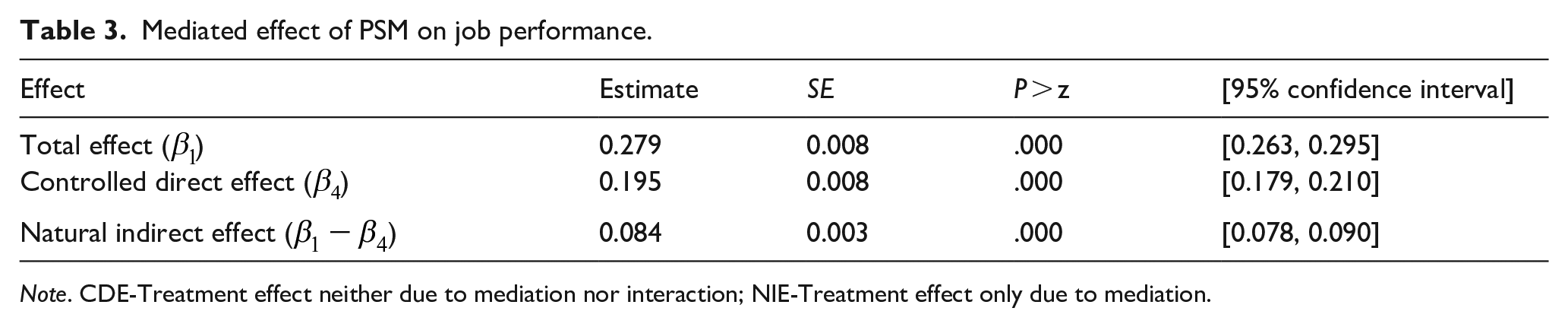
Note. CDE-Treatment effect neither due to mediation nor interaction; NIE-Treatment effect only due to mediation.
Discussion and conclusion
This study refines PSM theory by articulating its pathway to job performance within the context of the Korean public sector. By integrating the mediating impact of OCB and the interaction impact of pandemic using cross-sectional data, we extend the theoretical boundaries of PSM. The findings claim a sequential linear process, where PSM plays an important role in motivating public employees to achieve better performance, with this effect mediated by OCB. These results underscore the importance of emphasizing PSM as a source of intrinsic motivation and OCB as a practical behavioral mechanism to improve job performance. From a theoretical perspective, this study confirms the mechanism by which internal motivation, expressed through actual behaviors such as OCB, translates into improved performance. Beyond demonstrating the direct impact of PSM on job performance, this study contributes to confirming the logical structures of these effects in the South Korea context. It provides valuable implications in how intrinsic motivation and actual behavior are linked to job performance, particularly in light of the societal and environmental shifts that have reshaped perceptions of public service in this specific setting.
Furthermore, our findings are consistent with previous studies demonstrating that PSM positively affects OCB (Campbell & Im, 2016; Gnankob et al., 2022; Karolidis & Vouzas, 2019; Pandey et al., 2008; Piatak & Holt, 2020; Shim & Faerman, 2017) and align with studies indicating that PSM influences job performance through OCB mediation (Chiang & Hsieh, 2012; Indarti et al., 2017; Mostafa & Leon-Cazares, 2016). In addition, the results of this study contribute to the literature by providing evidence that the pandemic has impacted the Korean public sector. Notably, while the adoption of flexible work systems post-pandemic appears to improve performance (L. Liu et al., 2021), there is a concurrent decrease in OCB, providing insights into the multifaceted effects of the pandemic. Although the COVID-19 pandemic has been found to positively affect job performance, aligning with the findings from previous studies (Ki & Lee, 2025; F. Liu et al., 2024), it does not demonstrate a moderating effect on the relationship between PSM and job performance. This suggests that while the pandemic impacts job performance, its interaction with PSM may differ. Furthermore, although this study shares similarities with F. Liu et al. (2024), it is set against a different background. Unlike Liu et al.’s work, this study utilized a larger dataset and focused on data from South Korea, allowing for an emphasis on temporal changes. As a result, the effects of the pandemic were identified, but the findings may diverge. Therefore, it underscores the need for continued research on the impact of the pandemic.
This study has several limitations. First, relying on perception-based survey data from public employees may present measurement challenges. While previous studies found no significant discrepancies between objective and subjective measures, future research could combine both to enhance robustness. Second, latent variables may affect job performance, as complete control over unobserved biases is not possible. For example, improved work environments during the pandemic could have influenced performance. Future studies should explore these factors in post-pandemic contexts. Third, the findings may be limited to Korean or East Asian societies due to the context-specific data. However, the study may extend the PSM framework by examining cultural variations. Despite these limitations, the study highlights the significant commitment to PSM and OCB principles in the public sector.
The value of public service is reflected in the tendencies of public employees who place greater emphasis on intrinsic over extrinsic rewards. As Bozeman (2007) articulated, a substantial part of the motivational basis of public value is fueled by self-interest or self-satisfaction. The findings of this study assert the importance for public agencies to enhance the qualities of PSM and OCB as strategies to stimulate individual interest and commitment. However, it is critical to approach these improvements with caution. Given the diversity of employee motivations and responses, policy initiatives and management practices should not be a one-size-fits-all approach but should be tailored to effectively address varied individual and organizational needs. To recommend the PSM paradigm, the focus should be on addressing “how” questions about the processes by which PSM influences behavior and outcomes, rather than merely identifying “what” questions associated with high levels of PSM. In the era of digital transformation, the quest for intrinsic motivation and organizational commitment becomes increasingly critical to strengthen work performance as technological advancements reshape workplace ecosystems. With high levels of PSM and OCB, the adaptability of public employees can be leveraged to ensure continued resilience in digital environments.
Footnotes
Appendix
Questionnaire.
| Categories | Items |
|---|---|
| Job Performance | I am achieving the required results in my work. |
| I fulfill my responsibility to achieve the results of my duties. | |
| I am achieving the results required by the organization, other institutions, and stakeholders related to my work. | |
| OCB | I voluntarily help colleagues who are absent or a heavy workload. |
| I listen to my colleagues’ problems or concerns. | |
| I handle the equipment of my organization with the same care as if it were my own personal property. | |
| If I am dissatisfied with a coworker, I try to resolve the problem by talking directly to the person concerned rather than gossiping behind their back. | |
| I voluntarily attend meetings where attendance is not mandatory. | |
| PSM | PSM 1: Making a difference in society means more to me than personal achievements. |
| PSM 34: I would prefer seeing public officials do what is best for the whole community even if it harms my interests. | |
| PSM 23: I unselfishly contribute to my community. | |
| PSM 30: Meaningful public service is very important to me. | |
| PSM 13: I am often reminded by daily events about how dependent we are on one another. | |
| PSM 24: I have compassion for people in need who are unwilling to take the first step to help themselves. | |
| Goal Clarity | I clearly understand the organizational goals of my organization. |
| In our organization, priorities among organizational goals are clear. | |
| Our organization’s goals provide clear guidelines for carrying out duties. | |
| We can objectively measure the extent to which our organization’s goals have been achieved over the past year. | |
| Leadership | My superior provides me with a clear vision to aspire to in the future. |
| My superior motivates me to work hard. | |
| My superior encourages me to perform tasks from a new perspective. | |
| Discretion | I have a choice in how I perform my work/processes. |
| I can control the speed/deadline of work performance. | |
| I can participate in establishing work performance evaluation indicators/standards. | |
| Performance feedback | My supervisors effectively help me understand how I contribute to organizational goals. |
| My superiors understand how well I am performing my work. | |
| I receive regular feedback on my performance from my superiors. | |
| Feedback I receive from superiors helps me improve my performance. | |
| Merit-based rewards | The compensation I receive is appropriate considering my work performance. |
| The compensation I receive is reasonable compared to employees of private companies performing similar work. | |
| I am receiving fair compensation considering the difficulty of my work. | |
| I am compensated fairly relative to the level of responsibilities of my work. | |
| Workplace Benefits | Customized welfare system benefits consist of items that are actually necessary. |
| The welfare system for public servants is at a satisfactory level compared to that of employees of private companies. | |
| I can freely use vacation (annual leave) whenever I want. | |
| Job Stress | I sometimes receive contradictory requests/instructions from superiors. |
| The requirements of superiors/subordinates for my role are different. | |
| I have experienced internal conflict due to differences between official work responsibilities and my own values. | |
| The scope of responsibility for my work is unclear. | |
| The priority of my work is unclear. | |
| The method of carrying out my duties is unclear. | |
| My duties and responsibilities are too heavy. |
Acknowledgements
The authors used Grammarly and ChatGPT to improve readability and language refinement during the preparation of this article.
Declaration of conflicting interests
The author(s) declared no potential conflicts of interest with respect to the research, authorship, and/or publication of this article.
Funding
The author(s) received no financial support for the research, authorship, and/or publication of this article.
