




Abstract
In this paper we seek to understand how religion influences discretion in a developing fragile society: Palestine. Drawing on a recent review of the religion and public administration literature and the theory of representative bureaucracy, we ask: Does active representation on behalf of a religious identity exist? And if so, what does it look like? We explore four different possible manifestations, including none at all. In other words, this is a study of how religiosity influences civil servant behaviour in instances of discretion. Using original small-n in-person survey data, we find active representation by a majority of mid-level civil servants on behalf of a religious identity; we find evidence of religious service being underpinned by public service motivation and by pro-social motivation. Others are guided by traditional Weberian bureaucratic values while others are guided by what they perceive to be the religious foundation of the bureaucracy.
Introduction
Administrative reform is a key determinant in managing fragile and developing societies. While much attention is paid to reform structures and legal texts, we must also pay attention to the everyday decision-making processes of civil and public servants within these societies (O’Connor and Carmichael, 2020). Organisational norms and rules tend to govern behaviour in most contexts in Western public administration; however even in these rule-bound societies, discretion can sometimes be guided by primary identities such as race or gender, or in our case, religion. The theory of representative bureaucracy is often used to determine how this discretion is exercised. The theory supposes that a demographic may rely on its counterparts within the public administration to represent its interests. Under certain circumstances, where the issue is of importance to that demographic, and they comprise a critical mass (Meier and O’Toole, 2006), they can be expected to press for the interests of that demographic: what is now termed active representation (Mosher, 1968). O’Connor et al. (2020) found that it was not sufficient to identify active representation on behalf of a primary identity; rather, representative bureaucracy research needs to establish the various types of active representation that can manifest on behalf of a primary identity.
This study identifies, for the first time, the various natures of active representation on behalf of a religious identity among civil servants within the fragile, developing society. Further, we ask: what does actively representing your religion mean? How does it play out in practice? Does it mean being guided by the ethics of your faith? Does it mean serving your co-religions in society? Does it mean serving the poor and less well off? Or does it mean abiding by the rules of the organisation? Our study therefore is a study of how religiosity influences mid-level civil servant behaviour in instances of discretion and the manner in which it is expressed on the job. Put differently, this is the first study to explore the complexity of religion, representative bureaucracy, public service motivation and pro-social behaviours.
Paper structure
Our research makes three contributions: First we develop a series of theoretically derived statements that can identify how religion influences discretion; secondly, we empirically test our proposition (P) that there is a link between passive and active representation for religion. Thirdly, we identify the basis of active representation on behalf of a religious identity, so future studies can examine the underpinning nature of these competing manifestations. In the next section we present the various theoretical representation conceptions that are extant in the literature. After these are presented, we discuss our methodology. The following section identifies how these ideal types inform empirically existent typologies of active representation on behalf of a religious identity. The final section points to some implications for practitioners and academics, together with some limitations of the study.
Literature review
How does religion influence the behaviour of civil servants within the developing fragile society? Houston and Cartwright (2007), using the 1998 General Social Survey (US), point out that ‘respondents in public service occupations are more likely than others to indicate a higher level of spirituality’. Ongaro and Tantardini (2024) stress that we need to examine ‘how religion, faith, and spirituality affect public managers’ decision making, with the topic of administrative discretion appearing as an especially relevant topic for inquiry’ (see for example Vaughn and Otenyo, 2007). Bozeman and Murdoch (2007: 289) ask: “[D]o public managers’ religious beliefs and behaviours affect their work and their work-related attitudes?” How then does this religiosity influence behaviour? Pfaff et al. (2021), in their correspondence experiment, identify religion as a ground for street level discrimination showing that school principals in the USA are less likely to meet with prospective Muslim and Atheist pupils/parents than Christian/non-affiliated parents. Our study uses the theory of representative bureaucracy to help us understand how religiosity influences civil servant behaviour in these instances of discretion.
For the purposes of this article, we use the definition of religion as set out by Bell (1980: 333–4): “a set of coherent answers to the core existential questions that confront every human group, the codification of these answers into a creedal form that has significance for its adherents, the celebration of rites which provide an emotional bond to bring into congregation those who share the creed and celebration, and provide for the continuity of these rites from generation to generation”.
Islam and Christianity are the two religions that make up the majority of the Palestinian population. As outlined elsewhere in this special issue, and by Ongaro and Tantardini (2024) there is a dearth of research on religion and public administration, and by Bishu and Kennedy (2020), a complete absence of research examining religion and representative bureaucracy, to which we now turn.
Representative bureaucracy
Ongaro and Tantardini (2024) suggest that ‘future research might theoretically elaborate and empirically test the – problematic – functions of religion as a source of social cohesion and as an ideational basis for the design of accountability in public administration’. The theory of representative bureaucracy is particularly adept at responding to this call. In the past decades, we have seen three dominant waves of representative bureaucracy research (Bishu and Kennedy, 2020; Kennedy, 2014). In the early days, research focused on passive representation – the extent to which a particular demographic was represented in the civil service with respect to its composition in society. Gagnon et al. (2006) present an insightful multi-country overview of passive representation. More recently, we have noticed a turn in representative bureaucracy research that examines symbolic representation (Van Ryzin et al., 2017) and there is evidence to suggest there are boundary conditions to such representation (Johnston et al., 2023). Questions investigating if the proportion of black police officers corresponds with citizen perceptions of performance and trustworthiness (Riccucci et al., 2018), typify research questions in this burgeoning area. However, between these two waves, sits the largest body of representative bureaucracy research: the relationship between passive and active representation. Following Mosher (1968) and Pitkin (1967), research progressed to differentiate between that what the bureaucrat ‘is’ and that what the bureaucrat ‘does’. In other words, did the minority bureaucrat represent his or her counterparts in society? In what is now generally conceived of as the second wave of representative bureaucracy research, much scholarly attention has been devoted to the extent to which passive representation translates to active representation among minority bureaucrats. Questions investigating if female police leadership affects gender-based violence arrests (Andrews and Johnston, 2013; Johnston and Houston, 2018) or if female teachers disproportionately benefit female students (Keiser et al., 2002) or if black police officers actively represent their counterparts in society (Wilkins and Williams, 2008), and the associated factors that encourage/discourage such representation, dominate this section of the literature. It is therefore important to understand what people, groups or ideas bureaucrats represent when they do actively represent.
Type of demographic representation (Bishu and Kennedy 2020: 559).
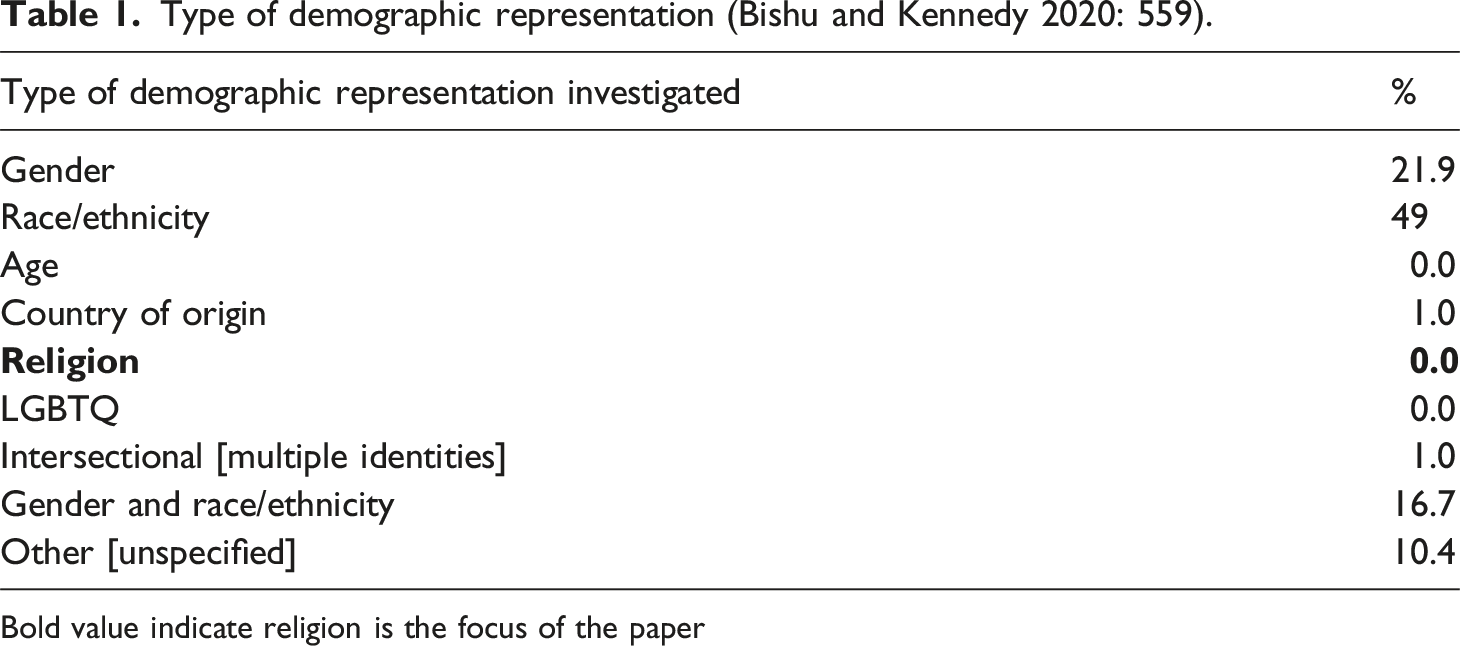
Bold value indicate religion is the focus of the paper
Therefore, religion is a gap in this second wave of representative bureaucracy literature. This is the first article that seeks to fill this void in the representative bureaucracy literature. Further, in a departure from studies that simply look for the presence or absence of active representation on behalf of a primary identity, recent research among Palestinian teachers in East Jerusalem found active representation to exist on behalf of a national identity; however how this active representation manifests itself differed markedly between street level bureaucrats. It was therefore concluded that it was insufficient to identify the presence or absence of active representation, but in instances of active representation, we must also identify the nature of active representation (O’Connor et al., 2020). There is little value in claiming women represent women or an ethnic group actively represents the interests of their co-ethnics in society if how they do so differ markedly. In summary, the second wave of representative bureaucracy misses religion as an independent variable and further, if active representation on behalf of a religious identity exists, it is important to understand how this is manifest and in what way it is expressed, for example refraining from carrying out policies, rules and regulations perceived to be in violation of basic religious principles or incongruent with the teachings of the religious authority.
Prior research: Religion and public administration. The theoretical ideal typologies
‘The influence of religion has so far been overlooked in PA research’ (Ongaro and Tantardini, 2023: 1). In our research design, we draw on ‘ideal types’ to explore this phenomenon. According to Ongaro (2020: 249) ideal types ‘may be used for framing empirics and gaining insights’, and are ‘geared to theory building…’ they are ‘context-insensitive’, and ‘are amenable to mental experimentation of what would happen when placed in context ‘A’ or context ‘B’…’. In his comprehensive review of philosophy and public administration, he proposes that we need to rediscover ‘the ‘lost arts’ of ideal-typing and of thinking beyond path-dependency (teleological-utopian thinking), as well as abstracting to the level of guiding ideas and principles through contrasting alternative PA paradigms’ (2020: 271). We draw on ideal-types in our research design as they facilitate the viewing of a phenomenon (representation of religion) through various existing, well-established public administration lenses. To develop our theoretical ideal types, we draw on a recent review of the religion and public administration literature where Ongaro and Tantardini (2024) found 67 articles on the subject, with 10 dominant themes emerging. Drawing on these themes and the articles referenced therein, we have compiled a range of possible ways in which active representation on behalf of a religious identity can manifest. These are pure ideal theoretical types, not expected to exist in their pure forms empirically.
Type one: Serve all of the people directly
First, civil servants may have a calling to public service and this calling may underpin their motivation to serve the entire public, as in Public Service Motivation (PSM) (Perry and Wise, 1990). In this scenario, a religious conviction underpins the four PSM dimensions established by Perry (1997): Attraction to Public Policy Making, Commitment to Public Interest, Compassion and self-Sacrifice. One strand of the religion and public administration literature sees that religion can attract people to be public servants: what they call ‘person-organisation fit’. Both subjects in the research by Lowery (2005: 328) consider their ‘professional life to be a calling or vocation’. One of the implications of Lowery’s study ‘pertains to the place of religion and spirituality in public administration. The kind of deep and rich connections that the research subjects drew between their belief systems and their work as public administrators’ (Ongaro and Tantardini, 2024). In this theoretically existent typology, bureaucrats favour statements that lead us to conclude that their religious belief meant that they interpreted their role as to improve the lives of others, along the public service motivation dimensions.
Perry et al. (2008: 453) see religious activity as an antecedent of PSM: ‘Religious activity is one of the strongest PSM predictors in the structural equations, and our interviews uncovered a nearly universal disposition to attribute exemplary acts to religion, spirituality, or a higher power’. An important distinguishing feature of this typology is that active representation on behalf of a religious identity does not necessarily mean that civil servants will represent their co-religionists in society. Those in this typology see their religion as underpinning their servitude of all of society. They do not represent their co-religionists, but their religion governs their way of life and their approach to decision-making.
This body of research therefore gives rise to our theoretical ideal type one: Active representation on behalf of a religious identity means that bureaucrats are motivated to serve all of the people directly. The questionnaire statements that comprise type one, and indeed each of our conceptual typologies, are presented in the findings section.
Type two: Religious norms should underpin the values of the bureaucrat
Second, civil servants may be selected, formally or informally, based on their spiritual or religious belief. This can lead to a belief that: to be a part of this organisation you must believe in its underpinning religious values. The religious values and the bureaucracy values are coterminous. Put differently by Ongaro and Tantardini (2024) when examining the Chinese bureaucracy, bureaucrats ‘must demonstrate their ability to reproduce in their profession as civil servant [’s] the ‘modes ‘of thought common to the majority of Chinese that incorporate both Confucian morality and also Taoist harmony’. An important feature of this typology is that bureaucrats would believe that to be a part of this organisation one must believe in the underpinning religious values of the organisation. Religion, faith and spirituality shape an organization’s mission and values as well as its management practices and performance (Ongaro and Tantardini, 2024). For this typology, religious beliefs guide how staff are managed and appraised. Research in this area concerns the influence of religion on public leadership, with a particular focus on leadership styles and values-based leadership (see for example Greenleaf, 1998, 2002). Put differently, distinguishing this type from type one, type two is guided by a set of values that coexist in the bureaucracy, politics and society. There is no public or private realm; no differentiation between motivations at work and at home. They embody a religious identity that is the foundation of society in all its structural forms. Type one is motivated by their religion to serve all of the general public: the doing good for others ideal. Conversely, type two sees the rules of their religion and the rules of the bureaucracy as one and the same – akin to a theocracy. This gives rise to type two: Active representation on behalf of a religious identity means that bureaucrats believe that religious norms should underpin the values of the bureaucracy.
Type three: A bureaucrat represents their co-religionists in society by directly providing them with benefits
Third, and related to the first two types is the idea that civil servants may interpret their role as to represent a section of the community or like-minded people; what Reissman (1949) would have termed the ‘service bureaucrat’. The service bureaucrat he identifies as seeking recognition from a particular group outside the civil service. Similarly, Downs (1956) identified the advocate and zealot, two types of ‘mixed motive official’ that could represent a set of policies or ideas, moderately or more forcefully within their roles. This has recently become known as pro-social motivation, i.e., serving a section of society (Ritz et al., 2020). In the core civil service, Pierskalla et al. (2021) find instances of religious discrimination within the civil service (of Indonesia) due to the religious beliefs of managers. Congruously, a growing body of literature looks at Faith-Based Organizations (FBOs) and the implications for their involvement in public services delivery (Ongaro and Tantardini, 2024): As citizens’ and civil society’s participation in public governance increases, the opportunity for bureaucrats to represent, consciously or subconsciously, the interests of groups with which they naturally share an affinity, increases.
This gives rise to type three: Active representation on behalf of a religious identity means that a bureaucrat directly represents the interests of their co-religionists in society by providing material benefits to that group.
Type four: No active representation
Fourth, a civil servant may not be religious, or may be religious, but disagree with bringing those religious values into the workplace. They may have a secondary professional identity or organisational identity that sits separate from their primary identity, and as identified by O’Connor (2014), O’Connor and Shahwan (2024) and Kennedy (2013), active representation on behalf of a secondary learned identity, is not altogether improbable. This gives rise to our fourth typology: There is no active representation on behalf of a religious identity.
Summary
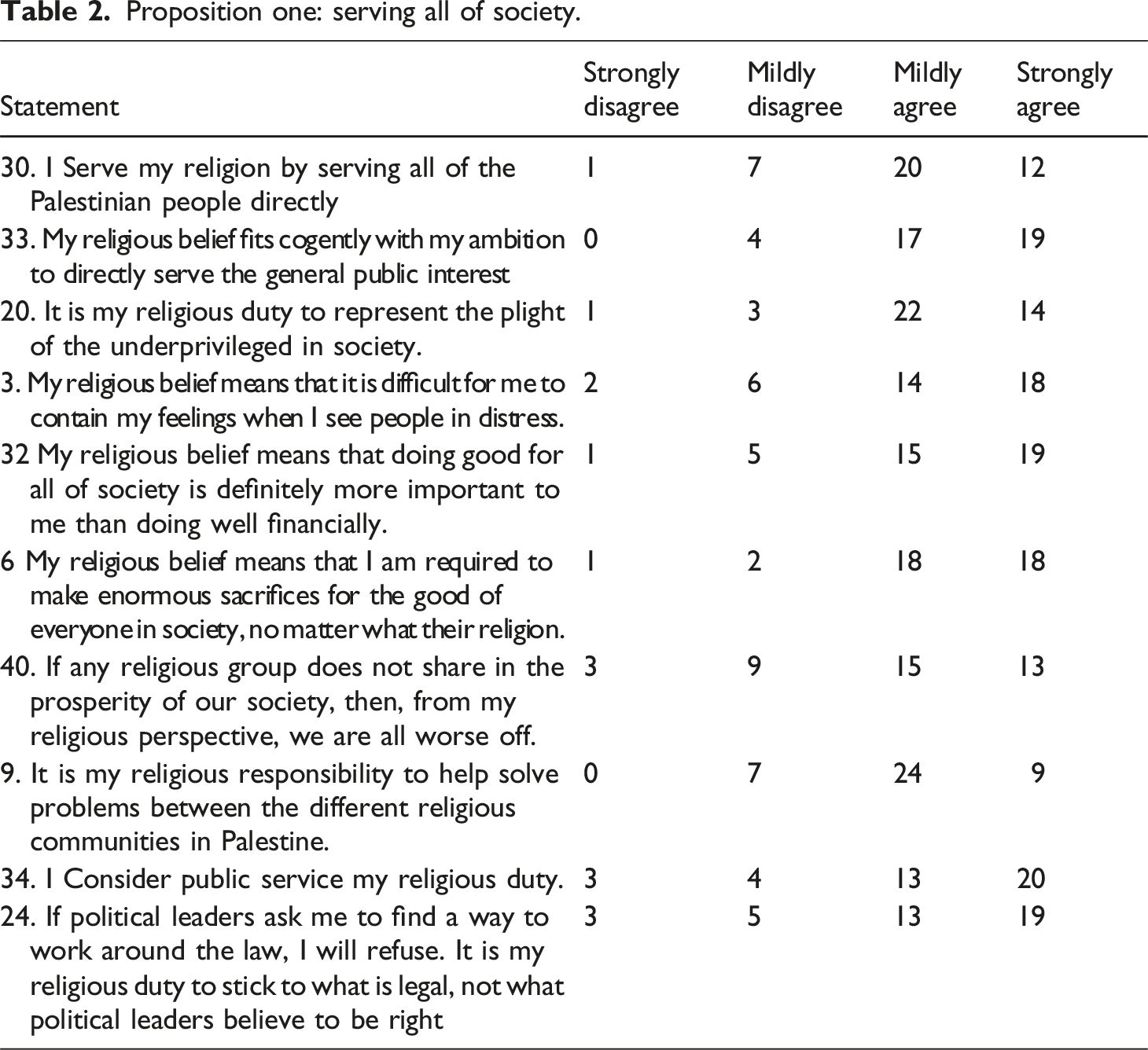
Proposition one: serving all of society.
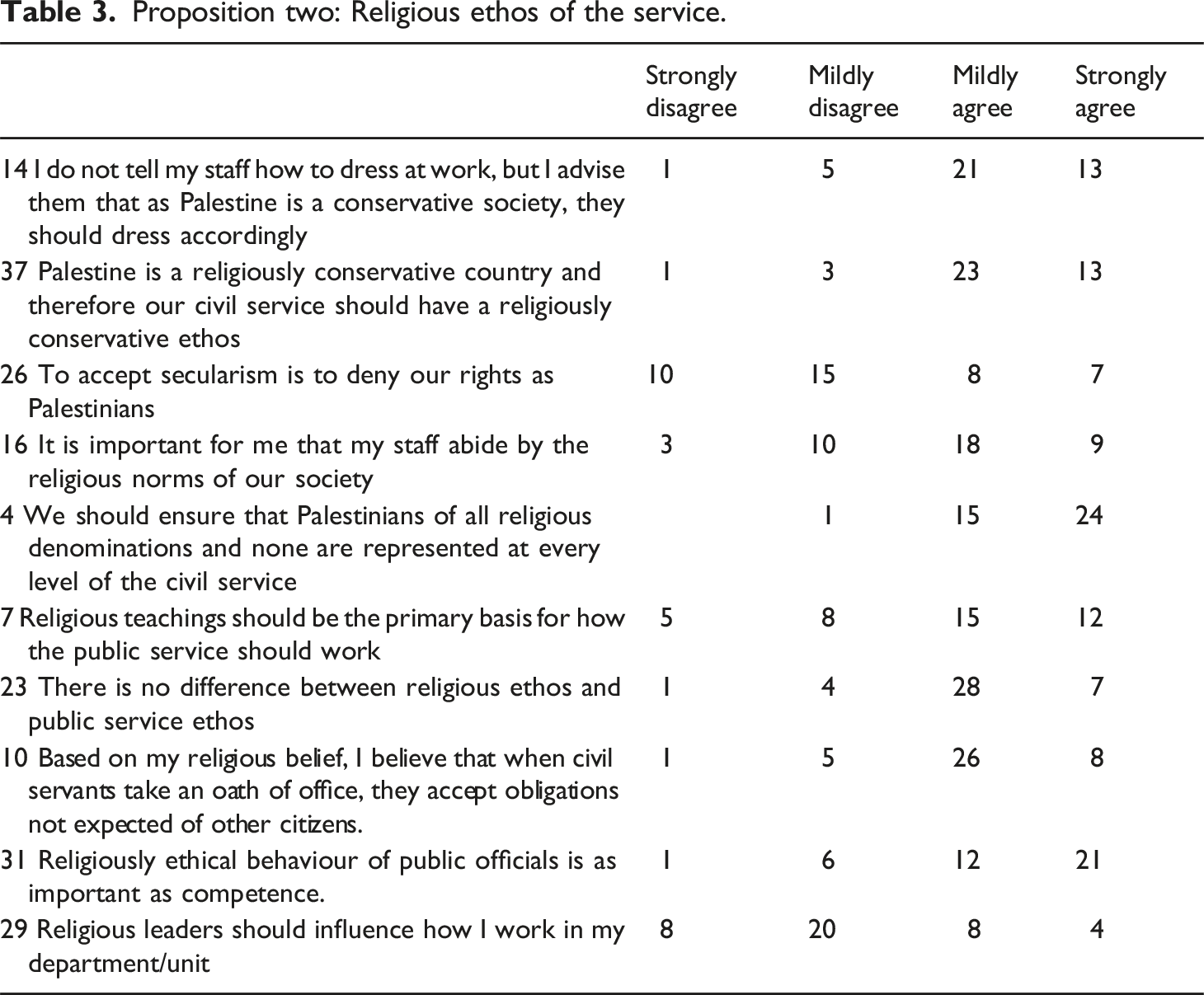
Proposition two: Religious ethos of the service.
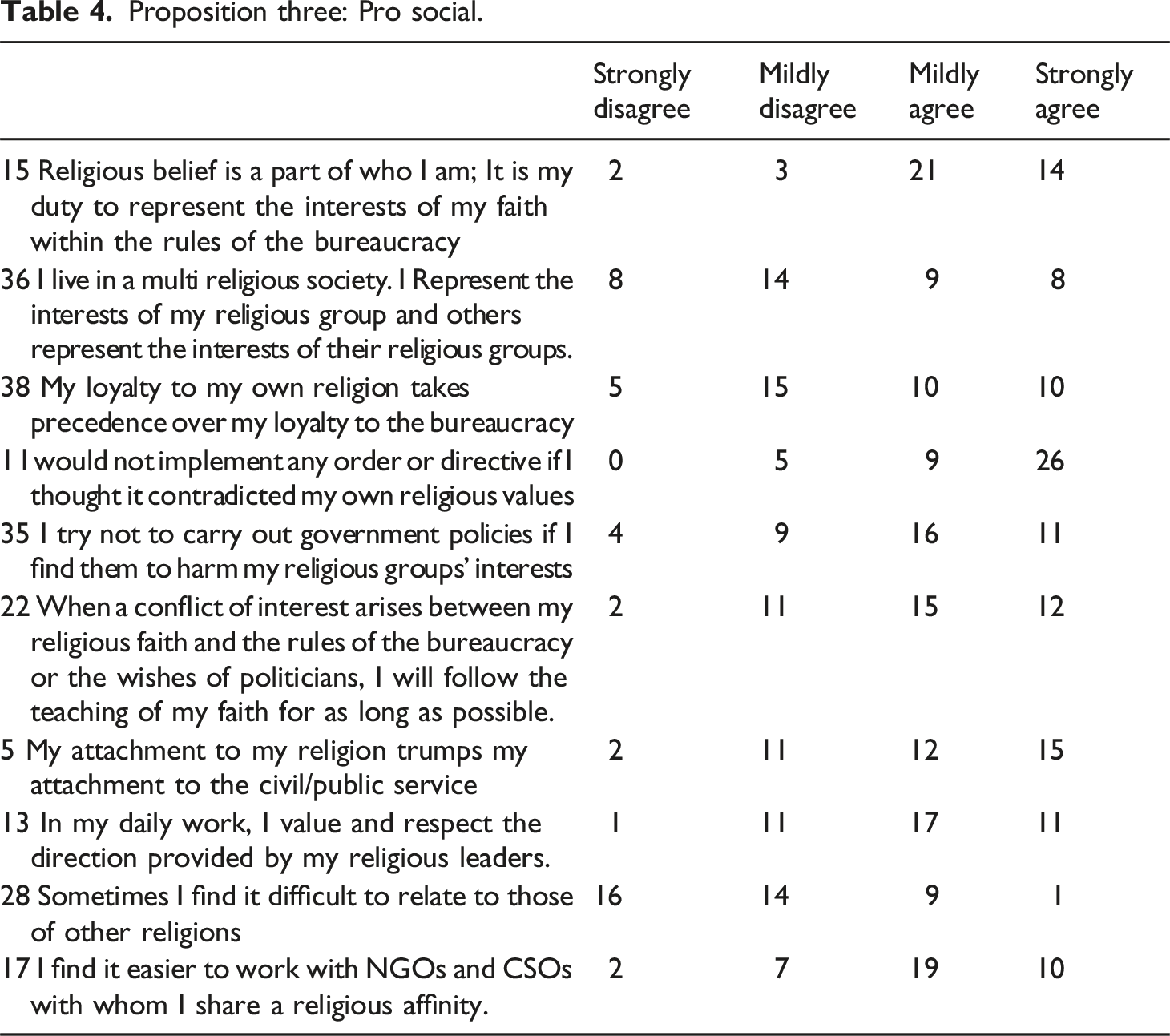
Proposition three: Pro social.
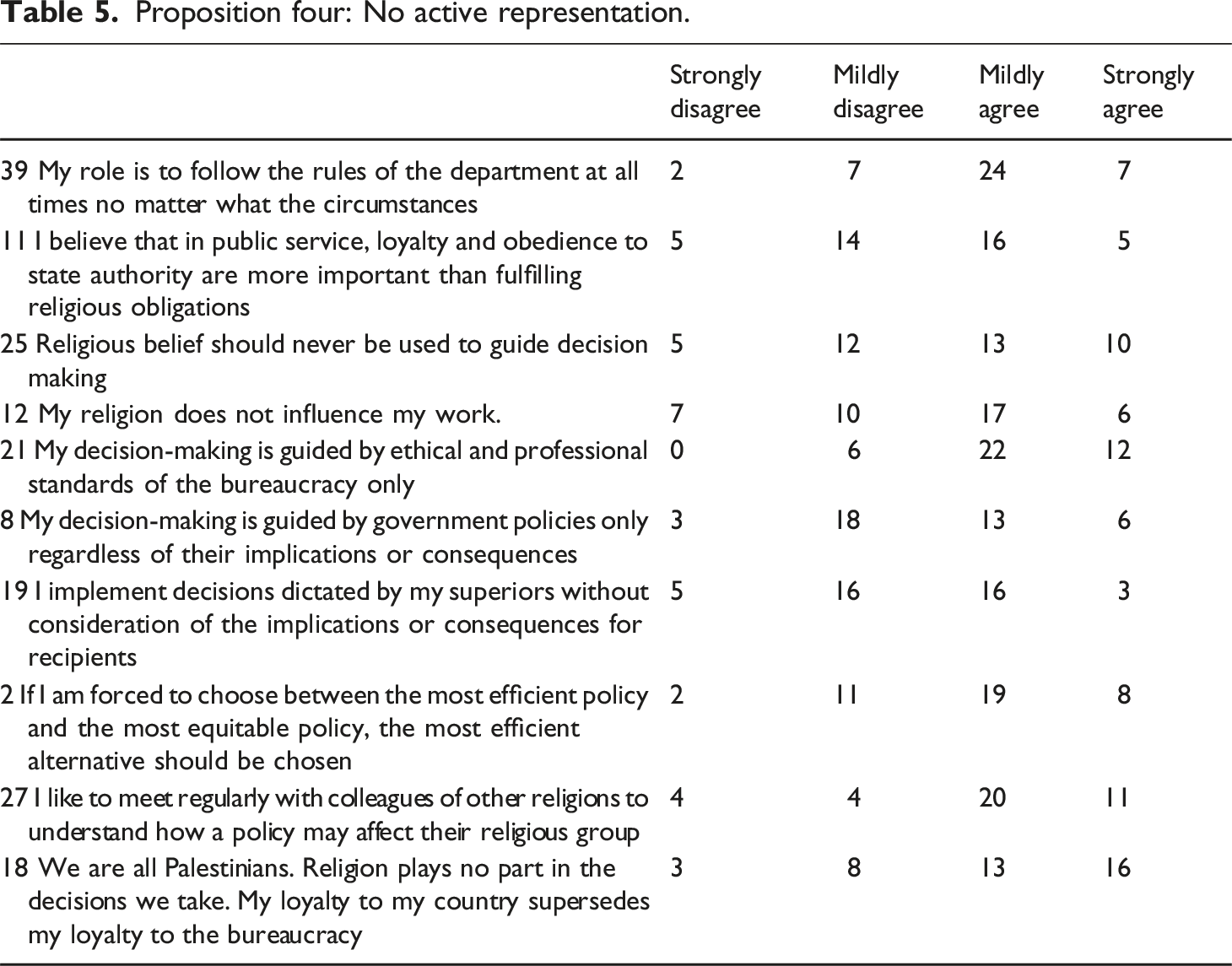
Proposition four: No active representation.
Background
Palestinian bureaucracy
We situate our study within Palestine: a fragile conflict society in the Middle East. Palestine is a society with a strong history of bureaucracy under occupation from the Ottomans through to the British Empire, and most recently as indirectly subservient to the Israeli state. (Shahwan, 2003) The amended basic law of Palestine (2003), which forms the constitutional and legal framework of the three branches of government clearly underlines the secularity of the system including the bureaucracy. While the Basic Law (constitution) in Palestine (Article (4)) stipulates that Islam is the official religion of the State, and Sharia law is the main source of legislations, Article 4, in practice, has little influence on the laws of the bureaucracy or its modus operandi, as evidenced in the Civil Service Law, issued in 1998 and its later amendments. At this point, we should stress, that notwithstanding the strong religious sentiments among the Palestinian population, the civil service laws in Palestine do not highlight religiosity or give a significant weight to the role of religion in the public service. The official code of ethics document for public servants issued in March 2016 has no mention of religion as a legal or moral reference of behaviour in the bureaucracy. It contains 18 articles concerning the required behaviour of employees in the workplace. Only in Article (7) section (2) of the Code, is the word religion mentioned, in relation to the prohibition of discrimination based on religious affiliation.
The civil service in Palestine comprises around 90,000 employees according to figures published by the Civil Service Commission in 2018. Males represent 57% and women 43%. Employees are classified into six categories. The members of the first (highest) category (1%) are appointed by the President and the prime minister (political appointees). This includes director generals in the ministries, Heads of major government agencies, for example (the Monetary Authority), ambassadors and political consultants to the president. The head of the civil service commission which is in charge of the management of the public service personnel affairs is appointed by the president directly.
The educational level of the bureaucracy is very high: 70% hold university degrees (bachelor 57%, post bachelor diploma 2%, Masters degrees 9%, and 2% PhDs). The young generation comprises the majority of the working force with 67% aged between 30 and 49 and 7% are less than 30 years old. Recruitment to the public service is officially an equal opportunity policy. However, the ruling Fatah faction has the lion’s share in the number of public servants especially in the upper echelons of the bureaucracy. There are no statistics on the religious or ethnic backgrounds or the tribal affiliations of the employees or their geographical distributions.
Grissom et al. (2009) found the environment in which a bureaucracy is set to influence the passive-active link. It is therefore noteworthy that, following the Islamic Revolution in Iran (1979) and the rise of political Islam in the region, religion and the state have become more homogenous. Behaviour of politicians as well as bureaucrats has become sensitised to the demands of the religious factions within their constituencies, further complicating their discretionary choices.
Method
Case selection
Bishu and Kennedy’s (2020) study identifies that only 1% of representative bureaucracy research has been conducted in the Middle East. Apart from some excellent edited volumes (Gagnon et al., 2006; Von Maravić et al., 2013), country studies also prove elusive. We therefore present the first English language study of representative bureaucracy in Palestine.
Secondly, Meier and O’Toole (2006) identify two criteria for passive representation to translate into active representation: the issue must be of importance to the minority/traditional out group and secondly, that the there be a critical mass of that group within the administration. The Palestinian bureaucracy fits cogently with these criteria. Palestinian society, and by association its civil service, are highly religious and our interview sample was drawn from departments more likely to face moral and ethical questions: The departments of Health, Education, Security, Taxes, Interior, Transportation and Local government. These departments were chosen as we felt they best fit the criteria for passive representation to translate into active representation on behalf of a primary identity. If active representation on behalf of a religious identity exists, it is most likely to do so here, according to the Meier and O’Toole (2006) conditions.
Given the controversial nature of the topic, in one of the world’s most heavily contested regions, our sole option to collect data was the small n, closed question, in-person collected survey. We targeted a set of posts within the public administration that we deemed to be most useful for our case study: mid-level civil servants in areas where active representation on behalf of a religious identity was most likely to be of importance to the official – ensuring a mix between the financial and the social. Once these posts were identified, we wrote to a small number of those civil servants known to us in these positions. These civil servants were able to provide us with the names of those civil servants in the positions for which we did not have names.
Grissom et al. (2009), as previously mentioned, found that the society in which the civil service sits, directly affect levels of active representation. If this line of thought is accepted, our case can be described as a ‘most likely case’ (Eckstein, 1975) as our society is highly religious. Nonetheless, our case is a secular bureaucracy with a firm commitment to bureaucratic neutrality in the law. It is not, in law at least, a bureaucracy (or theocracy) akin theoretical type two. Article (5) of the constitution ensures party pluralism, article six emphasises the principle of the rule of law as the basis of government and when viewed with article 9, guaranteeing equality before the law in terms of religion. However, Article 18 emphasises the conservative nature of the society, guaranteeing ‘Freedom of belief, worship and the performance of religious functions shall be guaranteed, provided that public order and public morals are not violated’ (Civil Service Law, 1998; emphasis added). The above articles have been adhered to in the Civil Service Law of 1998 in all of the major components of the public personnel system. For example, according to the amendments No (4) of the above law, Section (2) Article (7), Christian holy holidays (Christmas, Easter, New Year) were recognized as official holidays by government. Furthermore, the special religious feasts of Eastern Orthodox Church, the Catholic Church (such as Epiphany, Palm Sunday, Good Friday etc.) have been acknowledged and adherents who are government employees are granted one/2 day holidays for each of these occasions. The Samaritans religious holidays are also recognised. We therefore conclude that, by design, the articles in the Civil Service Law covering the functions of recruitment, selection, evaluation, promotion, discipline etc. do not reflect any aspect of what would be termed a theocracy. Akin to Dresang (1974) study in Zambia, the rules of the bureaucracy may be more influential in determining decision-making rather than the tribal affiliations of the official (although in Dresang’s case, the tribal affiliation is important for perceived legitimacy). Following Dresang (1974) line of thought, the social desirability therefore would be to reject representing your religion within the administration. Our case is therefore also a crucial case (Eckstein, 1975). For these reasons, we claim our research to be situated in a crucial case of the most likely variety.
We avoided the large-n online survey approach as civil servants in fragile, closed societies are often sceptical of such exercises and tend to give ‘expected’ answers, reducing the validity of such research designs in these scenarios. Given the highly sensitive nature of the topic, a probability sample would not have elicited much of a response. Palestine is not an open society. Mid-level officials are wary of being associated with a particular political or religious faction. We conducted 40 in person interview surveys as, according to Benoit and Laver (2006), when conducting elite or expert surveys, a sample of 30 is sufficient. To avoid a misunderstanding of the purpose of the questionnaire, we deliberately did not ask an individual’s personal religious identity, however, where possible, this was inferred from local knowledge, for example, the wearing of a crucifix or hijab or similar visibly identifiable marker. This was not possible in every case, but suffice to acknowledge that we were satisfied that our sample contained a critical mass (at least 33%) of Muslim and Christian respondents. (Note, this does not mean that a particular religious identity comprised a critical mass of a particular department surveyed).
While there are no Christian: Muslim civil service employment statistics available, the ratio in our sample is akin to that which we would expect in society. In a conflict environment, we did not want to increase religious tensions by misrepresenting the survey as a Muslim versus Christian study. In this instance, we are solely interested in establishing if and how religion guides behaviour.
We interviewed 23 men and 17 women. Nine had under 10 years’ experience, 22 had between 10 and 20 years’ experience and eight had more than 20 years’ experience (one missing response). Interestingly, 12 joined the service because it was the best job that arose during the depression. Seven joined as it was a way of representing their profession (e.g., accountancy, economics), five joined as they believed it to be the best way of serving their religious community; seven were always interested in public service and nine joined as they believed the civil service offered fair pay and good working conditions. In terms of religiosity, two did not feel at all religious, five did not feel very religious, 16 were ‘kind of religious’, 13 felt religious and four felt very religious.
In summary, we have selected a case where institutional rules prohibit active representation on behalf of a religious identity but where religiosity in society is high. Further, we targeted bureaucrats working in policy areas where the conditions set down for passive representation to lead to active representation are met.
Findings
The responses to our survey are presented in descriptive format due to the sample size. In this section we present the responses to each of our questions by theoretical category, beginning with proposition one:
Proposition one: Active representation on behalf of a religious identity means that bureaucrats are motivated to serve all of the people directly
This array of statements depicts the range of ways in which religion may underpin a civil servant’s motivation to serve the public directly. Most notably, it is about serving all of society – my religious calling means that I am to improve society by directly improving the lives of everyone. I serve my religion by serving all of society (statement 30) – being a model citizen is agreed with by 32/40 of our respondents. 36/40 see their religious belief fitting cogently with their ambition to directly serve the public interest (statement 33). Importantly, through agreement with statements 20, 3 and 40 (that emphasise that it is their religious belief that causes them to feel the distress of those underprivileged in society) religion motivates their drive to serve others, particularly those less well off in society. 33 of our respondents explicitly consider public service as their religious duty (Statement 34). Importantly, when political leaders ask them to do something they are uncomfortable with, it is their religious duty that dictates they do not work around the law. Statements 6 and 32, (making sacrifices for others and doing good for others: see Table 2) demonstrate that they put the interests of others before their own interests, but importantly, it is their religious belief that underpins this motivation. We see that the majority of responses indicate that religion underpins the behaviour of many of our respondents. This is the strongest set of statements that respondents agree with. We therefore conclude that for the majority of respondents, religion is a key driver that underpins their commitment to public service. Note: we are not interested in measuring the nature of PSM along its traditional dimensions. We simply seek to determine if their religious belief motivates underpins their use of discretion to ‘do good’ for all in society.
Proposition two: Active representation on behalf of a religious identity means that bureaucrats believe that religious norms should underpin the values of the bureaucracy
We now proceed to examine our second conceptual type. P2: Discretion is dependent on bureaucratic/organisational norms that are underpinned by religion. In line with the PSM finding above, we note that many civil servants see the alignment of religious values and civil service values. Statement 23: ‘there is no difference between religious ethos and public service ethos’, is agreed by 35 respondents and 27 believe that religious teaching should be the primary basis for how the civil service works (statement 7). 33 believe religiously ethical behaviour to be as important as competence (statement 31). There is therefore a strong feeling among respondents that the values of the bureaucracy and religious values are coterminous. However, it is noteworthy that 28 respondents disagree with the statement: Religious leaders should influence how I work in my department, (29) while 12 respondents believe that religious leaders should influence how they work in their department. This is indeed an important minority view; however, the majority view suggests that our religiously minded civil servants do not want to be told what to do by religious leaders – they will be guided by their faith, but are generally not responsive to the direct instruction of religious leaders. Their religious belief underpins their oath of office and the overall behaviour of the institution (statement 10). There is almost complete agreement that all religious affiliations be represented at all levels of the administration – passive representation (statement 4). While 27 believe that staff abide by the religious norms of society, (Statement 16) only 15 are see secularism as a threat to their Palestinian identity (statement 26). Finally, it is noteworthy that 36 believe that Palestine is a religiously conservative society and therefore the bureaucracy should have a religiously conservative ethos (statement 37).
In summary, we can therefore conclude that there is substantial support for the proposition that religion underpins civil servants public service motivation and that civil servants believe that religious values and institutional bureaucracy values should align.
Proposition three: Active representation on behalf of a religious identity means that a bureaucrat represents their co-religionists in society
Proceeding now to our third conceptual category: P3: Discretion is dependent on actively representing the interests of those in society (pro-social motivation/traditional active representant on behalf of a primary identity), we investigate the pro-social aspect of a bureaucrat’s role conception. We begin to see a greater level of disagreement with some statements in this category. This indicates that the pro-social typology exists, but is not as prevalent in our sample as the ‘serving all of the people’ typology (type one). 27 will follow the teaching of their faith for as long as possible when a conflict arises with the rule of the bureaucracy (statement 22), while 17 respondents agree with statement 36: explicitly stating that they represent the interests of their co-religionists in society – the traditional active representation on behalf of a primary identity.
For half of our sample, (20) loyalty to their religious identity takes precedence over their institutional or bureaucratic identity (statement 38), while 27 are more attached to their religion than to the bureaucracy (statement 5). 17 will actively represent the interests of their own religious community – the active representation on behalf of a primary religious identity proposition (36). However, this figure rises to 35 when we ask if civil servants will represent the interests of their religious group, within the rules of the bureaucracy (statement 15). 27 of our respondents wouldn’t implement a government policy if they perceived it to harm their religious’ groups interests (Statement 35). As we saw previously (statement 29, type two), while only 12 were influenced by their religious leaders, it is noteworthy that 28 respected the direction provided by their religious leaders (statement 13).
Proposition four: No active representation on behalf of a religious identity
Finally, we look at the null proposition: There is no active representation on behalf of a religious identity. Rather, the independence and neutrality of the bureaucracy dominate. Interestingly, we see that evidence also exists for this typology. This category however has the highest proportion of ‘disagree’ statements. These respondents identified themselves as either not religious or not very religious. It is the only case where we have alignment between religiosity and typology alignment. Only a minority of mid-level civil servants in our sample are not religiously motivated.
For 29, loyalty to the country supersedes loyalty to the bureaucracy (statement 18) while for 21 public service and obedience to the state are more important than religious attachment (statement 11). 31 like to meet with other religious groups to understand how a policy may affect them (Statement 27). 27 would choose the most efficient policy over the most equitable (statement 2). Only seven strongly believe that the rules of the bureaucracy should be followed under all circumstances (Statement 39).
We see a reluctance to follow the direction of their organisational superiors, without regard for the consequences for those affected by the policy (statement 19). Similarly, only 19 follow the direction of government, regardless of the policy consequences (statement 21). These respondents perceive themselves to have discretion. In many instances, their discretion is guided by their religion. Explicitly 17 identify that religion influences their work (statement 12). 23 believe that religion should never influence decision-making (statement 25).
Does religion matter?
As identified in the review, there is a small, but growing literature on religion and public administration. The context within which public administration takes place matters (Ongaro and Tantardini, 2023) and religion, in many parts of the developing world, is a part of that context. Many fragile societies are also religious societies. Given the shift from the hierarchical rule-bound Weberian ideal type model towards new public governance and indeed, concepts such as public value, outcomes-based accountability and public service motivation, in these societies, it is imperative that we grow the literature to identify the influence of religion on bureaucrat role conceptions and bureaucrat behaviour. In this paper we have used the theoretical lens of representative bureaucracy to achieve this end.
Representative bureaucracy is much more than establishing the passive-active link. Recall Donald Kingsley’s original text: ‘it will normally fall to them [treasury officials] to determine which questions are of such importance as to be carried to the Minister’ (1949:233/4). Discretion and its employ was central to his thesis. Representative bureaucracy is about the values underpinning discretion. Policies ‘do not operate in a social vacuum…they are, in fact, likely to be in touch with the general public, and the pressure groups that compose it…’ (Kingsley, 1944: 266). ‘The view of the Civil Servant as a disinterested assembler of facts simply will not stand examination’ (ibid: 275). Representative bureaucracy has grown from these beginnings to become a useful theoretical lens to understand the representation and role conceptions of officials. We have used Kingsley’s original thesis to examine the effect of religion on bureaucrat behaviour. Our research methodology does not support the creation of empirically existent typologies, however, we have provided the basis for such future studies. There is evidence to demonstrate active representation being underpinned by pro-social motivation and public service motivation. There is also evidence that indicates that the civil servant may prioritise active representation of a secondary learned identity: the organisation.
From our analysis of the data, we are able to identify a passive-active link on behalf of a religious identity for the majority of mid-level civil servants. Active representation on behalf of a religious identity certainly exists within our case study. This active representation manifests itself in different ways. For the majority, this is about public service, for many it is also the case that religious values and the values of the bureaucracy should align: the underpinning religious values of society should underpin the values of the bureaucracy and guide discretion. There is also evidence to support the pro social, direct representation of co-religionists in society, the traditional active representation on behalf of a primary identity proposition that we see in much of the second wave literature. Finally, all be they a minority, there are also those that strongly defend the secular, neutral bureaucracy and believe that religion and the bureaucracy should be kept separate.
Our findings suggest that religion matters. Religion influences discretion and it is clear that many respondents perceive that religion influences the norms of the bureaucracy. Administrative reform efforts in fragile, religious societies must therefore contextualise their reforms in the understanding that in instances of discretion, religious belief will guide behaviour. Further, many bureaucrats will act to stall or prevent the implementation of policies they believe to work against their religious beliefs. In a world where many administrative reforms emanate from traditional Western doctrines of public administration, greater attention to the dominance of religious beliefs in decision making is needed. These findings are in line with our expectations: those in a religiously conservative, fragile, developing society, actively represent their religion in instances of discretion: but how they do so differs. A limitation in our small n research design means that we cannot assert how widespread is this phenomenon. It would be interesting to explore if similar manifestations of active representation occurred in other fragile developing societies.
It is clear from our study that religious belief trumps political, organisational and professional allegiance in guiding discretionary activity for the majority of respondents. Public administration research should pay more attention to the influence of religiosity on the performance of public officials, an issue that regrettably has received minimal attention to date. If, as suggested by Houston and Carwright (2007:95), ‘Public servants are more likely than non-public service employees to indicate a higher level of all four dimensions of spirituality’…we need to understand how this religiosity or spirituality influences behaviour. Future research should therefore pay closer attention to the nature of active representation on behalf of a religious identity, rather than just its presence or absence. Representative bureaucracy should be considered a useful mechanism to understand the influence of religion on bureaucrat behaviour. Using the representative bureaucracy lens in Palestine has allowed us to identify a noticeable schism between official policies and the daily behaviour of civil servants in terms of the influence of religion: official secularism but religiously-oriented staff especially among the mid-level bureaucrats included in this study. This phenomenon is worth noting.
Conclusion
We conclude that the majority of respondents actively represent their religious identity within the bureaucracy. In line with O’Connor et al. (2020), how they do so differs. Mengistu and Vogel (2006: 205) remind us that it is bureaucratic values that underpin administrative reforms, and if these ‘fundamental bureaucratic values are unexamined, the tension between reform efforts and applied civil service values may manifest as obstacles to democratic reform…’. We have demonstrated in our research that religion is a core value that underpins bureaucrat decision-making in Palestine. Active representation on behalf of a primary religious identity exists. How this is manifest differs slightly between bureaucrats but suffice to acknowledge that it does exist.
Footnotes
Author’s note
Note that fieldwork for this research was conducted before the October 7th Hamas attacks and subsequent Israeli invasion of Gaza. We would like to thank all of the reviewers and guest editors for their critical but constructive advice on improving this article. The usual disclaimer applies.
Declaration of conflicting interests
The author(s) declared no potential conflicts of interest with respect to the research, authorship, and/or publication of this article.
Funding
The author(s) received no financial support for the research, authorship, and/or publication of this article.
