



Abstract
Whether mundane or meaningful, interpersonal encounters are prerequisites for (and have a significant impact on) many occupations. This study sought to understand the interpersonal impact and occupational relevance of encounters, through exploring encounters between bus drivers and disabled passengers. The Person-Environment-Occupation-Performance (PEOP) Model was applied as part of a Framework Analysis, separately examining bus driver and disabled passenger data. The Interpersonal-Person-Environment-Occupation-Performance (I-PEOP) Model prototype was then developed to enable simultaneous exploration of the factors impacting such encounters. Application of the I-PEOP and PEOP Models found encounters between bus drivers and disabled passengers were pivotal to the exclusion or inclusion of disabled passengers in their communities. Understanding the occupational relevance of encounters, and the factors that determine their interpersonal impact, prompts occupational therapists to identify and address how intersectionality, power dynamics, occupational roles, and inter-perceptions impact an individual’s community mobility and inclusion.
Plain Language Summary
Wherever we go, we meet people. We might smile at a baby in a pram, order coffee, or ask someone the time at the bus stop. These can be called “encounters,” little moments with strangers. Sometimes these encounters may help or stop people from doing things they need or want to do, or from feeling included in their community. Researchers wanted to know more about encounters between bus drivers and disabled passengers. So, they asked bus drivers and disabled passengers questions about their encounters. The researchers then mapped out drivers’ and passengers’ answers to try to better understand their encounters using a “model” called the Interpersonal-Person-Environment-Occupation-Performance Model. This model helps people look at how their individual and shared experiences overlap. Encounters greatly impact people, so it would be good to learn more about them in the future.
Introduction
Defining Encounters
While the term “encounter” may call to mind sci-fi novels or black-and-white movies, its academic etymology, including in the occupational therapy literature, has significantly fewer Hollywood affiliations. Drawing from urban geography research (Fincher & Iveson, 2008), Bigby and Wiesel (2018) defined encounters as fleeting or sustained exchanges between community members, or “the void left between passive presence and fully-fledged relationships.” Speaking to the barista about the weather, sharing smiles with a couple pushing their baby in a pram, and being asked what number on the lift you would like pressed are all examples of encounters, that is interactions with strangers (or distant acquaintances) in the community. Bigby and Wiesel’s (2018) work examined the nature of encounters that disabled people experience when mobilizing in their community, from “convivial” (positive) encounters to negative encounters. The subtle and insidious attitudinal and communicative discrimination experienced by many disabled people in their community encounters makes exploring their impact particularly relevant when identifying ableist society barriers (Das Neves et al., 2023).
The Relevance of Encounters in an Ableist and Disablist Society
Many disabled people experience negative encounters due to prevalent and perpetuated ableist and disablist attitudes. While the physical exclusion of disabled people is well documented (e.g., the lack of ramp access), attitudinal and communicative discrimination can prompt behaviors that are just as exclusionary and harmful (Bigby et al., 2017). Blind people and people with low vision report being dragged across streets by strangers without their consent (Mason-Bish, 2019); wheelchair users report being grabbed and propelled despite their protest (Mason-Bish, 2019); and people with invisible and dynamic disabilities report being accused of faking their disability (Dorfman, 2019; Osborne, 2019). All these are examples of negative encounters caused by misconceptions of, and attitudes toward, disability, including that disabled people are dependent and need to be “helped” by non-disabled people (Rees et al., 2021); that they are not capable of giving consent and having an independent voice; and that disability is always immediately visible and recognizable (de Beer et al., 2022). Medical, tragedy, and charity models inform these stereotypes, perpetuated by the media not only through how disabled people are represented (Rees et al., 2021), but also in how non-disabled people interacting with disabled people are modeled, often in paternalistic and infantilizing ways (Vertoont et al., 2021). As such, ableist and disablist attitudes and beliefs directly promulgate how non-disabled people engage with disabled people, including in encounters. These attitudes, and the structures enforcing them, can cause disabled people to be “segregated, marginalised, confined, controlled, exploited and represented by those wielding more power” (Hammell, 2023). This does not occur in isolation, often intersecting with other forms of discrimination.
Relevance of Intersectionality in Examining Occupational Encounters for Disabled People
Race, gender, class, age, and other intersectional factors impact the way people engage with and perceive disabled people (Berghs & Dyson, 2022). While disabled people are often misrepresented as a homogeneous, monolithic group, the Disability Justice Framework asserts disabled people as whole people with complex intersecting identities, each of those identities a “site of privilege or oppression” (Berne et al., 2018). Racism, sexism, and other discriminations are not simply experienced in addition to ableism, but rather beliefs about disability are deeply embedded in society’s values on class, race, and gender; it is impossible to isolate ableism and disablism from other discriminatory attitudes as they fuel each other (Berghs & Dyson, 2022). Bus drivers’ perception of and response to passengers, including their lived experience of disability and other intersectional factors, significantly impact their community mobility.
Understanding Encounters in the Context of Bus Transport for Disabled People
While often presented as simply a practical necessity, community access represents so much more. The act of mobilizing freely in one’s community is an expression of autonomy and belonging of which inclusion is a prerequisite. Even fleeting encounters can have a significant and lasting impact on community mobility. For example, passengers report that some bus drivers demonstrate inappropriate behavior, such as preventing passengers from boarding due to their assistance animal or providing inappropriate or unsafe physical assistance without obtaining consent (Das Neves et al., 2023). As a result of the negative interpersonal impact of such encounters, many disabled passengers reported not only being unable to catch the bus in that instance but also reducing or ceasing their public transport use altogether (Park & Chowdhury, 2021; Stjernborg, 2019). Due to the well-documented barriers to private transport use for some disabled people (Lubitow et al., 2017), restricted public transport use can represent a severe reduction in community access, resulting in social isolation and reduced health and well-being (Øksenholt & Aarhaug, 2018; Park & Chowdhury, 2021). Alternatively, positive encounters with bus drivers and members of the public can instead enable community access and inclusion for disabled people, reducing transport anxiety and widening mobility. Therefore, while brief moments with community members may appear irrelevant to some, for many people, encounters are the gatekeepers of community access and inclusion and as such have a pivotal role in facilitating occupational engagement.
Defining Occupational Encounters
In understanding encounters as integral to individuals feeling and being seen and included in society, their role in facilitating occupations becomes apparent. Occupations were traditionally defined as productive and meaningful activities that are essential to our health and well-being, namely “doing, being and becoming” (Wilcock, 1998). Hammell extended this definition to include belonging (Hammell, 2004), focusing on the experience of inclusion that can make occupations meaningful. This centering of belonging asserts how integral inclusion is to occupation. The authors define occupational encounters as fleeting or sustained interpersonal exchanges with community members that impact a person’s being, becoming, and belonging (Hammell, 2004). Some community roles are essential to occupational engagement; while the bus driver may be a stranger, an encounter with a bus driver is an expected and even required encounter to catch the bus and access everything from work, to dates, to leisure activities. Therefore, particularly when bus access is essential for community access, bus drivers’ encounters become occupational facilitators, as they hold enormous power in enabling occupational engagement or exclusion. Characterizing encounters as occupational provides two prompts: first, to truly acknowledge the profound impact that encounters can have on a person’s inclusion and quality of life, and second, that occupational therapy theory can be applied to examine and address barriers posed by occupational encounters. This article builds from the concept of encounters as being occupationally relevant as established by Bigby and Wiesel (2018) to being occupationally essential, offering an original intentionality to the exploring of encounters as occupational, including defining “occupational encounters.” The Better Transport Inclusivity for all Passengers (Better Trip) Project is a research project that examined occupational encounters between bus drivers and disabled passengers.
Exploring Data on Occupational Encounters Between Bus Drivers and Disabled Passengers
The Better Trip Project is a series of studies that examined the attitudes, behavior, and communication methods of bus drivers when engaging with passengers with lived experience of disability and chronic and mental health conditions. The research applied mixed-methods cross-sectional surveys and focus groups with disabled passengers and their support persons (the Listening to Lived Experience Study) and bus drivers (the Listening to Bus Drivers Study). The Listening to Lived Experience Study investigated how disabled passengers experienced bus drivers’ encounters, the impact of those experiences, and what their recommendations were to improve encounters between bus drivers and passengers, through analyzing over 130 responses from survey, focus group, and interview participants (Das Neves et al., 2023). The Listening to Bus Drivers Study examined bus drivers’ attitudes toward disabled passengers, what barriers they reported experiencing, and what they felt would enable them to support passengers better, drawing from over 70 bus driver responses from a survey, focus groups, and interviews (Das Neves et al., in press). The Person-Environment-Occupation-Performance (PEOP) Model was applied to explore the results of these separately published studies, together.
Application of the PEOP Model to Individually Explore the Experiences of Bus Drivers and Disabled Passengers
The PEOP Model facilitates exploration of the factors impacting a person’s occupational performance, and ultimately their health and well-being, by prompting users to consider Person, Environment, Occupation, and Performance factors (Baum, Christiansen & Bass, 2015). A recent application of the PEOP Model explored the occupational health and safety of light rail drivers (Naweed et al., 2020). The PEOP Model was similarly applied to examine literature review findings from the Listening to Bus Drivers Study, exploring the personal and environmental factors impacting bus drivers’ engagement with disabled passengers (Figure 1). Bus drivers reported factors inherent to the job of bus driving, such as stress from negative passenger interactions, weather events, traffic, and fatigue from the shift work and customer-facing nature of the job, which was amplified by operational pressure to drive as quickly as possible (Louit-Martinod et al., 2016; Useche et al., 2017). In the survey and focus groups, bus drivers emphasized a lack of training on how to communicate with and assist passengers, lack of operational support, time pressure, and transport inaccessibility were key factors impacting how they transported disabled passengers (Das Neves et al., in press). Using the PEOP Model and data previously published on understanding the views of passengers and bus drivers, this article aims to understand the interaction of these two groups and understand the interpersonal impact and occupational relevance of their encounters.
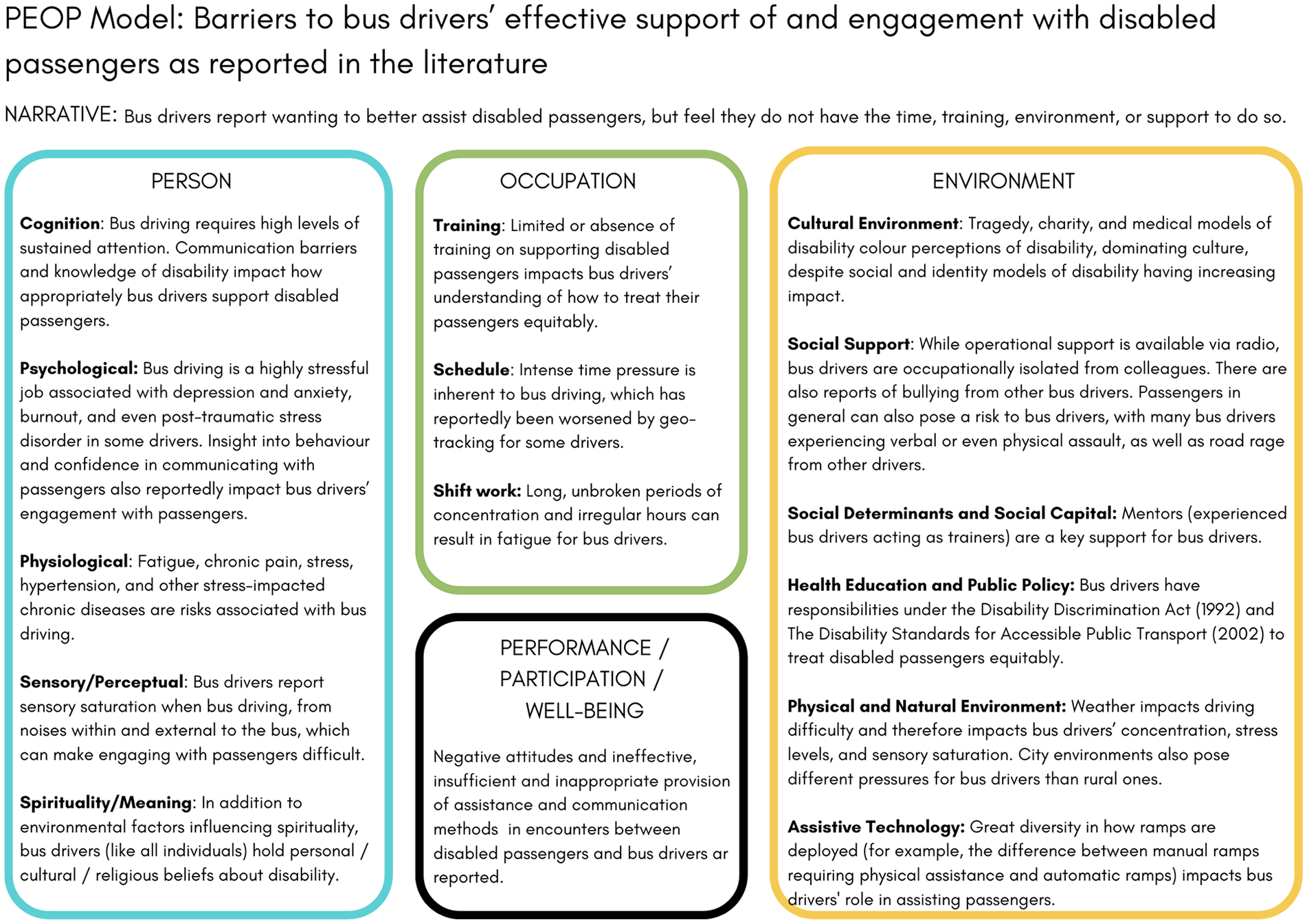
The Person-Environment-Occupation-Performance Model: Barriers to Bus Drivers’ Effective Support of and Engagement With Disabled Passengers as Reported in the Literature.
Method
The two applied data sets reported upon in this article are from research projects that were previously approved by the Federation University Human Research Ethics Committee (A21-064, and B21-069). A Framework Analysis (Gale et al., 2013) of the Listening to Lived Experience Study data was undertaken, reviewing focus group, interview, and qualitative survey data against the PEOP Model categories. Ritchie and Spencers’ (2002) approach to Framework Analysis was recently applied in transport accessibility literature by Chapman, Ehrlich, Bowley, and Kendall (2023), and a similar methodological approach was adopted in the current article. Chapman et al. (2023) define Framework Analysis as a “five-step process that focuses on contextual, in-depth systematic analysis: familiarisation; thematic framework; indexing; charting; and mapping and interpretation.” Post familiarization, the transcripts from the Listening to Lived Experience Study focus groups and interviews, as well as the qualitative data from the survey, were reviewed by the authors, and the PEOP Model categories used to index the data, charted in a table, and the findings mapped onto the PEOP Model (Figure 2). This model was then reviewed against the Listening to Bus Drivers PEOP Model (Figure 1). Through reviewing both data sets, dynamic interpersonal factors were identified, which were themes described by both bus drivers and passengers (such as each person’s perceptions of the other, power dynamics, and the interpersonal impact of the encounter). While these factors can be included in PEOP Models separately, an interpersonal PEOP Model was devised to enable the review of the factors (and how they interact) together. Through an iterative review process, again using Step 5 of Framework Analysis, the two applied PEOP Models were overlapped, merged, and extended to form the Interpersonal-PEOP Model (I-PEOP; Figure 3 and Table 1). The data from both PEOP Models were then re-entered into the I-PEOP Model framework (Table 2).
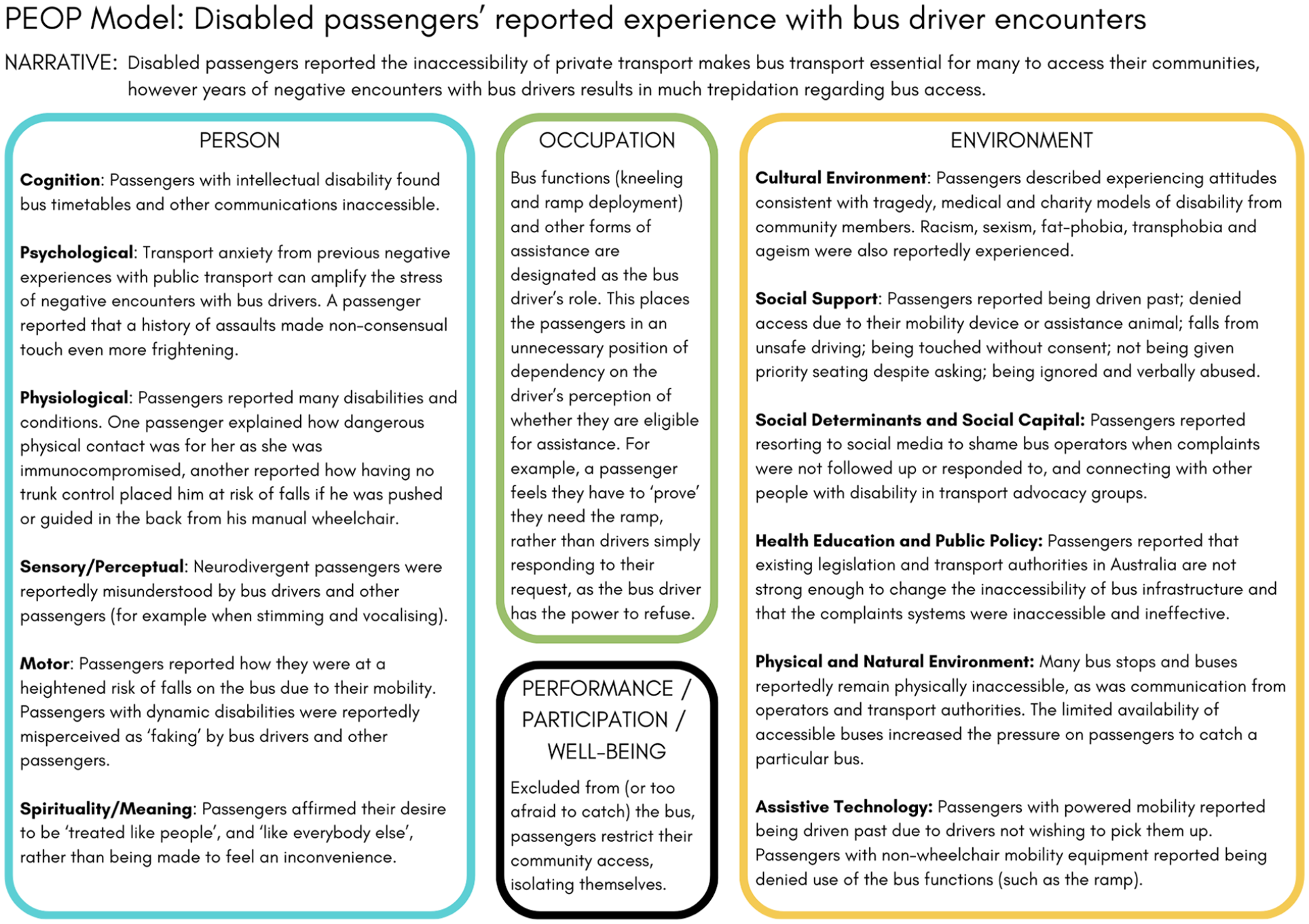
The Person-Environment-Occupation-Performance Model: Disabled Passengers’ Reported Experience With Bus Drivers’ Encounters.
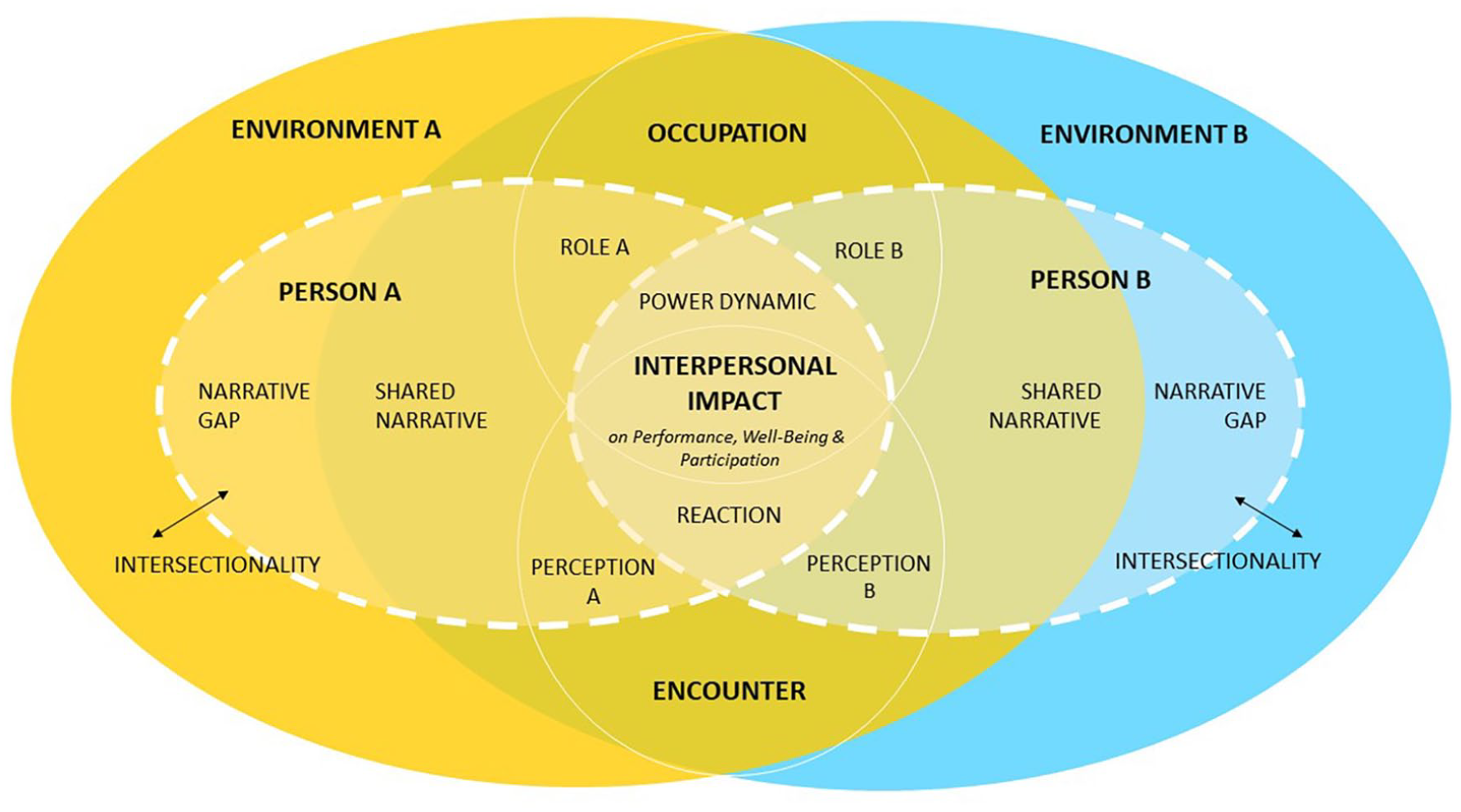
The Interpersonal-Person-Environment-Occupation-Performance Model.
I-PEOP Model Prototype Elements and Functions.
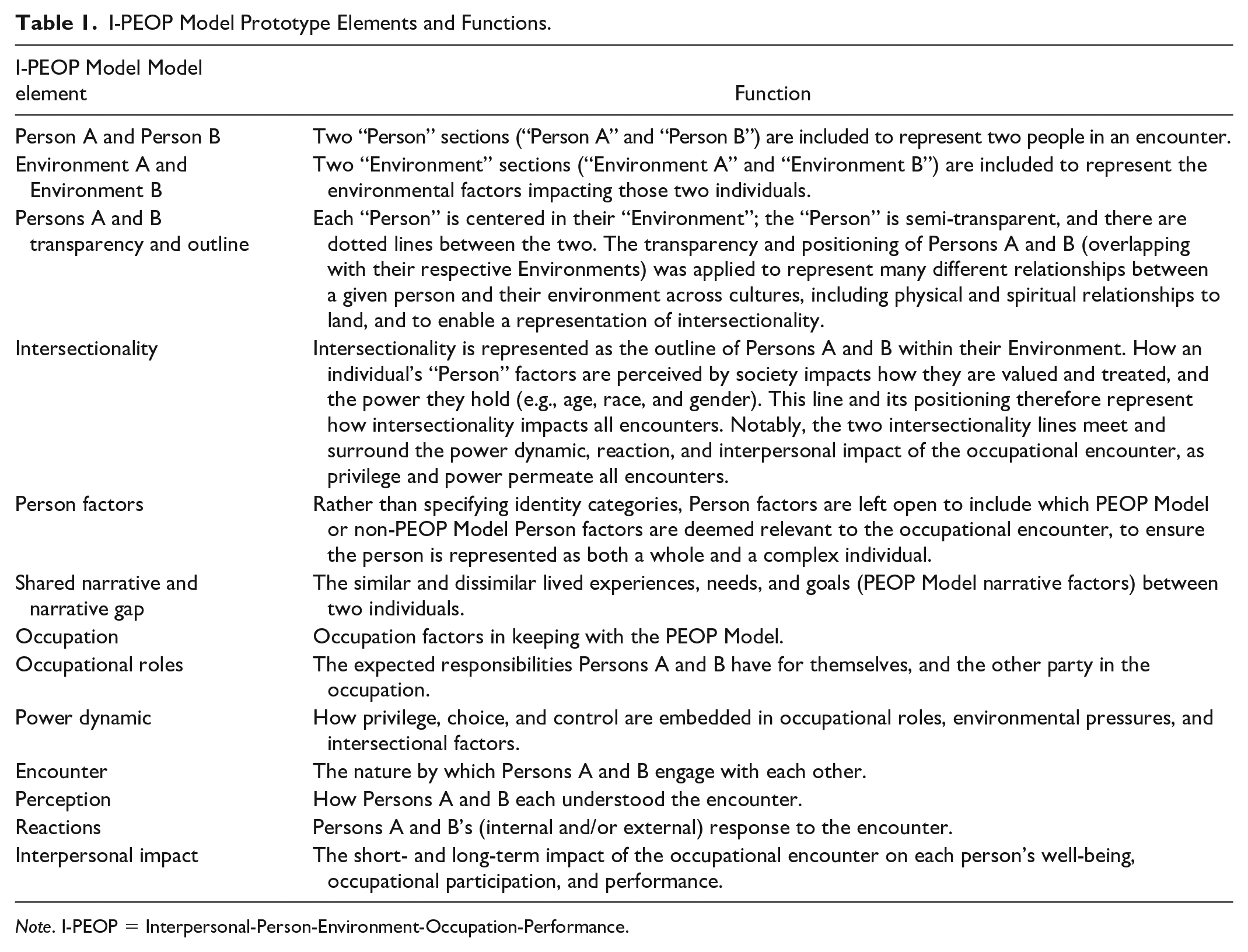
Note. I-PEOP = Interpersonal-Person-Environment-Occupation-Performance.
I-PEOP Model Prototype Application Example.
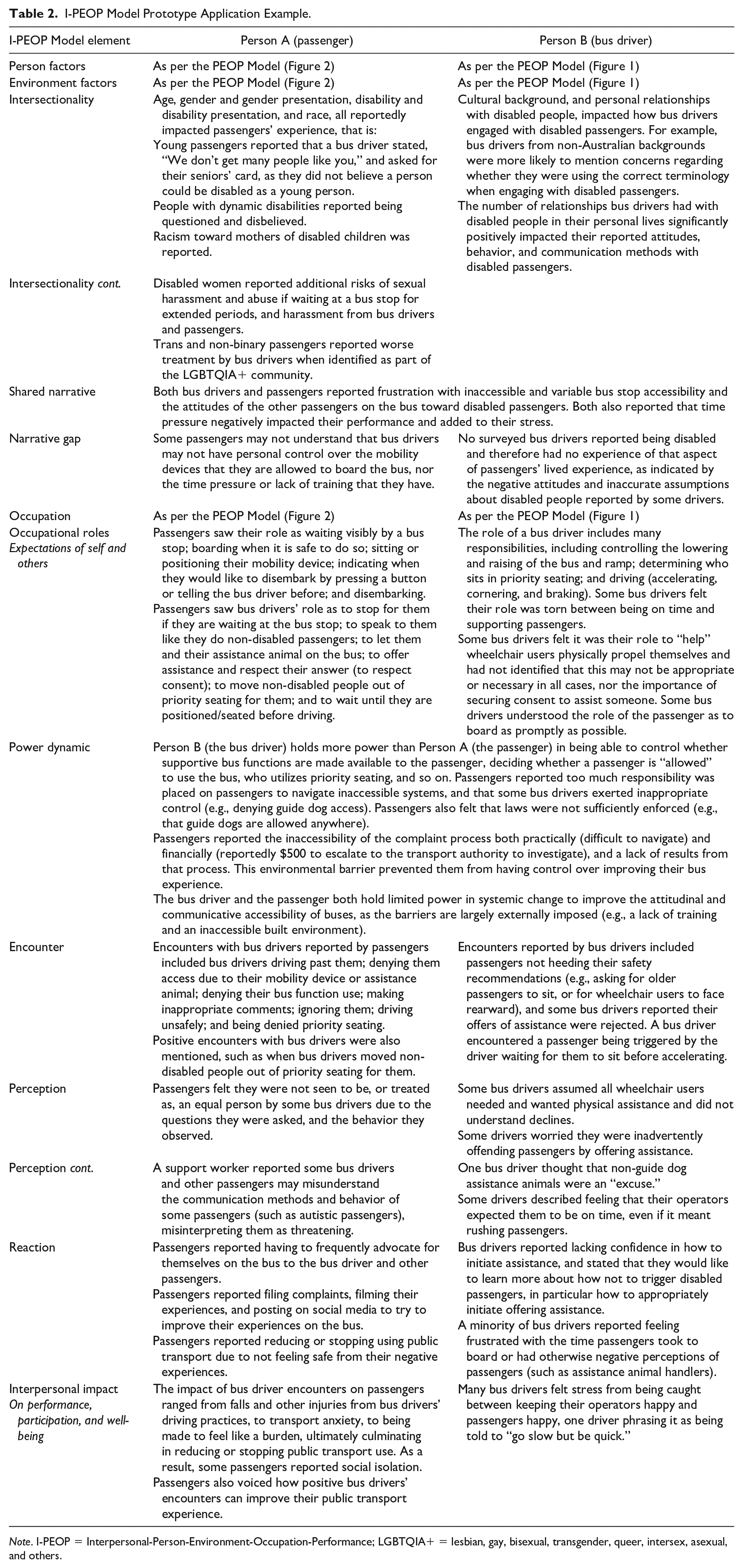
Note. I-PEOP = Interpersonal-Person-Environment-Occupation-Performance; LGBTQIA+ = lesbian, gay, bisexual, transgender, queer, intersex, asexual, and others.
Results
The developed PEOP Model from the Listening to Lived Experience Study data (Figure 2) illustrates how occupational performance (and resulting participation in catching a public bus) can be understood through examination of “person,” “environment,” “occupation,” and “performance” factors. Figure 3 then presents the merging and expansion of the two PEOP Models to form the I-PEOP Model. In Figure 3, Persons A and B (the passenger and the bus driver) interact, with shared and unique lived experiences, culminating in an interpersonal impact. Table 1 explains the elements and functions of the I-PEOP Model as presented in Figure 3. Table 2 then provides its application, providing examples of bus driver and passenger interactions and outcomes as generated through data collected from the two studies.
Discussion
This article explored the experiences of both disabled passengers and bus drivers, how those experiences intersect and interact, and their interpersonal impact, through the application of the PEOP and I-PEOP Models.
Applying the PEOP Model to Passengers
The PEOP Model application to the Listening to Lived Experience data (Figure 2) illustrates occupational, personal, and environmental factors impacting the mobilization of disabled people via bus, with emphasis given to passengers’ encounters with bus drivers. As detailed previously (Das Neves et al., 2023), disabled passengers reported being driven past, ignored, verbally abused, being moved without their consent, denied access due to their mobility device or assistance animal, and denied access to the supports they need. In applying the PEOP Model, factors additional to bus driver engagement, such as an inaccessible built environment, an ableist and disablist culture, and a person’s previous negative experiences with public transport, are identified as significantly impacting how safe and included disabled passengers feel on the bus (Park & Chowdhury, 2021). The barriers to private vehicle use also result in buses being an essential means for some passengers to access their community (Velho et al., 2016). This and the occupational factor of bus drivers being responsible for many bus functions inadvertently make bus drivers gatekeepers for community access for many disabled people. As such, passenger reports of reduced community access and social isolation due to no longer being able to catch the bus can be understood as a result of the environmental, occupational, and personal factors they experience, but, integrally, bus drivers’ encounters are ultimately the key determinants of successful bus transport for many disabled people. Understanding the full extent of why bus drivers engage with disabled passengers, in the way reported, is not possible through the PEOP Model alone. The I-PEOP Model was developed and applied to interactively review passengers’ and bus drivers’ data.
Applying the I-PEOP Model to Bus Drivers’ Encounters
The I-PEOP Model prototype was developed to explore the results of the Listening to Bus Drivers and Listening to Lived Experience studies (Figures 1 and 2) together, to identify interacting factors influencing bus drivers and disabled passengers, and the interpersonal impact of their occupational encounters. Through drawing on the two individually applied PEOP Models, some interpersonal factors were identified:
inconsistencies in how bus drivers and passengers define bus drivers’ role, resulting in unmet performance expectations;
an inherent power imbalance between the bus driver and passenger occupational roles;
potential gaps in lived experience and therefore misperceptions, particularly when intersectional factors differ (widened by environmental factors); and
the potential for mutually negative, and unequal, interpersonal impact from an occupational encounter.
While these factors can be listed in individual PEOP Models, the I-PEOP Model was developed to allow for the interacting factors to be presented together, rather than having to reference two PEOP Models, and to demonstrate their interacting nature.
The Relevance of the I-PEOP Model Functions When Exploring an Occupational Encounter
The I-PEOP Model prototype encourages the examination of intersectional factors and gaps in lived experiences, highlights occupational roles and their resultant power dynamic, and ultimately assists in identifying the interpersonal impact of an occupational encounter. Centering the “Person” within their given “Environment” in the I-PEOP Model (Figure 3) enables the meeting of Person A and Person B which is essential in reflecting an occupational encounter. The transparency and positioning of Persons A and B (overlapping with their respective Environments) were applied to represent many different relationships between a given person and their environment across cultures, including physical and spiritual relationships to land. The outline between Person and Environment representations was included to reflect a phenomenon unique to occupational encounters; when Person A and Person B meet, they perceive one another through the lens of their own experiences, and their understanding of the others’ intersectional factors. Intersectional factors (such as age, race, gender, and gender presentation) impact how a person’s identity is received by others and society at large, being sources of both oppression and privilege (Berne et al., 2018). The difference in intersectional factors between two individuals is also reflected through the representation of each person and their environment in the I-PEOP Model; both personal and environmental factors between Person A and Person B deliberately overlap to represent how some experiences are shared by two people in an encounter (e.g., both Person A and Person B may be living in the same city), resulting in shared narrative components. There is also however a narrative gap, meaning Person A may have internal and external experiences that are vastly different to Person B, and vice versa. The two persons meet in the Encounter, where they perceive and react to each other, influenced by occupational factors which include the roles they play and their embedded power dynamic. The collision and connection of two individuals in this occupational encounter then culminate in an interpersonal impact.
Occupational Roles
The bus driver role offers a clear example of contesting demands placed on an individual, with their operators and passengers sometimes expecting contradictory things. For example, passengers expected bus drivers’ role to include enabling their safety when boarding and disembarking and when driving the bus, while bus operators expected timeliness. Therefore, bus drivers reported feeling torn by seemingly conflicting requirements between this passenger need (the time and assistance to board safely) and what their operator expected (timeliness), one driver calling it being asked to “go slow but be quick” (Das Neves et al., in press). A similar disparity existed between how bus drivers and passengers felt assistance should be initiated. Some bus drivers felt it was their role to propel wheelchair users as an act of service, or “helping,” not identifying the need to first obtain consent (and respect the answer). This role was informed by a lack of training on disability, and cultural attitudes toward disability which position non-disabled people as “saviors” (Timke, 2019). Passengers instead expected their consent to be honored. Passengers also reported bus drivers were not letting passengers board with their mobility equipment and assistance animals, nor moving non-disabled passengers from priority seating when there was a need for a disabled person to use them, which they felt was the bus drivers’ role. While drivers may have been fulfilling their role as defined by their operator, they were not fulfilling the expectations that passengers had for their role. The nature of the occupational roles of bus drivers and passengers also informed an unequal power dynamic.
Power Dynamics
The occupational roles of each member of an encounter directly influence who holds power in the encounter. Bus drivers control all bus factors, including where the bus stops, what bus equipment and functions are made available to passengers, whether the bus starts before a person is seated or positioned, and how the bus is driven. The result was that passengers were dependent on bus drivers believing them or perceiving them as disabled or “worthy” of the use of bus functions, which had to be filtered through their (sometimes erroneous) beliefs about disability. The lack of accessible, transparent, and accountable complaint systems for passengers furthered their lack of power in encounters with bus drivers.
Intersectionality and Gaps in the Lived Experience Narrative
Intersectional factors were reported by passengers as impacting how they were received and responded to by bus drivers, such as the passengers’ age, race, weight, or gender. For example, young women with dynamic disabilities were disbelieved; one passenger spoke of being called a faker by the driver and other passengers due to changing mobility aids, and another was asked for her senior’s card and reported the bus driver could not believe a young person could have a disability, saying “we don’t get many people like you.” In this example, it is not that the bus drivers questioned all disabled people, but rather held misconceptions about age, gender, and disability, such as that disability is only experienced by older people. Bus drivers’ own lived experience impacted this understanding of passengers. For example, bus drivers who had multiple relationships with disabled people in their personal lives, or had recent training, were more likely to have more positive attitudes, behavior, and communication methods with disabled passengers than their peers who did not (Das Neves et al., in press). While environmental and personal factors are typically seen as discreet and fixed, intersectional factors are deeply fluid, as they are not simply about who a person is (e.g., a young disabled woman), but how they are perceived due to those factors, and how they are seen through the lens of their encounter partners’ own experiences. These perceptions inform how each person is received and responded to.
Encounters, Perception, and Reaction
As identified in the PEOP Models, when examining encounters between bus drivers and disabled passengers, some bus drivers reportedly engaged in attitudes, behaviors, and communication methods that resulted in passengers feeling like they were not seen as people, and as equals, for example, some bus drivers report manually assisting a passenger despite the passenger declining assistance. Bus drivers perceived passengers’ refusal of assistance as rude, while passengers perceived bus drivers’ actions as assault. Passengers had a significant reaction to bus drivers’ performances, including lodging complaints to operators and transport authorities, trying to escalate complaints on social media, and joining advocacy groups. Bus drivers reported an interest in improving their understanding of disability, particularly how to offer assistance appropriately.
Interpersonal Impact
The interpersonal impact of bus driver and passenger encounters illustrates the relevance of understanding encounters as occupational. Passengers reported reducing or ceasing public transport use due to negative experiences, which, due to the barriers to private transport use for some disabled people (Lubitow et al., 2017) can result in social isolation (Øksenholt & Aarhaug, 2018; Park & Chowdhury, 2021). Bus drivers reported feeling stuck between supporting passengers and reaching timeliness targets from their operators. While the largely negative interpersonal impact of encounters was discussed, some passengers also mentioned how pivotally uplifting a positive experience could be, particularly given many encounters are taking place in an already stressful and inaccessible public transport environment. Therefore, encounters hold potential as barriers or enablers to a person’s occupational performance, participation, and well-being.
I-PEOP Model Informed Practice
Through the application of the PEOP and I-PEOP Models, key barriers to disabled passengers feeling and being safe and included on the bus can be targeted. The PEOP Model identifies clear environmental and occupational barriers such as improving the accessibility of buses and bus stops, reducing time pressure, and increasing bus drivers’ understanding of disability through educational training (the details of the proposed training program published in a previous study; Das Neves et al., in press). The I-PEOP Model, through drawing from two PEOP Models, allows for the examination of the interacting factors. For example, the content of the bus driver training can be determined by reviewing gaps in lived experience between passengers and bus drivers, examining the different expectations of passengers and bus drivers about a bus driver’s role, and targeting attitudes and beliefs about disability that intersect with beliefs about other factors impacting passengers (such as race or gender). The PEOP Model provides depth in examining a given person or community, and the I-PEOP Model in comparing them.
Limitations
The I-PEOP Model was a prototype created purely for an exploration of a specific occupational encounter (bus drivers and disabled passengers), drawing from Better Trip data and literature related to this specific encounter. As a result, the I-PEOP Model, including the new intersections it generated, reflects only this kind of occupational encounter. To be able to infer relevancy for other occupational encounters, extensive exploratory literature reviews and data collection in other occupational encounters are required.
Implications for Future Studies
The I-PEOP Model prototype prompts occupational therapists to examine encounters occupationally. Table 1 provides definitions for all elements of the I-PEOP Model; this, and the example of its application (Table 2) offer occupational therapists a guide for its use in their practice with clients, for example in examining encounters between a person and someone in their community. Additional work to review the relevance of the I-PEOP Model in wider settings is required to determine if it is suitable for also examining relationships, not just encounters, as this application may assist occupational therapists in examining their relationships with clients. Traditionally, relationships between occupational therapists and clients have been defined in unilateral terms, for example in the “client-centered” approach, where an occupational therapist is led by their client’s needs and experiences (Restall & Egan, 2021). Restall and Egan (2021) proposed that “inadequate consideration of the relational context of occupation” (including oppressive structures and practices within occupational therapy, reflecting wider societal forces) fails to acknowledge how the occupational therapist impacts that relationship. These two concepts of mutual interpersonal impact, and the need to identify societal forces and their impact on the occupational therapist and their client, are mirrored in this article’s reflections on occupational encounters. Therefore, while the I-PEOP Model was designed to explore an occupational encounter, it prompts questions on power imbalances, intersectionality, and interpersonal impact inherent in all occupational relationships which may add value to exploring such relationships. This application extends beyond this article, however, and requires further research on this specific dynamic.
Conclusion
Occupational encounters offer glimpses into how two individuals’ personhood, intersectionality, power dynamics, occupational roles, and environmental factors weave together to influence how they perceive and respond to each other. As demonstrated through the encounters between bus drivers and disabled passengers, such encounters can have an occupationally relevant impact on a person’s occupational participation, performance, and, perhaps most significantly, their quality of life, by determining how safe and included they feel, and are, in their communities. Through applying the PEOP and I-PEOP Models, occupational therapists can capture the deeply interpersonal and interconnected nature of occupational expression. Environmental and personal factors are not binary, static, distilled forces. Rather they are dynamic forces that live within, beyond, and between the individuals experiencing them.
Supplemental Material
sj-docx-1-otj-10.1177_15394492241237744 – Supplemental material for Occupational Encounters: The Interpersonal Impact of Bus Drivers’ Engagement With Disabled Passengers
Supplemental material, sj-docx-1-otj-10.1177_15394492241237744 for Occupational Encounters: The Interpersonal Impact of Bus Drivers’ Engagement With Disabled Passengers by Bonnie Das Neves and Carolyn Unsworth in OTJR: Occupational Therapy Journal of Research
Footnotes
Acknowledgements
The researchers acknowledge that Aboriginal and Torres Strait Islander People across the continent and the surrounding islands are the Custodians and Traditional Owners of their Country Land, Waters, and Sky), now known collectively as Australia. See additional information for a full Acknowledgment of Country ( ).
).
Author’s Note
The primary author is neurodivergent and uses identity-first language but acknowledges the individual preferences of all disabled people.
Declaration of Conflicting Interests
The author(s) declared no potential conflicts of interest with respect to the research, authorship, and/or publication of this article.
Ethical Approval
This article includes data from two studies approved by Federation University Australia’s Human Research Ethics Committee:
The Listening to Lived Experience Study (A21-064)
The Listening to Bus Drivers Study (B21-069)
Funding
The author(s) disclosed receipt of the following financial support for the research, authorship, and/or publication of this article: This work was supported by the Department of Transport and Planning Victoria (grant no. G2199).
Supplemental Material
Supplemental material for this article is available online.
References
Supplementary Material
Please find the following supplemental material available below.
For Open Access articles published under a Creative Commons License, all supplemental material carries the same license as the article it is associated with.
For non-Open Access articles published, all supplemental material carries a non-exclusive license, and permission requests for re-use of supplemental material or any part of supplemental material shall be sent directly to the copyright owner as specified in the copyright notice associated with the article.
