




Abstract
Public transport is a viable option that can help persons with visual disability to overcome mobility challenges. The main aim of the review is to identify existing provisions, barriers, and/or access to public transport services for persons with visual disability. A scoping review was conducted based on the framework proposed by Arskey and O’Malley. A total of 16 studies were systematically selected out of 273 published literatures which was obtained from electronic database searches. Four themes emerged from the selected studies. The major theme was challenges related to accessing public transport from the perspective of persons with visual disability (PVD) with presentation of information, drivers/workers attitude, bus design, technological barriers, and accessibility of public spaces being the subthemes. The other three themes were the challenges reported by the transport drivers, available facilities/adaptations and resolutions, and policies and recommendations. In conclusion, the current review suggests that access to public transportation for persons with visual disability is considerably inadequate. Poor presentation of information, inappropriate driver attitude, and inconsistent bus design seem to be the major barriers persons with visual disability encounter during public transport travel.
Introduction
Globally, it is reported that about 15% of the world’s population live with some form of disability, of whom 2%–4% experience significant difficulties in functioning (World Health Organization, 2011). Mobility presents one of the challenges for persons with disability (PWD) because existing transport facilities seem to pay less attention to the travel needs and accessibility issues of PWD (Tudzi et al., 2017).
Persons with disability have been reported to have a high dependence on public transportation as a means of mobility compared to the general population (Penfold et al., 2008). Also, people with disabilities are more likely to have problems with inadequate transportation (Taylor et al., 2010). The absence of appropriate transport services affects the ability of persons living with disability to fully experience their community and various aspects of life (Bezyak et al., 2017; Christensen, 2014; Kerins, 2002). As a result, they become increasingly isolated and often marginalized in the community’s social, economic, and political environment (Chenoweth & Stehlik, 2004; Silverstein, 2000), with some persons home-based due to transportation difficulties (Bureau of Transportation and Statistics, 2003).
Visual impairment or disability is one of the most common forms of disability in the world (World Health Organization, 2011). Globally, it is estimated that about 2.2 billion people have a near or distant visual impairment. A person is said to be visually impaired or has a visual disability if the presenting visual acuity (VA) in the better eye is worse than 3/60 or has a presenting near VA worse than N6 or M.08 at 40 cm with existing correction (World Health Organization, 2021). The loss of vision, whether central or peripheral, leads to a limitation of functional ability. This can have an impact on one’s capacity to undertake daily living tasks such as the ability to move around and use all forms of transport (Gallagher et al., 2011). This results in loss of independence associated with social isolation among people with vision impairment (Baker & Winyard, 1998; Long et al., 1996).
Public transport plays an important role in the lives of persons with visual disability as it may be the sole viable mobility option to seek education, work, medical care, food, and many other venues in their community (Sáez et al., 2019). Mobility is also essential because it allows one to participate in many aspects of life such as employment, education, health care, shopping, social occasions, and multiple recreational activities. Despite the importance of mobility and/or transportation, the majority of persons with disabilities do not have access to adequate transportation (Bezyak et al., 2020).
The availability of accessible public transport for persons with visual disability (PVD) is of great relevance. People with vision disability would struggle to be fully involved in society without access to public transportation even after they have undergone orientation and mobility (O&M) training (Casey et al., 2013). Therefore, the adequate provision of an integrated accessible public transport service is one of the significant services that impact the quality of life for people with visual disability (Gallagher et al., 2011; Kerins, 2002).
The main aim of the review is to identify existing provisions, barriers, and/or access to public transport services for persons with visual disability. It also sought to identify and document suggestions in the literature that could improve public transport services for persons with visual impairment. The research questions included, how accessible is public transport to PVD, what are the barriers PVD face when using public transport, and are there any suggested/documented solutions to these problems?
Research process
This scoping review adopted a methodology based on the framework proposed by Arskey and O’Malley (2007) with the recommendations suggested by Levac and colleageus (2010) taken into consideration. The five-key framework of a scoping review proposed by this methodology includes (1) identifying the research question, (2) identifying the relevant studies, (3) study selection, (4) charting of the data, and (5) collating, summarizing, and reporting the results.
Identifying the research question
This review was to investigate the access to public transportation for persons with visual impairment. The main purpose of this research was to document available barriers, facilitators, and experiences of persons with visual disability who use public transport and public workers who provide these services. This research also sought to identify suggestions or solutions that may be available in the literature concerning how transport services for persons with visual disability could be improved. The main questions this review sought to answer were as follows: How accessible is public transport to PVD? What are the barriers PVD face when using public transport? and Are there any suggested/documented solutions to these problems?
Identifying the relevant studies
Eligibility criteria
Studies were considered for review if they reported either barriers, experiences, or enablers related to services for persons with visual disability who use public transport. Studies that described or reported the experiences of disabled persons (including PVD), who use public transport but did not specify the percentage or number of persons with visual disability who participated in that study were not included. Also, a study detailing experiences of persons with disability (PWD) on public transport was excluded if those experiences were not peculiar to persons with visual disability. Review articles were also excluded from the current review.
Data sources and search strategy
The search was implemented in three electronic databases: PubMed, Web of Science, and Embase. These scientific-based research databases were selected because they were comprehensive and covered a wide range of scientific disciplines.
Five key terms were identified based on the aim and title of this review, these were added to form an initial search phrase “access public transport visual impairment.” Synonyms to these keywords were identified as well to form eight additional phrases that were used to search the electronic databases. The final search phrases developed were nine and these included: “access public transport visual disability,” “access public transport blind,” “access vehicle visual impairment,” “access vehicle visual disability,” “provision public transport visual impairment,” “barrier public transport visual impairment,” “barrier public transport visual disability,” and “barrier public transport blind,” because it was considered by the researchers that these terms were directly related to the objectives of the review. All nine search phrases were used independently on the electronic databases. Then, Boolean operators were used to narrow and combine literature searches to produce a more comprehensive search result. The Boolean operator “OR” was used to combine all nine search phrases and the search was repeated in electronic databases to produce a combined result. No limits on dates, subjects, or types were placed on the database search.
Study selection
Title or abstract screening
The title and abstracts of the articles obtained from these electronic databases were screened and the ones unrelated to the objectives of the review and did not meet the minimum criteria were excluded. The articles that were identified to be relevant to the review were extracted together into a new excel sheet file and the full text of the articles was obtained. Duplicates that resulted from the fact that multiple databases were used, were identified, and removed from the list of studies to be reviewed. Four reviewers from the research group, studied and reviewed the full text and selected the final list of studies included. This was done independently and each was added when three or more members listed it. The searches were supplemented by hand-searching the bibliographies of included studies from the databases. One of the reviewers screened the citation information to remove duplicates. The title and abstracts of these studies were screened and irrelevant manuscripts were removed. The process for the selection of the final studies was the same as that done for articles obtained from the electronic databases. A detailed illustration of how studies were included in the current review is shown in Figure 1.
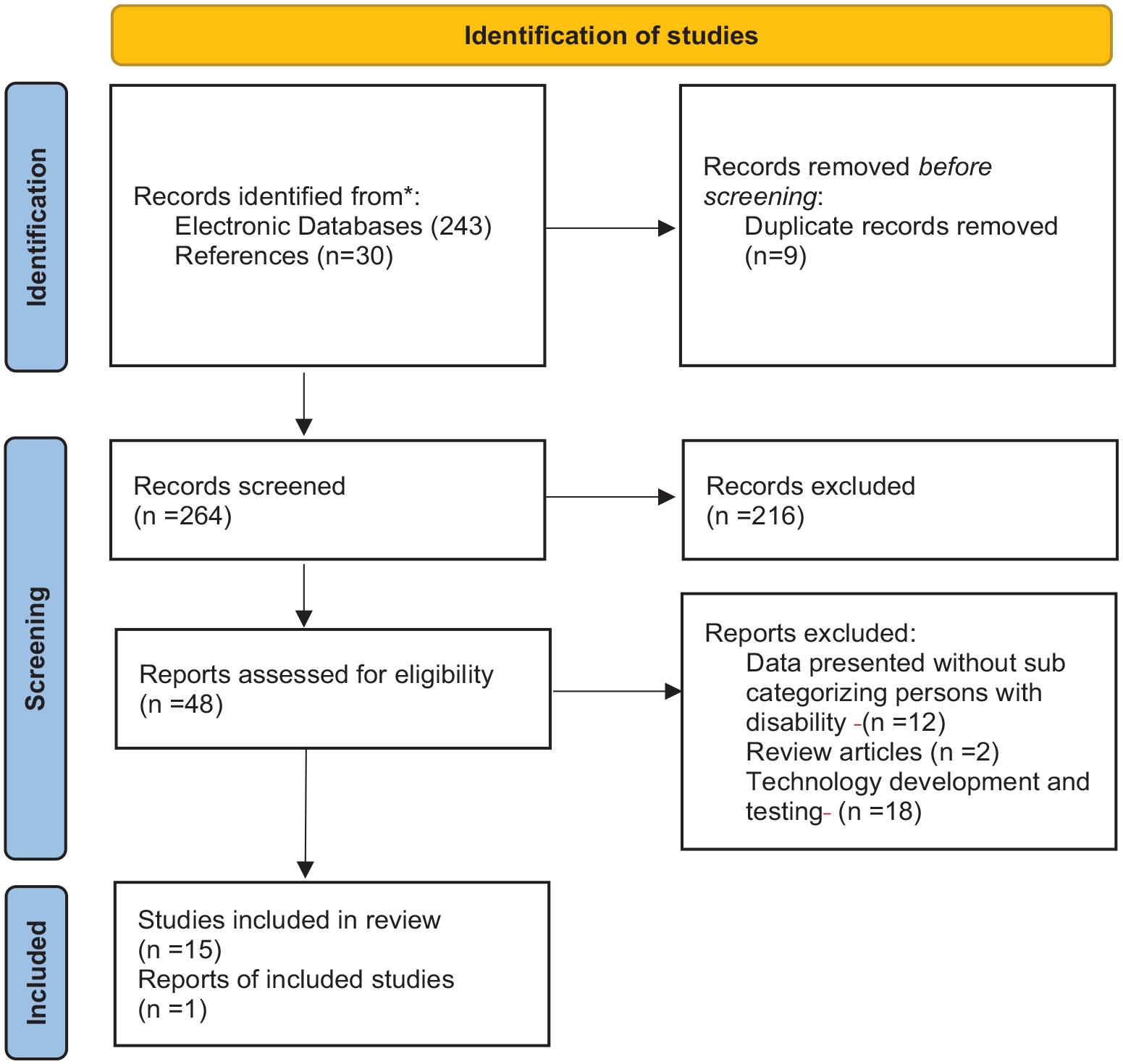
PrismaSR flowchart.
Charting of data
Data characterization
The articles that were deemed as being related to the objectives of the review were extracted into an excel sheet and the full articles were obtained and subsequently reviewed. The excel sheet contained the article title, authors, year of publication, participants, age range, and/or mean age when available and type of study design. Other data extracted from these selected papers were the challenges faced by persons with visual disability, facilitators/enablers, suggested solutions, and challenges from the perspectives of drivers/workers.
Collating and summarizing and reporting the results
Data summary and synthesis
The data extracted were under four broad headings; access to public transport perspective of PVD, access to public transport perspective of drivers, facilitators/enablers, and suggested solutions. The challenges from the perspective of persons with visual disability were categorized under five main themes. These included the presentation of information, drivers/workers’ attitudes, bus design, technological barriers, and access to public spaces. The suggested solutions in the pieces of literature obtained were also categorized into six main themes, that is, training/education, policy-related, accessible information, standardization of design, technological advances, and benefits/support.
Results
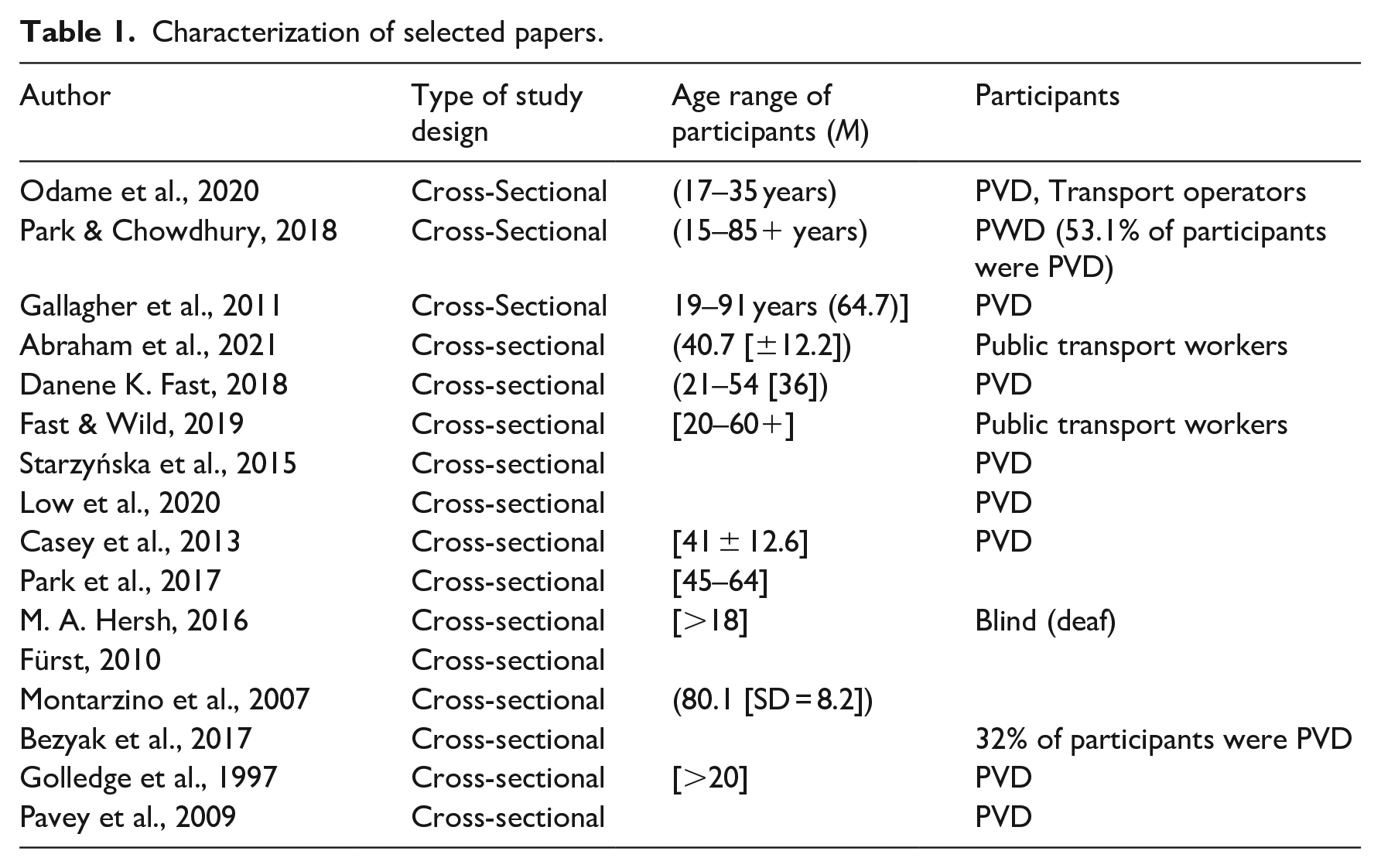
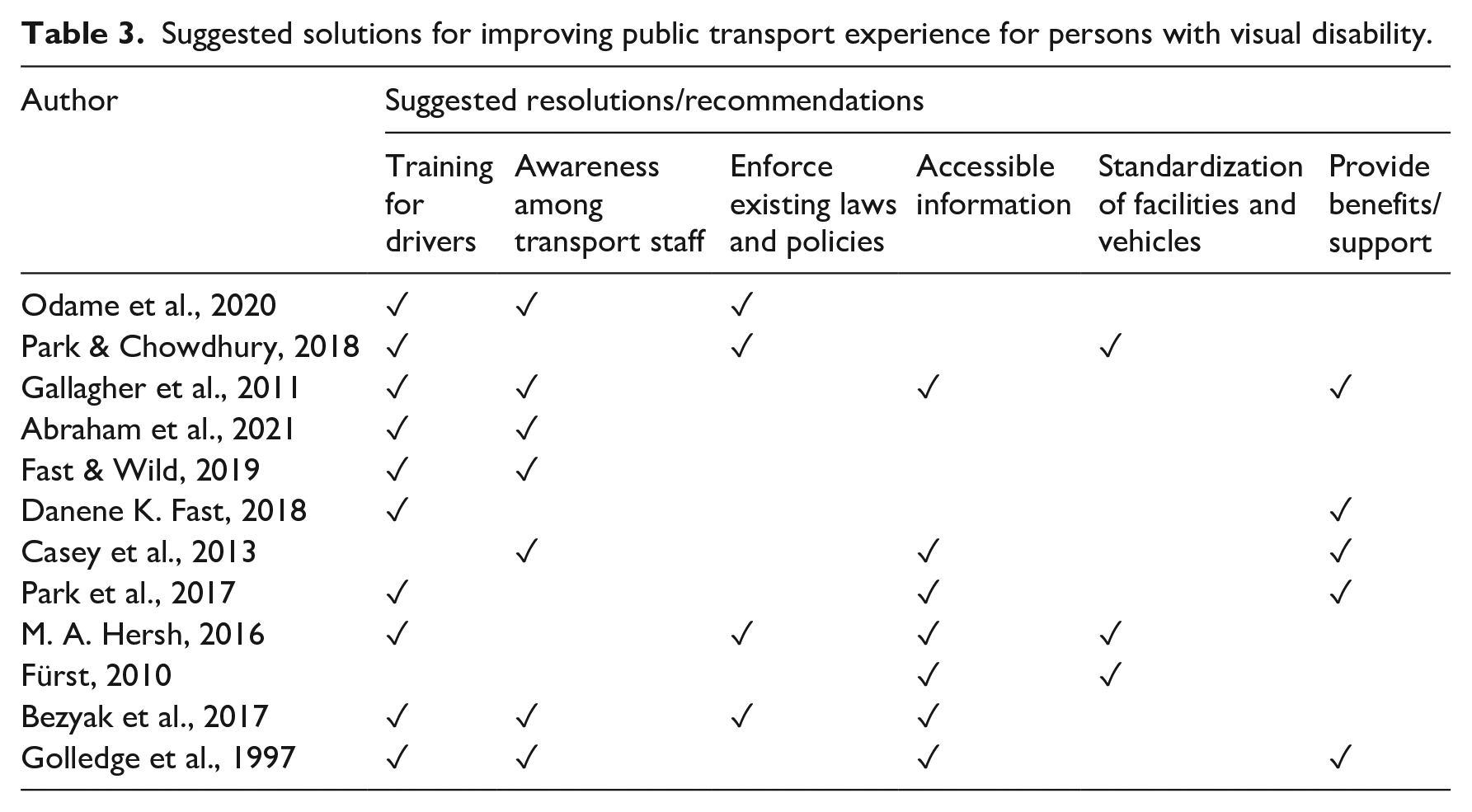
The number of publications included in this scoping review was 16 (Table 1). The publication dates for the selected records range from 1995 to 2021. Most of the studies included in this review were conducted in Western countries, with only two studies from Africa. The results were presented under four main headings: access to public transport: the perspective of persons with visual disability, access to public transport: the perspective of drivers, facilitators/enablers, and suggested solutions. The characteristics of selected papers are shown in Table 1, challenges from the perspective of persons with visual disability and drivers are shown in Table 2 and the suggested resolutions, recommendations, and/or policies are presented in Table 3.
Characterization of selected papers.
Challenges faced by PWD and transport operators.
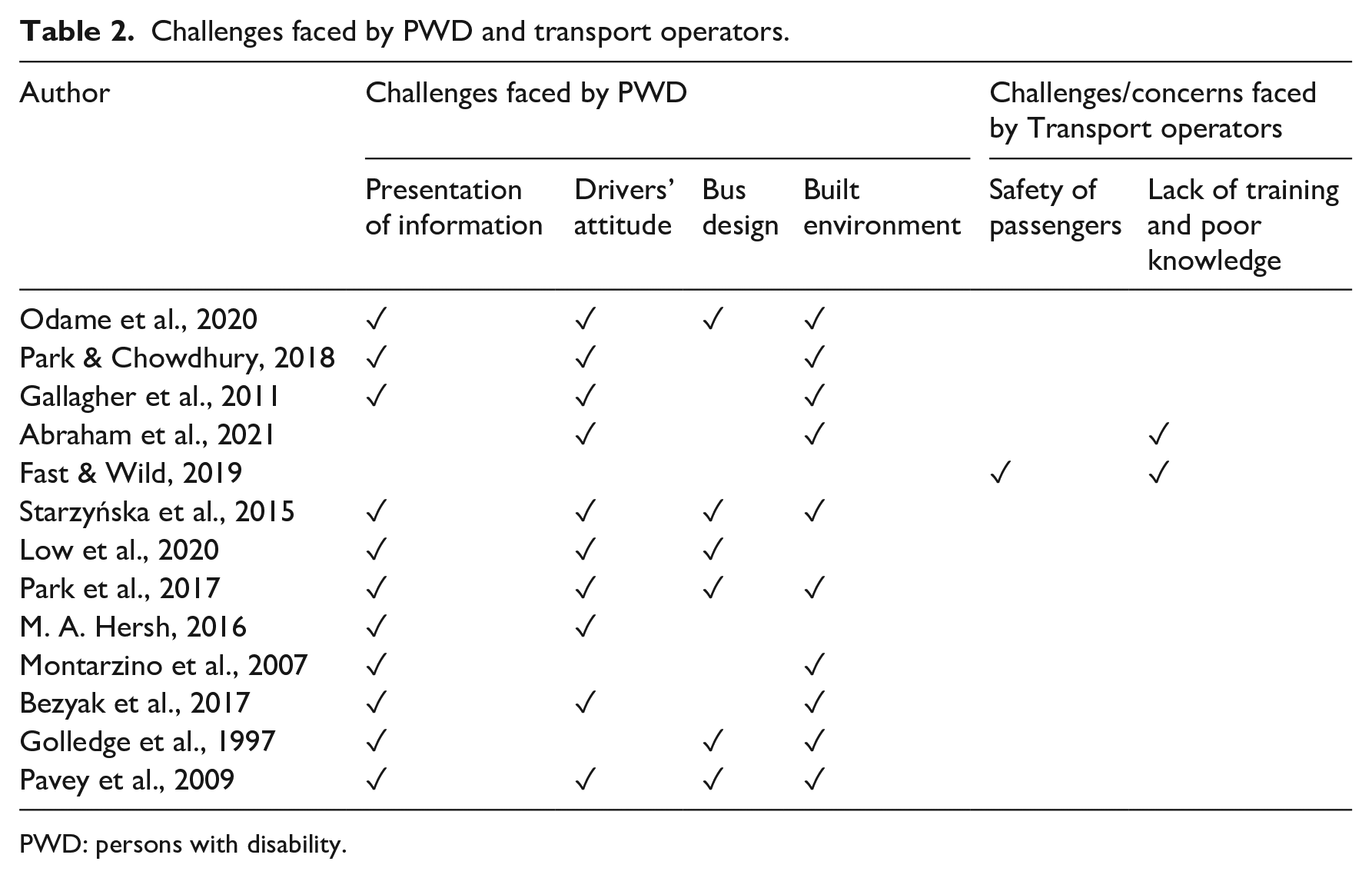
PWD: persons with disability.
Suggested solutions for improving public transport experience for persons with visual disability.
Challenges related to accessing public transport from the perspective of PVD
Presentation of information
Access to information was observed to be the most commonly reported barrier for persons with visual disability who use public transport (Table 2). The participants reported a lack of information concerning the number of approaching buses and difficulty identifying the correct bus to choose from when several or multiple buses arrived at one time (Golledge et al., 1997; Hersh, 2016; Park et al., 2017).
Several studies also documented the low access to information or lack of real-time information (Golledge et al., 1997; Low et al., 2020; Park & Chowdhury, 2018; Park et al., 2017) as a major barrier to the use of public transport. Also, visually impaired persons had concerns about not being informed or updated as the bus approached their designated stops (Casey et al., 2013; Golledge et al., 1997). This usually leads to them getting dropped off at the wrong stops (Casey et al., 2013), and also, information about vehicle failures and potential transfers at a given stop including waiting time before the next bus/tram was not communicated (Starzyńska et al., 2015). Problems with on-route activity, such as communicating with the driver about where to stop, signaling an approaching driver to stop, and getting to and from the nearest bus stop, were also documented (Golledge et al., 1997).
There have also been reported difficulty with reading bus numbers, the content of bus route, destination station, and other service information displayed on the front of the bus or overhead screens because there is poor presentation and visibility of information either due to poor/low contrast and small prints (Golledge et al., 1997; Montarzino et al., 2007; Park & Chowdhury, 2018; Park et al., 2017).
Several studies reported the lack of audio or voice announcements concerning travel information such as “current stop,” “next stop,” bus numbers, and bus destinations, as a barrier to the access to information by persons with visual disability during public transportation. In cases when this audio information is present, they are either delayed, unclear, of low audio volume, or within noisy environments that impede hearing of these announcements (Hersh, 2016; Low et al., 2020; Park & Chowdhury, 2018; Park et al., 2017; Starzyńska et al., 2015).
Drivers/workers’ attitude
Attitudes of drivers, public transport workers, and occasionally the general public were noted as the second most reported deterrent for accessing public transportation for persons with visual disability. Several studies documented that drivers and workers exhibited hostile, rude, poor, and inappropriate attitudes when relating to persons with visual disability (Bezyak et al., 2017; Gallagher et al., 2011; Low et al., 2020; Odame et al., 2020; Park et al., 2017; Pavey et al., 2009). Drivers and operators are usually unaware or lack the knowledge about the needs of visually impaired persons, (Bezyak et al., 2017; Park et al., 2017; Pavey et al., 2009) as drivers do not react to persons with a white cane, (Park et al., 2017; Starzyńska et al., 2015) with some unwilling to offer assistance (Low et al., 2020).
Most persons with visual disability who use public transport feel “forgotten” on buses or trains as drivers forget to announce bus stops or when a bus is approaching their designated stops (Bezyak et al., 2017; Casey et al., 2013; Golledge et al., 1997). Some drivers also, forget to stop the bus at the desired destination, thus dropping them at the wrong stops (Park et al., 2017) or not stopping despite persons with visual disability waiting at stops (Bezyak et al., 2017; Park et al., 2017).
Despite a recommendation by Ghana’s disability act, Abraham and colleagues (2021) reported that drivers were still unwilling to reserve (front) seats of their vehicles which are the most accessible for persons with visual disability as indicated in the disability act. Other issues had to do with drivers not pulling in far enough to the curb or not warning a person that they are stepping off the bus directly in front of an obstacle (Casey et al., 2013), difficulty locating their change as drivers hand it over anyhow (Hersh, 2016) and inappropriate driver language (Park et al., 2017).
Bus design
The internal and external bus design has been one of the reported difficulties persons with visual disability encountered when using public transport. Public transport vehicles come in different designs and sometimes lack the basic adjustment and accessories that enable access by persons with visual disability. Studies have reported that the lack of uniformity and consistency in the internal bus layout and design has been a concern to persons with visual disability who use public transport (Gallagher et al., 2011; Low et al., 2020). The absence or no usage of low floor facilities coupled with the steps on some bus seats being too close makes it difficult for visually impaired persons to negotiate steps on buses (Gallagher et al., 2011; Park & Chowdhury, 2018).
Reports have also been made about the lack of standardized priority space or designated areas and/or seats on public buses for people with visual disability (Odame et al., 2020; Starzyńska et al., 2015). Other issues related to bus design had to do with the doors and buttons; such as persons getting stuck in automatic doors, inaccessible door opening buttons or communicating buttons, faulty stop buttons, lack of bright color to indicate edge, and bus buzzers not in the same place/location on buses (Gallagher et al., 2011; Starzyńska et al., 2015).
Technological barriers
Odame and colleagues (2020) stated that the unavailability of assistive technology like communication tools that enable independent intercommunication between drivers and persons with visual disability was a major barrier to accessing public transport on an inclusive university campus. Another technological barrier reported by persons with visual disability who use public transport was the lack of information or auditory output on maps (Golledge et al., 1997; Park et al., 2017).
Accessibility of public spaces
Bus services and infrastructure that enables access to bus stations was noted to be poor. Barriers such as the lack or poor footpaths to bus stops have been reported (Park and Chowdhury, 2018; Park et al., 2017), with some roads/routes leading to taxi/vehicle stations not accessible (Bezyak et al., 2017) for people with visual disability due to potholes, mounds, unpaved routes, gulleys, and so on (Abraham et al., 2021). Obstructions on footpaths such as footpath closures, cones, recycling bins, cars, low-hanging branches, undulating footpaths, plants, and benches (Golledge et al., 1997; Park & Chowdhury, 2018; Park et al., 2017) and the diversity of the architecture or design of an environment makes these bus terminals and stations inaccessible.
There are also difficulties in boarding and alighting from buses and taxis because even though the low-floor buses have been introduced, buses do not seem to park in the right places, so there is a gap between the pavement and the bus (Golledge et al., 1997; Pavey et al., 2009). In Addition, one study documented that there were no designated/allocated areas for parking for persons with visual disability at bus stations (Abraham et al., 2021), while others reported difficulty with identifying and stopping the right bus to the desired destination (Casey et al., 2013; Golledge et al., 1997). Poor street lighting (Park & Chowdhury, 2018; Park et al., 2017) and lack of pedestrian crossings (Park et al., 2017) have also made it difficult for persons with visual disability to cross a street to find a transfer point (Golledge et al., 1997).
Significant amounts of frustration were experienced when signs were poorly located and illegible or when elevators were located in hard-to-find places (Golledge et al., 1997) or when there are no shelters at the bus stop (Park et al., 2017). Golledge and colleagues (1997) also recorded difficulties experienced by PVD with estimating where they were while traveling, dealing with a crowded vehicle, and difficulty finding pickup points for different modes of transportation, and difficulty learning the intervals between connecting services.
Challenges related to accessing public transport from the perspective of public transport drivers
Only two studies under the current review included drivers as participants (Abraham et al., 2021; Fast & Wild, 2019) as shown in Table 2. Fast and Wild (2019) reported that drivers had concerns about the failure of persons with visual disability to recognize the correct stops, locate a seat, and directionality to ensure their safety, as passengers are at risk of tripping or falling (Fast & Wild, 2019). The second study noted that drivers did not know how to relate to visually impaired pedestrians during public transport, they also did not have knowledge about the seating options for passengers with visual disability. They also expressed a lack of the prerequisite skills and training on the provision of services for passengers with visual disability (Abraham et al., 2021)
Available facilitators/adaptations
Various and diverse options had been adopted or were available that sort to aid or assist persons with visual disability who use public transport. The use of mobility aid such as white cane was commonly reported (Abraham et al., 2021; Casey et al., 2013; Golledge et al., 1997; Odame et al., 2020), as helping PVD navigate and warn them of ground-level obstacles and irregularities (Golledge et al., 1997). The white cane also served as an easy identification marker for drivers/public workers to recognize persons with visual disability and offer assistance (Abraham et al., 2021; Odame et al., 2020). The use of a white cane was employed by some persons with visual disability to estimate the height between the floor and the first step of the shuttles when boarding these vehicles for transport (Odame et al., 2020).
The policy to offer free transport service usage for persons with visual disability was also available as reported by some studies (Low et al., 2020; Odame et al., 2020; Pavey et al., 2009), while one study reported that provision was made to accommodate persons with visual disability on public buses when they are informed 24 hr before usage (Gallagher et al., 2011). Some behavioral adaptation employed by PVD includes the timing of the buses, stopping all buses and asking the driver, or asking other people waiting at the stop for the bus number (Casey et al., 2013).
Use of aids like spot ring telescopes (primarily to pick out route numbers on buses or to read street signs), typed brailed, or handwritten signs on cards that described routes and the buses or bus stops were also reported by (Golledge et al., 1997). Vehicles that had accessible features, such as the outside color of buses, color contrasting grab rails, kneeling buses, Braille on bell-pushes, and reduction of steps on and off vehicles (Casey et al., 2013) were all reported to be useful. Other vehicles had low-floor bus services, lower steps at the door, chevron-marked steps, nonslip floors, and brightly colored handrails (Montarzino et al., 2007). Other enables like audible announcements, the presence of train managers on newer carriages, (Casey et al., 2013), and drivers stopping or slowing down to allow persons with visual disability to cross the road (Abraham et al., 2021) were all documented as aiding the use of public transport.
The way forward (resolutions, policies, recommendation)
Training/education
The most documented solution to improving access to public transport for persons with visual disability was the provision of training programs for public transport drivers, workers, and to some extent the general public as shown in Table 3 (Abraham et al., 2021; Casey et al., 2013; Fast, 2018; Fast & Wild, 2019; Gallagher et al., 2011; Golledge et al., 1997; Hersh, 2016; Odame et al., 2020; Park & Chowdhury, 2018; Park et al., 2017). A training program of this nature is recommended to be should be obligatory, standardized (Gallagher et al., 2011) and administered through relevant state agencies with the possibility of influencing the selection of public transport drivers (Odame et al., 2020). The contents of the training must include guidelines based on feedback from travelers who are visually impaired regarding their own needs, and use such data to establish training sessions for public transport workers (Fast, 2018; Fast & Wild, 2019).
Policy-related
Most studies recommended that there should be strategic ways to ensure that existing national and local policies aimed at providing the necessary support for disabled persons with visual disability are regulated and enforced (Bezyak et al., 2017; Golledge et al., 1997; Odame et al., 2020; Park & Chowdhury, 2018). The creation of outreach programs where discussions for resolutions can be done in an open public forum and incorporating strategies such as contact, education, and social influence may target negative attitudes toward individuals with disabilities. Results could be used for policy development (Bezyak et al., 2017).
Accessing information
With improving access to information during travel by persons with visual disability, it has been reported that audio and current announcements on incoming and departing vehicles, trouble reports, and bad weather conditions should be done (Fürst, 2010). As reported in this study, this information should be of clear and articulate pronunciation and terms that are used only locally should be avoided. Designing and recording taped announcements, that could be played at the bus station and during travel would be a great way to make this information accessible to persons with visual disability (Fürst, 2010).
In another study, authors reported that there should be the introduction of Braille or large-print information on identification numbers on the buses, schedules, waiting times, en route locations, and bus locations (Golledge et al., 1997) This information could be visual or auditory and should be available at arrival times at bus stops/terminals or on the buses themselves. Another suggestion (Golledge et al., 1997) was for auditory information to include access to human operators on telephones and regular and clear announcements by drivers of the nearest cross streets at bus stops. Other studies documented that there should be real-time audio announcements and a good representation of information (Hersh, 2016; Park et al., 2017).
Technological advances in improving access to information; a new technology that could be developed and designed specifically to aid public travel by persons with visual disability was documented. A satellite navigation technology that could give automatic stop announcements (Gallagher et al., 2011) and the development of a reliable, efficient, and comprehensible audible announcement system (that could be linked to the global positioning system [GPS]) (Casey et al., 2013) would be helpful. Personal assistive devices and applications (e.g., cell phone applications) could be developed to provide feedback directly to the individuals (Bezyak et al., 2017).
The introduction of an early warning system to alert drivers that people with disabilities are waiting to embark at pickup points has also been suggested (Golledge et al., 1997). Street crossings at points where buses connect should have auditory pedestrian signals and crossing lights. Commuters will also benefit from the development of a device that could indicate clearly which bus is located at which pickup point when multiple buses converge (Golledge et al., 1997).
Standardization of vehicle design
The interior design of buses or vehicles should be in high contrasting colors with dazzle-free materials (matt surfaces, no polished metal elements) as it has been shown to significantly improve the orientation of the visually impaired and help them recognize potential dangers and react in time (Fürst, 2010). Yellow markings are relatively satisfactory (Fürst, 2010). When considering the design of the exterior of buses, locating the position of the entrance as well as the door openers on the outside should be easy. The entrance door should be distinguished from the rest of the vehicle and advertisement posters that cover the whole vehicle including doors should be avoided (Fürst, 2010).
For the design concerning the bus station environment, bollards, cordons, construction site grids, interior spaces such as lounges or corridors in stations, and other signboards and stand-up displays in public space should be marked in colors contrasting with the background. Some specific suggestions reported was; bollards marked in reflective colors, traffic signposts with markings at two-level, cordon with high contrast to the floor, barriers and signs should be designed in a way that sidetracking or shifting is not possible, colorful marking and contrasting of obstacles on the ground to improve perceptibility of the obstacles (Fürst, 2010).
There is a need for an international standard for the layout of public transport stations, toilets, and other facilities on public vehicles to reduce the barriers of PVD to international travel and tourism and increase their safety (Hersh, 2016; Park & Chowdhury, 2018). This must be complemented by consistency in vehicle design (Park & Chowdhury, 2018).
The difficulty of drivers identifying passengers with visual disability or PVD missing their buses at stations could be resolved by the introduction of color-coded plastic cards with the bus numbers. Potential passengers who are visually impaired could hold out these cards to attract the attention of the drivers (Hersh, 2016).
Providing benefits/support
Provision of benefits or supports and its implementation as a means of aiding public transport for PVD were reported in some studies (Gallagher et al., 2011; Golledge et al., 1997; Park et al., 2017). Mobility for PVD could be significantly enhanced if a system is instituted to allow taxi drivers to accept free travel passes (Gallagher et al., 2011). Therefore, there is a call for the revision of the benefits system (Park et al., 2017) to ensure it provides maximum benefit to commuters with visual disability. Recommendations such as the need to introduce volunteer guides that would take PVD persons through their first few uses of a transit system and such guides should be available when needed (Golledge et al., 1997). Second, housing-relocation services that would help people who are visually impaired find housing with easy access to bus stops (Golledge et al., 1997) could be established and incorporated in the benefits system.
Discussion
The purpose of this scoping review was to identify existing provisions, barriers, and/or access to public transport services for persons with visual disability. It also sought to identify and document suggestions in literature that could improve public transport services for persons with visual impairment. Public transportation has become a necessary means of improving the quality of life and independence of persons with visual disability as it aids their participation in societal activities. The ability to use public transport is an expression of autonomy and facilitates social interactions (Asplund et al., 2012). Visual disability has been associated with loss of independence (Berndtsson, 2000) with visually impaired people reported to be the second least likely to travel (Small et al., 2012). It is evident from this literature that the majority of PVD do not feel that public transport is accessible. The main accessibility issues raised by persons with visual disability, included lack of access to information, driver attitudes, variability of internal and external bus design, the inaccessible public spaces, and technological barriers.
The majority of the literature articles included in this review that investigated barriers experienced by PVD focused broadly on barriers to the built environment and public transport, a limited number of published literature examined barriers concerning the whole public transport journey chain (Gallagher et al., 2011; Park & Chowdhury, 2018). As proposed by (Frye, 1996) journey chain is made up of elements that are linked together. Zhang (2011) grouped these elements into four phases to highlight the out-of-vehicle and in-vehicle phases, for visually impaired persons to have a successful use of public transportation, all elements of the whole journey chain should be accessible, right from the first step which is access to information to the very last step of walking to the destination.
Only two studies (Abraham et al., 2021; Fast & Wild, 2019) from the current review investigated the access to public transportation for persons with visual disability from the perspective of public transport drivers or workers, with most studies investigating the journey by persons with visual disability from the users’ perspective. Assessing the use of public transport by PVD from their perspective is very good and paramount (Park & Chowdhury, 2018), but with the most commonly reported barrier to the use of public transport being the attitude of public transport drivers and/or workers, it would be important for studies to look at accessibility to public transportation by persons with visual disability from the driver’s perspective. It would help assess the training needs of these drivers and improve awareness of visual disability among these important stakeholders of the public transport system.
Individuals with visual disability have more difficulty walking in an unfamiliar environment (Gallagher et al., 2011), if the built environment leading to bus stations could be standardized with a bit of uniformity in design that could increase the confidence of PVD when journeying with public transport even in places where they have not been before as the environment are stereotyped with familiar patterns. Also, persons with visual disability who have had some form of mobility training, particularly with aids such as a white cane or guide have been reported to be more confident in their ability to go out and about (Emerson & McCarthy, 2014). However, it was observed that the majority of the participants used in these studies had not received any form of mobility training (Gallagher et al., 2011). Therefore, free mobility training should be given to persons with visual disability in the quest to improve accessibility to public transport. In addition, studies would have to be conducted to evaluate whether persons with visual disability have received mobility training or not and how that affects their access to public transportation.
The availability of free travel options for registered persons with visual disability seems very laudable and appreciated by some participants (Gallagher et al., 2011; Low et al., 2020; Pavey et al., 2009), its implementation and enforcement was also documented as a recommendation in improving accessibility to public transport (Odame et al., 2020). However, some participants in one study reported that the free travel pass is of little use to those who do not live adjacent to public transport stops. The participants in this study who lived in rural areas felt that free transport should be available when it is needed and in an appropriate format and that this free travel pass should be extended to taxis and not just buses (Gallagher et al., 2011). This request to extend free travel to taxis was also documented by a study in Africa (Abraham et al., 2021).
For persons with disabilities (visual disability), embarking on any journey starts with information as they need to be certain that the entire journey is accessible before they set out on a trip, this is important since they cannot adapt easily to the barriers they may encounter (Park & Chowdhury, 2018). It is known that the reception of auditory stimuli plays a very important role in the functioning of people with visual impairment (Mlynski et al., 2021), therefore, making all information that aids public transport auditory would be beneficial as suggested by some studies in this current review (Fürst, 2010; Golledge et al., 1997; Hersh, 2016; Park et al., 2017).
Another key observation made was that even though the burden of visual disability is more prevalent in low and middle-income countries (World Health Organization, 2011), only two studies (Abraham et al., 2021; Odame et al., 2020) were obtained for this current review using our criteria. Two directions are always necessary for any field when considering future research in any area; these include building on current research and filling gaps where there is currently little or no research (Emerson & McCarthy, 2014). It is expedient for more studies to be done in these regions to gather evidence on the experience and barriers of the visually impaired about public transportation.
In conclusion, the current review suggests that access to public transportation for persons with visual disability is considerably inadequate. Poor presentation of information, inappropriate driver attitude, and inconsistent bus design seem to be the major barriers persons with visual disability encounter during public transport travel. Available facilitators that could aid public transport were also found to be low and non-existent in some regions. With improving accessibility to public transportation for PVD, evidence shows that implementation of policies, training of public transport workers, and standardization of bus design would be highly beneficial. There is a large under-representation of studies from low to middle-income countries in this review. There is therefore the need to increase reporting of public transport use by persons with visual disability since more than 90% of persons with visual impairment live in these countries.
Most of the challenges concerning the accessibility to public transport for persons with visual disability are from their perspectives, with very few studies investigating accessibility from the perspectives of public transport operators. Future studies should therefore report the access to public transport for persons with visual disability from the perspective of these important stakeholders that provide public transport services. The studies included in the current review assessed diverse areas of accessibility to public transport, hence making comparisons between different countries difficult. There should be the development of a standardized model where access to public transport for PWD can be investigated in various countries. The most document resolution to improving access was the training of public transport workers, most especially the drivers who seem to be important personnel in the use of public transport, it is imperative that a training manual for drivers be developed based on the documented needs of persons with visual disability when using public transportation.
Footnotes
Acknowledgements
We acknowledge the support of the Directorate of Research, Innovation and Consultancy of the University of Cape Coast.
Declaration of conflicting interests
The author(s) declared no potential conflicts of interest with respect to the research, authorship, and/or publication of this article.
Funding
The author(s) received no financial support for the research, authorship, and/or publication of this article.
