



Abstract
Remote interventions can uniquely benefit and significantly increase the motivation/engagement of autistic adolescents and young adults (AYA) in intervention processes. The evidence-based, technology-based Social Participation and Navigation (SPAN), originally a remote intervention for AYA with traumatic brain injuries, shows great promise for autistic AYA. This formative evaluation aimed to inform SPAN adaptations for autistic AYA. Fifteen researcher and clinician stakeholders provided feedback and modification recommendations via a semistructured interview. Stakeholders described potential participants who might benefit, intervention goals, intervention delivery procedures, and additional program-content and technology suggestions, including original components to preserve or adjust. Findings provided a basis for developing a new SPAN-ASD website and intervention manual. The next steps include assessing website usability and feasibility and a pilot implementation study of SPAN-ASD with autistic AYA.
Adolescence, the transition from childhood to adulthood (World Health Organization, 2020a) when adolescents and young adults (AYA) gradually take more control over their actions, make personal choices, and strive to develop autonomy, independence, and participation in daily life (Backes & Bonnie, 2019), can especially challenge autistic youth. Autism spectrum disorder (ASD) is a lifelong neurodevelopmental disorder characterized by restricted, repetitive behavior patterns and social-communication and interaction challenges across multiple contexts (Diagnostic and Statistical Manual of Mental Disorders [5th ed.; DSM V]; American Psychiatric Association [APA], 2013).
The double empathy problem in autism reflects the perception, norm, and expectation differences. It concerns social-communication breakdowns between autistic and nonautistic individuals and is influenced by both groups having difficulty understanding each other (Crompton et al., 2021; Milton, 2012). This perspective aligns with the view that autistic and other neurodiverse individuals can have different (vs. deficient) ways of communicating. Interventions with autistic individuals should include their preferred social rules and contexts to reduce the double empathy gap (Milton et al., 2018).
A key priority for the autism community worldwide is intervention and research focused on developing skills to manage and participate in daily life (e.g., Bottema-Beutel et al., 2021; Fletcher-Watson et al., 2019). However, evidence suggests a mismatch between the goals and desires of autistic AYA and their abilities. For example, autistic AYA and their caregivers may agree that independence is a desired goal (Cheak-Zamora et al., 2017), but they cannot always achieve this goal (Lamash & Josman, 2020). As a result, they often grow into adults who depend on their parents for support in performing routine tasks and activities (e.g., Baker et al., 2021; Sosnowy et al., 2018). Although autistic AYA desire to belong as much as their typically developing peers (Deckers et al., 2017), they report less community participation and fewer social interactions (Lamash et al., 2020; Lounds Taylor, 2017). Reports from autistic adults indicate their motivation to pursue friend, romantic, and family relationships, mainly with other autistic persons (Crompton et al., 2021). Thus, environmental and societal supports and occupational-based interventions to promote the independence, community participation, and well-being of autistic AYA may ease their transition into adulthood (Lai et al., 2020; O’Rourke et al., 2020). Such interventions can be delivered in person or remotely.
Remote interventions include information and communication technologies (e.g., audioconferencing, messaging, wearable/sensor technologies, and virtual reality) to deliver remote health care and behavioral services (Rispoli & Machalicek, 2020) and provide unique benefits. They can reach more populations with limited time, mobility, and clinic access. Remote-intervention characteristics, such as incorporating technology, can significantly increase the autistic AYA’s motivation and engagement in the intervention. Unlike clinic treatment, remote interventions may present natural environments that benefit specific goals. For example, remote interventions to promote daily functioning allow recipients to manage processes in their natural home environments (Hassrick et al., 2021).
Although remote interventions in occupational therapy were active before the COVID-19 pandemic (American Occupational Therapy Association [AOTA], 2021), lockdowns precipitated a fast, broader transition to telehealth for worldwide health care (World Health Organization, 2020). This transition created opportunities for many organizations and clinicians who continue to use telehealth, preferring video-based meetings for their ease of use and ability to reach more clients (Neri et al., 2022). Recent research demonstrated the efficacy of telehealth-based occupational therapy services among various populations (Little et al., 2021; Nissen & Serwe, 2018). Lamash et al. (2022) conducted a systematic review to evaluate remote (including pre-pandemic) interventions promoting health-related outcomes for autistic AYA. Results indicated a lack of empirical evidence on their efficacy in promoting autonomous daily functioning and social participation and inadequate information on which autistic individuals might benefit most from directly delivered remote interventions (Ellison et al., 2021; Ford et al., 2021). Thus, it recommended further clinical and research work in these areas.
Social Participation and Navigation (SPAN; https://spanprogram.com/) is a technology-based remote intervention originally designed to facilitate social participation for AYA with traumatic brain injuries (TBI) by supporting them in developing and achieving personal goals (Bedell et al., 2017; Narad et al., 2018). It later included adolescent TBI and brain-tumor survivors (Wade et al., 2018). Subsequent studies included transition-age young adult TBI/brain-tumor survivors and the development of a website and goal-planning web application (app) given technical problems with the initial mobile app.
The SPAN’s key intervention components are its (a) website (www.spanprogram.com), including “Brief Tips” and “Key Topics” (e.g., SPAN introduction and overview, social participation, goal-setting, planning to achieve goals, staying positive, and self-regulation); (b) goal-planning app accessed through the website, allowing participants to create step-by-step action plans, strategies, deadlines, reminders, and reinforcements to achieve each goal; and (c) videoconferencing meetings with trained, supervised college-student coaches who support and help participants identify barriers, additional supports, and resources and refine action plans as needed.
Autistic individuals present high motivation for using digital devices (Odom et al., 2015) and could benefit from telehealth (Mazon et al., 2019). Preliminary results of implementing SPAN for AYA with TBI/brain-tumor indicated that participants successfully met remotely with their coaches, expressed high satisfaction with virtual coaching, and developed and accomplished social-participation goals (Narad et al., 2018; Wade et al., 2018). SPAN shows great promise as an innovative, technology-supported intervention for promoting social-participation and daily living goals among autistic AYA. Thus, it is important to understand how it can be used/modified for autistic AYA and integrated into clinical practice.
This study was the first phase of a larger project to develop and modify the original SPAN program to be useful for autistic AYA. We conducted a formative evaluation to obtain views and suggestions of expert clinician and researcher stakeholders working with autistic AYA and their families. We examined stakeholders’ views and suggestions for modifying/adding components to the existing SPAN features to address the needs of autistic AYA and integrate SPAN-ASD into clinical practice. Subsequent research phases involve adjusting and testing the website’s modified content, feasibility, and usability and intervention studies with autistic AYA.
Methods
Participants
We used convenience (word-of-mouth) sampling to recruit 15 researchers and clinicians from the United States and Israel for the study. The stakeholders included five occupational therapists (OT, PhD) and one psychologist (PhD), leading researchers in the autism field; four occupational therapists (OT, PhD), leading developers of remote interventions for AYA with neurodevelopmental disorders; four expert occupational therapists (OT, MSc) working with autistic AYA; and one autism-expert manager in the Israeli education system (MA). All researchers had published on the subject; all clinicians had at least 5 years of experience.
Formative Evaluation
Formative evaluation reviews a program’s initial development to determine its strengths and weaknesses before conducting pilot or feasibility studies in later development stages (Elwy et al., 2020). By sharing early data, the implementation team can adapt and improve the process during the study and more successfully implement the innovative intervention (Bauer et al., 2015). Usually, formative-evaluation data (quantitative and qualitative) are collected in semistructured interviews or focus groups with patients/care recipients, providers, or other stakeholders (Palinkas et al., 2019; Tessmer, 2013). The semistructured interview in this study included open-ended questions: (a) For whom will the intervention be suitable in terms of autism characteristics (e.g., ages, communication, and functional skills)? (b) Who will deliver the intervention? (c) What are the intervention-delivery procedures (e.g., What goals fit this type of intervention? Suggestions for the length and frequency of the meetings and outcome measures to evaluate its effectiveness)? (d) What should be included on the website and general intervention content (i.e., What should be kept from the original SPAN website and what should be added or modified?). Finally, the stakeholders made additional comments and provided additional tips and recommendations.
Procedure
The Ethics Committee of the University of Haifa (approval number 182/19) approved the study following ethical standards. We contacted the stakeholders via email, presented the research aims and importance, and invited them to participate in the formative evaluation. The stakeholder meetings were in-person or remote (videoconference). The researcher presented the original SPAN website, app, and intervention-manual outline (for AYA with TBI). The stakeholders provided feedback and recommendations to modify the SPAN program for autistic AYA via the semistructured interview.
Data Collection
The semistructured interview guide included closed- and open-ended questions on aspects of the SPAN-ASD delivery procedures (e.g., number of sessions, frequency, duration, devices, type, and number of goals) and features of autistic AYA who might benefit most from it (e.g., ASD level, age, and intervention providers). Stakeholders considered their clinical/research experiences and evidence when responding and suggesting modifications to existing SPAN intervention components to address autistic AYA.
Data Analysis
The first researcher conducted all interviews, documented the stakeholders’ responses, and summarized the responses with a structured template aligned with interview-guide questions and topics (presented in the “Results” section). We used descriptive statistics for the close-ended questions and information that could be described by frequencies. Based on Elwy et al.’s (2020) recommendations for using formative evaluation to improve clinical implementation, we used a directed-content analysis (see, Hamilton & Finley, 2019; Hsieh & Shannon, 2005) to address prespecified interview topics, including highlights of each category.
Results
Results are organized into four primary categories identified during data analyses: (a) potential participants, (b) intervention goals, (c) intervention delivery procedures and content, and (d) additional suggestions for program or technology (website/app) content. The results highlighted the frequency of responses to selected closed-ended questions and key qualitative responses to open-ended questions on each topic.
Potential SPAN-ASD Participants
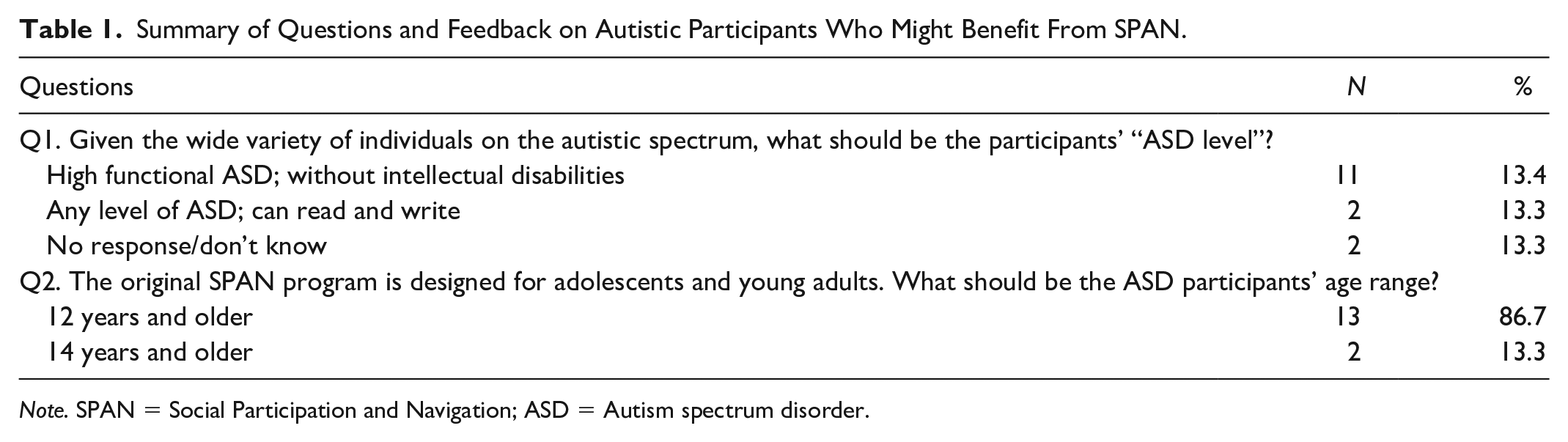
Table 1 presents the questions about potential participants’ features (e.g., functional level, age, and delivery method) and frequency of stakeholder responses or recommendations regarding autistic participants who might benefit from SPAN-ASD. The most suitable target population was AYA aged 12 years and older without intellectual disabilities. Two of 15 stakeholders suggested the participants would not need high verbal-expressive ability but should be able to read and write to communicate with the clinicians and use the SPAN-ASD web app and videoconferencing. Stakeholders recommended including only AYA aware of their ASD diagnoses, involving peers (with or without ASD) in the intervention, and motivating the ASD participants to use the SPAN-ASD technology to help their peers.
Summary of Questions and Feedback on Autistic Participants Who Might Benefit From SPAN.
Note. SPAN = Social Participation and Navigation; ASD = Autism spectrum disorder.
Intervention Goals to Include
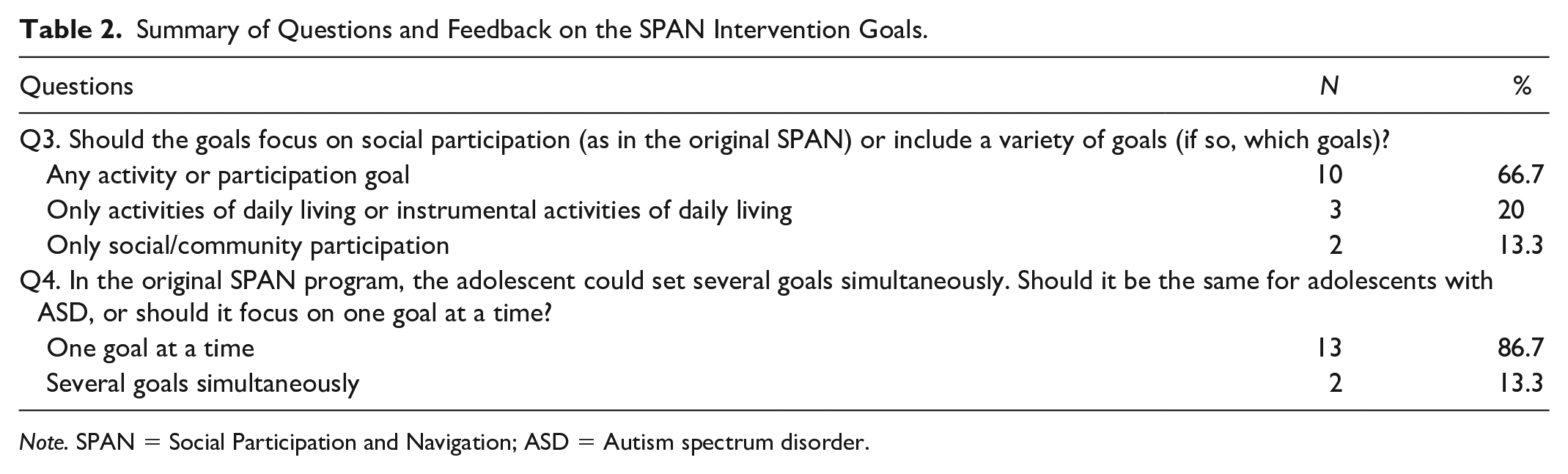
The original SPAN program focused primarily on promoting social participation. We asked the key stakeholders their preferences for social-participation and other intervention goals that would be important and feasible to address as part of the program for autistic AYA. Table 2 presents the questions and related response frequency.
Summary of Questions and Feedback on the SPAN Intervention Goals.
Note. SPAN = Social Participation and Navigation; ASD = Autism spectrum disorder.
Additional comments/recommendations for intervention goals were to choose achievable, motivating goals and ensure social goals focused on functional abilities rather than emotional or core autistic characteristics (e.g., increase eye contact or decrease repetitive and stereotype behaviors). Participants also suggested that clinicians lead the goal-planning process in small steps at the process start and gradually encourage the AYA to do it independently. Finally, they recommended focusing on one goal at a time to address the flexibility challenges common among autistic people and allow continuity in goal-setting.
Intervention-Delivery Procedures and Content
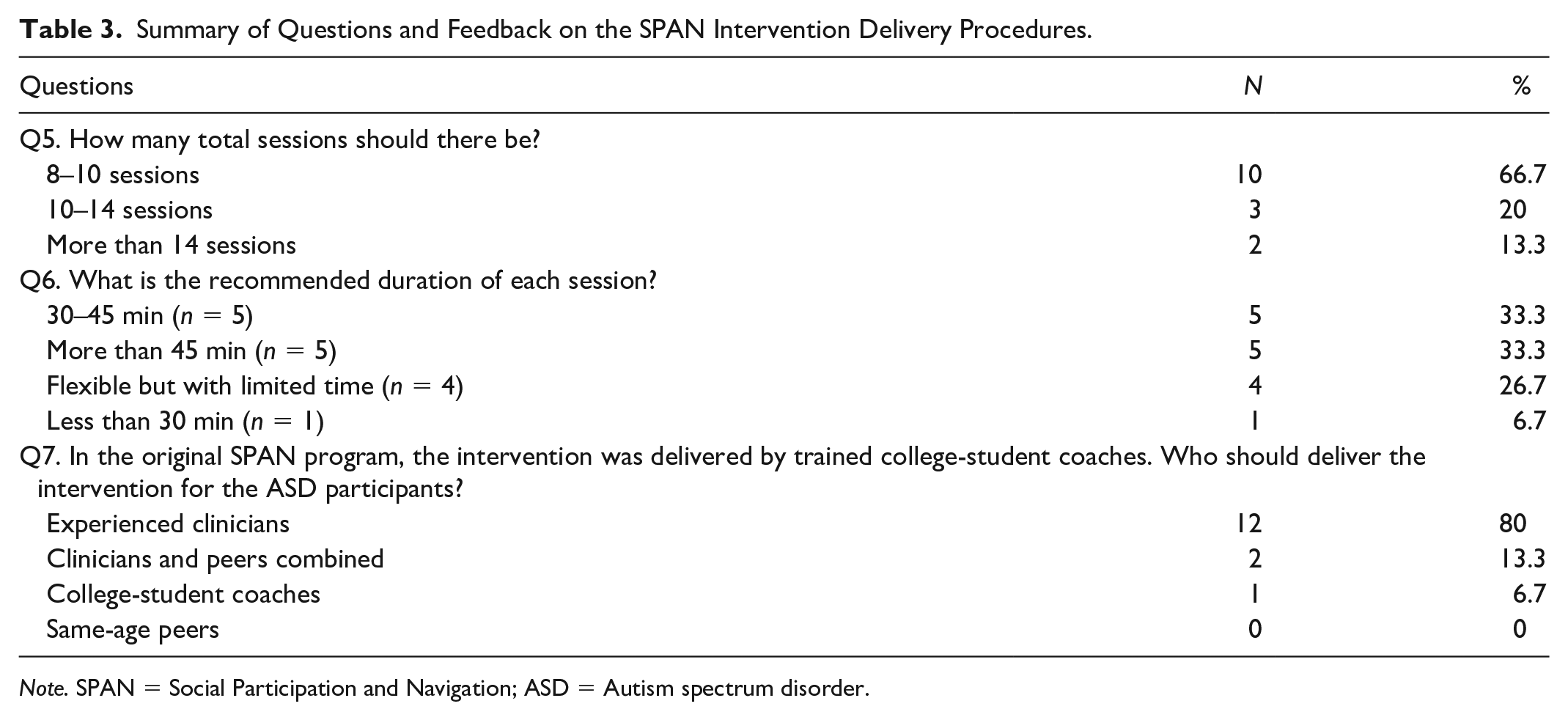
In the original SPAN-TBI, AYA participated in up to 10 weekly videoconferencing meetings (30–60 min each) with trained college-student coaches to support the app’s goal-achieving process (Wade et al., 2018). In this study, we asked stakeholders their preferences for the best ways to deliver SPAN to autistic AYA. Table 3 presents the questions and related answer frequency. Most stakeholders suggested that, unlike the original SPAN (which used trained, supervised college-student coaches), experienced clinicians should deliver the SPAN-ASD program. Furthermore, some open-ended-question responses emphasized the importance of clinicians reviewing and discussing AYA’s actions toward achieving their goals and factors that assisted or hindered them. This process parallels the original program’s virtual-coaching process with college-student coaches. Although the intervention is intended for direct delivery to AYA, stakeholders suggested it is important to offer parents opportunities for involvement by, for instance, sending updates (e.g., email or telephone) throughout the intervention about their children’s needs and progress.
Summary of Questions and Feedback on the SPAN Intervention Delivery Procedures.
Note. SPAN = Social Participation and Navigation; ASD = Autism spectrum disorder.
After reviewing the original SPAN program (website, app, and manual-brief view), stakeholders suggested: including information about ASD and its key characteristics (in wording tailored to AYA), being an adolescent (e.g., transition to adulthood and preparation for independent life in the community), self-identity, self-advocacy, metacognitive functions (e.g., awareness and executive functions), strategies for daily life functioning (e.g., planning and time management), and focusing on abilities, strengths, and positive wording (e.g., strength-based approach).
In the interview summary, the stakeholders described how they would present and deliver the intervention to autistic AYA. Overall, their feedback suggested remote delivery as a short-term, customized intervention to promote participation or personal goals for any activity.
Based on their impressions of the original SPAN website/app, stakeholders recommended elements to retain (features already in SPAN) or modify to benefit autistic AYA: respectful, age-appropriate wording based on strengths-based and self-determination approaches; more vivid visual feedback demonstrating users’ progress toward the goal; more elements that might encourage users to enter the system between sessions (e.g., automatic emails and notifications); options for a self-feedback self-rating button (e.g., “How did I fulfill my tasks this week?” or “How did I use the new strategy in my daily routine?”); billboard features where users can stay updated about age-relevant leisure activities in their area, add events and ideas from their profile, and invite friends to join them; and a feature added to the “contact us” option allowing users to leave advice/comments for program managers (who gain new ideas from users’ perspectives).
Discussion
SPAN is a technology-based, remote intervention originally developed and designed to facilitate personal social-participation goals for AYA with TBI (Bedell et al., 2017; Narad et al., 2018; Wade et al., 2018). This formative evaluation study aimed to inform modifications to the SPAN as an intervention for autistic AYA (SPAN-ASD).
Potential Participants
The SPAN’s overarching goal is to promote social participation, and the adapted program aims to deliver an intervention that could reach autistic AYA, who, by definition, have social-communication differences. These differences might translate to significant challenges as these young people transition toward independent living in the community (Farley et al., 2009). Given the wide diversity of autistic individuals, it was crucial to obtain feedback to understand which autistic AYA might benefit most from remote intervention. Participant characteristics that key stakeholders recommended as a starting point for the modified SPAN-ASD include higher-functional autistic AYA (12 years and older) who can read and write. Future feasibility/usability studies will examine these and additional personal/environmental factors. The modified SPAN-ASD program will also address participants’ anticipated diversity by being person-centered and strengths-based and creating a customized approach to address individual preferences, strengths, resources, needs, and goals (Hatfield et al., 2018; Koenig & Shore, 2018).
Intervention Goals
The original SPAN was developed to promote social-participation-related goals. Given the vast heterogeneity among autistic AYA, it is challenging to identify desired outcomes with similar meanings across this population (Lounds Taylor, 2017). Stakeholder feedback indicated the importance of customized support to address sensory-diversity, problem-solving, and routine-change-related challenges. These recommendations align with past intervention studies addressing autistic AYA’s goals (e.g., Lee et al., 2021; Lopez-Herrejon et al., 2020). Like the original program, the modified SPAN-ASD will address these challenges, tailoring the intervention to each participant’s needs, abilities, and supports. The program will consider a broad range of goals that can be implemented within the intervention’s time frame and on a remote platform.
Most key stakeholders suggested allowing any activity or participation goals that can be achieved in a short-term intervention. They emphasized that the goals should focus on functional abilities rather than ASD core impairments and using strengths-based and self-determination principles. These recommendations are consistent with evidence on the effectiveness of remote interventions among autistic AYA in promoting functional goals, such as job-interview (e.g., Hatfield et al., 2017), daily living (e.g., Ford et al., 2021), and social-participation (e.g., O’Rourke et al., 2020; Tang et al., 2021) skills.
Intervention Delivery Procedures and Content
Stakeholder feedback included recommendations for a short-term intervention (8–10 sessions) focused on a specific, functional activity or participation goal. Evidence (e.g., Lamash & Josman, 2021) suggests that short-term interventions addressing specific adaptation or life skills may handle these needs because many autistic AYA have difficulty persisting in interventions. Their reasons include a lack of motivation or persistence, challenges in changing routines, highly specific or limited interests, and initiation challenges (Duncan et al., 2021).
Whereas college-student coaches (trained and supervised by experienced clinicians) delivered the SPAN for TBI, the key stakeholders recommended that experienced clinicians virtually deliver the intervention for autistic AYA. Evidence suggests that clinicians (e.g., occupational therapists and speech therapists) and educators might be well-suited to deliver ASD interventions, given their knowledge of ASD characteristics, challenges, and coping strategies (Lawton & Kasari, 2012). Professionally provided academic support and clinical interventions are linked to increased motivation and engagement in programs among autistic students (Ryan & Patrick, 2001).
The stakeholders suggested adding content focused on abilities and strengths (instead of deficits; for example, Donaldson et al., 2017; Fuentes et al., 2021), self-identity, self-advocacy (Zuber & Webber, 2019), and metacognitive strategies for daily functioning, as in the original SPAN website content. Existing evidence noted relationships between metacognition, daily functioning, and self-management among autistic individuals (Munsell et al., 2021; Pasqualotto et al., 2021). Some evidence-based interventions are based on metacognitive functions to promote daily functioning goals (e.g., CO-OP; Wilson, 2014), but information on the use and effects of metacognitive strategies in interventions to achieve functional goals with autistic AYA remains limited.
Considering autistic individuals’ sensory sensitivity (APA, 2013), the stakeholders’ recommendations/highlights for modifying the SPAN website/app for autistic AYA included references to visual components and features (e.g., consistent colors, text, and image style). As noted in the literature (e.g., Tomchek et al., 2017), these can promote engagement and interest and prevent visual overwhelming.
Conclusion
Based on this formative evaluation, we developed a new SPAN-ASD website (www.spanprogram.co.il) and intervention manual for autistic AYA. The website contains information on ASD, the SPAN-ASD program description, and tips and tools based on the original SPAN version and stakeholders’ suggestions. It is divided into an open-access area with content webpages and a personal area requiring usernames and passwords to access features for managing personal goals.
Unlike the SPAN for TBI, which used trained, supervised college-student coaches to deliver the intervention (Narad et al., 2018; Wade et al., 2018), clinicians or educators would deliver the SPAN-ASD intervention using a written, structured, and detailed manual. This new manual introduces the program and its theoretical background, includes detailed, week-by-week intervention guidelines, and incorporates the main components suggested or modified for autistic AYA.
This study’s limitation is that autistic AYA were not included as key stakeholders in the formative evaluation. However, upcoming research steps will assess the SPAN-ASD website’s usability and feasibility with those user stakeholders. An implementation pilot study is underway with autistic AYA to further examine the SPAN-ASD’s feasibility, usability, and benefits, and results will be disseminated upon completion.
Footnotes
Declaration of Conflicting Interests
The author(s) declared no potential conflicts of interest with respect to the research, authorship, and/or publication of this article.
Funding
The author(s) disclosed receipt of the following financial support for the research, authorship, and/or publication of this article: This work was supported by the Israeli National Insurance (Grant agreement number 18329).
Ethical Approval
The study was approved by the Ethics Committee, University of Haifa (approval number 182/19) in accordance with the ethical standards.
