



Abstract
Objectives:
To create a Japanese version of the Engagement in Meaningful Activities Survey (EMAS) and assess internal consistency, test–retest reliability, convergent and structural validity.
Method:
We conducted a cultural translation and validation study of the Japanese version of the EMAS (EMAS-J) in a sample of 96 community-dwelling older adults in the Tohoku Region of Japan.
Results:
Internal consistency of the EMAS-J (α = .91) was very good. Low to moderate correlations were found with indicators of health-related quality of life, depression, and life purpose and meaning. Exploratory factor analysis indicated a two-factor structure within the EMAS-J; cultural differences in item-factor composition compared with previously reported EMAS factor structures are discussed.
Implications:
The EMAS-J is a reliable and valid assessment of engagement in meaningful activities for older adults in Japan. The assessment can be used to evaluate the effects of occupation-based interventions upon health and well-being.
Introduction
Japan has become one of the world’s longest-living countries with older adults accounting for more than 25% of its population (Ritchie & Roser, 2019). To address concerns for a rapidly aging society the Japanese government implemented “The Gold Plan 21,” which called for health promotion strategies to “build a vibrant image of older adults,” which can be understood as fostering a positive attitude toward life and building a sense of life purpose in older adults (Ministry of Health, Labour and Welfare, 2002). Subsequently, the Requirement to Adopt Measures for Secure Employment of Older Persons bill was approved by the Diet, Japan’s national legislative body (Cabinet Office, Government of Japan, 2012). Together, these two laws promote opportunities for older adults to remain active and engaged within their local communities.
Engaging in community-based activities may delay the onset of age-related disability and minimize mortality rates in older Japanese adults (Okura et al., 2018). The mechanisms accounting for these effects are not well understood, though evidence suggests that increased activity levels may offer a protective effect by mitigating depression and the onset of disability. Recent research indicates that the development of a sense of life purpose and meaning via activity may foster social activities and minimize mortality risk (Alimujiang et al., 2019; Seko & Hirano, 2021). As well, evidence from a lifestyle intervention with ethnically diverse older adults has shown that the significance, or meaningfulness, of therapeutic activity may account for lower levels of depression compared with no treatment controls (Juang et al., 2018). Such evidence supports the notion that activity meaning may promote mental health and foster a sense of life purpose and well-being (Kielhofner, 2009). Health promotion initiatives in Japan should, therefore, consider how to best conceptualize and measure older adults’ engagement in meaningful activities as one path toward maintaining health and well-being.
Occupational therapy practitioners use purposeful activities that are meaningful to the person in relation to their personal beliefs, values, and needs (Christiansen & Townsend, 2004; Hinojosa & Kramer, 1997). Although the meaning of engaging in activities is unique to each person, occupational therapists can identify personally significant activities which may increase motivation and purpose (Fisher, 1998; Pierce, 2001). Personally significant activities reflect a sense of felt or experienced meaning (Eakman et al., 2018; Nelson, 1997). Theoretical and empirical work in this area indicates that an activity’s meaning is likely comprised of multiple experiential qualities, such as a sense of belonging and helping and feelings of autonomy, mastery, and progression toward a goal. These experiential qualities may, in turn, promote experiences of satisfaction and pleasure (Atler, 2015; Eakman, 2014; Hammell, 2004; King, 2004), thereby accounting for the therapeutic effects of activity on health and well-being of older adults.
Thus far, standardized Japanese versions of scales created overseas, such as the Meaning in Life Questionnaire (MLQ; Steger et al., 2006) and the Medical Outcomes Study 36-Item Short-Form Health Survey version 2 (SF-36v2; Ware & Sherbourne, 1992) have been used to assess purpose and meaning in life as well as physical, mental, social and emotional functioning (e.g., Imai, 2019; Steger et al., 2008). These assessments, however, do not assess the meanings older adults’ ascribe to their day-to-day activities. Examples of scales intended for evaluating subjective experiences in activities that have been developed in Japan include the Occupational Challenge Assessment, which is a self-report assessment on how challenging an activity is (Morohoshi et al., 2017), and the Self-Completed Occupational Performance Index, which assesses an individual’s sense of satisfaction about leisure activities, productive activities, and self-care (Imai & Saito, 2010). However, these scales only evaluate a narrow aspect of activity meaning such as how challenging or how satisfied one is with their day-to-day activities. Thus, a scale that comprehensively evaluates diverse aspects of meaning in activity is needed.
The Engagement in Meaningful Activities Survey (EMAS) was developed by Goldberg et al. (2002) to assess the varied meanings individuals ascribe to their current activities. According to the authors, the EMAS was designed to reflect, “. . .activity’s congruity with one’s value system and needs, its ability to provide evidence of competence and mastery and its value in one’s social and cultural group” (pg. 19). This scale considers 12 diverse, yet related aspects of meaning reflecting experiences of belonging, selfhood, and pleasure (Eakman et al., 2018). The EMAS has been translated into Polish (Brożek & Tokarz, 2018), French (Lacroix et al., 2018), Korean (Nam et al., 2018) and Spanish (Prat et al., 2019), and the psychometric qualities of these translations have been tested. The structural validity of the scale has also been evaluated in the English, Korean, and Spanish versions, with the EMAS consistently demonstrating a two-factor structure.
The EMAS has also been used to determine the effectiveness of occupation-based interventions for older adults with breast cancer (Petruseviciene et al., 2018; Radomski et al., 2020), persons with dementia (Mansbach et al., 2017), and for people with chronic diseases living in a low-income housing community (Ciro & Smith, 2015). Furthermore, the EMAS has demonstrated positive relationships with life purpose and meaning, and negative associations with depressive symptomology in older adult samples (e.g., Eakman, 2012; Nam et al., 2018). We believe that by developing and testing the Japanese version of the EMAS (EMAS-J), it would be possible to validly evaluate the meanings Japanese older adults ascribe to their everyday activities. Such an understanding could promote occupation-based interventions seeking to improve meaningful activity participation; clarify relationships between meaningful activity, health, and well-being; and facilitate cross-cultural comparisons between these concepts.
Materials and Methods
Participants
Participants were community-dwelling adults aged 65 years or older who were recruited using a poster distributed at community centers and event venues in the Tohoku Region, Japan. We excluded individuals who required daily caregiving and those who had been diagnosed with a psychiatric disorder. The sample size was determined based on the COSMIN Risk of Bias Checklist; we ensured a sample size of at least 6 times the number of items (Mokkink, 2017). In the case of the EMAS-J, the number of items is 12, therefore, the minimum number of participants required was 72. The study design was approved by the appropriate ethical committee and conducted in accordance with the Declaration of Helsinki.
Measures
Basic information
Participants were asked if they had been diagnosed with a psychiatric disorder and if they were independent in activities of daily living. Self-report questionnaires were used to collect information about sex, age, and presence/absence of cohabiting family members.
EMAS-J
The EMAS was used in the present study to measure the extent of engagement in meaningful activities in a sample of Japanese older adults. The original EMAS begins with open-ended questions and then uses a self-report questionnaire consisting of 12 items purported to reflect the construct of meaningful activity participation (Goldberg et al., 2002). We translated and validated only the self-report questionnaire in line with other translation studies using the EMAS (Brożek & Tokarz, 2018; Lacroix et al., 2018; Nam et al., 2018; Prat et al., 2019). In the EMAS, participants are asked to consider 12 aspects of meaningfulness in their day-to-day activities (e.g., The activities I do help me take care of myself, The activities I do contribute to my feeling competent, The activities I do are valued by other people), and respond to each of the 12 items using a five-point Likert-type scale (1 = never, 2 = rarely, 3 = sometimes, 4 = usually, and 5 = always). The 12 responses were summed to calculate an EMAS total score ranging from 12 to 60 points. A higher score indicates greater perceived meaning in a person’s day-to-day activities.
Our team developed a Japanese version of the EMAS, referred to as the EMAS-J, in accordance with best practices in the translation and cultural adaptation of patient-reported outcome measures (Wild et al., 2005), which included the following steps: (a) Two people who were native Japanese, fluent in English, and knowledgeable about health care and welfare in Japan independently performed a forward translation of the EMAS survey from English into Japanese. One person was an occupational therapist, and the other was a professional translator. (b) These two forward translations were then compared with each other by the aforementioned occupational therapist and an additional native Japanese speaker familiar with occupational therapy. Differences between the two versions were discussed and, based on consensus, the better translation was advanced for backward translation. (c) A backward translation was then completed by an additional bilingual translator whose native language was English. (d) A native English speaker who was an occupational therapist with expertise using the EMAS and in the concept of meaningful activity then reviewed the backward translation. Discrepancies between the original EMAS survey and the back translation were discussed by this content expert and the aforementioned bilingual occupational therapist, and corrections were made to produce a provisional version of the EMAS-J. (e) This provisional EMAS-J was then pilot tested with eight Japanese older adults and found to be satisfactory, with a minor modification to include the five-point scale and the content represented by each number along with each of the 12 EMAS-J prompts. (f) This version of the EMAS-J was then given to a bilingual translator different from the forward translator, whose native language was English, to again perform a backward translation of the questionnaire into English. (g) The English-speaking content expert from Step 4 then reviewed this backward translation and found no discrepancies with the original EMAS survey resulting in yielding the final version of the EMAS-J used for the present study. Permission to translate was obtained from an author of the EMAS (Goldberg et al., 2002). Please see Appendix for the EMAS-J.
The following scales were used to obtain convergent validity evidence for the EMAS-J. That is, we anticipated low to moderate positive associations with the Japanese versions of the Medical Outcomes Study SF-36v2 and MLQ subscales, and a negative association with the Center for Epidemiologic Studies Depression Scale (CES-D).
Japanese version of the SF-36v2
The SF-36v2 (Fukuhara et al., 1998; Ware et al., 1994) is a self-report questionnaire used to evaluate eight health concepts: physical functioning, role physical, role emotional, general health perceptions, social functioning, bodily pain, vitality, and mental health. The summary score of the original version is based on the two-factor structure of the physical component summary (PCS) and mental component summary (MCS). However, previous research has recommended norm-based scoring based on the three-factor structure of PCS, MCS, and role/social component summary (RCS; Suzukamo et al., 2011) for the Japanese version. Therefore, norm-based scoring was employed in this study.
Japanese version of the CES-D
The CES-D (Radloff, 1977; Shima et al., 1985) is a self-report questionnaire of 20 items, and it is used to evaluate depressive symptomology. Participants were asked to provide responses using a four-point scale (0 = none to 3 = 5 days or more), and the total score was used for analysis in accordance with the usage guide of the CES-D (Shima, 1998).
Japanese version of the MLQ
The MLQ (Shimai et al., 2019; Steger et al., 2006) is a self-report questionnaire consisting of 10 items used to evaluate the sense of meaning and purpose in life. Participants were asked to provide responses using a seven-point scale (1 = absolutely untrue to 7 = absolutely true). The MLQ consists of two factors: presence (MLQ-P) and search (MLQ-S) for meaning and purpose in life. These scores were created according to published criteria and were used for analysis within this study.
Procedure
The investigation was performed by qualified occupational therapists who instructed participants to respond to the following order of survey instruments: EMAS-J, SF-36v2, CES-D, and MLQ. Questionnaires were collected as soon as participants completed them. Two weeks later, the EMAS-J was sent by mail to 75 participants to evaluate test–retest reliability. Missing values for the SF-36v2 (Fukuhara & Suzukamo, 2004) and CES-D (Japan Statistics Bureau, Ministry of Internal Affairs and Communications, 2019) were processed in accordance with each manual. A person’s average scale value was substituted for their respective missing EMAS-J and MLQ data.
Statistical analysis
Descriptive statistics and reliability
Descriptive statistics were used to analyze participants’ demographics, and item and scale characteristics. In addition, the normality of the item scores and scale scores for each questionnaire were examined using the Shapiro–Wilk test. Parametric tests were used for analysis of normally distributed data, while non-parametric tests were used for analysis of non-normally distributed data. The internal consistency reliability of the EMAS-J was examined with Cronbach’s α. A Pearson’s product-moment correlation coefficient was calculated to determine the two-week test–retest reliability of the EMAS-J.
Analysis of structural and convergent validity
The structural validity of the EMAS-J was first assessed through exploratory factor analysis (EFA) by maximum likelihood method with Promax rotation. The number of factors was determined in the following manner. First, we used the Kaiser criterion (eigenvalue of one or more) and a scree plot. A factor loading of 0.400 or more was used to interpret the items that make up a factor. Cronbach’s alpha was calculated for each factor to examine the internal consistency of the factor structure.
Furthermore, to explore the validity of the factors extracted by this EFA, we performed a confirmatory factor analysis (CFA) using covariance structure analyses. In addition, we tested the fit of the factor structure identified by Eakman et al. (2010a) within the present sample using CFA. The two-factor model identified by Eakman et al. (2010a) is a Social Experimental Component (SEC = EMAS Items 6, 7, 8, 9, 10, 11, and 12), which was positively correlated with a Personal Competence component (PCC = EMAS Items 1, 2, 3, 4, and 5). We used the comparative fit index (CFI), Tucker–Lewis index (TLI), and root mean square error of approximation (RMSEA) to test the goodness-of-fit of the factor structure models.
Next, convergent validity was assessed on the model demonstrating the better CFA goodness-of-fit. We used Pearson’s product-moment correlation coefficients or Spearman’s rank correlation coefficients relating the total score of the EMAS-J scale and each of its factors with the SF-36v2-PCS, SF-36v2-MCS, SF-36v2-RCS, CES-D, MLQ-P, and MLQ-S. SPSS Statistics Version 22 (IBM Corporation, Armonk, NY, USA), Amos Version 24 (IBM Corporation, Armonk, NY, USA), and R Version 4.0.3 (R Core Team, R Foundation for Statistical Computing, Vienna, Austria) were used for statistical analyses, with significance set at p < .05.
Results
Descriptive Statistics and Reliability of the EMAS-J
We recruited 97 participants who gave written consent; one participant who met the exclusion criteria was excluded. The investigation and subsequent analysis involved 96 participants (57 women and 39 men). The median age of the participants was 75.0 years, the interquartile range was 70.0 to 79.0 years, and the age range was 65 to 92 years. There were 81 participants were living with someone, and 15 participants were living alone. Table 1 shows the mean (standard deviation) or median (interquartile range) of each scale.
Descriptive Statistics of the EMAS-J and Criterion-Related Variables.
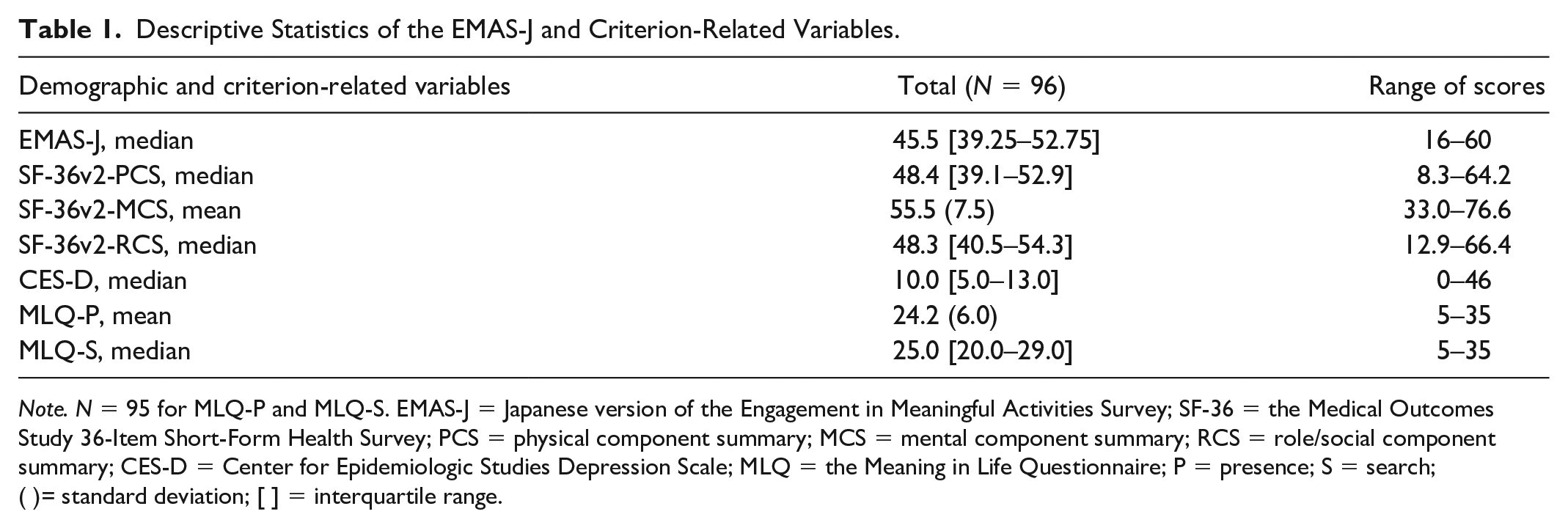
Note. N = 95 for MLQ-P and MLQ-S. EMAS-J = Japanese version of the Engagement in Meaningful Activities Survey; SF-36 = the Medical Outcomes Study 36-Item Short-Form Health Survey; PCS = physical component summary; MCS = mental component summary; RCS = role/social component summary; CES-D = Center for Epidemiologic Studies Depression Scale; MLQ = the Meaning in Life Questionnaire; P = presence; S = search; ( )= standard deviation; [ ] = interquartile range.
The Shapiro–Wilk test showed that the EMAS-J, SF-36v2-PCS, SF-36v2-RCS, and MLQ-S data were not normally distributed (p > .05). The Cronbach’s alpha of the EMAS-J was 0.91 and the correlation coefficients among the EMAS-J items were r = 0.41 to 0.74. Analysis of 2-week test–retest reliability for the EMAS-J was performed using data from 69 participants that agreed to the retest, with a Pearson’s product–moment correlation coefficient of 0.73 (95% confidence interval [CI] = [0.60, 0.83], p < .001).
Structural and Convergent Validity of the EMAS-J
Table 2 shows the results of the EFA. We extracted a two-factor structure from the EMAS-J. The alpha coefficients of each extracted factor indicated good internal consistency: 0.88 for Factor 1 (seven items) and 0.86 for Factor 2 (five items).
Exploratory Factor Analysis of the EMAS-J.
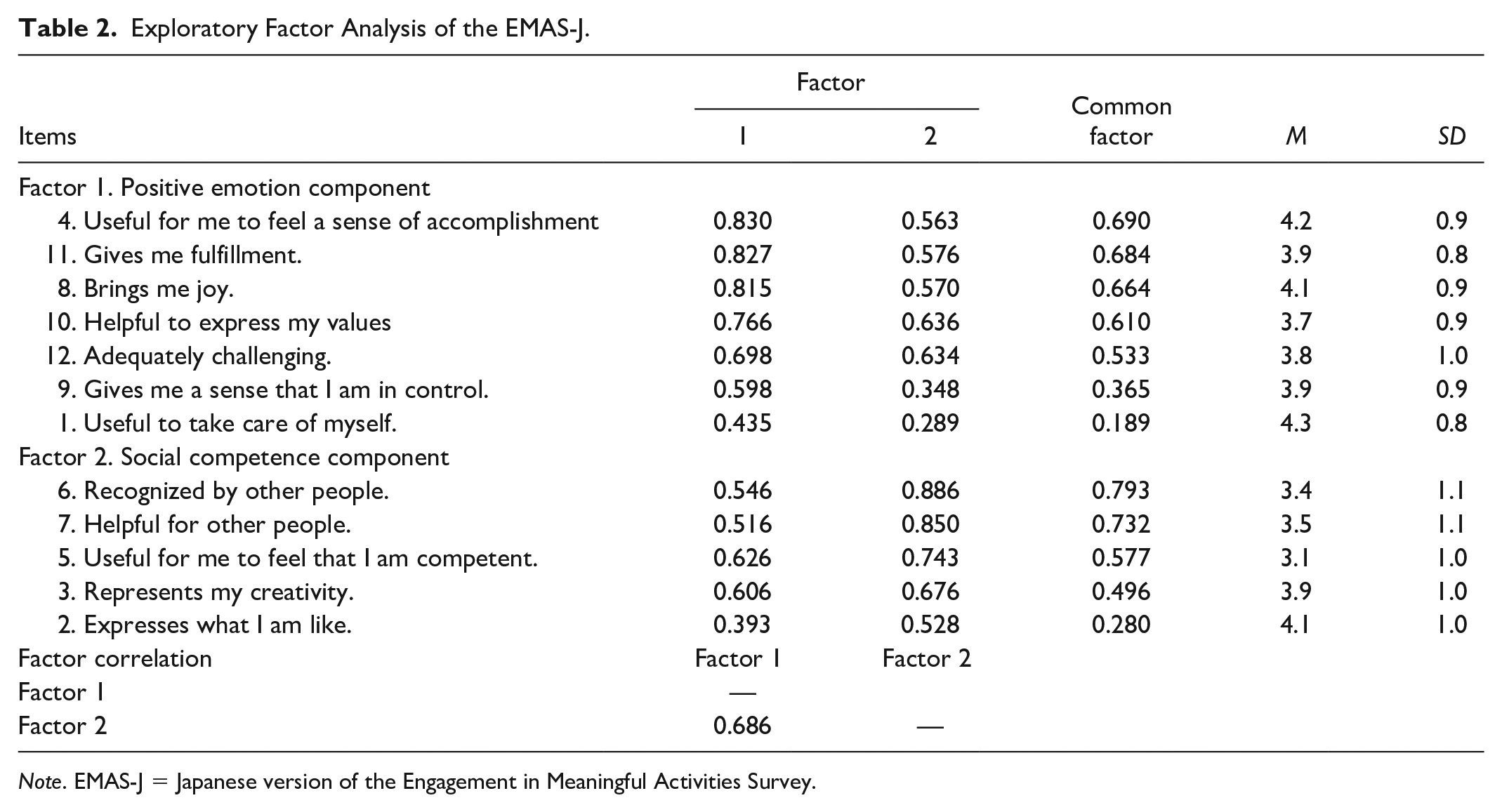
Note. EMAS-J = Japanese version of the Engagement in Meaningful Activities Survey.
Factor 1 was associated with the expression of personal values along with a sense of accomplishment, satisfaction, joy, challenge, and control. We named this factor “positive emotion component” (PEC) given the items’ likely associations with positive emotional experiences. Since Factor 2 was related to recognizing one’s value within a social group, and being of help to others, along with related experiences of competence, creativity, and a sense of selfhood, we named this factor the “social competence component” (SCC).
The results of the CFA on two-factor model (PEC = EMAS-J Items 1, 4, 8, 9, 10, 11, and 12; PCC = EMAS-J Items 2, 3, 5, 6, and 7) identified by EFA in the present study were CFI = 0.935, TLI = 0.919, and RMSEA = 0.088 (90% CI = [0.057, 0.118]) (Figure 1).
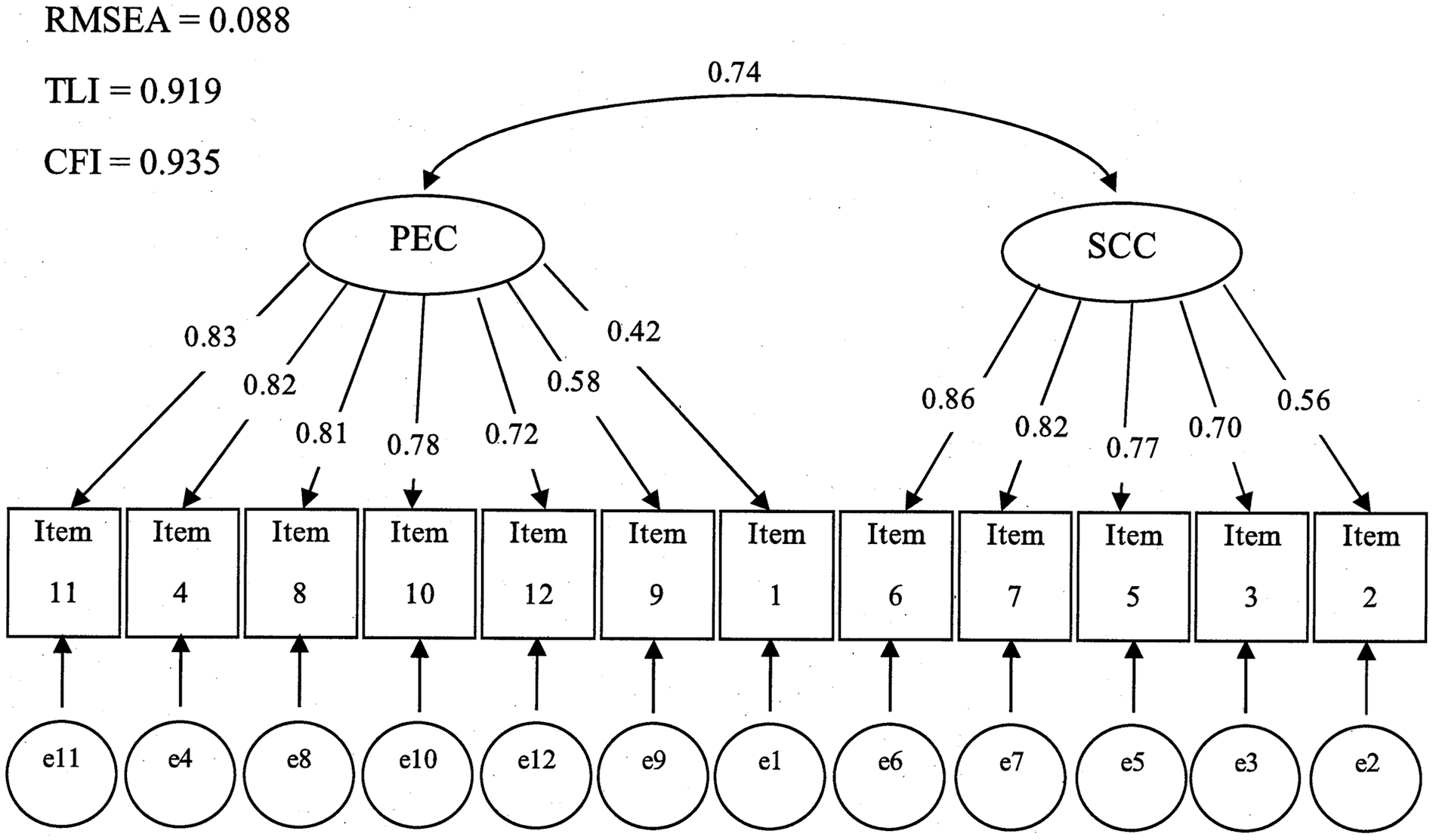
Confirmatory factor analysis of the EMAS-J.
In contrast, the results of CFA on the original two-factor model (SEC = EMAS Items 6, 7, 8, 9, 10, 11, and 12; PCC = EMAS Items 1, 2, 3, 4, and 5) identified by Eakman et al. (2010a) were CFI = 0.837, TLI = 0.797, and RMSEA = 0.140, 90% CI = [0.114, 0.166]. Therefore, we decided to retain the two-factor model extracted in this study, as it adequately reflected the EMAS-J.
Table 3 shows the correlation coefficients between the total score of the EMAS-J and the scores for SF-36v2, CES-D, and MLQ. Significant low to moderate positive correlations were found between the EMAS-J total score and SF-36v2-MCS (r = .23), SF-36v2-RCS (r = .24), MLQ-P (r = .46), and MLQ-S (r = .37). A low negative correlation was found between the EMAS-J and CES-D (r = −.20). A low positive correlation was found between the EMAS-J and the SF-36v2-PCS (r = .18), though this relationship was not statistically significant.
Correlations Between Criterion-Related Variables, EMAS-J, and EMAS-J Components (N = 96).
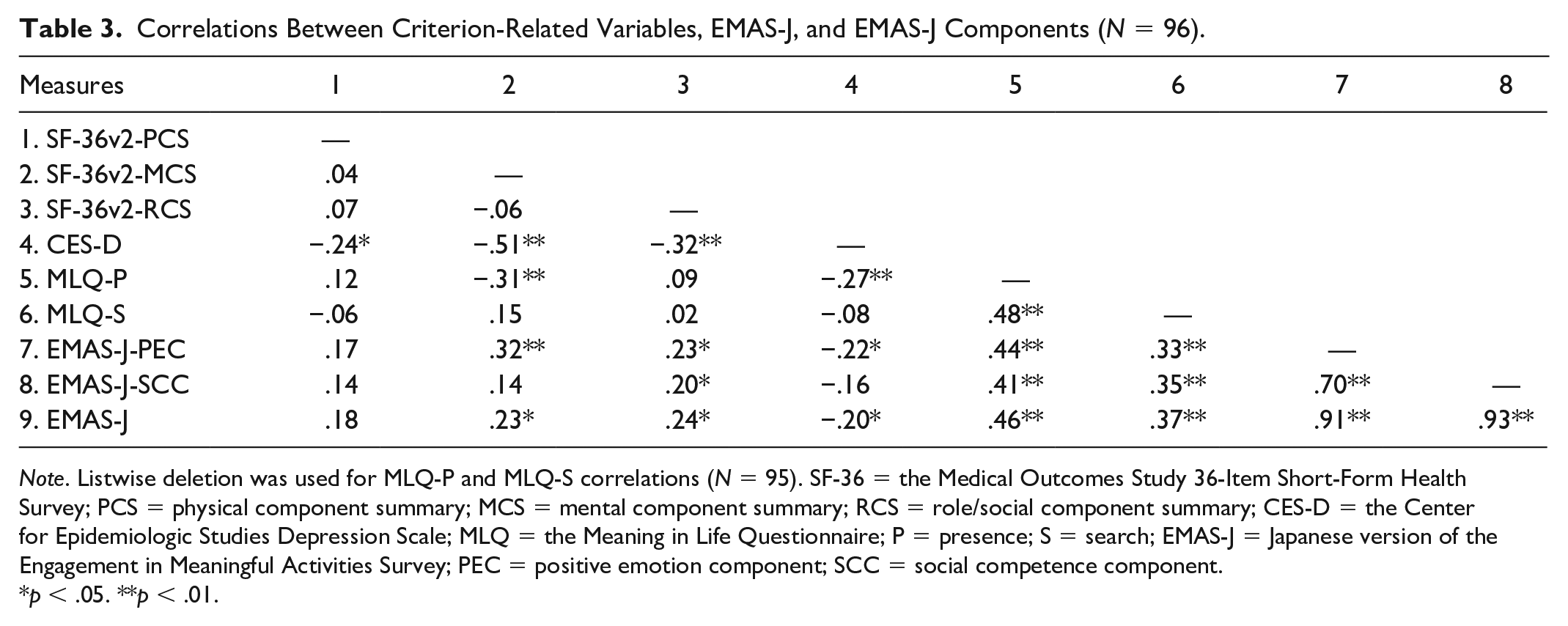
Note. Listwise deletion was used for MLQ-P and MLQ-S correlations (N = 95). SF-36 = the Medical Outcomes Study 36-Item Short-Form Health Survey; PCS = physical component summary; MCS = mental component summary; RCS = role/social component summary; CES-D = the Center for Epidemiologic Studies Depression Scale; MLQ = the Meaning in Life Questionnaire; P = presence; S = search; EMAS-J = Japanese version of the Engagement in Meaningful Activities Survey; PEC = positive emotion component; SCC = social competence component.
p < .05. **p < .01.
Discussion
The purpose of this study was to produce a Japanese version of the EMAS (EMAS-J) and verify its reliability and validity in a sample of community-dwelling well older adults. Access to a valid assessment of meaningful activity can aid occupational therapists in Japan in determining the effects of occupation-based interventions. As well, researchers in Japan can explore meaningful activity change as a likely causal mechanism linking occupation-based interventions to positive outcomes, such as health-related quality of life and life purpose and meaning.
Our sample was representative of the typical gender distribution of older adults in Japan. That is, 43.5% of older adults above the age of 65 years are men and 56.5% are women (Japan Statistics Bureau, Ministry of Internal Affairs and Communications, 2019). In this study, 40.6% of participants were men and 59.4% were women.
Initial evidence indicates the EMAS-J has adequate reliability and construct validity as a measure of engagement in meaningful activities. The scale demonstrated very good internal consistency reliability in this sample (α = .91) and had adequate test–retest reliability. Validity evidence for the EMAS-J from this study is also supportive of the psychometric qualities of the scale. Below, we briefly review the convergent validity and structural validity evidence for the EMAS-J.
We included measures of health-related quality of life, depression, and life purpose and meaning to assess the convergent validity of the EMAS-J. As anticipated, we found low positive relationships between the EMAS-J and the SF-36v2 MCS score and SF-36v2 RCS score as recommended by Suzukamo et al. (2011). The present findings are consistent with prior studies involving the EMAS, which demonstrated similar relationships with these aspects of health-related quality of life in an American sample of older adults (Eakman et al., 2010a, 2010b).
A low negative association was found between the EMAS-J and the CES-D, a well-validated indicator of depression. Past research has shown low negative relationships between meaningful activity and depression in older adult samples (Eakman et al., 2010a; Nam et al., 2018), consistent with the idea that higher levels of meaningful activity engagement would be associated with lower levels of depressive symptomology. A recent study demonstrated lower depressive symptoms following an occupation-based lifestyle intervention (Juang et al., 2018). Those authors found that changes in activity meaningfulness within the older adult sample and perceptions of increased control over their day-to-day lives were likely causal mechanisms leading to lower levels of depression.
The EMAS-J was positively associated with the MLQ subscales (Steger et al., 2006), which assess the presence of and the search for meaning and purpose in life. Related work in older adult samples has shown low to moderate positive associations between measures of life purpose and meaningful activity as assessed by the EMAS (Eakman et al., 2010a; Nam et al., 2018). Present relationships were anticipated given that engagement in meaningful activities may create, and likely sustain, a life rich with meaning and purpose (King, 2004). A sense of searching for meaning in life, however, is associated with lower levels of well-being in European American samples. In Japanese samples, the relationship tends to be positive as we have found in this study, perhaps given interdependent cultural values associated with striving to improve upon oneself within personally important social groups (e.g., Markus & Kitayama, 1991; Steger et al., 2008).
The structural validity of the EMAS-J was evaluated using EFA and CFA. We found a two-factor structure within the EMAS-J when EFA was employed, including PEC and SCC. Eakman et al. (2010a) also reported a similar structure in a sample of older adults in the United States. A two-factor structure in the EMAS has also been identified in other versions of the EMAS, including the Korean version, as used in a sample of older adults (Nam et al., 2018), and the European-Spanish version, as used in sample of people with persistent mental illness (Prat et al., 2019).
Interestingly, we found that the SEC and PCC reported by Eakman et al. (2010a) offered a relatively poor fit in our sample of older Japanese adults. The CFA results indicated our primary PEC—comprised of Items 1, 4, 8, 9, 10, 11, and 12—and the secondary SCC—comprised of Items 2, 3, 5, 6, and 7—within the EMAS-J demonstrated improved model fit when compared with the fit of the SEC and PCC components found by Eakman et al. (2010a).
The EMAS includes two socially related meanings, “feeling valued by other people” (Item 6) and “helping other people” (Item 7), which were aspects of the primary SEC found by Eakman et al. (2010a) in an American sample and confirmed by Nam. et. al. (2018) and Prat et al. (2019). In the present Japanese sample, however, EMAS-J Items 6 and 7 were associated with the secondary SCC. One reason for this discrepancy may be related to cultural differences in the construal of the self. According to Markus and Kitayama (1991, 2003), individuals in Western cultures tend to construe the self as relatively independent or separate from others within their environment. Alternatively, the cultures of East Asian countries such as Japan tend to shape a socially interdependent construal of selfhood within its people. An interdependent construal of the self would identify relationships with significant or mattering “others” as an ever-present aspect of experienced meaning, thereby shaping perceptions of personal agency and a sense of selfhood (Cross et al., 2011; Markus & Kitayama, 2003).
In addition, motives for actions within interdependent cultures may foreground other-focused meanings, such as caring for others and feeling connected to others (Markus & Kitayama, 2003). Such foregrounding would apply consideration for others as an interpretive frame for the varied experienced meanings assessed by the EMAS. Thus, these cultural differences in the construal of the self may have led to the slightly different factor structure found in the EMAS-J. We are not certain why the factor structure of the Korean EMAS was generally consistent with that found by Eakman et al. (2010a). There is a growing understanding, however, that East Asian countries such as Korea and Japan have distinct cultures and practices and therefore it may be unrealistic to expect similar response patterns within their respective versions of the EMAS (Kashima et al., 2004; Park et al., 2017). As well, we are uncertain why the EMAS-J items “take care of yourself” (Item 1) and “sense of accomplishment” (Item 4) were associated with the primary PEC and not the secondary SCC. This may have also been a function of cultural differences. Future study will be needed to confirm our results and to explore factors that may explain such discrepancies.
Limitations and Future Research
We determined that the EMAS-J is a reliable and valid assessment of engagement in meaningful activities in our sample of Japanese older adults. However, this study had some limitations. First, the data for the EMAS-J, SF-36, CES-D, and MLQ used to examine convergent validity were not normally distributed. This may have introduced sampling bias because our participants were relatively healthy and active older adults who came to community centers or event venues. Second, we did not include additional variables such as education level, marriage history, work history, functional level, medical history, or income level, which could be used to establish and assess more diverse samples. As well, future research should consider including persons’ construal of themselves as an interdependent versus independent self, which could then be used to assess for differences in the factor structure of the EMAS across nationalities (Cross et al., 2011; Markus & Kitayama, 1991). Such work could improve our understanding of meaningful occupation within and across countries. Finally, we recommend researchers to consider employing additional indicators of activity participation to assess the effects of occupation-based programming. For example, indicators of change in the frequency as well as the meaningfulness of activity participation could illuminate the mechanisms through which occupation-based interventions positively affect health and well-being (Juang et al., 2018). By doing so, the EMAS-J might be a useful evaluation scale for demonstrating the impact of government legislations and public policy in Japan, which promote opportunities for older adults remain active and engaged within their local communities.
Conclusion
We employed best practices in the cultural translation of patient-reported outcome measures to create the EMAS-J. The initial evidence indicates that the scale is a reliable and valid assessment of engagement in meaningful activities in Japanese older adults. The EMAS-J can be used to establish levels of meaningfulness within individuals’ day-to-day activities as well as to evaluate change in meaningfulness following occupation-based interventions. Finally, the EMAS-J has the potential to clarify the mechanisms through which occupation-based interventions may positively influence health, well-being, and quality of life.
Supplemental Material
sj-docx-1-otj-10.1177_15394492221090624 – Supplemental material for Development of the Japanese Version of the Engagement in Meaningful Activities Survey
Supplemental material, sj-docx-1-otj-10.1177_15394492221090624 for Development of the Japanese Version of the Engagement in Meaningful Activities Survey by Yuki Kawakatsu, Kayoko Yokoi, Katsuko Tanno, Aaron M. Eakman and Kazumi Hirayama in OTJR: Occupation, Participation and Health
Footnotes
Acknowledgements
We thank all the facility staff who cooperated in recruiting participants, including the Takiyama Regional Comprehensive Support Center, Kojirakawa Care Center, and Chitose Community Center. We also thank Shuki Honma and Mikoto Nakamura for their comments which were useful to develop the EMAS-J.
Declaration of Conflicting Interests
The author(s) declared no potential conflicts of interest with respect to the research, authorship, and/or publication of this article.
Funding
The author(s) received no financial support for the research, authorship, and/or publication of this article.
Research Ethics Section and Patient Consent
This study was conducted with the approval of the Yamagata Prefectural University of Health Sciences Ethics Committee (number 1811-25).

Supplemental Material
Supplemental material for this article is available online.
References
Supplementary Material
Please find the following supplemental material available below.
For Open Access articles published under a Creative Commons License, all supplemental material carries the same license as the article it is associated with.
For non-Open Access articles published, all supplemental material carries a non-exclusive license, and permission requests for re-use of supplemental material or any part of supplemental material shall be sent directly to the copyright owner as specified in the copyright notice associated with the article.
