




Abstract
This article studies the intersection of systems ecology and urban planning in the Inter-Institutional Policy Simulator (IIPS) project, conducted between 1970 and 1974 in Metro Vancouver, and tries to understand how ecologists influenced the planning of urban systems. I analyze the rise and fall of IIPS as the interaction between “IIPS the Platform” and “IIPS the Product,” or between the network of experts and the simulator they aimed to create. Although IIPS failed to create a desirable product, I argue that the project can exemplify ecologists’ desire to reform the practice of urban planning through the power of systems science.
Historian Jennifer Light’s two monographs on urban planning in the twentieth-century United States highlight the philosophy influencing how planners envisioned the problems of, and improvement for, major American cities. Beginning from the interwar period, planners and real estate developers selectively borrowed “ecological” ideas like “succession” and “invasion” from social scientists—especially the “Chicago School” sociologist who themselves borrowed these terms from biologists—to design housing projects which claimed to remedy, but sometimes actually reinforced, the inequalities arising from race and class ideologies. 1 However, Light argues that the popularity of ecological metaphors gradually diminished when another planning philosophy emerged from the military–industrial–academic complex. Between 1945 and 1975, urban planners and city administrators teamed up with experts from the defense and aerospace industry as well as university academics to explore the potential of using cybernetics, computer technology, and simulation models in the amelioration of urban problems. From digital filing system to community broadcasting, from budget management to the collection of social statistics, these experiments helped to assemble a network of urban intellectuals even though, in reality, few projects “achieved their promised reforms” while “average city dwellers found few visible effects.” 2
My goal is to fill the gap between Light’s two monographs by exploring the role ecologists played in the imagination of cities after the rise of “systems” thinking in North America. This article starts by introducing the history of systems ecology and its relation to urban planning and adopts a science and technology studies (STS) approach to analyze ecologists’ strategy of network building. Specifically, I argue that ecologists in the United States and Canada were able to promote their expertise by utilizing the “systems” in systems ecology as various “boundary objects” or “scientific objects which both inhabit several intersecting social worlds” and “satisfy the informational requirements of each of them.” 3 While boundary object has been widely utilized in the study of scientific institutions and the production of scientific knowledge, only recently do planning scholars apply boundary object to the analysis of cities, especially in the field of sustainable development and resilience planning. 4 Besides, STS scholars view planning practices not as “black boxes” shrouded in technological mystery but as situated objects with agency and politics, and their focus is not only on how planners succeed in enlisting the power of technoscientific objects but also on their failures to do so because of the complicated relationship between heterogenous actors. 5 Therefore, I believe that to apply the idea of boundary object in particular, and an STS approach in general, to the history of planning can enhance our understanding of the nuanced construction of planning practices and the mutual influence between the society and planning experts. This article examines how the ontological and epistemological characteristics of boundary objects allowed urban planners, city administrators, economic modelers, and academic ecologists to collaborate in the Inter-institutional Policy Simulator (IIPS) project, which is the focus of this article.
Initiated by a group of academics at the University of British Columbia, IIPS received funding from the City of Vancouver, the Greater Vancouver Regional District (GVRD), the Ministry of State for Urban Affairs (MSUA), and the Ford Foundation. Its aim was to devise “a new approach to solve large-scale and complex urban problems” through the construction of a computer model capable of simulating and synthesizing different aspects of the city (Figure 1). 6 This article studies the factors underlying the early success and eventual failure of the IIPS project by scrutinizing the interaction between what I call “IIPS the Platform” and “IIPS the Product”—the network of experts and the computer simulator they intended to construct. The idea of boundary object is utilized to illustrate the importance of “disciplinary techniques” in connecting the ambition of the Platform to the concrete Product the project aimed to create. As I will show, the project members’ difficulty to find a middle ground between the conflicting visions in the Platform eventually led to their failure to deliver the promised Product as well as the dissolution of the project. Nevertheless, I propose that IIPS remains a significant example for the bold vision it embodied and the opportunity it created for the participating experts who could test the limit of systems theory in a planning project with complex organizational arrangement and adjust their practices after this “failed” experiment.
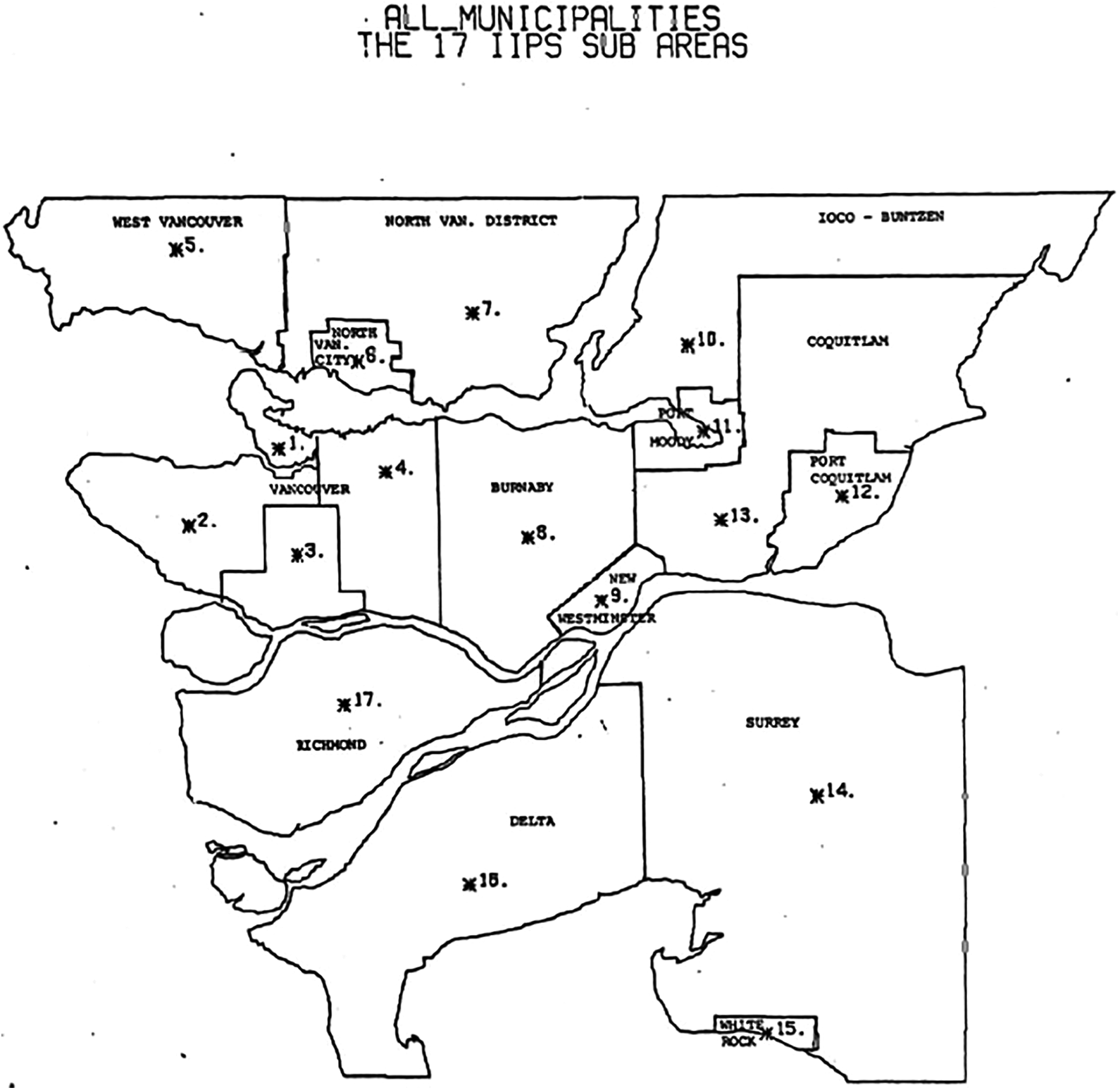
Inter-institutional Policy Simulator (IIPS) planning areas. Source: Doug Ash, “Using the Model,” p. 3, October 1974, Box 13, Folder 16, IIPS fonds. UBC Archives.
Furthermore, the emphasis on resilience in the project is very noteworthy. As Wachsmuth and Angelo argued, contemporary visions of sustainable cities combine the conventional “green urban nature” with a “gray urban nature,” or the belief that “sustainability is a thing lurking beneath the surface of the city, to be uncovered through science, technology, and expertise.” 7 While IIPS did not directly promote green space or biodiversity conservation, it tried to revise planning practice by emphasizing the “boundary” in which cities can accommodate unexpected disturbances. As such, IIPS is valuable for planners who attempt to understand the history of the “gray urban nature” concept—what are the contexts that make “smart” cities potential “solutions” to the planetary environmental and socioeconomic crises we face, and how does the notion of resilient city evolve in the past fifty years? 8 But before we can appreciate the lessons of IIPS, a brief journey into the history of systems ecology should be helpful.
The “Systems” in Systems Ecology
The research program of “systems ecology” originated in the development of the ecosystem concept. In the 1930s, the most debated ecological ideas in the United States were “biological community,” or the distinct assemblage of organisms, and the theory of “ecological succession,” which proposed that an originally simple community composed of grasses had the tendency to transform into a complex and stable forest community. 9 Organicist metaphors, which were popular in turn-of-the-century America, played a crucial role in this debate. For instance, plant ecologist Frederic Clements tried to equate biological communities to organisms and succession to the physiological development of organs. 10 While Clementsian organicism lost most of its followers by 1940, American ecologists remained eager to find new metaphors for ecological processes. A mechanistic concept of ecosystem, developed by British ecologists Arthur Tansley and Charles Elton, soon came to their aid.
As the ecosystem idea captured the relations not only between organisms but between organic and inorganic processes, this new conceptualization of nature added the flows of energy and materials into ecologists’ agenda. One prominent figure in the field was Yale ecologist Evelyn Hutchinson who combined mathematical models and empirical fieldwork together in his study of the energy and biochemical cycles of lakes. As Joseph Taylor argues, after the World War II, Hutchinson and his colleagues would bring ecologists closer to the technocratic vision of reducing “the complexity of social and ecological relations to a single energy dial for the social engineers to adjust.” 11 The pursuit of a mathematically and biochemically oriented ecology therefore fostered an ambition laden with social and political values.
The careers of the Odum brothers and Stanley Auerbach nicely exemplified how ecologists promoted their research in Cold War America. In 1954, the Odum brothers went to study the environmental impact of nuclear tests at Eniwetok Atoll at the request of the Atomic Energy Commission. Instead of conducting a simple ecological survey, they used the opportunity to measure the net primary productivity of the coral reef ecosystem. Ironically, the Odum brothers were not familiar with coral taxonomy and “could not identify most species on the reef.” 12 Nonetheless, this disembodied and decontextualized approach was influential in the community of young ecologists. With their schematic representation of quantified material and energy cycles, ecology in the 1950s looked more and more like complex cybernetic diagrams. Technology developed during the Cold War also served as new tools for ecosystems study. Stanley Auerbach’s career at the Oak Ridge National Laboratory reflected this context. Although his work initially concentrated on the environmental and health impacts of radiation, in the late 1950s, Auerbach started using radioactive isotopes as “tags” to trace chemical cycles in the forest near the laboratory. He also pioneered the adoption of digital computers to create and test ecosystem models.
In a 1964 article titled “A New Ecology,” Eugene Odum suggested that the role of ecosystem as a “basic unit of structure and function” in ecology was equivalent to the role of cells in molecular biology. 13 As the ecosystem concept helped ecology reach its “maturity” as a scientific field, Odum argued that the “new ecology is thus a systems ecology.” 14 With the advent of this new ecology, he expected ecologists to analyze and integrate various biological, chemical, and even social systems and solve complex problems with new biochemical and digital technology. The construction of systems ecology in the 1960s as a field distinct from previous “schools” of ecology therefore reflected a strategy to unify ecology through a universal paradigm. Interestingly, this strategy appeared to echo the rhetoric systems scientists adopted to promote systems theories and cybernetics—to assert that modern technoscience compelled the society to adopt new worldviews and to absorb the lexicons and practices of other disciplines as one’s own expertise. 15 As a result, the rise of systems ecology embodies the larger sociocultural milieu of Cold War America, when computer technology and systems theory became the “mainstream” of scientific research. 16
However, while the initial spread of systems analysis and computer simulation across academia was largely sponsored by the American military–industrial complex, 17 systems ecologists instead chose to realize their cybernetic vision by assuming the role of environmental managers. As Kenneth Watt argued in the opening chapter of Systems Analysis in Ecology, after witnessing the damaging effects of defoliants and pesticides, the mandate of ecologists should be “to study systems as whole and not just collections of fragments of systems.” 18 Simulation models were then presented as powerful tools in solving complex environmental problems. Other authors in the volume supported Watt’s argument by investigating how ecological phenomena could be approached by multiple submodels without sacrificing systematic complexities. Imagining themselves as holistic scientific managers, ecologists after Odum’s “new ecology” seemed to follow the lead of systems thinking with much caution and self-awareness rather than pure techno-optimism.
Crawford Holling: Ecologist Turned Urban Planner
One of the contributors to Watt’s volume was Canadian entomologist Crawford Holling. After graduating from the University of Toronto, Holling spent his early career at the government-funded Forest Insect Laboratory in Sault Ste. Marie, Ontario. It might come as a surprise that an “applied” biologist like Holling would become an influential theorist for integrated socioecological systems. Agricultural entomology is, however, not devoid of theoretical significance, while the study of insect populations in the early twentieth century had an important place in the development of mathematical biology. 19 By the 1950s, competing hypotheses about the mechanism of prey–predator interaction and the apparent “balance” of their populations generated heated debate over the relative merits of density-dependent and density-independent factors, while the characteristics of predation in the different life stages of prey and in the presence of multiple predators were intensively discussed.
Attracted to technology like computer simulation and programming languages such as FORTRAN, Holling and other Canadian ecologists were eager to participate in theoretical debates and learn novel techniques just like their American counterparts. 20 In his chapter in Systems Analysis in Ecology, Holling suggested that, by building a set of malleable simulation models, ecologists can take advantage of “an intimate feedback between experiment and theory” and make frequent revisions to their models based on empirical observation. 21 Cybernetic metaphors also influenced Holling’s philosophy: he conceived ecosystems as cycles of mathematical transformations and ecological research as a “feedback” between simulation and fieldwork. In the 1960s, Holling further developed his systems philosophy and embarked on a new career. Harnessing the power of computer models, Holling presented himself as not merely an applied entomologist or a theoretical biologist, but a systems scientist who could offer “holistic” solutions to a variety of environmental issues.
Holling’s success in branding his study of the predation on insects as both an economic solution to pest problem and a scientific “proof” for the efficacy of biological control—hence a rationale to limit pesticide use—got the attention of Gordon Harrison, director of the Resources and Environment Program at the Ford Foundation. 22 In 1967, the Foundation recruited him for a regional simulation project which encompassed six different locales in the United States and Canada: Hawaii, San Diego, Erie, Nashville, Seattle, and Vancouver. 23 Holling, after accepting the position as the director of the Institute of Animal Resource Ecology at the University of British Columbia (UBC), initiated the Vancouver project called Inter-institutional Policy Simulator (IIPS) with a five-year grant worth $350,000 in 1970.
Two of Holling’s theoretical papers concerning the relation between cities and ecologists reflected his understanding of urban system when the project began. The first, “Ecology and Planning,” focused on the environmental and socioeconomic problems caused by the use of DDT for malaria and agricultural pest control. The paper criticized policies that applied simplistic solutions to complex systems. Since a system can retain its characteristics only when the disturbances it received were within a certain boundary, changes exceeding this boundary could dramatically alter the system to the extent that a desirable equilibrium was no longer attainable. The paper further argued that urban projects utilizing “the simplest and most direct intervention” similarly failed because they neglected the complex nature of cities. Freeway projects that stimulated “urban sprawl and inner city decay,” ghetto removals that “disrupted social interaction,” and industrial tax cuts that contributed to “pollution deteriorating the quality of life” were all examples of practices which falsely simplified the urban system. 24
The second paper, “Toward an Urban Ecology,” began with a discussion about the properties shared between ecosystems and urban systems and attempted to present ecologists as a unique class of urban experts whose mandate was less “improving the efficiency of the urban system” than “maintaining the resilience” of the ecological and socioeconomic components of the city. 25 While the paper acknowledged the limited predictive power of ecosystem models, it suggested that, since urban issues required interdisciplinary solutions, ecologists could contribute to this endeavor by working “in conjunction with economists, sociologists, or engineers.” 26
Several common themes ran through both papers—the portrayal of ecology as a branch of systems science studying “boundary” and “resilience,” the assertion that urban issues were rooted in the systematic complexity of cities, and the claim that ecologists could make unique contributions to these interdisciplinary problems. To study the boundary in which a system can remain resilient in the long run is thus more desirable than “fixing” the system at an “equilibrium” in the short run. The ecologists–planners would, in Holling’s view, refine the urban planning practice with extra caution, holism, and modesty. However, the strategy Holling used to make room for ecology—translating the discipline into a branch of systems science—was not unique. As I have demonstrated, ecologists like Odum brothers and Stanley Auerbach actively embraced a mechanistic view of nature and presented their research in the languages of systems sciences (e.g., computer models and cybernetic feedback loops) well before Holling. What differed systems ecologists in the 1950s from those in the 1970s was, arguably, the rise of popular environmental movement and urban social activism in the 1960s.
Here, I briefly summarize two contexts contributing to systems ecologists’ desire to rebrand themselves as holistic planners. The first was the perceived environmental damage brought by the use of chemical pesticide like DDT. This case became a symbol of how scientists’ ambition to boost agricultural productivity and safeguard human health turned out to be counterproductive because of their ignorance of the complicated relations within the ecosystem. Biologists, especially entomologists like Holling, thus encountered the pressure, as well as opportunity, to retheorize the practice of pest control and to present the study of ecosystems in the popular language of “holism.” 27 The second context was the urban sprawl and unrest in the late 1960s. As large-scale infrastructure projects became increasingly unpopular due to its tendency to exacerbate socioeconomic injustice in marginalized communities, a more inclusive and diverse city became a palatable alternative. Both contexts had their local manifestation in the early 1970s Vancouver, which witnessed the creation of various environmental groups, such as the Greenpeace, on the one hand, and the success of a campaign to stop a freeway that would destroy the Downtown Eastside and its predominantly Chinese–Canadian community, on the other hand. 28 As a result, when Holling began his urban simulation project, he quickly adopted the rhetoric of resilience and boundary to express his understanding of the complex nature of cities and translated the “systems” in the “systems ecology” as a specific approach of planning that can best capture the dynamics of urban systems.
To further compare Holling’s strategy with that of earlier systems ecologists, I argue that ecologists advanced their careers by using “systems” as “boundary objects.” For instance, the radiated atoll in Eniwetok could be considered an operational risk in the military “command and control” system, but it also contained worth-investigating ecosystem processes such as energy and chemical cycles. The different but compatible meanings of “systems” thus enabled different “translations,” which allowed ecologists to make knowledge claims and expand the scope of their research. If systems ecologists in the 1950s appealed to the authority of systems science to fund the research on energy and biochemical flows, Holling presented his expertise in systems ecology as conducive to the study of urban systems in the early 1970s (Figure 2). However, IIPS also differed from previous collaborations because of its multiple and partial methods to discipline the network of actors—or what I describe as “IIPS the Platform.”
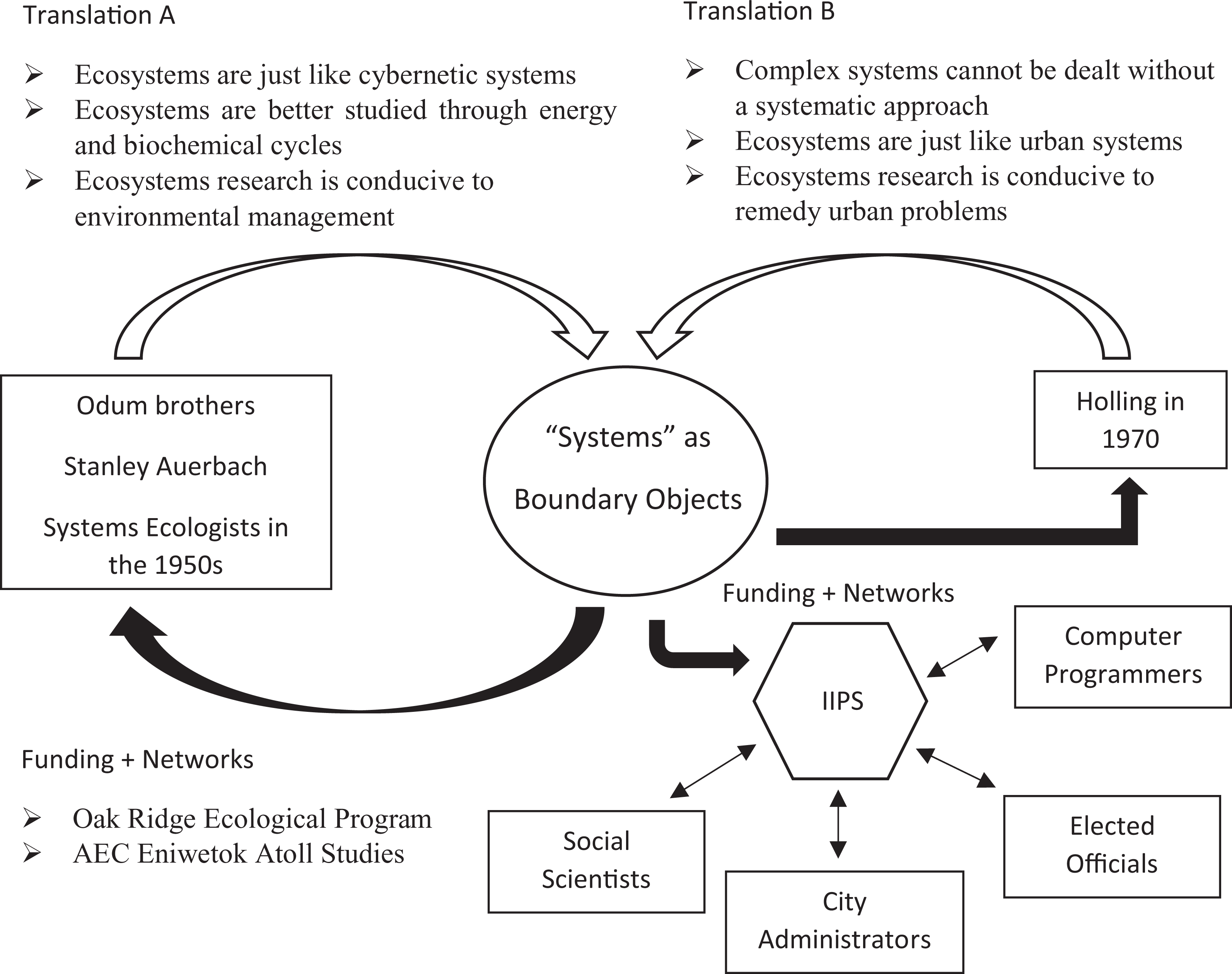
Network strategies of systems ecologists.
Assembling IIPS: The Platform and the Product
What is the relationship between boundary objects and the techniques designed to “discipline” the network that relies on these objects? Star and Griesemer’s paper used the works of ecologist Joseph Grinnell to elucidate this connection. Grinnell’s research on the evolution of the California landscape through scientific classification of species was impossible without the cooperation of diverse actors—his patron Annie Alexander, the collectors and trappers, the university administrators, and the animals themselves. The specimens became boundary objects which retained different meaning for different actors, and to ensure the “autonomy and communication between worlds” embodied by these objects, Grinnell devised “a clear set of methods to ‘discipline’ the information obtained” by nonscientist actors. 29 As the only ecologist in the network, Grinnell used the standardization of specimen quality to discipline other actors’ activities. He could then affirm his authority while enlisting other actors into his own research program.
Instead of a network stabilized by a set of standardized methods and expanded through those “disciplined” boundary objects, IIPS improvised, tested, and discarded multiple disciplinary techniques to accommodate its changing organizational structure. To approach this messy reality, I will study IIPS as primarily a platform where experts, government officials, and technoscientific objects could meet, clash, and influence the meaning of the “nature” of cities. In addition, IIPS the Platform was organized around a product—the computer model designed to simulate the dynamics of Greater Vancouver. As I will show, it is the connection and tension between “IIPS the Platform” and “IIPS the Product” that determines the rise and fall of the project.
A document nicknamed “The Proposal” offered a snapshot of the conception of the project. 30 Prepared in May 1970 by Holling and his collaborator, economic modeler Michael Goldberg, it started by highlighting the geography of Vancouver, especially its well-bounded topography, and the absence of large-scale planning projects in its history. Both factors, the authors suggested, made the region “rarely suited as a laboratory for studying urban systems.” 31 The Proposal then included a review of urban simulation studies in North America to explain the limitations of past projects. The pitfall in transportation planning, for example, came from an overemphasis on the road network itself: even if modelers could draft meticulous plans for a “highway system,” such a system remained a “subsystem of a total transportation system of the larger urban subsystem of the more general urban ecosystem.” 32
Subsequently, the Bay Area Simulation Study (BASS) served as an example of a more comprehensive and holistic simulation project. Created by a Berkley team which included Goldberg, BASS built a multimodel simulator based on a computer database of employment records, demographic data, and land use patterns. Designed for regional economic forecasting, BASS nonetheless failed to attract users from the local government due to a lack of collaboration between the academics and city officials. To remedy the flaws of BASS, the authors suggested that IIPS should incorporate a “continual feedback between hypothesis, model, and experiment” in order to create an interactive network between the modelers exploring policy options and the officials testing these alternatives. 33
As a result, IIPS was conceived as an experiment on institutional networks and interdisciplinary collaboration (Figure 3). Its early organizational structure included Holling and Goldberg as co-directors, the subgroups working on different simulators, and a “Core Group” which allowed academics and urban administrators to discuss the goals of the study. However, tensions between IIPS the Platform and IIPS the Product surfaced in this early stage. It was true that, at the Platform level, IIPS aimed to recruit as many “experts” as possible into the network, but since the mandate of the project was to construct the Product, that is, the urban simulator, those who challenged the primacy of computer models in the project were unlikely to join the Platform even if they were considered potential contributors.
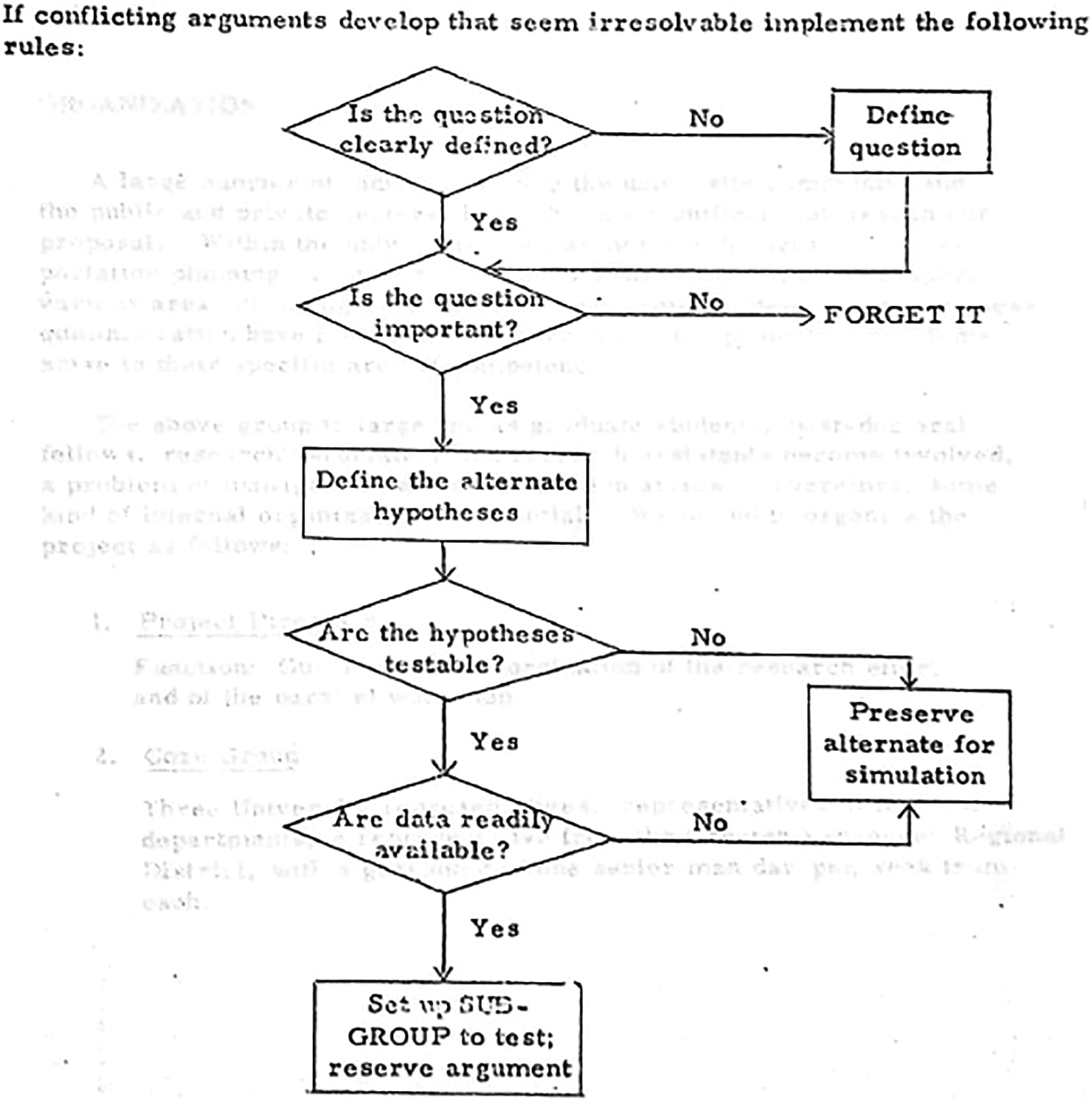
Flowchart for conflict management. Source: Michael Goldberg and C. S. Holling, “The Vancouver Regional Inter-Institutional Policy Simulator,” p. 8a, May 27, 1970, Box 10, Folder 7, Inter-institutional Policy Simulator fonds.
For example, the project had difficulty in winning support from the Department of Anthropology and Sociology. Although the Department Head, Cyril Belshaw, along with faculty members Dorothy Smith and George Gray, attended the “Open Meeting” held in June 1970, the Department remained reluctant to participate in the project in the following months. 34 A point of disagreement was the feasibility of using simulation models to study and forecast complex urban dynamics such as “quality of life.” As the modelers insisted on the centrality of computer simulation, a first set of “disciplinary technique” was invented to draw boundaries between those who agreed with the use of computer models in the creation of IIPS the Product and those who did not (Figure 4).
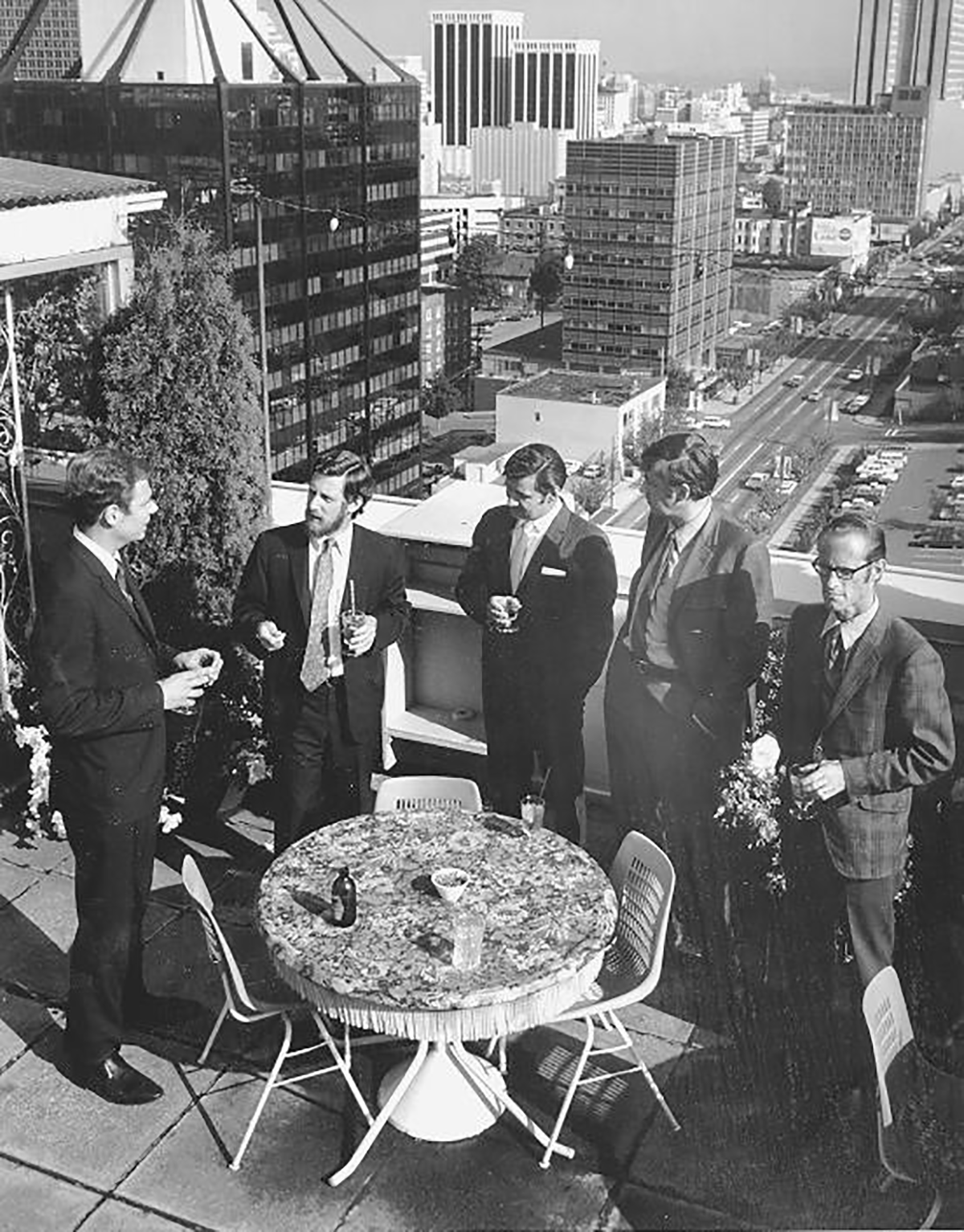
Group photo of regional computer model research team. From left to right: Drew Thorburn, William Curtis, Peter Leckie, Michael Goldberg, Crawford Holling. Unknown photographer. Source: University of British Columbia (UBC) Archives [UBC 1.1/13267].
How effective were such techniques? IIPS did succeed in attracting academics and graduate students who formed various “subgroups” and simulated different aspects of the city. These participants also treated IIPS the Product as a variety of boundary objects. As long as their agenda affirmed the importance of models, they could stay in their own subgroups and pursue activities that were translated as models or modeling: from writing computer codes to collecting social statistics, from drafting conceptual diagrams to chatting with city officials (Figure 5).
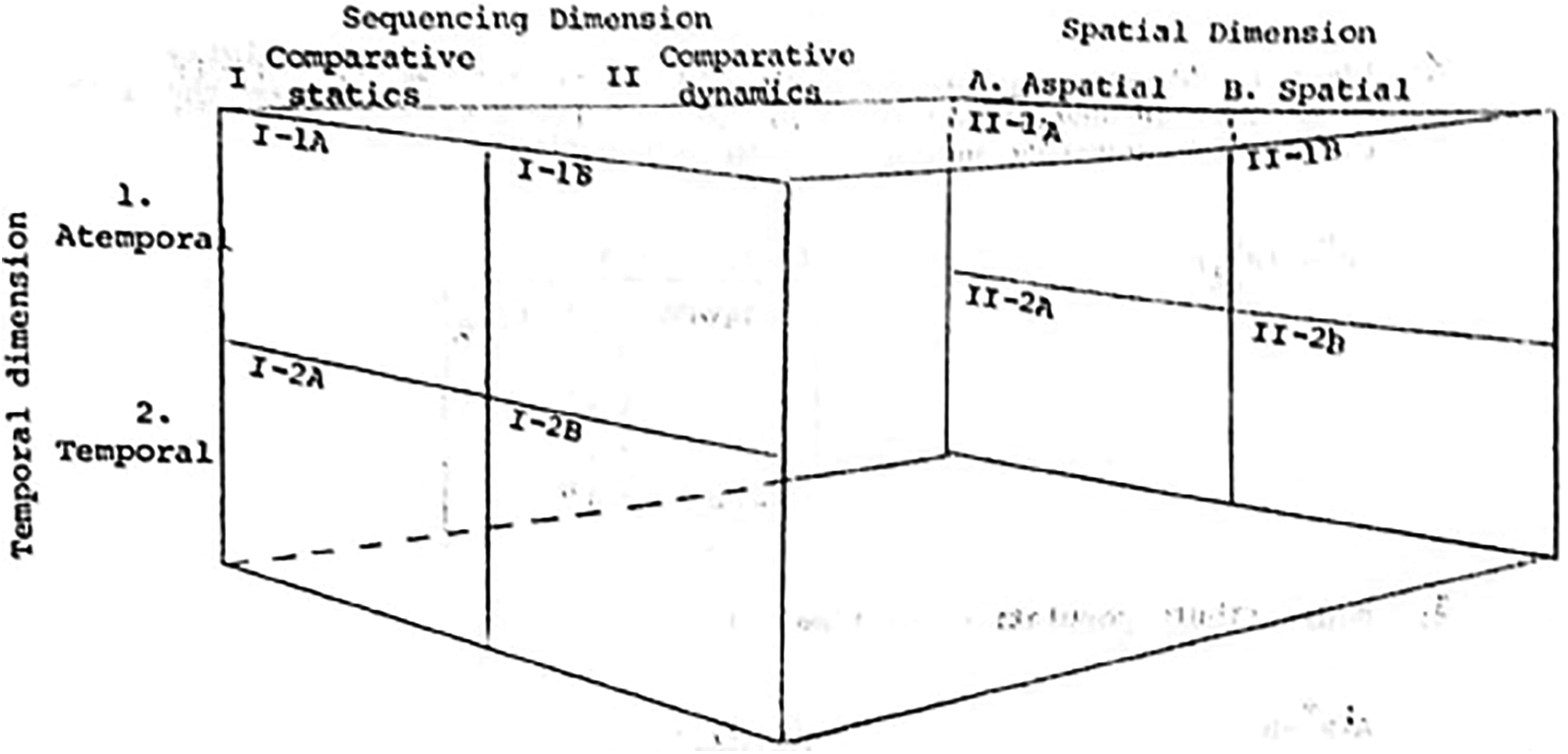
Conceptual diagram for Human Ecology submodel. It aimed to study the spatial, temporal, and sequential aspects of Vancouverites’ daily activities. Source: Robert Kelly, “Human Ecology Subgroup,” p. 12, November 1972, Box 3, Folder 5, Inter-institutional Policy Simulator fonds.
The project nonetheless faced several organizational challenges to create such a simulated urban system. How could one coordinate the subgroups and distribute tasks such as data gathering, modeling, and programming? What were the policy options useful to the local government? How could the project ensure the compatibility between various submodels simulating housing, population, and labor market? By 1972, these issues began to threaten the continuation of the project. If the first set of disciplinary technique assembled IIPS the Platform by encouraging participation while guarding the centrality of computer models in the construction of IIPS the Product, the second set of disciplinary technique emerged at a time of organizational crisis, and its focus was not so much on maintaining the Product as a boundary object than on preventing the collapse of the Platform.
In July 1972, the Core Group held a meeting in an attempt to clarify issues concerning “objectives of participating institutions, minimum standards for Core Group members, management versus advisory functions, and public participation and communications.” 35 After the meeting, the Core Group took over the project management and decided to hire a full-time communication manager to produce monthly operational reports as well as draft public-oriented programs. As a result, the Core Group enhanced its power mainly by creating a group of salaried staff whose job was solely to provide secretarial and programming services, but it did not recruit any planners to coordinate the research activities in the subgroups. The majority of modelers in IIPS remained volunteers who designed their own simulators, and the Core Group had little control over their research directions. To make things worse, in late 1972, a debate broke out within the Core Group concerning the relative merits of “studying carefully one or two runs of a highly disaggregated model” and “glancing at many runs of quick, highly responsive inter-acting models.” 36 Finally, the modelers decided to experiment on both kinds of models, which further delayed the development of the simulator. Goldberg later lamented that although IIPS “successfully avoided the product oriented pitfalls” of BASS, it “had fallen prey to a host of new process related dangers.” 37 To put it bluntly, IIPS had “too much concern for form” but “too little concern for, and support of, modeling activities.” 38
A paradox thus appeared. By shifting the focus away from the production of the simulator, the Core Group attempted to save the Platform through an (over-)emphasis on consensus and communication processes between the volunteer modelers. However, what this disciplinary technique actually achieved was the consolidation of the network of economic modelers and city managers within the Core Group. This consolidation did not solve the deeper problem in the Platform, in which the ties between ecologists and the rest of the project members became increasingly strained.
The Core Group’s failure to ensure effective communication between its economic and ecological modelers eventually forced Holling to resign from the project in late 1972. His reason to quit the project was twofold: one was his difficulty to recruit ecologists into the project and the other was the role strain he experienced as the director of both IIPS and the Institute of Animal Resource Ecology (IARE). The ecologists’ marginal position in IIPS was reflected by the fact that, among the eight modeling subgroups, only two of them—the health system subgroup and the pollution subgroup—included IARE faculty or students. This situation might be caused by UBC ecologists’ lack of interest in urban simulation, but it can also imply the overwhelming interest IIPS aroused among the economic modelers from the Faculty of Commerce and Business Administration. While the economic modelers at UBC may follow Holling’s lead to adopt the ideas of “boundary” and “resilience” in the studies of cities, their professional community remained largely separated from that of Holling’s. Besides, as a newly hired academic, Holling lacked connections to the elected officials and urban managers in Greater Vancouver or to the programmers and social scientists at UBC. Holling’s struggle to effectively communicate with participants from the economic-focused subgroups thus made it difficult to introduce more ecologists into a network saturated with economic modelers and their allies in local governments.
Moreover, despite his interests in urban problems, Holling was first of all hired as an ecologist to coordinate the nascent resource ecology curriculum at UBC, and IARE was the most important institution through which he connected with other ecologists and graduate students. As IIPS and IARE shared a computer lab, the two inevitably competed for hardware and software resources. 39 The computer-intensive projects Holling pursued easily became a source of conflict. For example, Charles Krebs, a mammal ecologist, protested that the IARE was “heavily committed to computing facilities” but not to “facilities for field ecology.” 40 Holling’s commitment to IIPS therefore threatened to disrupt his graduate courses and strain his relationship with colleagues. Seen in this light, his critique of IIPS during an IARE meeting—“programs like IIPS should be completely divorced from the Institute due to lack of surety of its success”—was understandable. 41 The second set of disciplinary technique thus strengthened the connection between economic modelers and city officials in the Core Group but ultimately failed to retain its ecological modelers in the Platform.
When Disciplinary Techniques Failed
“You have to have idealism in your system and the system has to be set up so that it will listen to the dreamers. But on the practical side of it you have to be awfully careful at what point you bring your ideals into a discussion and how you bring them in.”—Drew Thorburn in an interview with Gil Evans, Communication Manager of IIPS. 42
After the 1972 reorganization, IIPS was under the leadership of Drew Thorburn, a planner from the GVRD. In the beginning of 1973, the relationship between IIPS and its patrons appeared to be fairly good. Harry Swain, an economic geographer serving as liaison between IIPS and the MSUA—the federal agency which added a total of $375,000 to the budget of IIPS in 1972, suggested that MSUA would continue funding the project even if the local governments withdrew their support, since the virtue of IIPS was to allow “a general overview of what might happen under certain conditions.” 43 It seemed that the Core Group still had faith in the uniqueness of the project as both an intellectual experiment and a practical exercise. The struggle to discipline the Platform would be rewarded once the model was operational and the computer program fully developed.
According to Robert Kelly, a UBC marketing professor and the interim director before Thorburn’s appointment, organizational crises were “inevitable in a project such as IIPS” since its complicated and experimental nature was prone to “discouragement, recriminations, and an absence of clear-cut and easily-attained objectives.” 44 After the project survived the expansion, downsizing, and stabilization of its membership, Kelly believed that it was time for the participants to focus on practical model building and apply the model to real planning scenarios. Instead of discovering scientific truths about the “nature of cities,” the priority of IIPS was increasingly the fulfillment of the contract with its sponsors. The final set of disciplinary technique was thus the reorientation of the Platform’s research activities to sponsors’ expectations about IIPS the Product—a particularly difficult process for all technoscientific practices. 45
This set of technique turned out to be the least successful as the sponsors began challenging the management efficiency of the Core Group. A crisis broke out after Barry Wellar was appointed as the liaison between IIPS and MSUA in late 1973. A geographer specialized in aerial photograph, remote sensing, and computer models, Wellar, was well qualified to evaluate and appreciate the technoscience behind the IIPS. Nevertheless, he was disappointed with the communication procedures of the project, in which decisions were made frequently without consulting him or the MSUA. In sharp contrast with the relaxed attitude of Harry Swain, who was personal friends of several Core Group members, Wellar put a strong emphasis on standard procedures and organizational hierarchy. For example, when the Core Group decided to compensate Kelly’s volunteer work as the interim Project Director with an honorarium of $5,000, Wellar opposed this practice. 46 The Core Group nonetheless made the compensation without Wellar’s knowledge and greatly infuriated him.
Two additional communication-related controversies further damaged the trust between IIPS and MSUA: a surprise visit of William Armstrong, Deputy President of UBC, to MSUA, and the Core Group’s participation in a conference at the request of the Ford Foundation. Insisting that Thorburn should notify him in advance about these activities, Wellar warned that “IIPS’ hopes for success” depended on “frank and full disclosure on the part of all parties.” 47 From the Core Group’s perspective, Armstrong’s visit was a strategy to deepen the connection with the Ministry, and the Ford conference was a valuable opportunity to expand the inter-institutional network. For Wellar, these unreported actions reflected at best another sign of poor project management and at worst attempts to bypass him in the liaison with the sponsors. 48 In early 1974, tension between the two institutions rose to the extent that Thorburn demanded all “meetings and other conversation involving members of the Core Group, and in particular Barry Wellar” to be tape-recorded, and he cautioned that failing to do so may cause a disaster “equivalent of the Watergate tape fiasco” and “destroy whatever little credibility” IIPS retained with the Ministry. 49
Wellar’s criticism of IIPS subsequently extended from its management style to its technical accomplishments. As an external review called by MSUA was approaching, he requested complete project documentation, arguing that the reviewers should have “read and digested the materials” before they evaluated the simulator at UBC. 50 Wellar seemed to imply that without the model structures and computer programs examined in advance, the Core Group would exploit the simulator demonstration as a chance to impress those ill-prepared reviewers while obscuring technical flaws. Eventually, the progress review commissioned by MSUA was overwhelmly negative. It was unclear whether Wellar’s hostility toward Core Group had influenced the review team, but this forced disclosure of detailed research and management activities—and the mistakes made during the course—could have shaped some of the reviewers’ understanding of IIPS prior to the demonstration. In fact, one of the major criticism was precisely the lack of project documentation, which the review team considered a reflection of the shaky technical foundation as well as managerial deficiencies of the project.
Certainly, factors independent of the strained relationship between the Ministry and Core Group also contributed to the unfavorable review of IIPS the Product. For example, according to the review team, the substandard quality of the simulator was a result of Project Director’s inability to “set priorities, meet deadline [sic], and demand some measure of quality in the work produced” because of the “reliance on volunteers” to build the submodels. 51 This dependence on volunteers had been an issue since the conception of the project. As Thorburn would admit in the final report of IIPS, each “University Department was very reluctant to reward their staff for work done in IIPS because that work gained few papers or reports that could be reproduced under the name of that Department.” 52 Evidently, the consolidation of Core Group in 1972 had little positive effect on disciplining the volunteer modelers whose activities constituted the very foundation of IIPS the Product.
The failure to create a desirable Product is ultimately the failure of the Platform. As the review team argued, the Core Group had failed to engage in “areas of policy and longer range program planning” and largely ignored “the ‘inter-institutional’ policy aspects of IIPS.” 53 Specifically, the team criticized the Core Group for treating the inter-institutional collaboration as primarily a channel to highlight “the inputs/benefits from or for a particular contributor” even though the Group had “very little concern” over concrete questions such as “what do the research activities contribute to politicians’ and others’ understanding of policy processes” or “which policy issues are addressed by the submodels.” 54 This negative depiction was apparently also an accusation that held the Core Group solely accountable for the breakdown of the network between the various participants and organizations.
To add insult to injury, the review suggested that the fundamental cause of the failure to make IIPS relevant to urban planners was not only the lack of experiment on model application but also the fact that “an inter-acting set of models with sufficient sophistication” was basically nonexistent, and consequently the Core Group could not even “begin to contemplate testing policy impact,” let alone “begin to think about policy variables that would be related thereto.” 55 The reviewers were especially critical about the four submodels—Population, Economics, Land Use, and Transportation—that the Core Group had claimed to be fully functional and interactive (Figure 6).
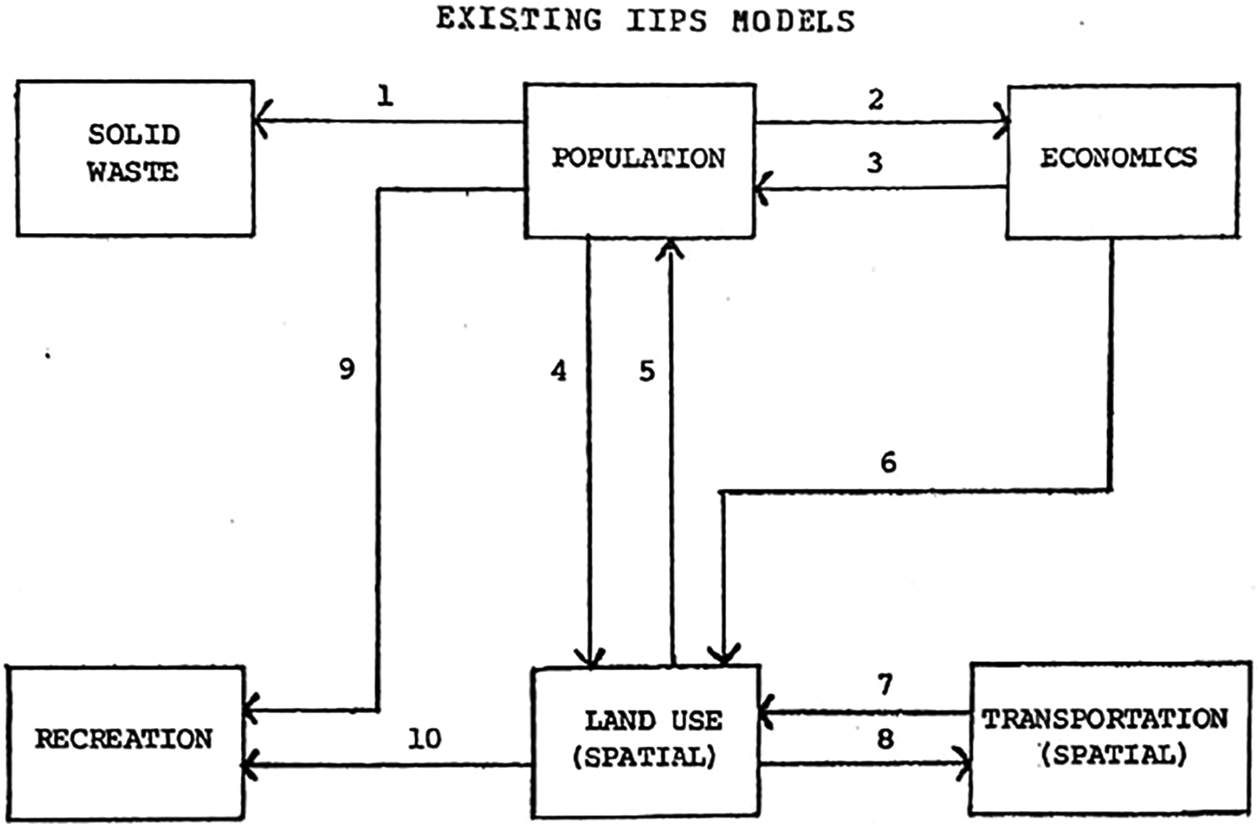
Inter-institutional Policy Simulator (IIPS) models before the termination of the project. Note that two additional models (Recreation and Solid Waste) are included in this version of simulator. Source: Doug Ash, “Using the Model,” p. 5, October 1974, Box 13, Folder 16, IIPS fonds.
First, the review team criticized that empirical data such as statistics of zoning areas and employment records were frequently missing, outdated, or uncalibrated and that the models relied on untested hypotheses and questionable assumptions. Flaws in submodels had made cross-model interactions—a key feature IIPS promised to offer—very unreliable. Failure to secure the reliability of the output from one model lead to the dysfunction of the other. Since a user had to calibrate these poorly constructed models with “exogenous” data, or values that were not produced by the models but collected or assumed by the user, the potential advantages of IIPS as a simulator based on multiple submodels were severely limited.
Among all the problems the review team mentioned, probably the most serious one was the fact that more reliable computer simulators had already been developed by private companies and governmental agencies. For the reviewers, it was unacceptable that the hundreds of thousands of dollars IIPS received was invested not in the “tighter management and accountability system” but instead in “a grad-seminar-writ-large.” 56 Their recommendations included reorganization of the Core Group, the employment of full-time modelers to replace volunteers, a complete clean-up of the substandard and incompatible computer codes, and more thorough project documentation. The verdict for Thoburn’s Core Group was passed: despite the efforts to reorient research direction, the compromise for practical objectives, and the struggle to repair the inter-institutional network, the diffusion of interests and a consensus-based management style produced only conflict and confusion.
Conclusion
In summer 1974, after the negative progress review and disputes among project members who were anxious over the fate of IIPS, the Core Group negotiated with the University and the Ministry to create a “phasing-down plan.” The computer infrastructure would remain at the University, existing simulation products would be “put to useful application by local authorities,” while the archived materials would offer “guidance to future projects of this nature.” 57 This phasing-down plan essentially frozen all ongoing activities of IIPS. The promise of IIPS—to capture and connect the different aspects of Vancouver as a holistic system and to unveil the hidden dynamic of cities—was broken, and the partially constructed simulation models found no user in the government. IIPS ended up as a parody of its inter-institutional ambition: as the phasing-down plan unfolded, the MSUA retrieved its funds, the municipal government seized the technical reports, and university departments got their faculty back for teaching and researching duties. The institutions that had created IIPS were united again in the last days of its existence. This time, however, it was the termination of the project that served their mutual interest.
Although the results of IIPS fell far short of the original vision, the institutional network assembled to launch the project did not completely disappear. For instance, Holling’s career after his stint in the IIPS highlights another kind of context in which “systems” can find their place. In 1973, he became a cofounder of the International Institute of Applied Systems Analysis (IIASA) and initiated the Ecology Project with a focus on simulation study of spruce budworm, a forest pest. An organization that brought together American and Soviet Union scientists, IIASA, promised tremendous networking and funding opportunities for systems scientists. 58 This endeavor to invent more precise and ecologically complex model made Holling drift away from his urban research program, but he did not simply revert to his old image of a Canadian entomologist enthusiastic about simulation. Instead, through the network of IIASA, Holling made his spruce budworm study an international paradigm case for environmental planning and management. 59 Harry Swain, who continued to work in the Canadian government after his brief stint in MSUA, also joined the IIASA in 1974 and remained a close friend of Crawford Holling.
As for IIPS modelers and planners, some of them started their own career in the municipal or provincial governments. The academics at IARE would be further drawn to Holling’s systems ecology and kept tinkering with computer simulation as a powerful tool for environmental planning. Many of these ecologists later collaborated with Holling in the writing of Adaptive Environmental Assessment and Management, a monograph commissioned by IIASA and now a widely cited document in conservation and resource science. 60 As in Jennifer Light’s research on how technoscientific objects and practices such as computers, operation research, and satellites had influenced US urban policies and imagination of cities in the 1960s, the bold ambition to incorporate computer technology in planning usually failed, but the institutional network between the government, industry, and academia still flourished.
To conclude, the “failure story” of IIPS demonstrates the importance of experts’ networking strategies in the creation and termination of an urban planning project involving university, multiple levels of government, and private foundation. The “systems approach” IIPS adopted, while reflecting ecologists’ intention to promote their expert status through mending the environmental and political problems of North American society, had failed not because of public hostility toward technocratic scientific practices but because of the experts’ own failure to maintain the network among the heterogenous array of actors involved in the project. It turned out to be difficult for the centralized, hierarchical ideal of systems analysis to accommodate the conflicting interests the academics and the government had retained.
Even though the project itself failed to deliver the promise of an “ecological” vision for cities, its participants have manifested, based on their belief in the power of systems sciences, what Sheila Jasanoff described as a “sociotechnical imaginary”—the “collectively held, institutionally stabilized, and publicly performed visions of desirable futures, animated by shared understandings of forms of social life and social order attainable through, and supportive of, advances in science and technology.” 61 Importantly, some of the participants of IIPS, such as sustainability scientist William Clark and ecological planner William Rees, became highly influential pioneers in developing concepts and practices of sustainable development and resilience planning. Thus, this article also highlights the importance for historians of science and of urban planning to focus on the interaction between ecologists and planners in projects like IIPS. What are the impacts of systems analysis, which remained dominant in ecology and urban planning in the early 1970s, on the formulation of later concepts such as “ecological footprints” and “ecosystem services”? Does the urge to quantify, analyze, and optimize the “nature” of cities persist in planning philosophy today? In the 1980s, the focus of academic ecology gradually shifted from cybernetic systems to the conservation of biodiversity and the sustainable management of resources, but the case of IIPS, as part of the history about the entanglement of ecology and planning, remains relevant to contemporary issues, such as the debates concerning the “social–ecological systems” models and the studies of community “resilience” in the face of environmental, climate, and public health crisis. To confront these challenges, we have to move beyond the computerized and simulated nature of IIPS and start to take seriously and negotiate with the complexities in our society that the models have failed to represent.
Footnotes
Declaration of Conflicting Interests
The author(s) declared no potential conflicts of interest with respect to the research, authorship, and/or publication of this article.
Funding
The author(s) received no financial support for the research, authorship, and/or publication of this article.
