




Abstract
Around 1970, the City of Berkeley briefly became an epicenter of radical experimentation in urban planning and design, directly stemming from the counterculture of the late 1960s. This essay examines the ideological and political emergence of Berkeley’s counterculture urbanism, arguing that its experiments left two important legacies in the history of planning. On the level of utopian thought, it articulated a clear alternative to mainstream capitalist urban development, or what Henri Lefebvre called “abstract space.” On the level of contemporary planning practices, it opened up still-unresolved conflicts, especially between localized environmental preservation and the abstract, economic demands for affordable housing.
Keywords
In the early 1970s, the City of Berkeley across the bay from San Francisco briefly became an epicenter of radical experimentation in urban planning and design. Rejecting both centralized, bureaucratic planning tools and dissolving normative distinctions between public and private space, activists proposed an alternative planning process that would devolve planning and urban design decisions to hyper-local neighborhood groups; promote the collectivization of urban land; and shift both administrative and design decisions to ad hoc committees and radical non-profit groups. The shape of this urbanistic vision took direct inspiration from the counterculture agitations of the late 1960s, and most explicitly from the 1969 occupation and building of Berkeley’s People’s Park, which informed its ideological template. This form of planning, which might accurately be dubbed counterculture urbanism, was relatively short-lived, at least in its most radical intention. Nevertheless, it left an important legacy in Berkeley and elsewhere that continues to resonate across progressive circles of urban planning and design. This paper examines the structural development and contradictory aftermath of Berkeley’s counterculture urbanism in the period between 1969 and 1973. Berkeley’s counterculture planning in the early 1970s exemplifies a significant rupture in the normative assumptions and politics of mainstream American planning practice around 1970. To some extent, it represented yet another wave of reaction against top-down bureaucratic planning that had been spearheaded a decade earlier by Jane Jacobs and by advocacy planners such as Paul Davidoff. 1 On the other hand, it went much further than these earlier revolts in conceiving of a completely alternative mode of urban land use and social governance.
The ideological shape of this counterculture urbanism emerged most explicitly in the pages of the underground press. In March 1970, The Berkeley Tribe, published an illustrated manifesto for a redefining the regulated zones of urban space and their social uses. The manifesto fundamentally questioned the block-and-street system, which had long been a commonplace of numerous American cities, including Berkeley, since the 19th century and which sharply demarcated proper private uses and narrowly defined public rights of way. Highlighting the ideological basis of what continued to be a tacit planning practice in American cities, they wrote: All land in Berkeley is treated purely as a market commodity. Space is parceled into neat consumer packages. In between rows of land parcels are “transportation corridors” to keep people flowing from workplace to market… the “efficiency of a consumer society depends upon neat distinctions between public and private space, between home, job and market. The more separate we become, the more the economy “grows,” and vice versa.
2
An accompanying before-and-after drawing suggests an alternative to this condition of abstract, commodified space. (Figure 1) The upper drawing depicts a group of three-story buildings: three large houses and a long, narrow apartment building, each on a separate lot and divided by fences. Cars dominate the wide, paved streets that converge on the corner of the block. The ‘after’ image shows the identical buildings, with roughly the same massings and exterior walls. However, everything around the existing building envelopes have been utterly transformed. The apartment building has acquired a rooftop park while two houses in the foreground have been physically joined together with the apartment building through a series of decks at the second and third floors. The fences have all disappeared, and the ground plane has been transformed almost beyond recognition. Except for one small cul-de-sac, streets and automobiles have entirely disappeared, now replaced by landscaped parks and garden plots. Buildings no longer sit on separate parcels but rather on a continuous network of pedestrian paths and pastoral landscape. In order for Berkeley to be transformed into such a city, the fundamental relations of private property, transportation, and commerce would need to be correspondingly altered. That, in fact, was the visual point of the image. The aim became one of disarticulating the city from what the counterculture called ‘the system,’ in fact, multiple interdependent systems: the system of bureaucratic master planning; the system of abstract real-estate exchange; the system of functionalist zoning; the system of private automobile transportation; the system of rationalized architectural production; and the system of spatial segmentation—between public and private, as well as between domestic and institutional. It was, in effect, a kind of pragmatic utopianism that sought to undo the spatial order of technocratic rationality, replacing it with a new kind of urban order. People’s Architecture et al, alternative housing plan, The Berkeley Tribe, March 13–20, 1970.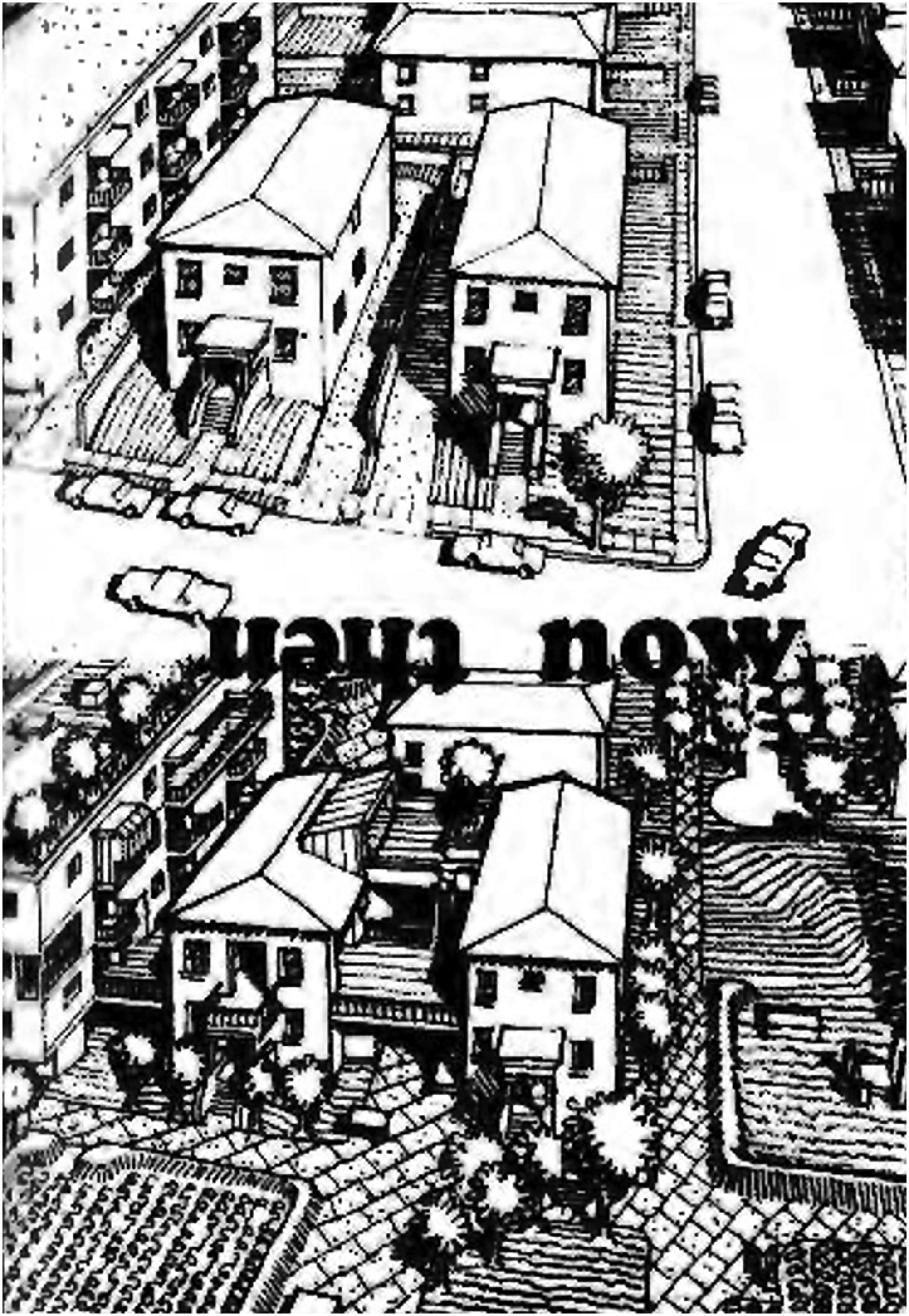
Scholars have frequently emphasized the special role of Berkeley as a center of leftist and counterculture radicalism in this period, famously sparked by the 1964 Free Speech Movement, the 1965 anti-Vietnam War protests, and the pivotal role in 1969 of People’s Park, the contested lot of undeveloped University land that became emblematic of struggles over free speech, neighborhood control, administrative authority, and the perceived failures of modernist urban design. 3 Geographer Don Mitchell, for example, has connected specific events surrounding People’s Park with questions about the “right to the city” and who comes to define and control public space, especially “as a political space that encouraged unmediated interaction, a place where the power of the state (and other property owners) could be kept at bay.” 4 Meanwhile, architectural and urban historians, such as Peter Allen and LaDale Winling have examined the role that People’s Park played in debates over campus planning, arguing that People’s Park marked a significant reversal in the acceptance or feasibility of modernist planning practices, especially insofar as the People’s Park occupation entailed a rejection of both urban renewal and modernist, institutional architecture. 5 Such accounts of Berkeley’s urbanistic radicalism, however, have tended almost exclusively to focus on the battle over People’s Park, without examining the radical urbanism that followed in the immediate wake of People’s Park itself. Generally, People’s Park has tended to be treated as a negation of architectural modernism and urban renewal planning rather than as the starting point for a new set of urbanistic paradigms emerging from the counterculture around 1970. Consequently, the alternative planning that followed in the wake of the People’s Park incident has frequently been forgotten or overlooked.
Addressing that gap, this essay builds on but also expands the scope of these earlier analyses of Berkeley’s radicalism and its effects on the built environment. Bringing new documents and sources to bear on the topic, it focuses on the larger utopian aims and spatial imaginary of Berkeley’s counterculture around 1970. At the same time, it contributes to the larger history of counterculture experiments in the built environment that have hitherto largely concentrated on the rural communes and the back-to-the land movement of the late 1960s and early 1970s. 6 This essay, by contrast, investigates a specifically urban variation on such counterculture interventions in the physical environment, a variation which brings it in necessary proximity to conventional city planning. The term “counterculture” referred in that period, both to a worldview and to an identifiable, demographic group of largely white-middle class youth who chose, with variable degrees of commitment, to resist or opt out of mainstream society and institutions. 7 In Berkeley, this counterculture overlapped in complex ways with other kinds of activism, generally identified with the “New Left,” who organized around civil rights, peace, and environmentalism. 8 For the counterculture activists in Berkeley around 1970, wider issues such as affordable housing and urban ecology were inextricably linked with community control over land and planning powers. Key to articulating these linkages and generating concrete proposals for a new kind of urban design were the advocacy groups and small-scale organizations that effectively formed a bridge between the free-form, anarchistic radicalism of the counterculture and the political institutions within Berkeley, such as Berkeley Planning Commission, but also to urban design discussions well beyond Northern California. Berkeley’s counterculture urbanism, as it emerged around 1970, I argue, left two important legacies in the history of planning. On the level of utopian thought, it articulated a clear alternative to mainstream capitalist urban development, or what Henri Lefebvre called “abstract space.” 9 On the level of contemporary planning practices, it opened up a series of still-unresolved conflicts, especially between localized environmental preservation and the abstract, economic demands for affordable housing.
The South Campus Crucible
The development of Berkeley’s counterculture urbanism was intimately connected with both its student radicalism and its metropolitan geography. A medium-sized city of approximately 120,000 residents, situated across the bay from San Francisco and bordering the port city of Oakland on the south, Berkeley in the 1960s had a dual identity. It was both a university town, driven by the economic and institutional demands of the University of California at its center, and an independent municipality with a strongly suburban character, being connected to various commuting patterns across the Bay region. Commuter connections had been gradually developing, first with the completion of the Bay Bridge to San Francisco in 1936, followed by the opening of the 880 freeway to Oakland and San Jose in 1957.
10
By the 1960s, construction was also underway in Berkeley for three commuter rail stations of the Bay Area Rapid Transit (BART) system. The 1968 amended Berkeley Master Plan called for “high intensity uses above and immediately adjacent to the new stations.”
11
(Figure 2) Meanwhile, the University of California’s Berkeley campus had been developing rapidly since 1945, both from infusions of Cold War government spending and a growing student enrollment. Although there was also a small downtown commercial core and other few local industries, their interests were increasingly overwhelmed by the University on the one side and the residential neighborhoods on the other. “Land Use,” Highlights of the Berkeley Master Plan (Berkeley: Berkeley planning department, November 1968): 2.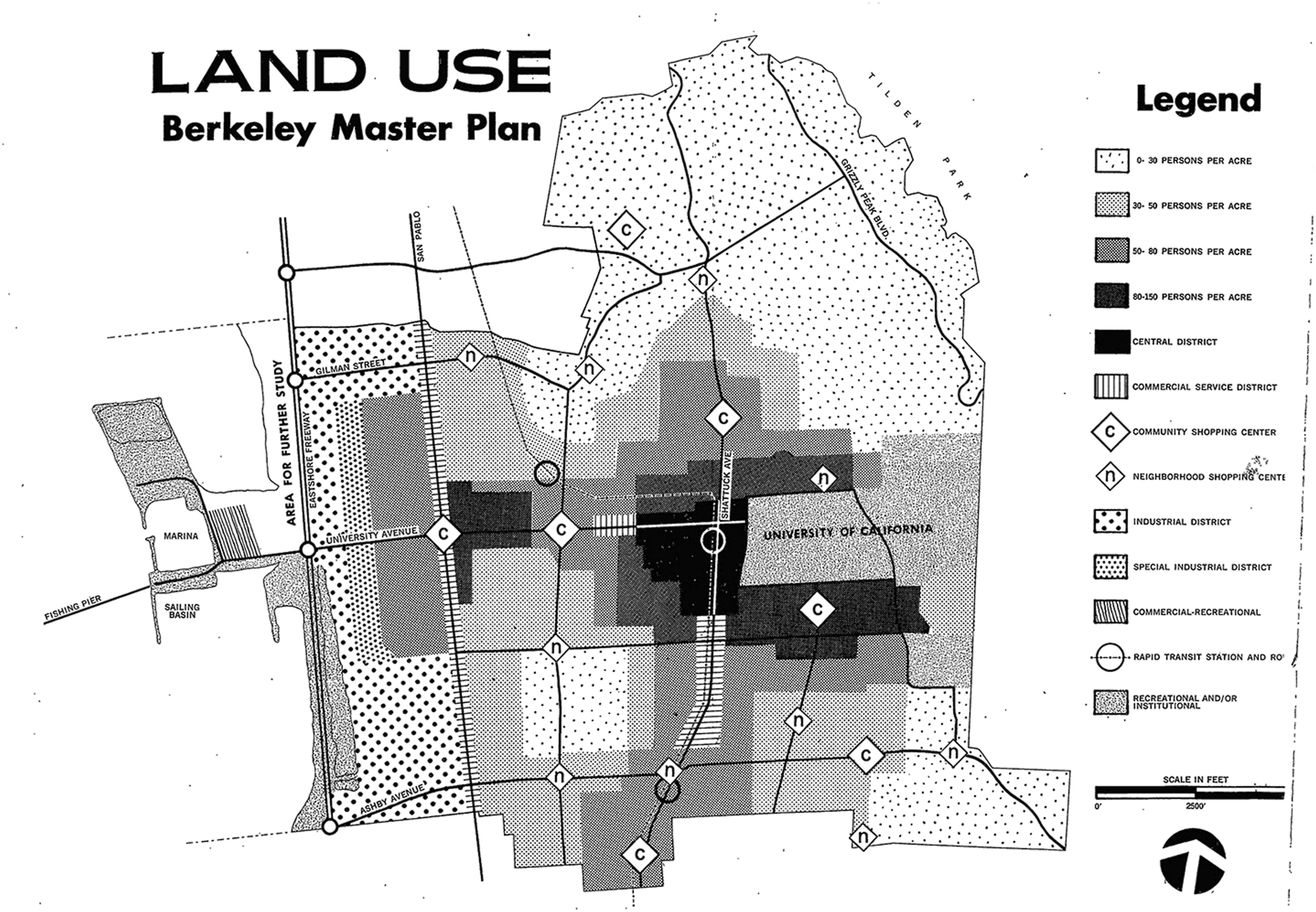
The geography of these residential neighborhoods was also quite distinct, creating zones of differing political interest. The most obvious split was the historical division between the neighborhoods around and above the University campus in the eastern foothills, with its wealthier, professional population, and the western flatlands by the bay, with its modest middle-and-working class bungalows. The city was also differentiated north to south, with middle-and-upper-middle class neighborhoods situated north of the campus and the poorer, more industrial neighborhoods lying along the southern border with Oakland. The African American population, 25% of the total in the 1960s, was heavily concentrated in the southern-and-westernmost sections of the city. 12 At the intersection of these various geographies lay the South Campus neighborhood, with its large, slightly worn Victorian and shingle-style houses. Already in the 1930s and 40s, the South Campus neighborhood had begun gradually transforming into a bohemian student neighborhood. Many of the houses had become subdivided into apartments, and most were, by the 1960s, owned by absentee landlords. More recent small apartment buildings, often on narrow lots, had also increased the population density of the area over time. Demographically, the neighborhood had become populated not only by students in search of cheap rent but also by bohemian free-thinkers, artists, and small merchants attracted to its distinctive cultural and intellectual atmosphere.
The counterculture revolt against official planning in Berkeley began, unsurprisingly, in this South Campus neighborhood, which had assumeed its own identity as a radical counterculture enclave. 13 Both the demographic and visual appearance of Berkeley’s South Campus neighborhood shifted noticeably in the mid-to-late 1960s. Most publicly visible was the enormous migration of young, hippie dropouts who arrived from various parts of the country, attracted by the reputation of the San Francisco Bay Area and specifically drawn to the neighborhood’s commercial strip along Telegraph Avenue. In the chaotic wake of San Francisco’s 1967 Summer of Love, a number of hippies left the Haight-Ashbury neighborhood for the apparently more welcoming streets Berkeley. The area soon became famous, or else notorious, for housing the heart of Berkeley’s counterculture ghetto on the sidewalks of Telegraph Avenue, with its various bookstores, head shops, but also in the Victorian and Shingle-style houses, many of which were quickly becoming the sites for various kinds of experimentation in communal living. A group called the Provos created a “free store,” and the Berkeley Free Church advertised a switchboard and network of “crash pads” to assist the influx of homeless youth. Student activists, recently politicized by the 1964 Free Speech Movement and Anti-Vietnam War demonstrations, also sought refuge and alternative forms of organization in the same South Campus neighborhood. The demographic line between student and non-student fluctuated as students dropped out or graduated but sometimes remained in place to join the swelling ranks of the neighborhood’s counterculture. As a consequence of this volatile-but-productive mixing of New Left students and counterculture migrants, dozens of urban communes formed experimental affinity groups and alternative domestic formations, adapted to the Victorian and early 20th century frame houses on their rectangular lots.
Counterculture residents of the South Campus neighborhood, often expressing a sense of embattlement against the police and other authorities, were highly suspicious also of mainstream urban planning and real estate development. Such general mistrust soon translated into coherent political action. In one dramatic example, a splinter caucus of the Berkeley Peace and Freedom Party, calling themselves “Ecology Action,” intervened directly in the urban environment.
14
Engaging in a kind of guerrilla urban design, Ecology Action members arranged what they called “plant-in” at the corner of Dwight and Telegraph, near the commercial center of the South Campus neighborhood.
15
Not coincidentally, this was also part of the original “urban renewal” zone from the 1955 Berkeley Master Plan which was now being more gradually redeveloped for denser apartment buildings, the despised modernist “ticky-tackies” that many counterculture opponents assumed would be rented to commuting professionals, leading to gentrification and displacement. Highlighting the ecological waste associated with conventional housing and real-estate development, the building of this spontaneous park was also intended to bring urban residents out of their anonymous, consumer lives and into direct face-to-face relations. Ecology Action members carefully recorded the construction of the resulting “Chuck Herrick Peace and Freedom Park” through a series of photographs of the event, from its announcement and construction to its eventual demolition by a city bulldozer. In one particularly pointed image, a figure is shown covering up the real estate sign for the future apartment development with a new sign announcing the unauthorized park.
16
(Figure 3) Ecology action, photograph documenting the construction and demolition of the Chuck Herrick Peace and Freedom Park, dated May 1968, Bancroft Library, UC Berkeley.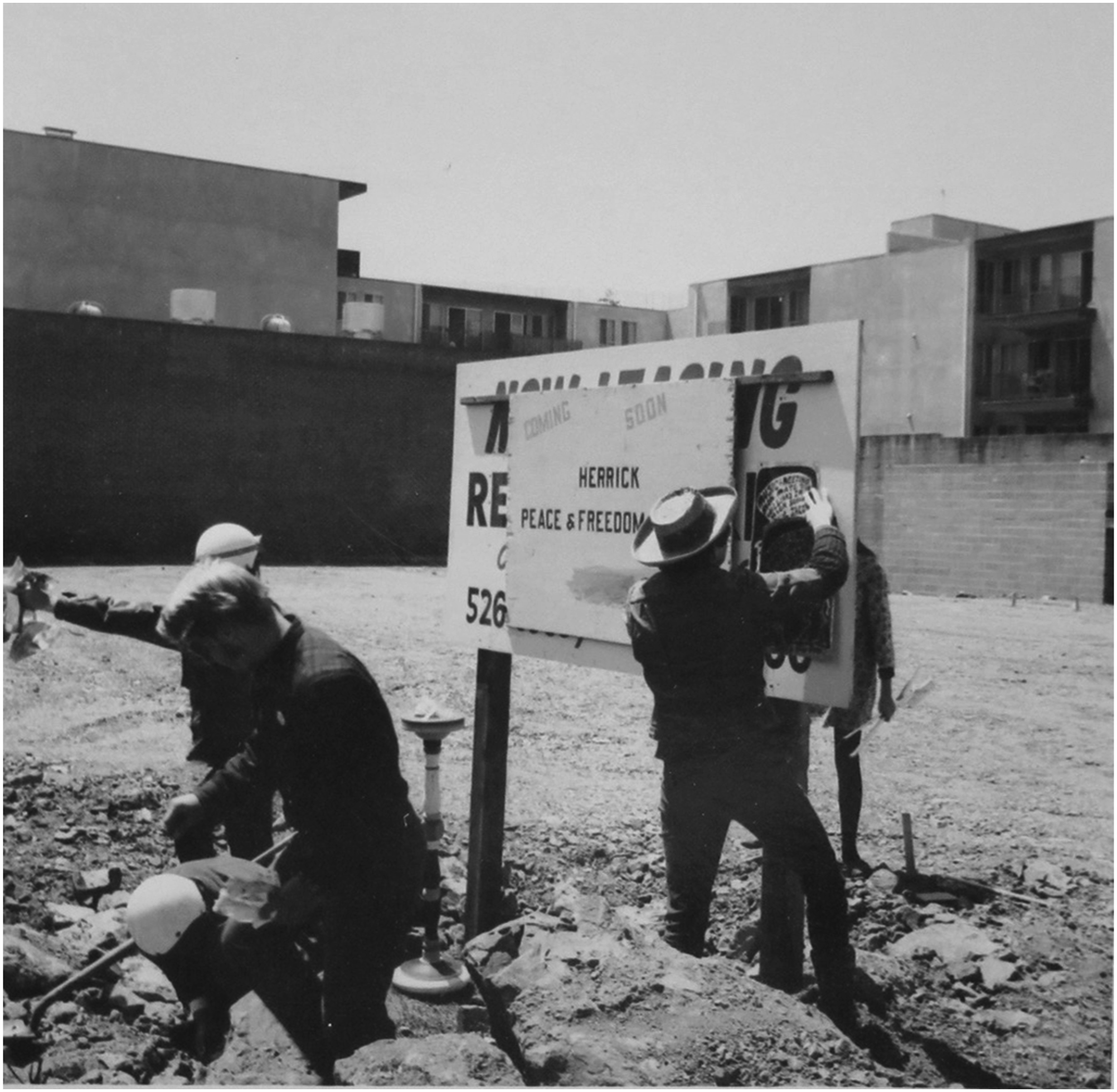
The rise of the activist, counterculture population in the South Campus neighborhood reinforced perceptions among many in the planning establishment and University administration that the South Campus neighborhood was “blighted,” a designation it had already received in the late 1950s, and that only the mass removal of so-called substandard buildings could generate urban order. University officials in the upper administration were also alarmed by mingling of the student and counterculture populations and sought to zone for what they deemed to be proper campus-related functions, segregating these functions from what they saw as a troublesome population of counterculture immigrants into the South Campus neighborhood. Administration officials relied for their authority on the 1956 Long Range Development Plan for the Berkeley Campus which called for new land acquisition in the residential areas to the south of the campus near Telegraph Avenue, as well as into the central business district. 17 As part of this plan, the University had already constructed a series of modernist dormitory blocks, which many students and counterculture residents alike viewed as unwelcome intrusions into the South Campus neighborhood. 18 Aligning with University administration goals, the Amended Berkeley Master Plan of 1960 had included the South Campus neighborhood as part of the “approximately half of the city’s residential areas” having “sufficient indications of substandard conditions to justify urban renewal action.” 19 In 1965 the University administration combined forces with the City of Berkeley in proposing a “South Campus Urban Renewal Plan” to greatly expand the footprint of the campus into the neighborhood, as well as adding new public parking facilities, driving a new street through the neighborhood, and increasing the minimum lot sizes.
Opposition to the South Campus Renewal Plan quicky arose from three interlocking constituencies: neighborhood merchants concerned about displacement; a coalition of new left and counterculture activists desiring to carve out what they called a ‘liberated space’; and radical planners and architects, many of them from UC Berkeley’s College of Environmental Design who sought alternatives to mainstream urban design. In a surprise vote in 1966, the Berkeley City Council, petitioned by a coalition of traditional local merchants and counterculture activists, voted down the urban renewal plan, leaving the university to re-make the neighborhood exclusively with its own funds. 20 The University administration then moved unilaterally to push through a modified urban renewal scheme that would result in the notorious battle over the future of Block 1875-2, between Dwight Way and Haste Streets, just east of Telegraph Avenue, which soon came to be known as “People’s Park.” Citing problems of crime and so-called blight, university officials hoped to create a cordon sanitaire between the main university campus and the counterculture neighborhood at its gates. 21 Using eminent domain, the University acquired the critical lots between Dwight Way and Haste Streets, evicting its residents and demolishing its buildings, mostly the large Victorian and Shingle-Style houses preferred by the student and counterculture population alike. 22 The eviction and demolition thus left a gaping hole, in what many, not without reason, perceived to be a community under siege. Filled only with compacted earth and rubble, Block 1875-2 served as an informal parking lot from late 1967 to early 1969.
In spring 1969, a group of counterculture radicals took out an advertisement in the Berkeley Barb, announcing that a park would be created on the site of the University lot by whomever showed up, willing to labor both physically and imaginatively. Prefiguring later and more ambitious proposals, the announcement suggested that out of this spontaneous convergence of individuals some coherent communal order might emerge, beyond simply the addition of a new park: “We could have a child care clinic or a crafts commune which would communicate its wares by having medieval-style fairs, a baseball diamond, a rock concert, or a place to think and sleep in the sun.” 23 As thousands of people converged on the site, including many students, often enduring hours of difficult physical labor for the collective thrill of the event, optimistic observers found reason to believe that a grassroots urbanism might supplant official planning. Like the smaller scale Peace and Freedom Park of the previous year, the ad hoc building project was seen as a way of constructing, not just verdant space, but also a new kind of community. The often-difficult volunteer labor was felt by many to be liberating precisely because it seemed unalienated, self-directed, and creative. 24 This first People’s Park experiment came to a dramatic end only 3 weeks after it had begun. On May 15th, the University administration erected a fence around the site of People’s Park in the early morning hours, and police evicted those who remained as trespassers. The notorious street battles between protesters and police that followed in its immediate wake quickly became international news. 25
Over and above its symbolic importance in the struggle between the University administration and the countercultural stronghold in the South Campus neighborhood, People’s Park remained for many radical activists only a small part of a much more ambitious project, namely, to remake the City of Berkeley into the spatial embodiment of an egalitarian, communitarian city—in direct opposition to the ‘establishment’ order of institution, family and private property. The best known articulation of this ideal counterculture model was the “Berkeley Liberation Program,” which was published anonymously in the May 30th issue of The Berkeley Barb and attributed to Stew Albert, Tom Hayden and other New Left activists hoping to leverage political momentum around People’s Park for a more wide-ranging revolution. 26 One of the central tenets of the Berkeley Liberation Program was the aggressive assertion of what planners, especially on the left, called “community control”: “We shall create a genuine community and control it to serve our material and spiritual needs.” 27 Community control would entail, in part, the re-shaping of physical space: “We will make Telegraph Avenue and the South Campus a strategic territory for revolution…We will create malls, parks, cafes and places for music and wandering.” Echoing both the militancy of such New Left groups as the Black Panthers and the drop-out, anti-establishment rhetoric of the counterculture, The Berkeley Liberation Program emphasized mutual-self-help and small-scale alternatives to corporate capitalism and the nuclear family. Thus, the 11th point, under the heading “Soulful Socialism,” asserted: “We will find ways of taking care of each other as comrades. We will experiment with new ways of living together such as communal families in which problems of income, childcare and housekeeping are mutually shared.” 28 Through a rhetoric of community control that connected localized urban spaces with altered forms of institutional, family and property relations, the Berkeley Liberation Program effectively extended the revolutionary claims of People’s Park, in terms of collectivized, anti-institutional urban planning, to the larger space of the surrounding city, including its patterns of housing, business and recreation.
Counterculture Design and Neighborhood Politics
Shortly after the National Guard erected the fence around People’s Park in May 1969, activists shifted their attention to a lot several miles to the northwest where a long strip of newly vacant land soon provoked another flashpoint between activists and the planning establishment. The land in question was no longer University property but rather that of the Bay Area Rapid Transit (BART) Authority, whose construction activities had led to another swathe of vacant land. In order to build the shallow tunnel for the North Berkeley station, the Bay Area Rapid Transit Authority had proceeded, via eminent domain, to demolish a long line of houses along several blocks, digging trench for the tunnel and then covering it up again, with expectation that the land would be profitably redeveloped with dense apartments. The activists soon began constructing a new park on a part of this site, which they dubbed the “People’s Park Annex.” The occupation and building of the People’s Park Annex shifted the center of gravity for urbanistic experimentation from the South Campus Neighborhood to the North Berkeley Neighborhood where anti-gentrification politics combined with fierce advocacy for local community control. A newsletter published by the North Berkely Neighborhood Council in 1970 described the local neighborhood activist efforts to maintain the Annex: “securing an agreement: they persuaded the BART board to allow this land to be, for the interim, a user-developed park.” The same newsletter goes on to describe residents’ fears of displacement and their lobbying Berkeley City Hall to maintain the strip of land for “civic, housing, and aesthetic uses” and opposing “the interests of land speculators attracted by the vacant BART lands along Hearst Avenue.” 29 While sharing much of the same enthusiasm and ideals of the first People’s Park, the Annex builders encountered much less publicity and police resistance as the Bay Area Rapid Transit Authority, which continued to own the land, refused to evict the occupiers or take any immediate action to develop the Annex site. In addition to its negotiation with BART over the interim use of the land, the North Berkeley Neighborhood Council engaged a group called People’s Architecture in order to render “a proposal for use of the BART lands,” following extensive discussions with local residents and neighborhood groups. 30
Founded in 1969 by a group of young, idealistic architects, planners, and political scientists—many of them recent graduates of UC Berkeley—People’s Architecture acted as an ad hoc neighborhood redevelopment agency, organizing local residents; lobbying against the construction of new, speculative apartment buildings; and proposing alternative urban designs. In summer and fall of 1969, representatives of People’s architecture voiced their opposition at Berkeley City Council meetings, specifically against proposed plans to widen Hearst Avenue and to permit the BART District to sell the vacant land for profitable apartment development. Echoing the counterculture critiques of Berkeley’s “ticky-tackies,” People’s Architecture published a flier, posing the stark choice “Parks or Profit” and suggesting that the apartments and street-widening would benefit BART and new commuters at the expense of existing residents. (Figure 4) As part of their work for the North Berkeley Neighborhood Council, whose members broadly shared counterculture sympathies, People’s Architecture also developed a comprehensive proposal for the entire strip of BART land, including the area around the People’s Park Annex, stretching along the east-west axis of Hearst Avenue. Known as the Hearst Community Plan, it proposed three phases of gradual development, combining: parks with cul-de-sacs; low-rise, affordable housing; a medical facility; a variety of co-ops, sharing childcare and a communal kitchen; and an open-air market.
31
People’s Architecture, flier circa 1969, BOSS Archives, Berkeley Public Library.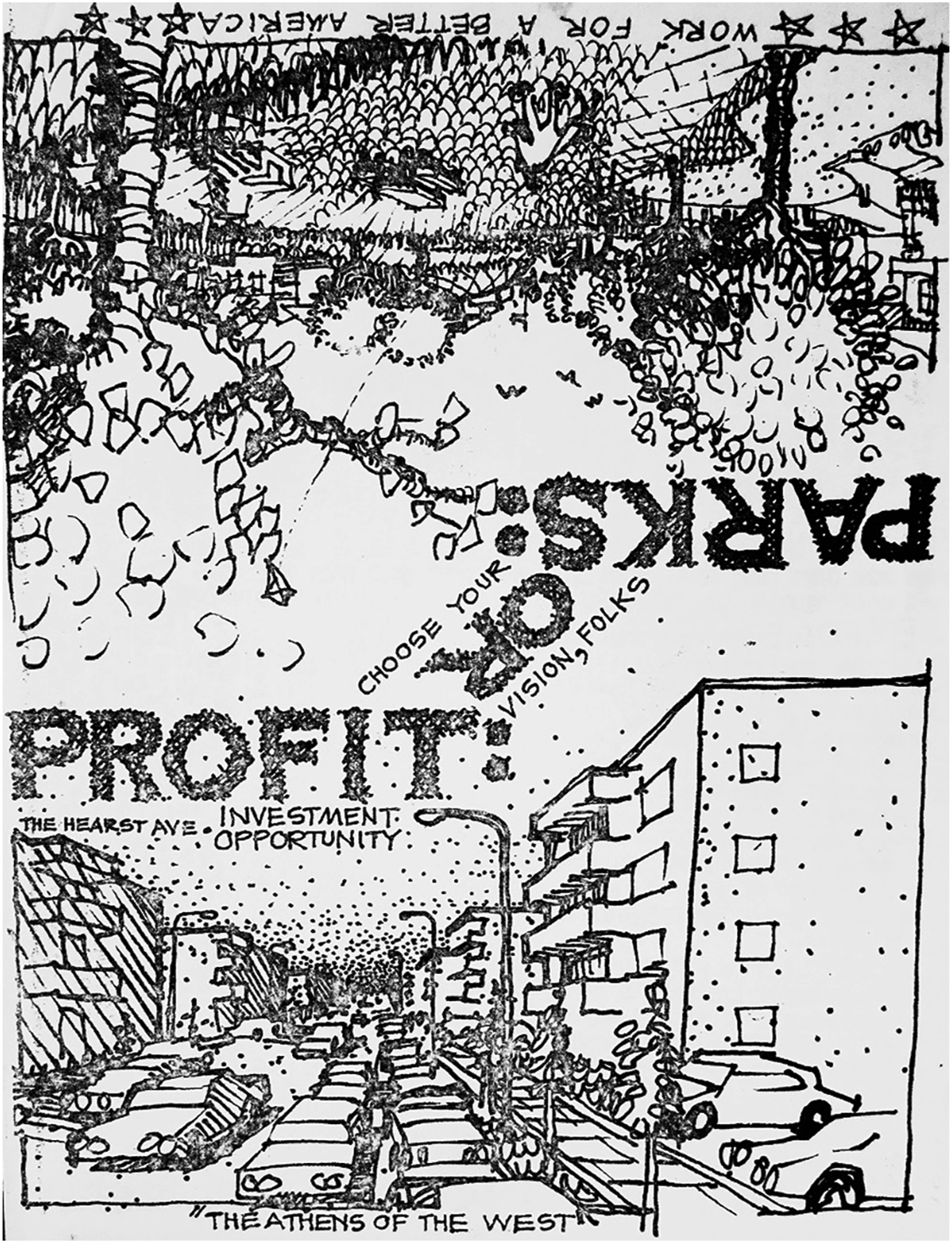
Drawings for the Hearst Community Plan, prepared by People’s Architecture, then appeared in the 5 December 1969 issue of The Berkeley Tribe. The drawings depicted the Hearst Avenue strip, including the avenue itself, developed as a park-like environment, incorporating the existing People’s Park Annex at the center.
32
(Figure 5) Buildings of different shapes and sizes, including an irregular cluster of row houses suggest a kind of collaborative building effort in which the distinctions between park and city, public and private begin to dissolve. The People’s Park Annex at the center now expands into Hearst Avenue and an adjacent cross street, completely filling in the intersection. The adjoining, partial geodesic dome, suggests a public performance space or covered market. Cul-de-sacs with diagonal parking spaces penetrate towards the former intersection, creating a mixed-use superblock. On the opposite side of the People’s Park Annex, another cul-de-sac leads towards a row of communal townhouses, set slightly askew from the surrounding grid. Unlike the superblocks of mid-twentieth century modernism, the Hearst Avenue proposal acts, not as a tabula rasa, but rather as a kind of variegated infill of the existing urban fabric. All the existing surrounding buildings are retained. The most dramatic changes occur, not in the architectural fabric, but rather in the conventionally zoned functions and boundary lines at the ground plane. The street grid is no longer a continuous transportation network but rather a variable pattern of asphalt, pedestrian paths, and parklike plantings. Sidewalks are no longer just limited to the periphery of streets, and parks are no longer simply green blocks designated as recreation. Whereas the conventional zoning of streets, sidewalks, private lots, and individualized housing units facilitated anonymous forms of labor and consumption—commuting to a job while renting or owning a private living space, People Architecture’s ambiguous and flexible ground plane seemed intended to facilitate common stewardship and mutual economic cooperation. In effect, the Hearst Community Plan offered an initial test case for the ways in which activists might concretely extend the idea of People’s Park to the city as a whole. People’s Architecture, Hearst community plan, The Berkeley Tribe, December 5–11, 1969.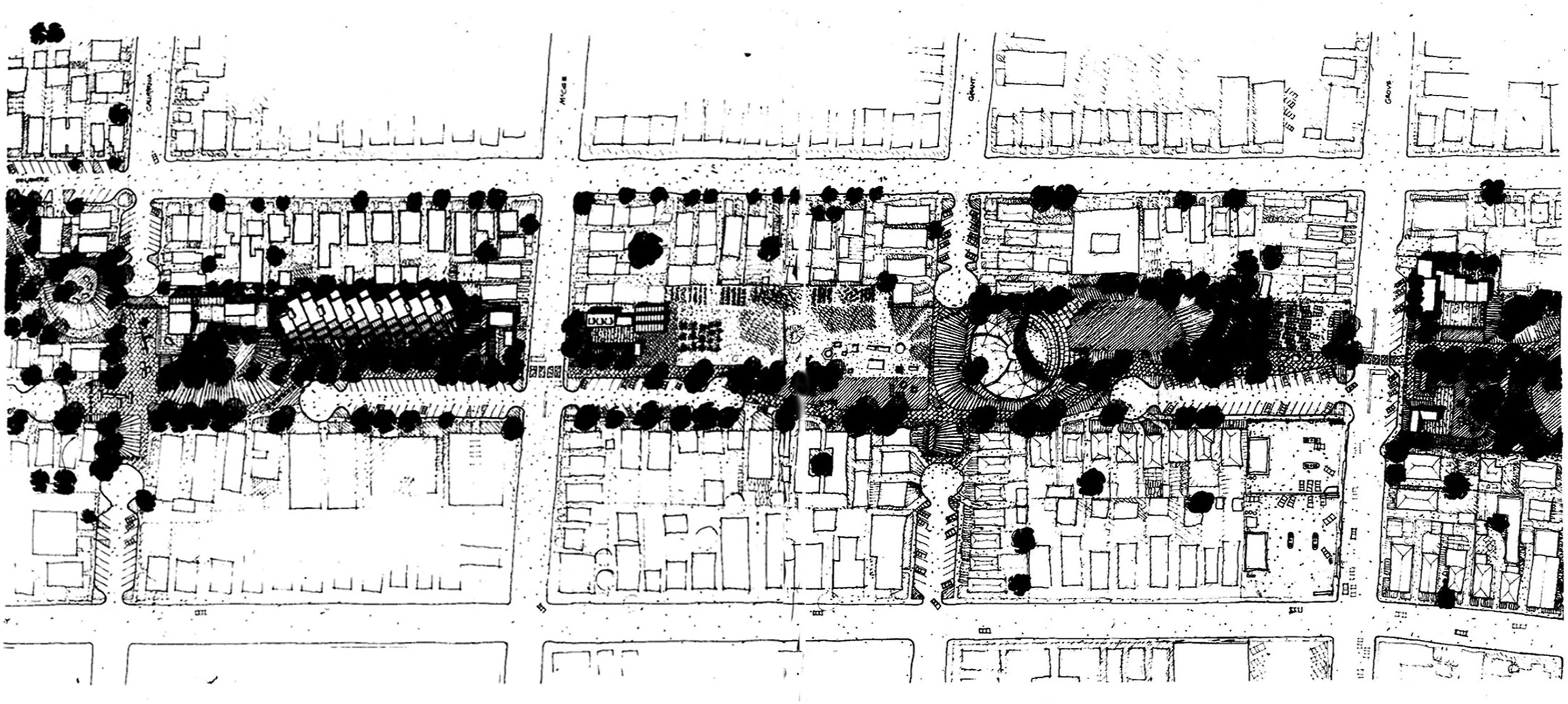
Counterculture Urbanism as Social Space
Counterculture activists, including members of People’s Architecture, continued in the meantime to press forward an urbanistic agenda that would completely circumvent any kind of official planning mechanisms or planning agencies. The distrust of government bureaucracies and official planning mechanisms deemed to be “establishment” was, in fact, a core identifying feature of the counterculture more broadly. Many participants in the counterculture in Berkeley and elsewhere believed that that they were on the vanguard of a spiritual, political, and ecological revolution that required withdrawing from and refusing to participate in a mainstream society that they judged to be irredeemably corrupt. This distrust of institutions of all sorts, especially of hierarchical and impersonal bureaucratic institutions, resulted in an inward turn towards small groups of like-minded counterculture activists. 33 Cooperative, personal, egalitarian, face-to-face communication was preferred to expertise delivered from official sources and mainstream media. For the counterculture planner-activists in Berkeley, this inward communitarianism then manifested itself in hyper-local interventions, emphasizing neighborhood control and the socialized use of urban space. This cooperative, collective form of urbanism was not merely a utopian projection on the part of the People’s Architecture and other activist groups. It reflected concretely the countercultural organizations that had sprouted up in various Berkeley neighborhoods at the end of the 1960s as a way of rethinking collective life outside the abstract space of bureaucratized capitalist society and real estate speculation. In 1970 several activist groups, including People’s Architecture, Ecology Action, the Berkeley Tenant’s Union and the Berkeley Food Conspiracy, a non-profit food cooperative, attempted to formulate what a counterculture urbanism might actually look like on the ground if it were allowed to proliferate across the city.
The result of this collaboration was the 4-page manifesto, briefly introduced at the beginning of this essay. First published in 13 March 1970 edition of The Berkeley Tribe under the title, “… And But for the Sky, There Are No Fences Facing” – taken from the Bob Dylan song, “Mr. Tambourine Man,” the manifesto was clearly addressed to a counterculture audience who would be already prepared to accept many of its more radical premises. Beginning with the sentence – “People’s Park was the beginning of the revolutionary ecology movement” – its text clarified that this revolutionary practice would be outside of, if not antithetical to, the dominant modes of urban planning: “With the park we demonstrated that through communal, democratic and spontaneous development, we could make much better use of resources than the system.”
34
The introductory section pitted the experiences around the building of People’s Park against the combined forces of UC Berkeley’s campus planning and the City of Berkeley’s current Master Plan. The environmental “rape” wrought by overbuilding and traffic was here connected with the destruction of counterculture housing and communities within Berkeley’s neighborhoods, especially in the South Campus: The master plan will put 50,000 more people into Berkeley during the next 10 years…The rapists are trying to institute a sanitizing program of cultural genocide on the South Campus: Drive out the longhairs, tear down the brown shingles, and put up plastic ticky-tackies for the technocrats…The projection along the BART strip is for new highrise apartments for commuter swingers …
34
Survival against these forces entailed both preservation of the existing architectural fabric (e.g., the “brown shingles”) and dissolving the boundaries of private property that kept this fabric divided into small parcels.
The manifesto was wide-ranging in its specific proposals, attempting to connect together issues of architecture, zoning, transportation, economics, politics and culture in to a single overarching model of urban space that could potentially be applied to many different locations across the city. The section under “shelter” elaborated on proposals to demolish walls and floors that separated different units of existing buildings, especially the newer, ‘ticky-tacky’ apartment buildings, “whose assumptions don’t relate to our community” and to create space “arranged to encourage communalism.” Meanwhile, the section under “Land,” condemned the functional divisions of space, especially between private lots and public streets dedicated to automobile traffic. The manifesto offered concrete suggestions for bridging together buildings, removing fences, and replacing pavement and asphalt with soil and plants. This communalization of neighborhood land also presupposed a partial withdrawal from the mainstream economic networks of production, consumption, and transportation. The section on “Food,” therefore, emphasized the Food Conspiracy as a non-profit cooperative alternative to the supermarket and use of neighborhood land for urban farming. Similarly, the section on “Transportation” promoted the avoidance of commuting: “Try and localize as much of your living as possible.” Finally, the section on “Community Services” proposed organizing localized, semi-volunteer alternatives to mainstream, large-scale institutions: “that small groups of neighbors mobilize resources and energy in order to cement fragmented neighborhoods back together and begin to take care of business (from childcare and first aid to political education) on a local level and in an integrated way.” 34 Thus, the manifesto clearly recognized that the physical changes in the built environment—the removal of walls or fences, and the repurposing of streets—also necessarily entailed a general social movement towards hyper-local collectivism. Optimistically, it assumed a wider dissemination and acceptance of counterculture values citywide.
After denouncing both the atomization of individuals in tiny apartments and the profit-driven division of real estate, the manifesto began also illustrating this alternative urbanism, based on localized mutual aid and adaptive reuse of the existing urban fabric.
35
The spatial transformation of several typical streets and blocks is then depicted in another “before and after” drawing. (Figure 6) The most dramatic transformation is that of the streets themselves, which are reduced from a uniform gridiron of cars and pavement to a single through street and one cul-de-sac. Former streets and intersections, losing their strictly separate boundaries and functional uniformities, become a patchwork of paved paths, gardens, and small parks. Houses and apartment buildings, now connected by bridges, begin to lose their individual identities. As the buildings join together around the former block peripheries, they create patterns of semi-enclosure in the centers of the blocks. Physical adjacency, it is suggested, becomes the basis for communal cooperation, creating patches of urban land that are neither abstractly public, in the sense of modernist “green space,” nor entirely private, in the sense of traditional back yards. Rather, the drawing suggests a matrix of community-tended land whose ownership and mode inhabitation appear both differentiated and porous. A large arrow labels one of the buildings near the center as a “lifehouse.” Coined by the group Ecology Action to signify a corner house that is partially transformed into an ecological resource center, the lifehouse here reappears as a generalized neighborhood center, as part of countercultural system of local self-governance. People’s Architecture et al, alternative block plan, The Berkeley Tribe, March 13–20, 1970.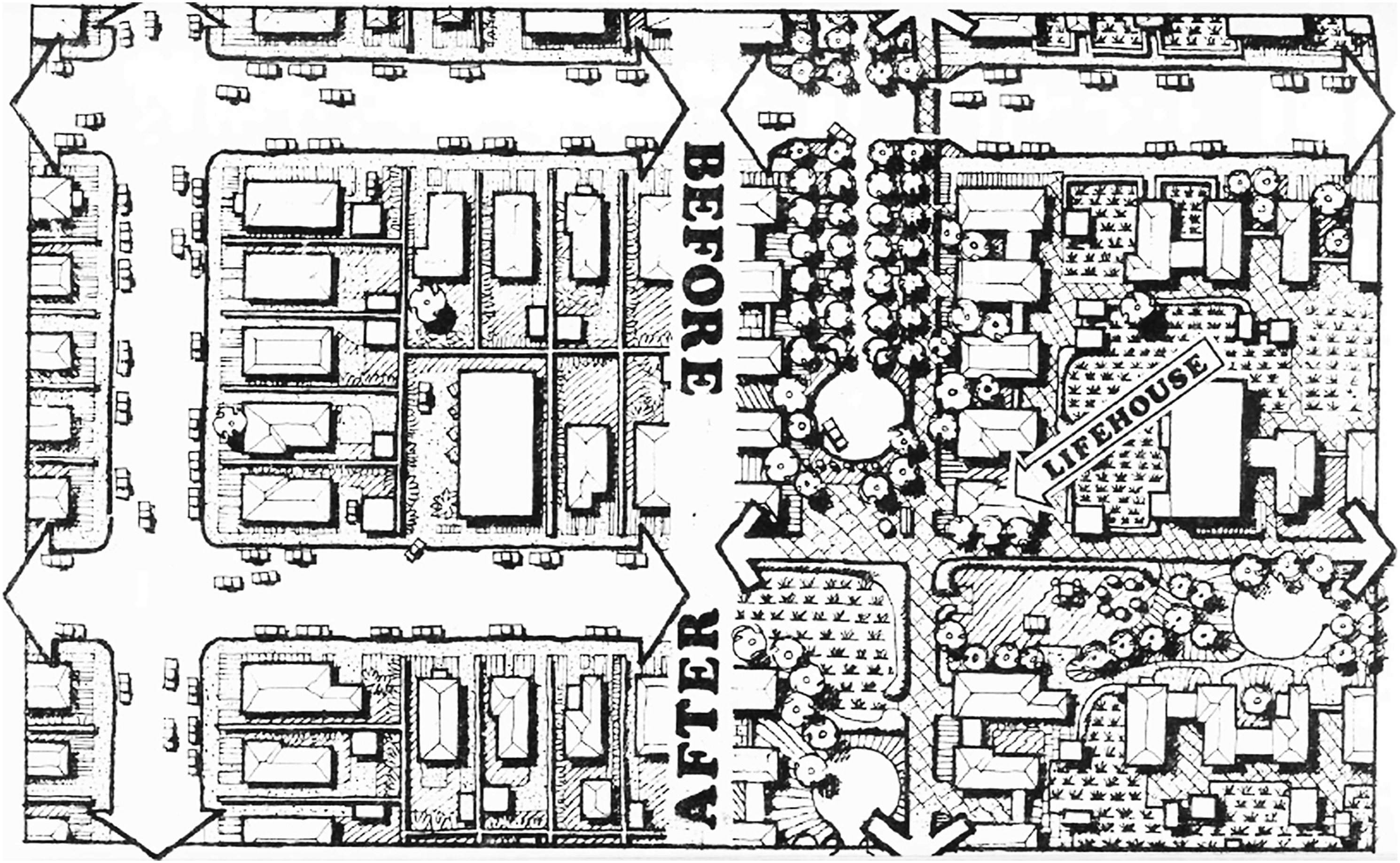
The Berkeley Tribe manifesto of 1970 soon circulated well beyond Berkeley itself, being both reprinted and summarized in the international counterculture and anarchist press. Theodore Roszak, who had famously coined the term ‘counterculture’ in his 1969 book, The Making of a Counterculture, republished a slightly abridged version of the manifesto in his 1972 anthology, entitled Sources, intended as a theoretical and pragmatic guide for those who were attempting to continue the counterculture revolution into the 1970s. In his editorial introduction to the re-printed manifesto, now under the title, “Blueprint for a Communal Environment,” Roszak wrote: “In what follows is a set of practical suggestions for transforming the existing homes and neighborhoods of our disintegrating neighborhoods into ecologically sane, communally robust environments.” 36 Roszak's Sources reprinted the Berkeley Tribe manifesto as part of an optimistic project for a gradual change towards the larger counterculture vision of decentralized collectivism, not just in Berkeley but everywhere that the counterculture might embark on similar experiments. One year later, in 1973, the Berkeley Tribe manifesto appeared prominently in Murray Bookchin’s treatise, The Limits of the City, a plea for small-scale, ecologically based communitarianism. Intellectual heir to Peter Kropotkin and Lewis Mumford, Bookchin was already well known in counterculture circles for his concept of revolutionary ecology, which blended biological and social understandings of ecology to argue for an anarchist decentralization of ‘megalopolitan’ urban forms. 37 In Bookchin’s generally pessimistic narrative, the Berkeley Tribe manifesto becomes the optimistic counterpoint for the future. It “avows and explores a new way of life at the most elementary level of human intercourse.” 38 The counterculture itself becomes the driver of urban amelioration.
In The Limits of the City, Bookchin derides most of postwar planning as functionalist window dressing over the malaise, anomie, and exploitation of mass industrial society: “Modernist city planning offers us functional urban designs without human values and rationally organized space without civic content.”
39
By contrast, counterculture planners reverse the order of planning, beginning with the reconceptualization of the social-economic order and then reconceiving an urban-architectural space to fit that order. Thus, countercultural revolution necessarily precedes any revolution in planning: For the counterculture planners, the point of departure was not the “pleasing object” or the “efficiency” with which it expedited traffic, communications and economic activities. Rather, these new planners concerned themselves primarily with the relationship of design to the fostering of personal intimacy, many-sided social relationships, non-hierarchical modes of organization, communistic living arrangements, and material independence from the market economy.
40
At its core, Berkeley’s counterculture urbanism entailed a spatial extension of the domestic commune from the individual building or household to the wider city. Individual communes extend outward into micro-neighborhood collectives; collectives, in turn, form the basis for an informal economy of small local groups; and urban land is more generally collectivized into a commons. However, neither the tasks of maintaining informal, face-to-face collectives, nor that of escaping the market economy, least of all the real estate economy, proved very feasible over the course of the 1970s. Berkeley’s counterculture urbanism had grown out of a relatively narrow and particularly unstable demographic: the largely white middle-class youth who had voluntarily chosen to drop out of mainstream society and experiment with new ways of living. The boundaries of commitment to this voluntary counterculture were vague and variable, and the population itself was highly mobile. 41 Many domestic communes failed after just a few years, and Berkeley’s counterculture youth, even at their height, never constituted a majority of the city’s overall population. It is not surprising, therefore, that the urban pattern described in the Berkeley Tribe manifesto never extended across the city beyond, perhaps, a few parcels. Nevertheless, such counterculture urbanism did end up leaving its permanent mark on the city.
Preservation Politics and Housing Affordability
As the utopian fervor of counterculture began to fade over the course of the 1970s, Berkeley’s counterculture activists turned towards the more pragmatic and conventional path of municipal politics. As many of the student radicals who had formed radical organizations in the wake of People’s Park graduated and moved away from Berkeley, some of the focused energy of counterculture radicalism dissipated. People’s Architecture, for example, had disbanded by 1974. Successor groups tended to be more professionally organized as specialized non-profit organizations dedicated to specific such issues such as affordable housing.
42
What Berkeley’s counterculture urbanism lost in terms of grandiose utopian vision, it gained in terms of more long-lasting and concrete results on the ground. Turning to strategic alliances across the city, activists focused now on two broad goals: slowing or stopping large-scale development and maximizing the supply of affordable housing. These were goals that appeared, especially to later critics, to be mutually contradictory. In fact, the only way in which these goals could not seem contradictory would be if the City of Berkley were to somehow isolate itself from the regional and national real estate economy. This withdrawal from the wider economy is, in fact, exactly what counterculture activists contemplated. The March 1972 edition of the underground newspaper New Morning contained a special section under the title, “Land Use in Berkeley” which made clear that the collective control of land would become a strategic goal: The abuses of private land ownership [have] brought many people in Berkeley to search for a means to democratize land use and eventually socialize land itself. Political power, we are all learning, is the absolute ability to shape and control space.
43
The remainder of the special section then documented and editorialized on some of the more specific strategies that aimed to buttress this more general goal. A section on the Berkeley Tenant’s Union described the goal of declaring housing to be a public utility and to more generally remove the profit motive of landlords: “The land in this community must be used to benefit all the people, not to make money for the few.” 44 A section on the South Campus Neighborhood proposed constructing 16 mini-parks in the middle of existing streets, both reducing traffic and preserving existing housing. The section on the Ocean View neighborhood outlined an alternative to the proposed West Berkeley Industrial Park that would have demolished several blocks of low-income bungalows. The section on the North Berkeley neighborhood updated the Hearst Community Plan and envisaged collectively run cooperative facilities, including “cooperatively managed workshops, car repair garage, and kitchen facilities for the entire community.” 45 The special section then concluded with proposal for an Urban Land Use Association, potentially replacing Berkeley’s existing Redevelopment Agency and devolving planning powers to local neighborhood community groups.
Such strategic initiatives marked a gradual shift among counterculture activists, away from mere resistance and protest against established systems, towards a more concerted attempt to steer the reigns of municipal governance and urban planning. This shift was greatly facilitated by the leftward swing of Berkeley’s City Council with the election in 1971 of three members of the radical “April Coalition,” who included Ilona (Loni) Hancock, with the strong backing of the South Campus neighborhood, and two Black Caucus representatives, Ira Simmons and D’Armey Bailey. 46 Although still a minority vote within the nine-member city council, April Coalition members gave a certain degree of voice to the counterculture activists and their proposals. This foothold within municipal politics, together with an increasingly sophisticated understanding of planning legislation and procedures, enabled counterculture activists to enact specific pieces of their larger agenda. It also forged new kinds of alliances. One of the earliest and most concrete results of this more pragmatic activism was the passage of the “Neighborhood Preservation Ordinance” via citywide ballot initiative on April 17th, 1973 by a 60% margin. 47 Its wording squarely took aim at what had been one of the most consistent targets of counterculture activists: the private construction of dense apartment buildings, or ‘ticky-tackies.’ Calling for a comprehensive, citizen-led revision of the master plan to redress excessive zoning densities, the ordinance opened with the following justification: “New construction in a city as built up as Berkeley requires demolition, often of attractive low rent older homes, thus actually reducing the stock of decent housing available to those most in need of it—families, low income and underserved, racial minorities and students. Although charging high rents, most new dwellings have been of uniformly low quality.” 48 The ordinance required any demolition permits of existing housing be approved by a board of adjustments and be shown not to negatively impact existing housing. It also mandated a minimum percentage of low-income units for any new construction. Neighborhood preservation, in this context, aimed to equalize quality-of-life zoning benefits that had previously been concentrated in the wealthy hills neighborhoods in the northeast.
The Neighborhood Preservation Ordinance proved to be the most powerful legal tool available to counterculture activists in their coalition politics against the perceived forces of gentrification and what sociologist Harvey Moloch called “the growth machine” of urban politics. 49 More concretely, the ordinance represented an alliance between radical groups, who objected, on ecological and anti-corporate grounds, to the new construction of dense, speculative apartment buildings and modest home-owners concerned about more conventional issues, such as traffic congestion, increased infrastructure burdens, and rising property taxes. Martha Nicoloff, one of the main organizers and co-authors of the Neighborhood Preservation Ordinance, straddled both interest groups. As a resident of North Berkeley and outspoken chair of its North Berkely Neighborhood Council, she simultaneously represented the interests of its middle-class homeowners and remained an outspoken activist for the People’s Park Annex and the Hearst Community Plan. Following passage of the Neighborhood Preservation Ordinance, Nicoloff and the North Berkely Neighborhood Council lobbied against any building development at all on the Hearst Avenue Strip, and neighborhood activists urged the BART District to sell the land to the city. When the BART District sold half of the strip to a local community college for the development of administration buildings, neighborhood activists, via the City Council appealed the matter to the state legislature, which then passed a bill in 1977 overriding the community college’s right to develop the land, thus effectively forcing sale of the entire strip to the city. 50 By 1978 the strip had officially opened as Ohlone Park, named after the local Indian tribe that had historically lived in the region, and memorial remnants of the People’s Park Annex were retained at the center although the once anarchistic, counterculture space had now been thoroughly integrated into a pleasant but hardly radical municipal park.
Meanwhile, Berkeley’s counterculture began to make strategic alliances with residents in the heavily African American neighborhoods in West Berkeley and South Berkeley, especially to lobby against redevelopment plans in these locations. Counterculture activists soon joined forces with the remnant of a beleaguered working-class neighborhood on the verge of disappearance for an already approved industrial park in West Berkeley. Building on a 1955 “special industrial district,” the West Berkeley Industrial Park, had been approved by the city council in 1966 as a Federally subsidized urban renewal site, with a quasi-independent Redevelopment Agency appointed to carry out the redevelopment. However, the largely industrial parcel also included several blocks of working-class bungalows that had been slated for purchase and demolition by eminent domain. People’s Architecture, in this context, began reviving the identity and resistance of the Ocean View neighborhood, which had been zoned for industry and declared blighted. 51 The resulting Ocean View Committee soon began attending meetings of the Berkeley Redevelopment Agency and the Berkeley City Council, raising objections and submitting alternative plans that would include the preservation and rehabilitation of remaining neighborhood housing. For counterculture activists, the situation in Ocean View seemed ominously to repeat the fate of the housing that had been demolished on the site of People’s Park. Moreover, it seemed to pit long-time residents, many of them poor and African American, against large-scale bureaucratic planning and corporate interests. Instead of leading to occupations and street protests, however, the battle for the Ocean View neighborhood largely took place at meetings of the Berkeley Redevelopment Agency and courtrooms, where the Neighborhood Preservation Ordinance was invoked to halt demolitions. These and other actions effectively slowed down the redevelopment process until 1977 when a ballot initiative dissolved the West Berkeley Industrial Park and its attendant redevelopment agency. 52 In the 1980s and 1990s, Ocean View residents maintained some of this grassroots activism in what one observer called an “economic justice coalition,” attempting to preserve both affordable housing and a local industry in an environmentally conscious manner. 53 By the early 2000s, however, Ocean View had almost entirely lost its former working-class character. What remains of its preserved buildings have now been incorporated into a desirable, and correspondingly expensive, neighborhood of restored bungalows, newer live-work spaces, and coffee shops. 54
A somewhat different scenario unfolded in South Berkeley, a largely African American neighborhood and center of Black Panther activism which suffered from disinvestment and high unemployment. The core of this neighborhood, near a future BART station at the Oakland border, had already been designated as an urban renewal area under a 1967 Model Cities Program grant. 55 At the center of the South Berkeley redevelopment area was a two-block parcel of abandoned World War II naval barracks, called Savo Island, which had been acquired by the Berkeley Unified School District for possible development for a new school. Soon after the People’s Park occupiers had been evicted in May 1969, a group of activists proposed transforming the Savo Island barracks into what they dubbed a “People’s Pad,” effectively a place to house many of the homeless counterculture youth from the South Campus neighborhood. 56 Activists quickly drew up a short-term contract to lease the site for 3 months from the Berkeley Unified School District for a nominal sum of $1.00. This proposal immediately set off a firestorm of protest, particularly from nearby African American residents who resented what they saw as an invasion of largely white hippies into the South Berkeley neighborhood. As one nearby resident stated: “To have white middle-class people from outside come in to live free in black community already overcrowded is a hard pill to swallow.” 57 The People’s Pad proposal was subsequently voted down by both the school board and the South Berkeley Model Cities Council. The failure of the People’s Pad initiative did not end the idea of using the Savo Island site as a radically new kind of collective housing, but the dialog now shifted from temporarily housing People’s Park refugees to creating an alliance with nearby South Berkeley residents to control the future of the site. In August 1972, counterculture activists strategically sited their second “People’s Housing Conference,” which included the “first public discussion of a new redevelopment project at Savo Island,” at the Berkeley Black Caucus Office in South Berkeley, in conjunction with a newly formed Savo Island Neighborhood Association. 58
As it emerged over the course of the 1970s, Savo Island became the centerpiece of a larger program for the collectivization of Berkeley’s urban resources, spearheaded by a new wave of more pragmatically oriented activists. The key figure in this shift was a recent urban planning graduate named Edward Kirshner who translated vague collectivist aims into hard-nosed economic policy ideas. In 1972, Kirshner and other activists formed a radical think tank called the Community Ownership Organizing Project, which sought ways of transferring private utilities and housing into collectively owned enterprises, on a municipal or else cooperative basis. 59 Kirshner and his collaborators ideas were published in a 1976 white paper, entitled The Cities’ Wealth: Programs for Community Economic Control in Berkeley, California. In The Cities’ Wealth, Savo Island featured as a primary example of leveraging municipal resources for the purposes of low-income cooperative home ownership, involving “the use of revenue-sharing monies, tax-increment financing and the bonding authority of the City of Berkeley.” 60 When finally completed in 1979, the Savo Island Cooperative Housing Development resembled, in its outward architectural form, housing that had earlier been proposed for the Hearst Community Plan. Two-story apartments and townhouses were arranged in loose clusters around parklike common areas. The blocks, both open and closed, suggested a gradient of public to private, from the street, to the semi-enclosed common lawns, and finally to the semi-private yards adjacent to the townhouses. Despite such appearances, however, the Savo Island Cooperative was far from the communitarian, mutual-aid ideals of the counterculture. 61 Socially and administratively, it was a managed, low-to-moderate-income housing project, whose residents needed to apply for limited slots and who might or might not be inclined to deal with their neighbors. 62
Conclusion
To the extent that activists succeeded in shaping the forces of urban development at the local level—by, for example, preserving open space, older buildings, and a quality of ‘place’—they also conferred economic value on the surrounding urban spaces that continued to house commuters, students, and those simply attracted to the atmosphere of its parks and neighborhoods. Unlike the many rural communes that appeared across North America between 1967 and 1972, which could more plausibly imagine themselves to be founding ‘new’ settlements on ‘open’ land, Berkeley’s counterculture urbanism attempted to transform the abstract space of the American capitalist city from within the very center of that space. 63 It directly challenged conventions of private property, functional zoning, and the social organization of space. In doing so, counterculture activists had to grapple directly with the existing tools for regulating and controlling that space, from land ownership to municipal codes. It was this direct confrontation with the existing city that highlighted the contradictions and limitations of this kind of utopianism. Its core principle of ‘community control’ generated a hyperlocal parochialism completely at odds with Berkeley’s geographic and institutional position within the San Francisco Bay Area, centered on its twin roles as the site of a major research university and a residential suburb. At this dynamic node, Berkeley’s counterculture planners sought to carve out a verdant enclave of low-rise buildings that would be relatively free from the ‘external’ pressures of the market economy. For the American counterculture in general, such a stepping outside of the market economy was always an illusion. In a relatively wealthy municipality hosting a major research university, this illusion was made even more fragile by the larger forces of regional development and demographic movement, as well as the legal and political frameworks that supported these forces. Many of the most radical ordinances and policies that aimed to remove real estate from the capitalist marketplace encountered political headwinds, both from Berkeley landlords and from statewide initiatives. 64 Berkeley’s radical rent control ordinance of 1972, to take just one example, was ruled unconstitutional by a state court in 1976. 65 The rent stabilization of vacant apartments, or vacancy control, across Berkeley, was then outlawed by the statewide Costa Hawkins Rental Housing Act of 1995. 66 The passage of Proposition 13 in 1978, which limited property tax increases, gradually benefitted long-term property owners over more recent, often younger purchasers. Those who were newest and most transient, notably the increasing number of students at UC Berkeley, were then faced with the highest housing costs.
As Berkeley’s housing affordability and homelessness crises, like those of the surrounding region, have only grown more acute in the intervening decades since the 1970s, the politics around new development, urban green space, and preservation have shifted considerably. Even as Berkeley’s non-profit housing sector continues to generate islands of affordable stability, there is no longer an illusion that Berkeley can wall itself off from the wider movements, migrations, and displacements that have reshaped the entire San Francisco Bay Area. 67 The conservation of buildings, open spaces, and neighborhood character, in itself, does not necessarily lead to the conservation of racial diversity or housing affordability; and, some claim, it actively fosters gentrification by limiting the building of new housing. In fact, many on the left now strategically align themselves with developers who promise to simply increase the overall regional housing supply, even as they also press the same developers to provide a higher percentage of ‘affordable’ housing units in particular places. One of the most notable expressions of this realignment came from housing activist Randy Shaw, who in his 2018 book, Generation Priced Out, specifically condemned Berkeley’s 1973 Neighborhood Preservation Ordinance: “The NPO succeeded all too well…In the long term it stopped construction of new apartments so effectively that Berkeley had an epic housing shortage by the early 1980s.” 68 Today, this debate has also returned to the original site of People’s Park, where the University is attempting to reclaim the site for student housing, using the same kind of argument around housing affordability and the general need to increase the housing supply. 69 In addition to dormitories, the University’s approved proposal for the site, includes transitional and low-income housing, and a small memorial park. However, the older counterculture arguments around ecology and preservation, which never entirely subsided, have now been reignited by a new battle over the People’s Park site, including both street protests and lawsuits, citing the California Environmental Quality Act and the site’s contested status as a historic landmark. 70 It seems unlikely that the legacy of Berkeley’s counterculture urbanism will be put to rest anytime soon.
Footnotes
Declaration of Conflicting Interests
The author(s) declared no potential conflicts of interest with respect to the research, authorship, and/or publication of this article.
Funding
The author(s) received no financial support for the research, authorship, and/or publication of this article.
Correction (November 2023):
The location of “people’s park” has been corrected in this version.
