



Abstract
Immigration-impacted college students, including undocumented students and U.S. citizens with undocumented parents, struggle with food and essential needs insecurity. Drawing on focus groups with 38 immigration-impacted undergraduates, we examine barriers to campus essential needs resource use and investigate the extent to which self or parental immigration status influences use. Findings reveal structural, psychological, and operational barriers and highlight how institutional trust, peer networks, and culturally responsive practices can facilitate more equitable access to resources.
Introduction
Immigration-impacted Latino/a/x students, which includes those who are undocumented or have undocumented family members, experience higher rates of essential needs insecurity than their U.S. citizen peers with lawfully present parents. A 2020 survey of undergraduate students at the University of California (UC) found that three in five immigration-impacted students are food insecure compared to two in five among the general student population (Enriquez et al., 2021). This group also faces a range of immigration-related structural barriers that may deter them from accessing resources, such as ineligibility and concerns about current and future threats to their own and family members’ security (Lowrey & Van Hook, 2021).
Given the rising rates of low-income Latino student enrollment (National Student Clearinghouse Research Center, 2025), it is likely that higher education institutions, and Hispanic Serving Institutions in particular, are enrolling large numbers of immigration-impacted students. This is because Latino immigrant families are disproportionately subjected to punitive immigration policies given that half of Mexican and Central American immigrants are undocumented (Babich & Batalova, 2021; Israel & Batalova, 2020; Migration Policy Institute, n.d.). Indeed, a quarter of Latino children in the United States have at least one undocumented parent (Clarke et al., 2017).
Though we have limited research on immigration-impacted Latino students specifically, research has established that, in general, many Latino college students navigate serious financial constraints (Bauman, 2017) and have difficulty meeting their essential needs, including food and housing costs (Goldman et al., 2024). Notably, Latino students report higher rates of food and housing insecurity than their white peers (Goldrick-Rab et al., 2019). A 2024 study of 3,000 Latino current and recent college students found that 85% could not consistently access affordable and healthy food; this happened even more frequently among lower income students (UnidosUS, 2024). Such strain poses a threat to students’ academic success and wellbeing as research shows that those experiencing food insecurity have higher rates of psychological distress, lower rates of academic achievement and greater risk of departure from higher education before degree completion (Savoie-Roskos et al., 2023).
Colleges and universities—especially those serving historically marginalized students—have responded by developing campus-based essential needs programs intended to alleviate these burdens (Speirs et al., 2023). Universities offer a range of campus resources to help address students’ essential needs, defined as the fundamental resources required for a students’ well-being and academic success, including access to food, housing, transportation, and healthcare (Crutchfield et al., 2019; Goldrick-Rab et al., 2018). A recent study of U.S. postsecondary institutions found that 88% of surveyed universities offered some type of resource; most often, they offer food pantries and financial management, while some also offer emergency grants and meal plans (Speirs et al., 2023). In the UC system, for example, all ten campuses have an on-site basic needs center that strives to support students’ essential needs by providing access to food, emergency housing, and other support services (University of California Office of the President, n.d.).
Despite the growing availability of campus essential needs resources (Speirs et al., 2023), they remain underutilized. Prior research emphasizes the role of psychological and operational barriers in limiting access to campus support services, including stigma surrounding poverty (Cady, 2016; Freudenberg et al., 2019) and lack of awareness and accessibility (Goldrick-Rab et al., 2018; Hallett et al., 2019; Landry et al., 2024). While studies have examined the general challenges facing first-generation and low-income students (Davis, 2022; Ko et al., 2023), far fewer have focused specifically on the experiences of immigration-impacted students.
To support the development of equitable student services, we must first understand the lived experiences and barriers that marginalized students face. This study seeks to expand our understanding of the factors that shape immigration-impacted students’ use of campus essential needs resources. Using a qualitative study design, we collected data from 38 immigration-impacted students attending a UC campus to assess barriers and facilitators to access and use of the campus basic needs center, and to investigate the extent to which self or parental immigration status influenced students’ decision-making process when navigating these services.
Barriers to Campus Essential Needs Resource Use
Psychological barriers can deter students from using various campus resources, particularly those related to food insecurity (El Zein et al., 2018; Idehai et al., 2024). Stigma surrounding poverty and resource use discourages help seeking due to concerns about being perceived as dependent or undeserving (Cady, 2016; Freudenberg et al., 2019). Students also associate resource use with personal failure, reinforcing beliefs that they should manage on their own (Cady, 2016). Internalized stigma is shaped by broader societal narratives that equate self-sufficiency with success, discouraging students from using services even when struggling (Freudenberg et al., 2019). Stigma can manifest as specific concerns about being seen or judged by peers or faculty (Cady, 2016; Goldrick-Rab et al., 2018). Reflecting this reality, scholarship often highlights the importance of crafting non-stigmatizing outreach strategies to encourage campus resource use and close gaps in students’ essential needs (Valle et al., 2025).
Limited awareness and knowledge of resources are operational barriers that can prevent resource use. Awareness is a critical first step in resource use as many students do not access campus basic needs services simply because they do not know they exist or have only a vague understanding of what they offer (Goldrick-Rab et al., 2018). Unlike financial aid or academic advising, which are widely discussed and integrated into university processes, basic needs services often lack the same visibility, leaving students to navigate resource access on their own (Hallett et al., 2019). Students may not understand eligibility requirements, application processes, or how to physically access services, which can further deter engagement.
Additional operational barriers related to availability and accessibility present additional challenges that can deter use. Campus food pantries and resource centers struggle with insufficient funding to meet student demand (Hagedorn-Hatfield et al., 2022). As a result, services may be insufficient to meet student need or have stringent eligibility requirements or complex application processes (Cady & Broton, 2020). Center location and hours of operation can conflict with students’ class and work schedules, making it difficult for them to secure services (Cady & Broton, 2020). Studies have also shown that low-income and commuting students face disproportionate difficulties in accessing resources due to transportation barriers and inconvenient locations (Landry et al., 2024). Operational barriers also disproportionately impact first-generation and low-income students who may lack the institutional knowledge or social capital to navigate university bureaucracies (Davis, 2022; Ko et al., 2023; Renn, 2022).
Potential Structural Barriers for Immigration-Impacted Students
Immigration-impacted families face substantial structural barriers that can increase immigration-impacted students’ need for essential needs services. Today’s undocumented student population is largely ineligible for the Deferred Action for Childhood Arrivals (DACA) program, meaning that they are unable to secure federal permission to work and have limited access to financial aid. Having undocumented parents can also increase family financial strain and exposure to chronic financial strain, including food and housing insecurity (Enriquez et al., 2026; Zambrano Torres et al., 2024). Despite their high need for campus essential needs services, immigration-impacted students face unique barriers that may deter their use.
Immigration status functions as a structural barrier that may compromise one’s eligibility for services. Specifically, undocumented immigrants are ineligible for federally funded safety net programs such as the Supplemental Nutrition Assistance Program (SNAP) (Perreira & Pedroza, 2019). In California, SNAP is administered as CalFresh where recipients receive monthly benefits that can be used to buy food. Many U.S. citizens students face substantial difficulties establishing their eligibility for this critical resource that helps address chronic food insecurity (Martinez et al., 2024). Campuses that rely heavily on such programs to address the chronic financial strain of low-income students likely find it difficult to provide such substantial services to undocumented students.
Despite their eligibility, U.S. citizens with undocumented parents or family members may avoid accessing such safety net resources. Research has found that immigration-impacted families often experience a “chilling effect” where fears of exposing their family members’ immigration status prevent them from engaging with institutional support services (Vargas, 2015). This fear is particularly heightened by policies that have historically been weaponized to discourage immigrants from seeking government assistance (Lowrey & Van Hook, 2021). For example, the public charge rule is a federal policy that allows immigration officials to deny lawful permanent residency or visa applications if an individual is deemed likely to become primarily dependent on government assistance (Bleich & Fleischhacker, 2019; USCIS, 2022). Thus, even when campus resources are not federally regulated, misinformation and uncertainty surrounding such policies create lasting anxiety that may deter students from utilizing services.
Institutional trust likely plays a critical role in shaping immigration-impacted students’ willingness to access resources. Research has shown that students are more likely to seek assistance when they perceive their university as a safe and protective institution (C. Suárez-Orozco et al., 2011). However, research on higher education and undocumented students highlights the inconsistency of institutional support (Savoie-Roskos et al., 2023). While some universities actively build trust through designated undocumented student centers and confidentiality policies, others fail to clearly communicate protections, leaving students uncertain about the risks of obtaining services (M. M. Suarez-Orozco et al., 2015). It remains unclear to what extent immigration-impacted students may develop institutional trust outside of undocumented student services.
In addition to structural barriers, one’s own or family members’ immigration status can inform unique psychological barriers. A study of UC undocumented students’ use of campus mental health services found that they normalized the mental strain that resulted from their legal vulnerability and anticipated immigration status-related stigma upon revealing their situation (Cha et al., 2019). It is possible that similar perceptions emerge with regards to accessing essential needs services as immigration-impacted students may normalize their lifelong, chronic financial strain and anticipate similar immigration-related stigmas for accessing resources. Studies have also shown that immigration-impacted families may avoid institutional interactions due to anxieties about exposing their family’s legal vulnerability (Abrego, 2011; Enriquez, 2020). Abrego (2011) further shows that students often internalize messages that discourage reliance on external aid, viewing self-sufficiency as a means of protecting their family’s safety and future.
Ultimately, prior research suggests that there are psychological, operational, and structural barriers that can deter the use of campus essential needs resources. This study aims to assess the extent to which these barriers apply for immigration-impacted students who are undocumented or have undocumented parents. Further, we seek to identify facilitators that may help campuses effectively serve this marginalized student population. This is critical to the mission of Hispanic Serving Institutions as Latinxs are disproportionately likely to come from low-income households and be immigration-impacted.
Methods
This study uses a qualitative study design, including semi-structured interviews with campus basic needs center staff and qualitative data collection with undergraduate students to assess campus essential needs resource utilization. Using a community-engaged research approach (Payán et al., 2022), we partnered with a UC campus basic needs center at a Hispanic Serving Institution. The University of California is on track to become the nation’s first Hispanic-Serving System, with five campuses currently designated as Hispanic-Serving Institutions (HSIs) and the remaining four identified as emerging HSIs (Freeling, 2023).
Recruitment and Data Collection
We conducted seven semi-structured interviews with basic needs center staff between August to September 2024 to learn about the type of services the center offers, including a physical and mobile food pantry, emergency grants, grocery support cards, an emergency meal swipes program, counseling and financial wellness services, and CalFresh application assistance. Based on staff interview responses on barriers immigration-impacted students may encounter, we developed student focus group and interview guides. The semi-structured interview guide covered the following topics: essential needs and insecurities; accessing resources; experience of resources; immigration status-related barriers.
We conducted qualitative data collection with 38 immigration-impacted students at one UC HSI campus between October 2024 and January 2025. Participants were recruited via a flyer that was shared via email with professors and posted in multiple resource center’s weekly newsletters, social media and physical campus space. Finally, we conducted snowball sampling by asking participants to refer eligible friends. Eligibility criteria included: (1) being 18 years or older, (2) attending as a returning student, and (3) identifying as either undocumented or having at least one undocumented parent.
Students had the option to select a focus group or one-on-one semi-structured interview. We conducted seven individual semi-structured interviews and ten focus groups ranging in size from two to five participants each. Focus groups and interviews averaged 1.5 hr long and all student participants were compensated $40 for their time. All participants were given pseudonyms to protect their identity.
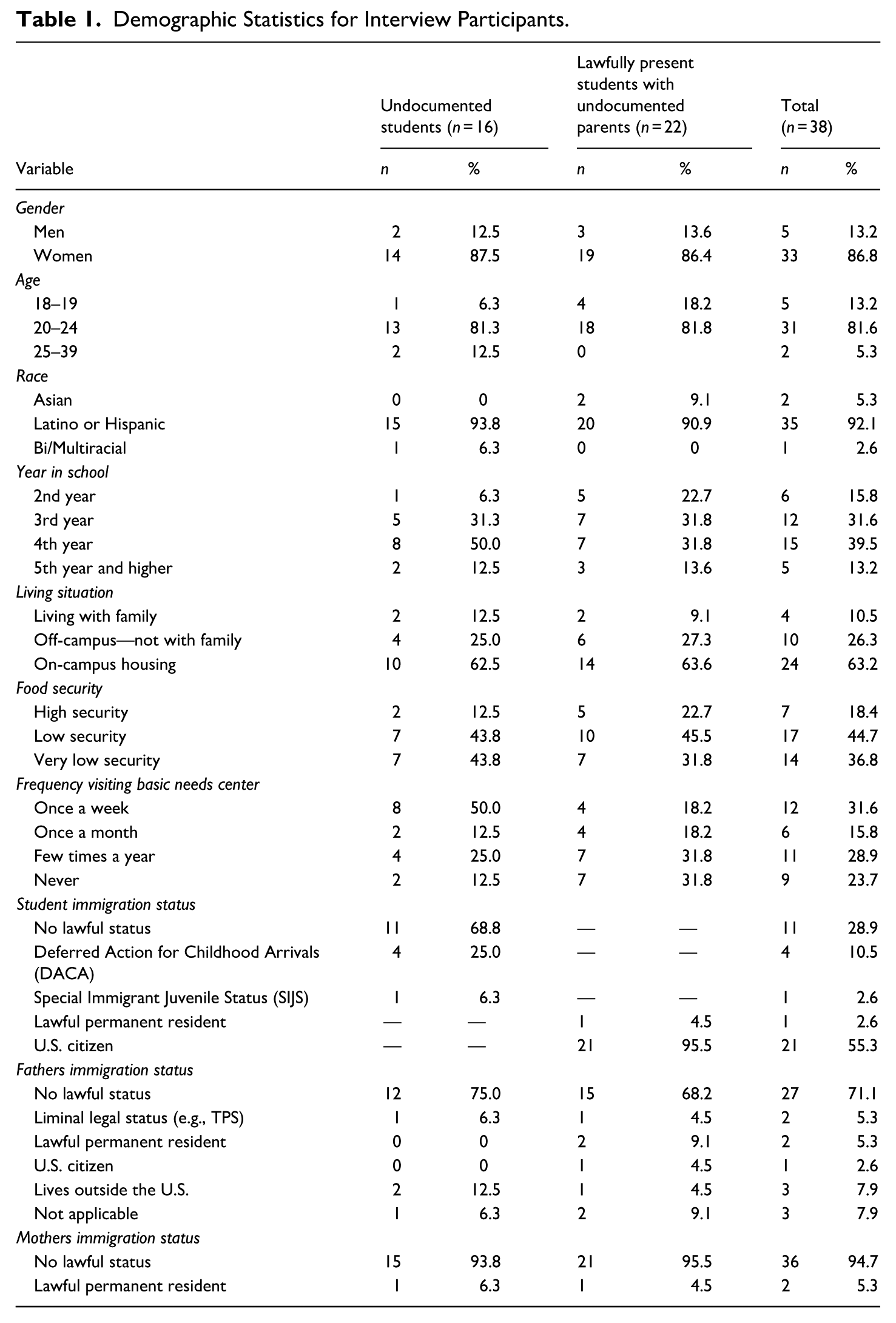
We spoke to a total of 38 participants, including 21 U.S. citizens with at least one undocumented parent, one legal permanent resident with at least one undocumented parent, 11 undocumented students with no legal status, four undocumented students who were DACA beneficiaries, and one student with Special Immigrant Juvenile Status (SIJS). The majority of participants (87%) identified as female. Thirty-one participants were between the ages of 20 to 24, five participants were 18 to 19 years old, and two participants were between the ages of 25 to 39. The majority of participants (n = 35) identified as Latino or Hispanic, two participants identified as Asian, and one participant identified as bi/multiracial. All participants were undergraduate students in either their second year (n = 6), third year (n = 12), fourth year (n = 15), or fifth year or higher (n = 5). The majority of participants (n = 24) reported living in on-campus housing, while 10 reported living off-campus, not with family, and four reported living at home. Most participants (n = 31) reported either low food security (n = 17) or very low food security (n = 13), whereas only seven reported having high food security. Out of 38 participants, 18 reported being frequent users of the basic needs center stating they used it once a month or more, whereas 20 reported infrequent use with nine having never used it, and 11 having used it a few times a year (see Table 1).
Demographic Statistics for Interview Participants.
Data Management and Analysis
Interviews and focus groups were recorded and transcribed for analysis. Materials were uploaded into HyperResearch, a qualitative data analysis program, where a flexible coding approach was applied (Deterding & Waters, 2021). Each case was index coded with demographic attributes and five codes related to broad areas covered by the interview guide: essential needs, accessing basic needs center, experiences with basic needs center, status barriers, and envisioning support. We then reviewed each index code and post-interview memos to write analytical memos for each research question and develop an analytic codebook. Analytic coding consisted of applying a small group of 3 to 6 codes at a time to increase reliability. Emergent analytical code groups included accessibility, awareness, social factors, financial factors, institutional communication, and institutional trust. Code groups were organized in operational, psychological, and structural factors in line with the literature.
Researcher Intentions and Positionality
This study was informed by our positionality as researchers and, in some of our cases, members of immigration-impacted communities. We are dedicated to developing research that amplifies marginalized voices and will inform policy and practice to advance equity, inclusion, and justice. This led us to develop a partnership with the campus basic needs center to identify key research questions and inform data collection materials. We approached participants with an intention to share mutual experiences and information; this included our connections to immigration-impacted communities and personal use of the campus basic needs center. During the analysis and writing phase, we continued to center participant voices and identified recommendations based on their input.
Findings
Our analysis identified three key factors that shape immigration-impacted students’ use of campus essential needs resources: immigration status-related legal vulnerability, stigma as a psychological barrier, and operational constraints. For example, Maria, a third-year undergraduate U.S. citizen with undocumented parents who has never visited the campus’ Basic Needs Center, provided insight into how these factors coalesced. She explained: I remember growing up and going with my mom to WIC. . . [But] my dad does sort of discourage us [from accessing essential needs on campus] mostly because I feel like he wants to take care of us as much as he can. So he doesn’t like it when we go out and search for other things, because he’s just like ‘Why don’t you just ask me?’. . . I feel like it’s a little bit [of] pride that he has wanting to take care of his family all by himself. . . . I grew up with that. Where you have to learn how to handle stuff on your own. Or don’t look for outside resources, because you’re capable of doing it on your own.
Growing up with chronic economic insecurity, her father, the family’s economic provider, sent mixed messages—allowing her mother to apply for WIC, a supplemental nutrition program for women, infants, and children, when she was little, but simultaneously discouraging reliance on external aid. Upon entering college, Maria faced food insecurity but hesitated to use campus essential needs services. She confronted her father’s lifelong narratives of self-sufficiency as well as deeply ingrained concerns about her family’s legal vulnerability. Additionally, as a first-generation student, she found navigating the campus bureaucracy overwhelming, with little guidance or culturally responsive outreach to help her determine where to begin accessing resources to meet her essential needs. Maria’s example highlights how immigration-impacted students face a myriad of barriers to using campus resources. Yet, we found that many of the immigration-impacted students we spoke to were largely able to navigate immigration status- and stigma-related barriers only to be stymied by operational ones.
Immigration Status and Legal Vulnerability
Many immigration-impacted students reported that undocumented status served as a barrier to accessing essential needs resources. Both explicit and implicit fears surrounding their own or their family’s safety discouraged them from seeking support. Some students received direct messages from their families whereas others internalized concerns about potential repercussions from obtaining services, such as the threat of deportation, public charge, and future adjustment of one’s immigration status. These fears discouraged students from accessing support but many overcame these barriers due to strong feelings of institutional trust.
Many undocumented students reported that their immigration status posed an explicit barrier by making them ineligible for high-impact resources. Specifically, their campus basic needs center strongly encouraged and invested resources to support students’ application for CalFresh; their website prominently states: “CalFresh is a federal nutrition assistance program that helps people purchase healthy foods at most grocery stores and farmers markets. Students can receive up to $291 per month. We offer 1-1 CalFresh application assistance appointments via Zoom.” Barbara, an undocumented undergraduate student with no legal status, recalled seeing these center announcements and applied for it during her first year: That’s when I got really discouraged. I applied. I took my time. It- the process didn’t take forever, but it took time off my day. I was excited. I was hopeful because they didn’t mention that it wasn’t meant for undocumented people. They just say, [if] you’re [a] UC student, you should go for it. . . . I was so sad I didn’t get it, [they] told me, “Oh, you don’t qualify for it.” . . . They didn’t say it was because of my status, but I already kind of knew it, and I only knew it because my [undocumented] roommate was like, ‘I also applied for it, and they told me the same thing.’ So I was like, Well, I guess we know why.
Such experiences taught undocumented students to anticipate their ineligibility. Gus, another undocumented student with DACA in the same focus group, shared:
It’s like that where you think it’s available to you, but it’s not. So after having those experiences, not like trauma or anything, but like it’s, it’s just like you don’t want to—
You generalize it.
Yes, exactly. So just having that there [that undocumented/DACA students are eligible], [That’s a] game changer.
Affirming Barbara and Gus’ experiences, the remaining focus group participants called for explicit language stating that undocumented/DACA students are eligible for resources otherwise they would assume their status made them ineligible.
Several immigration-impacted students, regardless of their own immigration status, shared that they were dissuaded from using resources that may inadvertently put their undocumented family members at risk. Maria, a U.S. citizen with undocumented parents, said, “I avoid being put in situations where I would have to talk about that [immigration status]. It’s definitely [a] fear that something could happen. Like if I say the wrong thing, I’m putting my parents at risk, and my siblings at risk because they need our parents.” Given significant fears of detention, deportation, and family separation, students avoided applying for or accessing resources when they anticipated having to discuss their own and/or family members’ immigration history and/or immigration status on applications.
Some students’ fears were amplified by messages from family members, particularly parents, who discouraged them from accessing resources. When asked if anyone discouraged them from seeking our essential needs resources or services, Perla, an undocumented student with DACA, responded: My mom does. Growing up she didn’t receive any government assistance because she really wanted us to thrive in school, so she didn’t want that to backfire [on] us in any type of way. . . . Now that I’m a mother myself, she tells me the same thing: don’t be receiving any aid for your child when you can work. . . . Don’t let it backfire on him, in case it’s going to be affecting him later on. Then also, because of the legal status . . . [it’s] that fear they’re going to . . . see all this stuff [receiving aid], then if there’s ever an opportunity for us to get citizenship, they’re going to see that you weren’t able to take care of yourself on your own without assistance. So, it’s always just that fear. . . .We just play it safe.
Perla’s mother’s warning reflects a deep-seated fear that accepting any form of assistance could have long-term consequences for their family members’ immigration status and future legalization opportunities. These fears stemmed from political rhetoric and proposed policies that threatened to expand the types of resources that would mark one a “public charge” and thus ineligible to adjust one’s status (Fremstad, 2018). Although her mother specifically referenced government aid, Perla internalized this caution broadly, extending it to all institutional support, including campus resources. This fear of the “unknown” creates a chilling effect, where students like Perla choose to “play it safe” by avoiding resources that could benefit their college success.
Given this culture of caution, institutional trust and clear communication was critical in encouraging students to access campus essential needs resources. Several students reported feeling a sense of safety and security on campus. Cecilia, an undocumented student without legal status for example, shared: I’m more comfortable putting down my [campus] address than my home address. So if anything requires my address, I’d rather put the [campus address] . . . because I think it’s safer for me to put that one down than my address, because then I go home [and] my parents are there. It’s not just me, you know?
Similarly, Sophia, a U.S. citizen with undocumented parents, reported not feeling as concerned about her parents status as she used to in high school “especially because” of her status as “a college student.” She adds, “a lot of students in college are in the same boat, so I think we can rely on each other and know that [our] information is protected.” The college campus was described by students as a protective buffer that decreased the risk of deportation threats to themselves and their families. Similarly, Dana, a U.S. citizen with undocumented parents shared: Within [this university]? I don’t think about status . . . [This university] accommodates both non-citizens and U.S. citizens so I don’t really have any issue . . . because they don’t really ask about your status. I don’t think that’s a thing I’ve ever encountered so I feel comfortable using [the basic needs center].
This sense of safety within the university context illustrates how institutional environments that actively avoid surveillance and status disclosure can foster greater trust and increase students’ willingness to access essential needs resources.
Students also highlighted the importance of trusted adults. For example, Jimena, an undocumented student without legal status shared that “in the last quarter of last year, I built a bond with an academic counselor so I know now that I can ask her for help.” However, trusted adults should have a cultural awareness as Alex and Maria, both U.S. citizens with undocumented parents discuss below:
There’s kind of a disconnect between the student and the counselor because of demographics. Where [they] don’t understand . . . my experience because some of it is cultural, and they don’t have that experience. So I do think diversifying the staff . . . would be helpful and mak[e] it more comfortable for students to access those resources.
I agree with those points where it’s definitely been when you try to access some of these resources [on campus], it’s a little difficult because that disconnect between two people is there and it does push you [away] from wanting to continue seeking out help.
These reflections underscore that while trusted and/or culturally responsive staff play a crucial role in facilitating students’ access to support and encouraging them to continue seeking help.
Psychological Barriers
Stigma is recognized as a pervasive psychological barrier to resource use (Cady, 2016; Freudenberg et al., 2019; Goldrick-Rab et al., 2018). Indeed, the campus’ Basic Needs Center staff who participated in interviews frequently cited stigma as a barrier to students’ use of the center’s resources. For example, Claudia, a staff member, believed that students in need did not use the center’s resources because: “There’s always going to be that personal stigma. . . . It is like pride or shame, right?” However, while most immigration-impacted student participants acknowledged the possibility of stigma surrounding the use of essential needs services, the vast majority said they did not personally experience feelings of shame or embarrassment as significant psychological barriers to use.
Only a few students explicitly described feelings of shame or stigma associated with needing help or being poor. Lupe, a U.S. citizen with undocumented parents who has never visited the center, highlighted how her feelings of shame stemmed from life-long socialization in a family facing chronic poverty. She recalled: “I was kind of raised to be ashamed of the fact that I’m poor, because, again, like, it’s something that was instilled in us, like shame, judgment.” Cecilia, an undocumented student without legal status who visits the center once a week, further highlighted how the shame can manifest as perceived stigma of those using resources: “I feel like it’s not embarrassment, but I don’t [ know] how to– I feel like it’s so stigmatized to go to a resource center, or even especially, like a [food] pantry. . . . But me visiting it, I feel like, I don’t know why. It’s just that, like, I guess ashamed feeling.”
A handful of students reported being discouraged from using resources due to vicarious stigma. Specifically, they worried that parents would be stigmatized or ashamed if they did not sufficiently provide for their children. For example, while her parents encourage her to access resources related to her education, Aislinn, an undocumented undergraduate without legal status, recognized that when it comes to essential needs, “They do have a mindset where, like, I’m their child, so like, they should give me support.” Aislinn expressed a sense of self-reliance that stemmed from her parents, which manifested as worry and concern about the perception of her parents by others. This dynamic reinforced how stigma can operate through familial expectations, where students’ reluctance to seek support is not about personal shame but about protecting their parents’ dignity and perceived ability to provide.
However, the vast majority of students reported that stigma was not a significant psychological barrier to their use of resources. Perla, who visits the center about once a week, for example, explained: “We grew up in poverty. So I feel like that shame went away a long time ago for myself.” Echoing similar sentiments, Jasmin, who visits the center a few times a year, shared the following about not having stigma towards accessing essential needs services: Growing up, I’ve never been surrounded by affluent people, so I’m not really sure what the stigma is behind using resources. Also here [at this campus], I surround myself with individuals who have similar experiences to me. . . . I just don’t see the stigma around it because I don’t surround myself with individuals who probably see it as a negative thing.
Growing up in low-income communities and facing chronic financial strain, immigration-impacted students were not socialized into seeing resource use as stigmatized because they were frequently surrounded by others who were also low-income and accessing resources.
Having peers and friends who also faced financial insecurity served as an important facilitator to normalize use of essential needs services. Peer discussions helped to further reduce stigma by framing resource access as a collective struggle rather than an individual shortcoming. Julia, who visits the center once a week, for example, excitedly shared: When I talk with my friends, I don’t say that I’m struggling. It’s a normal conversation. I’d be like, “Oh, I went to the food pantry. I got this, this, and that.” Sometimes, they’re like, “What is the food pantry?” [And I respond]: “We need to talk!” So I [tell] them the resources. . . . It’s regular conversations and talking about it. That’s the best way to go.
By far, the students we spoke to most often credited peers and friends with introducing them to campus essential needs resources and encouraging their use. Some students discussed visiting the food pantry with positive feelings; one even characterized it as a “free shopping spree.” Notably, these experiences are shaped by the reality that immigration-impacted students’ peer groups include other low-income students who are also struggling to meet their essential needs. Thus, students are not receiving stigma from their peer groups but are rather normalizing the experience of accessing resources together.
Operational Barriers
Immigration-impacted student participants revealed that operational barriers were most often responsible for preventing them from learning about and accessing campus essential needs resources. Even when they knew about resources, the limited availability of resources and their struggles accessing them could hinder use. Ultimately, awareness, availability, and accessibility were some of the most significant barriers for immigration-impacted students in our study.
Awareness
Most students remembered that they had been unaware of specific resources available to them due to insufficient outreach and unclear communication. For example, Cecilia, a fourth-year undergraduate student worker for the Basic Needs Center, shared she did not know much about the center or its resources during her first 2 years. As a student worker there now, she found this to be common: “I’ve encountered a lot of people who don’t know anything about it, even though the name says Basic Needs Center, it’s like. ‘What is that, you know?’” She frequently encountered students who are aware the center exists but had a vague understanding of its services. Further, we found that most focus group participants knew only about the food pantry and few knew about the other offered resources.
Some students remembered hearing about the Basic Needs Center early in their college careers, during enrollment or a campus orientation program. Alexa, a fourth year undergraduate U.S. citizen with undocumented parents, recalls hearing about it in her first year, because she was in a Summer bridge program which prepares incoming freshmen the summer prior to their first year. However, the majority of freshmen living on campus are placed in residence halls and are required to purchase dining packages with their housing agreement. Jessica, for example, admits that she “didn’t know about the Basic Needs Center at [campus] because last year I was a freshman so I was eating at the dining hall.” While they may face financial strain during their first year(s), they are not well positioned to benefit from the food pantry because they do not have access to cooking space. They often do not remember about available resources once they move into different living quarters later in their college career.
Peer networks play a crucial role in raising awareness about campus resources, as students are often introduced to essential needs services through friends, classmates, or student organizations that actively use or promote them. In our study for example, students who work at or volunteer on campus providing services to students were more likely to know about the basic needs center and essential needs resources. Jasmin for example, acknowledged that she has “more of a unique position [to know about resources] because I am involved in [other] resource centers like the Dream Center, the Latinx Resource Center, UC Immigrant legal services. . . . Because of my position of being within these spaces I bring [information] towards my different friend groups.” Students who had friends or peers actively working at the basic needs center or other campus organizations were more likely to be aware of resources available to them. Maria, for example, recognized the importance of peers in this process: “I agree with the point that Alex made, where it’s like knowing people that already know how things work, because I feel like something that also probably discourages me was the fact that not knowing how things work is a little off-putting.” Social media was another source of peer information. Students identified sites like Instagram or Reddit as important resources and found information valuable to them. Olivia, for example, uses Instagram to keep “up to date with [centers’] events,” while Martin and Gus use Reddit to “find resources” too.
Availability
Immigration-impacted students struggling to meet their essential needs believed that the main barrier to using campus resources was the limited availability of offered resources. Most services, including accessing the food pantry, required an appointment. Many participants reported that high-demand and a rigid appointment system for the food pantry made it difficult to secure any appointment, let alone one that fit their schedule. For example, Danni explained: I think their appointments book really quick. Because I know last year– that’s kind of also why I stopped going because I knew that the [appointments] open at a certain time of the week, and then it’s kind of almost like . . . where you have to be first, and I kind of just gave up [because they all booked up fast]. I was like, you know what? Maybe they are really more hungry than me, so I’m fine.
Other students, like Jasmin, also noted difficulties contacting basic needs center personnel: “Even meeting with a student staff from the Basic Needs Center it’s kind of hard finding, like the correct time. . . There have been instances where I kind of needed assistance from professional staff at the Basic Needs Center, and they were like ‘Oh, I can’t really schedule you in right now.’” High demand for essential needs support created limited availability. As Maria noted, this forces students to forgo the center and “figure something else out.”
Many students shared that the limited availability of resources informed a common perception that these resources are scarce and meant for others in more urgent need. The center often used messaging that various services should only be used as a “last resort.” Dana shared how she interpreted this: “At first I was hesitant, because it said, use this as your last resort. So I was like, ‘Oh, I don’t know if I should use it, because maybe there’s other people more struggling than me, because I still have a job technically.” Students said this messaging also led them to believe that housing or financial resources were only for those in dire circumstances, such as those who were unhoused or in foster care. Difficulties with booking appointments further reinforced this perception. Thinking that resources are only for those who are “struggling more” or in a “worse position” than them, students like Dana avoid using resources that otherwise would help relieve some of their food or financial insecurity.
Those able to get access to food pantry appointments reported that the utility of this resource could be limited by the unavailability of certain items. Dana, who never visits the center, shared the following: I always have classes, and then after class, I have work, and then by that time, it’s already late [because] they close early. So it’s like at that time, I don’t have any time to go. . .I was checking the times, and there weren’t any times after a certain time. I have classes from like 9 to 12 and then from 12 to 4 I have work. So where am I gonna have time?
Additionally, high demand often leads to limited stock, leaving students without the specific items they need. While Martin shared that he heard some “people get text notifications when [the pantry] is restocked,” he wasn’t fully sure how true that was or where to sign up for notifications. Ultimately, a lack of information about item availability disincentivized students’ use of this resource. Julia, who visits the center once a week shared, Sometimes you see there’s not much of that thing available and then you see that they’re gone, there’s no more. And sometimes when I don’t have [an appointment] because sometimes the times [available] don’t work for you. . .the first students that go in take everything and this is not the fault of the people that are working there because they’re students but they don’t restock those items. So I think that’s one of the bad things.
Accessibility
Students’ busy schedules and multiple commitments were often barriers to the Basic Needs Center’s accessibility, which we define as the quality of one’s experience using a resource. Sally, who also visits once a week, explained the following: [The center] has limited hours and I have to [visit] in between my school schedule, and I have a fellowship starting. So my time is very limited and it makes it hard in that regard. . . I wish I didn’t have to wait, because if push comes to shove, that means that one day I might have to go without food, if I know that I’m not going to be able to access it.
Similarly, Perla who visits once a week, laments how “time consuming” a visit is even with an appointment. Limited time forces students to weigh the cost-benefit of seeking resources. Indeed, Danni, who visits the center only a few times a year, shared she “couldn’t justify making the trip out to the basic needs [center], because [it takes] a lot of time to commit to going there, waiting, and coming back.” Many students had to forgo support altogether when the time required does not align with their demanding academic and work schedules.
Another significant obstacle to accessing services was the physical location of the center on the edge of campus. Students who lived on campus reported that its far distance from on-campus housing was inconvenient. As Sophia notes, “even though the [campus bus] line provides transportation to the Basic Needs Center, the struggle, like dragging, like carrying the bags in the bus, it is a struggle. . .It is really inconvenient, because it’s kind of far and the bus sometimes does get full.” While having a car could alleviate some of these struggles, the lack of nearby parking was an issue.
In light of these challenges, many students expressed a strong preference for the center’s mobile pantry service. This service is the center’s pantry model that includes a 22-foot customized delivery van that would bring food closer to where students live on Fridays. Students would be able to obtain their groceries and supplies for the week from it with or without an appointment. However, the center has since discontinued this weekly service due to it being a “significant undertaking.” It is currently on campus on the first Friday of each month so students are able to access it then but many wish it was still available near their homes. Alexa shared, I really liked the Mobile Pantry, especially because I live [on the other side of campus]. So whenever it was around here, . . . I knew I could consistently just go grab the food and then bring it back [home]. . . Compared to the actual center, [the] Mobile Pantry, no matter where [in campus housing] it was, it was still closer. So even if I had to walk with the groceries, it was still a closer walk than having to take the groceries on the bus.
This preference for the mobile pantry highlights the importance of lowering the time-cost associated with accessing essential needs resources.
Discussion
This study highlights the complex interplay of structural, psychological, and operational barriers that shape immigration-impacted students’ access to essential needs resources. Our findings suggest that immigration-impacted college students are largely able to navigate immigration status and stigma-related barriers only due to an inclusive institutional context. Still, operational barriers play a significant role in shaping students’ decision-making processes.
Prior research on undocumented immigrants has highlighted how structural barriers, including deportation threats and legal vulnerability dissuade families from accessing essential needs resources (Abrego, 2011; Enriquez, 2020). Our findings affirm that immigration status is a significant structural barrier to essential needs resource use as undocumented students remain ineligible for key federal supplemental nutrition programs. For immigration-impacted college students, this means that they must rely more heavily on campus-based resources or that they may incorrectly assume they are ineligible for any resources. Persistent uncertainty surrounding policies like the public charge rule exacerbates anxieties that using resources could jeopardize their family’s stability or future immigration status, reinforcing a culture of caution and avoidance (Fremstad, 2018). Study findings suggest that immigration-impacted students’ have institutional trust in university and campus resource staff, and the university more generally, relative to government safety net resources. This existing trust helps facilitate students’ willingness to access campus basic needs resources. Campuses can further foster institutional trust by clearly communicating confidentiality protections and training resource staff to not request or disclose students’ immigration status. Trust can also be fostered through visible institutional commitments, such as investing in staff training to understand the unique needs and concerns of immigration-impacted students or partnering with undocumented student resource centers. Perhaps counter-intuitively, trust can also be fostered by clearly identifying whether immigration status contributes to student (in)eligibility for various resources.
Prior research on the use of essential needs resources also highlights stigma as a key psychological barrier to use (Cady, 2016; Goldrick-Rab et al., 2018). However, most students in our study did not internalize the stigma surrounding resource usage. Growing up in low-income communities and facing chronic financial strain, immigration-impacted students were not socialized into seeing resource use as stigmatized. Further, their social networks often included friends and peers who normalized the use of campus essential needs services. This suggests that stigma may be a less critical consideration at economically-diverse Hispanic Serving Institutions.
Ultimately, operations barriers related to awareness, availability, and accessibility were responsible for curtailing resource use. Many students were unaware of the full scope of campus essential needs resources, and those who were aware often struggled to utilize them due to limited operating hours, rigid appointment systems, or logistical challenges such as transportation and location. For example, a 9am to 5pm workday structure fails to accommodate the increasingly common reality that students are juggling coursework, employment, and family obligations that limit the time they have available on campus during these hours. Institutions may need to develop alternative resource systems to meet the unique needs of their diverse student body, including expanding or shifting operational hours to alternative times (i.e., evenings, weekends), providing mobile alternatives or services closer to student residential areas, or co-hosting events with other campus organizations to increase awareness and distribute resources.
This study has several limitations. First, our results are not generalizable to a student immigrant population or across college/university campuses. Future studies could conduct similar work with other immigrant populations and across multiple campuses or states with different levels of institutional and state support for immigration-impacted students. Second, there may be inconsistencies between staff perceptions and student accounts of certain barriers such as stigma. While staff frequently identified stigma as a barrier, most students did not describe it as a significant deterrent. This discrepancy highlights the need for further investigation into how staff perceptions of barriers are (mis)aligned with students’ lived experiences. Future research could triangulate findings through surveys or longitudinal studies to examine how these perceptions shift over time. Finally, given the sensitivity of immigration status, students may have underreported their challenges due to fear of disclosure.
Our findings underscore the need for universities to adopt a holistic approach to supporting immigration-impacted students. To address legal vulnerability concerns, university programming and policies must build institutional trust. They should provide clear messaging around eligibility and confidentiality policies and protections for undocumented students and their families. Universities should also expand access to resources by extending service hours, implementing alternative models, such as mobile pantries or quick meal pick-ups, and streamlining appointment systems. Additionally, targeted outreach efforts—particularly those led by peers with shared experiences—can help increase awareness and normalize resource utilization. By fostering institutional trust, expanding access, and addressing operational limitations, universities can play a vital role in ensuring that immigration-impacted students receive the support they need to thrive academically and personally.
Footnotes
Acknowledgements
Thank you to José Gutierrez, Chenyr M. Grace, Aransa Sanchez, and Eliana Chang who provided research assistance. We are grateful to our partners at the Basic Needs Center and participants for sharing their experiences with us.

Ethical Considerations
Approval was obtained from the UCI Institutional Review Board, protocol # 5130.
Consent to Participate
All participants provided verbal consent.
Funding
The authors disclosed receipt of the following financial support for the research, authorship, and/or publication of this article: This study was funded by a grant from the Center for Economic Justice UC Essential Needs Research Grant Program.
Declaration of Conflicting Interests
The authors declared no potential conflicts of interest with respect to the research, authorship, and/or publication of this article.
Data Availability Statement
Data is not publicly available due to the confidential nature of the study.