



Abstract
This study examines determinants of academic performance at a major Ecuadorian university. Results show that sex, parental education, and secondary school type strongly influence achievement, while early low performance predicts dropout risk. Significant variance across schools reflects institutional effects. Practical implications include early academic support, preparatory programs, and early alert systems to improve retention and promote equity in higher education.
Introduction
Academic performance represents a central concern in higher education research and policy, particularly across Latin America, where it intersects critically with ongoing debates about educational quality and equity. The expansion of university enrollment since the 1990s, alongside systematic evaluations, has heightened attention to student achievement outcomes. However, there is limited empirical research on the determinants of academic performance in the region.
Evidence from Latin America shows that broader access to higher education has not consistently reduced inequality or improved learning outcomes. Enrollment growth has often outpaced improvements in institutional capacity and pedagogical support, leaving structural disparities largely unaddressed (Bernasconi, 2008; Brunner & Ferrada, 2011; Chiroleu, 2011; García de Fanelli, 2014; Levy, 2006; Rama, 2006; Trow, 2007).
This study addresses this gap by examining academic performance at the Pontificia Universidad Católica del Ecuador, Quito campus (PUCE-Q), a prominent private institution serving over 21,000 undergraduate students from diverse socioeconomic and geographic backgrounds. Employing multilevel longitudinal modeling, this research examines how social background characteristics and institutional factors interact to influence student outcomes over time.
This study contributes to global literature on academic performance by examining how institutional structures and socioeconomic disparities interact within Ecuador’s highly centralized higher education system. The findings offer insights into mechanisms shaping student trajectories and performance in contexts marked by rapid enrollment growth and persistent inequality—challenges shared by many middle-income countries.
The following sections review relevant literature, describe the methodology, present the results and their discussions, and provide conclusions along with implications for policy.
Literature Review
The study of academic performance in higher education necessitates a multifaceted analysis. Existing literature identifies three broad categories of influence: personal, social, and institutional determinants. This review focuses on social and institutional factors and explores how these dimensions interact in settings marked by persistent inequality, such as those found in Latin America.
Social Background and Academic Performance
Prior research consistently highlights the strong influence of social background on academic achievement. Factors such as socioeconomic status, parental education, gender, and the characteristics of secondary schooling are central to this relationship (Azhar et al., 2014; Idris et al., 2020; Sheard, 2009; Voyer & Voyer, 2014; Yousef, 2019). Within this set, parental education—particularly that of the mother—stands out as a key predictor of student success because it shapes expectations at home and creates learning environments that reinforce classroom efforts (Azhar et al., 2014; Idris et al., 2020; Pérez & Castejón, 2006).
Family dynamics further mediate these effects. Research consistently shows that supportive, participatory family environments enhance students’ adaptability and self-esteem, thereby promoting academic success. Conversely, authoritarian or neglectful family structures create barriers to achievement (Pelegrina et al., 2001; Vélez & Roa, 2005; Wray et al., 2014). These findings underscore how family-level resources and practices translate into differential educational outcomes.
Demographic characteristics, including regional origin and urban-rural distinctions, contribute additional layers of complexity by influencing access to educational resources and university preparation (Guerrero et al., 2019). Similarly, gender differences in academic performance reflect broader sociocultural expectations and differentiated household responsibilities that persist into higher education (Raymond & Benbow, 1989; Varner & Mandara, 2014). These patterns reveal how cultural and economic inequalities embedded in students’ pre-university experiences continue to shape outcomes even after university enrollment.
Institutional Factors and Academic Success
Institutional conditions represent equally critical determinants of academic performance. Research demonstrates that structural elements—including course organization, institutional profiles, class size, and admission processes—significantly influence student outcomes (Montero & Villalobos, 2004; Pérez & Castejón, 2006; Salonava Soria et al., 2005). Early credit accumulation patterns have been linked to both retention rates and sustained academic motivation (Attewell & Monaghan, 2016), while alignment between students’ vocational interests and program selection enhances long-term performance (Salonava Soria et al., 2005).
Support mechanisms prove particularly crucial for student success. Academic counseling, financial aid programs, and psychological support services effectively mitigate the risks of failure and dropout, especially for students from disadvantaged backgrounds (Guadalupe & González-Gordon, 2022). These interventions demonstrate institutions’ capacity to counteract social disadvantages through targeted support.
Physical infrastructure and organizational systems also matter substantially. Curriculum design, assessment frameworks, and institutional culture create learning environments that either facilitate or impede student success. Research by Feldman and Rabe-Hesketh (2012) and Saraiva et al. (2011) illustrates how these institutional characteristics intersect with dropout dynamics, emphasizing the importance of comprehensive, systemic support mechanisms.
Temporal Dynamics, Dropout, and Academic Performance
The temporal dimension, closely linked to university retention and dropout (Eshghi et al., 2011), plays a critical role in shaping academic performance trajectories. Comparing the academic outcomes of students who persist in their studies with those who drop out reveals significant differences (Feldman & Rabe-Hesketh, 2012). Several studies have demonstrated that dropout is strongly associated with poor academic performance (Buenaño et al., 2023; Gonzáles López & Evaristo Chiyong, 2021; Saraiva et al., 2011).
Within Latin American higher education systems—characterized by centralized regulatory frameworks alongside substantial institutional heterogeneity—understanding these multilevel interactions becomes essential. Recent evidence suggests that universities can effectively mitigate social disparities when they implement strong academic support structures and align institutional practices with the needs of diverse student populations (Araujo Silva et al., 2020; Vélez Verdugo & Araujo Silva, 2022). These findings highlight the need to address both individual and institutional dimensions when tackling educational inequality and promoting student success.
Methodology
This study employs hierarchical linear modeling (HLM), also known as multilevel or mixed-effects modeling, to account for the nested structure inherent in educational data, where students are clustered within higher-level institutional units such as academic schools (Íñiguez Berrozpe & Marcaletti, 2018). This analytical approach is particularly well-suited for longitudinal data containing repeated measurements over time, addressing critical limitations of traditional statistical methods such as ANOVA, which assume balanced designs and complete data structures—conditions rarely met in real-world educational settings (Arnau & Bono, 2008). Despite their methodological advantages, multilevel longitudinal models remain underutilized in higher education research contexts.
In this study, academic performance serves as the dependent variable, operationalized through students’ Grade Point Average (GPA), calculated as the arithmetic mean of all course grades earned during each semester on the institutional scale ranging from 0 to 50 points. Institutional and social background characteristics function as independent variables, with School 1 serving as the primary grouping level.
Following Hair and Fávero (2019), we first define the model known as the “null model,” which does not include explanatory variables and serves to determine if there is variability in academic performance across institutional and individual levels. The null model is specified as follows (see Equation 1):

Where
To clarify the hierarchical decomposition of this model, we express it in two stages:


Substituting Equation (3) into Equation (2) recovers the null model in Equation (1). Here, β0j represents the mean GPA for school j; v0j is the deviation of school j ’s mean from the grand mean (between-school variation); and u0ij end subscript is the deviation of student i ’s mean from their school’s mean.
Given the longitudinal nature of the data, time—operationalized through students’ academic progression levels (semester)—is incorporated as an additional predictor in the model.

where the intercept and slope are allowed to vary by school:

To examine whether students exhibit significantly different performance trajectories over time, the model extended to allow intercepts and slopes to vary at both the school and student levels

Finally, Equation 6—where random intercepts and slopes are estimated with freely estimated (co)variances at both the school and student grouping levels—can be extended to incorporate explanatory variables that account for the observed variability in academic performance.
In simple terms, this model considers that students are nested within schools and observed over time. It estimates not only how academic performance changes on average as students advance in their studies, but also how this relationship may vary between schools and among individual students. This allows us to model both institutional and personal differences in academic trajectories more accurately than with standard regression methods.
Data
This study utilizes a comprehensive longitudinal dataset that integrates institutional academic records from PUCE-Quito with administrative data from Ecuadorian public institutions. The sample encompasses all undergraduate students who initially enrolled between September 2014 (cohort 2014-02) and February 2016 (cohort 2016-02), with tracking continuing through the second semester of 2019 (semester 2019-02). This temporal window generates a panel dataset with a maximum of 10 observation points per student and a minimum of one for those who withdrew after their first semester. The majority of academic programs observed follow an eight-semester structure.
The study population includes 11 of the university’s 13 schools. The Schools of Medicine and Education were excluded due to their distinctive evaluation systems that differ substantially from the standard institutional framework. This selection criterion yielded an initial database of 4,164 first-time students across the specified cohorts, comprising the complete panel dataset. Additionally, a balanced panel was constructed including students observed for a minimum of six semesters, resulting in 3,226 students. This temporal threshold was strategically chosen to maximize sample retention while focusing on students with demonstrated persistence and low dropout probability. Institutional data indicate that attrition occurs predominantly during the initial years of study, making six-semester observation a reliable indicator of academic commitment and reduced withdrawal risk.
Academic performance indicators and individual student characteristics—including GPA, gender, age, province of origin, tuition discounts, credit hours, course enrollment, and academic failures—were extracted from the university’s comprehensive student information system. School-level variables capturing “average faculty age” and “average faculty experience” were constructed through aggregation of institutional records. For each school and academic semester, mean age, and years of teaching experience were calculated across all faculty members assigned to courses within that school, then linked to individual students based on their school enrollment during specific semesters.
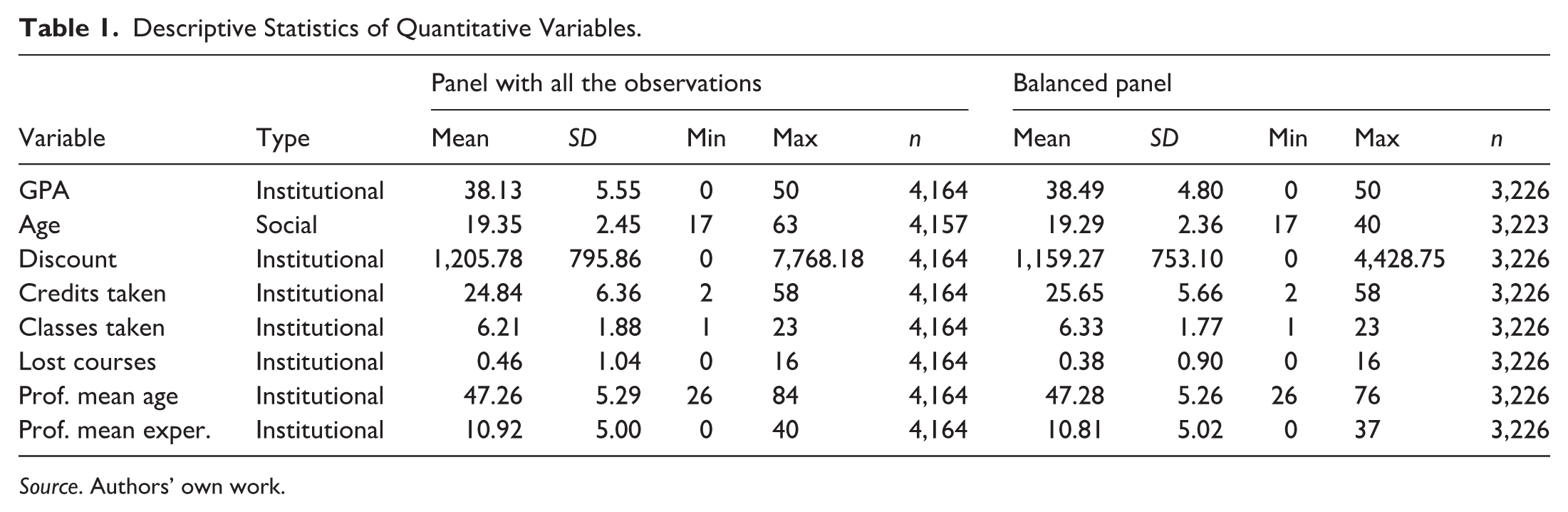
On the other hand, as this study used fully anonymized secondary data with no identifiable personal information, formal ethical approval was not required (Table 1). Finally, to address missing data, variables such as high school background and parental education were recoded to include an “Unknown” category. After this step, remaining missing values were handled via listwise deletion.
Descriptive Statistics of Quantitative Variables.
Source. Authors’ own work.
The GPA variable demonstrates that students in the balanced panel (those tracked over six semesters) exhibit higher mean grades and reduced dispersion compared to the complete sample. This pattern likely reflects the selective attrition of low-performing students who are more prone to dropout. This finding aligns with institutional variables such as credit accumulation, which is higher among balanced panel students compared to the complete sample, potentially related to lower course failure rates (higher in the complete sample). Course failures are particularly consequential as many serves as prerequisites for subsequent enrollment, especially during early academic levels. No significant differences are observed in other quantitative variables between the two groups.
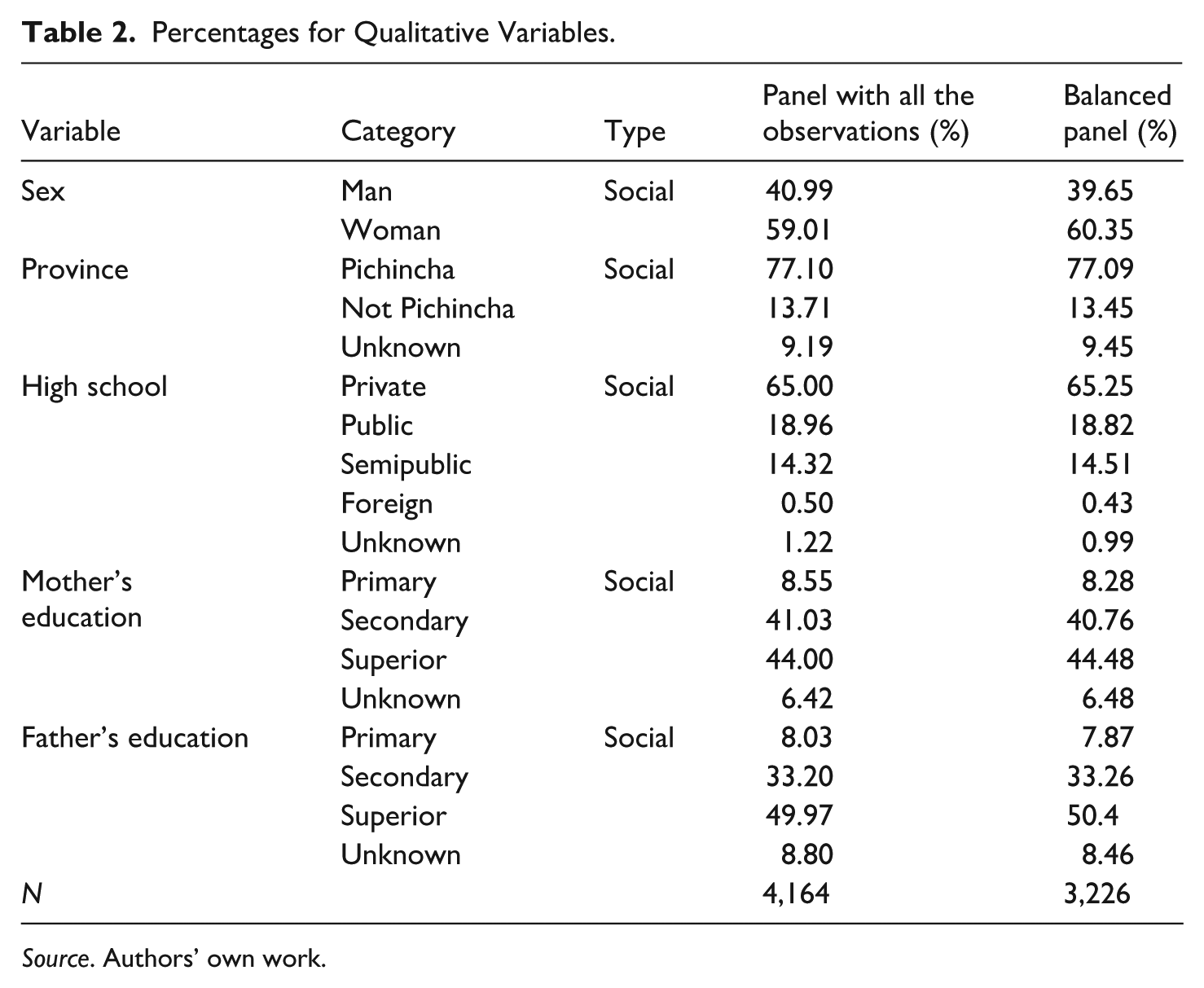
The qualitative variables consist entirely of social background characteristics. In both sample groups, women represent a larger proportion of students. Regarding geographic origin, approximately three-quarters of students come from Pichincha, the province where PUCE-Quito is located. Similarly, most students attended private secondary schools, consistent with enrollment at a private university. This pattern corresponds with parental education levels, where higher education predominates for both mothers and fathers, indicating households with sufficient socioeconomic resources to afford private schooling and access private higher education (see Table 2).
Percentages for Qualitative Variables.
Source. Authors’ own work.
Results and Discussion
The analysis demonstrates a clear pattern of progressive improvement in students’ academic performance over time. This upward trajectory is most pronounced during the initial academic levels, where students typically undergo a critical adjustment period as they transition from secondary to tertiary education—a shift that temporarily depresses early performance before subsequent recovery and improvement. Figure 1 illustrates these developmental patterns across both sample configurations, highlighting the consistent nature of this academic progression.
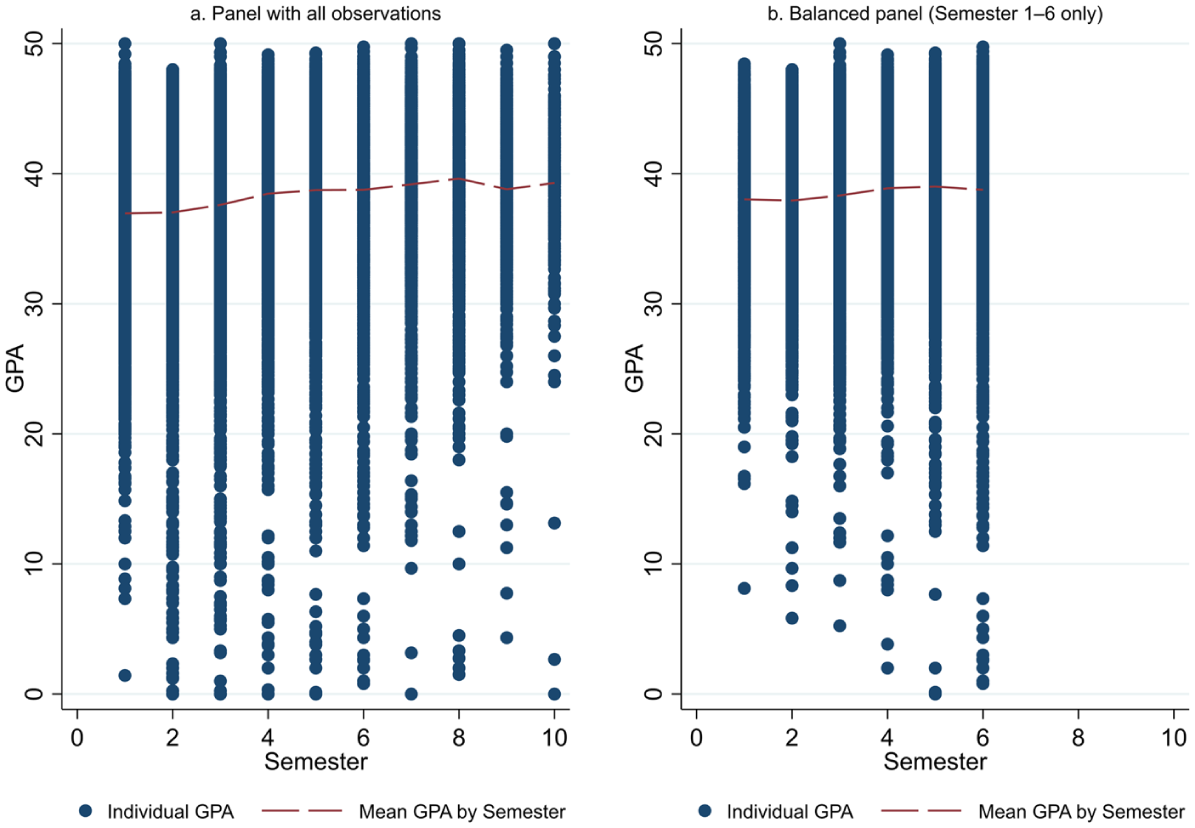
Evolution of the GPA by semester and by school: (a) panel with all observations and (b) balanced panel (semester 1–6 only).
Panel (a) displays average performance across all 10 academic levels using the complete dataset. The dotted red line demonstrates a clear upward trajectory in mean academic performance as students progress through higher levels. In contrast, panel (b) presents a markedly different pattern for the balanced panel: when students who eventually drop out are excluded from the analysis, average academic performance exhibits relative stability rather than pronounced improvement over time. This comparison suggests that the apparent performance gains observed in the complete sample primarily reflect the selective attrition of lower-performing students rather than genuine academic improvement among continuing students.
To investigate potential variation in academic performance trajectories across institutional units, Figure 2 presents ordinary least squares regression models examining the relationship between academic performance and time for each individual school. This school-specific analysis allows for examination of whether performance patterns vary systematically across different academic disciplines and institutional contexts.
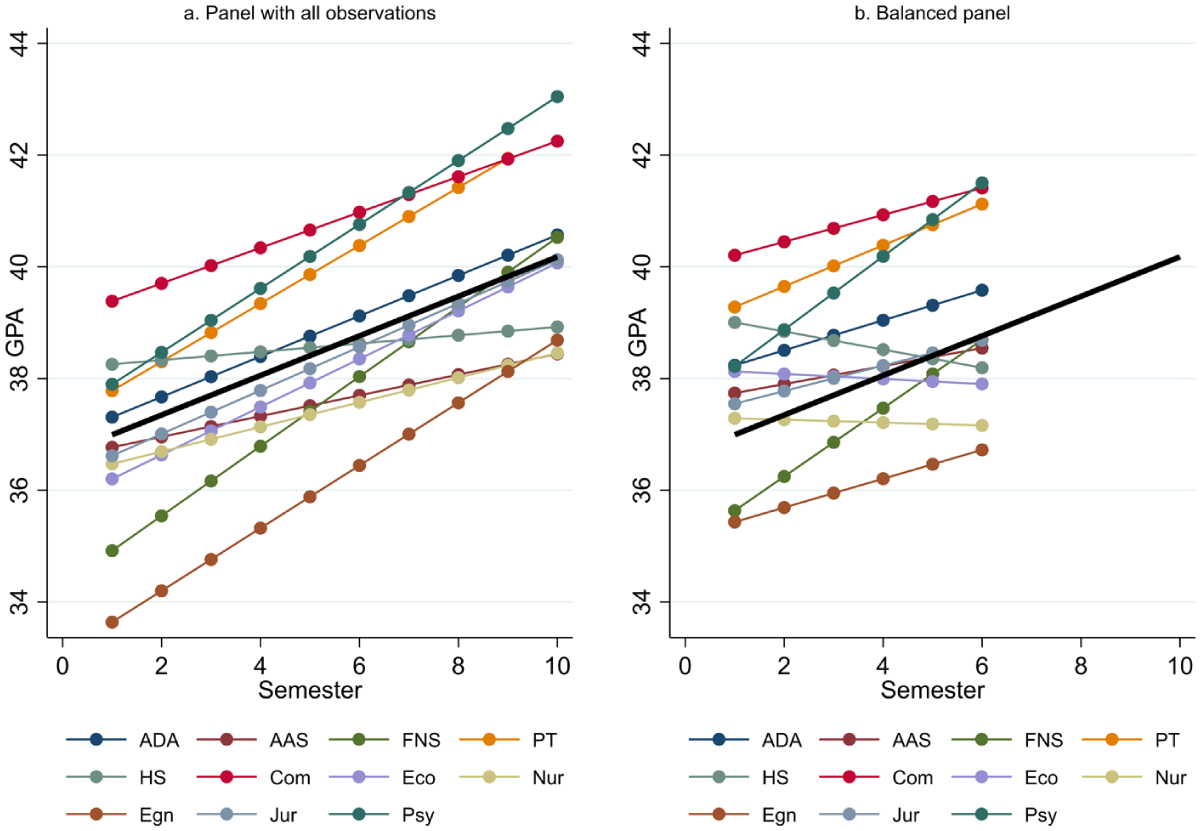
Evolution of GPA by semester and school: (a) panel with all observations and (b) balanced panel.
Panel (a) demonstrates that while all schools exhibit positive performance trends, the slopes of these regression lines vary considerably across academic departments. This systematic variation in improvement rates provides compelling empirical justification for employing a multilevel hierarchical model that incorporates school affiliation as a higher-level grouping variable, acknowledging that students’ academic performance improves at school-specific rates.
Conversely, panel (b) presents regression results exclusively for the balanced student cohort (excluding dropouts), revealing substantially greater variability in performance trajectories across schools. While most schools maintain positive slopes indicating continued performance improvement over time, several schools exhibit negative regression coefficients, suggesting declining performance trends among persisting students. This divergent pattern underscores the critical role of school-specific characteristics in explaining academic performance variations and demonstrates how institutional factors may differentially influence student outcomes even among those who remain enrolled.
The pronounced differences between the complete sample and balanced panel illustrate that sample composition fundamentally shapes observed performance patterns. Figure 3 further explores these dynamics by comparing academic performance trajectories of students who eventually drop out with those who persist over time. The results show that students who drop out consistently exhibit declining performance, highlighting their substantial influence on overall sample averages.
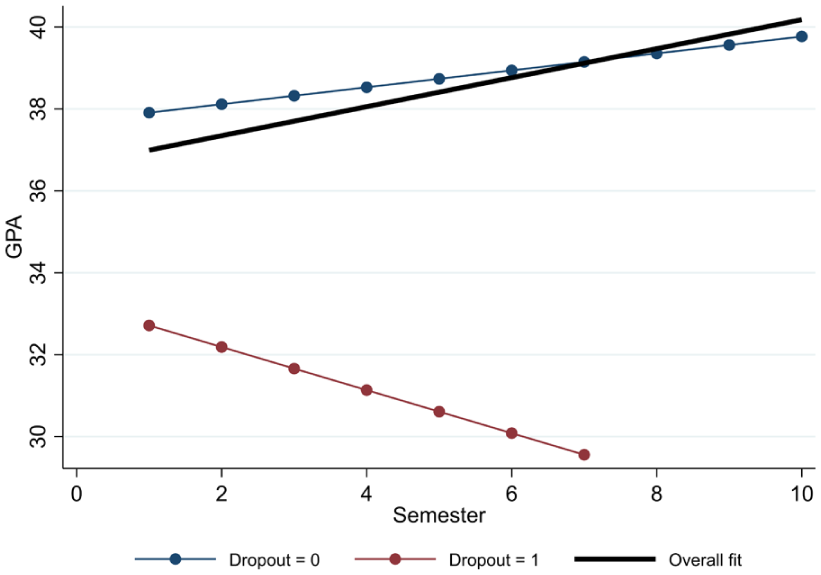
Evolution of performance among dropouts and non-dropouts.
Given the nested data structure identified through these preliminary analyses, hierarchical mixed models were employed to address the multilevel nature of the data. These models appropriately accommodate multiple sources of variance and enable comprehensive investigation of academic performance using explanatory variables that operate at three distinct levels: within-student variation over time, between-student variation within schools, and between-school variation across the institution (Hair & Fávero, 2019).
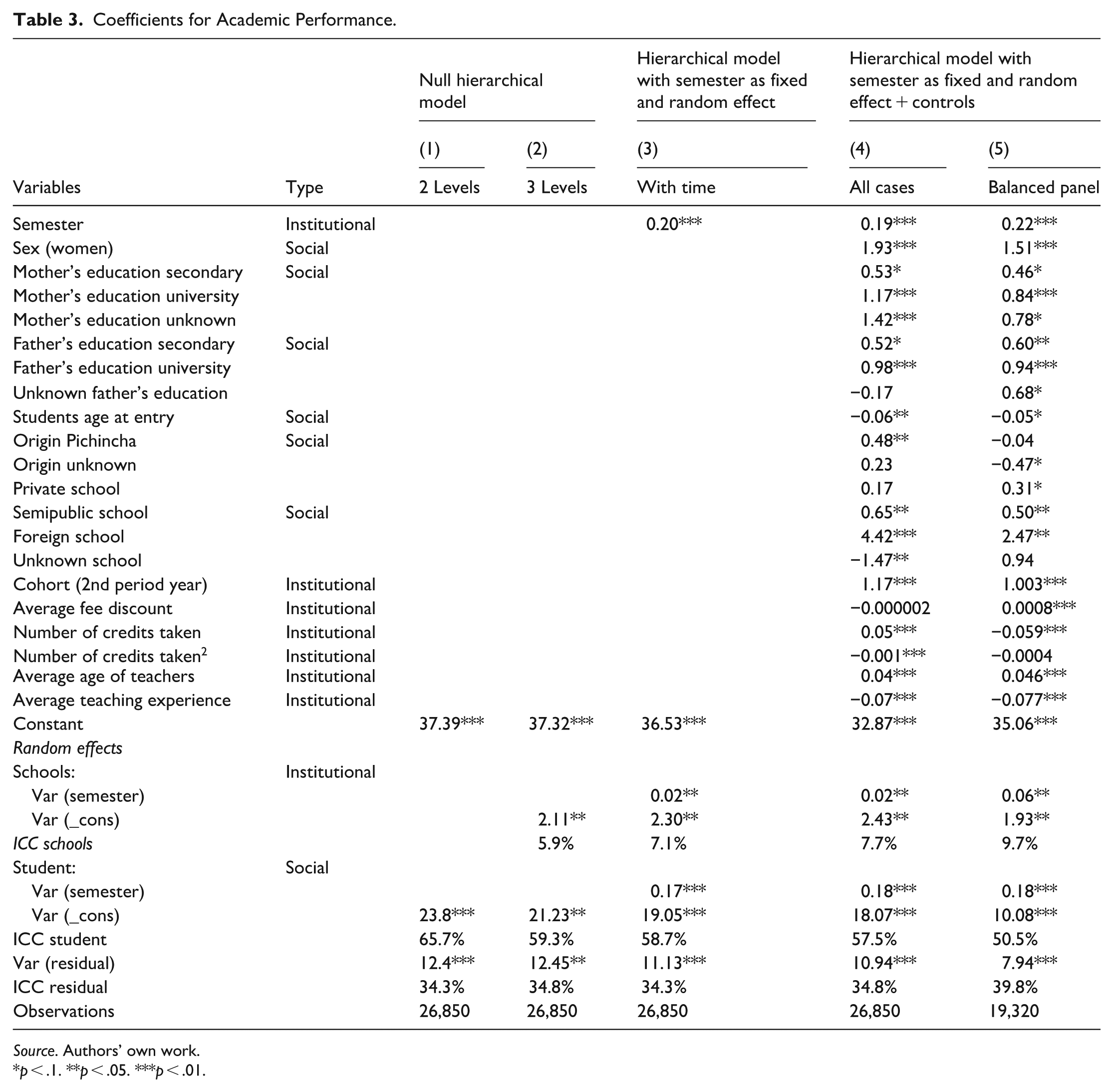
Table 3 presents the multilevel modeling results corresponding to Equations 1 through 6. Models 1 and 2 represent unconditional or “null” models that serve to validate the hierarchical structure of the data by partitioning variance components without incorporating explanatory variables. Model 1 establishes a baseline by examining total variance in academic performance among individual students, while Model 2 decomposes this variance into within-school and between-school components. These foundational models demonstrate the presence of statistically significant clustering effects through analysis of random intercepts and error terms, thereby confirming that sufficient between-school variation exists to justify the hierarchical modeling framework and supporting the analytical decision to treat schools as meaningful grouping units.
Coefficients for Academic Performance.
Source. Authors’ own work.
*p < .1. **p < .05. ***p < .01.
Table 3 presents the multilevel model results, grouping variables into two categories: institutional factors, including cohort, tuition discounts, academic credit load, and aggregated school characteristics such as average faculty age and teaching experience, and social factors such as gender, age at entry, parental education, province of origin, and secondary school type. The following is an analysis and discussion of the most relevant results.
Variance Structure and School Differences
The decomposition of variance using intraclass correlation coefficients (ICC) reveals significant differences in academic performance at both the school and student levels. In Model 2, 5.9% of the variance is attributable to school-level differences, while the majority occurs at the individual student level. This confirms the hierarchical structure of the data and supports the use of multilevel modeling. By Model 5, school-level variance increases to 9.7%, indicating that institutional heterogeneity persists even after accounting for individual and temporal factors.
These differences reflect the influence of internal academic subcultures, which shape policy implementation, resource allocation, and pedagogical priorities. As Arnold et al. (2023) note, faculty members within the same institution often prioritize initiatives such as student retention differently, influenced by factors like academic rank, seniority, and disciplinary norms. While formal regulations are standardized across the university, disparities emerge due to unequal resource distribution, variations in disciplinary orientations (e.g., prioritizing research over teaching), and informal norms regarding pedagogical practices. These micro-level variations help explain the persistence of school effects despite formal homogeneity and contribute to divergent student outcomes and retention capacity. Addressing these disparities requires strategies that promote shared responsibility, ensure equitable resource access, and align teaching priorities with student success.
Temporal Patterns and Panel Comparisons
Model 3 introduces semester as both a fixed and random effect, with a positive and significant coefficient, indicating that academic performance improves on average as students advance in their studies. Random effects remain significant for both schools and students, suggesting variation in improvement trajectories.
Models 4 and 5 compare all observations with a balanced panel of students who completed six semesters without dropout, confirming upward trends. Model 5 further shows that lower initial performance is associated with trajectories linked to higher dropout probability. This finding aligns with evidence from Buenaño et al. (2023) and Paura et al. (2025), who reported that students with weaker early performance face greater dropout risks, particularly during the first years.
In this sense, the study emphasizes that dropout is not solely a voluntary decision but is closely linked to early academic indicators. Within this context, Model 5, by focusing on a balanced panel that excludes early dropouts, more clearly captures the trajectories of persistent students, illustrating how low performance functions as a filter that anticipates attrition. This pattern aligns with the dropout risk component observed in Table 3, highlighting how early performance trajectories can serve as a predictor for dropout (Buenaño et al., 2023; Paura et al., 2025).
Institutional Factors
Interestingly, while average faculty age shows a positive association with student performance, teaching experience exhibits a negative effect. This apparent contradiction suggests that age-related attributes—such as maturity and socio-emotional skills—may benefit classroom engagement, whereas accumulated experience does not necessarily translate into effective teaching practices. This pattern likely reflects structural and cultural dynamics rather than diminished individual capacity, as senior faculty in many institutions often prioritize research and administrative duties over teaching. Martí-Ballester (2018) adds further nuance by identifying a non-linear effect: experience enhances performance up to a point, after which it becomes detrimental, possibly due to declining motivation and promotion systems that reward research over teaching. For their part, Arnold et al. (2023) and Thomas et al. (2025) indicate that effective pedagogy depends more on institutional support and incentive structures than on experience alone.
Addressing this paradox requires institutional policies that incentivize continuous pedagogical development and recognize teaching excellence. As noted by Amaro-Jiménez et al. (2020), faculty professional development acts as a key facilitator in building a community focused on student success. Therefore, measures such as structured professional development, reduced teaching loads, and sabbatical opportunities could help sustain faculty engagement and encourage innovation in classroom practices.
On the other hand, a very significant positive effect for the entering cohort indicates that students who enroll in the second academic period (mid-year) achieve systematically higher GPAs than those who enter in the first period. At PUCE, this pattern reflects underlying differences in student trajectories: students in the second cohort generally transition directly from high school, maintaining academic continuity and benefiting from updated study habits. In contrast, students in the first cohort often come from other regions, such as the coastal zone, or experience a gap period before starting university, which can reduce academic preparation and complicate adaptation. These findings suggest the need for targeted guidance and support programs, particularly for students entering the first cohort.
Finally, credit load exhibits a non-linear relationship with academic performance. The positive linear coefficient suggests that moderate credit enrollment promotes engagement and progression, while the negative quadratic term indicates diminishing returns. In the balanced panel, this relationship reverses, with sustained high credit loads associated with lower GPAs. This pattern supports the hypothesis that early attrition disproportionately affects students who struggle with course intensification, leaving only those capable of managing heavy workloads. These results align with Aina et al. (2024), who note that overloading students accelerates dropout risk, particularly among those with fewer resources to cope with high academic demands.
Together, these institutional factors underscore that improving academic performance is not only about individual effort but also about structural conditions that shape learning environments.
Social Factors
Social determinants of academic performance remain highly significant across all model specifications, underscoring how individual and family-level attributes shape university trajectories. Variables like gender, parental education, age at entry, or high school background reflect dimensions of cultural and social capital that influence academic performance.
In this sense, for example, female students consistently outperform their male peers, even after controlling for institutional factors and focusing on the balanced panel. Prior research attributes this advantage to stronger self-regulated learning strategies, disciplined study habits, and higher academic persistence among women (Sheard, 2009; Varner & Mandara, 2014; Voyer & Voyer, 2014). These findings emphasize the need to explore whether institutional practices reinforce or mitigate such patterns.
On the other hand, higher parental education is positively associated with students’ academic performance, confirming the enduring role of cultural capital in higher education outcomes. Students whose parents completed secondary or higher education consistently achieve better results, even when controlling for other factors. Although effect sizes are smaller in the balanced panel, significance persists, highlighting that advantages linked to family background extend beyond early semesters. This pattern aligns with evidence that parental education fosters academic expectations, provides access to support networks, and facilitates navigation of university systems (Azhar et al., 2014; Idris et al., 2020).
Additionally, older students tend to exhibit lower academic performance on average. This association reflects the challenges of non-traditional trajectories, often marked by work obligations or interrupted educational pathways that constrain time and cognitive resources for academic engagement. The reduced effect size in the balanced panel suggests self-selection, as older students with lower performance are more likely to leave early. These findings echo prior research linking delayed entry to higher dropout risk and lower integration during the first year (Casanova et al., 2023; Eshghi et al., 2011). These results underscore the importance of early support and flexible learning strategies for older students to reduce attrition risks.
Finally, the differences in secondary school type reveal persistent structural inequalities in pre-university preparation. Students from private and semi-public schools, and especially those from foreign schools, display systematic performance advantages compared to their peers from public institutions. Although the magnitude of these effects declines in the balanced panel, their persistence underscores how disparities in educational quality and resources at the secondary level continue to shape university outcomes. This highlights the need for equity-focused initiatives, such as preparatory programs and targeted academic support, to mitigate the cumulative disadvantages associated with public schooling.
Taken together, these results demonstrate that academic success is not solely an individual outcome but is strongly patterned by social and cultural factors established before university entry.
Conclusions and Policy Implications
This study confirms that academic performance in higher education is shaped by a combination of individual and institutional factors, with persistent inequalities influencing student trajectories. The variability observed across schools highlights the importance of institutional subcultures and resource allocation in shaping outcomes. Furthermore, the finding that faculty age positively correlates with student performance—while teaching experience has a negative effect—emphasizes the complex nature of human capital dynamics within universities. These patterns call for systemic strategies that integrate early interventions, targeted equity measures, and ongoing faculty development.
Equity-Oriented Strategies
Persistent gaps linked to gender, age, parental education, and secondary school background underscore the need for public policies that address Ecuador’s underlying structural inequalities. At the institutional level, it is essential to identify specific student groups and develop tailored support mechanisms. For example, older students may benefit from academic mentoring or hybrid learning modalities that allow them to balance studies with work responsibilities. Likewise, students who begin their programs in the first academic term of the year, often coming from other provinces or after a gap year, may require additional academic and psychosocial support during their transition.
For students entering university with academic deficiencies stemming from secondary education, early identification is key. Bridging programs or preparatory courses—currently lacking in many institutions—should be implemented to support their academic integration. Admission policies could be adjusted to include diagnostic assessments aligned with the skills required for each academic program, rather than relying exclusively on standardized entrance exams. This approach would allow for early identification of students who may benefit from additional support and help maximize the effectiveness of leveling interventions.
However, while such measures are commonly applied in international contexts, universities in Ecuador may face institutional challenges in raising admission standards while maintaining enrollment targets, highlighting tensions between quality and access.
Academic Performance, Dropout, and Public Policy
Early academic performance is a strong predictor of dropout risk. Universities should develop early warning systems, particularly for first-year students, using indicators such as GPA, credit completion rates, and course withdrawal records. These systems should trigger structured interventions such as personalized academic advising, remedial workshops, and mentoring programs to support students at risk.
Nonetheless, dropout cannot be understood solely through the lens of academic performance. Social, economic, and psychological factors also play a critical role, and addressing them requires more comprehensive approaches. In this regard, both public and institutional policies must go beyond viewing dropout as a mere metric in quality assurance systems. Instead, it should be recognized as a broader social issue that undermines equity and national development. This calls not only for monitoring dropout rates, but also for identifying their structural causes and designing interventions that promote academic persistence without compromising educational standards.
Institutional Management and Faculty Development
The specific academic unit to which a student belongs remains a consistent factor in explaining academic performance. Differences in outcomes are shaped not only by each school’s internal academic culture, but also by decision-making processes at the unit level. Identifying and scaling up successful practices across academic units could contribute to overall institutional improvement. Still, underlying disparities in the distribution of material and human resources across schools may also be contributing to unequal results.
In particular, regarding human capital—and especially faculty—the paradoxical relationship between age and teaching experience points to the need for policies that promote continuous pedagogical renewal. Beyond traditional evaluations, criteria for promotion and recognition should include indicators related to teaching innovation and student engagement. Institutional goals must align with structured faculty development initiatives, offering incentives that sustain motivation and ensure that academic careers are oriented toward student success.
Footnotes
Acknowledgements
The authors wish to express their sincere gratitude to the Pontifical Catholic University of Ecuador for the support provided through its Research Directorate. We also thank the study participants, whose commitment and collaboration made this work possible.
Author’s Note
Bernardo Villegas is now affiliated Centre for Human-Inspired Artificial Intelligence, University of Cambridge, UK.

Funding
The authors received the following financial support for the research, authorship, and/or publication of this article: This publication has received financial support from the Pontificia Universidad Católica del Ecuador to cover the Open Access publication fees.
Declaration of Conflicting Interests
The authors declared no potential conflicts of interest with respect to the research, authorship, and/or publication of this article.