



Abstract
Using LatCrit and QuantCrit, we examined the effect of school climate, ethnic identity, and self-esteem on grade point average (GPA) in a sample of 300 Latinx high school students. We found significant positive correlations between climate and GPA as well as self-esteem and GPA. Moreover, using structural equation modeling, we found self-esteem mediated the relationship between climate and GPA. This highlights the role of institutions in improving the educational experiences and increasing the educational attainment of Latinx students.
Higher education is an essential stepping-stone in job employability in adulthood (Ng, 2022). However, occupational disparities persist across racial/ethnic communities (U.S. Bureau of Labor Statistics, 2023). Ethnically minoritized students continue to have the lowest levels of educational attainment at each stage (U.S. Census Bureau, 2021). The pushout rate for Latinx 1 high schoolers has significantly declined from 15.1% in 2010 to 7.4% in 2020 (National Center for Education Statistics, 2022). Yet, their pushout rate (7.4%) remains higher than White (4.8%), Black (4.2%), and Asian (2.4%) students. Pushout refers to practices that contribute to students dropping out (Chen, 2013). Ladson-Billings (2006) coined the term educational debt to address the cumulative effect of foregoing resources among ethnically minoritized students. Pérez Huber et al. (2014) highlight the increasing educational debt of Latinx individuals and the negative long-term effects if it is not addressed. Thus, it is imperative to identify factors that retain Latinx students.
We focus on the Latinx community, the largest growing population in the U.S. (U.S. Census Bureau, 2021), and the youngest ethnic group, with a median age of 30 years versus 44 years for Whites (Schaeffer, 2019). This has led to an expected increase in Latinx college enrollment (Excelencia in Education, 2019). Researchers have documented the promotive effects of a positive school climate, self-esteem, and ethnic-racial identity on high schoolers’ academic achievement (Huang et al., 2017; Reupert, 2021), but few focus on Latinx youth (Cooper Stein et al., 2018). We seek to highlight how positive school climates can buffer some of the effects of systemic racism experienced by Latinx students to promote ethnic identity, self-esteem, and academic grades (i.e., Grade Point Average or GPA).
Therefore, the current study examined individual and institutional factors contributing to the academic success of ethnically minoritized students in a public high school. Two questions guided the study: (RQ1) What is the relationship between students’ individual factors (self-esteem and ethnic identity) and their academic grades (GPA)? (RQ2) What is the relationship between institutional factors (school climate) and students’ academic grades (GPA)?
Critical Race Theoretical Lenses: LatCrit and QuantCrit
Latina/o Critical Race Theory (LatCrit), an extension of Critical Race Theory (CRT; Bell, 1995) examines the unique experiences of Latinx communities, including ethnicity, education, and legality, in the U.S. and globally (Solórzano & Delgado Bernal, 2001). LatCrit highlights Latinx’s multidimensional identities and the intersectionality of racism, sexism, classism, ethnicity, identity, and other forms of oppression (Solórzano & Delgado Bernal, 2001). We examine two prominent themes in LatCrit: education (climate) and identity (ethnic identity, self-esteem) contributing to the academic success of Latinx high school students.
Like LatCrit, QuantCrit applies the tenets of CRT to quantitative research designs, methodologies, and analytical interpretations to reveal racialized inequities that affect minoritized students and their communities (Garcia et al., 2018). QuantCrit, “considers historical, social, political, and economical power relations” to examine the intersections of race with other social categories (e.g., gender and socioeconomic status) using quantitative material (Garcia et al., 2018, p. 149). We employ QuantCrit to gain insight into the political, institutional, and systemic dimensions of racism impacting students using structural equation modeling.
School Climate
The U.S.’s long history of institutional racism can be seen in Latinx students’ oppression throughout K-12 schools and higher education via segregation and tracking into agricultural work (Blackwell, 2011; Chávez, 2002). We can see this legacy of racism today in schools’ curricular structures, processes, and discourses (Solórzano & Delgado Bernal, 2001; Yosso, 2002). LatCrit challenges us to examine how school climates either perpetuate this legacy of racism or have been transformed into sites that foster Latinx success. In the current study, we examine how Latinx high school students perceive their high school’s school climate, and how the school climate impacts their overall success: self-esteem, ethnic identity, and grades.
A positive school climate is associated with improved student outcomes, including higher academic achievement, better emotional-wellbeing, and higher self-efficacy (Huang et al., 2017; Zysberg & Schwabsky, 2021). As such, Glass and Westmont (2014) found that school climate improved GPA and fostered cross-cultural interactions with peers. A positive school climate is also a precursor to self-esteem development and ethnic pride (Camacho et al., 2018; Fisher et al., 2020; Swanson et al., 2003). Furthermore, teachers who create a culturally responsive environment also have greater student engagement (Gay, 2010; González et al., 2005).
Ethnic Identity and Self-Esteem
Latinx students must navigate a Western, Educated, Industrialized, Rich, and Democratic (WEIRD) curriculum throughout the K-12 educational pipeline (Henrich et al., 2010; Yosso, 2002). LatCrit exposes how racialized inequalities embedded in the curricular structures, processes, and discourses reproduce the status quo and further impact Latinx students’ educational experiences (Solórzano & Delgado Bernal, 2001; Yosso, 2002). Rarely are schools acknowledging and valuing language, culture, and histories (i.e., assets and funds of knowledge) Latinx students bring. Instead, schools perpetuate deficit-based ideologies when students are not seen upholding the status quo (Davila & Bradley, 2010). LatCrit serves as an important analytic tool to examine how forms of resistance, such as ethnic pride and healthy self-esteem, can revolutionize the educational landscape for Latinx students and support their academic success.
A growing literature examines the impact of adolescents’ ethnic identity and mental health (including self-esteem) on educational outcomes and vice versa (Reupert, 2021). Self-esteem is defined as how students value their worth (Rosenberg, 1965), whereas ethnic identity refers to students’ self-identification to a distinct ethnic group (Phinney & Chavira, 1992). Empirical evidence has demonstrated having a strong ethnic identity is significantly associated with positive psychological well-being among minoritized adolescents (Rivas-Drake et al., 2014), including self-esteem (Cavazos-Rehg & DeLucia-Wack, 2009; Smith & Silva, 2011) and fewer depressive symptoms among minoritized adolescents and young adults (Smith & Silva, 2011). Overall, a bidirectional relationship between ethnic identity and self-esteem exists, and in turn, boosts academic grades.
Ethnic Identity and Educational Outcomes
Given that our study of Latinx high schoolers was conducted in California from 2009 to 2011, we use LatCrit to critically examine the dismantlement of bilingual education programs after California passed Proposition 227 in 1998 (Legislative Analyst’s Office, 1998). Although repealed in 2016, the consequences of Prop 227 have left an imprint on generations of Latinx students. This policy devalued the Spanish language and hindered Latinx students’ cultural and social development. One overlooked facet of bilingual education is the opportunity to explore one’s ethnic identity. As a result, the lack of support for Spanish literacy and Latinx identity exploration penalizes students’ assets, thereby perpetuating systematic inequities (Davila & Bradley, 2010). Using a LatCrit perspective, we recognize that fostering ethnic-racial identity is a resistance tool to counteract oppressive policies inherent in educational institutions.
Studies on Black and Asian high schoolers found that those with a more positive ethnic identity were more likely to report higher GPAs (Boston & Warren, 2017; Hsin & Xie, 2014). Greater endorsement of students’ ethnic identity may have a protective effect on students’ self-esteem, and in turn, boost grades (Oyserman, 2008). For instance, Altschul et al. (2006) found that ethnic-racial identities predicted their academic GPA among Black and Latinx middle school students. Similarly, Supple et al. (2006) found that for Latinx high schoolers, positive ethnic identity predicted higher grades among 9th and 10th graders.
Self-Esteem and Educational Outcomes
To understand the impact of self-esteem on educational outcomes, it is important to examine how institutionalized racism (vis-à-vis tracking) negatively impacts the educational journey of Latinx youth. Tracking is the practice of sorting students by academic ability level for all classes. Through tracking, students are put into one of three tracks: (1) above average/gifted, (2) average, or (3) below average, but Latinx students are disproportionately represented in the lower two tracks (Noguera, 1995; Oakes, 2005). Pérez Huber (2011) suggests that racist nativism—positions power within a racial hierarchy that justifies native (White) dominance—is pervasive in California public K-12 education, often portraying Latinxs as “criminals” and “non-native.” Pérez Huber suggests that these racist native microaggressions can be highly detrimental for Latinx youth of what it means to be Latinx, or they may lead Latinx youth to reject their ethnic identities or academic achievement, which could negatively affect their well-being, including self-esteem (Gándara & Contreras, 2009).
Still, considerable evidence has identified self-esteem as a predictor of academic achievement (Rivas-Drake et al., 2014; Supple et al., 2006). Strong self-esteem was shown to enhance students’ academic motivation, promote psychological well-being, and encourage the personal fulfillment of one’s goals, which are highly correlated with educational achievement (van der Kaap-Deeder et al., 2016). Consistent with this idea, Cavazos-Rehg and DeLucia-Waack (2009) found that GPA predicted self-esteem in a sample of 150 Latinx adolescents in grades 7 to 12. Finally, research has found a reciprocal relationship between self-esteem and academic performance (Zheng et al., 2020). In a longitudinal study of 674 Mexican-descent students from 5th to 11th grade, Zheng et al. (2020) found that students with high global (general) and academic self-esteem improved their grades over time, and vice versa.
Methods
Participants
The study participants consisted of 300 Latinx adolescents in 9th and 10th grade attending a public high school located in Southern California. The high school was predominantly Latinx (71%) and had an Academic Performance Index statewide ranking score of three (3), whereby one (1) is considered low and ten (10) is high.
The sample was sex balanced with 145 females (48.3%) and 155 males (51.7%). The mean age was 14.8 years (SD = 0.90), with 181 students (60%) in 9th grade, and 119 (40%) in 10th grade. Most participants (80.3%) reported being born in the US—a stark contrast to 15.7% of mothers and 14.3% of fathers born in the United States. The students’ parents had similar levels of education, with a mean grade of 10.65 (SD = 3.2) and 10.59 (SD = 3.2) for mothers and fathers, respectively. Ten cases were eliminated as univariate and bivariate outliers since they showed response bias (extreme responses and diagonal pattern responses).
Survey Measurement
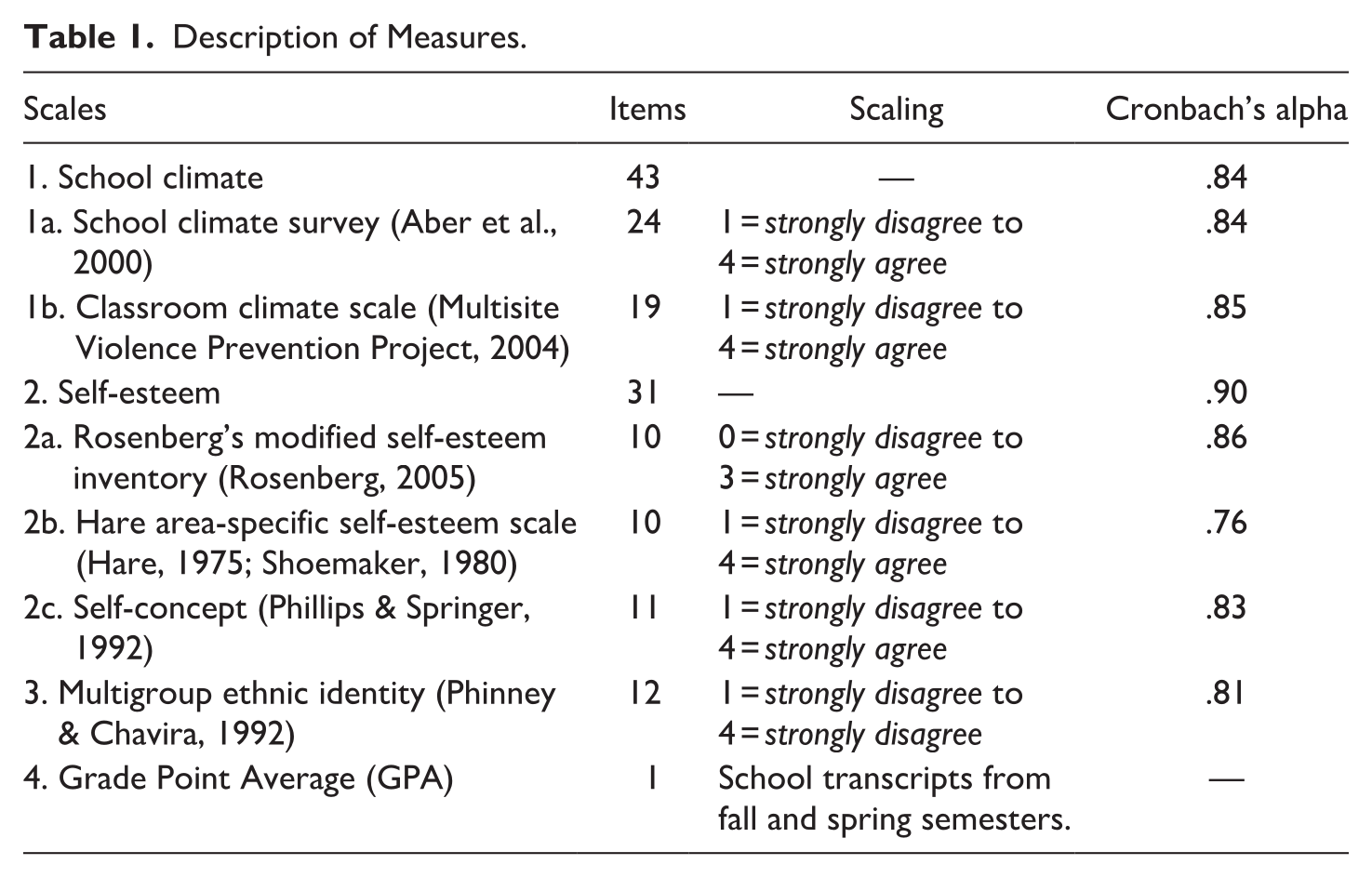
We used existing scales for reliability and validity, including the 12-item Multigroup Ethnic Identity scale for ethnic identity, a composite of 43 items from the School and Classroom Climates scale for school climate, and a composite of Self-Esteem using 31 items from two scales (see Table 1 for survey details). All variables had good reliability. The GPA variable was obtained through the students’ school transcripts. In applying a QuantCrit approach, critical scholars emphasize the importance of knowing the eugenics origins of statistical methods (Garcia et al., 2018; Zuberi, 2001). Moreover, we acknowledge that the measures, except for ethnic identity, were created for White populations. Nonetheless, these measures successfully captured the same constructs among Latinx populations, as shown by the high reliability. While GPA is not the only measure of success, it continues to be the principal measure used in academia to determine college admission, degree attainment, and thus used in this study.
Description of Measures.
Procedure
The university Institutional Review Board and high school officials approved all procedures. Participants were recruited from 9th- and 10th-grade English classrooms and were given participant packets with a survey, parental consent, and adolescent assent forms. One week later, the research team returned to collect the surveys, and those who returned completed packets were given $10 for participation. All youth were invited to participate, but only Latinx. were included in this study.
Design and Analysis
Reliability tests, descriptive statistics, including means and standard deviations, were computed in SV26|IBM SPSS Statistics 26 (IBM Corporation, 2019). For our primary analysis using Structural Equation Models (SEM), we used the full information maximum likelihood with the maximum likelihood estimator in Mplus Version 8.4 Demo (Muthen & Muthen, 2020) to handle missing data (Kline, 2011).
Model fit was determined using the comparative fit index (acceptable if CFI ≥0.90; good if CFI ≥0.95), the Tucker–Lewis Index (acceptable if TLI ≥0.90), root mean square error of approximation (acceptable if RMSEA < 0.08, good if RMSEA < 0.06), standardized root mean square residual (acceptable if <0.10), and Chi-Square test (acceptable if there is a small χ2, i.e., close to 0, and/or p > .05; Hu & Bentler, 1999). Given the non-nested nature of our alternative models, we compared parsimony-adjusted indices such as Akaike Information Criterion (AIC) and sample-size adjusted BIC (nBIC) between alternative models, where smaller values were “better” (BIC Difference 0–2 = weak, 2–6 = positive, 6–10 = strong, and >10 = very strong; Raftery, 1995). Since AIC and nBIC are descriptive course indexes that do not say whether a model is significantly better than another model, we considered other models’ fit indices such as CFI, TLI, RMSEA, and percentage of variance explained, etc. (Raftery, 1995).
Authors’ Positionality
All three authors are Latinas—of Guatemalan, Peruvian, and Mexican descent—daughters of immigrants from low-income communities, and first-generation college students. Jaqueline V. Dighero, is a doctoral candidate in education, a first-generation college student, and a daughter of Guatemalan immigrants, who has experienced unsupportive school climates in graduate school. These experiences sparked her interest in researching how campus climate affects Latina/o/x students. Ilene N. Cruz is a master’s student in psychological science, a first-generation Peruvian-American, and a daughter to working-class immigrants. As a product of the Los Angeles Unified School District, Ilene possesses firsthand knowledge of the systemic discrimination inherent in U.S.A. institutions of K-12 learning. Gabriela Chavira is a Chicana professor in psychology whose lived experiences in navigating P-20 educational systems influenced her research on pathways to adulthood. She has mentored over 70 minoritized students into master’s and Ph.D. programs. Altogether, their unique experiences and challenges navigating the public P-20 education system inspired them to pursue doctoral studies and influenced their research examining systemic barriers and issues of justice, equity, diversity, inclusion, and access (JEDIA) in public education.
Results
To answer our two research questions, we conducted correlational analyses between individual factors and institutional factors and GPA. We found correlations between the individual factors and institutional factors. Therefore, we ran a path analysis to see how the individual and institutional factors worked together to inform GPA. In the following, we discuss the correlations and path analysis results in detail.
Correlations
A Pearson Correlation examined the relationship between school climate (M = 118.63, SD = 15.20) and self-esteem (M = 88.65, SD = 11.60). The relationship was positive, moderate in strength, and statistically significant (r(272) = .29, p < .001). A Pearson’s correlation examined self-esteem (M = 88.65, SD = 11.60) and ethnic identity (M = 34.92, SD = 5.54). The relationship was positive, weak in strength, and statistically significant (r(281) = .14, p = .02). A Pearson Correlation examined self-esteem (M = 88.65, SD = 11.60) and academic GPA (M = 1.99, SD = 1.04). The relationship was positive, weak in strength, and statistically significant (r(244) = .16, p = .01). For a full list of all correlations examined, please see Table 2.
The Correlations of the Study Variables.
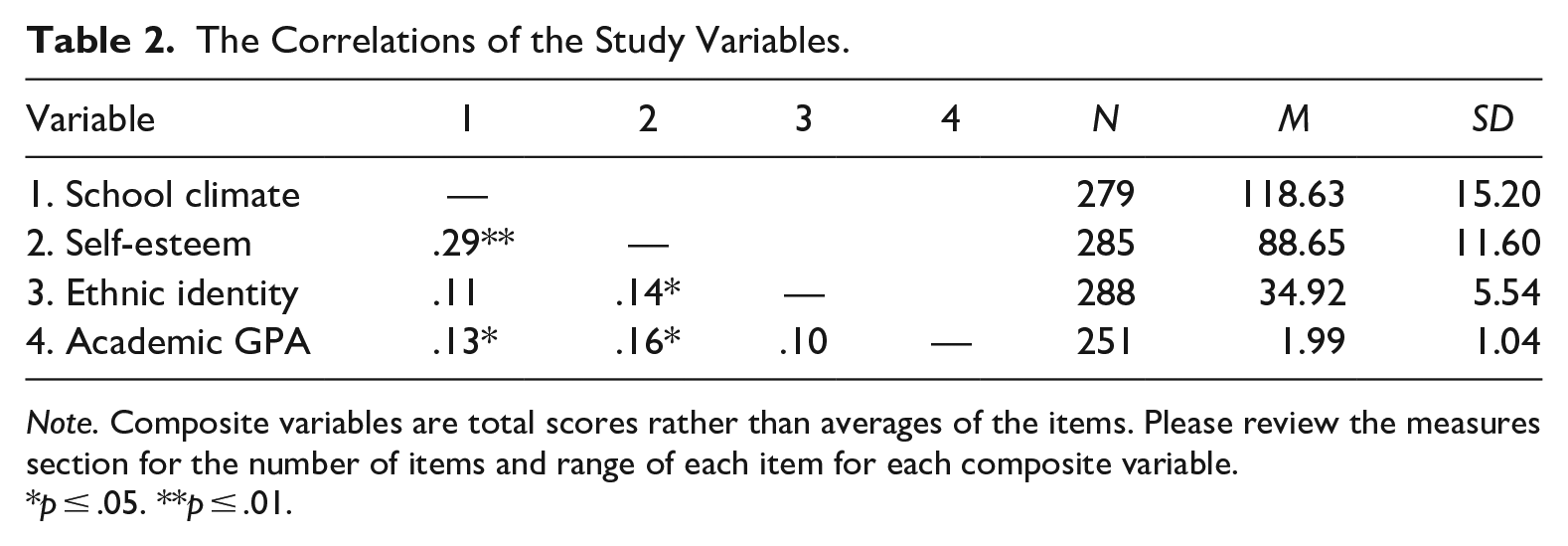
Note. Composite variables are total scores rather than averages of the items. Please review the measures section for the number of items and range of each item for each composite variable.
p ≤ .05. **p ≤ .01.
Path Analyses
The proposed path analysis model (see Figure 1) demonstrated good model fit, χ2 = 1.78, df = 1, p = .18, CFI = 0.98, TLI = 0.87, RMSEA = 0.05, SRMR = 0.02. The Chi-Square model fit index was small and not statistically significant indicating no difference between predicted and observed covariance, and thus providing an indication for a potentially good fitting model. The CFI was greater than 0.90, indicating a good model fit. The TLI was less than 0.90, indicating a poor model fit. The RMSEA was less than 0.06 and the SRMR was less than 0.10, which warrants a good model fit. Thus, we concluded that our proposed model was a good fitting model as indicated by our model fit indices. We found that our two individual factors, ethnic identity and self-esteem, had a significant bidirectional effect (0.12). Only one individual factor (self-esteem) had a direct effect on GPA (0.14, RQ 1). Additionally, self-esteem mediated the relationship between our institutional variable of school climate and our outcome variable, GPA (0.29 × 0.14 = 0.04, RQ2).
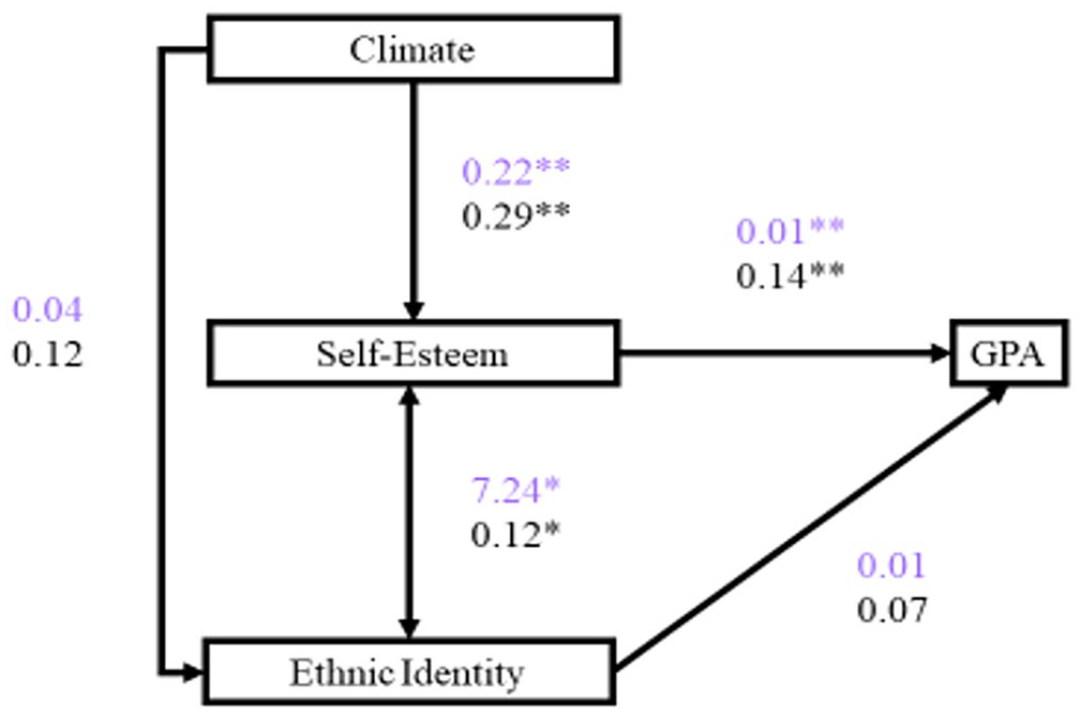
The structural equation model with self-esteem as the mediator.
Discussion
We found that our individual and institutional factors–self-esteem, ethnic identity, and campus climate–contribute to the academic GPA of Latinx high school students (Huang et al., 2017; Reupert, 2021). The first research question examined students’ individual factors on their GPA, and we found that self-esteem had a positive and predictive relationship to GPA (Cavazos-Rehg & DeLucia-Wack, 2009; van der Kaap-Deeder et al., 2016). However, unlike prior studies, ethnic identity did not predict students’ GPA (Supple et al., 2006). We also found a bidirectional relationship between self-esteem and ethnic identity (Smith & Silva, 2011; Rivas-Drake et al., 2014). In California, where students of Latinx descent make up more than half of the student K-12 enrollment (California Department of Education, 2023), and are likely to attend majority/ minority schools that share their ethnic-racial background, students’ ethnicity may not be salient (Smith, 1991; Yip, 2014). Salience measures how relevant ethnicity is at a specific moment in time and is situationally variable (Yip, 2014). This sample of Latinx students may not perceive oppression by others because they make up the majority on campus, and do not often reflect on ethnic identities, compared to those who are in the minority in their schools.
To examine the relationship between climate (institutional factor) and students’ GPA, we found that climate positively predicts students’ educational outcomes (Huang et al., 2017; Zysberg & Schwabsky, 2021) through self-esteem. This finding parallels previous studies that found that fostering a positive school climate is a precursor to self-esteem development and ethnic pride (Camacho et al., 2018; Fisher et al., 2020; Swanson et al., 2003). There were alternative models that were a good fit, yet the main predictors were individual factors. In applying a critical approach, we chose the current model because it places the responsibility for student success on systematic, institutional factors (i.e., school climate), rather than a deficit model that holds the responsibility of students’ success on individual characteristics.
Creating a Positive School Climate
At the institutional level, school districts can work alongside school leaders to nurture a positive school climate using evidence-based practices. Schools can conduct surveys and moderate student panels to assess school climate and sense of belonging. Schools can use this data to improve school practices and school climate. Additionally, by reallocating federal and state funds, schools can invest in teacher training that focuses on belonging and develop community-based participatory partnerships that assist students (Gonzalez, 2021).
Furthermore, diversifying the education workforce has been a long-standing priority in K-12 schooling. Indeed, racial congruence between students, educators, and school leaders is critical in promoting a positive school climate. Researchers have found that students taught by teachers of color were more likely to report increased math and reading scores, college aspirations, graduation rates, and individualized attention and support (Carver-Thomas, 2018). Hence, it is important for school district leaders to hire a diverse teaching force that reflects its student population for the academic success and well-being of minoritized students.
Fostering Ethnic-Racial Identity Exploration
Researchers highlight the role of ethnic-racial identity on student grades (Supple et al., 2006). It may be that ethnic-racial identities are less salient for Latinx students who attend schools where they are the majority. In such majority-minority schools, it may be essential to support all students and provide a safe space for them to explore their ethnic-racial identities. Using critical lenses, we recognize that nurturing ethnic-racial identity may be an exercise of liberation for Latinx K-12 students. We implore school personnel to consider the complexities of Latinx identities to encompass other domains, such as religion, sexual orientation, immigration status, skin tone, language, socioeconomic class, etc. By doing so, prevailing Latinx student stereotypes can be dismantled, and instead emphasize the vibrant multidimensional nature of each student. Culturally responsive teaching is critical for the academic success of Latinx students. Teachers can find creative ways to help foster positive Latinx identities by assigning Latinx-authored essays, books, and articles from diverse, intersectional backgrounds. Schools can host events that foster awareness and pride in their community. Subject-specific classes can highlight the contributions of Latinx community members who made significant contributions in those fields (e.g., STEM, music, and art). In applying a LatCrit perspective, we urge school leaders to adopt a Culturally Responsive School Leadership framework that emphasizes culturally responsive pedagogy within the school environment to explore ethnic identity, address Latinx students’ needs, and promote JEDIA (Huchting & McGowan-Robinson, 2022).
Increasing Justice, Equity, Diversity, Inclusion, and Accessibility (JEDIA) Initiatives
It is well-established that prejudice and discrimination can be internalized by individuals from minoritized communities. Research shows that ethnically minoritized students, including Latinx, disproportionately experience teacher biases and punitive discipline by administrators, and are less likely to be encouraged to attend 4-year universities (Campbell & Ronfeldt, 2018). In promoting a LatCrit consciousness, we focus on systemic advocacy to advance social transformation for Latinx students. It is therefore imperative for school personnel to receive JEDIA training to reduce biases and become culturally aware/competent when working with Latinx students to reduce school pushout. Providing equity-minded praxis in educational settings will foster a safer environment for Latinx students to grow, explore, and learn.
Conclusion
This study illuminates the importance of institutional and individual factors in the educational experiences of minoritized youth, specifically those of Latinx descent. By using critical lenses, we are able to consider the long history of US K-12 educational institutions oppressing Latinx students, including segregation and tracking (Moll, 2011; Oakes, 2005). These findings highlight several recommendations for educational institutional actors, such as school administrators and teachers. It is important to address the compounding consequences of continuously ignoring the needs of Latinx students in U.S. education settings. Given that Latinx students make up the majority of students in California public schools and their academic success will impact their future opportunities, we have a moral and economic imperative to close the educational debt that exists. These findings suggest a few ways to reduce such debt, including educators and administrators fostering positive school climates, ethnic identity exploration, and JEDIA initiatives.
Footnotes
Correction (April 2024):
Article updated; for further details please see the Article Note at the end of the article.
Declaration of Conflicting Interests
The author(s) declared no potential conflicts of interest with respect to the research, authorship, and/or publication of this article.
Funding
The author(s) disclosed receipt of the following financial support for the research, authorship, and/or publication of this article: This work was supported by the National Institute on Minority Health and Health Disparities, Research Infrastructure in Minority Institutions (Chavira, grant number 1P2OMD003938); the National Science Foundation Graduate Research Fellowship Program (Dighero, Fellow ID 2018259200); and the University of California Riverside, School of Education, Flora Ida Ortiz Endowed Fellowship (Dighero).
1.
The citation “Aber et al., Unpublished manuscript” in Table 1 has been updated to “Aber et al., 2000” and its reference has been updated to “Aber, M. S., Meinrath, S. D., Johnston, J., Rasmussen, A. E., & Gonzalez, A. (2000). School climate survey: High school version. Champaign, IL: University of Illinois at Urbana-Champaign School Climate Research Team.” in the Reference list.
2.
The sentence “As a product of the Los Angeles Unified School District, Ilene possesses firsthand knowledge of the systemic discrimination inherent in American institutions of learning.” in the Authors’ Positionality section has been updated to “As a product of the Los Angeles Unified School District, Ilene possesses firsthand knowledge of the systemic discrimination inherent in U.S.A. institutions of K-12 learning.”
3.
The word “Latina/o/x” in the sentence “All youth were invited to participate, but only Latina/o/x were included in this study.” in the Procedure section has been updated to “Latinx.”.
4.
The citation “Rosenberg, 2004” in Table 1 has been updated to “Rosenberg, 2005” and the reference for the same has been added to the reference list as “Rosenberg, M. (2005). Modified Rosenberg’s self-esteem inventory (a). In L. L. Dahlberg, S. B. Toal, M. Swahn, & C. B. Behrens (Eds), Measuring violence-related attitudes, behaviors, and influences among youths: A compendium of assessment tools, (2nd ed., pp. 147). Centers for Disease Control and Prevention, National Center for Injury Prevention and Control.  ”
”
5.
Article also updated to correct minor grammatical and spelling errors.