



Abstract
Despite intersectional barriers to accessing and navigating institutions of higher education, Latine college student enrollment and attainment rates are increasing. This critical quantitative study employed Community Cultural Wealth framework to identify connections between cultural coping strategies and resilience among 143 Latine students at a Predominantly White Institution. Using the newly developed Cultural Wealth Coping Scale, this study revealed that linguistic capital and cognitive resilience capital promote resilience. Recommendations for future research and practice are provided.
A pesar de las barreras interseccionales para acceder y navegar por las instituciones de educación superior, las tasas de matriculación y logros de los estudiantes universitarios Latine están aumentando. Este estudio cuantitativo crítico empleó el marco de la Riqueza Cultural Comunitaria para identificar las conexiones entre las estrategias de afrontamiento cultural y la resiliencia entre 143 estudiantes Latine en una institución predominantemente blanca. Usando la Escala de Afrontamiento de Riqueza Cultural recientemente desarrollada, este estudio reveló que el capital lingüístico y el capital de resiliencia cognitiva promueven la resiliencia. Se proporcionan recomendaciones para futuras investigaciónes y prácticas.
Latines 1 make up 18.7% of the United States (U.S.) population and accounted for over half of the population growth between 2015 and 2020 (U.S. Census Bureau, 2021). This is one of the youngest, fastest-growing populations in the U.S. (Lopez et al., 2018), projected to comprise a fourth of the population by 2045 (U.S. Census Bureau, 2018). Nonetheless, their representation in higher education remains disproportionate to their representation in the U.S. Specifically, they are underrepresented at 4-year institutions (Santiago et al., 2016) and overrepresented at Hispanic Serving Institutions (HSIs; Excelencia in Education, 2021). While Latine associate and bachelor’s degree attainment has increased since the mid-1990s (Santiago et al., 2016), their bachelor’s degree attainment remains lower than their Black and White peers (Schak & Nichols, 2018).
The college experience comes with various challenges including managing increased autonomy, academic pressures, balancing various responsibilities, navigating new physical spaces and social supports, and financial stressors (Hurst et al., 2013). Latine individuals often face additional, unique challenges and stressors. For example, Latine students are more likely than their peers to come from low-income households and identify as first-generation college students (Latino et al., 2020). Moreover, the Latine community often faces multiple layers of intersectional discrimination and subordination (Romero et al., 2014), pressure to assimilate (García-Louis, 2023), and familial responsibilities (Espinoza, 2010; Rodriguez et al., 2019). Specifically, at Predominantly White Institutions (PWIs) where this study took place, Latine students report experiencing overt racism, microaggressions, and negative stereotypes (Nelson Laird et al., 2007; Von Robertson et al., 2016; T. Yosso et al., 2009). While it is important to understand the struggles faced by these communities, Kanagui-Munoz (2014) argues that it is equally as important to “focus on their resilience and utilization of cultural wealth” (p. 100).
Despite such adversity, Latine college completion rates continue to increase (Excelencia in Education, 2022). These strides demonstrate Latine individuals’ resilience in the face of a plethora of obstacles revealing a conceptual gap in the understanding of what exactly promotes such resilience. As such, it is imperative to understand the coping strategies that contribute to Latine individuals’ psychological resilience. More specifically, general knowledge of coping and resilience must consider cultural contexts, as research suggests that coping strategies may correspond with cultural group norms and behaviors (Kanagui-Munoz, 2014; T. Yosso et al., 2009).
Lazarus and Folkman (1984) define coping strategies as cognitive and behavioral efforts to withstand stressful situations. Coping research has traditionally been conducted through a Eurocentric lens that fails to consider the unique struggles of various ethnically/racially minoritized groups (Kanagui-Munoz, 2014). Similarly, psychological resilience research has neglected to recognize the cultural contexts in which resilience occurs. Recognizing this critical gap in the literature, Ungar (2006) attests, “We do not yet know what resilience means to non-western populations and marginalized groups. . .who live side-by-side with their ‘mainstream’ neighbors in western settings” (p. 219). There is a need for psychological resilience and coping research to be more culturally relevant to diverse populations, specifically the Latine community.
While there is a growing body of research that has explored cultural assets among Latine students, there remains a dearth of studies examining how cultural coping strategies serve as protective factors of resilience. Protective factors are defined as elements that protect individuals from harm and allow them to withstand and even thrive amid difficult circumstances (Fletcher & Sarkar, 2013). This study employed the Cultural Wealth Coping Scale (CWC), to identify coping strategies that Latine college students utilize to promote resilience. This scale is heavily grounded in T. J. Yosso’s (2005) Community Cultural Wealth (CCW) framework, which argues that there is capital in the Latine culture that functions as an asset in education and society at large.
Significance
A culturally relevant understanding of coping among Latine individuals is beneficial for practice and research. First, a culturally contextual understanding of coping and resilience can combat the deficit lens through which these students are too often viewed. Furthermore, institutions will be able to provide culturally relevant curricular and co-curricular support systems that promote resilience among this rapidly growing population. Additionally, this study provides a critical quantitative approach to cultural justice work.
Theory
The conceptualization of cultural assets and how such assets are leveraged to promote coping and resilience is informed by Latine Critical Race Theory (LatCrit). LatCrit is a segment of Critical Race Theory (CRT) that highlights the unique experiences of oppression among Latine individuals in the U.S. Developed in legal studies (Delgado & Stefancic, 1993), CRT and LatCrit have been applied to other fields, including the field of education (Ladson-Billings & Tate, 1995). CRT argues that race and racism are part of society, laws, structures, and institutions (Brown, 2003; Crenshaw, 1991; Delgado & Stefancic, 1993). LatCrit draws attention to the intersection of race and other forms of oppression commonly faced by the Latine population (e.g., classism, sexism; nationalism; Solorzano & Bernal, 2001; Villalpando, 2004). Using LatCrit, this study resists the notion that institutions of higher education (IHEs) operate in fair and neutral ways, free of racial/ethnic discrimination.
Community Cultural Wealth
Several studies take a deficit approach to this type of inquiry, painting communities of color (CoC) as culturally poor and blaming minoritized individuals and groups for racially stratified educational outcomes (T. J. Yosso, 2005). The American education system has historically been dominated by the White elite and consequently has further oppressed minoritized populations (Bourdieu & Passeron, 1990). When students fail to adopt the “national culture”—speak the dominant language, behave in certain ways, or learn material that has been deemed worthy by the dominant group—such failure is attributed to a lack of effort or motivation (Bourdieu, 1984, p. 178). Success is erroneously measured by the level of assimilation, often resulting in a loss of cultural preservation (Bourdieu, 1984). Bourdieu (1984) argues that the education system perpetuates societal inequalities through hierarchical structures that place value on the dominant culture while attempting to erase all other cultures (Bourdieu, 1984).
Despite this historic attempt to strip communities of their cultural strengths, power, and values, T. J. Yosso’s (2005) CCW model encourages cultural reproduction among CoC and challenges the notion that these populations lack cultural wealth. The CCW model contends that minoritized individuals acquire six cultural assets that contribute to cultural wealth (i.e., aspirational, familial, social, navigational, linguistic, and resistant) and assist them in surviving and thriving in society and education (T. J. Yosso, 2005). Each form of capital aids CoC in overcoming social, emotional, and psychological stressors (Kanagui-Munoz, 2014).
The Current Study
Despite adversity, Latine students demonstrate resilience. T. J. Yosso’s (2005) CCW model serves as a guide to better understanding sources of resilience, specifically culturally relevant coping strategies. Thus, the current study aims to investigate the relationship between cultural coping strategies and resilience using the newly developed CWC (Kanagui-Munoz, 2014). This study is guided by two research questions. First, how reliable is the CWC as a measure of culturally relevant coping strategies? Second, which CWC coping strategies significantly predict psychological resilience? It is hypothesized that the CWC will serve as a reliable tool to identify cultural protective factors of resilience for Latine students, providing invaluable knowledge for educators, administrators, and policymakers to better support this population.
Methodology
Procedures and Participants
This study took place at a private Christian college in north Texas. At the time of data collection, the undergraduate enrollment was 9,474. Of the three largest ethnic/racial groups, this PWI enrolled approximately 6,461 White students, 1,383 Latine students, and 493 Black students. Over 1,000 self-identified ethnic/racial minoritized undergraduate students were invited to participate in this study via email. Inclusion criteria included being 18 to 25 years old and a full-time undergraduate student. Each participant was asked to complete an online survey lasting no longer than 25 min. Quota sampling was employed, and the survey remained open until 10% of the Latine student population had participated in this study.
Measures
Demographic Questionnaire
Participants responded to demographic and background questions by providing their age, gender identity, ethnic/racial identity, national origin, and spoken languages.
Connor-Davidson Resilience Scale
The 10-question Connor-Davidson Resilience Scale (CD-RISC-10) measured resilience. This scale contained 10 questions each rated on a 5-point scale, with higher scores reflecting greater resilience (Kuiper et al., 2019). For the CD-RISC 10, the total score ranges from 0 to 40 (Kuiper et al., 2019). This scale is validated in a variety of populations (e.g., large community samples, university students, and members of different ethnic groups). It is also offered in over 30 different languages (Connor & Davidson, 2003). This measure asked questions participants to rate, for example, their “ability to adapt to change” and “deal with whatever comes.”
Cultural Wealth Coping
The CWC is an asset-based, psychometrically sound scale intended to assess cultural coping strategies (Kanagui-Munoz, 2014). Seven (7) domains of capital (i.e., Cognitive Resilience Capital, Familial Capital, Peer Capital, Distress Management Strategies, Spirituality Capital, Cultural Legacy Capital, and Linguistic Capital) were measured through 25 Likert scale questions ranging from 1 (not helpful at all in my situation) to 5 (extremely helpful in my situation). Higher scores indicate higher usage of cultural assets to cope (Kanagui-Munoz, 2014).
Data Analysis
To analyze data, assumptions were evaluated for normality, homoscedasticity, linearity, and multicollinearity (Berry et al., 1985). Cronbach’s alpha evaluated the internal consistency of the CWC and CD-RISC-10 (Bland & Altman, 1997). Average scores were calculated for psychological resilience with higher scores indicating higher resilience. A multiple regression analysis assessed which coping strategies predict participants’ psychological resilience.
Results
Descriptive Statistics
A total of 143 undergraduate Latine students completed the online survey. One hundred thirteen identified as female/women, 27 males/men, and 4 individuals identify as gender non-conforming or non-binary. Their ages ranged from 18 to 24 years (M = 19.95, SD = 1.21).
Reliability
Cronbach’s alphas indicated that the seven subscales of the CWC were adequately reliable (Cognitive Resilience Capital: α = .743; Familial Capital: α = .747; Peer Capital: α = .774; Distress Management Strategies: α = .783; Spirituality Capital; α = .779; Cultural Legacy Capital: α = .767; and Linguistic Capital; α = .738; Cronbach, 1951). All internal consistency estimates were acceptable, ranging from 0.743 to 0.779. A validation study of the CWC yielded strong concurrent and construct validity (Kanagui-Munoz, 2014). Compared to the other versions of the CD-RISC (i.e., 2- and 25-question measures, the CD-RISC 10 has provided the highest levels of validity and reliability (Kuiper et al., 2019). In this study, Cronbach’s alpha indicated good reliability of this scale (resilience: α = .864) (Campbell-Sills & Stein, 2007).
Multiple Regressions
A simultaneous enter method multiple regression was used to assess which coping strategies (i.e., Cognitive Resilience Capital, Familial Capital, Peer Capital, Distress Management Strategies, Spirituality Capital, Cultural Legacy Capital, and Linguistic Capital) predict participants’ resilience. Based upon a regression model built using all predictors, there was a positive main effect of Cognitive Resilience Capital, b = 0.34 (SE = 0.06), t = 3.82, p = .001, and Linguistic Capital, b = 0.21 (SE = 0.06), t = 2.03, p = .045, with higher Cognitive and Linguistic scores being associated with higher resilience scores. There was no effect for all other variables in the model. Table 1 presents the regression coefficients.
Regression Analysis Model Predicting Resilience for Latine Students.
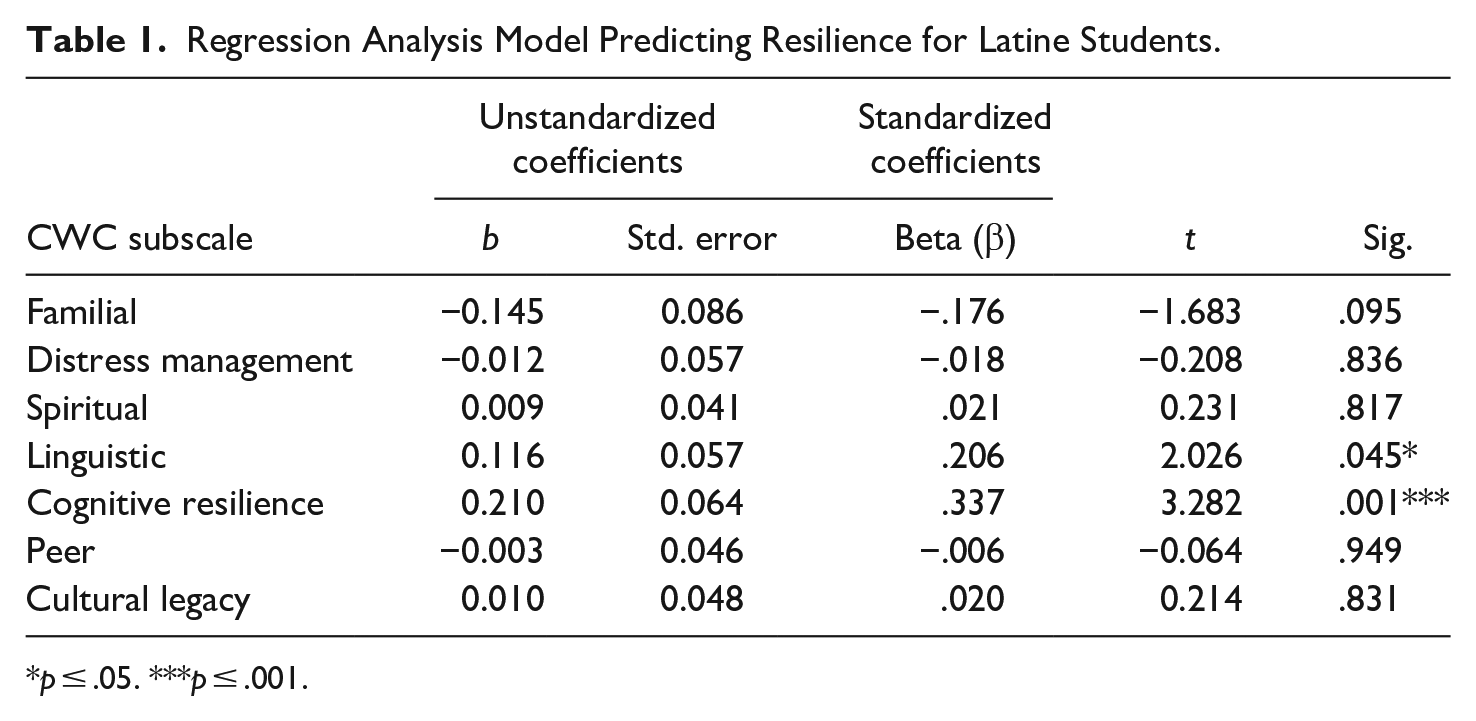
p ≤ .05. ***p ≤ .001.
Discussion
This study sought to understand the relationship between cultural coping strategies and psychological resilience for Latine college students. Specifically, the utilization of a new measure, CWC, allowed for this relationship to be examined. Research questions sought to first examine the CWC as a tool for assessing culturally relevant coping strategies, and second, identify which of those strategies promote resilience for Latine students. The results of this study paired with the initial CWC validation studies suggest that this scale is a potentially useful tool for assessing culturally relevant coping strategies for Latine individuals.
Further, Cognitive Resilience Capital (CRC) was a significant predictor of resilience in this study. CRC is aligned with T. J. Yosso’s (2005) aspirational capital which reflects cognitive motivations to overcome obstacles. This subscale refers to an individual’s ability to cope through optimism and hope. This finding is consistent with previous research that connects optimism and hope with several positive outcomes including psychological well-being and improved mental health (Gallagher & Lopez, 2009).
Linguistic Capital (LC) also served as a protective factor for resilience in this study. This area of cultural wealth highlights the resources and intellectual skill set that accompanies knowing more than one language (T. J. Yosso, 2005). The CWC assesses LC through three self-report questions of frequency: (a) used another language, dialect, or informal words to speak with people that could help me, (b) used words and phrases in another language to better express myself, and (c) used communication media (e.g., television, Internet, radio) in another language. Of those who reported speaking more than one language, Spanish and English were the languages spoken.
Alternating between two languages is often referred to as code-switching. Code-switching is defined in sociocultural linguistics as the process of choosing or altering elements of a language to contextualize dialog (Nilep, 2006). Barker’s (1947) early research on code-switching indicated that bilingual (i.e., Spanish and English) individuals were expected to speak English in formal settings where Anglo-Americans were present and reserved speaking Spanish in less formal settings such as within their homes. This historical perspective mirrors more recent findings of code-switching in higher education. For instance, in a study conducted by Sánchez et al. (2021), a first-generation Latina recounted her undergraduate experiences at a PWI: You kind of have to code switch a lot at a PWI, you act a certain way in classes in front of your professors, and then when you are around the community [people of color] you feel comfortable, you can be yourself and there is no pressure, you can be authentic, but you kind of have to put on a mask. . .around the university. (p. 598)
It is important to note that scholars have more recently offered terms such as code-meshing (Canagarajah, 2011) and translanguaging (Creese & Blackledge, 2010; García, 2009) to reduce the markedness of the term code-switching.
This finding suggests that Latine students are using the Spanish language to better communicate their needs and seek help from others, presumably those who also speak Spanish. In doing so, this ability to utilize an additional language to meet personal needs promotes resilience. Furthermore, the results of this study support T. J. Yosso’s (2005) CCW framework by highlighting Spanish-speaking abilities as assets that produce capital.
Briefly, there is some insight to offer on why the remaining subscales did not predict resilience. First, the Distress Management Strategies scale focuses on an individual’s ability to distract themselves and/or avoid their problems. The effectiveness of this passive approach is equivocal in the literature, with some studies finding it helpful (e.g., L. M. Edwards & Romero, 2008) and others suggesting it harmful (e.g., Strug et al., 2009). Similarly, research has classified Spiritual Capital as both a passive and an active coping strategy that produces mixed results. For instance, research has linked religious coping to positive (Dunn & O'Brien, 2009) and negative (R. R. Edwards et al., 2005) outcomes.
Next, the concept of acculturation could explain the non-significant impact of Familial, Peer, and Cultural Legacy Capital (CLC) on resilience. These forms of wealth are central, cultural values in collectivist communities. For instance, familismo—Latines’ commitment and loyalty to their family—is integral in the Latine community. However, research suggests that the acculturation process impacts social relationships and cultural identity (Lechuga, 2008). Indeed, research has found that acculturation is negatively related to CLC, suggesting the more an individual acculturates to the White Anglo, individualistic culture, the less likely they are to reflect upon and be inspired by their cultural histories (Kanagui-Munoz, 2014). Future research should further evaluate how the utilization of these forms of capital impact the Latines.
Implications for Research
Research on cultural capital continues to be largely qualitative and/or theoretical in nature (Monkman et al., 2005). While these methods provide invaluable insight into the presence and functions of cultural capital, researchers and scholars (e.g., Stage, 2007; Tabron, 2019) argue there is a need for more critical quantitative inquiry that promotes equity and combats the oppressive usage, both presently and historically, of traditional statistical methodology. The use of the CWC in this study serves as an example of a culturally sound and critical approach to assessing the relationship between coping and resilience among Latine students.
Future research studies could investigate the effectiveness of this tool’s ability to identify protective factors within other CoC (e.g., Black, Asian). Investigation of cultural capital at a variety of institution types (e.g., HSIs, community colleges, Historically Black Colleges, and Universities) would reveal contextual differences in how cultural capital is leveraged among Latine students. Additionally, explanatory-sequential analyses would allow qualitative data to be collected based on these quantitative findings. For example, qualitative analyses would allow for a deeper understanding of what resources students seek that contribute to their cognitive resilience. This knowledge could inform campus initiatives and services. It would be beneficial to identify physical spaces (e.g., co-curricular spaces, classrooms, residence halls) on college campuses where students feel empowered or discouraged to speak a language other than the dominant campus language. Finally, understanding with whom (e.g., faculty, support staff, peers) students feel comfortable or uncomfortable speaking a non-dominant language would be useful.
Implications for Practice
This study can inform higher education practices in several ways. First, colleges and universities should allocate more resources to bilingual on-campus programing and services. Providing written communication and information (e.g., mass campus emails, admissions processes, New Student Orientation (NSO) materials) in both Spanish and English only reduces preliminary barriers to access and navigation. However, bilingual collateral does little to promote a sense of connectedness between students and their campus. Witkowsky et al. (2020) found that offering Spanish-speaking NSO programming created “a bridge between the institution and the participants to mediate the possible conflicting cultural values” (p. 361). Thus, offering more university programming and initiatives (e.g., counseling services, tutoring, advising, NSO, affinity groups) led by Spanish-speaking faculty, staff, and students can contribute to Latine students’ linguistic capital as well as potentially serve as an avenue for cognitive resilience and social capital. Przymus and Huddleston (2021) caution schools to contemplate the covert messages and effects of bilingual signage on campuses. Evaluating the location, size, context, and color of bilingual signage can reveal unconscious biases about the value of a language and lead to identifying ways to promote shared linguistic and other forms of social capital.
Second, institutions should offer culturally relevant curricula that center the voices of marginalized communities and combats the epistemological violence that IHEs have perpetuated since their inception. Furthermore, Mein et al. (2022) recommend offering in-class group assignments and activities that allow Spanish-speaking students to collaborate. Faculty should also refrain from using methods that “other” the Spanish language such as italics.
Limitations
This study has limitations. Replication is needed to generalize the results of this study. Furthermore, this is the first known study to use the CWC. As such, replication studies should evaluate the reliability of this measure. Finally, while the sample size was representative of the college student population, a larger sample size might offer additional insight.
Conclusion
This critical quantitative study used CCW framework (T. J. Yosso, 2005) to identify connections between cultural capital and resilience among Latine students. This study revealed that linguistic capital and cognitive resilience capital serve as protective factors for resilience. These findings can inform higher education practice and future research.
Footnotes
Declaration of Conflicting Interests
The author declared no potential conflicts of interest with respect to the research, authorship, and/or publication of this article.
Funding
The author received no financial support for the research, authorship, and/or publication of this article.
