




Abstract
Time is a concept often spoken and written about, but rarely identified as an asset for individuals with disabilities, particularly in Hispanic Serving Institutions (HSI). The following discusses how systems and processes are impacted by time. The article further focuses on practical applications associated with time in supporting students with disabilities transitioning and acculturating to HSIs.
The number of students with disabilities attending post-secondary education (PSE) settings is increasing (Aquino & Scott, 2022). This includes Hispanic Serving Institutions (HSIs). Although developmental and educational models and studies have proposed time bands/time-lines for processes such as human growth and cognitive development (e.g., Erickson’s Theory—Jordan & Tseris, 2018; Piaget’s Theory—Baken, 2014), language development and language acquisition (Cummins, 1983; Ríos & Castillón, 2018; Thomas & Collier, 2003), and culture change (Jasinskaja-Lahti et al., 2011; Lopez-Class et al., 2011), do we in practice, only train on the models and current research in coursework, or are there practical applications of time that can guide the operationalization in PSE settings, particularly with students disabilities and specifically at HSIs?
In this article, we discuss the current situation involving students with disabilities in PSE and how HSIs currently serve this growing but often overlooked population. This is followed by examining some models and research that consider time in individuals acquiring developmental and academic skills, knowledge and traits through a systemic framework and process (Azzopardi & McNeill, 2016; Paat, 2013), joining the theories and concepts (Jaakkola, 2020) to regard time as advantageous and necessary to consider. Lastly, there is an exploration of practical applications of time followed by a discussion on future directions of using the phenomena of time as an asset and vehicle for serving PSE students with disabilities in HSI settings.
Students With Disabilities Attending PSEs
Similarly to their typical peers, students with disabilities have goals and aspirations for advancing their education and becoming successful independent adults. Approximately 69% of students with disabilities attend 4-year colleges and 28% attend 2-year colleges (National Center for Education Statistics, 2022 The number of students with disabilities in PSE has increased (Postsecondary National Policy Institute, 2022) and tends to continue to grow. Higher education appears to be attainable as a post-school option for young adults with disabilities. However, acceptable PSE outcomes for students with disabilities are less achievable in comparison to students without disabilities: PSE completion rates of students with disabilities are lower than those in general population (41%vs. 52% respectively; Newman et al., 2011).
When it comes to student achievement, the role of the PSE institution cannot be underestimated. To ensure students with disabilities have the best chances to succeed in PSE, it is necessary to understand their needs and provide them with targeted adequate support. In addition to the specialized services provided by the office of Disability Services for Students, institutions of PSE develop campus-wide infrastructure of supports and services that is based on analysis of student demographics (e.g., centers for first-generation college students, centers for veterans and military families).
HSIs Serving Students With Disabilities
In their discussion regarding Minority Serving Institutions (MSIs), Aquino and Scott (2022) point to the fact that students with disabilities who utilize office of disability services for students are more likely to persevere in PSEs. In a systematic review identifying “servingness” (p. 746) in HSIs, Garcia et al. (2019), focused on overarching premises and suggestions for future implications and operationalizing the quest of HSIs. Taylor and Burnett (2021) have indicated that investigations regarding HSIs specifically aiding students with disabilities is inadequate, as the focus has been on other components associated with HSIs. Thus, broader recommendations need to build on lessons learned from the pandemic as recently discussed for minority serving institutions (Aquino & Scott, 2022) and from recommendations from serving diverse populations (Buchanan et al., 2021).
Time and Its Association With Developmental and Educational Systems/Processes
Time is used in educational and developmental theories and models that not only impact eligibility determination for students being identified as individuals with disabilities but also impending interventions (Salvia et al., 2017; Sattler, 2018). Although research-based, these are typically coming from a western worldview of time for cognitive milestones (Baken, 2014; Jordan & Tseris, 2018) language acquisition (Cummins, 1983; Ríos & Castillón, 2018; Thomas & Collier, 2003) and even culture change (Jasinskaja-Lahti et al., 2011; López, 2022; Lopez-Class et al., 2011). These are variables associated with time, and can lead to potential difficulties, obstacles and even lack of academic success, particularly with individuals with disabilities in various chronosystems, including the shift into PSEs (Paat, 2013). The authors propose using time as an asset versus viewing time as a potential deficit.
Time and Program Systems/Processes
Systemic Time
Once admitted to an HSI, students must develop a plan for successful completion of program requirements and graduation. Traditionally, students are required to take classes each semester to maintain their full or part time student status. For example, students must be enrolled for 12 or more semester hours during Fall and Spring semesters to be considered a full-time student with corresponding benefits such as financial aid. This systemic approach does not always align with student goals, aspirations, and personal situations that vary from an individual to an individual.
Individual Time
Based on a systematic correlational literature review, transition-related skills acquired by students with disabilities prior to entering PSE are recognized as predictors of their success in the new educational environment (Mazzotti et al., 2016, 2021; Test et al., 2009). Personal time management is a skill necessary for one’s ability to set goals, prepare a plan to achieve the goals, and take initiative to reach those goals. This applies to all life situations, including attending college. Once admitted to college, students must develop a plan for successful completion of program requirements and graduation that are based on personal situations and endeavors that might happen simultaneously (e.g., raising a child, caring for an aging parent/relative, working full time, living with a disability).
Training Time
As discussed, success in PSE for students with disabilities depends on help they receive beyond the supports provided by the institutions because of their disability. However, only 44% of PSE students with disabilities reported receiving some type of help (Newman et al., 2011). The approach of targeted training time might translate into increased time management skills, and as result, positive educational outcomes for students with disabilities.
Time and the Classroom and Instructional System/Processes
Many barriers have been identified by instructors related to providing effective instruction for students with disabilities in PSE settings. Specific, time-related challenges have included the ability to obtain information on students’ backgrounds and needs, training and preparation as effective and inclusive instructors, making teaching and course organization accessible, and developing knowledge and skills related to using new technology (Watts, López, & Davis, 2023). At the classroom-level, proactive training and planning can support the accessibility, engagement, and communication/relationship-building, which can support the learning and overall success of individuals with disabilities in PSE settings
Instructor Accessibility and Engagement
Instructors within HSIs have perceived multiple time-based strategies that can effectively support students with disabilities. One technique focuses on taking the time to develop a working knowledge of the students’ backgrounds and culture experience(s). This knowledge can then be utilized to make learning activities and assignments more culturally relevant, which in turn, can increase engagement, accessibility of content, and overall success, as perceived by the instructor (Watts, López, & Davis, 2023). Instructors have also reported hands-on learning activities and techniques facilitated more meaningful and relevant learning, built on students’ background knowledge and experiences. Instructors who embedded real-world learning and application activities found students were able to better access and connect the content to their own lives, and therefore, better comprehended and retained the information (Sharma et al., 2018).
Another technique to increase engagement and accessibility of content was related to the general organization of the course materials and supports, which professors indicated was essential for facilitating positive student learning and course outcomes (e.g., test scores, quality of assignments and presentations). Instructors have emphasized supporting student learning by using a Universal Design for Learning (UDL) approach that differentiates instruction in multiple ways, utilizes multiple formats, multiple ways of presenting material, and multiple ways of assessing student learning (National Center on Universal Design for Learning, 2014). In addition, professors described how UDL helped them not only reach all students but also self-evaluate personal teaching outcomes and make informed decisions for future instructional planning. For example, instructors may find it necessary to supplement online instruction with interactive learning activities for their diverse learners, in order to make learning more engaging. Although instructors stated that this professional development training (i.e., UDL strategies and techniques) requires additional time considerations, it makes future course planning and organization more accessible, which in turn, deter a majority of problem-solving time or additional instruction time that would otherwise be required to support students with disabilities in obtaining the material.
Outside of Classroom Time and Connections
Most diverse student populations in higher education require additional, differentiated instructional time and individual feedback on their learning and progress in order to be academically successful (Watts, Garfield, & Davis, 2023). Supplement instructional time at the PSE level may include using campus resources such as tutoring, writing center supports, and/or graduate/teaching assistant meetings or labs. Instructors and peer supports can proactively support their students who require extra support and feedback by prompting meeting opportunities outside of the standard classroom/instructional time. Although office hours may suffice for the general student population, students with disabilities can benefit from regularly scheduled one-on-one office hours with instructors and/or small group peer support group arrangements (Watts & McKenna, 2022). These reoccurring check-ins can support relationship development between the student(s) and instructor, as well as opportunities for active progress monitoring or learning, direct individual feedback, and specific positive reinforcement (i.e., praise) to increase motivation and success within the course (Watts & Kerr, 2022). Scheduling regular, individual office hours can be a reliable and practical strategy for supporting students with disabilities in PSE. For instructors who perceive this strategy as an additional strain on their already limited planning time, technological supports may be used to provide alternative means of communicating instructions, directions, and individual feedback. One technique includes using recorded video messages to students, containing assignment directions, walkthroughs, models/examples, and/or alternative ways of presenting in-class information. These videos can increase accessibility and comprehension due to students’ ability to access them at any time and replay them multiple times which can support learning at their own pace. Although an initial challenge in time and training, learning and using new technology can be essential and effective for supporting students with disabilities in PSE.
Conclusions
HSIs have a unique opportunity to expand “servingness” (Garcia et al., 2019, p. 746) to include students with disabilities. This can be realized through the merging (e.g., Jaakkola, 2020) of the developmental processes and systems discussed and how they are associated, driven and impacted by time and can occur particularly in HSI settings. This potentially leads to academic success if they are recognized, valued, and operationalized in policy, programing and practice (Aquino & Scott, 2022; see Figure 1).
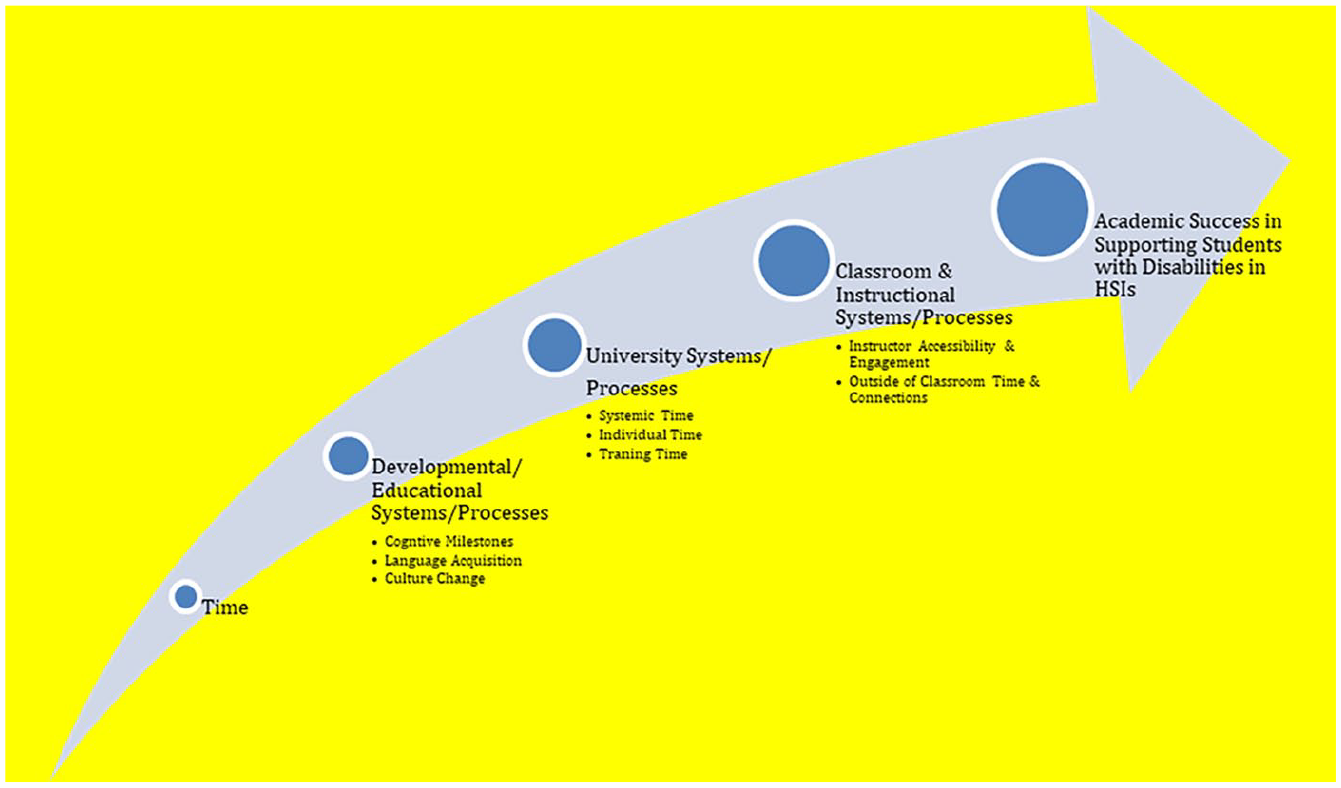
Time-impacted systems/processes and practical applications of time affecting student academic success in supporting students with disabilities in HSIs.
Discussion further encompassed considering time at the classroom and instructional level. Figure 1 further illustrates how time serves not only as a catalyst but provides the space and opportunity for teaching, engagement and connection for students with disabilities attending HSIs (Taylor & Burnett, 2021). This exemplifies focused efforts in supporting students with disabilities (Garcia et al., 2019).
Future areas of research include validating expanding the processes and systems with other characteristics associated with time. This includes additional investigation of specific HSI and classroom/instructional applications in programing, instruction and interventions that can expand and enhance support for students and institutions. Furthermore, exploration and implications associated with HSI policies and systemic practices, would expand institutional paradigms (Buchanan et al., 2021; Garcia et al., 2019).
Footnotes
Declaration of Conflicting Interests
The author(s) declared no potential conflicts of interest with respect to the research, authorship, and/or publication of this article.
Funding
The author(s) disclosed receipt of the following financial support for the research, authorship, and/or publication of this article: This research is sponsored by the Office of Postsecondary Education (OPE): Transition Programs for Students with Intellectual Disabilities into Higher Education United States Department of Education (Grant Reference P407A200021). Any opinions, findings, conclusions, or recommendations are those of only the authors and do not necessarily reflect the views of the Department of Education.
