



Abstract
Using data from the U.S. Department of Education National Center for Education Statistics Integrated Postsecondary Education Data System (IPEDS), longitudinal trends in graduate degree completion rates for Hispanic and White students were analyzed over a period of 17 years (2002–2019). The results indicated that there was a significant positive linear trend in graduation rates for both Hispanic and White graduate students, with no adverse impact in graduate degree completion rates for Hispanic students when compared to White students.
Introduction
Graduate education has become an important asset for individuals who seek higher paying occupations (National Center for Education Statistics [NCES], 2022a). Holding a doctorate would lead to 43.1% more in weekly median earnings than a baccalaureate degree (Bureau of Labor Statistics [BLS], 2021); while holding a master’s degree would result in an increase of 18.0% in weekly median earnings compared to a bachelor’s degree (BLS, 2021). In addition, graduate education tends to improve one’s ability to secure long-term employment. In 2021, unemployment rates for individuals holding a doctorate were 1.5%, while for those holding a master’s degree were 2.6%, compared to 3.5% for individuals holding a bachelor’s degree (BLS, 2021). Completion of a graduate degree is especially important for first-generation college students and students of ethnic minorities (Zusman, 2005) who may continue to face the challenges associated with intergenerational poverty and discrimination (Lee et al., 2003).
Hispanic students are less likely than students in other racial and ethnic groups to succeed in graduate school (Offstein et al., 2004). For instance, during the 2015 to 2017 period, Hispanics were underrepresented among all the graduate degree completers (Taylor et al., 2020). While Hispanics were roughly 18% of the total U.S. population at that time, Hispanic students only represented 7.4% of all the master’s degree completers, 6.2% of all doctoral degree completers, and 8.3% of the professional degree completers—including all the dental, medical, and law schools’ degrees conferred (Taylor et al., 2020). Throughout the manuscript, we use the word “Hispanic” to include all Hispanic and Latin populations, as reflected in the U.S. Census definition, 1 while we use the word “White” to refer to the population of non-Hispanic Whites.
Theoretical Framework and Literature Review
Following contemporary education scholars (Vargas et al., 2020; Yosso, 2014; Yosso et al., 2009), we use Critical Race Theory (CRT, Delgado, 1995) and LatCrit Theory (Solórzano & Yosso, 2001; Valdes, 1998) to examine disparities in graduate degree completions between Hispanic and White students. Comparing the two groups is relevant in that Whites and Hispanics represent the two largest groups in the United States. However, Hispanics continue to be underrepresented among graduate degree completers. Because Whites are the privileged group in society (McIntosh, 1998), comparing Hispanics to Whites is important, as demonstrated in current empirical research (Hobson et al., 2022).
CRT and LatCrit interrogate the law as potential ground for hidden discrimination. “Color-blind” propositions have the potential to legitimize discrimination in ways that are difficult to recognize and eliminate (Delgado, 1995; Yosso, 2014; Yosso et al., 2009). For instance, the blanket application of admission criteria and placement tests solely based on GPA, GRE scores, or participation in honors’ programs, may be examples of “color blind” policies and practices that potentially discriminate against applicants from underserved communities (Baumgartner & Johnson-Bailey, 2010). Further, the use of recommendation letters tends to favor students attending more prestigious schools who may have interactions with influential scholars (Baumgartner & Johnson-Bailey, 2010). These standard practices might fail to consider the diversity of experiences and skills that Hispanic students—or other minority students—can bring to the table (Yosso, 2014), including work experiences, community-based experiences, or experiences developed while taking care of family members. Furthermore, the marginalization that Hispanic students experience in graduate school tends to reflect societal values that validate stereotypes about Hispanic people as lazy (Kirschenman & Neckerman, 1991), contributing to limit the success of members of the Hispanic communities more generally (Bonilla-Silva, 2006).
White students continue to have an advantage in American educational institutions (Morgan, 2022). School districts that serve majority of students of color and students identified as “English-learners” (i.e., students whose parents do not speak English at home), receive less state funds that student serving White students (Morgan, 2022). This contributes to the gap in STEM education and may affect student potential for college success (Morgan, 2022), consequently limiting opportunities for graduate education. Whereas minority groups are negatively impacted, White privilege continues to be asserted in the name of “meritocracy,” an unfortunately exploited myth (McIntosh, 1998). Perhaps the most problematic aspect of White privilege is that those who benefit from it have no reasons to question how social systems de facto prevent the integration of people of color and immigrants.
With an emphasis on the impact of race and ethnicity on individual outcomes in higher education and in society in general, the LatCrit framework is relevant to (1) examine the current higher education landscape in reference to diversity and inclusion, (2) identify barriers to Hispanic student completion of graduate programs, and (3) highlight the advantages of graduate completion rates for Hispanic communities. In addition, Quantitative Critical Race Theory—as an application of CRT to empirical studies, (QuantCrit, Gillborn et al., 2018; Teranishi, 2007) is relevant to explain the use of macro-level data comparing Hispanic and White students.
Diversity and Inclusion in Higher Education
The 1862 Morrill Land Grant Act (Nevins, 1962) provided states and public institutions of higher education with the blueprint to expand the curriculum of academic disciplines to include areas of studies, such as agricultural studies, that had been traditionally undermined across academic institutions. Such expansion led to the inclusion of a more diverse student body (Lee, 2002; Tran et al., 2016). But access to education is still deeply rooted in historical, social, and political contexts. For minority groups, admission to higher education is intertwined with traditional views of race and ethnicity. Such views have shaped formal admission processes and standards, which contribute to the social hierarchy among members of society (Allen et al., 2008). Experts have argued that such standards tend to be arbitrary and are expression of the power of those who frame them (Bell, 1979). At the state and national levels, race and ethnicity are also taken into consideration when designing and implementing policies that aim to support the inclusion of minority groups. For instance, higher education uses race and ethnicity to classify institutions based on proportion of students who identify as minorities (Allen et al., 2019); this classification determines the type and amount of funds the federal government will provide to support the enrollment and success of minority students. A particular group of minority-serving institutions are Title V Hispanic Serving Institutions (HSIs), defined as higher education institutions in which at least 25% of the undergraduate students identify as Hispanic (U.S. Department of Education, n.d.). According to Excelencia in Education (2022), roughly 42% of all HSIs offered post-secondary education, while the remaining 58% only offered undergraduate programs, either 2-year or 4-year programs. Among those offering graduate programs, 26% offered doctoral programs, 13% only offered master’s level programs, and 3% only offered post-baccalaureate certificates. This proportion is still very low, in spite the evidence that postsecondary education is essential to advance careers among Hispanic young adults (G. A. Garcia & Guzman-Alvarez, 2021). Since institutions of higher education can pursue the HSI denomination only if 25% of the student population served are Hispanic, this might indicate that Hispanic students tend to enroll in smaller universities—such as regional campuses, which are less likely to offer master’s degree and doctoral degree programs.
Challenges to Success for Hispanic Students
The reasons behind Hispanic graduate student low completion rates must be examined both within higher education institutions (Page, 2013; Rudolph et al., 2015; Sowell et al., 2015) and in society (I. O. García & Henderson, 2015).
At the institutional level, experts have asserted that lack of Hispanic representation among faculty directly impacts Hispanic students in academia (Alcantar & Hernandez, 2020; Ek et al., 2010; Gonzales, 2015; Hagedorn et al., 2007; Torres, 2006; Venegas, 2021). Within U.S. institutions of higher education, Hispanic faculty represent approximately 3% of the total faculty, and 2% of tenured faculty (NCES, 2022b). Even within HSIs, estimates have indicated that Hispanic faculty were only 6.0% of the 1.5 million faculty in higher education (NCES, 2022b), with a ratio “Hispanic student to Hispanic faculty” of 146:1—this ratio compares to an overall “student to faculty” ratio of 28:1, without considering racial or ethnic background within the same institutions (Vargas et al., 2020, p. 50). Such estimates may suggest that the allocation of resources is unevenly distributed, even within institutions of higher education that are meant to serve Hispanic students. This is problematic, as it limits the opportunity for Hispanic students to have faculty mentors from similar cultural backgrounds (Martinez, 2018), who might be more equipped to understand the challenges Hispanic students face in graduate school and in the professional environment. Supportive mentors are needed in graduate programs to positively influence Hispanic students’ sense of belonging (Holloway-Friesen, 2021; Salazar, 2021), which in turn directly impacts self-efficacy (Muñoz, 2021). Experts have pointed out that graduate student satisfaction increases as students form stronger emotional ties with their mentors (Waldeck et al., 1997).
At the societal level, studies have indicated that intergenerational poverty and parents’ low educational attainment may contribute to the underrepresentation of Hispanic students among those who complete graduate programs. When compared to White students attending graduate school programs, Hispanic students are more likely to come from families with parents with low educational background (Taylor et al., 2020). In addition, the burden of family and work obligations (I. O. García & Henderson, 2015), often prevents Hispanic students from succeeding in graduate school (Rudolph et al., 2015).
Advantages of Graduate Education for Hispanic Students
The presence of graduate students in institutions of higher education is essential to support undergraduate students (G. A. Garcia & Guzman-Alvarez, 2021). Reducing the gap between non-Hispanic and Hispanic faculty members requires training larger numbers of graduate students; hence, making sure Hispanic students are successful completing graduate programs is paramount (G. A. Garcia & Guzman-Alvarez, 2021). Moreover, Hispanic student completion in graduate programs has the potential to improve financial independence and economic mobility in Hispanic communities (G. A. Garcia & Guzman-Alvarez, 2021).
An area of particular concern is the limited participation of Hispanic students in the STEM fields, with only 20% of all Hispanic master’s degree completers holding a STEM degree (Taylor et al., 2020). Employment in areas like computer science and engineering tend to provide higher salaries and support mobility (Landivar, 2013), but only 6.5% of employees in the STEM fields are Hispanic. For this reason, scholars have pointed to the need to improve the inclusion of Hispanic graduate students in the STEM fields. Hispanic graduates would become role-models for younger students (Aguirrei-Covarrubias et al., 2015), which in turn would improve graduation rates among Hispanic STEM students (Beheshti et al., 2022; Fleming et al., 2014; Okahana et al., 2018).
Hispanic communities rely on capable Hispanic leaders to understand the needs of the Hispanic population. Limited graduate school attainment among Hispanics can severely affect their leadership potential. For instance, scholars have asserted that Hispanic communities need nurse leaders who understand the social determinants of health that characterize the Hispanic population (Villarruel, 2017). More Hispanic nursing faculty are needed for the persistence of Hispanic students in nursing programs, especially students from disadvantaged backgrounds (Ortega et al., 2020). Experts have urged institutions of higher education to “think more critically about how to serve graduate students, not just undergraduates, starting with enrollment and leading into training and development that will lead to greater economic mobility” (G. A. Garcia & Guzman-Alvarez, 2021, p. 13).
Method
Our review of extant studies may suggest that monitoring completion trends for Hispanic students in U.S. graduate programs is necessary to identify gaps in their progress. Because Hispanics represent the second largest majority in the U.S. population (U.S. Census, 2022), comparing them to Whites is relevant to have a point of reference in assessing success, as demonstrated in current empirical research (Hobson et al., 2022). Whites also constitute the “majority group” and the “favored group” in CRT and LatCrit; thus, Whites are an important group in the analysis of Hispanic social integration. This information is needed to advise higher education policies and practices that aim to boost Hispanic students’ inclusion and success. In the study, QuantCrit—as an application of CRT to empirical studies (Gillborn et al., 2018; Teranishi, 2007), provided a framework for a comparative analysis. Empirical studies are relevant to examine differences in educational and professional achievement that directly impact success and socio-economic development (Gillborn et al., 2018).
Research Questions
Drawing from CRT, LatCrit, and QuantCRit, we use macro-level national data to address the following research questions:
What is the trend in graduate degree completion rates for Hispanic students?
What is the trend in graduate degree completion rates for White students?
How do the trends in graduate completion rates for Hispanic and White students compare?
Is adverse effect present for Hispanic graduate students when compared to White graduate students?
Graduation Data
Total annual graduate program enrollment and degree completion data for Hispanic and White students were retrieved from the Integrated Postsecondary Education Data System (IPEDS), maintained by the National Center for Education Statistics of the U.S. Department of Education. Currently, information is available for 17 academic years from 2002–2003 to 2018–2019.
Analyses
Following the recommendations by Dey and Astin (1993) concerning the examination of trends in data consisting of percentages, bivariate regression analyses were conducted to separately evaluate graduate degree completion rates over the time period covered by the IPEDS data set (2003–2019) for Hispanic and White students. Using multiple regressions, we developed Trend (linear) Regression Analysis of completion rates to compare Hispanic and White graduate students (both y-intercept/constants and slopes), by first combining the subgroup datasets and then adding two more independent variables to the analysis: (1) a dichotomous variable for Group and (2) an interaction term between Group and Time (G*T). The final analysis involved calculation of the “four-fifths rule”—a measure used by federal agencies to compare groups (EEOC, 1978), for each of the 17 years in IPEDS data set. This entailed multiplying the White student graduate degree completion rate by four-fifths (.8) and comparing it to the corresponding Hispanic student rate. If the Hispanic percentage was less than four-fifths of the White rate, adverse impact was present.
Results
A summary of the IPEDS graduate degree completion data analyzed in this study is provided in Table 1, along with adverse impact calculations.
Trends in Enrollment, Completion, and Adverse Impact by Group.
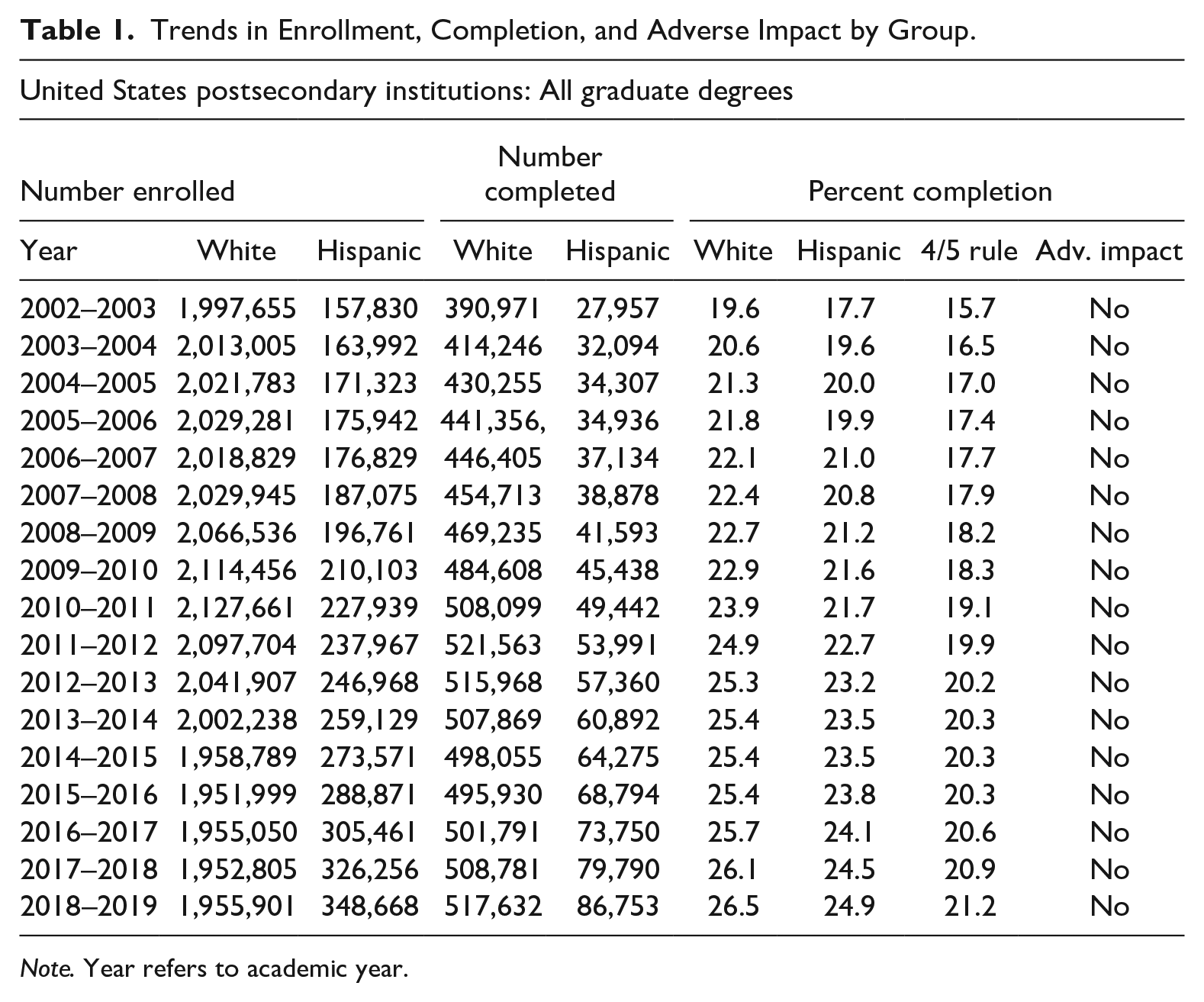
Note. Year refers to academic year.
The nine columns in Table 1 offer the following information: (1) the 17 academic years examined, (2) the number of White students enrolled in graduate programs, (3) the number of Hispanic students enrolled in graduate programs, (4) the number of White students completing graduate degrees, (5) the number of Hispanic students completing graduate degrees, (6) the percentage of enrolled Hispanic students completing graduate degrees, (7) the percentage of enrolled Hispanic students completing graduate degrees, (8) the four-fifths rule cut-off (i.e., the White completion percentage multiplied by .8), and (9) a determination if adverse impact was present (i.e., Hispanic completion percentage less than the four-fifths rule cut-off).
Regression results for the three graduate student groups (Hispanic, White, and Both Student Groups combined) are presented on Table 2.
Trend (Linear) Regression Analyses.
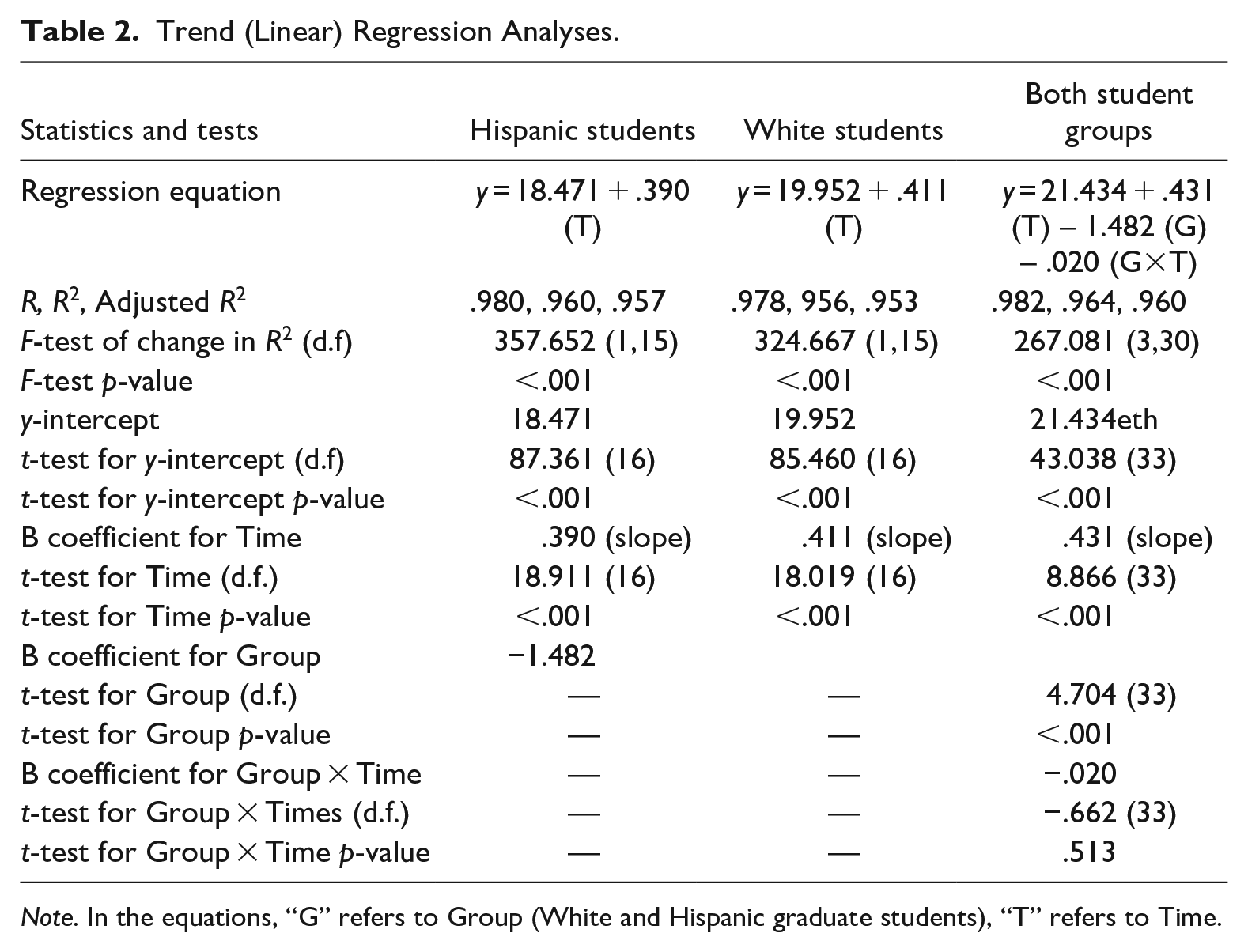
Note. In the equations, “G” refers to Group (White and Hispanic graduate students), “T” refers to Time.
The figures for Hispanic students document a very strong, statistically significant positive linear trend in the annual data. The t-test of the regression coefficient for Time indicated that Hispanic student graduate degree completion rates have been consistently increasing over the 17-year period from 2003 to 2019, by approximately .39 points per year. The overall fit of the linear model was very impressive, as reflected in the R-square value of .960 (adjusted R2 .957).
Results for the regression analysis with White students indicated that, as for Hispanic students, there was a strong positive linear trend between graduate degree completion rates and Time, with a statistically significant slope of .411. Thus, the graduate degree completion rate for White students increased by approximately .411 percentage points annually. The robust computed R-square of .956 (adjusted R-square of .953) indicated that the derived linear model represented a strong fit with the observed data.
The regression model including both White and Hispanic students confirmed a statistically significant difference between Hispanic and White student y-intercepts/constants. At the onset of the 17-year period covered in the IPEDS data set (2002–2019), the Hispanic graduate degree completion rate (y-intercept) was 18.471, compared with the White value of 19.952. There was no difference in regression line slopes (rates of change) for the two subgroups. Once more, the regression model yielded a strong fit with the observed data, as indexed by the very large R-square of .964 (adjusted R2 .960).
Discussion
There are three encouraging conclusions that can be drawn from the findings in this study. First, the percentage of Hispanic students completing graduate degrees has steadily increased from 2003 to 2019. Interestingly, the computed annual increase of .390 (slope of the regression line) was nearly identical to that reported by (Hobson et al., 2022), for Hispanic student 6-year college graduation rates over essentially the same period (2002–2018). Second, no adverse impact was found when comparing Hispanic graduate degree completion percentages to those for White students. In each of the 17 years, the Hispanic completion percentage exceeded the four-fifths rule cut-off (.8 × White percentage). Third, given that the Hispanic and White student regression lines were parallel (no statistically significant difference in slopes), adverse impact is not predicted to occur in future years. However, the findings must be interpreted with caution. As a comparative measure, the “four-fifth rule” used to measure “adverse impact” focuses on the idea that, for minority students, achieving at least 80% of what White students achieve is good enough. This seems inherently unfair. In addition, as the analysis shows, parallel regression lines representing the differences between White and Hispanic students also mean that parity (or convergence) will never be achieved. Without substantial future increases in the rate at which Hispanic students complete graduate degrees (and/or decreases in the White student rate), equality is not attainable. Further, we must remember that equality and equity are substantially different concepts, and to support minority students, it is important to focus on comparable advantages, rather than equal results (Espinoza, 2007). The present study confirms the premises of CRT and LatCrit as applied to the field of education (Solórzano & Yosso, 2001; Vargas et al., 2020; Yosso et al., 2009), in that Hispanic students face greater challenges than White students in graduate school completion. Our analytical comparison is only based on graduate student completion rate differences between White and Hispanic students, as aggregate-level data that focus on socio-economic factors is not currently available. Previous studies on Hispanic graduate student achievements (see for instance, Beheshti et al., 2022; Fleming et al., 2014; G. A. Garcia & Guzman-Alvarez, 2021; Holloway-Friesen, 2021; Landivar, 2013; Muñoz, 2021; Okahana et al., 2018 among others) have provided a strong background explanation that motivated us to examine differences between Hispanic and White students over a 17-year period. However, our findings cannot directly address issues associated with institutional limitations, such as lack of mentors (Vargas et al., 2020), admission practices (Bell, 1979), or the incentives provided by HSIs (G. A. Garcia & Guzman-Alvarez, 2021). In addition, while the current study does not permit an analysis of student direct experiences in post-baccalaureate programs, it provides an incentive for future studies to examine the root causes of Hispanic and White student differences in graduate program completion.
Recommendations
Based upon the findings in this study, the following recommendations are offered. First, the solid record of Hispanic student graduate school completion and progress should be acknowledged and celebrated! Second, more funding (federal, state, private) is needed to support Hispanic student graduate enrollment and to increase the rate of graduate degree completion. For example, successful initiatives like The Ph.D. Project (n.d.) (designed to fund students of color in pursuit of doctoral degrees in business) should be expanded to include other disciplines and include financial support for master’s degrees. Finally, a national public service marketing/promotion campaign is needed to encourage Hispanic students to consider graduate school enrollment and the exciting career possibilities involved (Aguirre-Covarrubias et al., 2015; Beheshti et al., 2022; Fleming et al., 2014; Okahana et al., 2018; Villarruel, 2017), including faculty positions in academia and the opportunity to mentor future generations pursuing college degrees (Martinez, 2018).
Current research shows that faculty diversity and associated mentoring positively impact minority student academic achievement, including program completion (Chun et al., 2016; Holloway-Friesen, 2021; Martinez, 2018; Vargas et al., 2020). Thus, the rate gains needed for parity with White students in both college graduation (Hobson et al., 2022) and graduate degree completion would be facilitated by increasing the number and percentage of Hispanic faculty members in both baccalaureate and graduate programs.
Future Research
Future research would be beneficial in three areas. First, a comprehensive theoretical model of adverse impact in higher education degree attainment is needed to guide future research on likely causes of this problem and high potential solutions. Second, research is needed to explore beyond the global measures of national graduate degree completion percentages addressed in this study to include separate analyses for masters and doctoral programs, independent assessments of graduate degrees by field, and an examination of state-level success rates and patterns. Third, future research on Hispanic graduate student education should also focus on the impact of family low expectations on student success. Fourth, an examination of the impact of “color-blind” policies and practices that set guidelines for entry level proficiency (e.g., GRE score, GPA score, or completion of academic certificates), which are meant to serve primarily White students, is needed in the study of minorities in education (Vargas et al., 2020; Yosso et al., 2009).
Limitations
Several limitations are present in the study. The comprehensive IPEDS data analyzed included all graduate degree completions combined, without regard for level (master’s or doctoral) or discipline. The term “Hispanic” is used to include a broad category of minorities who differ by history of immigration, culture, and often socio-economic status. As experts have asserted (Allen et al., 2019; Solórzano & Yosso, 2002), categorizing students based on broad racial and ethnic lines, without taking into consideration other measures reflecting challenges (both individual and generational) may continue to oppress and marginalize the very students that diversity and inclusion efforts aim to empower. Moreover, the data are for the nation, which may mask important differences at the state level. Further, the “four-fifth rule” employed to determine adverse impact is not a measure of equality, but it rather demonstrates that a proportion of .8 might be good enough for minority students when compared to White students. Finally, the time covered is limited to academic years 2002–2003 to 2018–2019.
Conclusion
The value of graduate education is multifaceted. High level reasoning is at the core of graduate education; moreover, graduate students have access to numerous opportunities to build social capital (Bourdieu, 1979; Coleman, 1988; Putnam, 2007). Their professional ties to mentors, diverse groups of peers, and community partners contribute to building graduates’ networks of relationships. Such relationships are likely to become durable social connections that contribute to graduates’ success in the labor market and within institutions that hire them. Both resource sharing practices and recognitions tend to be highly dependent upon professional networks (Bourdieu, 1979). Inclusion of minorities in graduate programs is needed to positively impact communities of color. The social capital students build in graduate school is needed to foster economic and social mobility in underserved communities. To make progress, we must focus on programs that support the inclusion and integration of Hispanic and other minority students.
Footnotes
Acknowledgements
The authors wish to acknowledge the Editor and anonymous reviewers. We are in your debt! We appreciate your work and recommendations to make the manuscript a fine contribution accessible to all.
Declaration of Conflicting Interests
The author(s) declared no potential conflicts of interest with respect to the research, authorship, and/or publication of this article.
Funding
The author(s) received no financial support for the research, authorship, and/or publication of this article.
