




Abstract
This systematic review includes 125 peer-reviewed education-research articles that employ a LatCrit framework (from a search including articles published from 1995 to 2020). The author examines how the literature utilizes LatCrit and advances ideas about race, Latinxs, and Latinidad in education. The author presents significant patterns and divergences in the literature’s strengths, challenges, and tensions. Some strengths include detailing Latinxs’ experiences and valuing experiential knowledge. The author problematizes four research practices: (1) describing LatCrit with select tenets of CRT; (2) not defining race or other relevant concepts (language, culture, etc.); (3) claiming Latinxs are unique because of their multidimensionality; and (4) exceeding LatCrit’s scope by rationalizing the study’s use of LatCrit because its participants are Latinxs. The author argues that these complications lead to a paradox: even though LatCrit emerges from critical race theory and is described as for Latinxs, the literature largely undertheorizes race and lacks clarity about conceptualizing Latinxs as a racialized group. The author recommends four framing ideas that are particular to LatCrit and that help advance the specificity of Latinidad in education.
Keywords
For decades, education researchers have examined students’ outcomes and experiences in education, attesting to how societal power injustices and racism affect racialized-othered 1 students, such as Latinxs 2 (e.g., Murillo et al., 2021). How education research conceptualizes race and attends to racial issues may influence how some people (including educators) think about race and racialized groups (Skiba, 2012). Consequently, education research should advance historicized and counterhegemonic understandings of concepts such as racism and race, an imperative intervention for several reasons, including that national debates about race and racism have brought heightened attention to educational institutions teaching about racial issues.
To advance counterhegemonic understandings concerning racial issues, the field of education has primarily drawn on the framework critical race theory (CRT), which centers racism as an explanatory construct for inequities (e.g., Busey et al., 2023; Cabrera, 2018; Leonardo, 2013). When this research focuses on Latinxs in particular, education researchers often invoke Latino critical race theory (LatCrit), a branch of CRT associated with Latinxs (e.g., Solórzano & Delgado Bernal, 2001; Solórzano & Yosso, 2001). LatCrit, CRT’s oldest and perhaps most fecund branch (evidenced by this review including 125 articles of empirical studies), is likely to remain a popular and consequential framework for some education researchers. Yet, there is no systematic literature review dedicated to LatCrit in education, even as scholars have repeatedly reviewed CRT (e.g., Busey et al., 2023; Cabrera, 2018; Dixson & Rousseau, 2005; Howard & Navarro, 2016; Ledesma & Calderon, 2015; Tate, 1997), with some concentrating on CRT’s specific concepts (e.g., intersectionality; Harris & Patton, 2019) and newest branches (e.g., DisCrit; Annamma et al., 2018), or using CRT to examine issues that a particular racialized group faces (e.g., Asian Americans; Yi et al., 2020). Reviews, as several scholars have noted (e.g., Busey et al., 2023; Tate, 1997), play an important role in shaping the field’s use of CRT; yet LatCrit has proliferated without substantive assessments of how education scholars utilize LatCrit. While the large volume of LatCrit literature alone merits a systematic review, I contend that an essential rationale for reviewing this literature relates to how education researchers use LatCrit to attend to race and other relevant concepts.
The LatCrit framework, with its emphasis on race and Latinxs, influences how education researchers conceptualize “Latinx” and “race”. These descriptions matter because understanding the social constructedness and racial status of “Latinx”—now the United States’ largest racialized group (surpassing the number of Black Americans in 2003; Clemetson, 2003)—elucidates our society’s racialization processes and hierarchies; And recognizing societal ideas about race can lead to counterhegemonic ideas about racial issues. Accordingly, this theoretical literature review’s purpose and contribution are to understand how scholars draw on the LatCrit framework to shape their research on education (broadly conceived) and to conceptualize race, Latinxs, and/or Latinidad (i.e., “Latino-ness”). Thus, the review also examines how this scholarship delineates the boundaries of the Latinx category. The review aims to advance LatCrit as a theory that provides specificity about Latinxs in education and Latinx as a racialized category. The review’s broader purpose and contribution are to assess LatCrit by identifying trends in research practices and in the literature’s findings, strengths, challenges, and tensions to reorient scholars and shape the field (as reviews aim to do; Lather, 1999). This article provides a systematic review based on these guiding questions: (1) How does education scholarship employ LatCrit in research studies? (2) How does this literature advance ideas about race and the specificity of Latinidad in education? (3) What are the strengths and weaknesses that appear in this literature as they relate to the previous questions?
To ground this review’s foci and objectives, I start by defining fundamental concepts and further explain why our conceptualization of “Latinx” matters. Then, I briefly present LatCrit in law (from whence LatCrit emerged) and then LatCrit in education. I describe the search for and analysis of the literature. Next, I present my findings while emphasizing the literature’s strengths. In the discussion section, I spotlight four research practices that form a significant pattern in the literature as a whole. I argue that these research practices produce a paradox, and I recommend that scholars reconsider LatCrit’s tenets. I conclude by providing implications for researchers using LatCrit.
Defining Race and Other Relevant Concepts
The concept of race alludes to the erroneous idea that humans mated in isolated regions, resulting in biologically distinct populations and human lineages (Hochman, 2019). 3 As a European-originated ideology within a white-supremacist context, race has been used to classify people into groups by overlooking their different cultural practices and then placing these groups in a racial hierarchy with Whiteness on top (Hall, 2021; Kendi, 2016). This ideology employs the racial hierarchy to denote people’s humanity and worth and to justify material consequences and exploitation in a capitalist system. Because race is not a biological fact, the socially constructed differences that delineate racialized groups are arbitrary and not always defined by phenotype (Omi & Winant, 2015). For example, society may delineate and racialize a group based on imagining that group’s shared language, as I argue is the case for Latinxs (Chávez-Moreno, 2021b).
The Latinx Racialized Category
Some scholars are ambivalent about Latinx being either an ethnic or a racialized label—even while they acknowledge that Latinxs experience racism in education (Chávez-Moreno, 2021b). In line with scholars like Gómez (2018, 2020) and Haney López (1997), I assert that “Latinx” is a racialized category. 4 “Latinx” is a racialized category because—like the “Black” and “Asian” categories—it (1) refers to a group that is imagined to come from a particular region, and (2) essentializes the people in this large heterogeneous group by ignoring their different cultural practices to assign them to an arbitrary category. In contrast, the concept of ethnicity helps one highlight the similarities and differences in people’s cultural practices. Although ethnic categories also could be used to mark in- and out-groups, the purpose of Euro-American conceptions of race involves the process of racialization: create an allusion to “races” (biological groups) existing, essentialize people, sort them into a group, and arrange the groups into a white-supremacist racial hierarchy, where Whites capitalize at the expense of racialized Others.
Racialization includes the process of delineating the groups and the contradictory meanings assigned to those groups and the material consequences those designations have on people’s lives (for further discussion of racialization, see Omi & Winant, 2015); Thus racialization is not a synonym for racial discrimination or identity, which Hochman (2019) critiques some scholars of doing. While the boundaries (or definitions) of individual people’s identities are not fixed or absolute, and people may experience multiple forms of racial discrimination; here I refer to the racialization process not as individual racial identity formation (e.g., Afro-Latino) or discrimination, but to society’s process of creating racialized groups. These groups are socially constructed by delineating boundaries and constructing (unstable) categories. And the making of the Latinx category (i.e., Hispanic) is well documented even as the boundaries, or what is Latinx, are ambiguous and not already constituted (Mora, 2014).
The Specificity of Latinidad
I use Latinidad as a racializing term (not to refer to pan-ethnicities) akin to Blackness and Whiteness. In terms of racialization, “specificity” refers to the particular ways an essentialized group is racialized differently from other racialized groups (i.e., what is specific to Latinxs and not to Black folks). Thus, I use specificity of Latinidad to refer to the specific social constructs that make “Latinx” (or Latinidad) distinct from other racialized groups (not looking at the within-group differences of, e.g., Boricuas vs. Mexican Americans). Attending to the boundaries that delineate the group means recognizing that racialization is always changing and relational, as Molina et al. (2019) assert.
I do not use specificity of Latinidad to mean differentiating between the discrete national or ethnic groups that are usually sorted into “Latinx” (e.g., Guatemalan American). People assert the differences (e.g., “I’m Puerto Rican”), which is a way of resisting race’s essentialization, and identify with people from their racialized category over their experiences and struggle against this oppression. Because here I use Latinidad to refer to a racialized group, not to a group of people’s ethnic identity or cultural practices, I do not follow some scholars’ use of the plural “Latinidades” to mark the different ways of experiencing and performing Latinidad (e.g., Aparicio, 2017).
This divergence points to the fact that scholars from diverse disciplines debate the specificity of Latinidad, its boundaries, and what ideological work Latinidad is doing in society (e.g., Aparicio, 2017; Bebout, 2019; Busey & Silva, 2021; Caminero-Santangelo, 2012; T. Flores, 2021; Milian, 2019; Rosa, 2019). The debates about the making of racialized groups and specifically “Latinx” and Latinidad aim to illuminate America’s racial order and imagine how to subvert its white-supremacist racial hierarchy (e.g., Gómez, 2020; Molina, 2014; Pulido & Pastor, 2013). Moreover, it matters whether or not Latinxs are seen as a racialized group because the ethnicity label bestows on them a perpetual foreignness that affects how they relate to others’ struggles and hinders cross-racial coalitions (Bebout, 2019; Gómez, 2020; Mutua, 1999). What is certain is Latinxs’ importance in American society, and this makes it incumbent on education scholars to be specific about how they conceptualize this group (Busey & Silva, 2021; Chávez-Moreno, 2021b).
Positionality
This literature review offers a partial and perspectival analysis (Lather, 1999), and it is shaped by my identity as a Chicana and immigrant, my scholarly training and agenda, and my reflexivity practices related to Latinidad, racialization, and other oppressions (Chávez-Moreno, 2021c, 2022). These practices have led me to question, for example, how the education field defines race and Latinx. They have also led me to recognize that community cariño (caring) has contributed to my resiliency as a student, educator, and researcher. Having been positively affected by the scholars’ works reviewed here, I recognize that elder scholars have paved the path for me; thus, I join a community of scholars who are exposing injustices and working toward an education for self-determination (Chávez-Moreno, 2021a; Pacheco & Chávez-Moreno, 2021). From this vantage point, I offer a literature review that builds on this scholarly tradition and contributes a caring critique toward the field’s vitality and empirical strength.
LatCrit in Law
Latina/o critical legal theory (LatCrit; I use “LatCrit in law” when differentiation is needed from education’s LatCrit) draws from several critical traditions, including critical legal studies, Asian American legal scholarship, feminist legal theory, queer theory, critical race feminism, and especially critical race theory. Scholars developed LatCrit because they saw CRT as exclusionary due to its Black/White focus; thus, LatCrit sought to include other racialized groups, not just Latinxs, through a “big tent” approach (Valdes & Bender, 2021). According to legal scholars Delgado and Stefancic (2000), LatCrit’s four most prominent themes are immigration, language, differential racialization, and the Black/White race-binary paradigm. Other scholars conceive of LatCrit as encompassing national origin, class, gender identity, and other intersecting identities that have a bearing on one’s experience with U.S. colonialism and imperialism (e.g., Espinoza & Harris, 1998; Haney López, 1997). This list, according to Mutua (2006), speaks to LatCrit’s contribution of “multidimensionality” as an emerging theory similar to CRT’s intersectionality.
Importantly, from LatCrit’s inception, scholars debated whether Latinxs constituted a racialized or ethnic group (Delgado & Stefancic, 2000), with, for example, Haney López (1997) arguing that Latinx should be conceptualized as the former. Mutua (2006) suggests that some founders of LatCrit conceptualized Latinxs from an ethnicity model given that they considered Latinxs could be “raced differently, as black, white, and/or mestizo, among other differences” (p. 371). Favoring an ethnicity model implies that Latinxs share a culture, which generates several tensions, as Mutua (1999) observes by way of critique. Mutua argues that this obscures the different racisms experienced by racialized groups and hides or denies “the extent to which the [Latinx] group is racialized as non-white” (p. 1183).
Other scholars have critiqued LatCrit in law literature for other reasons. In their appraisal of LatCrit, LatCrit legal scholars Aoki and Johnson (2008) describe the commitment of LatCrit symposia (the main publishing venues for this scholarship) to publish all submissions, resulting in unrefereed, low-quality scholarship which has contributed to LatCrit’s “lack of intellectual focus” and “excessive repetition of similar general themes” (pp. 1159–1160). Aoki and Johnson noted that questioning the Black/White paradigm has been hackneyed to the point that LatCrit has lacked new insights. They conclude that LatCrit, apart from its early publications (symposia circa 1997–1999), has lost its edge and has not contributed meaningful insights.
The history and status of LatCrit in law lead to comparisons with LatCrit in the education field, ideas I return to in different sections (although I do not compare the different fields’ use of LatCrit). Next, I turn to LatCrit in education.
LatCrit in Education
LatCrit was introduced to the education field by Solórzano and his students, now established scholars. They drew heavily from CRT/LatCrit in law to define LatCrit in education; for example, Solórzano and Yosso (2001, 2002) cite a 2000 conference primer on LaCrit in law that describes LatCrit as for theorizing how race/racism intersect with other forms of oppression and shape educational discourses, processes, and structures. The primer also presents LatCrit as a theory for examining the racism that affects racialized Others broadly and Latinxs specifically. In their 2002 article, they only used a CRT framework and argued it should be applied to address Latinx issues, while describing their work as driven by a “LatCrit consciousness” (p. 39).
Solórzano and Delgado Bernal (2001) adopted CRT’s defining elements into five themes for “a CRT and LatCrit framework in education” (p. 312): (1) centering race and racism and connecting them with other forms of subordination; (2) challenging dominant ideology; (3) committing to social justice; (4) centering experiential knowledge; and (5) using an interdisciplinary lens. They differentiated LatCrit from CRT by stating that the former focuses on a “coalitional Latina/Latino pan-ethnicity and addresses issues often ignored by critical race theorists such as language, immigration, ethnicity, culture, identity, phenotype, and sexuality” (p. 311). They continued, “LatCrit is a theory that elucidates Latinas/Latinos’ multidimensional identities and can address the intersectionality of racism, sexism, classism, and other forms of oppression” (p. 312). Education scholars often cite these foundational works when using LatCrit.
Other scholars have extended CRT/LatCrit’s themes into specific areas of education (e.g., higher education; Villalpando, 2004) and proposed a LatCrit methodology (testimonio; Pérez Huber, 2012). While LatCrit is an established framework, Elenes and Delgado Bernal (2009) have produced the only review of LatCrit in education. They aimed for their chapter to review work using theoretical frameworks that help study Latinx education and are informed by Latinxs’ experiential knowledge. Their review focused on four theoretical traditions: borderland/border theories, Chicana feminist theory, and CRT and LatCrit, with the authors merging their analysis of LatCrit/CRT. Thus, their chapter was not a systematic or dedicated review of LatCrit. They offered insights into the early LatCrit empirical scholarship and its limitations. Relevant to my review are their points that the literature largely lacked robust intersectional analyses, often used both CRT and LatCrit, and focused on Chicanxs. Of course, the way researchers employ a framework evolves; hence, LatCrit scholarship could be different now and/or have other significant patterns and divergences, and my review aims to update and reveal other information about the literature.
Locating the Literature
In seeking out empirical education studies that use LatCrit as a framework, I conducted a delimited search of two specific education-research journals and of 10 academic databases featuring education and social science publishers (see Online Appendix A for a list of databases and sources). I searched databases most likely to include journals aimed at an education audience because my intent was to see how LatCrit is being interpreted and used by education scholars. Therefore, I excluded law journals (an additional reason below) and articles on the training of professionals (e.g., social workers, lawyers, doctors) other than teachers. Following other reviews’ practice for ensuring the quality of the articles (e.g., Cabrera, 2018; Johnston-Guerrero, 2017), I selected delimiters such as “only peer-reviewed publications” (if available). My intention to include peer-reviewed studies also supported my decision to not search law journals. Most of the published LatCrit scholarship in law journals is from LatCrit symposia and does not undergo rigorous peer review—recall Aoki and Johnson’s (2008) disclosure that LatCrit in law’s commitment to inclusivity has provided a “virtual guarantee of publication to any and all symposium contributions, without meaningful review or screening of submissions” (p. 1163).
I aimed to include as many eligible articles as possible, but as with many literature searches, mine likely did not catch all articles, thus this review is not an exhaustive accounting of the research. I started the search with the year 1995 because that was the publication year of the article that introduced CRT in education (Ladson-Billings & Tate, 1995), even though I surmised (correctly) that the Solórzano and Delgado Bernal (2001) article would be the first using LatCrit in education. This review is meant to be an interpretive synthesis of research, and the 25-year span (1995–2020) met the review’s purposes, especially considering that other instructive reviews have found a 5-year span to be representative for gauging research practices (e.g., Johnston-Guerrero, 2017).
I began my online database searches in April 2021 and completed them in 2 months. But before my searches, I consulted with my university’s education-specialist librarian, who advised searching Harvard Educational Review and Teachers College Record on their own databases because these well-regarded journals have relatively few published articles indexed in EBSCO databases compared to other similar journals. I followed the advice and then checked to verify whether this was the case; I found that had I only relied on the EBSCO databases for these two journals, I would have missed some articles that did not appear in the databases’ results. After this initial search, I then used EBSCOhost (see Online Appendix A) to simultaneously search five databases, and this prevented duplicates from appearing in my results. For all 12 sources/databases, I elected to use search terms that yielded the most articles for further review (see Online Appendix A). My searches yielded 705 potential articles.
To determine which of these articles to include in the review, I conducted two eligibility phases (see Online Appendix B for a schematic representation of this process and for examples of excluded articles). First, I screened articles in each of the database/source online-search results. I read the journal name and the article’s title, abstract, and keywords (adopted from the practice of other reviews, e.g., Yi et al., 2020). I looked for articles that: (1) referenced LatCrit, CRT, or critical race studies (with the plan to filter in Phase 2 for only articles that used LatCrit as a framework); (2) were education-focused; and (3) were empirical studies (I excluded theoretical/conceptual essays, reports, and program descriptions). If I was uncertain whether the article met these criteria, I kept the article for further review in the next phase.
In the second eligibility phase, I skimmed each article’s (n = 277) Theoretical Framework section (or the equivalent) to determine whether it used LatCrit. If this remained unclear, I searched the article for the term “LatCrit” to determine whether and how it used the term. I found that most of the articles in question mentioned LatCrit cursorily, in passing, or in citing other work, and thus I ended up discarding those articles. If an article was still not clear, I read it in its entirety. At this point, most articles that I ended up excluding were not empirical studies (e.g., reports/descriptions of programs). Completing this second phase resulted in 125 articles that met the criteria for this review. (I cite all 125 articles, and I asterisk them in the references.)
Analyzing the Literature
To answer my review’s questions, I adapted a critical framework for reviewing literature: Research as Historically Situated Social Practice (RAHSSP; see, e.g., Chávez-Moreno, 2020; Chávez-Moreno et al., 2022; Cochran-Smith et al., 2013). This approach recognizes that researchers act in social spaces embedded in historical, socioeconomic, and institutional power relations, and that they are guided by purposes, interests, and experiences, not only their epistemological or methodological approaches. Cochran-Smith and colleagues (2013) identified certain research practices (i.e., researchers’ social practices) that one could examine, which I adapted for this review into five RAHSSP categories: (1) Construction of problems and framing of research questions; (2) Underlying assumptions and logic for using LatCrit; (3) Method, research design, racial identity; (4) Trends in findings and implications; and (5) Trends in defining race, conceptualizing Latinxs, and in LatCrit providing specificity about Latinxs and Latinidad. These adapted RAHSSP categories align with my purpose of examining researchers’ social practices in articles using LatCrit, and they guided my two stages of analysis.
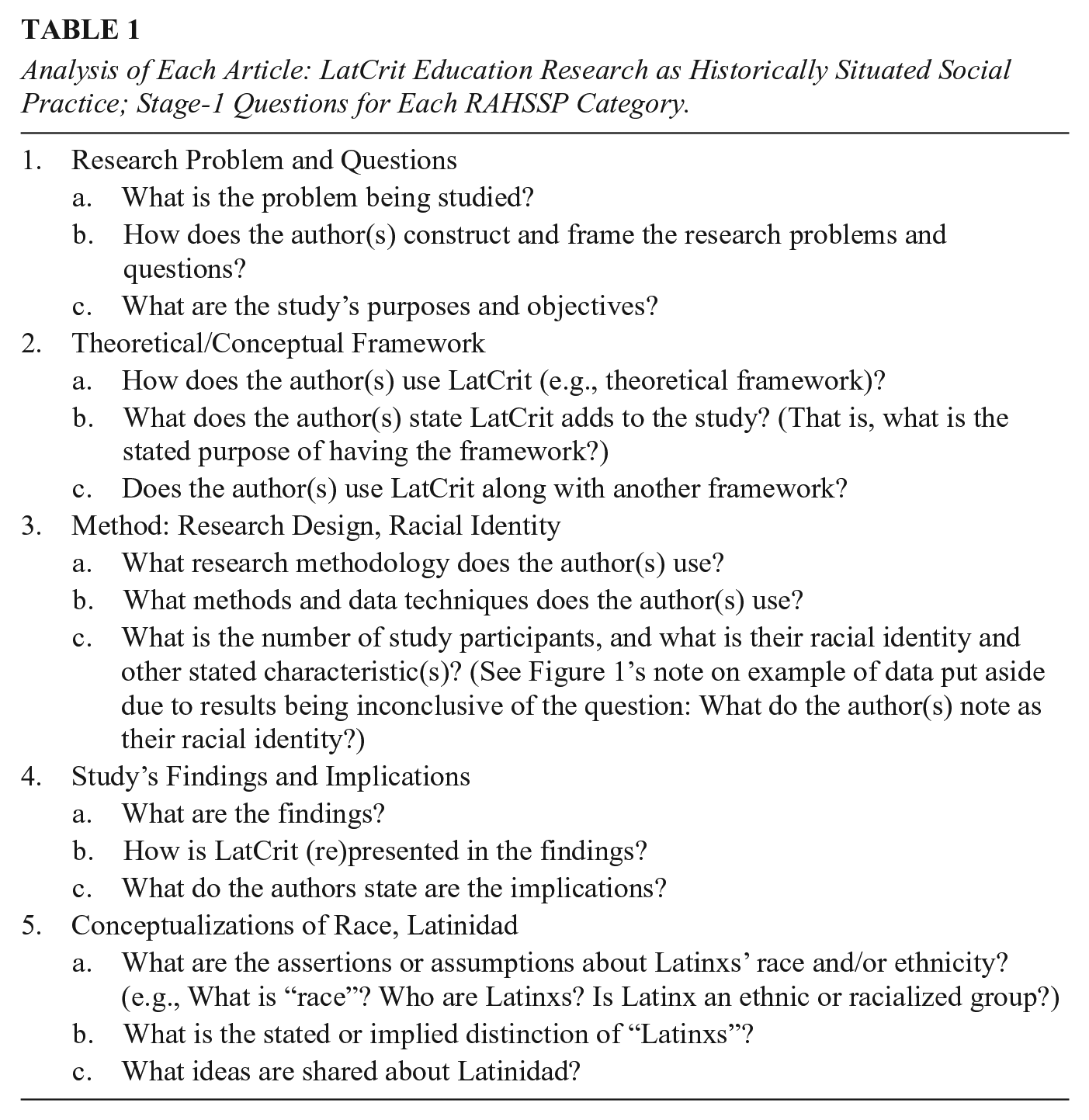
Stage 1 centered on coding each article. For this stage, I formed questions to guide my analysis of each article based on the five RAHSPP categories (see Table 1). As I read each article, I highlighted its text (inductive codes) and wrote short notes (deductive codes) to answer the Table 1 questions. I cataloged each article’s codes in a chart (see Figure 1). I also wrote stage-1 analytic memos about preliminary trends and divergences in research practices. I used the chart and my stage-1 analytic memos to re-evaluate and refine my guiding questions and the RAHSSP questions in Tables 1 and 2. This helped me to eliminate queries that were superfluous or inconclusive (e.g., author racial identity), emphasize those relevant to my purpose (e.g., author description of LatCrit), and elaborate on my analysis where needed (see note in Figure 1).
Analysis of Each Article: LatCrit Education Research as Historically Situated Social Practice; Stage-1 Questions for Each RAHSSP Category.
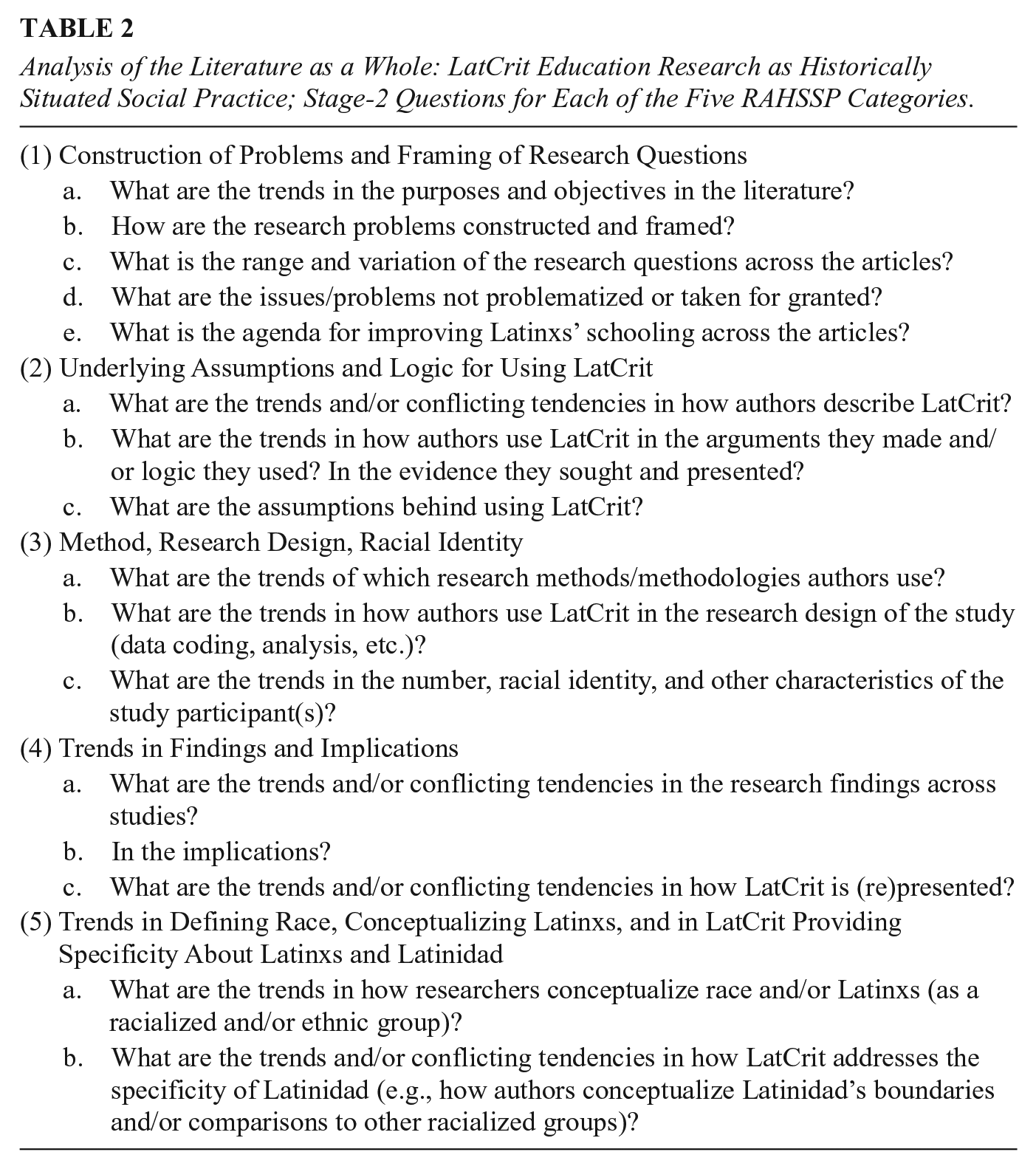
Analysis of the Literature as a Whole: LatCrit Education Research as Historically Situated Social Practice; Stage-2 Questions for Each of the Five RAHSSP Categories.
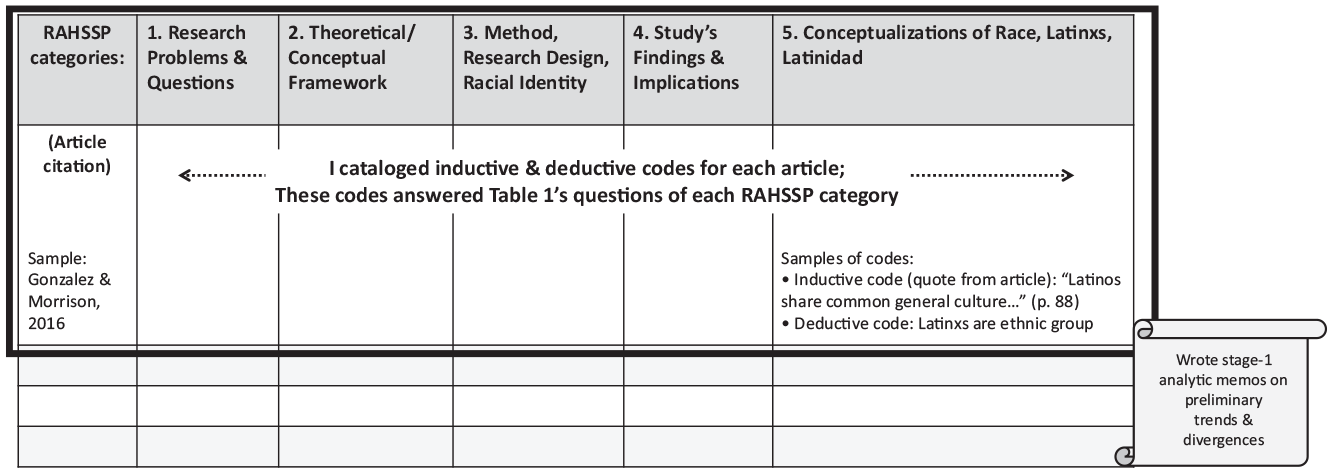
Schematic Representation of Stage 1, Analysis of Each Article.
After coding each of the 125 articles, I moved to the stage-2 analysis of the literature as a whole. For Stage 2, I wrote questions that would help me examine each of the five RAHSSP categories in the literature (Table 2). I concentrated on answering the questions from one of the categories at a time, looking for trends and divergences in the literature as a whole (see Figure 2 for a schematic representation of stage-2 analysis). I relied on the stage-1 codes, consulted my stage-1 analytic memos, and reread articles when needed. I wrote stage-2 analytic memos that answered the stage-2 questions and noted trends and divergences in each category. After completing the stage-2 analytic memoing for all categories, I reviewed all my stage-2 analytic memos, assessing the trends and divergences in the literature as a whole and consulting the articles when needed. Stage 2 helped me to focus on the researchers’ social practices in the literature as a whole, thus systematically identifying trends in research practices, challenges, tensions, and omissions. This enabled me to detect noteworthy divergences and achieve a comprehensive understanding of how the field employs LatCrit.
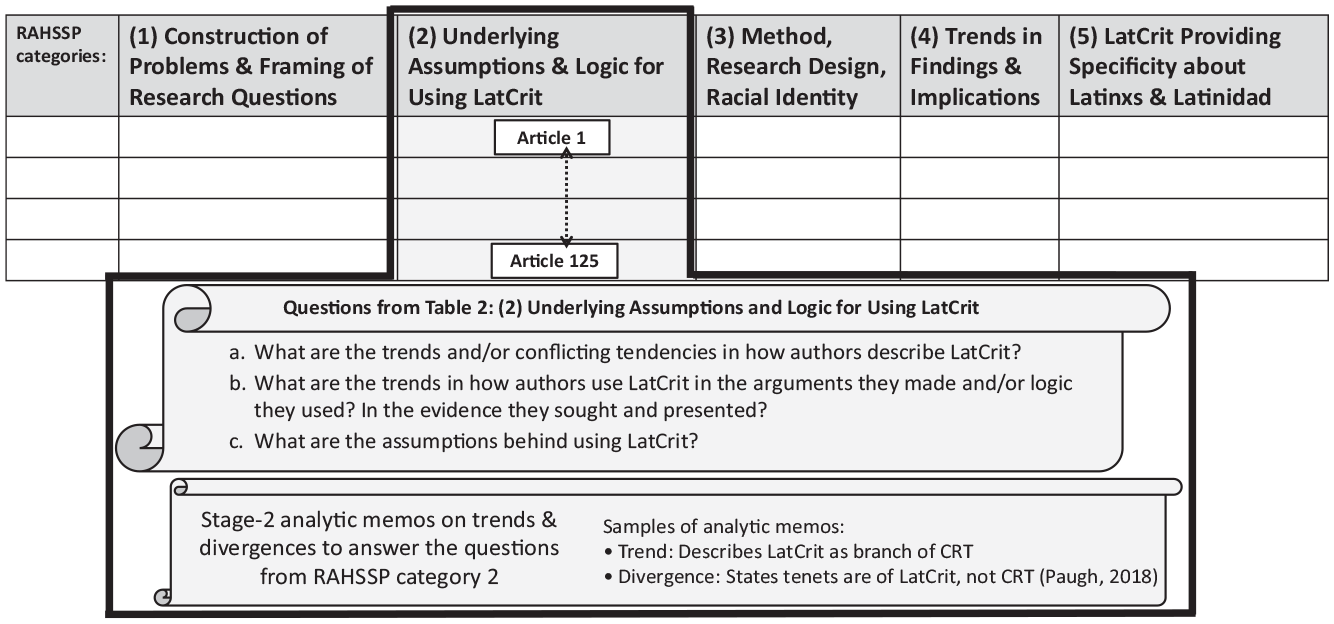
Schematic Representation of Stage 2, Analysis of the Literature as a Whole.
Findings: LatCrit in Education
To answer my review’s guiding questions, I organized the findings with the five RAHSSP categories (see Online Appendix C for a summary of findings). I highlight trends and divergences in researchers’ social practices in each category, with a focus on the strengths of the literature. I end the section by summarizing what the literature says as a whole.
(1) Construction of Problems; Framing Research Questions
Taken together, the articles in this literature review identified discrimination against Latinxs, along with a need to know more about Latinxs’ circumstances, as the fundamental problem animating their research. One way that some articles framed the problem was by citing the growing population and/or large majority of Latinxs, especially in the school-aged demographic, and emphasizing that this population is underserved, marginalized, not represented, and/or has low academic outcomes compared to other groups (e.g., Hernandez & Murakami, 2016; Irizarry & Donaldson, 2012; P. Z. Morales et al., 2016). The literature generally noted that because of Latinxs’ large numbers, researchers, policymakers, and educators need to know about Latinxs’ experiences and perspectives, which can offer us a nuanced understanding of structural inequalities (González & Immekus, 2013), how policies affect this population (Irizarry, 2011a), and how to improve the education provided to Latinxs. The articles also note that the population increase among Latinxs has a bearing on the educational experiences of youths, which, in turn, has brought changes in policy and practice that research should examine (e.g., Bettencourt et al., 2020; Salas, 2017).
Other articles likewise stressed the need to learn more about Latinxs’ experiences, but constructed the problem in terms of the Black/White binary in America’s racial consciousness (e.g., Salinas et al., 2016). These researchers positioned their studies as critiques of the Black/White binary in research on racism and education. They stated that because of this binary, research has not thoroughly examined the institutional discrimination affecting Latinxs through, for example, language policies (e.g., Poza & Viesca, 2018; Revilla & Asato, 2002) and, less frequently, criminalization (Caraves, 2018; Portillos et al., 2012). They suggest that a LatCrit framework can help to disrupt this binary (e.g., Irizarry, 2007; Muñoz, 2016).
Repeatedly, the scholars claimed that extant research has not focused on the voices and experiences of Latinxs (students, parents, school administrators, etc.; Fernández, 2016). They reasoned that because of this absence, we need to know more about Latinxs’ lived experiences with racism and education (Bacon et al., 2019; Malagón, 2010). The lack of Latinx voices connected to another problem that researchers noted: educational research has historically focused on deficits that keep Latinxs from succeeding (Ayala & Contreras, 2019; Farrington, 2018). To combat deficit thinking, many researchers framed their study around Latinxs’ explanations of their experiences and struggles (Hayes et al., 2013) and/or how Latinx participants navigated their educational journey, especially in spaces where they are minoritized (Aguirre et al., 2020; Ek et al., 2010). Researchers tailored their questions so that they examined Latinxs’ experiences in specific contexts. Some of the studies ask, for example, “What are the educational experiences of Latinxs in__?”: continuation high schools (Malagón & Alvarez, 2010); STEM fields (Peralta et al., 2013); rural settings (Peralta, 2013); predominantly White universities in the South (Robertson et al., 2016). Based on this research practice, the conclusion, then, is that by knowing how Latinxs successfully navigated a particular context, and by listening to their suggestions for practice/policy changes, practitioners and policymakers and the field at large can enact changes that advance educational equity (Sampson, 2019). Researchers stressed that it is vital that we grasp how Latinxs are resisting this oppression, which is how they become resilient (Flores, 2018; Ramos & Torres-Fernandez, 2020).
Although most articles framed the problem as one primarily of discrimination against Latinxs, especially in spaces where they are underrepresented or undervalued (Vélez, 2016), two of them complicated this narrative. First, Alemán (2009) examined an institution in which Latinxs occupy leadership positions, but where inequities persist. Alemán asked why inequities persisted even though the school district’s leadership racially mirrored the student community. He showed how Latinxs in leadership perpetuated practices and policies that were inequitable. Alemán theorized about “Latina/o racial consciousness” and Latinxs who identify as White (or do not). Second, Rodela and Fernández (2019) also demonstrate how Latinxs can perpetrate racism, anchoring their research in the complexities of Latinx intragroup advocacy—specifically, how privileged Latinxs represented Latinxs with less privilege or status.
On the whole, the literature exhorted scholars to challenge deficit ideas about Latinxs’ educational issues, often emphasizing the need to elevate Latinxs’ experiences through their own voices. Scholars formulated their research questions with an eye toward remedying the lack of focus on Latinxs caused by, for example, the Black/White binary and/or spotlighting the large Latinx population and the urgent need to improve their academic outcomes. The research questions across the articles were largely uniform in their aim of listening to the unheard voices of Latinxs; learning from their experiences, struggles, and resiliency; and calling for their perspectives to help shape schooling reforms. Few articles problematized how Latinxs may themselves adopt hegemonic ideologies (for an exception, see, Alemán, 2009).
(2) Underlying Assumptions and Logic for Using LatCrit as Framework
The literature was also mostly uniform in describing LatCrit as a framework specifically for Latinxs. Most scholars conveyed how they used LatCrit because it was a framework that focused on the unique experiences, identities, and oppressions of Latinxs (Freire et al., 2017; Pecina & Marx, 2020). They explained that LatCrit allowed them to address the issues that the Latinx community faces and, in particular, how race and racism in the education system affect Latinxs (Flores et al., 2020; Pimentel, 2014; Pulido, 2009). Some readily shared that they included LatCrit (alongside CRT and, sometimes, another framework) because their research focused “on Latino-related issues” (Noboa, 2013, p. 328). Across the articles, scholars justified using LatCrit solely because their study participants were Latinxs, departing from LatCrit in law’s “big tent” approach of LatCrit including other racialized Others.
Many scholars explained, moreover, that LatCrit is an apt framework for studying Latinxs because it accounts for their multidimensionality, including aspects like race, ethnicity, culture, language, accent, immigration status, citizenship, class, gender, sexuality, phenotype, and skin color (Lechuga-Peña & Lechuga, 2018; Oppland-Cordell, 2014; Revilla, 2012). Typifying the arguments in favor of LatCrit, Amos (2013) explained that the approach “examines experiences unique to the Latina/o community, such as immigration status, language, ethnicity, and culture” (p. 54). Villalpando (2003) wrote that “LatCrit is a more valid and reliable lens to analyze Latinas/os’ multidimensional identities and can address the intersectionality of racism, sexism, classism, and other forms of oppression for Latinas/os more appropriately than CRT” (p. 622). While the articles offered slightly divergent lists of Latinx identity components, every article that contained such a list asserted that LatCrit enables one to consider Latinxs’ distinctive multidimensionality and/or intersectionality.
Another key overlap in many articles is their contention that Latinxs’ experiences are intersectional. Quite a few noted that they included LatCrit because the framework enabled analyses that considered intersectionality; some articles conceptualize intersectionality as about how racial discrimination intersects with other identities, including immigration status, language, class, and gender, to make a distinct type of oppression (Young, 2016; Zavala, 2014). While there was less consistency in whether articles attributed intersectionality to CRT, scholars agreed that LatCrit focuses on the intersectionality specific to Latinxs.
Few articles incorporated the majority of the listed identity aspects into their analysis, findings, or discussion (for exceptions, see Aragon, 2018; Muñoz & Maldonado, 2012). In one exception, Muñoz and Maldonado (2012) planned four interviews (each focusing on specific topics, e.g., culture, immigration) and one focus group with four undocumented Mexicana college students. The authors organized the findings section into subsections that each discussed one theme (legal status, race, culture, & gender) while connecting to other themes. Also of note, these authors were the only ones to write the word “specificity” in relation to Latinxs:
A LatCrit of Education interrupts the discussion about race issues along the lines of a white–black binary to include and consider the experiences of racialized Latino/a populations in their specificity. Specifically, LatCrit constitutes an elaboration of CRT to include issues such as language, immigration, ethnicity, culture, and identity (see Solórzano and Delgado-Bernal 2001). (Italics added, p. 312)
Muñoz and Maldonado wrote about the specificity of Latinidad and defined this specificity as a product of Latinxs’ multiple dimensions.
More often, articles that listed the different dimensions focused on one aspect (e.g., language, Arreguín-Anderson & Kennedy, 2013; Garza, 2020) or two aspects (e.g., language and race, Monzó & Rueda, 2009; Pennington et al., 2019). In an example of the former, Arreguín-Anderson et al. (2018) used LatCrit to focus on Mexican-American children’s language practices and to challenge dominant ideologies that position children’s languaging as deficient. Their study, along with several others (e.g., Torrez, 2013), used LatCrit and another language-specialized framework(s). Focusing on two aspects, Pérez Huber (2010, 2011, 2015) coined the term “racist nativism” and described it as a framework under LatCrit. She and others have applied and further developed the theory of racist nativism to show how it affects Latinxs (Pérez Huber, 2009a; Pérez Huber & Cueva, 2012; Pérez Huber & Solórzano, 2015; Scribner & Fernández, 2017). Whether the article focused on one or more aspects, the scholars’ logic in employing LatCrit was mostly consistent: LatCrit is unique to Latinxs, and/or it addresses the listed aspects that society uses to marginalize Latinxs.
Many articles used counterstories (i.e., counter-narratives), and some described LatCrit as the theoretical framework that focused on Latinxs’ counterstories (Mancilla, 2018; Petrone, 2016). For example, Osorio (2018) employed LatCrit to highlight students’ counterstories of their families’ experience crossing the México/U.S. border. Pearson et al. (2015) used LatCrit to highlight Latinxs’ multidimensional identities and to present parents’ majoritarian stories and counterstories about school choice. In using counterstories, Pearson et al. positioned their work to emphasize experiential knowledge, one of the five themes that Solórzano and Delgado Bernal (2001) listed as foundational to CRT and LatCrit in education (see list in section “LatCrit in Education”).
Many of the articles listed these five themes (which some called tenets) and noted that all or some of the themes guided their use of LatCrit (Irizarry & Raible, 2014; Lara & Nava, 2018; Ostorga & Farruggio, 2020). In one such example, Delgado Bernal (2002) states that these five themes “form the basis of both CRT and LatCrit” (p. 109) but that LatCrit attends to a “coalitional Latina/Latino pan-ethnicity” and “issues often ignored by critical race theorists” (p. 108) such as language, immigration, and so forth. Her article contrasted the epistemology of a Eurocentric lens with that of a CRT/LatCrit lens; the former creates deficits while the latter challenges these deficits and highlights Latinxs’ strengths. Delgado Bernal’s article is notable for its early adoption of LatCrit in education and for elaborating on a major virtue of a CRT/LatCrit lens. Indeed, most of the articles share one important contribution: they counter deficit-based thinking that has shaped how the education field has constructed the research problems. In sum, the logic for using LatCrit is that it provides a framework that values the knowledge of Latinxs and illuminates their unique experiences through counterstories and other similar methods (e.g., narratives, testimonios, oral histories).
While the authors’ reasoning for using LatCrit was very similar across the articles, some studies used LatCrit to examine questions about Latinx individuals’ identities (Hernandez et al., 2014; Morales, 2018; Sánchez, 2020). To spotlight one divergent study, Núñez and García (2017) stated that LatCrit “emerged out of identity development theories” (p. 1). They explained that LatCrit helped them explore Latinx elementary-school students’ identity development and its connections to attending college. The authors’ study employed the famous Clark doll experiment to elicit children’s perceptions about race and gender and then assess the children’s “perceptions of college as an attainable goal” (p. 1).
Apart from some outliers, the prevalent trend in the literature was to describe LatCrit as a framework for centering Latinxs’ unique experiences, multidimensionality, and/or intersectionality. Scholars often focused on one or two of these dimensions (e.g., race+immigration OR race+language) and stated that LatCrit provides a mechanism for affirming and uplifting Latinxs’ voices and knowledge. Scholars, for the most part, assumed that LatCrit provided specificity about the Latinx condition through its intersectional focus on Latinxs’ multiple dimensions.
(3) Method, Research Design, and Racial Identity
In this section, I refer to the trends in the articles’ research methods relevant to LatCrit as a theoretical and/or methodological framework. Given the research practice of seeing LatCrit as a source of perspectives unique to Latinxs, the research design across the articles skewed toward methods that highlight participants’ voices. Most studies used qualitative techniques that involved interviewing a small number of participants; some included observations and, to a lesser extent, focus groups. Interviewing was the primary data-collection method and allowed studies to incorporate the voices of Latinxs (Handsfield & Valente, 2016; Rodriguez, 2011).
Many scholars named their methodology as counter-storytelling (or similar, e.g., testimonio, pláticas, narrative analysis), a mode of presenting participants’ experiences with education, racism, and other oppressive situations (Pérez, 2016; Rodela & Rodriguez-Mojica, 2020) or relating the researchers’ own experiences (Rodela & Fernández, 2019; Urrieta & Villenas, 2013). Authors noted that these methodologies allowed them to theorize participants’ experiences and count these as valuable evidence, which many noted as essential to LatCrit. While most authors employed LatCrit as a theoretical framework, when counterstories or testimonios were involved, some also named LatCrit a methodology (Pérez Huber, 2009b). Even when authors did not explicitly name their methodology counter-storytelling, the latter loomed large, with some scholars describing their participants’ actions and perspectives as counter-narratives (Ares, 2015; Rolón-Dow, 2005). Although some authors implied that counter-storytelling, testimonio, and pláticas emerged from LatCrit, these methods predate LatCrit (some, e.g., testimonio, were developed by Latinx or Latin American scholars).
Most of the non-qualitative studies analyzed documents, public discourse, and/or policies to learn how contemporary policies or discourses affected Latinxs and/or considered their needs (Cervantes-Soon et al., 2020; Freire et al., 2017; Jimenez-Silva et al., 2014; Zirkel & Pollack, 2016). Few articles engaged in historical inquiry (e.g., Ruiz-Escalante & Arreguín-Anderson, 2013) or quantitative analyses (Covarrubias & Lara, 2014; Rodríguez et al., 2016). In one mixed-method study, Stein et al. (2018) used a survey of a racially diverse pool of 1,132 students at a Texas high school to find out about the racial injustice Latinxs faced. The survey data (along with focal interviews of students, teachers, administrators, etc.) disclose whether non-Latinx people in a school community perceive anti-Latinx racism. In most non-qualitative studies, the trend was to imply that the scholars used LatCrit because Latinxs comprised the study population or focus, but LatCrit influenced little else, if anything, about the research design.
As for the identities of the research participants, the majority of studies include those who identified as Latinx or an associated national group (e.g., Mexican American, Puerto Rican). Of these, most had all or a majority of Mexican Americans and/or Chicanx participants (DeNicolo et al., 2015; Morton & Martin, 2013), and the articles with a different majority population focused on Puerto Ricans (Garcia et al., 2020; Irizarry & Antrop-González, 2013).
Few authors used LatCrit to examine the experiences of non-Latinx participants or a participant group without a majority or highlighted proportion of Latinxs. In one such exception, Macías (2018) presents testimonios of DACA recipients with birthplaces in Uganda, Mongolia, México, China, and Brazil. Macías explains that LatCrit facilitates researchers “studying the civil rights issues of Latina/os and how they intersect with, and diverge from, the struggles of other subordinated groups (Aoki & Johnson, 2008)” (p. 613). Despite legal scholars’ definition of LatCrit as a framework for international issues and diverse populations, few studies addressed non-Latinx issues. For example, in the only non-United States-based study, Webb and Sepúlveda (2020) used LatCrit to understand how Mapuche participants understood their Indigenous identity and navigated Chilean universities as students.
In sum, authors tended to use qualitative methodologies to challenge deficit narratives of Latinxs. The authors justified or described their methods (e.g., counter-storytelling) as relevant to LatCrit by stating that these methods advance LatCrit’s goal of honoring Latinxs’ experiential knowledge. Many of the articles interviewed a small number of Latinx participants to amplify the voices of Latinxs. Most of the research participants were Latinxs, specifically Mexican Americans and, in some studies, the authors themselves served as the participants.
(4) Trends in Findings and Implications
Because there were few significant divergences in how the literature constructed the problem, described LatCrit, and engaged with its research methodology, the trends in the findings and implications were also consistent. One of these consistencies lay in the presentation of the findings, which connects to LatCrit’s emphasis on elevating Latinx participants’ voices. For instance, because many scholars drew on CRT/LatCrit storytelling and/or aimed to use LatCrit to amplify the voices of the study’s Latinx participants (Menchaca et al., 2016), many of the studies, especially those with few participants, presented their findings by including participants’ in-depth narratives (counterstories, oral histories, testimonios, etc.; Paugh, 2018; D. Rodriguez, 2010; Vega, 2023). Some articles, invoking the idea that Latinxs receive disproportionately low attention, emphasized that their findings helped illuminate Latinxs’ experiences in under-researched U.S. regions of New Latinx Destinations/Diaspora, like the Southeast and Midwest (Abrica et al., 2020; Smolarek, 2020).
The reviewed studies organized their findings into themes and quoted their participants, using these quotations as evidence similar to what one encounters in non-LatCrit qualitative studies—but the former’s epistemological stance toward participants’ knowledge distinguishes it from the latter (see, e.g., Fernández, 2002). Even in qualitative articles that did not feature lengthy participant narratives, the findings often mentioned LatCrit’s penchant for valuing the experiential knowledge of racialized Others (Garcia, 2019; Quiñones et al., 2011). For example, Irizarry (2011b) used the five CRT/LatCrit themes that Solórzano and Delgado Bernal (2001) foreground to organize his implications and suggest changes to teacher-education programs, including an injunction to value Latinxs’ experiential knowledge.
One prevalent trend in the research findings was that Latinxs suffered from racist policies (Alemán, 2007) and had negative experiences with racism and other types of discrimination (e.g., microaggressions, linguicism, nativism; Arreguín-Anderson & Ruiz-Escalante, 2014). Scholars found that participants’ experiences helped participants understand power and inequities (Connor, 2009; del Rosal et al., 2018). The findings also painted a detailed portrait of the racist obstacles that Latinxs face in the U.S. education system, along with suggestions for countering these. For example, Urrieta et al. (2015) focused on the tenure and promotion process of Latinx faculty. They found that, despite hostile environments, faculty were resilient, and the authors concluded that faculty’s perseverance should not absolve universities of the responsibility to implement structural and cultural changes for building supportive environments. Several other articles detailed such racism and then described how Latinxs resist deficit ideologies (Rodriguez & Rodriguez, 2020), create counter-narratives (Martinez, 2020), and/or affect social change in the interest of marginalized communities (Revilla, 2004). This literature revealed specific strategies that Latinxs employed to overcome challenges—for example, tapping into family resources or creating safe spaces (Suriel et al., 2018).
Authors often stated that their findings pointed toward the need for practitioners, policymakers, and/or researchers to learn about the struggles Latinxs face. They also stated that practitioners and policymakers need to hear Latinxs’ stories of success and how Latinxs navigate, are resilient, and overcome challenges to improve their experiences in unwelcoming contexts, for example, White-normative educational institutions (Morales, 2018) or those in which they are underrepresented, such as the teaching profession (Rivera, 2022). The rationale behind this was that in order to counter deficit ideologies and/or implement policies that better serve Latinxs, it is essential to listen to and appreciate the stories and perspectives of Latinxs.
A less recurrent trend emerged from the finding that having participants engage in critical methods such as counter-storytelling benefited them (Batista-Morales et al., 2019; López, 2016). Fránquiz et al. (2011) wrote about eliciting teacher candidates’ counterstories, which the authors and the candidates then used to challenge majoritarian and deficit views of bilingual learners. The articles suggested that these types of research methods should be extended into pedagogical methods and used with all participants to enhance their critical consciousness and help them challenge oppressive policies and practices.
Often articles did not explicitly mention LatCrit in their findings, instead implying a connection to LatCrit by asserting, for example, how Latinxs were discriminated against because of a certain dimension of their identity. One example left unclear even an implicit link to how the findings incorporated LatCrit. Araujo (2011) stated using “community cultural wealth [CCW] through the lens of LatCrit” (p. 258), and while she described CCW in the framework section, LatCrit was undefined. Araujo provides important findings which show that a migrant program provided Latino 1st-year college students with navigational and social capital (two elements of CCW) by, for example, helping students fill out required forms. But since LatCrit was undefined as well as unmentioned throughout the discussion, how LatCrit influenced the findings is difficult to determine.
In sum, following the previous RAHSSP categories, the trends in the findings and implications were largely consistent. This scholarship (re)presented and/or tacitly incorporated LatCrit in its findings by exposing oppressive practices and ideologies, highlighting participants’ counter-narratives, and valuing the knowledge of marginalized people, especially Latinxs. The implications often included a call for schooling institutions to be more attentive to the experiences of Latinxs who contend with racism and other oppressions. Additionally, some of the literature urges counter-storytelling as a critical pedagogical method ideally suited to racialized Others.
(5) Trends in Defining Race, Conceptualizing Latinxs, and in LatCrit Providing Specificity About Latinxs and Latinidad
Across the articles, the prevalent trend was not to explicitly define ethnicity or race or Latinx beyond stating something like: “race is a social construction meant to oppress people of color.” But a few were explicit that race is an ideology based on erroneous ideas about biogenetic differences (Davila & de Bradley, 2010). In terms of conceptualizing Latinxs, most authors implied that Latinx was both a race and ethnicity by listing “race” and “ethnicity” in the multiple dimensions. However, some made their choice explicit. Irizarry (2012) stated that Latinxs can be of any race and multiracial. González and Portillos (2007) justified LatCrit as their framework because Latinxs are an ethnic group and LatCrit emphasizes ethnic discrimination (language rights, immigration, citizenship). Some scholars mention or imply that Latinxs have a shared culture, background, and/or language. For example, Gonzalez and Morrison (2016) stated that “Latinos share a common general culture meaning that their origins are either from a Spanish speaking country or their parents come from a Spanish speaking country,” but then noted that recent research shows “Latino college students have distinct backgrounds even when they come from the same Spanish speaking country of origin” (p. 88). Their article was also an outlier in its use of LatCrit to review the literature on Latino college persistence and examine “the lack of use of Latino culture in these studies” (p. 88). In their findings, Gonzalez and Morrison discussed the differences in “specific Latino ethnic groups” (p. 100), which were based on nationalities (e.g., Cuban American).
As for the trends in addressing the specificity of Latinidad, very few employed LatCrit to advance ideas about what constitutes the Latinx racialized group and/or what its boundaries are in relation to other racialized groups. In one article that did focus on the making of ideas about the Latinx racialized group, Pérez Huber and Solórzano (2015) used LatCrit to theorize about how the historical image and discourse of the Mexican bandit creates ideas about Mexicans. They argued that these images and discourses contribute to racist understandings about Latinxs. Their article, published in Qualitative Inquiry for a special issue on CRT in education, is an example of education research that uses LatCrit to show how discourse and multimodal text help form ideas about Latinidad.
In the same special issue, historian Olden (2015) focused on racial formation (the process of racialization) as part of a historical study of a school-desegregation legal case. Olden discussed how Mexican American students were considered White or non-White in the court case, and how the fluidity of racial categories shows that people negotiate and create the boundaries of racial categories. Her work is an outlier in this literature review in another way: Olden did not cite LatCrit-in-education literature, instead drawing on LatCrit legal scholarship and its idea that the law “played a critical role in the making and remaking of American racial knowledge” (p. 252). While these special issue articles did not include the term Latinidad (and they focused on Mexican Americans), their inquiries contribute to ideas about constructing the Latinx racialized category.
Very few authors used the term Latinidad; fewer theorized about it. In one that did both, López and Irizarry (2019) complicated the question of which students are read as Latinx, and they argued that we ought not to see Latinidad and Indigeneity as mutually exclusive. Their implications for research included a call for more study of Indigeneity. Flores and Garcia (2009) also touched on inclusivity and focused on ideas about Latinidad’s complexities. They wrote about a space in a predominantly White campus where Latinas, to cope with alienation, shared their testimonios, which included thinking about what it means to be recognizable as Latinx. The authors used LatCrit and other frameworks “to identify the dominant contemporary narratives of Latina/o authenticity in the US” (p. 162) and unpack the intricacies and tensions of Latinidad.
The trend across the articles was to leave race undefined and implicitly position Latinxs as both a racialized and an ethnic group by listing the multiple dimensions. When it came to addressing the specificity of Latinidad, very few articles theorized about Latinidad’s boundaries, changes, and/or comparisons to other racialized groups. Most employed LatCrit to contribute to specificity about the racial discrimination affecting Latinxs in particular contexts and with certain combinations of identities/positions (e.g., Puerto Rican female teachers). Few articles linked this to theorizing about the specificity of Latinidad in education.
What the Literature Says as a Whole
Together, the research practices signal that education scholars have developed LatCrit into a theoretical framework for studies that largely focus on educational issues relevant to the Latinx community and/or that include Latinx research participants. This distinction has evolved along with a proliferation of frameworks in education that revolve around a racialized group (e.g., AsianCrit, BlackCrit, TribalCrit)—thus, one sees why education researchers perhaps use LatCrit specifically for Latinxs, moving away from the inclusive approach of LatCrit in law.
One of the literature’s strengths was its contribution to detailing the racism that Latinxs experience (e.g., examining particular participants and/or specific spaces). The literature provided contextualized and/or historicized accounts of the existing inequities facing Latinxs, analyzing the experiences of Latinxs to understand the structural issues affecting them. Attention to how a specific group experiences racial discrimination is one of LatCrit in law’s themes; however, the literature did not use the term “differential racialization” (Delgado & Stefancic, 2000) to describe its practice of focusing on the particular racism that Latinxs suffered.
Another of the literature’s strengths comes from its social practice of valuing the experiential knowledge of the research participants, resulting in detailed accounts by Latinxs. These accounts show how racial discrimination affects them and how Latinxs understand, resist, and/or navigate their circumstances under our society’s injustices. The literature valued Latinxs’ perspectives and offered these to inform possible reforms.
Very few researchers utilized LatCrit to examine what delineates the Latinx group in relation to other racialized groups. This research practice suggests that LatCrit in education leaves aside LatCrit in law’s debate about whether “Latinx” constitutes a racialized or ethnic group. Instead, articles that did comment on Latinidad speculated on whether the concept included various identities. Next, I discuss the conflicting tendencies, omissions, and weaknesses from the review of the research practices in LatCrit scholarship.
Discussion: Four Critiques of the Literature Expose a Paradox
In this section, I spotlight and problematize four research practices that form a significant pattern in the literature: (1) describing LatCrit with general themes from CRT rather than themes specific to LatCrit; (2) listing a string of dimensions but only focusing on one or two concepts and/or not defining these concepts and detailing how they affect the Latinx condition in education; (3) implying that the specificity of Latinidad is multidimensionality; and (4) exceeding LatCrit’s scope by rationalizing the study’s use of LatCrit because its participants are Latinxs. I explain how these research practices impact the ability of LatCrit research to contribute research toward illuminating the specificity of Latinidad in education.
(1) Describing LatCrit With General Themes From CRT
While Solórzano and Delgado Bernal (2001) described five themes that undergird CRT and LatCrit, some articles stated or implied that the themes were particular to LatCrit. These articles used the themes to contribute important theorizations and implications, such as the need for different educational institutions to value participants’ experiential knowledge. But these CRT/LatCrit themes could be applied to any study with a critical and/or social justice perspective. And while researchers’ social practices did focus on the Latinx population and/or issues that affect them, the CRT/LatCrit themes do not attend to the specific construct “Latinx” (or Latinidad). Accordingly, the literature as a whole did not speak to the differences that distinguish “Latinx” from other racialized groups. If LatCrit is to attend to specificity about Latinx or Latinidad, scholars must develop themes particular to LatCrit and tailored to this aim. The research practices across the articles defined LatCrit based on its attention to Latinxs’ multiple dimensions; however, this practice is problematic, as I demonstrate next.
(2) Listing a String of Dimensions
Many scholars stated that they used LatCrit because it acknowledges the importance of multiple dimensions (race, ethnicity, culture, language, accent, class, gender, sexuality, skin color, phenotype, citizenship, and immigration status). This listing leads one to assume that a rigorous application of LatCrit explains the interconnection of these aspects in the experiences of Latinxs. However, some articles listed the dimensions, but then looked only at one dimension and failed to link this to the other aspects. Further, few articles specifically defined, attended to, or analyzed all the intersectional concepts they listed as affecting Latinxs’ experiences in education. This research practice results in what I term a string of dimensions, a list that does not include conceptual parameters and/or analytic depth that would lay bare how all these dimensions affect the Latinx condition in education. 5 This practice then adopts a perfunctory description of LatCrit or of Latinxs’ uniqueness, which undermines the original intent of LatCrit’s examination of multiple dimensions.
Defining LatCrit by its attention to the dimensions presents another issue: Aiming to include everything that affects an individual’s experience results in some concepts that lack definition and depth—which included the concept of race, a point to which I later return. This outcome is not surprising given that LatCrit does not offer theoretical or conceptual parameters of the aspects in the multiple dimensions. Some scholars avoided LatCrit’s undertheorizing of concepts by supplementing with another framework, one that specialized in the undertheorized concept (often language). Thus, perhaps the robust research findings/analyses resulted not from LatCrit but from the framework that clearly defines the concept and promotes an in-depth analysis of that aspect.
Here then, LatCrit perhaps contributed in other ways, for example, in valuing the experiential knowledge of participants—a principle it shares with CRT. So now I return to the literature’s contribution of valuing participants’ experiential knowledge to trouble another trend. Perhaps because articles emphasized how LatCrit values experiential knowledge, few explored the fact that some Latinxs may subscribe to hegemonic ideologies and practices. While education research suggests that racialized Others do not always advance counterhegemonic ideas and practices (Chávez-Moreno et al., 2022), in using LatCrit to examine Latinxs’ perspectives, the literature largely ignores and/or deemphasizes this inconvenient reality. This prevalent trend might lead one to the erroneous conclusion that Latinxs’ experiential knowledge is free from hegemonic meaning-making, and thus should be unconditionally accepted rather than scrutinized and critiqued.
(3) Implying the Specificity of Latinidad is Multidimensionality
Another issue that emerged from LatCrit’s multidimensional emphasis relates to Latinxs’ purported uniqueness. While some authors clearly described using LatCrit to explore how the multiple forms of oppression uniquely show up in Latinxs’ experiences, some used wording that implied, probably unintentionally, that Latinxs uniquely experience multiple forms of oppression related to culture, language, ethnicity, immigration status, and so forth (a few emphasized that language oppression is particularly relevant for Latinxs). The latter implies that LatCrit is used to study Latinxs’ multidimensionality because Latinxs have multidimensionality (and other groups do not).
This inference becomes more pronounced when we add that, as a whole, the literature did not include other racialized groups or empirically compare their and Latinxs’ experiences to detail Latinxs’ uniqueness. Thus, the literature’s logic for using LatCrit (LatCrit’s multiple-dimension emphasis) and research design (only for Latinxs) can imply that LatCrit is appropriate for Latinxs because they have multidimensionality. And these research practices could lead one who seeks specificity about Latinidad to deduce that Latinxs’ uniqueness lies in their having multidimensionality and that this differentiates Latinxs from other groups.
To be clear, no authors stated that other racialized groups lack multidimensionality. Rather, I argue that the research practices of the literature as a whole (i.e., using LatCrit to explore the multiple forms of oppression only of Latinxs and without designing studies to include other groups) could imply this conclusion. Certainly, these oppressions (linguicism, colorism, classism, racism, sexism, etc.) also affect other racialized groups, like Asian Americans and Black Americans, and thus do not account for the uniqueness of Latinx. For example, Black Americans’ racialized experiences are also shaped by language (e.g., Chávez-Moreno, 2024; Dumas & ross, 2016). Black Americans’ accents and languaging affects how people perceive them and how racial discrimination is brought to bear on them at the individual and policy levels. At the policy level, for example, when schools do not offer official bilingual-dual-language options that teach Black English, they fail to validate the language practices of Black communities. But LatCrit was not used to examine their multidimensional experiences. Suggesting that other racialized groups also suffer from a nexus of these same oppressions does not mean that Latinxs do not have different experiences. However, the literature does not provide the empirical comparisons needed for discerning these differences. And given this research practice, what then is LatCrit saying is different about Latinxs? Said another way, how then is LatCrit lending specificity to Latinidad?
I propose that in defining LatCrit as a framework that examines dimensions particularly or uniquely relevant to Latinx, and in not using LatCrit to examine the dimensions of other racialized groups, scholars inadvertently imply that LatCrit would not be appropriate for use with other racialized groups, perhaps then implying that they are not as affected by these dimensions. Stating that the framework is specific to Latinxs because it accounts for these intersecting concepts, makes LatCrit seem overly broad; and it does little to distinguish what about the Latinx experience is different from that of other racialized groups in the United States.
(4) Exceeding LatCrit’s Scope by Rationalizing the Study’s Use of LatCrit Because its Participants Are Latinxs
The fourth pattern I noticed across the articles relates to LatCrit’s scope and the authors’ rationale for using LatCrit. Some scholars exceeded LatCrit’s scope by using it for inquiries that did not connect to LatCrit’s origins and/or make use of its affordances. One example is a set of inquiries focused on Latinxs’ identity development. Some articles described LatCrit as a framework for analyzing individual Latinxs’ racial identity development, in conjunction with another aspect of their positionality/subjectivity. Some implied that their rationale for using LatCrit was that they focused on Latinx participants—a reason that other non-identity studies also gave. The field does need research that provides specificity to the Latinx construct by examining the experiences of individuals as they become or enact a Latinx identity; however, LatCrit’s contribution to this area was limited to acknowledging that identity is intersectional and multifaceted. Using LatCrit to inquire into identity development often removed it from its academic genealogy, that is, its intended utility as a mode of examining the structural, institutional aspects of racial discrimination. Because of this genealogy, LatCrit lacks tools for analyzing identity development, and indeed some analyses seemed strained, especially given that the education field has benefited from existing frameworks that specialize in identity development.
Studies about identity were not the only ones that seemed to have Latinx participants and thus tacked on LatCrit as a framework. But the important point is that this practice implies that the mere presence of Latinxs (or issues affecting Latinxs) rationalizes including LatCrit. I submit that the racialized identity of the research participants does not alone predetermine LatCrit’s suitability as a framework.
Next, I elaborate on some complications that these four research practices produce.
Paradox: Specifically About Latinxs, Yet Lacking Specificity
Given LatCrit’s origins and the thread throughout most of the LatCrit literature, one would imagine that LatCrit is a framework specializing in race, Latinxs, and, by extension, Latinidad in education. However, the complications above lead me to point out a paradox: Even though LatCrit emerges from critical race theory and exists for Latinxs, the literature that uses it largely leaves “race” undefined and undertheorized, and only vaguely conceptualizes Latinxs as a racialized group. This paradox means that the literature has not advanced understandings of the specificity of Latinx racialization and/or Latinidad in education.
Before discussing the implications of this paradox, I note two points. First, the paradox does not minimize the significance of the studies that have utilized LatCrit to examine the racism Latinxs face. Rather, it signals an opening to expand the use of LatCrit in specific ways. Second, perhaps race is under-theorized because of the research practice of listing a string of dimensions. Or perhaps, because some LatCrit legal scholars worked from an ethnicity model, this influences LatCrit in education to under-conceptualize race. Whatever the reason, the education field has reshaped LatCrit in different ways from legal scholars and should continue to do so.
Accordingly, I would suggest that the thread and paradox both ought to impel researchers toward specificity in LatCrit, a move that would advance LatCrit’s potential to contribute specificity to Latinidad in our racially hierarchical society. In the next section, I offer some theoretical tools and ways for the field to build on its initial focus on Latinxs.
Implications and Conclusion: Toward Specificity in LatCrit in Education
My critique leads me to rethink LatCrit’s tenets. Thus, instead of drawing from the CRT/LatCrit themes (i.e., tenets) first offered by Solórzano and Delgado Bernal (2001), I propose that the field could benefit by proceeding with framing ideas that are informed by the field’s research practices. I avoid describing the framing ideas as “themes” to prevent confusion with themes derived from research analyses. Nor do I use “tenets,” following Dumas and ross’ (2016) eschewing of tenets when calling for BlackCrit’s specificity on the grounds that tenets imply a fixedness “associated with religious statements of faith, or rigid ideological schools of thought” (p. 429). I offer these initial LatCrit framing ideas: (1) focus on issues that affect Latinxs and/or include Latinxs as the research participants; and in the case of the latter, value participants’ experiential knowledge yet recognize that Latinxs (like all people) can perpetuate hegemonic ideologies and practices; (2) define and theorize race and/or racialization; (3) conceptualize Latinx as a racialized group; and (4) advance the specificity of Latinidad.
Together, these framing ideas aim to advance a LatCrit that is specific and explicit in its focus and practices, and thus help to differentiate LatCrit from other frameworks while avoiding the complications I have described in this article. The first framing idea encourages future LatCrit studies to account for Latinxs’ hegemonic ideas and practices, and this would nuance the field’s understanding of Latinxs’ perspectives. The framing ideas also include some of what scholars already do (e.g., include Latinx participants). But by explicitly stating the first point as one of LatCrit’s framing ideas, education researchers untether themselves from LatCrit in law’s “big tent” approach and make LatCrit unreservedly focused on Latinx issues. However, not heeding the other framing ideas would lead to research practices that continue to exceed LatCrit’s scope into inquiries that merely have a Latinx population or deal with a topic relevant to Latinxs. Thus, for scholars who want to contribute to the specificity of Latinidad, I recommend the other framing ideas. The next sections elaborate on the other framing ideas.
Define and Theorize Race/Racialization
My critique of the LatCrit research practice of not defining concepts such as race in the string of dimensions mirrors some critiques of CRT. Some preeminent critical-race education scholars argue that the field has largely continued to undertheorize race (Leonardo, 2013) and that CRT in particular lacks a racial theory (Cabrera, 2018). Leonardo (2013), for example, argues that, surprisingly enough, CRT education scholarship leaves undefined the concept of race, which “is a problem not merely of definition but about setting conceptual parameters and analytical clarity” (p. 28). LatCrit research that defines race and/or racialization can better avoid these pitfalls and lead to rich theorizations.
Conceptualize Latinx as a Racialized Group
I advocate, too, for research that employs LatCrit to conceptualize Latinx as a racialized group/category. By doing so, the education field can continue to examine how Latinxs suffer historical discrimination and structural exclusion, but with the added advantage of supporting a focus on race/racialization. Inquiries could connect how these discriminations emerge from and contribute to perceptions of Latinxs’ perpetual inferiority. Such inquiries may illuminate how schooling reifies the allusion to (biological) races existing.
Different critical theories exist about Latinx as a racialized category; I recommend that scholars seek these out. Having done so, I have found it helpful to conceptualize the Latinx racialized group as follows. Latinx is a category meant to incorporate people into the U.S. settler colonial white-supremacist nation-state. Latinx refers to a racialized group of people who reside in the United States, are imagined to have a connection to the Spanish language, and suffer the effects of multiple colonialisms, specifically Spanish colonialism, American colonialism, and American imperialism (Chávez-Moreno, 2021b). Among other affordances, this conceptualization of Latinxs moves toward a “coalitional Latinx group” without the “pan-ethnicity” label that frames Latinxs as perpetual foreigners.
Advance the Specificity of Latinidad
Eschewing the string of dimensions would permit other ways to contribute to the specificity of Latinidad. While many ways exist for engaging in such work, scholars could, for example, examine Latinxs’ racialization. To help devise a research practice in support of this, the field might take up a relational racialization lens. This lens conceptualizes racialized categories as constructs always formed in relation to one another (e.g., see Molina et al., 2019). Thus, to obtain specificity about Latinidad, one looks at how the racialization of the Latinx group compares with, connects to, and differs from other racialized groups. While the reviewed literature focused on Latinxs’ differential racialization (even though few authors used this term), the field could extend its focus on the particular racism Latinxs suffer to include research practices for theorizing this racism relationally. Complementing the differential approach with a relational-racialization lens could help LatCrit retain focus on the need to theorize race and racialization. This would suit LatCrit (and CRT) given that these are known to be frameworks that draw from interdisciplinary perspectives.
These recommendations continue LatCrit’s affordances while removing the perfunctory string of dimensions that does not operationalize concepts. They also prevent the perpetuation of ahistorical and hegemonic understandings of race and racialized groups (e.g., the essentializing idea that “Latinxs have a shared culture”). Additionally, these recommendations further facilitate studying how Latinxs are positioned in relation to Indigeneity, Blackness, Whiteness, settler colonialism, imperialism, and so forth. Indeed, one promising feature of the current literature is its movement toward examining Indigeneity and the legacies of colonialism. The field needs more work that considers the relationship of Latinxs to U.S. imperialism, especially given that many Latinxs are from immigrant backgrounds, often driven from their homeland because of American imperialism (González, 2011).
Like all frameworks, my proposal will have limitations. Some of the pitfalls I identified in my previous commentary could remain. Perhaps my call to complement LatCrit with relational racialization could overextend LatCrit’s scope by using it for inquiries misaligned with LatCrit’s origins and/or affordances. Other pitfalls could emerge and would deserve attention. Because many ways exist to develop theory, I hope that the initial framing ideas I propose would allow us to have conversations that might inspire richer conceptualizations of LatCrit.
To end, the LatCrit framework guides which questions researchers ask, how researchers investigate these questions, and what implications they consider. The ideas about race and Latinxs that scholars advance in their work influence how society, and of course educators, understand these concepts and the educational issues affecting our society and Latinxs in particular. Consequently, how scholars employ LatCrit to conceptualize Latinxs’ racialized status informs how we understand America’s racialized society and Latinxs’ role in its future.
Supplemental Material
sj-pdf-1-rer-10.3102_00346543231192685 – Supplemental material for Examining Race in LatCrit: A Systematic Review of Latinx Critical Race Theory in Education
Supplemental material, sj-pdf-1-rer-10.3102_00346543231192685 for Examining Race in LatCrit: A Systematic Review of Latinx Critical Race Theory in Education by Laura C. Chávez-Moreno in Review of Educational Research
Supplemental Material
sj-pdf-2-rer-10.3102_00346543231192685 – Supplemental material for Examining Race in LatCrit: A Systematic Review of Latinx Critical Race Theory in Education
Supplemental material, sj-pdf-2-rer-10.3102_00346543231192685 for Examining Race in LatCrit: A Systematic Review of Latinx Critical Race Theory in Education by Laura C. Chávez-Moreno in Review of Educational Research
Supplemental Material
sj-pdf-3-rer-10.3102_00346543231192685 – Supplemental material for Examining Race in LatCrit: A Systematic Review of Latinx Critical Race Theory in Education
Supplemental material, sj-pdf-3-rer-10.3102_00346543231192685 for Examining Race in LatCrit: A Systematic Review of Latinx Critical Race Theory in Education by Laura C. Chávez-Moreno in Review of Educational Research
Footnotes

Supplemental Material
Supplemental Material for this article is available online.
Notes
Author
References
Supplementary Material
Please find the following supplemental material available below.
For Open Access articles published under a Creative Commons License, all supplemental material carries the same license as the article it is associated with.
For non-Open Access articles published, all supplemental material carries a non-exclusive license, and permission requests for re-use of supplemental material or any part of supplemental material shall be sent directly to the copyright owner as specified in the copyright notice associated with the article.
