



Abstract
This study examined the association between COVID-19 psychological distress and mental health symptoms as moderated by social support among 107 Hispanic undergraduates at a large public Hispanic-Serving Institution in Southern California. Results indicated pandemic distress was positively, and social support was negatively, associated with mental health symptoms; social support did not moderate this relationship. Findings signal the need to identify protective factors that buffer mental health symptoms among Hispanic undergraduates during global crises.
Research suggests Hispanic-serving institutions (HSIs) offer a more culturally responsive and diverse environment (Núñez et al., 2011) and yield better academic outcomes for Hispanic compared to non-HSIs (Crisp & Nora, 2010). Additionally, HSIs with greater than 50% Hispanic enrollment are thought to provide more culturally responsive academic climates (Sanchez, 2017). Recent qualitative evidence revealed belongingness within HSIs was related to the presence of and engagement in campus microclimates or smaller distinct and inclusive spaces for students of color (Serrano, 2020). Interestingly, Hispanic undergraduates in HSIs report similar mental health symptoms compared to their white counterparts (Holliday et al., 2016) and other students of color (Serpas, 2021a). Also, Arana et al. (2011) found the interrelationship between micro-level influences (e.g., student, family contexts) and meso-level influences (e.g., HSI context) was associated with perseverance toward academic achievement among Hispanic undergraduates. While HSIs have the capacity to support favorable mental health outcomes for Hispanic, they may not meet the unique needs of the diverse Hispanic student population, such as first-generation (Cuellar, 2019) and Afro-Hispanic students (Esmieu & Terraza, 2017), particularly during the COVID-19 pandemic.
Universities nationwide were largely unprepared for the massive disruptions caused by the COVID-19 pandemic, as well as the unique needs of students facing disproportionate adversities, including Hispanic students (C. H. Liu, Pinder-Amaker, et al., 2020). The COVID-19 pandemic has negatively affected Hispanic persons in terms of economic concerns (e.g., job loss, food insecurity) and virus transmission and mortality rates (Centers for Disease Control & prevention, 2022; Hooper et al., 2020). The transition to distanced learning was also accompanied by reduced on-campus engagement with potentially supportive resources for Hispanic mental health (e.g., microclimates; Serrano, 2020). The pandemic has sprouted greater mental health difficulties with evidence indicating that high levels of loneliness, COVID-19 worry, and low distress tolerance were related to clinically elevated depressive, anxiety, and traumatic stress symptoms among young adults (Liu et al., 2020). Liu et al. (2020) found that Hispanic participants were less likely to report high anxiety which they suggest was attributable to protective resources such as social support. Studies of Hispanic undergraduates within HSIs report high levels of stress, anxiety, and depressive symptoms at the height of the pandemic among Hispanic students (Ibarra-Mejia, Lusk, & Jeon, 2022; Ibarra-Mejia, Lusk, & Umucu, 2022). These mixed findings provide justification for examining the role of protective resources on the association between COVID-19 distress and mental health outcomes among Hispanic undergraduates.
In one study of predominantly Hispanic (80%) undergraduates from an HSI, higher levels of stress were found once the pandemic began and grit and gratitude moderated this observation (Bono et al., 2020), suggesting protective resources may buffer pandemic distress on mental health (meso-level influences; Arana et al., 2011). To aid in examining COVID-19-specific distress, researchers validated measures to assess psychological distress salient to the COVID-19 pandemic. Instruments were validated for COVID-19 fear (Ahorsu et al., 2022), anxiety (S. A. Lee, 2020), and racial bias (Fisher et al., 2020). Research on these measures suggests they are positively associated with and distinct from general mental health symptoms (Fisher et al., 2020; Litam et al., 2020; Serpas & Ignacio, 2021a; Son et al., 2020; Wang et al., 2020). COVID-19 distress is uniquely associated with mental health outcomes among Hispanic undergraduates with one study reporting that higher coronavirus fear and anxiety was associated with more post-traumatic stress symptoms (PTSS) and, along with other distress constructs, accounted for 62% of the variance in PTSS (Torres et al., 2022). Since studies investigating these associations among Hispanic undergraduates within HSI settings are limited, it is crucial to investigate the relation between pandemic distress and mental health outcomes among this population.
Social Isolation and Social Support
Prior to the COVID-19 pandemic, research has supported an inverse relationship between social support and mental health symptoms (Hefner & Eisenberg, 2009). Literature has indicated Hispanic undergraduates generally report disproportionately higher isolation, defined in this study as feelings of loneliness, low social support, and poor social resources (Cornwell & Waite, 2009). Conversely, Social support is a source of strength among Hispanic undergraduates. For instance, family connection is a central tenet within some Latin American populations (e.g., familismo) and may buffer psychosocial adversity (Corona et al., 2017). Indeed, research among Hispanic within HSIs echoes these observations where one study conducted within an HSI found familial encouragement promotes academic achievement among Hispanic undergraduates (Arana et al., 2011). Additional HSI research has shown family social support among Hispanic undergraduates was associated with better psychological health and academic outcomes (Jimenez et al., 2022). Another study found social support from family and friends buffers stress on mental health among Hispanic attending a large public HSI (Suwinyattichaiporn & Johnson, 2022). In sum, multi-dimensional social supports are consistently associated with better mental health outcomes among Hispanic undergraduates within HSI settings. Thus, social support is implicated as a protective resource against mental health symptoms, although its association with COVID-19 pandemic stressors is less defined for Hispanic undergraduates within an HSI.
COVID-19 pandemic research has documented increased loneliness (i.e., poor social support) among young adult populations and its association with a greater likelihood of mental health difficulties (C. M. Lee, Cadigan, et al., 2020). Indeed, with high risk for social isolation, the pandemic has provided greater importance to maintaining social relationships with family, friends, and significant others to prevent the risk of social isolation-mediated psychopathology (H. Liu, Zhang, et al., 2020). Few studies have examined the role of social support in the association between COVID-19 pandemic distress and mental health symptoms among Hispanic undergraduates within the HSI context.
Conceptual Framework: Stress Buffering Hypothesis
As an extension of preceding stress and coping models (Lazarus, 1966; Lazarus & Folkman, 1984), the stress buffering hypothesis (Cohen & Willis, 1985) posits internal (e.g., personality characteristics such as intrinsic motivation; Serpas, 2021b) and external (e.g., social support) protective resources attenuate the harmful effects of stress on mental health. In this way, social support—as an external protective resource—is suggested to moderate the ability of stress to advance into psychopathology (Cohen & Willis, 1985).
Research has supported the stress buffering hypothesis among the general population (Thoits, 2011) and among Hispanic undergraduates (Crockett et al., 2007; Johnson-Esparza et al., 2021; C.-Y. S. Lee, Goldstein, et al., 2020). For instance, a recent study found that among a large sample of first-generation Hispanic undergraduates, family social support moderated the association between stress and depression such that at high levels of family social support the relationship was weaker (Suwinyattichaiporn & Johnson, 2022). Despite these findings, research has yet to test the stress buffering model to examine multi-dimensional social support, pandemic distress, and mental health symptoms among Hispanic undergraduates enrolled in an HSI. In support of the relevance of this notion, research has identified social support as a protective factor against social and emotional loneliness among college students during the pandemic. For example, an international study found social support was negatively associated with pandemic-induced loneliness (Labrague et al., 2021). Research during the pandemic also supports peer support and emotional wellbeing as a protective resource against mental health symptoms among college students (Sun et al., 2020).
COVID-19 research has investigated the stress-buffering hypothesis among Hispanic undergraduates. For example, in a large cross-sectional study of 1,222 students (94% Hispanic) recruited from an HSI, differences in stress levels were not detected between samples collected before and during the pandemic, suggesting the presence of protective resources that may buffer against pandemic-related stress (Benham, 2021). Also, in a study of racially/ethnically diverse undergraduates (30% Hispanic) multi-dimensional social support (family, friend, and significant other) moderated the association between COVID-19 worry and mental health symptoms (Szkody et al., 2021). Additionally, among Hispanic students within an HSI, greater multi-dimensional social support was associated with fewer PTSS; however, this relation was attenuated once COVID-19 fear and other stressors were considered (Torres et al., 2022). These findings support the need for further research to examine social support as a moderator of multiple sources of COVID-19 pandemic distress on the mental health of Hispanic students within an HSI.
Current Study
The chronicity of the COVID-19 pandemic provides reason to quantify the relationship between multiple sources of pandemic distress and mental health symptoms among Hispanic undergraduates within an HSI setting. Equally important is the need to identify factors that may offset the influence of COVID-19 pandemic distress on mental health symptoms among Hispanic students. Although past research has indicated social support moderates the relation between general and pandemic psychological distress on mental health symptoms among Hispanic undergraduates (Suwinyattichaiporn & Johnson, 2022; Torres et al., 2022), further research is needed to study the effect of multi-dimensional social support on multiple sources of pandemic distress. We proposed the following hypotheses: (a) pandemic distress variables would be positively associated with mental health symptoms, (b) social support would be negatively associated with mental health symptoms, and (c) higher levels of social support would moderate the effect of pandemic distress on mental health symptoms where participants endorsing more social support were expected to report fewer mental health symptoms regardless of their level of COVID-19 pandemic distress.
Method
Participants
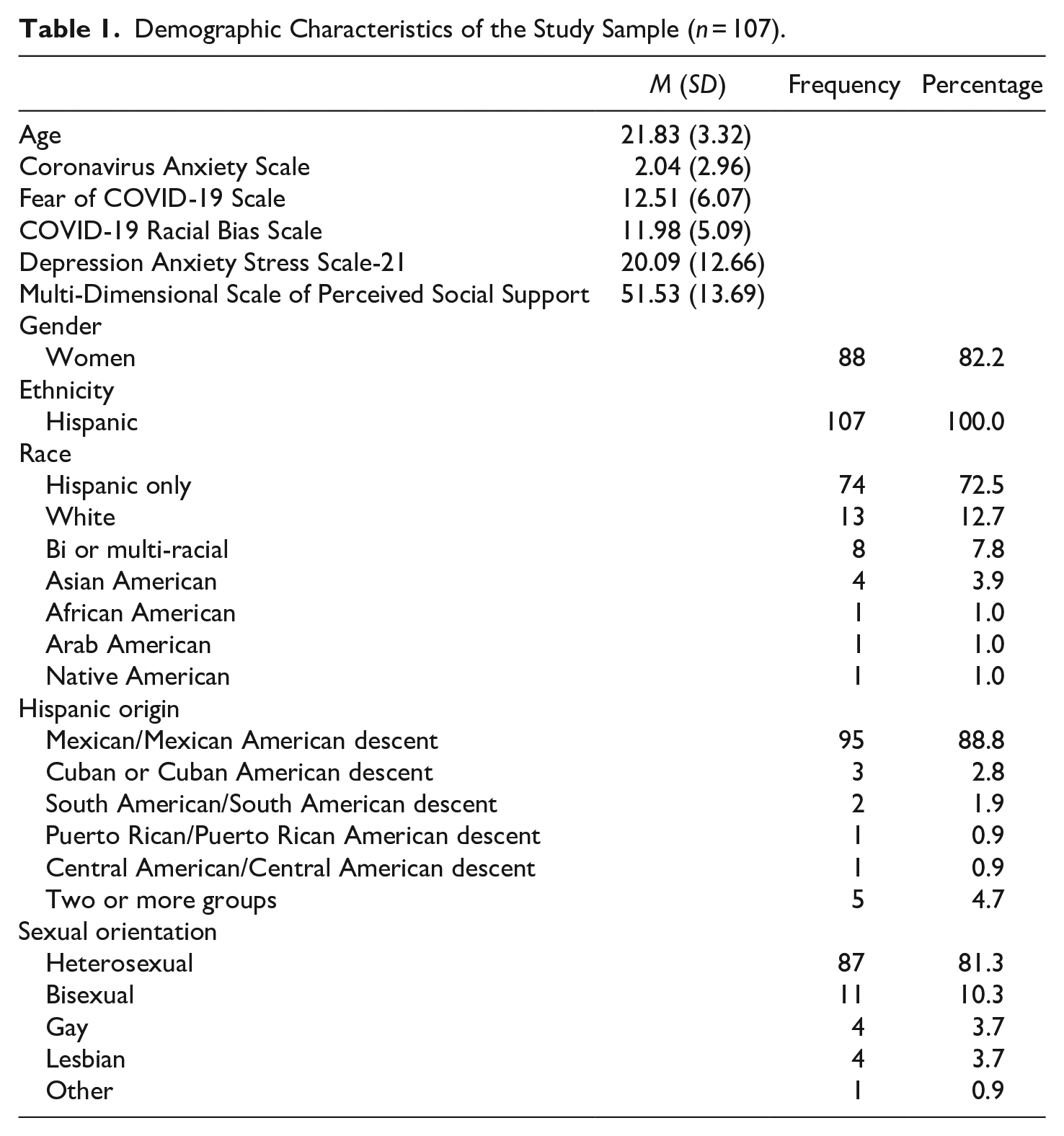
The analytic sample (n = 107) included advanced standing undergraduates comprised of 88 women and 19 men whose ages ranged from 18 to 44 (M = 21.83, SD = 3.32). Participants 1 identified their sexual orientation as heterosexual (81%; n = 87), gay (4%; n = 4), lesbian (4%; n = 4), bisexual (10%; n = 11), and other (1%; n = 1). Participants were drawn from a large urban 4-year public university in Southern California designated as an HSI with approximately 40,000 students enrolled (46% Hispanic). All participants in this study self-identified as Hispanic. Participants self-identified as largely Mexican American (88%), but the sample also included Central American (1%), Cuban American (3%), Puerto Rican American (1%), South American (2%), and two or more Hispanic subgroups (5%). The sample was drawn from a larger student survey conducted during the Fall 2020 semester, the first virtual semester that examined correlates of undergraduate mental wellness. Participant demographics are provided in Table 1.
Demographic Characteristics of the Study Sample (n = 107).
Procedure
Undergraduates enrolled in an intermediate psychological research methods course were invited to participate in an online study during the Fall 2020 semester. Students provided informed consent and completed the study online via an anonymous survey link. Students were compensated with extra credit. Participants completed demographic, pandemic distress, mental health symptoms, and social support measures. The California State University, Fullerton Institutional Review Board approved this study.
Measures
Demographic Questionnaire
Participants provided demographic information that included age, gender, race, ethnicity, and sexual orientation.
Coronavirus Anxiety Scale
The Coronavirus Anxiety Scale (CAS; S. A. Lee, 2020) is a unidimensional 5-item self-report measure of state anxiety toward the coronavirus. Participants rated their frequency of anxiety symptoms related to the coronavirus over the past 2 weeks (0 = not at all, 4 = nearly every day). Higher scores reflect greater coronavirus anxiety; no items were reverse scored. Scores were summed with possible scores ranging from 0 to 20. The CAS has demonstrated adequate psychometric properties in its initial validation (S. A. Lee, 2020) and in the current study (α = .863; M = 2.04, SD = 2.96). The CAS has previously shown strong psychometric properties among samples of largely Hispanic students of color drawn from an HSI (Serpas & Ignacio, 2021a).
Fear of COVID-19 Scale
The Fear of COVID-19 Scale (FCS; Ahorsu et al., 2022) is a unidimensional 7-item measure of fear associated with the coronavirus. Items are rated on a 5-point Likert scale (1 = strongly disagree, 5 = strongly agree). Higher scores suggest more fear and no items were reverse scored. Sum scores were calculated with possible scores ranging from 7 to 35. The FCS has previously demonstrated strong psychometric properties (Ahorsu et al., 2022) and in the current study (α = .883; M = 12.51, SD = 6.07).
COVID-19 Racial Bias Scale
The COVID-19 Racial Bias Scale (CRBS; Fisher et al., 2020) is a unidimensional 9-item measure of how COVID-19 is adversely affecting societal attitudes toward one’s racial/ethnic group (e.g., “people of my race/ethnicity are more likely to lose their job because of the coronavirus”). Items are anchored on a 4-point Likert scale (1 = strongly disagree, 4 = strongly agree). Higher scores reflect more bias, and no items were reverse scored. Sum scores were calculated with possible scores ranging from 9 to 36. The CRBS demonstrated adequate psychometric properties when validated among a diverse sample of young adults (including Hispanic students), with high inter-item reliability across racial/ethnic groups (Fisher et al., 2020), and in the current study (α = .776; M = 11.98, SD = 5.09).
Depression Anxiety Stress Scale-21
The Depression Anxiety Stress Scale (DASS-21; Lovibond & Lovibond, 1995) contains 21 items that measure depressive, anxiety, and stress symptoms. The DASS-21 contains seven items for each subscale with each item anchored on a 4-point Likert scale (0 = not at all, 3 = nearly every day) where higher scores reflect more symptomology. Past research has shown strong psychometric properties of the DASS among Hispanic undergraduates (Serpas, 2021a). Hispanic undergraduate research has best supported the DASS-21 as a unidimensional instrument (Camacho et al., 2016). Thus, the present study computed a composite mental health symptoms score (α = .929; M = 20.09, SD = 12.66).
Multidimensional Scale of Perceived Social Support
The Multidimensional Scale of Perceived Social Support (MSPSS; Zimet et al., 1988) is a 12 item-instrument that measures perceptions of social support adequacy from three sources: family, friends, and significant other. Participants rated their level of agreement with statements assessing the adequacy of social supports on a 7-point Likert scale (0 = very strongly disagree, 6 = very strongly agree). Past research shows strong psychometric properties of the MSPSS among Hispanic undergraduates (Ermis-Demirtas et al., 2018). For the present study aims, a composite score was computed to create a social support index where higher scores reflect more overall social support (α = .902; M = 51.53, SD = 13.69).
Analysis Plan
Descriptive statistics were calculated using SPSS version 27. Univariate and multivariate normality assumptions were screened using skewness, kurtosis, z scores, and Mahalanobis distance (Mahalanobis distance >20.52, p < .001). Bivariate correlations assessed multicollinearity. Hypotheses were tested using three hierarchical regression analyses, one for each pandemic distress variable. For each model, COVID-19 pandemic distress and social support variables were entered into block one and their interaction into block two. Mental health symptoms were included as the criterion. An alpha of .02 was used to account for multiple analyses. A power analysis using G*Power 3.1 indicated a sample size of 77 was ideal to detect a moderate effect with 80% power.
Predictor variables were centered at the sample mean before analysis. Simple slope analysis was performed for significant interaction effects to examine associations at one standard deviation (SD) below (low scores) and above (high scores) the mean of social support using conditioning values for each pandemic distress variable set at one SD below (low scores) and above (high scores) their mean score (Aguinis, 2004; Hayes, 2017). A significant incremental R2 for the interaction term indicates an interaction effect which generally accounts for 1% to 3% of additional variability in the criterion (Aguinis, 2004). Standardized coefficients are reported for regression analyses.
Results
Preliminary Analyses
Pandemic distress variables were modestly associated with each other (r’s: .45–.58, p’s < .05) as well as with the DASS-21 composite (r’s: .27–.52, p’s < .05). The MSPSS composite was correlated with the DASS-21(r = −.32, p = .001) but not with any pandemic distress variables (p’s > .05). Age was not associated with primary study variables (p’s > .05). Independent samples t-tests showed no differences in study variables between men and women (p’s > .05). One multivariate outlier was found (Mahalanobis distance >20.52, p < .001); however, its exclusion did not alter results. This case was retained in the reported analyses to converse power (n = 107).
Moderated Multiple Regressions
Coronavirus Anxiety
The two-block MMR model accounted for approximately 36% of the variance in mental health symptoms, R2 = .36, F(3, 103) = 19.01, p < .001. Greater Coronavirus anxiety was associated with more, β = .50, p < .001, whereas, social support was associated with lower mental health symptoms, β = −.30, p < .001. Results did not detect a statistically significant interaction effect, βinteraction = .00, p = .974.
Fear of COVID-19
The two-block MMR model was statistically significant and explained approximately 20% of the variability in mental health symptoms, R2 = .20, F(3, 103) = 8.58, p < .001. Greater fear of COVID-19 was associated with more mental health symptoms, β = .31, p < .001. More social support was related to lower mental health symptoms, β = −.34, p < .001. An interaction effect was not detected, βinteraction = .00, p = .977.
COVID-19 Racial Bias
The two-block MMR model explained approximately 18% of the variance in mental health symptoms, R2 = .18, F(3, 103) = 7.63, p < .001. Greater COVID-19 racial bias was associated with more mental health symptoms, β = .27, p = .003 and higher social support was associated with lower mental health symptoms, β = −32, p = .001. The interaction effect was not statistically significant, βinteraction = .08, p = .385.
Discussion
This study examined social support as a moderator of COVID-19 pandemic distress on mental health symptoms among Hispanic undergraduates within an HSI. First, it was hypothesized that pandemic distress variables (coronavirus fear, anxiety, and racial bias) would be positively associated with mental health symptoms. This hypothesis was supported such that all pandemic distress variables were positively associated with mental health symptoms. This finding corroborates prior research showing pandemic distress constructs to be associated with poorer general mental health (Bono et al., 2020; Fisher et al., 2020; Litam et al., 2020; Son et al., 2020; Torres et al., 2022; Wang et al., 2020). However, this study is among the first to report on this association with a homogenous Hispanic undergraduate sample drawn from a large public HSI in Southern California.
Second, it was predicted that social support would be negatively associated with mental health symptoms. This hypothesis was also supported in that greater total social support was related to lower mental health symptoms. This finding substantiates the wealth of evidence that suggests social support is associated with better mental health outcomes in the general college student literature (Hefner & Eisenberg, 2009) and among Hispanic undergraduates within HSIs (Arana et al., 2011; Corona et al., 2017; Jimenez et al., 2022; Suwinyattichaiporn & Johnson, 2022). This observation also substantiates previous COVID-19 research documenting an inverse association between multi-dimensional social support and COVID-19 distress (e.g., coronavirus fear; Torres et al., 2022).
Lastly, guided by the stress buffering hypothesis (Cohen & Willis, 1985), it was hypothesized that total multidimensional social support would moderate the relation between each pandemic distress variable (fear, anxiety, and racial bias) and mental health symptoms. Contrary to predictions guided by the stress buffering hypothesis (Cohen & Willis, 1985), social support did not moderate this association for any pandemic distress variable. More pandemic distress was related to poorer mental health regardless of social support. This finding contrasts pandemic research reporting a moderation effect of social support (Szkody et al., 2021). Although, Szkody et al. (2021) contained only a small subsample of Hispanic students in their study sample. In addition, other research has found multi-dimensional social support to not correlate with mental health symptoms after considering pandemic distress including coronavirus fear among Hispanic undergraduates (Torres et al., 2022). Thus, it is possible that due to the chronicity of the pandemic, social support as a standalone resource was not sufficient in buffering mental health symptoms among Hispanic students. Also, the null moderation effect of social support signals the need to identify other protective resources and sources of resilience that may prevent pandemic distress from progressing into psychopathology. It is reasonable to hypothesize that internal sources of resilience may better equip Hispanic undergraduates to combat pandemic distress (e.g., Serpas, 2021b). Future research is needed to clarify whether potential internal and external factors may conserve the mental health resources of Hispanic undergraduates within HSI settings during the pandemic. Doing so is critical to identify the unique needs of this population in context.
Limitations and Future Research
This study contains limitations. This study was conducted at a 4-year public university in Southern California, limiting its generalizability. Future research should consider the experiences of Hispanic students within other contexts. Also, analyses were not disaggregated by specific pandemic-related adversities that may correlate with mental health symptoms (e.g., job loss; Park & Sprung, 2013). Student generation status was also not assessed, which prior HSI research has shown correlates with mental health and social support for Hispanic undergraduates (Jimenez et al., 2022). This study examined three domains of social support although other types of social support are also beneficial for Hispanic students within HSIs (peer mentoring; Moschetti et al., 2018). Thus, with the return to in-person instruction, HSIs may consider augmenting on-campus social and academic supports for Hispanic students. Also, the sample was primarily Mexican (88%) and, therefore future research is needed to study other Hispanic subgroups within an HSI context such as Afro-Hispanic students (Esmieu & Terraza, 2017). Future work may assess the role of social support in network models of pandemic distress and health behaviors for Hispanic students in HSIs (e.g., Serpas & Ignacio, 2021b). The null moderation effect indicates a need to identify other factors that attenuate psychological distress related to the COVID-19 pandemic such as personality characteristics (e.g., grit, growth mindset; Mosanya, 2020), coping mechanisms, cognitive capacities, and behavioral/lifestyle factors such as physical activity (Maher et al., 2021). Thus, further research is needed to assess the relevance of the stress buffering hypothesis (Cohen & Willis, 1985) in the context of coronavirus psychosocial stress among Hispanic undergraduates. Resilience interventions tailored for Hispanic undergraduates also warrant future consideration (Kwon et al., 2020). The pandemic distress measures in this study were recently developed with limited evidence of invariance for Hispanic students, specifically the FCS with no published data on internal structure for Hispanic students.
Since social support did not moderate pandemic distress, college health professionals may consider ensuring students are aware of university-level resources to support positive mental health outcomes. HSIs enroll nearly half of Hispanic undergraduates nationwide (Hispanic Association of Colleges and Universities, 2022) and, therefore hold a responsibility to ensure equitable education for students. Universities and colleges should consider strategies to maximize academic outcomes among Hispanic students with evidence-based and culturally-appropriate health promotion efforts.
Footnotes
Declaration of Conflicting Interests
The author(s) declared no potential conflicts of interest with respect to the research, authorship, and/or publication of this article.
Funding
The author(s) received no financial support for the research, authorship, and/or publication of this article.
