




Abstract
The purpose of this study was to examine music instruction at the California Labor School (CLS), located in San Francisco, California. This institution existed from 1942 to 1957 as a center for adult education affiliated with the Communist Party. Although the curriculum focused on Marxism and labor, the institution also offered classes in general subjects, vocational training, life skills, and the arts to enrich the lives of the immigrants, industrial workers, and people of color that it served. The music program included courses in music fundamentals, appreciation, and songwriting; group and individual instruction in voice, guitar, and piano; and ensembles for singers and instrumentalists. Many people studied music at the CLS for personal growth and enjoyment. Others, however, developed skills useful in promoting the agenda of the Communist Party and the American labor movement. This research focused on music teaching and learning at the CLS in relation to organization, administration, curriculum, ensembles, faculty, and political perspectives. The history of this institution as an agent of social change revealed ethical considerations for music education in modern PK–16 institutions. In addition, the CLS music program aligned with current recommendations for undergraduate study and could serve as an example for curriculum reform today.
Keywords
Introduction
The Communist Party of the United States of America (CPUSA) evolved out of the left wing of the socialist party in 1917 and gained strength from World War I and the Bolshevik revolution. The CPUSA followed the directives of the Communist International (i.e., Comintern) in Moscow and accepted the basic values of the movement including the common ownership of wealth, industry, and property; distribution of goods based on need; empowerment of workers; and single-party government led by proletariats (laborers) rather than the bourgeois (middle/business) class. Communists supported the principles of equality, freedom, and democracy for all, but felt these were impossible under capitalism and a government controlled by the elite. In the late 1920s, the CPUSA adopted policies that opposed racial discrimination and supported black liberation. They expanded into the Southern United States and made the recruitment and organization of black workers a priority. 1
Communists believed they could achieve their aims only through social revolution. Short term goals of the CPUSA focused on organizing labor unions and advocating for higher wages and better working conditions. 2 In the long term, they hoped for a revolution that would “overthrow the capitalist system and [establish] a Workers’ and Farmers’ Government.” 3 Failure to attract members into their unions and to gain wide-spread support for revolution resulted in policies that directed the party to work for change within existing labor organizations and government programs. 4
The CPUSA sponsored workers’ schools during the 1920s and 1930s to educate recruits on the principles of communism and to train labor organizers and union leaders. 5 During the 1940s, these institutions evolved into a robust network of adult education centers in about a dozen U.S. cities including New York, Chicago, and San Francisco. They had open admissions policies, low tuition, and a desegregated and antiracist, coeducational and antisexist ideology. These schools focused only on student learning and did not administer exams, assign grades, or grant degrees. Faculty consisted of common laborers as well as scholars with PhDs. Students were predominantly women, working people, immigrants, and people of color. Curricula included courses on Marxism, labor organization, and economic history, as well as classes related to general education, the social and physical sciences, vocational training, special interests, and the arts. 6
Classes in visual art, theater, dance, and music provided labor school students with recreation and personal edification, as well as a means of activism. A course titled “Shakespeare and the Elizabethan Stage” at the Jefferson School of Social Sciences in New York, for example, explored Shakespeare’s work in relation to his “democratic attitude toward the problems of poverty, women’s rights and racial equality.” 7 The class “Art and Society,” at the California Labor School in San Francisco, featured a series of ten discussions on the role and responsibility of the artist, led by faculty members of the art and social sciences departments. Topics included “What has art done for labor? What has labor done for art? What . . . is the place of art in society?” 8
Several authors have explored the history of labor schools in general and drama and architecture instruction, specifically. 9 However, I found no studies related to music education at labor schools affiliated with the CPUSA. The purpose of this study was to examine music instruction at the California Labor School in San Francisco, which existed from 1942 to 1957. This research focused on music teaching and learning in relation to organization, administration, curriculum, ensembles, and faculty. I also considered the extent to which music supported the communist and progressive values of the institution. Primary sources included course catalogs, letters, newspaper articles, and other ephemera, as well as recordings and photographs obtained from collections available through archives at the University of Michigan, the Wisconsin Historical Society, and San Francisco State University. I also utilized secondary sources consisting of journal articles, dissertations, and books to provide historical context and supplement primary materials.
California Labor School
The California Labor School (CLS)—originally named the Tom Mooney Labor School—opened August 3, 1942, in rooms above an automobile dealership on Turk Street in San Francisco. 10 The slogan “Education for Victory” emphasized the school’s mission during World War II (1941–1945) to provide “a comprehensive analysis of social, economic, and political questions as they appear in the light of the present world struggle against the Axis,” including “the history of our country, . . . the American labor movement, . . . and the Negro people.” 11 Although technically independent, the CLS served as “a utilitarian arm” for the CPUSA. Local party leaders made major decisions and courses on Marxism and the Soviet Union were cornerstones of the curriculum. 12 Nonetheless, the institution “belong[ed] to the community, for everyone’s use” and “welcome[ed] capable Communists and non-Communists on its faculty” and “students of every nationality, color, and religion.” 13
The name of the institution changed to the CLS in 1944. By this time, the school had opened a branch in Oakland and accepted support from numerous trade unions associated with the American Federation of Labor (AFL) and the Congress for Industrial Organization (CIO), as well as other labor related bodies and individual citizens. 14 Although students could take whatever classes they wished, administrators recommended plans of study for industrial workers, union workers, white collar workers, social workers, K–12 teachers, writers, artists, and art teachers. 15 Servicemen returning from the war could use their benefits under the G.I. Bill to pay for tuition and living expenses. Teachers in the San Francisco public schools could earn continuing education credit for many courses in the catalog. A full schedule of classes met in the evenings with a limited number during the day to accommodate housewives and workers on the night shift. Saturday arts lessons for children provided day care for parents who worked on the weekend. 16 The standard course fee was $6.00 (approximately $104.11 in 2024) in the fall of 1945. However, people could also purchase a $10.00 (approximately $173.52 in 2024) monthly membership that allowed access to all classes, special events, and the library. 17
The CLS was an integral part of the community and served 6,000 students from 1942 to 1944 and up to 15,000 per year by the end of the decade. In addition to the regular curriculum, the school sponsored lectures and forums on various topics, stage performances, art exhibits, and social dances. 18 In 1945, the U.S. State Department designated the CLS as the official host for labor delegations attending the founding conference of the United Nations in San Francisco. 19 The institution moved into larger facilities on Market Street in 1944, and again in 1947 to Golden Gate Avenue. 20 Additional branch campuses opened in Berklee, Los Angeles, and Palo Alto by 1948. 21
Arts programs became an important part of the curriculum at the CLS shortly after it began. According to David Jenkins, director of the institution from 1942 to 1949, . . . [A]lmost immediately artists and dancers and writers saw this school as a place for their activity as well. They started to flock to the school and not demand, but to say that they had an audience and they wanted to teach, and they wanted space. Art is a weapon in the struggle for socialism, for education as well as for self-expression.
22
An arts advisory council consisting of professionals in the community supported a faculty of prominent writers and artists. Mimi Kagan (1918–1999), for example, led the dance program from 1945 to 1949. 23 She was a Russia-born American modern dancer and choreographer whose avant-garde dance troupe was considered “a thoroughly communized group” and listed by the Federal government as a subversive organization in 1957. 24 Other renowned instructors included Anton Refregier (muralist), Margaret De Patta (jewelry design), and Lou Gottlieb (music). 25 Maya Angelou (1928–2014), a famous African American writer, poet, and civil rights activist, studied theater and dance on a scholarship to the CLS shortly after World War II. 26
Growing suspicion of Communism and the Soviet Union following the second World War created numerous challenges for the CLS. In July 1947, the school lost accreditation by the California State Board of Education and voluntarily declined tuition reimbursement from the G.I. Bill, possibly to avoid further scrutiny. In April 1948, the U.S. Attorney General added the CLS to the list of subversive organizations due to its left-leaning curriculum and affiliation with the CPUSA. 27 From this point forward, the school experienced constant investigations by the Subversive Activities Control Board in the Department of Justice and other government agencies. In 1951, the school relocated to smaller facilities on Divisadero Street in response to declining enrollment, financial donations, and union support. 28 The focus of the institution shifted away from labor education and it became a center for resistance to political repression during McCarthyism and the Cold War era. In spring 1957, the IRS seized the CLS for alleged tax evasion resulting in closure of the institution. 29
Music Instruction at the California Labor School
Music instruction at the CLS began in summer 1944 with the introduction of a choral ensemble and a music appreciation course. In addition, a children’s drama workshop met on Saturdays and included a one-hour lesson in dance and music.
30
In December 1945, Director Jenkins proposed the organization of a music department with a comprehensive curriculum consisting of courses in music history and culture, arranging, group piano, and choral singing. According to Jenkins, At present, there are few means through which labor can find expression in music in the Bay area. Whatever the California Labor School can do in fostering appreciation and production of music among the trade unions and the many community groups in San Francisco will add to . . . the unity of the diverse cultural groups which make up the Bay Area.
31
The proposal asked for $5,000 for the coming year to cover the cost of (a) a music department director, (b) additional instructors, (c) sheet music, and (d) equipment and maintenance. 32
Jenkins enlisted support from Isaac Stern, an American violinist, and Alfred Frankenstein, a music critic for the San Francisco Chronicle. A letter signed by Stern and Frankenstein in March 1946 solicited donations for the music department and emphasized the desire to . . . provide opportunities for cultural development for those sections of the community which are not now served by existing musical and cultural centers . . . [because] . . . no one who wishes to gain musical instruction or greater knowledge of music should be denied this privilege.
33
The CLS offered an expanded music curriculum starting in spring 1946 that included Choral Singing I and II, Piano for Beginners I and II, and three different courses in music history and culture. 34
Music Appreciation, Fundamentals, and Songwriting
The CLS offered several courses related to music history, culture, and composition. Most of these classes met sporadically for one or two terms, probably due to student interest and faculty availability and expertise.
Music appreciation courses, such as “How to Enjoy Music” in fall 1944, provided “a brief historical survey of the elements of musical composition.” 35 The winter 1945 catalog described “What Is Music and How Should We Listen to It?” as “a brief survey of the development of music from the past to the present [as] illustrated by records and guest artists.” 36 “An Introduction to Classical Music” in fall 1948 consisted of twelve lessons devoted to one or two western composers or musical styles each week. 37 These and other classes related to art music, such as “Music Form and Content” and “Music of Our Day,” were intended to help “those without previous musical knowledge . . . develop [the] ability to hear and understand music . . . [and] . . . thereby the enjoyment of the music listener.” 38 Although not focused directly on a communist agenda, these courses were likely taught through a leftist lens. For example, a lesson on Soviet composers Dmitri Shostakovich and Sergei Prokofiev focused on “the nature and development of musical forms under a socialist government.” 39 From a broader perspective, classes related to music history and culture provided an avenue for self-improvement by exposing people of the working class to artistic expression often reserved for the bourgeois elite. 40
Students could also study popular genres. “Jazz Talks” (spring 1945) and “American Jazz” (fall 1945) consisted of a series of five informal lectures on several prominent black musicians and the character, history, and background of the genre. 41 This course expanded to ten sessions beginning in spring 1946. 42 Contrary to their Soviet counterparts who viewed jazz as a degenerate western art form, communists in the United States embraced this music as an embodiment of the national character, and to create a welcoming and familiar environment that would attract American workers to the party. 43 Classes in jazz at the CLS represented a progressive curriculum and preceded those at mainstream colleges and universities, where faculty often viewed European practices and composed repertoire as superior to vernacular (i.e., African American) traditions and improvised music. 44
A few courses focused on larger issues related to music and sociology. “Music of the American People” in summer 1945 included discussions on “how the people’s music is an influence on what they do and is itself formed by what they do and think.” 45 Likewise, a five-week lecture series in fall 1949 focused on “Music in Developing Society.” 46
The CLS also offered courses related to music theory and composition. “Music Fundamentals” in the late 1940s and early 1950s focused on the basics of reading and writing music notation. 47 “Song Writers Group” in the mid to late 1940s called on musicians, songwriters, and poets to experiment with music composition around communist ideals. The class involved “a cooperative group in writing songs about world peace, unions, anti-discrimination, folk life, and other major fields in our daily lives.” 48 A flyer advertising the course stated that “. . . songs can be used as a method for expressing ideas and vital issues. . . . Songs for the people can be written by the people. All that is needed is some cooperative action between musicians and lyric writers.” 49 A report by the California Senate Fact-Finding Committee on Un-American Activities took a less favorable view, stating that the CLS had “inaugurated classes in the science of agitational song writing.” 50
Applied Lessons
Applied vocal and instrumental music was regularly offered at the CLS. “Piano for Beginners” began in fall 1945 and provided class instruction for up to ten students. The course provided “a working knowledge of . . . rhythm, scales, chords, elementary harmony, and sight reading” and expanded to include four levels by fall 1946. 51 Likewise, the institution offered classes in guitar starting in summer 1947 that focused on chordal accompaniment, and eventually on the history, literature, and technique of the instrument. 52 Private lessons for guitar, piano, and violin were also available periodically during the late 1940s and early 1950s. 53
Vocalists could study at the CLS through both class and private instruction. Class lessons during summer 1947 centered on the fundamentals of singing and were mainly intended to prepare students for participation in the CLS Chorus. However, instructor Frederick Welsh also offered private instruction “in classical and popular singing directed particularly to interpretation of songs of the people.” He also “provided training for those who have personal speech problems to correct foreign accent or stuttering, stammering, or lisping.” 54 These lessons helped recent immigrants improve their English, assimilate into American society, and avoid discrimination. 55
Instrumental Ensembles
The music department at the CLS occasionally offered ensemble courses for instrumentalists. The Modern Music Ensemble during the winter 1945 term consisted of a small orchestra for players with previous experience who performed “American music, both serious and popular” at school functions. 56 The Music Makers Workshop in spring and summer 1945 offered “an orchestra for fun for people who work” that met on Sunday evenings from 7:00 p.m. to 9:00 p.m. Participants rehearsed “serious and popular” folk music and did not pay a fee for the class. 57 An orchestra during the summer 1946 term emphasized music from the classical, romantic, and modern periods. Despite the complex repertoire, organizers encouraged participation by providing instruments and offering “special assistance . . . to less advanced students.” 58 Instrumental ensembles at the CLS were short lived, perhaps due to students’ lack of previous experience and opportunities to learn. 59
Choral Singing
Choral singing at the CLS began in summer 1944 when Naomi Sparrow, a local musician, organized the California Chorus on Tuesdays and Thursdays from 7:30 p.m. to 9:30 p.m. One session each week focused on the rehearsal of “folk, classic and topical songs” while the other provided instruction in music theory and appreciation. 60 By fall 1945, students enrolled in this ensemble through the Oakland campus and met on Thursday evenings in Berklee under the direction of Lorraine Campbell, a local singer, and a graduate of the University of California. 61
The course catalog for the main campus of the CLS in San Francisco listed two levels of choral singing in spring 1946, each meeting for 2 hours on Monday nights. Choral Singing I was for beginners without the ability to read notation while Choral Singing II included students with prior experience or who had completed Choral Singing I. Leo E. Christiansen, a local church musician and former student at the school, served as conductor of the choir and director of the CLS music department. 62
Organization
The CLS Chorus consisted of “office worker[s], social workers, writers, artists, longshoremen, warehousemen, waiters, technicians, housewives, students, veterans and public workers” and “allow[ed] no discrimination” when accepting members (see Figure 1).
63
Twenty-nine singers participated in the ensemble in June 1949 including six sopranos, eight altos, six tenors, and nine basses.
64
As was typical with communist organizations, everyone had a designated role and a voice in the decision-making process. The conductor had the final word on musical interpretation, policy, and programming. However, a repertoire committee solicited recommendations from the membership and met regularly with the conductor to discuss music selection. The librarian and a “house committee” maintained the music collection and other materials. The secretary was responsible to the director and monitored attendance records and handled correspondence. California Labor School chorus conducted by Leo E. Christiansen, circa 1950. Courtesy Labor Archives and Research Center, San Francisco State University.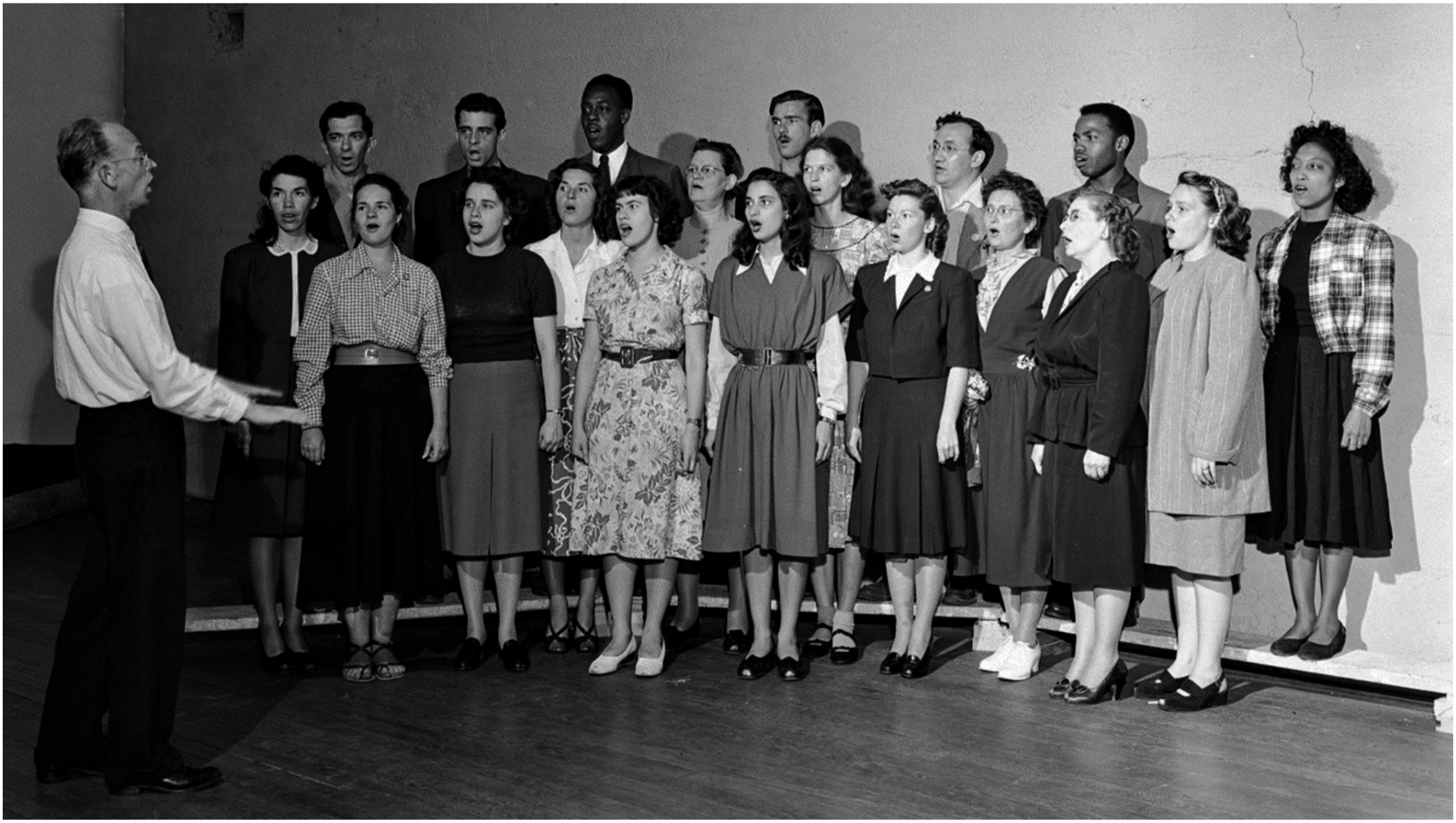
A business agent elected by the members received performance requests, handled logistics, and collected fees from sponsoring organizations. This individual also ensured that the ensemble was presented in the best possible manner. One document, for example, stated that “The Chorus generally will not appear at cocktail parties, but if at an affair where refreshments are served, the dispensing of such refreshments must cease when the Chorus sings.” Policies of the CLS Chorus required a unanimous vote to accept an engagement. If 65 percent of the members were for and 35 percent against accepting a performance request, the engagement was declined unless the 35 percent adopted the position of the 65 percent. This practice ensured that every member agreed to participate in each appearance. 65
Performances and Repertoire
The CLS Chorus appeared frequently at civic and school events and before trade unions, meetings of the AFL and CIO, and other organizations. Repertoire varied greatly and consisted of western art music, African American spirituals, labor songs, and folk selections from the United States and abroad. 66 Many selections contained original or adapted lyrics that supported communist ideals. Others represented patriotic music from countries with active communist movements including Russia, China, and Spain, sometimes sung in the original language. 67
In May 1946, the ensemble performed “The House I Live In” during an event sponsored by the U.S. State Department honoring visitors from the Soviet Union. 68 This song by Earl Robinson (music) and Abel Meeropol (lyrics) extolled the ideals of American democracy and religious freedom. Meeropol was a white and Jewish writer and musician who was a member of the CPUSA. He and his wife adopted the children of Julius and Ethel Rosenberg after they were executed in 1953 by the United States for espionage on behalf of the Soviet Union. 69 Robinson was a white left-leaning composer and folk singer-songwriter blacklisted as a communist in the 1950s. 70 The CLS Chorus occasionally appeared with Robinson in concert and regularly presented his songs, including “Joe Hill” about a famous labor leader framed for murder and executed in 1915, and “The Same Boat Brother,” which conveyed a message of global cooperation. 71
On October 9, 1949, the CLS Chorus sang “People’s Song” [Ch. “Rénmín zhī gē”] at a meeting of the Chinese Workers Mutual Aid Association celebrating the twelfth anniversary of communist victories in China. 72 At this event, a group of forty Chinese males supporting Democracy in China violently interrupted the meeting and broke windows, smashed furniture, threw eggs, and spread blue dye around the hall. 73 In February 1949 and 1950, the ensemble performed songs of freedom and liberation at National Negro History Week celebrations. Selections in 1950 included a musical setting of the poem “Freedom Train,” by Langston Hughes, the spiritual “Go Down Moses,” and the Negro national anthem “Lift Every Voice and Sing.” 74 On Friday, May 12, 1950, the chorus appeared with Earl Robinson and Paul Robeson at a concert sponsored by the local progressive party and the California Eagle, a black-owned newspaper. 75 Robeson was a popular African American singer, actor, and social activist who was investigated for his alleged involvement in the Communist Party, the early civil rights movement, and Soviet affairs. 76 According to the California Eagle, “The chorus of the California Labor School, directed by Earl Robinson, shared honors with Paul Robeson, and were applauded as they sang ‘May Day for Peace,’ ‘Didn't My Lord Deliver Daniel,’ and other popular songs. The climax came when, with Robeson taking the leading part, they sang ‘The Ballad for Americans,’ composed by Robinson.” 77
The Chorus also presented full-length concerts at school and throughout the community. In April 1947 and June 1948, the ensemble presented joint recitals with the CLS Dance Company, led by Mimi Kagen. The program in 1947 included a selection titled “She Died for Us,” sung by the Chorus to the tune of the Russian folksong “Meadowlands.” The work featured Kagan as a solo dancer portraying Zoya Anatolyevna Kosmodemyanskaya, an eighteen-year-old female Russian fighter who was tortured and hanged by the Nazis in 1941.
78
One selection in 1948 titled “The Whole Wide World Around,” featured words by singer/songwriter Tom Glazer sung to the choral “'O Haupt voll Blut und Wunden'” (“O Sacred Head Now Wounded”), from J. S. Bach’s Saint Matthew Passion.
79
The first verse proclaims that, Because we all are comrades wherever we may be, One union shall unite us, forever proud and free. No fascist shall defeat us, no tyrant strike us down, All those who toil shall greet us, the whole wide world around.
80
In May 1947, the Chorus appeared with the Dance Company in their first feature performance off campus at a high school in Palo Alto. Prior to the concert, Christiansen reminded singers of the importance of this event saying, “Hitherto, it has been our good fortune to appear before friends. In this case, however, we shall face a highly critical audience that has heard the finest in choral groups and will compare us in matters of technique, shading, quality, etc.” 81 A review in the Daily Palo Alto Times praised the chorus’s “precision, . . . vigorous attack, . . . [and] clean diction (in Spanish, French and Russian as well as English!).” The writer also stated that “Their tone is nothing special, which makes it all the more remarkable that [Christiansen] can draw out of them as much variety in effect. They are at their best in the livelier folk songs. The railroad songs were delightful.” 82
Christiansen occasionally challenged the CLS Chorus with extended multi-movement works. In December 1949 and January 1950, the ensemble presented The Yellow River Cantata, written by Chinese composer Xian Xinghai (1905–1945) in 1939. 83 Xinghai adapted the lyrics from a poem authored by Guang Weiren during the Second Sino-Japanese War. The work described the oppression of the Chinese people under Japanese invasion and called for all to take up arms to defend China. 84 The Chorus performed an English translation of the original Chinese lyrics. 85 The often unison and two-part texture of the four vocal parts was relatively easy to learn and thus conducive to amateur singers. 86
The CLS Chorus presented the first English performance of The Song of the Forest (Pesn’ o lesak) by Dmitrii Shostakovich (Op. 81) on November 4, 1951, at the American Russian Institute celebration of American-Soviet Friendship Week.
87
The composer created this large-scale patriotic oratorio in 1949 on a text by the official poet of the Soviet Union, Yevgeny Dolmatovsky. The work glorifies Joseph Stalin and recounts his reforestation program in Russian and Siberian following the devastation of WWII. Required performances of “Song of the Forest” in communist Eastern bloc countries functioned as propaganda and reminded citizens of their subordination to the Soviet Union.
88
In recounting the performance, Christiansen said, Our presentation . . . continues our interest in learning and presenting the people’s music of all nations. The vast afforestation project of which the cantata sings is an example of the peaceful occupation of the Soviet people. We look to the coming day when there shall be exchange visits of American and Soviet choral groups, each singing of their respective and harmonious plans for controlling nature.
89
The ensemble also staged musicals around communist themes. In April and May 1950, they presented a one-act comedic satire on Trial by Jury by W. S. Gilbert and Arthur Sullivan. Lyrics freely adapted from the original operetta as well as Pirates of Penzance and Pinafore conveyed a story centering on the unjust trials of prominent communists in the United States.
90
Likewise, North Atlantic—written soon after the establishment of the anti-communist North Atlantic Treaty Organization (NATO)—was a political spoof on the musical South Pacific by Richard Rodgers and Oscar Hammerstein.
91
Songs included “There’s Nothing Like a Union” (to the tune of “There’s Nothing Like a Dame”), “I’m Gonna Wash That Union Outa My Hair” (tune: “I’m Gonna Wash That Man Right Outa My Hair”), and “Bally Hoo” (tune: “Bali Hai”). “Some Enchanted Evening” from the original musical became “Some Subversive Evening.” Figure 2 provides lyrics for the first two verses.
92
Lyrics, verses 1 and 2, “Some Subversive Evening” from North Atlantic.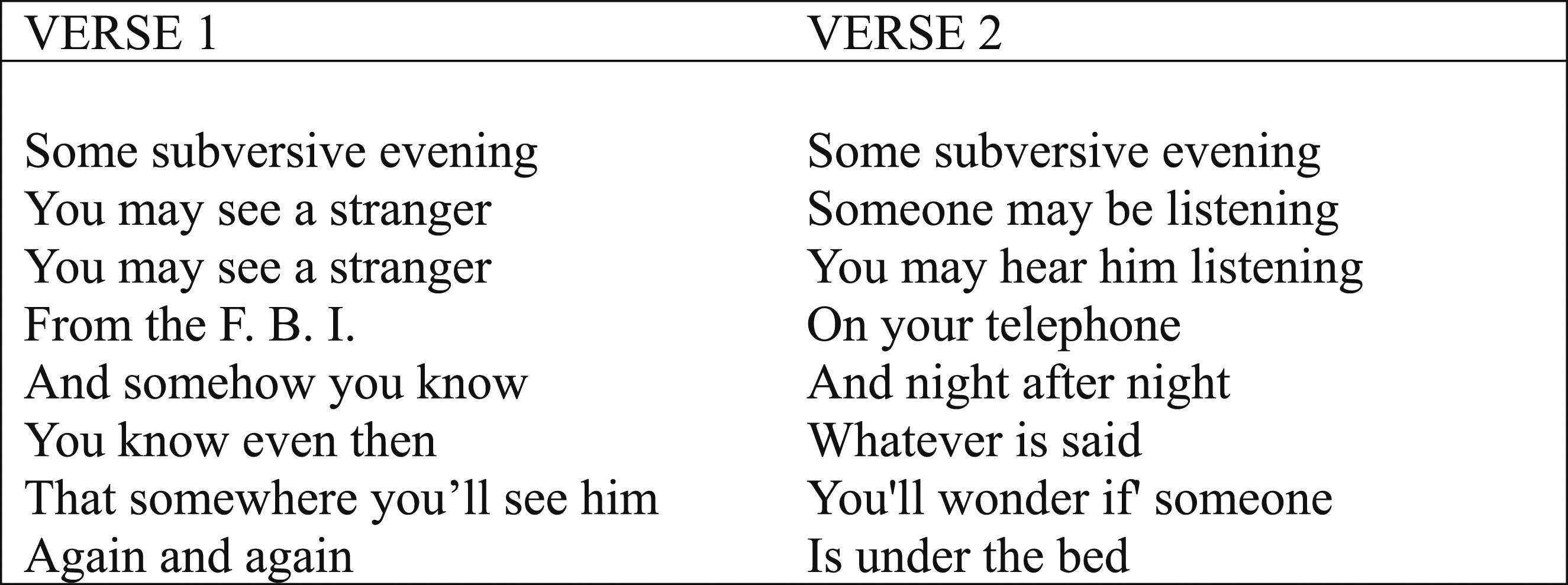
Recordings
The CLS Chorus produced three ten-inch 78 r.p.m. records.
93
Members of the choir selected song titles and helped finance these projects. Giacomo Patri, an Italian-born American artist and teacher at the CLS, designed the label (see Figure 3). The first record, produced around the fall of 1947, consisted of two pieces—“La Marseillaise,” the national anthem of France by Claude Joseph Rouget, and “Viva La Quince Brigada,” about Irishmen who fought in the Spanish Civil War against Franco. The choir chose these songs because they demonstrated the group’s ability to sing in foreign languages.
94
California Labor School chorus record label.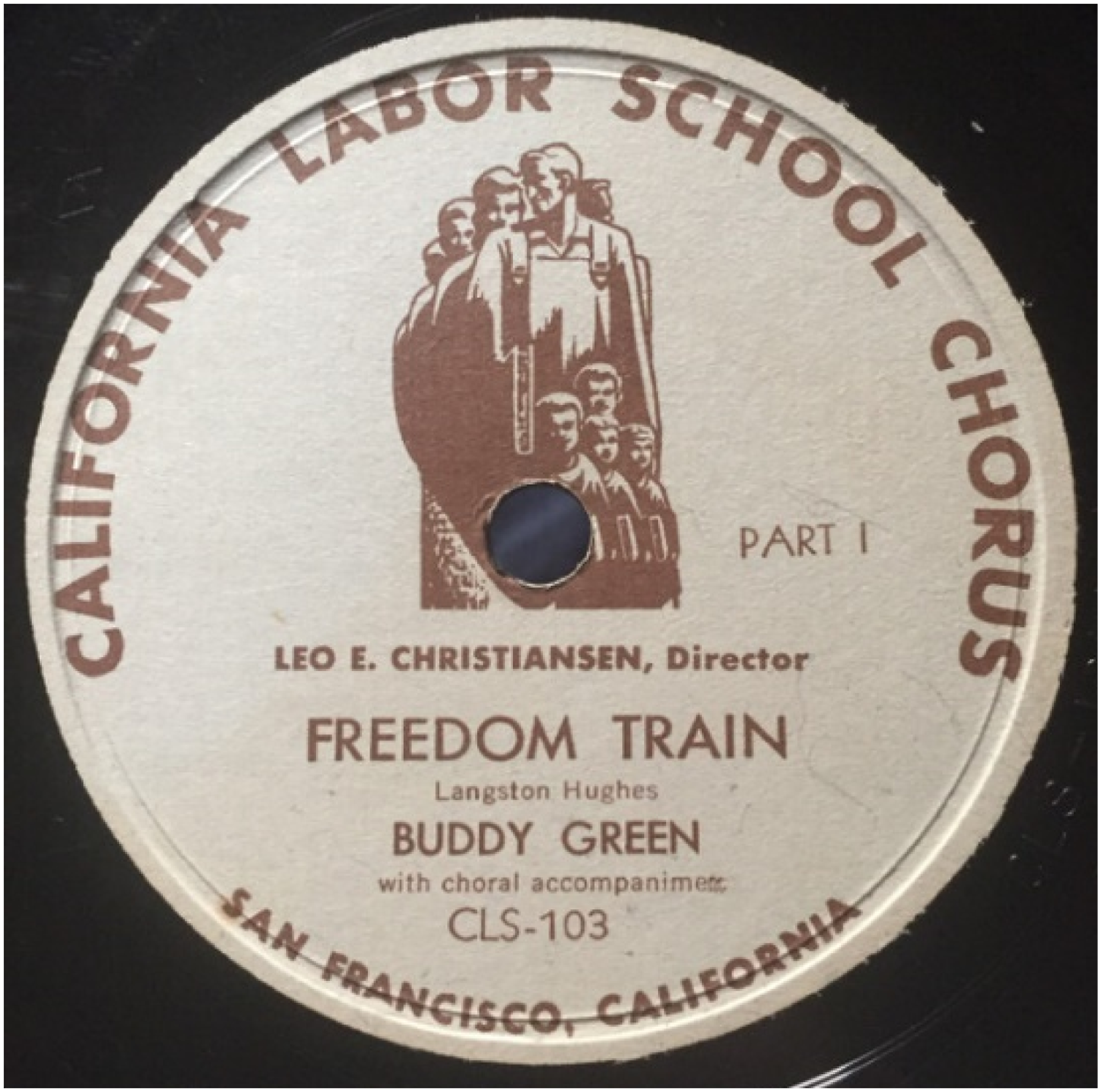
Two subsequent records featured the music and prose of African Americans. One recording produced during the 1949–50 academic year included the Negro National Anthem, “Lift Every Voice and Sing,” by James Weldon Johnson and J. Rosamond Johnson; “No More Auction Block,” a negro revolt song; and “Jim Crow,” an American folksong with words adapted by the Almanac Singers. According to program notes associated with the recording, the song “Jim Crow” “. . . hammers home the point that only the elimination of Jim Crow and white Chauvinism through the development of Negro-white unity can ‘put an end to the slavery’ and help to build a land where ‘Everybody’s free.’” 95
The third record, issued in the early 1950s, presented the poem “Freedom Train,” by Langston Hughes, read by Walter J. “Buddy” Green, and accompanied by the spiritual “Go Down Moses,” by the CLS Chorus.
96
Green was an African American member of the Communist Party, a local labor activist, and a staff member for the communist newspaper, the People’s Daily World.
97
The Freedom Train was a travelling museum sent from Washington DC by the Federal government in September 1947. This two-year initiative sought to promote patriotism in all forty-eight states through a display of important historical documents and artifacts. However, the Freedom Train soon encountered controversy due to its all-white staff and the fact that some cities in the South would not permit whites and blacks to view the exhibit together, as intended by organizers.
98
Hughes’ poem, published the week of the train’s departure, questioned if it truly represented freedom and predicted challenges along the journey, saying, Who is the engineer on the Freedom Train? Can a coal-black man drive the Freedom Train? Or am I still a porter on the Freedom Train? Is there ballot boxes on the Freedom Train? Do colored folks vote on the Freedom Train? When it stops in Mississippi, will it be made plain Everybody’s got a right to board the Freedom Train?
99
Informal Music Learning
In addition to curricular music courses, applied lessons, and ensembles, the CLS also offered informal and non-curricular music activities for the student body and the community at large. In some cases, the purpose of these events was to bring music to the masses. For example, the institution sponsored a series of recitals in May and June 1946 that included performances by the East Bay String Quartet and concert pianist Tanya Urey. 100 The Berklee Daily Gazette congratulated the CLS “on its efforts to bring to East Bay audiences programs of such high caliber.” 101 Paul Robeson appeared in concerts under the auspices of the CLS in 1953 and 1955. The concert in 1955 included art songs, spirituals, and music of the Chinese, Mexican, and Jewish peoples. Alan Booth, an African American concert pianist, accompanied Robeson and performed several solo selections, including pieces by black composers Samuel Coleridge-Taylor and Amanda Aldrich, Brazilian composer Camargo Guarnieri, and Chinese composer Liu Xue’an. 102
Concerts of phonograph recordings were also common. A “Sunday Musicale” sponsored by the CLS Student Association in January 1949, for example, included recorded performances of Calypso, music from southern Africa, freedom songs, and anthems of the International Brigade. 103 A similar event the following month featured recordings of symphonic repertoire with commentary by CLS music instructor Bill Jones. 104 A series of concerts sponsored by the Labor School Chorus in summer 1955 presented “selections from new Soviet recordings–many not yet available in West Coast record shops.” 105
Other music activities were more participatory. The Peoples Song Branch at the CLS was part of a national organization founded by Pete Seeger and others on December 31, 1945, to “create, promote, and distribute songs of labor and the American people.”
106
This group regularly hosted gatherings sometimes referred to as “hootenannies,” which involved informal performances and sing-alongs of folk and labor songs.
107
The Song Branch also participated in local labor strikes. According to Christiansen, “We were expected to go out on the picket lines and entertain the strikers, which we did. We’d get a [flatbed] truck and a piano on the truck and a couple of musicians and a few of our singers and off we’d go during the strike.”
108
(See Figure 4.) Performance by the California Labor School people’s songs branch near Pier 40, San Francisco, California, circa 1950. Courtesy Labor Archives and Research Center, San Francisco State University.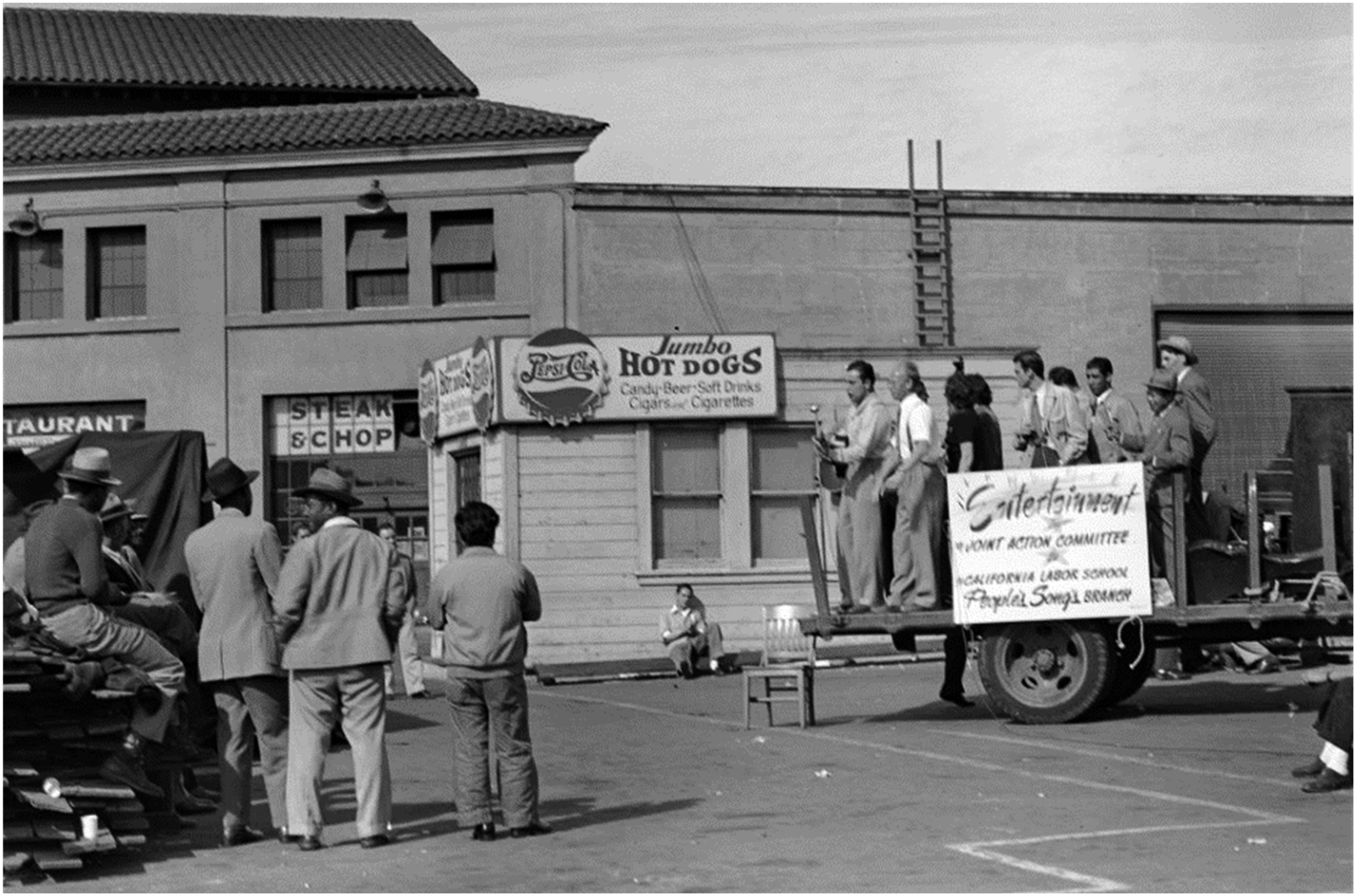
Guest artists often appeared at the CLS and included Pete Seeger (1919–2014), Jenny Wells (1913–2016), and Ernie Lieberman (1930–2023). 109 According to publicity flyers, Wells sang “people’s songs . . . of China, the Soviet Union, France, South Africa, Israel, [and] South America[,] and folk songs of the Mexican and Indian people of our own Southwest.” 110 Lieberman offered “an evening of fresh exciting entertainment–humorous and sad, of love and work and peace and freedom . . . to lift the hopes and aims of the people.” 111
In April 1955, Malvina Reynolds (1900–1978) premiered music from her new book titled Song in My Pocket, published by the CLS the previous year. 112 According to CLS Director Holland Roberts, “The book is a bundle of songs inspired by the great people’s movements of our day [and] . . . sings for peace and children at play in a bomb-free world from Maine to Mandalay.” 113 Reynolds was a member of the Communist Party who began her career as a singer and songwriter at the age of 45. Her songs reflected the radical political tradition of Pete Seeger and Woody Guthrie and frequently addressed issues around feminism, technology, the environment, and peace. 114
CLS Faculty
Communists and non-communists alike taught at the CLS. Although most faculty likely held left-leaning political views, the institution did not require instructors to be members of the party. 115 Faculty worked on an adjunct basis and received a standard hourly rate based on course load. 116
Music faculty came from varied backgrounds. Leo Edward Christiansen (1912–2006) served as music director and on the Board of Directors of the CLS, conducted the chorus, and taught piano, voice, and various other classes. Christiansen was also the choir master and organist at the Church of Saint Mary the Virgin (Episcopal) in San Francisco and a former director of the People’s Chorus. 117 Following his tenure at the CLS, he served as music director at St. Stephens Episcopal Church, conducted local community ensembles, and taught at the San Francisco Conservatory of Music, the College of Marin, and Marin Country Day School. 118
Several instructors were prominent performers and teachers of classical music. Naomi Sparrow (California Chorus and Children’s Drama Workshop) was an active pianist and chamber musician in the San Francisco area and eventually taught at Stanford University. 119 Tomo A. Yagodka (1903–1977) (How to Enjoy Music) was a composer and concert pianist who studied with Edward Elgar and performed throughout the United States and abroad. He became director of music therapy at Camarillo State Hospital in 1949 and served in this position for 19 years. 120 Ada Clement (1878–1952) (What Is Music and How Should We Listen to It?) was an active concert pianist who founded and directed the San Francisco Conservatory. 121 Thompson V. Chesnut (1918–2007) (instrumental ensembles) played French horn in the All American Youth Orchestra under Leopold Stokowski before serving in the U.S. Army during WWII. He founded the Servicemen’s Symphony Orchestra and led a dance band at the CIO Servicemen’s Center in San Francisco. 122
Other music instructors at the CLS focused on twentieth-century art music or popular genres. Iva Dee Hiatt (1919–1980) (American Jazz, Music of Our Day) studied with Ernest Bloch, Roger Sessions, and Randall Thompson, and earned a Master of Music degree at the University of California Berkeley in 1941. She taught at the San Francisco Conservatory of Music and the University of California Extension Division before accepting a position as Director of Choral Music at Smith College in 1948. 123 Ralph Auf de Heide (1915–2008) (Music of the American People) wrote and produced daily music programs for the Office of War Information during WWII. He eventually sold phonograph records and equipment, collected folk music, and wrote record reviews and articles on jazz, folk, and classical music. 124 Janet MacHarg (1923–2003) (Songwriters Workshop) was a political songwriter, cabaret performer, and writer. She joined the Communist Party and became a prominent social activist for the feminist movement, the peace movement, and LGBTQ rights. 125 Lou Gottleib (1923–1996) taught Music Fundamentals at the CLS in spring 1950. During the following decade, he performed as a jazz pianist and singer, arranged music for the Kingston Trio, and earned a doctorate in musicology from the University of California at Berklee. In 1959, he helped form the Limeliters Trio where he played bass and served as the comic spokesperson for the group. One music critic stated that the Limeliters “attained a stature equaled perhaps only by The Kingston Trio and The Weavers.” 126
Conclusion
The CLS existed from 1942 to 1957 as a center for adult education affiliated with the Communist Party. Although the curriculum focused on Marxism and labor, the institution also offered classes in general subjects, vocational training, life skills, and the arts to enrich the lives of the immigrants, industrial workers, and people of color that it served. 127 Many people studied music at the CLS for personal growth and enjoyment. Others developed performance and composition skills useful in promoting the values of the Communist Party and the American labor movement. Faculty and guest artists included left-leaning musicians and teachers from a variety of cultural and musical backgrounds, many of whom were or became important social activists during the mid twentieth century.
All music activities probably assumed a communist perspective either directly or indirectly. Classes and ensembles incorporated popular (i.e., people’s) music including jazz, folk, labor, and satirical songs, and patriotic repertoire of communist countries outside the United States. Music appreciation courses provided opportunities for people with limited means and experience to study classical repertoire often reserved for the middle and upper classes. Performances by ensembles and guest artists featured music by composers of color and from non-western cultures.
128
Songwriting classes developed artists and materials for the labor and progressive movement.
129
Hootenannies and similar events allowed the CLS community to participate in corporate music making around shared values.
130
According to one observer, It strikes me that one of the very things the CLS did was to let workers know . . . that culture belonged to them too. That art and drama and music and literature was not just the property of those people that had seats at the opera and who were on the self-perpetuating board of directors at the [fine arts] museum, but that it was for everyone.
131
The CLS taught music until it closed in 1957. However, the number of courses decreased through the 1950s as fewer students enrolled in the institution. 132 The only music offerings listed in the winter 1957 schedule were beginning and advanced sections of class guitar. 133
Music instruction at the CLS was a political act that should remind teachers today of the ethics involved in selecting repertoire to promote specific values, perspectives, and positions. 134 In its purest form, communism promotes freedom and equality for everyone through a classless society administered by common citizens without the need for laws. However, the realities and failures of this “Utopian Marxist vision” has often led party leaders to violate human rights and implement policies of social control to remain in power. 135 Likewise, pro-American music commonly presented in PK–16 schools today such as “The Star Spangled Banner,” “America the Beautiful,” or “God Bless America,” might not reflect the experiences of people of color, non-Christians, or those in low socioeconomic conditions. Music educators should consider students’ varied backgrounds when programming patriotic and religious selections or planning performances related to national observances such as Veterans Day and Memorial Day. These decisions might provide opportunities to discuss varied meanings and implications of value-laden repertoire for different social groups in the classroom. 136
Labor schools operated by the CPUSA provided education to adults unable or uninterested in pursuing a four-year degree and served as predecessors to modern community colleges. 137 Perhaps music activities at the CLS could inform colleges and other organizations looking to provide affordable and accessible enrichment instruction for adult learners. Such offering could include informal and short-term sessions—like Hootenannies and Sunday Musicales at the CLS—that facilitate music making through singing, recreational instruments, or drum circle, or provide opportunities for guided listening or songwriting. 138
In many ways, the music curriculum at the CLS reflected recommendations for tertiary study today by the College Music Society (CMS) Task Force on the Undergraduate Music Major (TFUMM). The TFUMM called for “fundamental change” in collegiate programs that would “reflect relevant needs” and close the gap between “music in the real world” and “music in the academy.” They made recommendations that would lead students to become “improvisor-composer-performers” through a curriculum focused on “creativity, diversity, and integration.” The TFUMM also advocated for more student choice and individualized course plans, streamlined and diversified classes in music theory and history, and an emphasis on service to the community and society. 139
Similarly, the CLS offered a curriculum that included art music, contemporary popular styles, and folk music from cultures around the world. Students of varying abilities were free to plan their programs around personal interests and encouraged to use their musicianship to engage the community and foster social change locally and abroad. Coursework could have prepared a student as an improvisor-composer-performer capable of writing, accompanying, and leading songs at rallies and other events. Perhaps aspects of the music curriculum at the CLS might serve as an example of potential changes in modern undergraduate degree programs. 140
Future studies should continue to examine the use of music education to support political and social agendas throughout history. This research might reveal the ethical concerns and effectiveness of such practices in the past and suggest ways of addressing similar issues today. Several examples from the United States and beyond exist in the literature. 141
Historians should also investigate post-secondary music instruction as related to nontraditional curricula, world music, and popular genres. This research might indicate more work in these areas than previously thought, especially outside typical four-year colleges and universities. 142 Findings from these studies could lead to a greater understanding of music education in tertiary institutions during the early and mid twentieth century and provide examples for restructuring current degree and non-degree programs.
Footnotes
Declaration of Conflicting Interests
The author(s) declared no potential conflicts of interest with respect to the research, authorship, and/or publication of this article.
Funding
The author(s) received no financial support for the research, authorship, and/or publication of this article.
