



Abstract
Reginald A. Byron on "broad daylight" gun violence.
News media broadcasts about urban citizens being shot in broad daylight have caused widespread concern in many American communities. Some news agencies have conducted their own short-term analyses, deducing that once rare daytime shootings have increased significantly over time (see, for instance, Philadelphia’s 6abc Action News’ analysis on May 11, 2022). Politicians and district attorneys in cities like Baltimore, Boston, Chicago, and New York City have reinforced these sentiments by decrying what seems to be an inordinate amount of daylight shootings—and what seems like daytime shooters’ lack of regard for human life or law enforcement capability (see WBZ-News Staff’s October 11, 2022 coverage of a shooting in the Roxbury neighborhood of Boston and Jackson Walker’s August 21, 2023 reporting on Chicago for The National News Desk as pertinent here).
Is there an empirical reality—or is the reported uptick in broad daylight shootings simply another moral panic?
But is there an empirical reality behind these assertions or is the reported uptick in broad daylight shootings simply another moral panic?
The few existing analyses of the timing of urban shootings, like medical professor and gun violence researcher Rebecca Robbins and colleagues’ 2024 article in the Journal of General Internal Medicine, can be improved upon. Researchers, for instance, typically define the “daytime” as falling between the hours of 6:00am and 5:59pm, while news media analyses commonly use 7:00am and 7:00pm as their daylight hours. Obviously, though, the sun rises and sets at different times depending on the season of the year and region of the country. On this basis and to my knowledge, there are no published analyses that capture whether there has been a genuine uptick in the proportion of daytime shooting victimizations over time and across American cities.
This article is, arguably, the first to do so.
To perform this analysis, I aggregated publicly available police department data for all fatal and non-fatal shooting victims over five years (2019-2023) and across 10 U.S. cities (Baltimore, MD; Boston, MA; Chicago, IL; Cincinnati, OH; Houston, TX; Los Angeles, CA; Nashville, TN; New York City, NY; Philadelphia, PA; and Seattle, WA). I chose these cities because of their varied population sizes (5 are among the largest U.S. cities and have over 1.5 million residents each, while the other 5 all have populations under 800,000) and widespread geographic locations (3 in the Northeast, 2 in the Pacific West, 2 in the South, 2 in the Midwest, and 1 in the Mid-Atlantic). Data for 6 of these cities were consolidated into separate shooting incident datasets made available on state government or police department websites. For Los Angeles and Baltimore, I downloaded general crime data and followed the shootings data extraction process employed in my 2025 publication on urban shootings in Sociological Research Online. For shootings data from Seattle and Houston, I filed open records (FOIA) requests with police departments and paid the nominal fees required to acquire the data. (Importantly, the public records officer from Houston explained that their office “does not have reliable data entry for 2019.” Therefore, I only present a four-year trend for Houston.)
To capture a more accurate assessment of the frequency of and possible fluctuation in the proportion of shooting victims who are shot during the daytime, I merged “to-the-minute” city-level daily sunrise and sunset data from the Visual Crossing weather data platform into my larger dataset of shootings variables and wrote syntax to compute a daytime shooting victims variable - defined as any victim that was shot after sunrise and before sunset (n=23,085). This methodological innovation allowed me to account for any fluctuations in daylight hours over climate seasons and across geographic regions, creating the most valid metric of daytime shootings possible.
As can be seen in the figure on the next page, New York City (NYC) was the only city in my dataset that exhibited a consistent rise in the proportion of daytime shooting victims over time. The most typical pattern across these cities was of an increase in the proportion of daytime shooting victims between 2019 and a pandemic year in which these values peaked (2020 in Chicago and Seattle; 2021 in Baltimore, Boston, and Philadelphia; 2022 in Cincinnati, Los Angeles, and Nashville). In each of these cases, the proportion of daytime shooting victimizations dropped in the subsequent year(s). General strain during the pandemic, the forced closure of daytime community resources, shifting daytime socialization patterns of community members, and a pullback on proactive policing practices (among other factors) could all help to explain this relatively consistent increase in the proportion of daytime shooting victimizations during the pandemic (see criminologists James Densley and Jillian Peterson’s 2024 article on murder during the pandemic in the Journal of Crime and Justice, data journalist Robert Gebeloff et al.’s 2024 New York Times article on how the pandemic reshaped U.S. gun violence, and criminologist Justin Nix et al.’s 2024 Criminology article on de-policing’s effect on later violent and property crime levels). These cities likely rebounded from the anomie of such significant societal changes at different speeds, leading to variable timing in the subsequent decline in the proportion of daytime shooting victims.
Web Sources: Analyze Boston. 2024. “Shootings”; Chicago Data Portal. 2024. “Violence Reduction–Victims of Homicides and Non-Fatal Shootings”; City of Cincinnati. 2024. “CPD Reported Shootings”; Data.phila.gov. 2024. “Shooting Victims”; Los Angeles Police Department. 2024. “Crime Data from 2010 to 2019” and “Crime Data from 2020 to Present”; Nashville.gov. 2024. “Police Data Dashboard: Gunshot Injuries Map”; NYC Open Data. 2024. “NYPD Shooting Incident Data (Historic)”; Open Baltimore. 2024. “Part 1 Crime Data.”
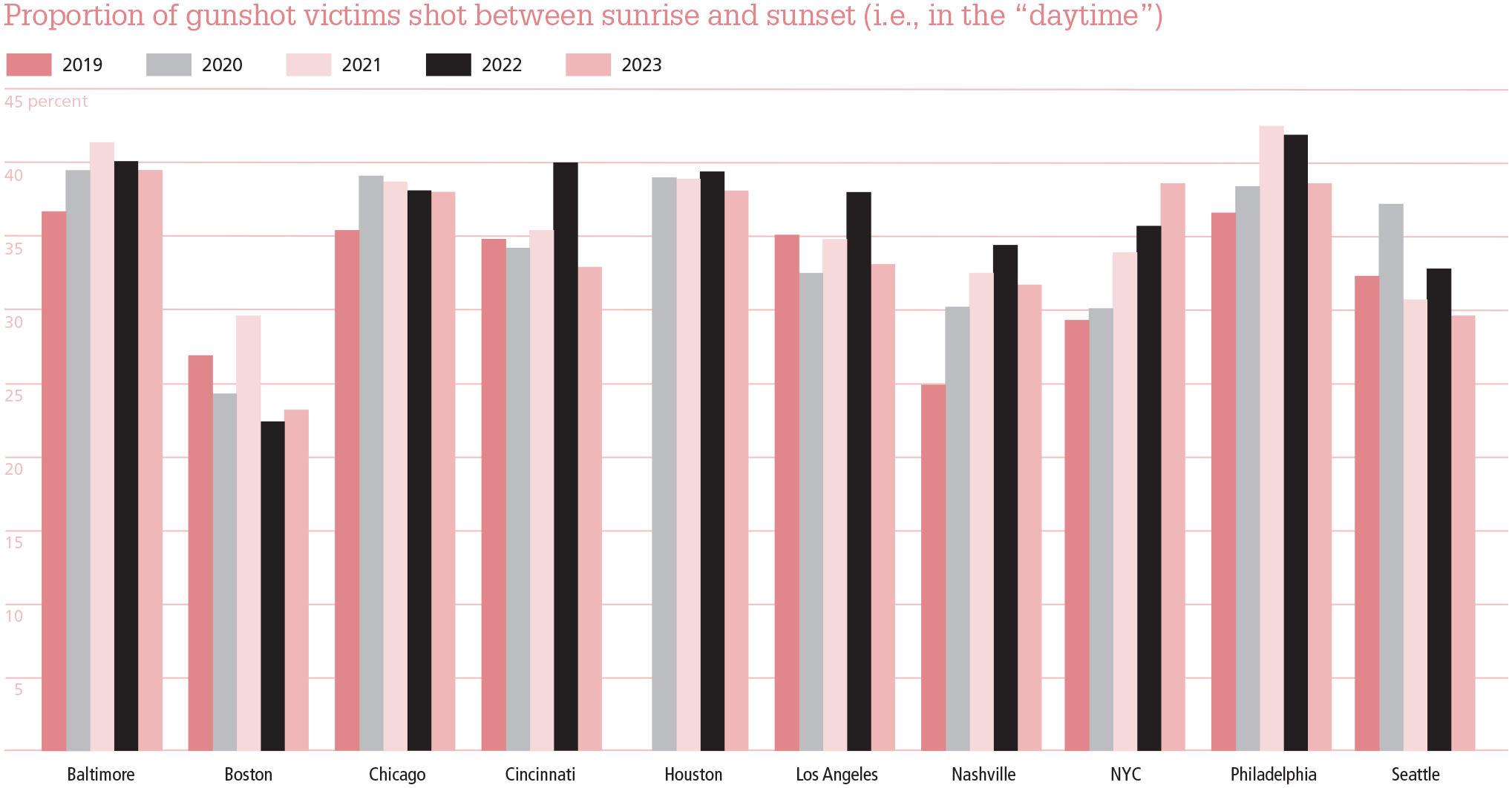
To unpack the steady growth of the proportion of daytime shooting victims in New York City (NYC, as shown in the first figure), it’s important to first note that the city started out with a lower proportion of daytime shooting victims in 2019 than most of the other cities in the sample. Therefore, its increase brought it in line with the average values in other large cities like Chicago, Houston, and Philadelphia. Nonetheless, the fact that the proportion of NYC daytime shooting victims increased by almost 10 percentage points – from 29.1 to 38.4 (a statistically significant rise of nearly 32%) across these 5 years is surprising. The only other city with a similar trend is Nashville, which saw a steady rise in the proportion of daytime shooting victims during the first 4 years under investigation, followed by a decrease in 2023.
Politicians and police leadership in New York City would likely argue that its increase in the proportion of daytime shooting victimizations is a result of gun offenders both benefiting from and becoming more brazen because of New York State’s 2020 bail reform (which made it harder for judges to remand defendants to pretrial jail detention and limited the crimes where judges could impose cash bail). Politicians and police leadership can make that claim, however, a 2024 report by Brennan Center of Justice economist Terry-Ann Craigie and attorney Ames Grawert shows that there is little empirical proof for it. Instead, I discern a compelling alternative explanation from a 2024 analysis by policy advisor Alan Berube of the Brookings Institution on how the pandemic changed net migration from U.S. cities..
Indeed, New York City had the largest pandemic percent population loss out of all the cities in my analysis. It is possible that this out-migration contributed to there being, to borrow urban activist Jane Jacobs’ concept, fewer “eyes on the street”—and that this decrease in citizens to witness and/or report crimes could have emboldened gun users during interpersonal disputes.
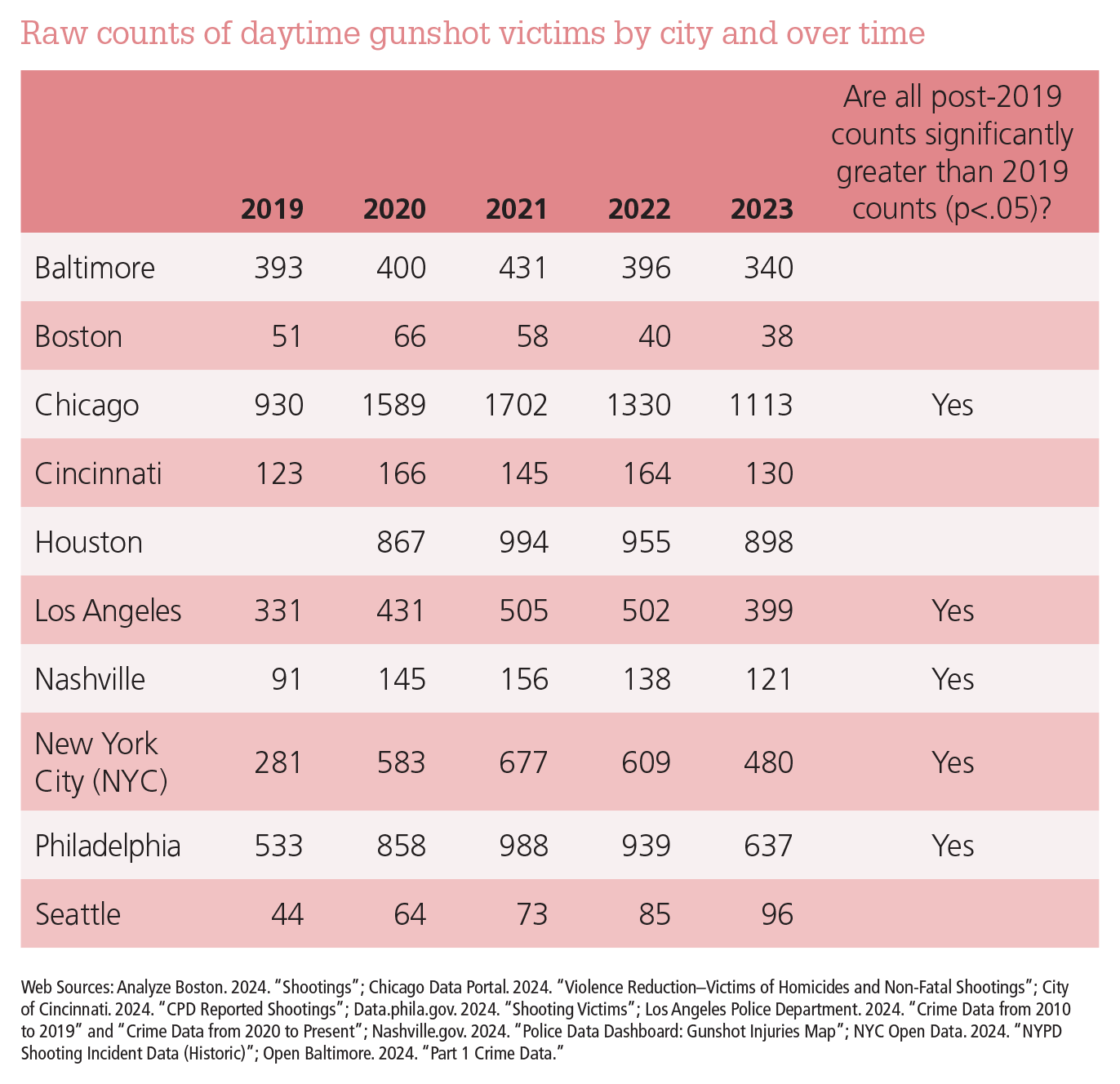
Raw counts of daytime gunshot victims by city and over time
Web Sources: Analyze Boston. 2024. "Shootings"; Chicago Data Portal. 2024. "Violence Reduction–Victims of Homicides and Non-Fatal Shootings"; City of Cincinnati. 2024. "CPD Reported Shootings"; Data.phila.gov. 2024. "Shooting Victims"; Los Angeles Police Department. 2024. "Crime Data from 2010 to 2019" and "Crime Data from 2020 to Present"; Nashville.gov. 2024. "Police Data Dashboard: Gunshot Injuries Map"; NYC Open Data. 2024. "NYPD Shooting Incident Data (Historic)"; Open Baltimore. 2024. "Part 1 Crime Data."
Another possible explanation is the smaller police presence on NYC streets during the latter of these years. After a string of violent crimes on the city’s public transit system, New York City’s mayor initiated a historically large subway deployment of police officers in 2022. This left fewer officers, from an already shrunken police force (see reporter Mandy Taheri’s 2025 Newsweek article about the “hiring crisis” in the New York City police department), available to manage the city’s daily street crime.
My analyses confirm the need for good social science to verify or challenge widespread beliefs about crime.
Before I offer conclusions, I realize that some readers may be interested in understanding the changes in the raw counts of shooting victimizations over these years. To provide this context, I include the table above. As can be seen in a handful of the cities in my analysis, there were significantly more daytime shooting victims in each year after 2019. However, these raw counts are not particularly useful when looking at trends. That’s because, unlike the values in the first figure, these values do not account for fluctuations in the total number of shooting victims over time, nor can they tell us about the proportion of shooting victimizations that took place in the daytime versus the nighttime.
My analysis here is important for four key reasons. First, it provides a methodological innovation to existing analyses of “daytime” shootings by redefining it as the period between sunrise and sunset and capturing the realistic variation in daytime hours across climate seasons and regional geographies.
Second, despite the alarm raised by media outlets and politicians, hardly any cities in this sample have had a consistent increase in the proportion of daytime shooting victims; for most, their rises were followed by subsequent declines during the 5-year span of this analysis. Furthermore, in each of these cities, nighttime shootings still predominate (especially in cities such as Boston).
Third, my finding of a distinctive pattern of steady increase in the proportion of daytime shooting victims in New York City provides a compelling argument for additional daytime violence interventions in that city. (Because this analysis captures a relatively short 5-year assessment, future scholars could investigate this trend more longitudinally).
And finally, this analysis complements existing qualitative accounts (like the interviews in Rod Brunson and Brian Wade’s 2019 article on police investigations of urban gun violence in the journal Criminology & Public Policy) to reveal what daytime shooting victimization looks like in the aggregate, over time, and across space.
Overall, my analyses confirm the need for good social science to either verify or challenge widespread beliefs about crime that may be the product of sensational media portrayals. These more rigorous findings should prove valuable to the citizens who inhabit these cities, to law enforcement and community-led violence reduction agencies as they seek to curb gun violence, and to news media agencies that want to share more valid empirical trends with their consumers.