



Abstract
Melanie Brazzell, Tara Leigh Tober, and Tristan Bridges on counting consequences.
On November 1, 2013, a young White man entered Los Angeles International Airport (LAX) with an AR-15-style semi-automatic weapon and over 500 rounds of ammunition. He harbored radical anti-government sentiments and came with the intention of killing TSA agents. He fatally shot the first agent he identified, Gerardo Hernandez, a father of two who had immigrated from El Salvador at 15. In the chaos that ensued, three more people were shot and others were injured. Police arrived within minutes and apprehended the perpetrator, who is presently serving life in prison.
This incident was a horrific crime, to be sure, but was it a “mass shooting”?
Intuitively it seems like one: the victims had no relation to the perpetrator and a large number of people were hurt. Yet the LA Times did not refer to it this way in their coverage. And you won’t find it in most U.S. databases of mass shootings, either.
Most social science research defines mass shootings based on a fatality threshold: four or more people killed (in 2013, a federal mandate lowered the threshold to three fatalities, but a threshold of four is still used in much research). The most restrictive definitions specify that shootings must occur in a single, public location by a single shooter, and they exclude incidents associated with gang violence, drug crimes, family violence, and intimate partner violence. This means that lots of incidents, even high-profile ones like the Los Angeles shooting, simply don’t qualify. For example, gun violence at Columbine High School (two shooters), Sandy Hook Elementary (multiple locations and family violence), and the 2021 attack on subway riders in New York City (too few fatalities) do not conform to the narrow criteria widely utilized in scholarship, journalism, and public policy.
Håkan Dahlström, Flickr CC

What makes a shooting “mass”? The implicit assumption guiding research on mass shootings is that “mass” shootings are distinct from “other” shootings that make up the majority of gun violence in the U.S., such as suicides; gang, drug, and crime-related shootings; and shootings with smaller fatality counts like the one at LAX. Since these incidents are excluded from analysis, however, we cannot know whether and how mass shootings meeting the narrow definition actually are as unique as is assumed.
Just as the concept and practice of mass shootings were being labeled as such and appear to have increased in frequency in the 1990s, lobbying by the National Rifle Association led to the passage of the Dickey Amendment, which prompted the CDC to avoid gun research. The resulting lack of federal data collection and research guidelines has left the scholarly and policy communities with no clear consensus on what constitutes a mass shooting.
Without federal research, journalists and civic organizations like Every-town USA, Mother Jones, and the Gun Violence Project have been left to study the problem. These groups expand the definition of “mass” shootings to include incidents like the one that claimed Hernandez’s life. Some of the projects define mass shootings as public, “random,” and “indiscriminate.” On this basis, they exclude family/partner violence or violence related to criminal activity like robbery, drugs, and gangs. Yet, the boundaries of these categories are blurry. The murders of elementary school children in Newtown, Connecticut in 2012 and again in Uvalde, Texas this year were preceded by murders of family members the same day; should they be counted as random or indiscriminate? Some shooters go to former workplaces or other familiar locations to seek revenge on people they know. Should the bystanders affected be included in the assessment? The categorization of gang violence is also riddled with problems since the media and police overattribute violence in communities of color to gangs.
Note: Data originally collected from Gun Violence Archive. Original data were checked and cleaned, resulting in the removal of incidents that did not meet the casualty threshold that defi nes the dataset (4+). Authors’ calculations.
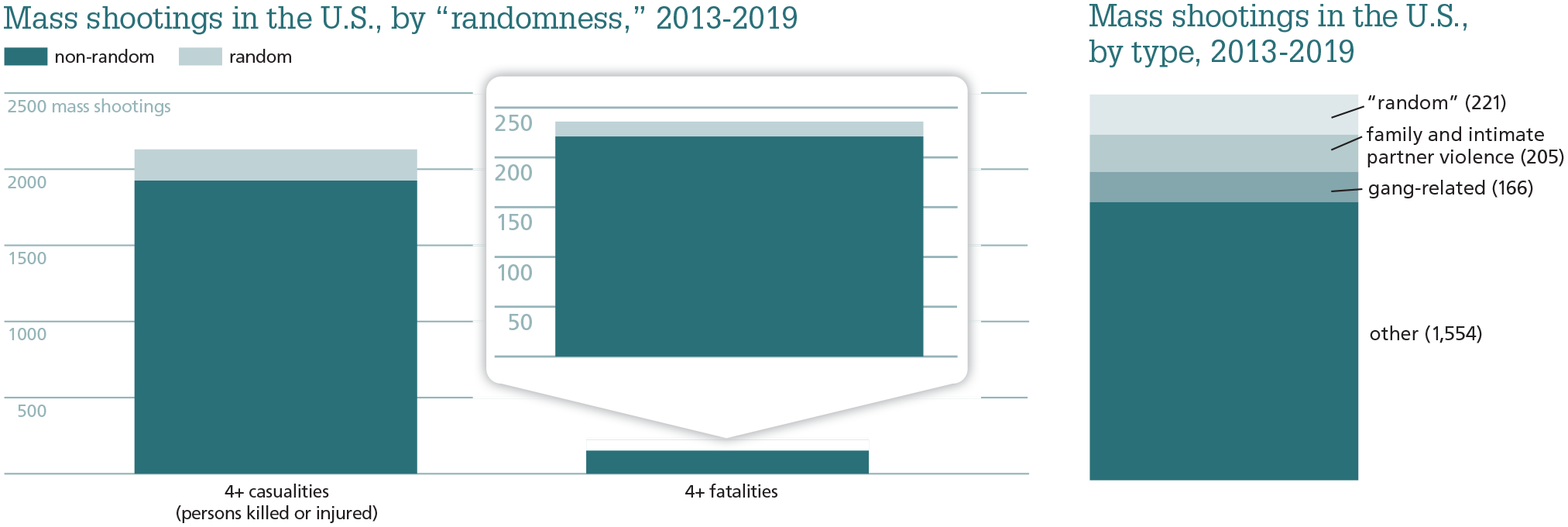
How we define a mass shooting shapes the data researchers gather about shootings and the perpetrator profiles they develop from that data, which can in turn influence public policy and practice related to gun violence. A narrow definition of a mass shooting limits us from learning about shootings outside that definition and from confirming if narrowly defined shootings are indeed unique.
More expansive definitions of mass shootings can yield deeper insights into a tragic phenomenon.
We have drawn on the Gun Violence Archive data to build a more comprehensive database of mass shootings. Based on the data, we present some preliminary results from the incidents in our database between the years of 2013 and 2019 to illustrate the value in using a less restrictive definition. Ours, for instance, is as follows: “Mass shootings” are gun violence incidents involving one to two shooters and four or more casualties (either injuries or fatalities). We do not restrict incidents based on surrounding locations or motives. As the first figure above shows, compared with the typically narrow definition used in research (4+ fatalities), our broad definition captures 1,926 more incidents between 2013 and 2019. Here we also document the proportion of those cases that we defined as “random” mass shootings (which we discuss in more detail below).
When assumptions about shooter motive and profile narrow the definition of mass shootings, it erases an enormous amount of gun violence and precludes the possibility of asking comparative questions across different types of shootings.
Consider a comparison between random, family/intimate partner, and gang-related mass shootings. When the latter are excluded in a narrow definition, asking how these types of incidents differ is not possible. As you can see in the figure, above right, only 221 of the 2,146 mass shootings we count between 2013 and 2019 met our definition of “random” (15 of which are incidents involving 4+ fatalities, as can be seen in the figure at left.
The randomness of a shooting is difficult to measure. We coded incidents as “random” if sources indicated shooters had no known relationship with the victims or the location. We coded incidents as family/intimate partner violence if they occurred between family members/partners or in a home, resulting in a subset of 205 shootings. Finally, we defined incidents as “gang-related” only if the sources identified them as such. This resulted in 166 incidents. A remaining 1,554 incidents fall into none of these categories, either because there were not enough details in media reports to categorize them clearly into the above categories or because incidents belong to a different category of non-random shooting, such as those at perpetrators’ workplaces or schools. This lack of data signals an additional understudied area made visible when we expand our definition of a mass shooting.
While we can’t speak to these “other” non-random shootings, we do consider why we are able to gather data for some types of shootings and not others and thus, why certain types of shootings receive more attention from researchers and the media than others.
Expanding the conventional definition of a mass shooting shows us the politics of data collection surrounding incidents that fall outside the narrow definition. In the figure on this page, we compare findings about incidents classified as random, related to family or intimate-partner (IP) violence, or gang-related. We also look at proportions of incidents in each of these categories by whether the shooter or shooters’ were known to or suspected by law enforcement and by perpetrator outcomes (killed, arrested, or outcome unknown/ suspect escaped).
Comparing perpetrators in family and IPV, gang-related, and “random” shootings, by shooter ID and outcomes, 2013-2019
Note: Data originally collected from Gun Violence Archive. Original data were checked and cleaned, resulting in the removal of incidents that did not meet the casualty threshold that defines the dataset (4+). Additionally, this figure includes outcomes and statuses for both single schooters and dual shooters; among the latter, each shooter’s status and outcome are counted separately. While the first two figures compare incidents, the n here refers to perpetrators and as such, is higher than the n for those figures. Authors’ calculations.
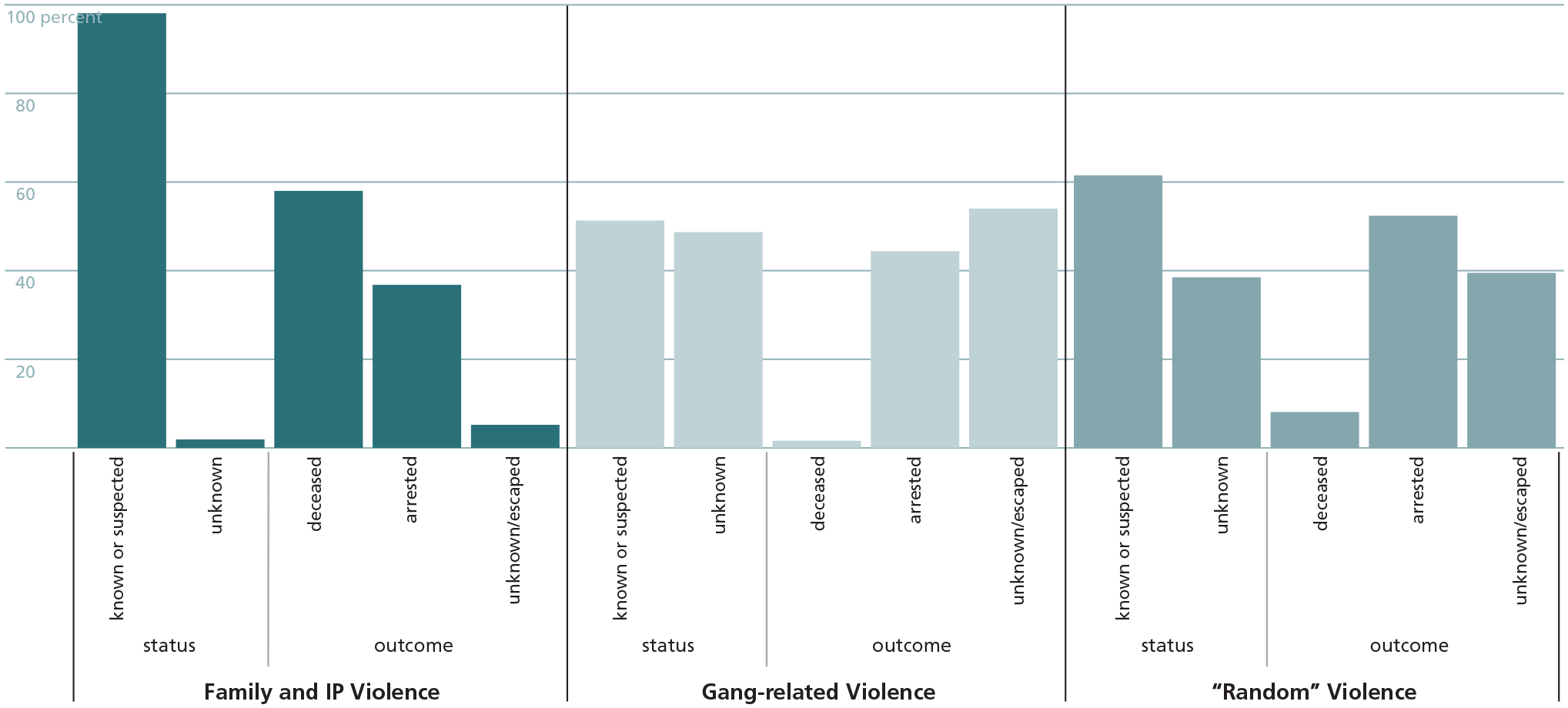
In almost all cases defined as family/ intimate partner violence, the shooter was known. This is due to the fact that perpetrators involved in family/IP violence incidents are by definition known to their victims and that the most common outcome for perpetrators, in comparison to random or gang-related incidents, was their own death (often self-inflicted). We were able to collect more news articles per incident (4.2, on average) about these types of shootings than others, suggesting these events receive more news media coverage and subsequently, result in better information in our gun violence database. We also discovered that an element of the ’mass shooter profile’ imagined as unique to random mass shootings (suicide by mass shooting) is actually most common in family and intimate partner violence shootings, an incident type typically excluded from the narrow definition of a mass shooting.
In contrast, very few of the gang-affiliated cases resulted in the death of the perpetrator. More commonly, these perpetrator outcomes are unknown. Gang-affiliated shootings also receive less media coverage (an average of 3.2 articles per incident) than other types. This suggests not only less public interest but, potentially, less police work and lower rates of resolution (that is, the perpetrator’s arrest). As news coverage is a primary source of data for research on the topic, another result is that there is simply less data about incidents disproportionately likely to be committed by and victimize communities of color. In other words, it leads to what scholars call a racialized data discrepancy.
Answering questions like “how many?” when it comes to mass shootings sounds deceptively simple. But, definitions and data availability harm our ability to answer basic questions about these statistically rare, but terrifying crimes. A more expansive definition of mass shootings can help us better understand whether those incidents meeting the narrow definition utilized in the majority of scholarship on the topic are as unique as we imagine. By examining whether and how incidents like the 2013 shooting at LAX, among others, “count” as mass shootings, we are able to better capture the scope of gun violence and identify patterns—that is, more expansive definitions can yield deeper insights into a tragic phenomenon.