



Abstract
Ethnographic research at an all-Black, all-boys high school uncovers the emotional and academic toll of young men’s untended grief in the wake of gun deaths. After the balloons are released and the candles are snuffed out, public vigils become private burdens for the youth who survive their peers.
On a warm Monday night in July 2016, roughly a hundred teens crowded an outdoor basketball court in Philadelphia to play and cheer on an intense summer league rivalry. The week before, a spirited finale to a close game had erupted into a fight, but this night’s games ended amicably. Then, as the boys scattered throughout the mostly residential Black working-class neighborhood, heading toward home, one group was confronted by a teenager with a gun. Reporters would later describe an “ambush” as the teen, evidently still incensed over the previous week’s game, fired indiscriminately into the small crowd. Two children were shot in their arms and legs, while a third, a boy of 15 named Tyhir, was hit in the face.
Tyhir had just completed his freshman year at Boys’ Preparatory Charter High School, less than a mile from the corner on which he was shot. Alerted through frenzied phone calls and text messages, clusters of young people from the school and the neighborhood huddled nervously outside the hospital while Tyhir was in surgery. Within hours, they received word that their friend and classmate was dead.
The loss of a young person is an immense tragedy in itself. In 2016 alone, an epidemic level of gun violence in Philadelphia resulted in nearly 300 homicides, 15 of them children (Philadelphia’s annual youth gun homicides would peak at 34 in 2021, then drop to 17 by 2024).
Over the days following Tyhir’s death, the Philadelphia Inquirer featured interviews with Tyhir’s heartbroken mother, the summer basketball league’s organizer, the chief of police, Tyhir’s middle school teacher, and a family friend. The devastation each death wreaks on the victim’s family and extended community is broadly recognized, but what toll does gun violence take on a young victim’s friends and peers—say, the kids who played ball alongside Tyhir that night, or those who survived the hail of bullets that killed him? Moreover, can we assess the effect of gunfire deaths on a murdered young person’s classmates and his school?
To understand the impact on teens, immediate and lingering, of losing a friend to gunfire, and its effect on their school, I began regularly visiting Boys’ Prep as an ethnographer. (Note that, while I use the real names of Tyhir and JahSun, introduced later, to honor their memory at the request of their families, I have, for privacy purposes, altered the name of the school as well as the names of other students and teachers throughout this article.) A single-sex high school designed to prepare low-income Black boys for college, Boy’s Prep struggles—like so many underresourced urban schools—to balance high academic expectations with the reality of its students’ lives. These youths were largely underserved during their previous decade of schooling, and they remain burdened by the precarities of poverty, racial oppression, and growing up in historically disinvested neighborhoods.
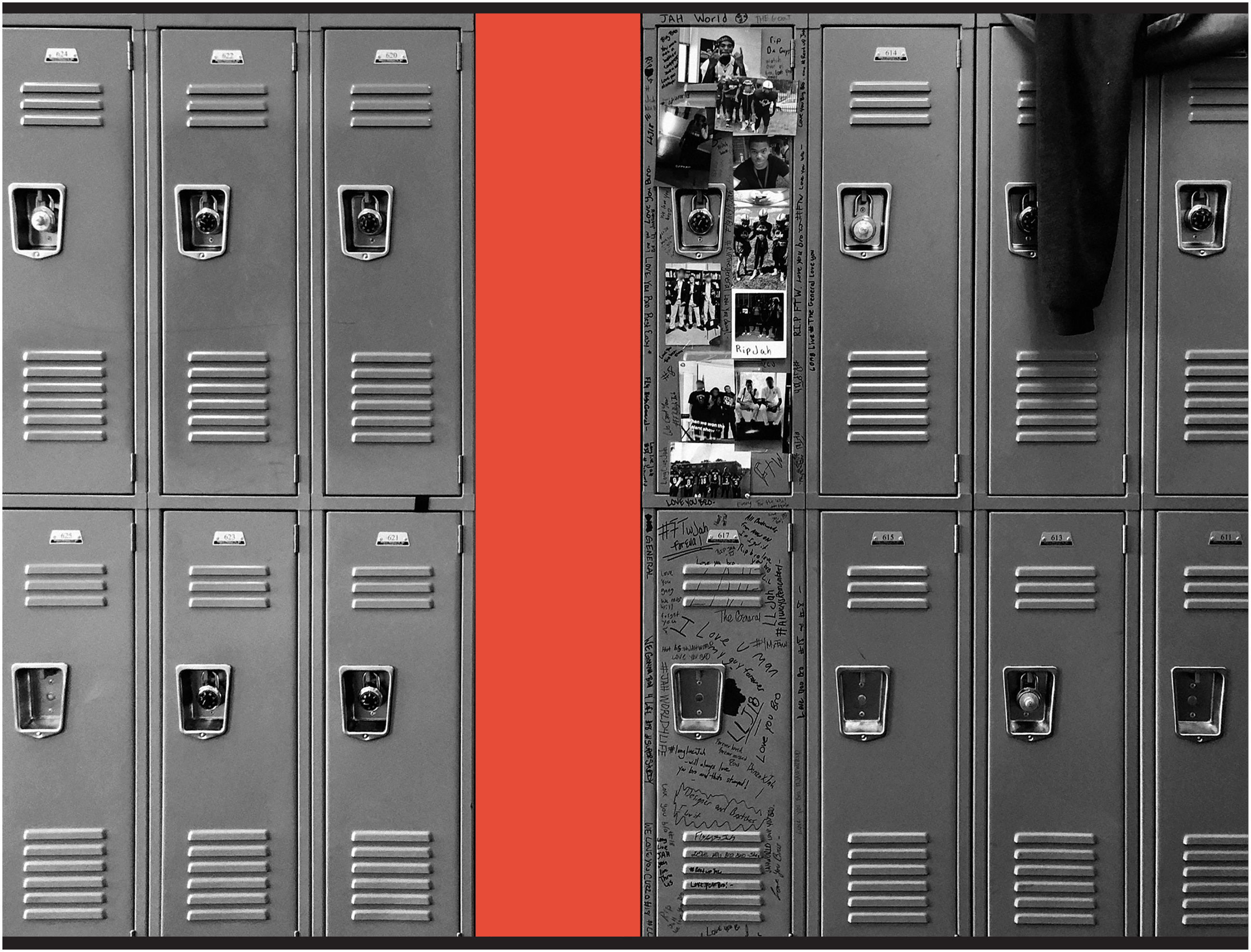
<< JahSun’s school locker (and the one below it) decorated as a memorial after his death. (At the request of his family, JahSun’s face has not been blurred; all other faces and names are blurred or disguised.)
As a White woman affiliated with a nearby elite university, I was an outsider to the Boys’ Prep community. Still, I was received openly and, over time, gained the trust of many in the building. In the two years that followed, I spent hundreds of hours hanging out with students in the school’s cafeteria and hallways, observing in classrooms, sitting in on staff and disciplinary meetings, attending schoolwide events, interviewing nearly 100 students and staff, and watching the boys express themselves and engage with each other on social media.
During this period, the community experienced two additional student fatalities by gunfire, one of them a close friend of Tyhir’s whom I had come to know quite well. All the children I observed at Boys’ Prep were weighed down by these deaths; many were also mourning murdered friends from other strands of their social networks.
The death of friends took a heavy toll on the teens I observed. For many, intense pain, anguish, fear, and confusion lingered for months, even years, almost entirely out of view of the adults in their school and in their families. These feelings resulted in setbacks to their relationships with school and teachers, as well as their grades, academic motivation, and expectations for the future. Just as troubling, I saw growing rifts emerge in the school community in the aftermath of gunfiredeaths, rifts that aggravated the pain, loss, and potential longterm injury of many students.
a story of student grief
The news of Tyhir’s murder spread overnight on social media, reaching nearly the entire student network of Boys’ Prep by the following morning. Tyhir’s friends expressed disbelief, shock, anger, and deep suffering. Some searched the photo libraries of their phones for a favorite picture of their friend to post on Instagram. They shared sentiments like “I’m drained of strength, I’m broken in tiny pieces” or “I don’t feel like the same me without u bro ❤ I’m fucked up.” Hashtags like #LLT, for Long Live Tyhir, caught on quickly. The next day at summer school, boys collapsed into the arms of friends and teachers. Even students who were not enrolled showed up at the school just to be in community. A vigil that evening at the basketball court and then, later, the funeral created more opportunities for Tyhir’s friends to support each other in their grief.
One of Tyhir’s close friends was a tall, lanky student known for his charisma and playfulness—for both better and worse, according to his teachers. Herc (a self-chosen pseudonym short for Hercules) had shared a raucous lunch table, a circle of friends, and a spot on the freshman basketball team with Tyhir. But Herc was out of town the night of Tyhir’s death, taking part in a summer-long outdoor program with no outside communication. His weeks in the woods had given Herc time to reflect on his life, prompting a resolve to focus more on school. Returning the following month to find his best friend dead, however, he felt anguished and bereft. “Once I found out… everything I learned on that trip just went out my head.”
Herc began his sophomore year mourning not only the loss of Tyhir, but a second close friend who was also a recent victim of gun violence, as well as the departure of two other classmates from his peer group at Boys’ Prep. The lunch table that had overflowed a year earlier, with more friends than could fit around it, had now dwindled to seating just five regulars. Meanwhile, so many spaces in the school building still held deep memories of Tyhir—the hallway where his locker had been, his usual seat in a classroom—making his absence palpable daily.
As the year progressed, Herc struggled fitfully to adapt to his losses. Missing his teammate, he quit the basketball team, after which, to “take [his] mind off things” and “cope with [his feelings and] the pain,” he increased his marijuana habit. Soon, after the drug was repeatedly found in his backpack, he was facing serious disciplinary trouble at school. Years later, reflecting on the period, Herc would diagnose himself with depression. “Probably the worst thing to suffer from,” he said. “It really eats you up inside. You’re not talking to nobody or trying to find help for yourself. It’s just like, I don’t know, it’s just bad.”
Screenshot, Nora Gross
Herc’s Instagram post reflecting on Tyhir’s death. The accompanying image, cut off for anonymity, shows a picture of Tyhir sitting on a stoop. Hazeem, one of Herc’s and Tyhir’s classmates, responded to Herc’s caption with a show of agreement and love.
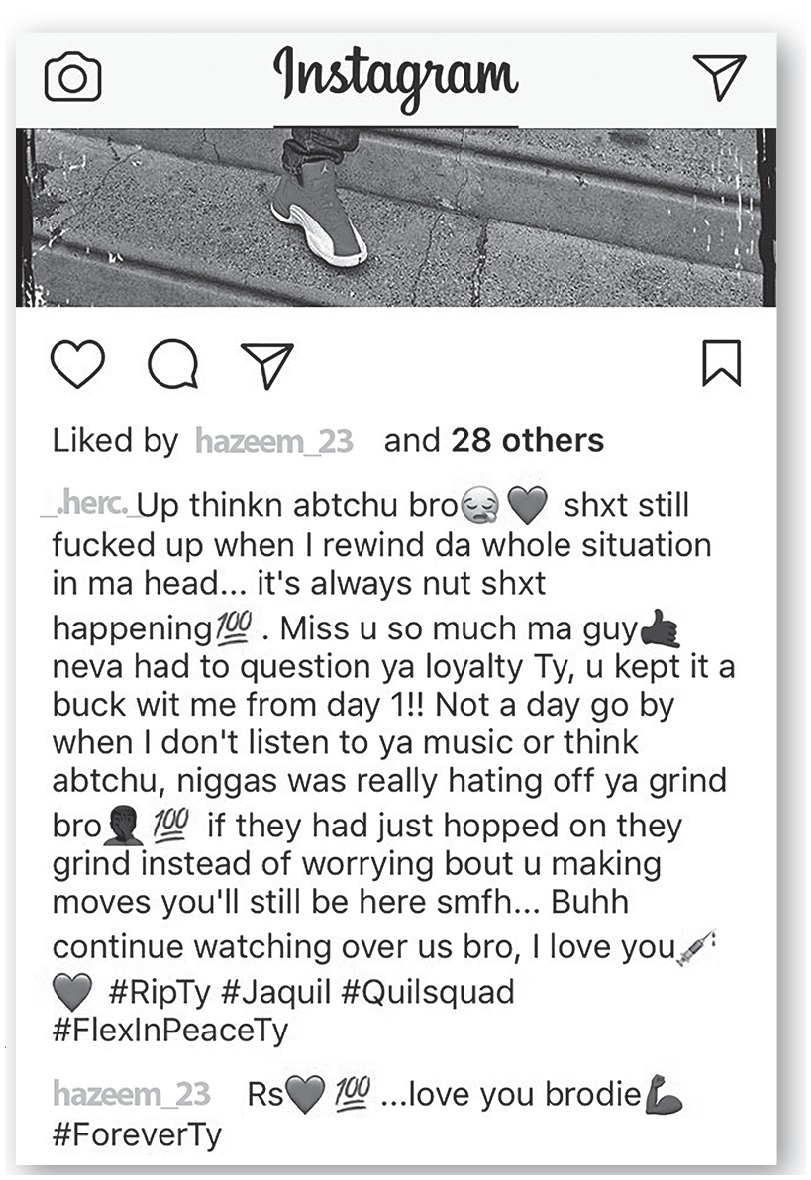
Screenshot, Nora Gross
Herc’s Instagram post on the one-year anniversary of Tyhir’s death. (Usernames in light gray on Instagram posts have been changed to protect anonymity.)

One night, about five months after his friend’s murder, Herc found himself alone in his room, feeling particularly low. Scrolling through Instagram, he came across a picture of Tyhir. He shared what happened next in an interview with me a month later: “I started thinking about [him] and how I found out. I don’t know. I just lost it. Then I started thinking about my life and all that. So I got angry, depressed.” A family member’s prescription drugs were in the bathroom. Herc found the bottle and swallowed the pills.
Fortunately, Herc’s brother found him unconscious shortly afterward and rushed him to the hospital. For the next three weeks, Herc would move through a succession of medical and psychiatric institutions. Upon returning to Boys’ Prep, Herc told no one what had happened—not even his friends (although his parents had communicated with the principal). Some wondered if he’d been out with the flu or, half-jokingly, if he had been jailed. At least one teacher believed he had gone into a drug rehab program. Herc found it “easier” to keep them guessing than to share the truth.
Herc’s silence at school about his feelings concerning the death of Tyhir and other friends may well have led his teachers to conclude that he had overcome his grief and moved on. But the evidence on social media (which Herc allowed me to observe) indicates how wrong that was.
Here, in a space for intimacy and interaction primarily with peers, Herc shared a nuanced picture of his inner life, which reveals how achingly and mercilessly the effects of loss continued to reverberate. He would, for example, periodically post messages, like the one on p. 36, reflecting directly to Tyhir on how “fucked up” he still felt, how much he missed his friend, and how often he thought about the injustice of his death.
Herc also confessed online to hiding or disguising his pain from others. In one telling post, he shared a picture of himself with a big smile and the caption “laughing to hide all dis pain.” On the one-year anniversary of Tyhir’s murder, Herc expressed a commitment to honor his friend through his own accomplishments and lamented that he had no one to talk to about his grief (see p. 36, right).
For Herc and so many of the boys I got to know during this study, the mourning for murdered friends continued for months and years, sometimes interfering in significant ways with their relationships, education, and future plans.
the school’s response
Unanticipated events for which no one is prepared may trigger random responses that resist analysis, but similar responses to recurrent events suggest a pattern worth noting. Such was the case of Boys’ Prep’s institutional response to each of the student gun deaths that occurred during the years of my study.
© Nora Gross
Boys’ Prep students gather outside the school for a balloon release to honor a murdered classmate.

© Nora Gross
A vigil in memory of JahSun is held on the school’s football field. Luminary bags, with messages and candles inside, form a “J” as JahSun’s friends gather together following the formal ceremony.

The first school day after a loss became a day of collective mourning. Very little teaching or learning was to be expected. Students would find candlelit memorials, cookies, extra boxes of tissues, and sometimes children’s cartoons playing in their classrooms; spaces designated for grief counseling offered by visiting professionals; a temporary lifting of disciplinary redirections or penalties for misbehavior; and few expectations that they would attend classes. Inevitably, the locker of the deceased student would be transformed into a collage of RIP messages and taped-up photographs (see p. 34). Often the day would conclude with a gathering with the victim’s family to release balloons.
Screenshot, Nora Gross
Herc posts an Instagram story memorializing eight deceased friends and family members, including Boys’ Prep classmates Tyhir, JahSun, and Bill (other names obscured).

Screenshot, Nora Gross
One of Tyhir’s friends posts a screenshot of another friend’s Instagram story, adding his agreement.

These days of shared grief—what I came to see as the easy hard period—were both heartbreaking and poignantly beautiful. As a teacher told her class on one of these first days back at school after tragedy, “we’re sharing the burdens together.” Communal mourning made each person’s sorrow feel less insurmountable, at least for a little while.
And yet, as early as the second day back, much of this communal grief would dissipate. The school favored a swift return to “normal.” Feeling tremendous external and internal pressure to educate a cohort of boys deemed “already behind” academically, Boys’ Prep administrators aimed to usher their students back to the classroom and business as usual. With no advance training in supporting youth after peer loss, many assumed the boys would bounce back quickly. The abrupt shift from a single day dedicated to public communal grief and unlimited accommodations to the renewed enforcement of academic and disciplinary policies, with only a few exceptions, would bring to the surface latent divisions both among the faculty and between students and adults—a pattern I identify as the hard hard stage after a shared school loss.
In November 2017, when a beloved Boys’ Prep senior, JahSun, was murdered, the school was thrown into another cycle of brief collective mourning, followed by a hurried and divisive return to normal school routines. For Herc, who had been in three classes with JahSun, things felt anything but normal. Acting out in response to an in-school suspension for accumulating too many “tardies,” Herc launched a flurry of punitive actions that, after a lunchtime yelling match with a school disciplinarian, snowballed into a more serious suspension and the threat of expulsion.
Reflecting on the complexity of the moment, Mr. Pratt, the head disciplinarian and one of only a handful of Black male faculty, explained that the tough policies were intended to prepare boys like Herc for the harshness of the world beyond the Boys’ Prep bubble: “[Herc’s] attitude will get him eaten alive out there [on the streets]. We care here, but not out there.”
That Friday, Herc and his father sat through a reinstatement meeting to assess his readiness to return to school after his suspension. As the vice principal, Mr. Hopkins, a White man in his first year at Boys’ Prep, urged Herc to discuss his long-term goals, Herc stared at his hands. “I live day to day,” he finally answered, barely speaking above a whisper. “I’m not thinking about the future.” At no time during this critical meeting was it mentioned that Herc, aged 17, had just days earlier lost his seventh close friend to gun violence.
Over the following weeks, there were numerous other instances when it seemed clear to me that adults were dismissing or discounting the grief their students were experiencing. For instance, about two weeks after JahSun’s death, I came upon two teachers chatting in the hallway between classes. Mr. Leonard, a young White English teacher, was concerned that some of his colleagues were being too soft on students who claimed to still be unable to focus in class after their loss. He was impassioned in his justification: “The system is tough on young Black men and they are going to face a lot of trauma, so they have to learn to keep moving after trauma.” He worried that some students were taking advantage of or becoming dependent on teachers who, in his view, were coddling them. Mr. Leonard’s colleague, a White female teacher, nodded sympathetically as he bemoaned still having several students regularly ditching class because they were “grieving,” only to find them playing in the hallway.
Mr. Leonard’s skepticism of certain students’ needs for accommodation, as well as his critique of colleagues as being too lenient, may have had a foundation in truth. Doubtless there are adolescents who might “take advantage” of the situation. But Black boys, as a group, have historically been denied the benefit of the doubt, the assumption of emotional complexity. As hallway conversations solidified into school norms during the weeks following JahSun’s death, two “sides,” as the principal put it, began to form among the staff. Many teachers found themselves becoming investigators of “real” vs. “fake” grief. At the extreme end was a group of teachers who argued that even those students whose grief was “real” needed to move on from the acuteness of their loss.
Indeed, many Boys’ Prep staff assumed their Black male students were inherently resilient—or, if they weren’t, that they ought to be. Resilience, or the capacity to withstand or recover quickly from adversity, is a foundational virtue promoted by Black Male Academies like Boys’ Prep and related school reform efforts that aim to promote marginalized children into the middle class through college-focused education. This approach to schooling aims to equip poor students to respond to the challenges of their social context by developing attributes like grit or zest. But as many education scholars have argued, it also has the capacity to make invisible the historical and ongoing trauma that many Black children carry to school. In the case of Boys’ Prep students, the unspoken assumption among some teachers seemed to be that this probably wasn’t the first or last loss their Black male students would face. And because they were likely to experience so much trauma in their lives, perhaps they needed to learn how to bounce back more quickly and effectively.
In the aftermath of each untimely student death, the Boys’ Prep community came together to grieve collectively and support struggling students. Over time, though, the long-lasting grief of Black boys mourning murdered friends went mostly unacknowledged or unheeded at school. This was not only about adults’ assumptions of their resilience, but also about the students largely concealing their inner lives from those adults. Teachers and school administrators who earnestly wanted to help the boys prepare for facing future traumas in an uncaring world inadvertently reproduced those very conditions at the school. Instead of promoting resilience, school staff may have fostered an environment in which students were expected to project invulnerability and hide their inner emotional lives. This condition of school life—what I call the hidden hard—may have come to be a permanent state for many students in the aftermath of repeated peer losses.
the hidden toll
Only a few members of Herc’s boisterous freshman year lunchtime crew graduated with him from Boys’ Prep. And though he crossed the graduation stage in 2019, he never recovered his early ambition and optimism. After multiple friends’ deaths and a bunch of failing grades, Herc’s dream of a career in journalism faded, as did any concrete plans for college. By age 22, the year he might have graduated college, Herc would need more than the fingers of both hands to tally up the number of close friends and family members he had lost to guns.
In relation to the children most profoundly victimized by gun violence, the ones who survive to sit in classrooms and earn diplomas are the fortunate ones. They live on to juggle the stress and thrills of adolescence. But many also nurse deep wounds their schools either overlook or try to push past. Institutions like Boys’ Prep are burdened with outsized expectations that they can reverse entrenched societal inequities and provide class mobility that’s already hardly attainable at scale; they have little capacity to provide the long-term social-emotional support students like Herc need. And Black boys, whose development is too often engulfed by racialized myths of toughness and resiliency, may be compelled to keep their grief in hiding at school, knowing it’s unlikely there will be anyone there to receive it with sensitivity and care.
Herc was just one of hundreds of children at Boys’ Prep to face the repeating drumbeat of loss as neighborhood gun violence stole the lives of their peers. There are thousands more like him across the country. Yet their grief remains largely invisible, even to the otherwise caring and empathic teachers and administrators trying to help them succeed. Every Tyhir and JahSun is a death too many, but how many Hercs, silently carrying a burden too heavy for their young shoulders, are we also neglecting?
© Nora Gross
A Boys’ Prep classroom features a red chalkboard wall on which students have scribbled signatures, doodles, and “Rest in Peace” memorials to deceased classmates.

recommended resources
Nancy Berns. 2011. Closure: The Rush To End Grief and What It Costs Us. Philadelphia: Temple University Press. A sociological and historical analysis of the societal push for closure and how it affects those grieving loss.
Amber Jean-Marie Pabon and Vincent Basile. 2022. “It Don’t Affect Them Like It Affects Us: Disenfranchised Grief of Black Boys in the Wake of Peer Homicide,” The Urban Review 54(1). A qualitative study of Black boys attending an urban high school and the responses of school staff to their grief after peer homicide.
Desmond U. Patton, Ninive Sanchez, Dale Fitch, Jamie Macbeth, and Patrick Leonard. 2017. “I Know God’s Got a Day 4 Me: Violence, Trauma, and Coping Among Gang-Involved Twitter Users,” Social Science Computer Review 35(2). An analysis of the grieving and coping practices of gang-involved Black youth on Twitter.
Jasmin Sandelson. 2023. My Girls: The Power of Friendship in a Poor Neighborhood. Oakland: University of California Press. An ethnography of Black girls’ friendships and support, including how they navigate peer homicide and experience grief through social media.
Patrick Sharkey, Amy Ellen Schwartz, Ingrid Gould Ellen, and Johanna Lacoe. 2014. “High Stakes in the Classroom, High Stakes on the Street: The Effects of Community Violence on Student’s Standardized Test Performance,” Sociological Science 1. Presents findings from a natural experiment showing the academic impacts on children exposed to community violence.