



Abstract
Olivia Baker and Baker Rogers on drag performance and gender identity.
The night I met Eris Bordello, we were both wearing bikinis inside one of Columbus, Ohio’s few gay clubs. Even though I wore six-inch black pleaser heels, she towered over me. Instantly mesmerizing, she was undeniably the most stunning person in the entire club. And while gorgeous, she had an air of nonchalance about her, as if to say I know I’m beautiful, and I know you know it, too. Eris, a nonbinary drag performer, grew up in a community that was hostile to her gender and sexuality, but inside this bar, she commanded admiration, attention, and adoration.
Trans rights and drag performance are contentious topics in the United States today. In 2023, at least 566 anti-trans bills were proposed in legislatures throughout the country, and at least 83 passed. Many states have implemented gender-transitioning care restrictions for transgender youth, exclusions for transgender women in sports, and regulations regarding which bathrooms transgender individuals may use. Simultaneously, lawmakers in states such as Montana and Tennessee are attempting to redefine what kinds of drag performance are legal and where they may be performed. In Ohio, Republican lawmakers Angela King and Josh Williams proposed legislation to ban drag performance outside of “adult cabaret locations.” Yet, drag has existed in the United States since at least the early 1900s, and it represents a rich and complex subculture of the queer community.
Amid ongoing LGBTQ+ attacks, drag performance offers a unique space for trans and nonbinary individuals to affirm their gender identities. Though I couldn’t have predicted it the night I met Eris, I would later sit down for close conversations with her about the meanings behind her drag persona, about her gender identity, and about her experiences in the drag community, nested within a conservative region of an increasingly conservative country.
A project at Ohio State University provided me an opportunity to interview nine trans and nonbinary drag performers, and even attend a few of their shows. Six interviews occurred in a group setting, while three were private, one-on-one interviews conducted over Zoom. These performers gave me a glimpse into what drag means for them, and the nuances of the Ohio drag scene as a whole.
Many of the performers I spoke with described growing up in a conservative and unaccepting context. For nonbinary drag artists Maja Jera, Calamity Addams, and Nxthing, this meant their family did not support their exploration of gender and sexuality. In an extreme case, Nxthing recounted being sent to conversion therapy to be healed of their “homosexuality.” Others referenced generally unaccepting small towns; as trans woman Maelstrom West put it, gender exploration was “not an option” for her in her hometown.
It is this sort of conservative context that adheres to the idea of gender fundamentalism, which views gender (social category of a performance) and sex (biological designation based on genitalia) to be synonymous, natural, unproblematic categories. Differences among sexes are understood as biological and innate, and the concepts of “male” and “female” are imbued with cultural expectations of what it means to be a “man” or “woman,” respectively.
Gendered norms pose a unique struggle for trans and nonbinary folk like Jemini Withaj and Calamity. Where do they belong in the “boxes”? This conflict has very real implications when it comes to dress, appearance, the embodiment of gender, and others’ perceptions. Many of the participants in my study talked about how their TNAB (Trans-Nonbinary) identity simply did not fit in with people’s understanding of sex and gender in their communities. The drag world, however, allowed them a physical space in which to experiment with gender presentation and a chosen family who could unconditionally understand and accept them.
The performers I spoke with expressed frustration with their inability to “fit into” rigid and arbitrary gender roles. Eris said that “technically, out-of-drag, I identify as nonbinary… but whatever somebody sees me as—I’m not gonna fight that.” Saying she doesn’t outwardly appear “stereotypically nonbinary,” Eris was often perceived as a man. Clinica Deprecious, an agender nonbinary drag performer, similarly noted that “there’s no way to pass off as nonbinary. Nobody on the street’s gonna see me walking in drag or out of drag and go, ‘that is an agender, nonbinary person’… That’s not something that realistically kind of exists in this time.” Not having a commonly known social category or understanding of TNAB identities means these folk are rendered invisible in society, and often required to “explain” themselves for others.
It also means that gender presentation, including dressing comfortably, safely, and in a gender-affirming way, can be difficult. Even the act of getting dressed could be overwhelming because, as Clinica shared, “If I dress particularly masculine, then I would feel dysphoria. If I dressed particularly feminine, I would still feel dysphoric.” Not adhering to gender norms also has consequences. For example, transmasc performer Jemini noted that, while they identify as a trans man, they still enjoy traditionally “feminine” things, like makeup, dresses, and the color pink. Because of this juxtaposition—that they do not embody traditional, hegemonic masculinity—their gender identity is often taken less than seriously. Thus, in Jemini’s experience, there is pushback for trans individuals who don’t “pass.” Existing in the in-between of gender roles can prove difficult. Calamity contributed an inter-sectional perspective to the conversation, sharing that “as somebody who exists in the United States as a Brown person, as a person of mixed race, as a person who is bigger and not necessarily an ideal body type, I have never felt particularly drawn to fashion outside of drag. I have always felt that that was not for me.” Traditional gender norms for appearance, which prioritize Whiteness, wealth, able-bodies, heterosexuality, and cisnormativity, are unobtainable to many.
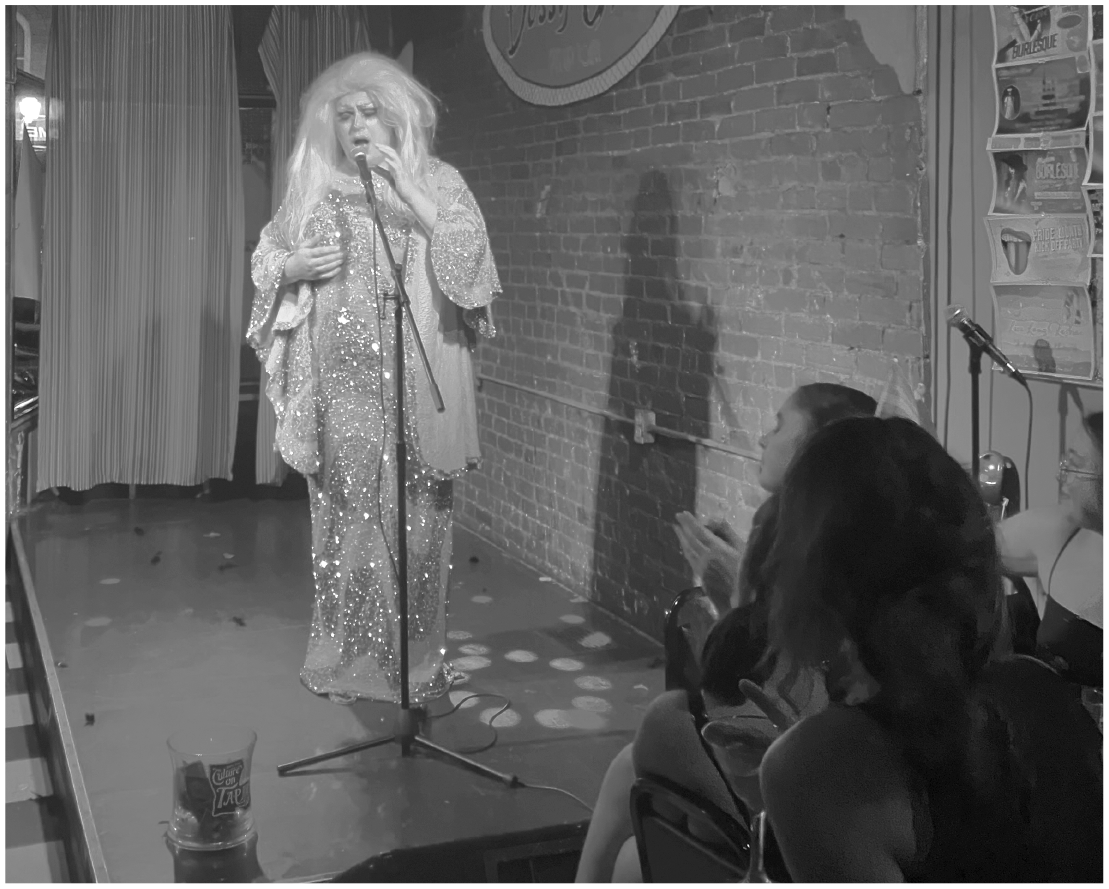
Maelstrom West performs.
Courtesy Olivia Baker
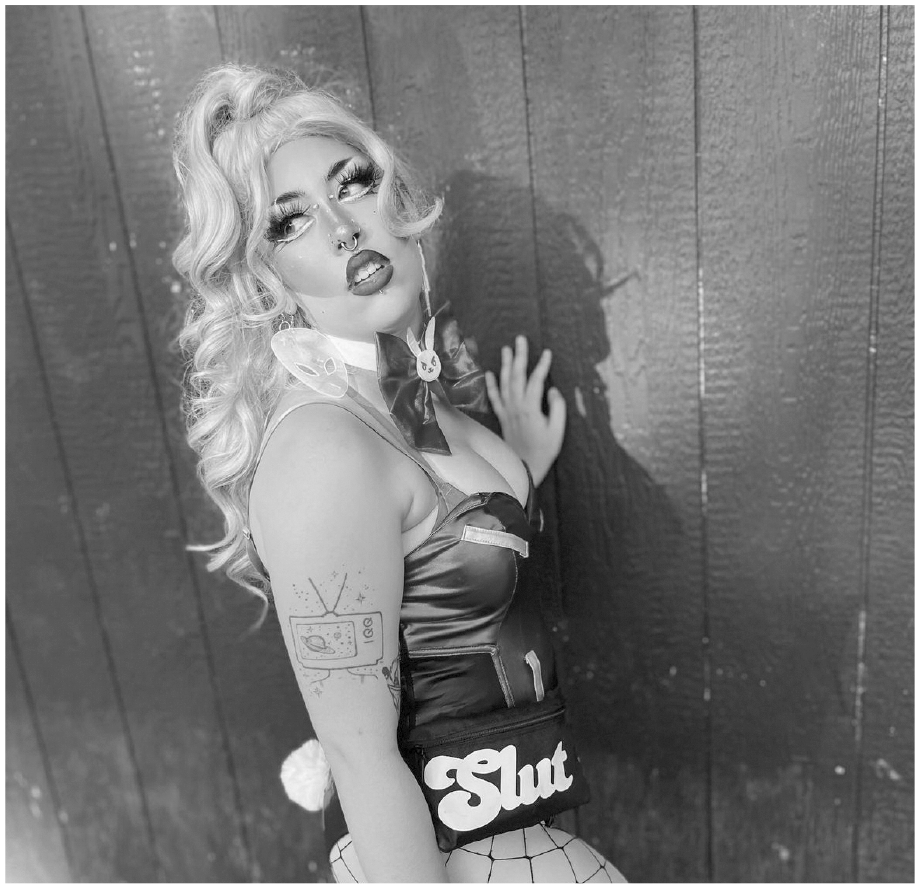
Jemini Withaj.
Photo by Maelstrom West, Courtesy Jemini Withaj
In a country where trans rights and drag are increasingly politicalized and polarized, leading to trans and nonbinary bodies becoming more policed in everyday institutions, it is important to have spaces where queer folk can experiment and express their gender freely. Drag communities provide TNAB individuals a uniquely supportive environment to explore gender expression without the same social repercussions they experience in the “real world.” Clinica, Calamity, and Maelstrom described exactly this phenomenon. Calamity, for example, called drag “a vehicle for people to discover themself, as well as an art form,” because the gender-bending nature of drag provides the opportunity to experiment with gender without the pressure of a label.
For Jemini’s partner, Maelstrom, drag actually helped her realize she was trans: “One time I was just like, you know what? I’m gonna go out [and perform as a drag king] and just do something I don’t normally do. And [afterwards] I called Jemini sobbing in hysterics because it wasn’t me, this isn’t who I am. I had a full mental breakdown and realized, at that moment, I’m a trans woman.” The act of deliberately turning masculinity into a performance, rather than her usual “doing of gender” in her day-to-day life, was revelatory for Maelstrom.
Drag is more than gender performance and experimentalism; it also provides a meaningful community for LGBTQ+ folk. All of the participants I spoke with described having close friends in the drag scene who represented their “chosen family” and served as networks of emotional and physical support in communities where drag or queerness may be looked down upon.
Ultimately, drag is a form of creative queer resistance. Nonbinary performer Edna Mwah explained that “one of my biggest goals right now when I’m in drag and curating shows is creating a safe space for our community and local queers that don’t have anywhere else to go… that’s just what our job is as drag performers.” Maelstrom agreed: “We are truly under attack as a community. So, to be visible and to be vocal is something that is really, really important to me because I need to show [others] that it’s okay to be who I am as a proud trans woman.”
For these TNAB performers, drag is more than lip-syncing, fantastical fashion, and gender performance. It is a precious space to discover gender identities, feel supported in queerness, and develop a close-knit community.