Abstract
David Bacon captures the eviction of an unhoused encampment, exposing the bones of capitalism.
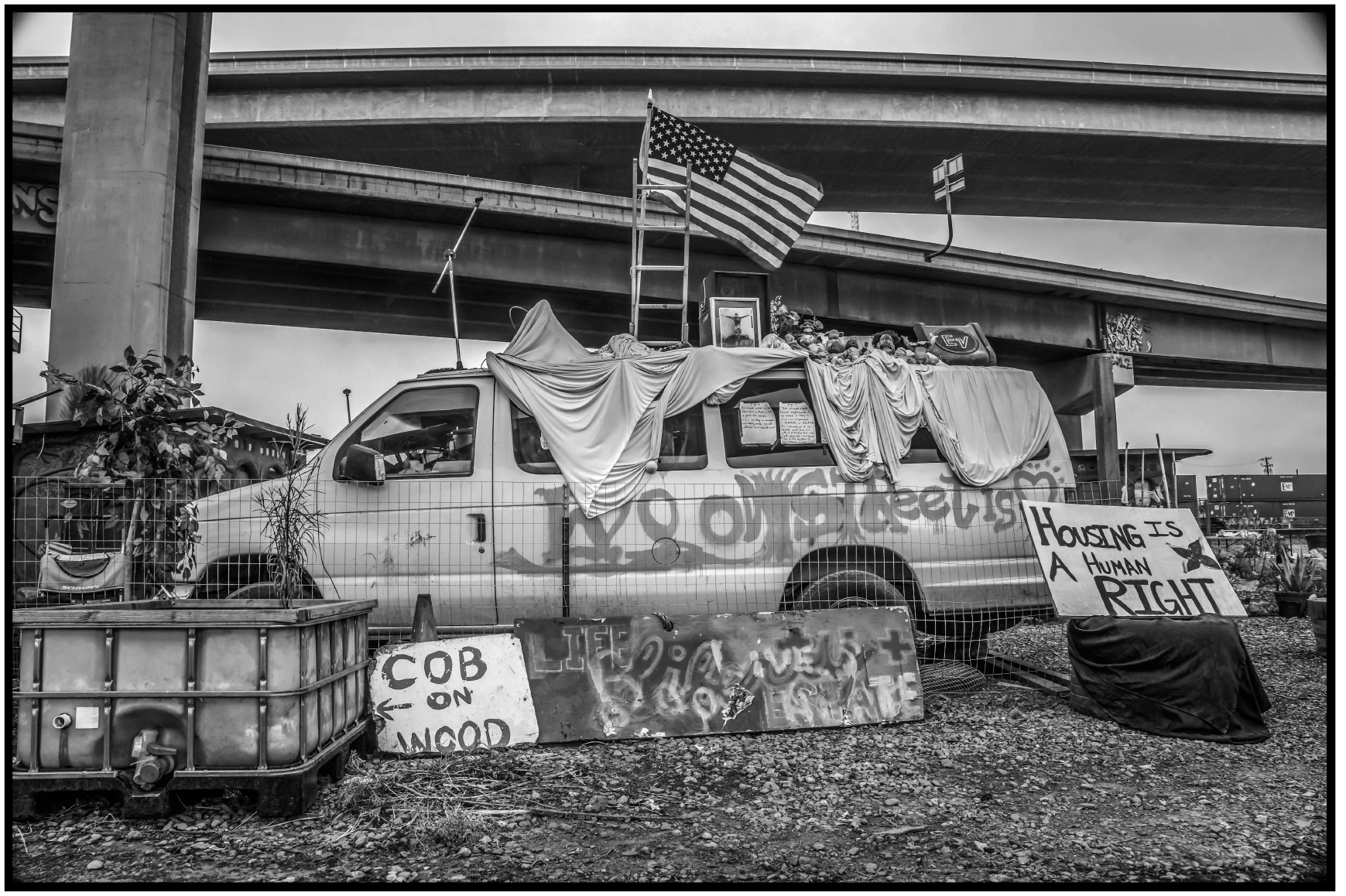
For the people evicted from Wood Street, Oakland, the largest unhoused encampment in northern California, housing is a human right. Residents had even painted their assertion in bright colors on a placard at the gateway to their dwellings. But the California Department of Transportation (“CalTrans”) disagreed. It owns the land under an enormous freeway interchange called The Maze, where over 300 people lived for years. The U.S. Constitution, CalTrans asserts, does not recognize a right to housing.
In the dispute over the mass eviction, Federal Judge William Orrick came down on the side of the state. “I don’t have the authority—because there is no constitutional right to housing—to allow Wood Street to stay on the property of somebody who doesn’t want it,” he admitted.
Early in 2023, the last 60 residents were forced to vacate the strip of land occupied by RVs, tents, and informal homes, extending for 25 city blocks. A series of reports by Nuala Bushari and Sarah Ravani in the San Francisco Chronicle documented the dire situation: Oakland’s homeless population had increased 24% in just three years. The city had 598 year-round shelter beds, 313 housing structures, and 147 RV parking spaces. All were filled. According to a census of the unhoused in early 2022, more than 5,000 people were sleeping on Oakland’s streets.
Wood Street Commons, the now-empty camp, had a long history. Houses were cleared from the original area in the 1950s to build the freeway maze leading to the Bay Bridge. In 2016, as gentrification and the city’s housing crisis grew increasingly acute, displaced people began setting up what would become Oakland’s longest-standing settlement of the unhoused. In one small section, residents and supporters erected a number of makeshift homes and a common area for meetings.
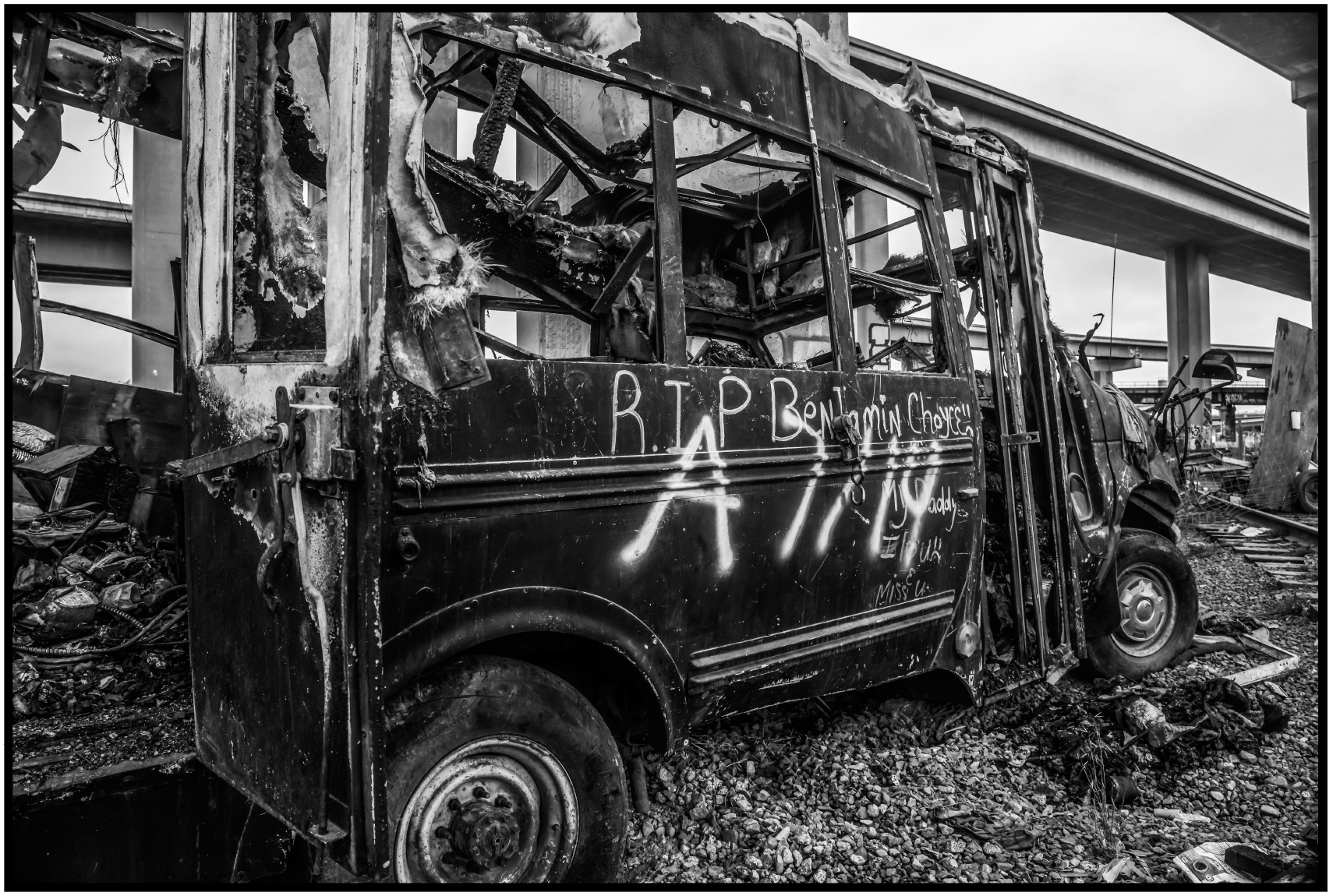
In recent years, however, fires became frequent on Wood Street; there were more than 90 in 2021. In April 2022, one man lost his life in a blaze in his converted bus, while, in July 2022, propane cylinders used for heating exploded in flames so hot that vehicles were incinerated. Of course, Wood Street wasn’t the only camp to suffer blazes. A city audit documented 988 fires in 140 encampments in 2020 and 2021.
But after the July 2022 fire, CalTrans announced that it would evict Wood Street’s residents. Lawyers for the unhoused convinced Judge Orrick to temporarily bar the action. In 2022, the state gave Oakland a $4.7 million grant to house 50 people, but as evictions proceeded, city administrators announced that non-profit developers planned to build 170 units of housing on the site. While Oakland needs housing desperately, virtually none of the evictees would ever be able to buy or rent one of these units.
Dustin Denega, an unemployed musician, said that in the four years he’d lived on Wood Street, he felt safe and protected from violence that often affects people sleeping on sidewalks. By contrast, a man was shot and killed in the “Tuff Shed” cubicles the city provided for the camp dwellers (calling them “alternative housing”). “That city housing is surrounded by a fence. You can’t have visitors, and it feels like a prison. And it’s not safe,” Denega said.
In 2018, United Nations Special Rapporteur on Adequate Housing Leilani Farha visited Oakland. “I find there to be a real cruelty,” she observed, “in how people are being dealt with here.” She compared Oakland to Manila, Philippines, Jakarta, Indonesia, and Mexico City, Mexico, where she said homelessness is basically tolerated. In the United States, a far wealthier country, being homeless is instead criminalized.
All photos © David Bacon
The Wood Street encampment of unhoused people stood under a freeway and railroad overpass. Volunteers organized to help its hundreds of residents try to resist eviction, but the city and CalTrans forced the encampment’s demolition.
The Wood Street eviction exposed the bones of capitalism. The right to property is enshrined in law, and the legal structure of the state will enforce it, even if it leaves people on the street with no place to sleep or live. Land is a commodity, and it is bought and sold. If the right to live on it comes first, the property right of any landowner is in danger. That requires the expulsion of people in land occupations.
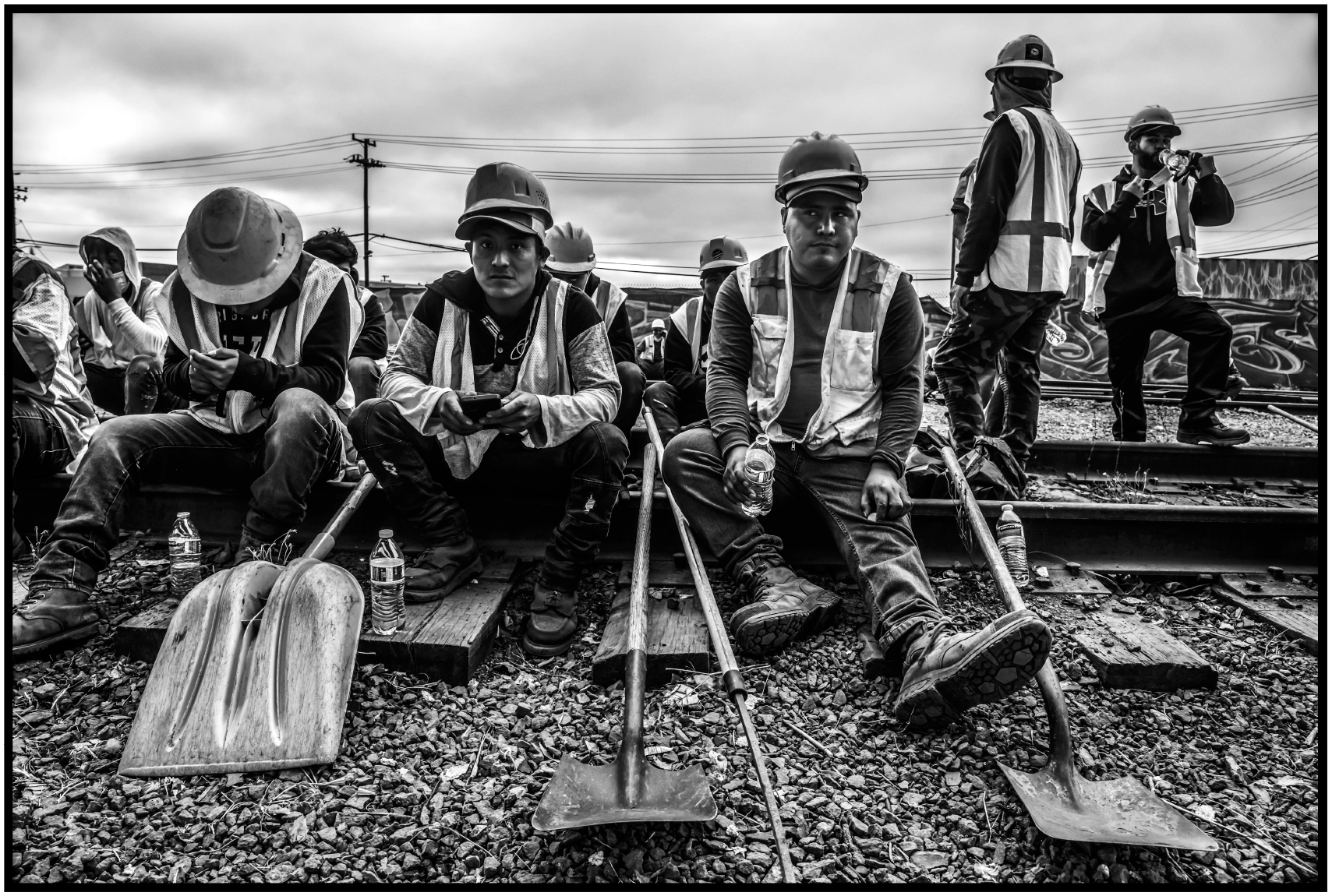
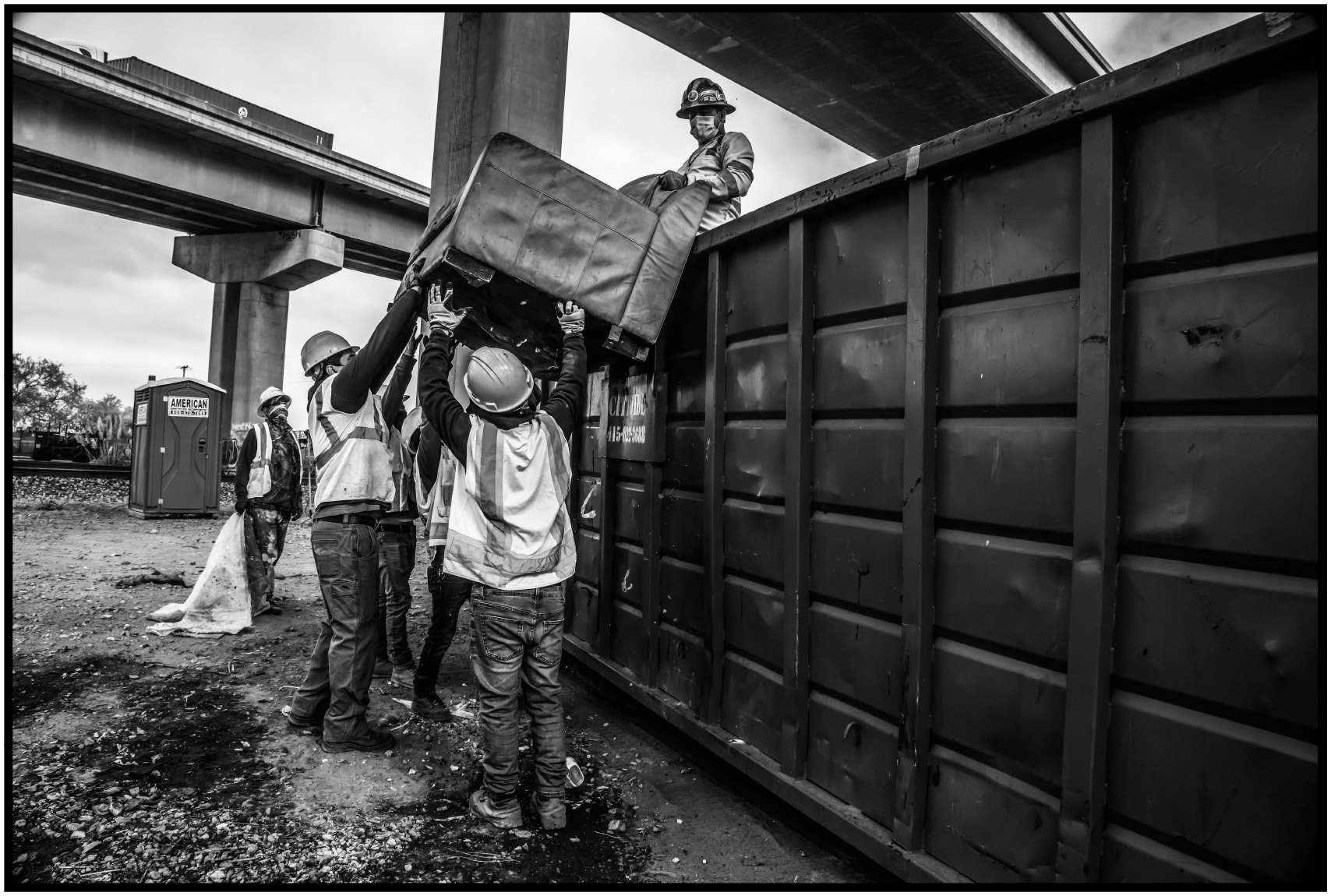
As camp residents departed, a group of day laborers took away belongings and discarded the trash left behind. They were some of Oakland’s lowest-paid workers, Mexican and Central American jornaleros who daily look for work on city streets, such as those documented by sociologist Gretchen Purser in her 2009 ethnography, The Dignity of Job-Seeking Men. While the jornaleros hauled out debris, another group of impecunious Oaklanders—the unhoused people who would soon be joining them on those streets—watched.
The workers cleaned out the camp for the lowest wages possible, demonstrating yet another aspect of municipal neoliberalism, alive and well in a city and state known for their progressivism.
Benjamin Choyce died from smoke inhalation in a fire in the converted bus where he lived.
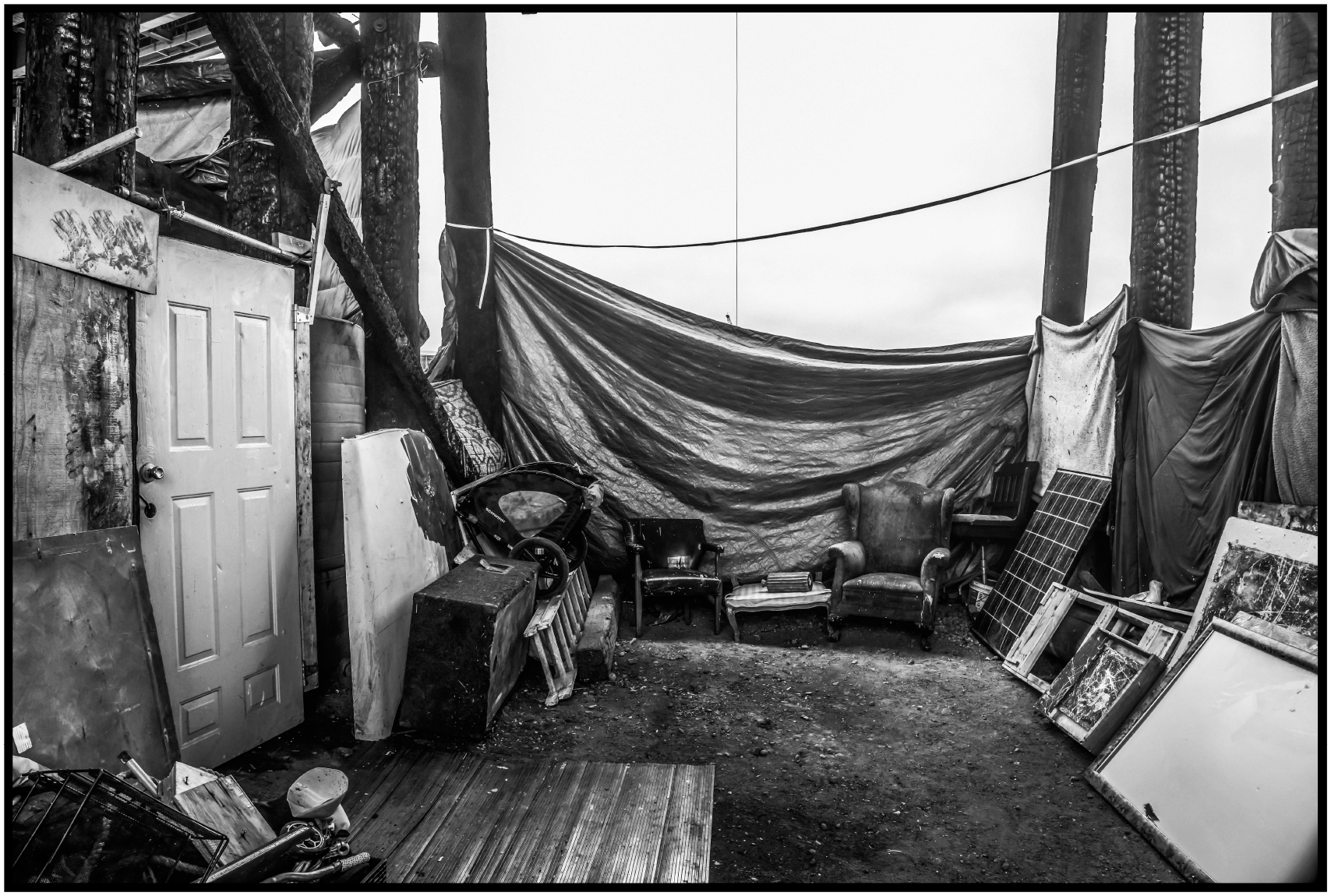
A living room or artist studio Wood Street resident Jake built under the trestle.
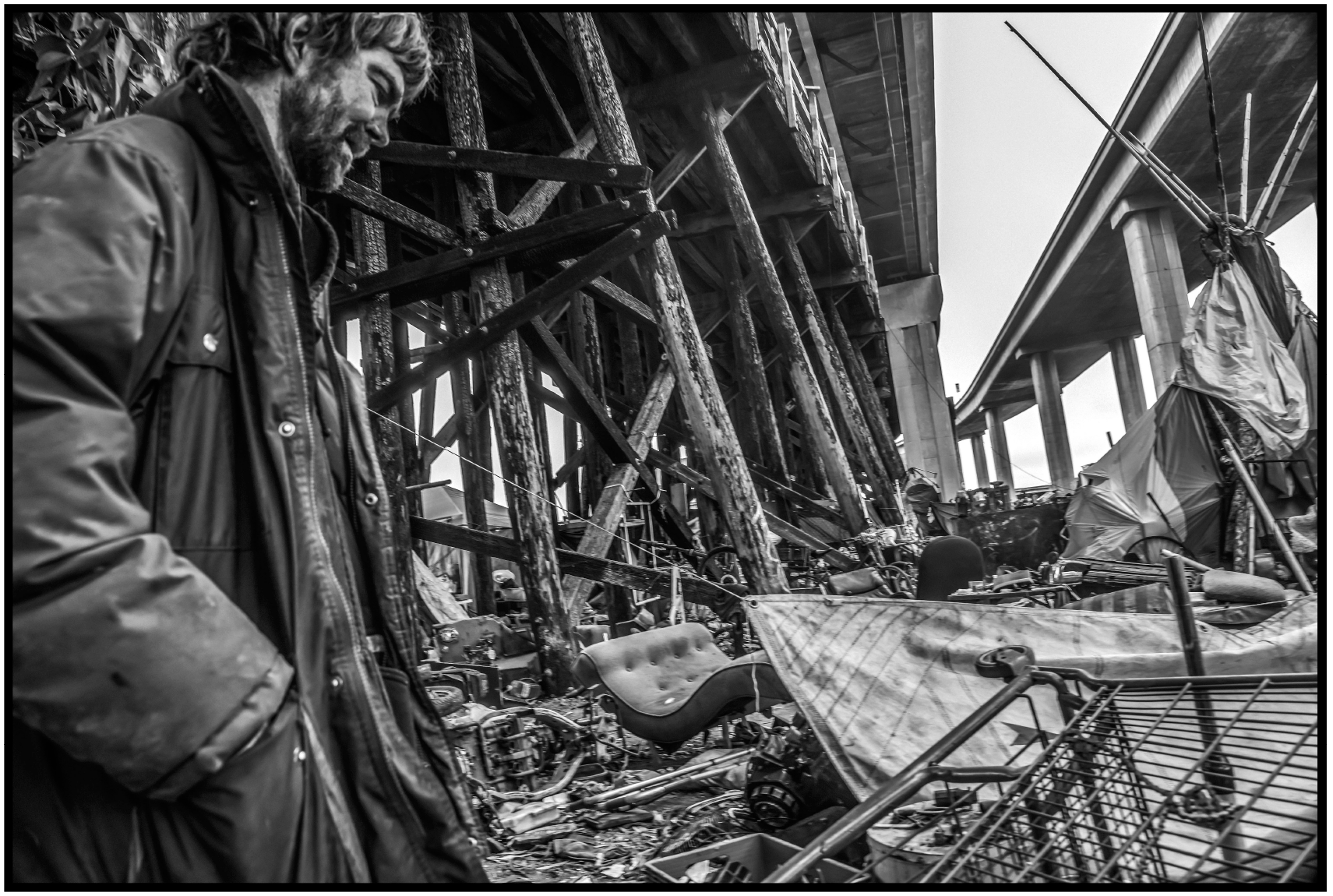
Jason, a resident, looks over the remains of homes and belongings after the big fire.
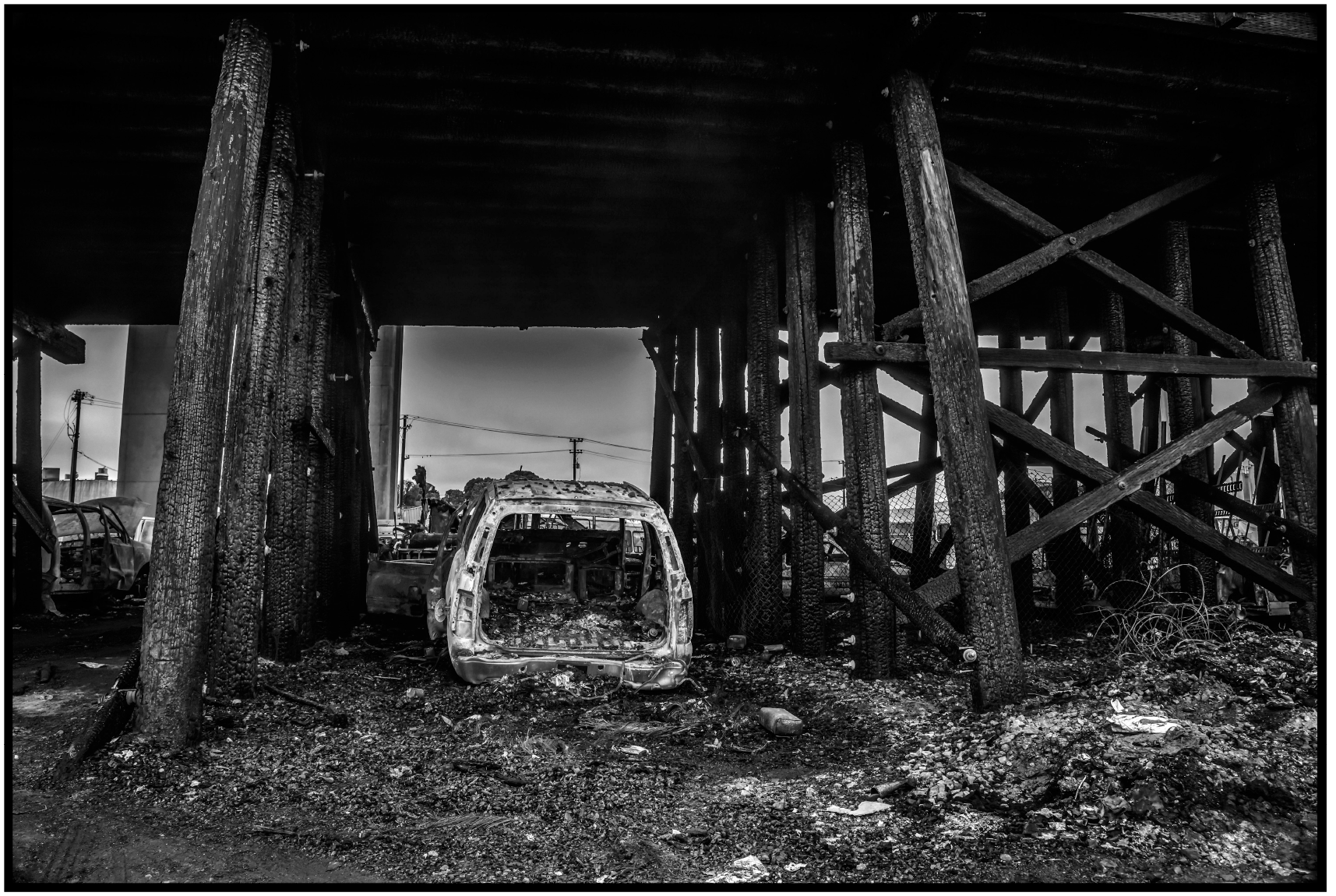
A car burned in the last big fire. When cars were burning, CalTrans had to close the freeway above.
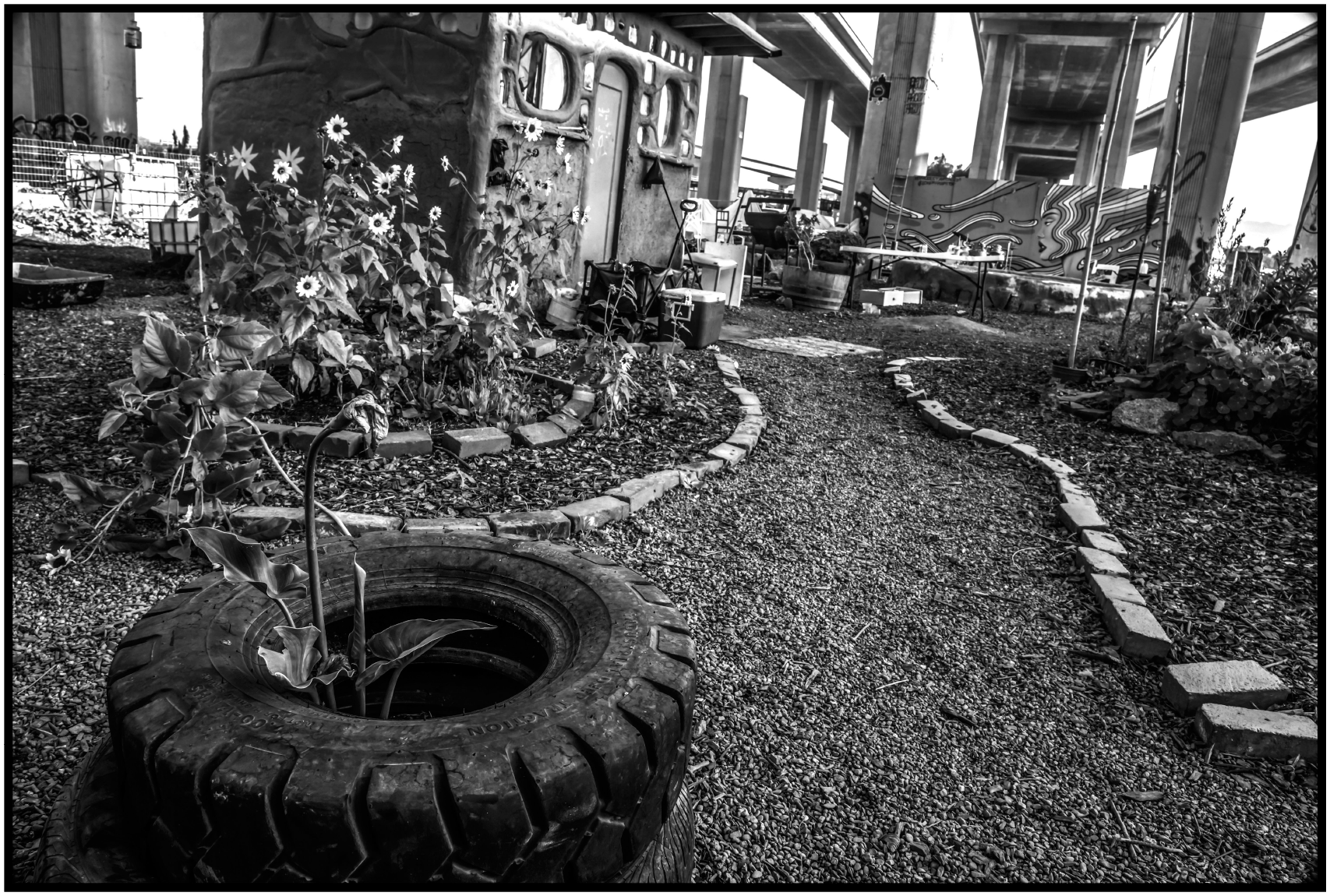
Some residents and volunteers build small homes with straw and mud, called cob, in a section of the camp they called “Cob on Wood.”
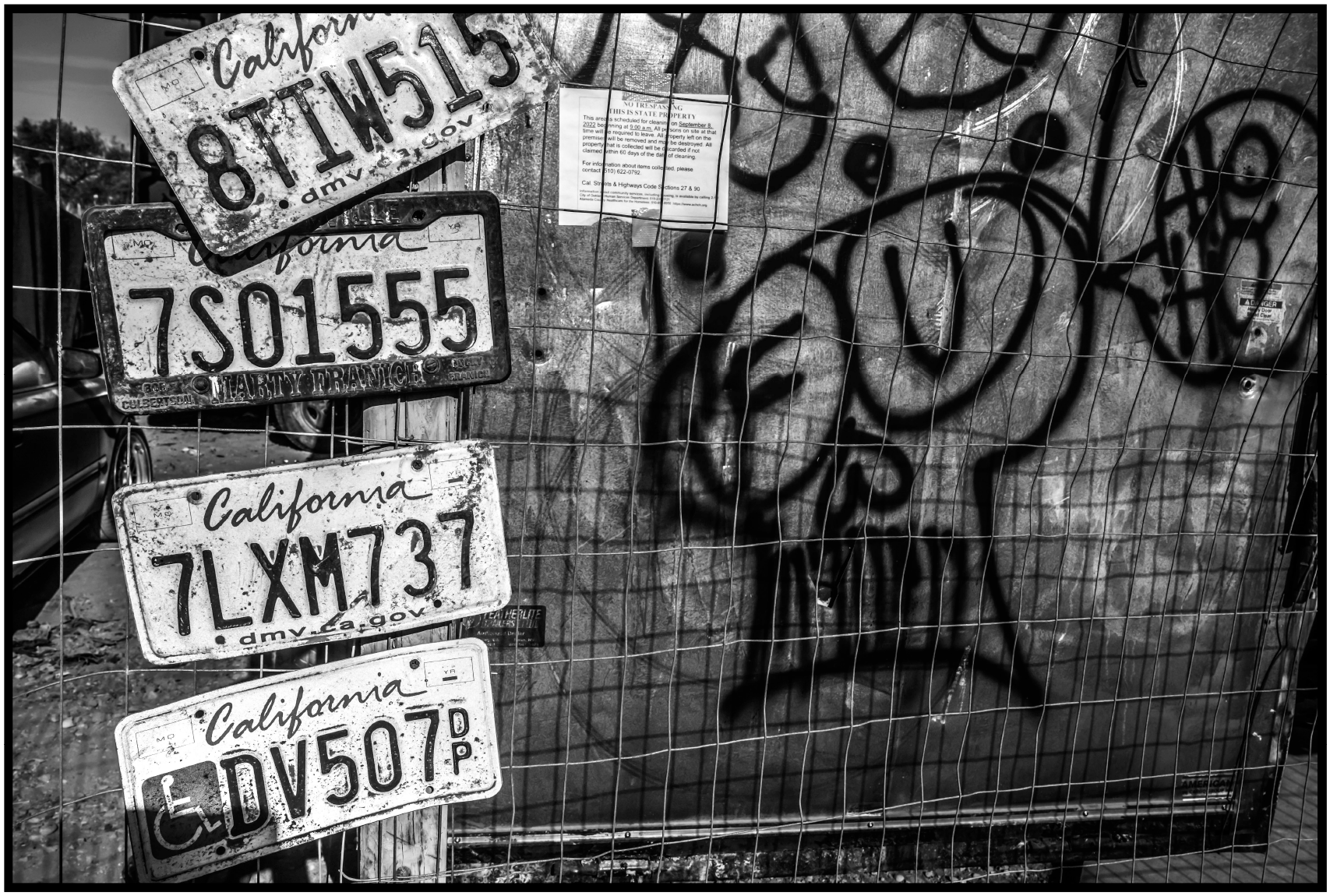
After BNSF Railroad and CalTrans announced they would force people to leave, notices were put on vehicles warning of the impending eviction.
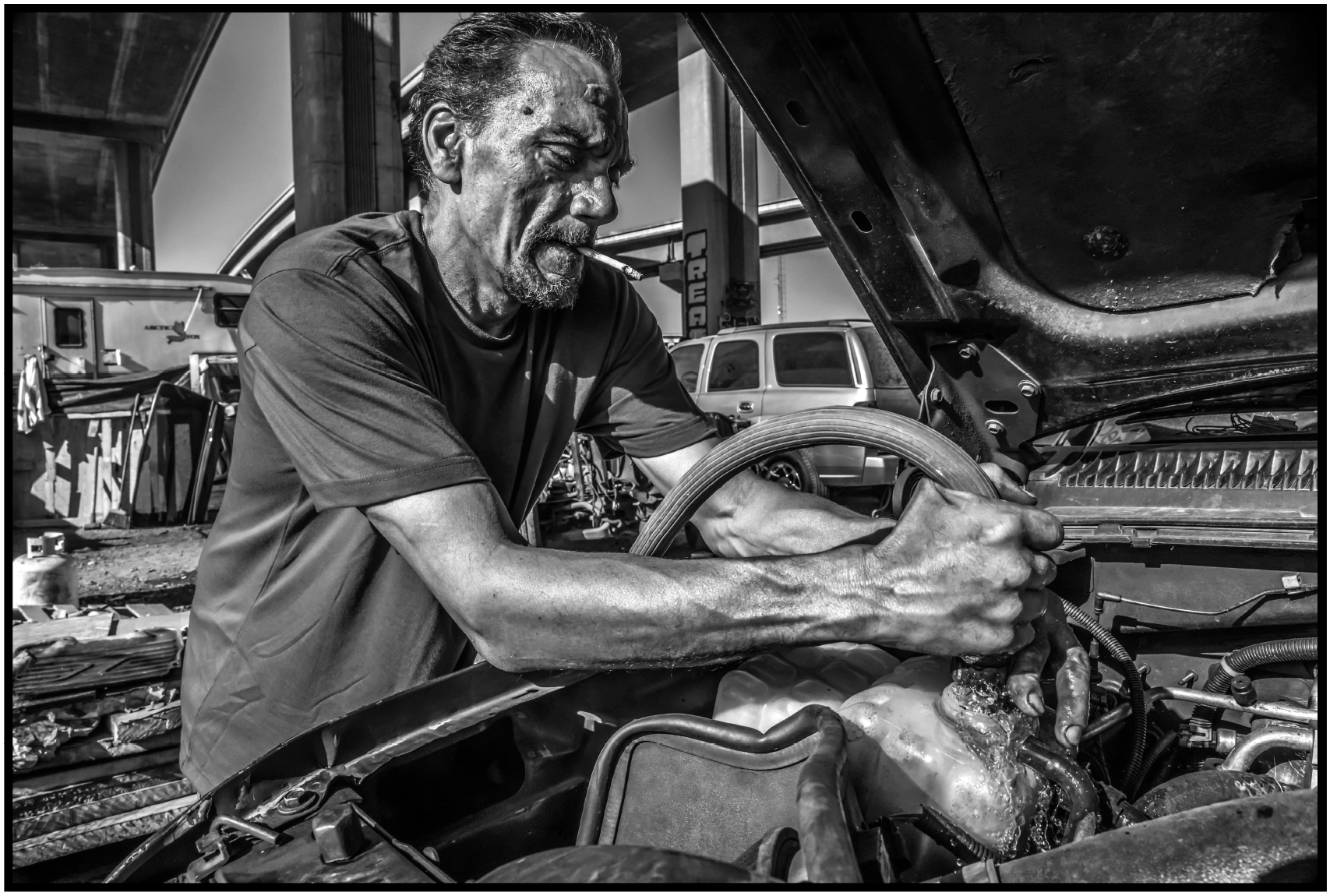
Adam Davis poured water into a tank in his car, readying himself to move to another location.
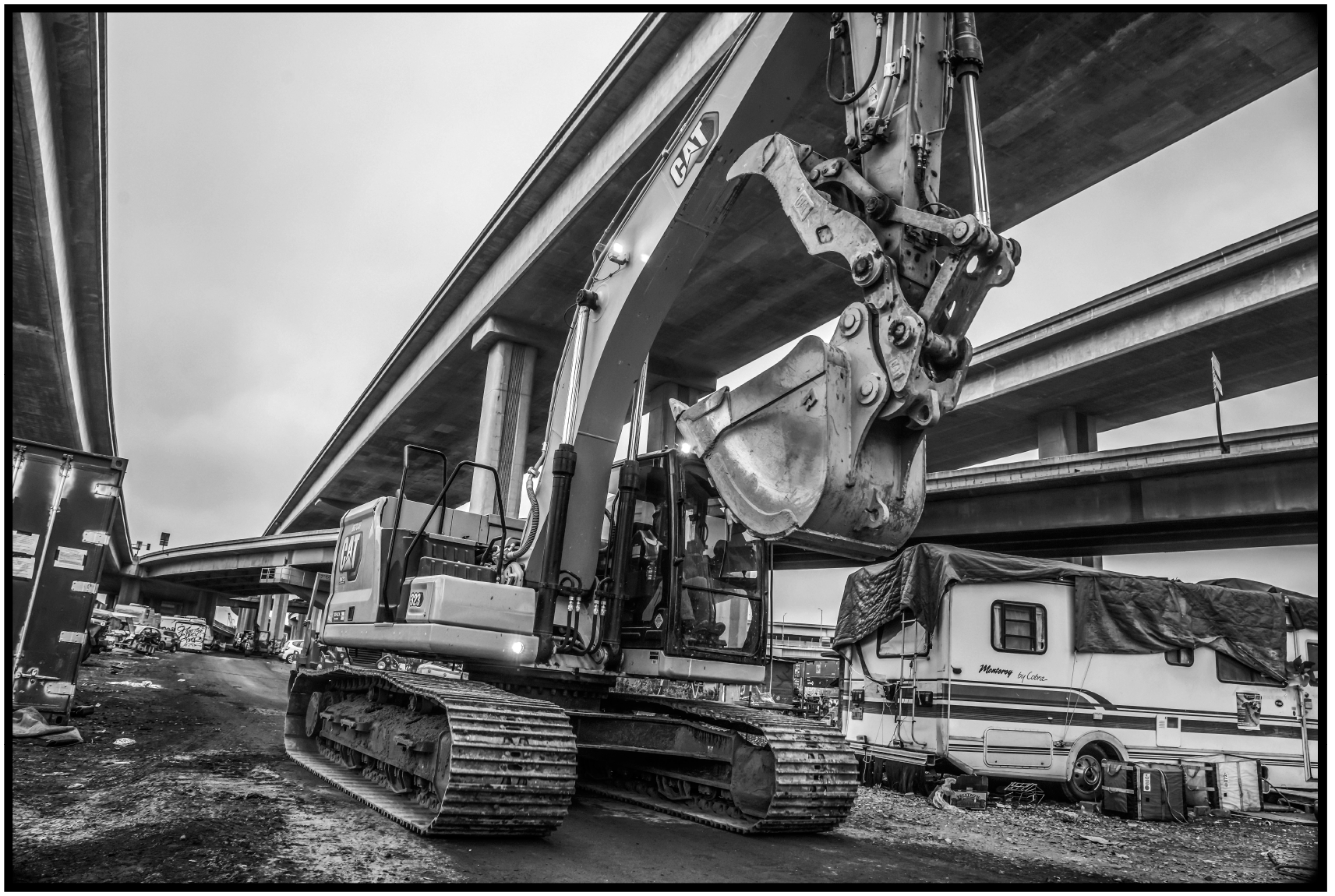
Heavy equipment is brought into the Wood Street encampment to frighten residents into leaving without more protest.
As a resident watches, a forklift hoists a resident’s SUV and takes it out of the camp under the freeway.

Day laborers are brought to clear the encampment.
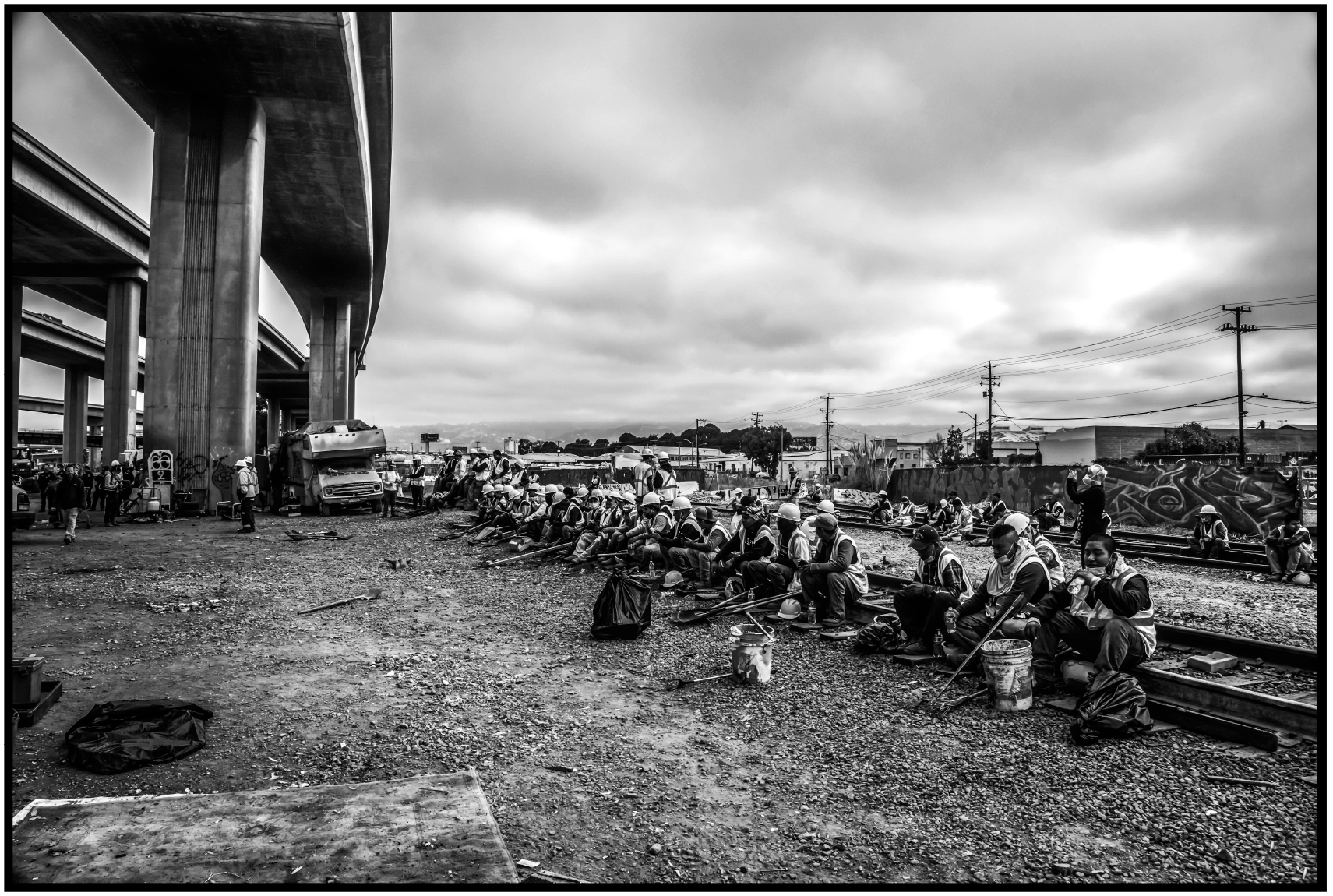
The day laborers brought to clear the encampment were Mexican and Central American workers, who find temporary jobs by waiting on Oakland sidewalks.
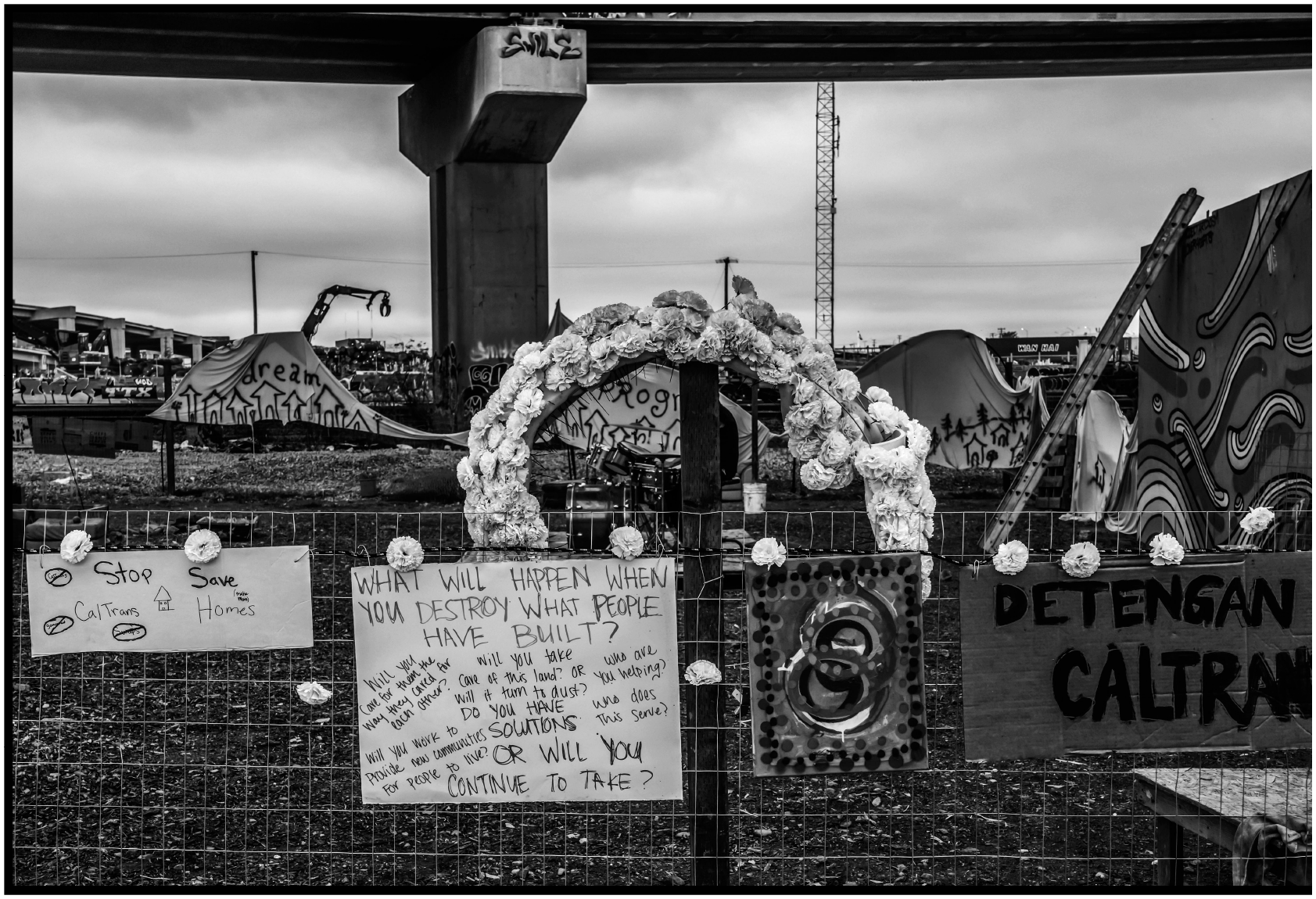
Residents and supporters write their last appeals, posting them on a fence they built to protect their meeting area.
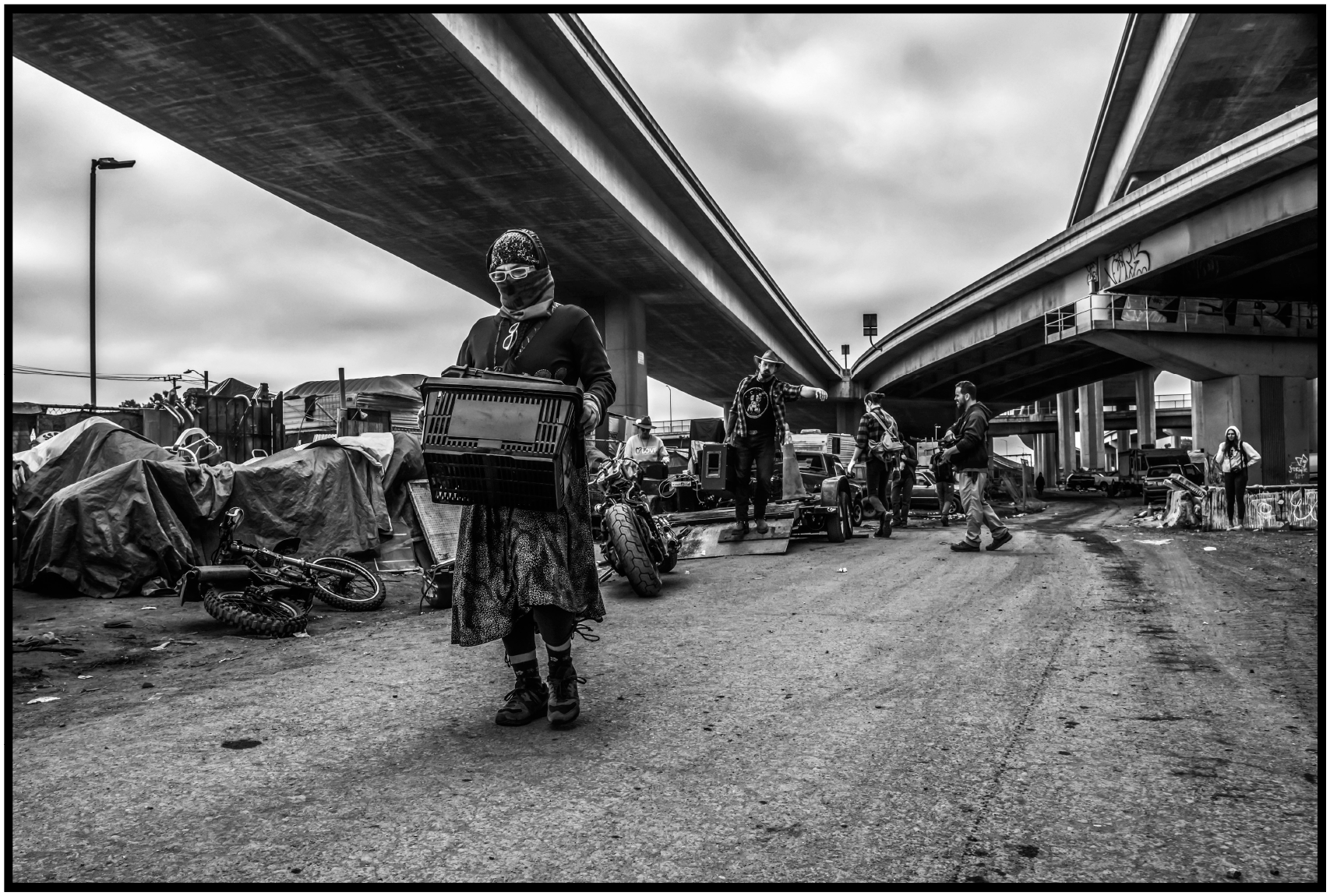
A volunteer brings in sound equipment for one last jam before the eviction.
Day laborers hoist a sofa left behind into a dumpster as trucks leave the huge port of Oakland on the freeway overpass above.
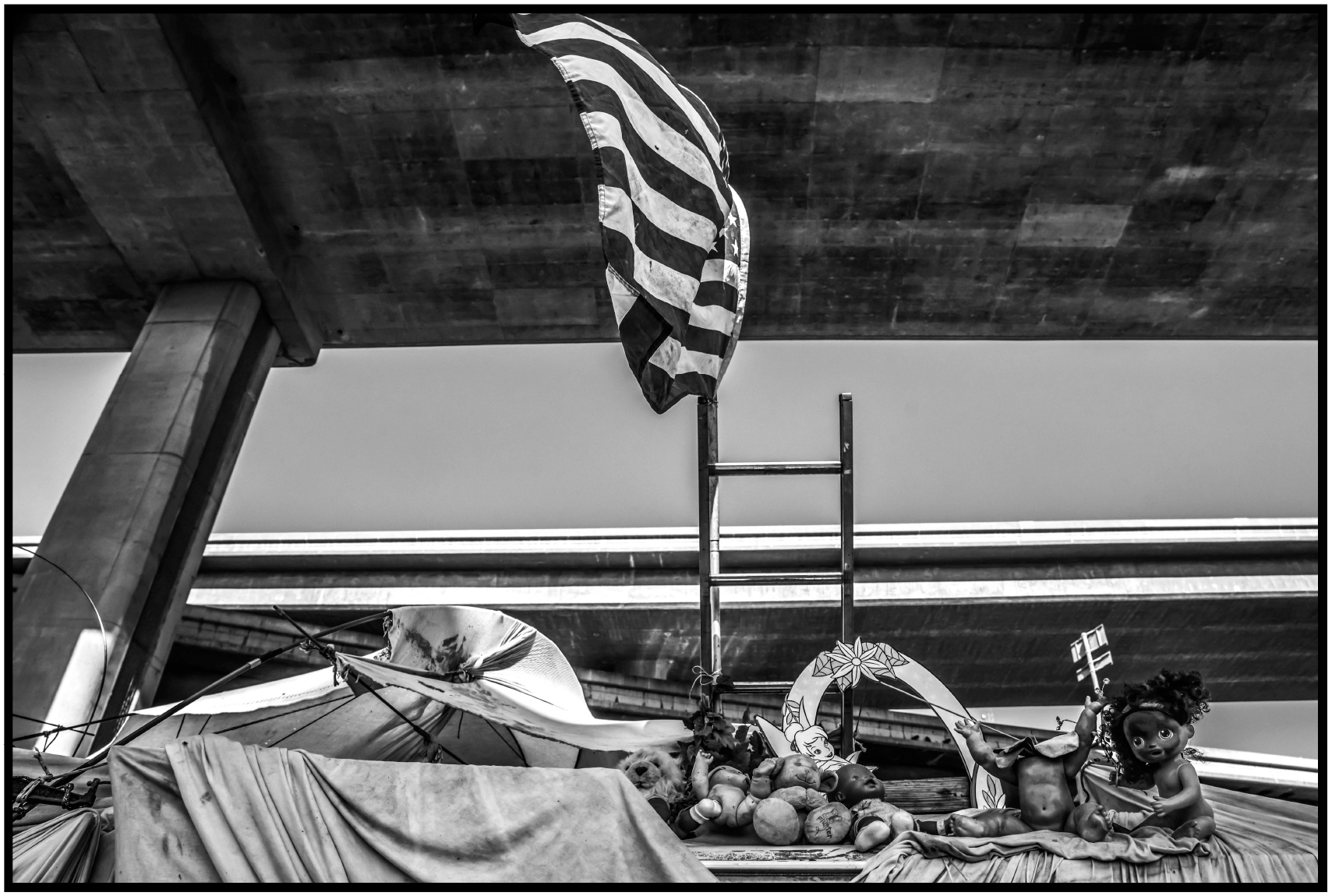
Dolls and a flag are the ironic comments left on a vehicle under the freeway, about to be towed away.