



Abstract
Jill D. Weinberg and Louise Bond on the insufficiency of the Pell Grant reinstatement.
The U.S. government reinstated Pell Grants for incarcerated people in July 2023, ending a ban in place since 1994. The reinstatement is estimated to give more than 750,000 incarcerated people the opportunity to pursue higher education in the 2023-24 academic year.
Colleges and universities have offered courses in prison since the 1980s, relying heavily on donations and grants to cover tuition costs, course materials, and minimal compensation for faculty. The Pell Grant reinstatement will reinvigo-rate prison education across the country, offering a financial lifeline for colleges and universities that operate in-prison programs with limited resources.
The return of Pell Grants for incarcerated students will also increase opportunities for them to take college courses in prison, and it may lead to them continuing or completing their studies upon release. Studies consistently show a correlation between a college degree and lower recidivism rates, so Pell’s reinstatement will likely help to decrease recidivism.
The Pell Grant reinstatement will reinvigorate prison education across the country.
Still, our research and experience working in prison education led us to pause and reflect on potential new challenges. Despite policy changes to increase college access, informal, taken-for-granted processes, as well as social and institutional barriers, may still lead to reinscribing inequalities and reinforcing the stigma of incarceration.
Even with Pell Grants, incarcerated and formerly incarcerated students will continue to face significant challenges in pursuing their education. The most notable obstacle is the barrier to financial aid. All students must complete the Free Application for Federal Student Aid (FAFSA) to receive Pell Grants and other federal student aids. The FAFSA is a complex process for anyone, but it is especially difficult for incarcerated students who often lack access to the requisite financial information and have limited communication with family to obtain the information needed to complete the form. Additionally, incarcerated students typically fill out FAFSA by hand because of limited access to the internet. Prison education programs could deploy a person to guide students as they fill out their FAFSA applications, but programs have limited time and resources. This process alone can impact not only incarcerated students accessing Pell Grants but also students released from prison looking to continue their studies on a college campus.
Further, though re-opening eligibility for Pell Grants is a step in the right direction, the amount of aid is insufficient to pay for tuition and living expenses at most full-time colleges and universities. According to the Department of Education, the 2023-24 maximum Pell Grant is $7,395 per academic year, while the average annual cost of attending college in Massachusetts, where the authors are located, exceeds $25,000 for a public four-year university—and it is nearly $50,000 for a private one. Students looking to complete or continue their education upon release will regain access to federal student aid in addition to Pell Grants, but the high cost of higher ed creates an additional financial burden, forcing students to take out loans, limit their options to schools that offer scholarships, or to work one or multiple jobs while in school.
It’s crucial to note that there is no law prohibiting colleges and universities from rejecting applicants on the basis of their criminal record. Indeed, studies have shown that students with felony convictions are more likely to be rejected. Even universities that offer degree programs inside prisons may be reluctant to allow those same students to continue and complete their studies on campus. Admitted students may also face restrictions, notably when it comes to student housing made (or not made) available to them, especially to those older than the average undergraduate population.
What’s more, there are ethical questions related to boundaries that educators and universities need to consider, balancing limitations imposed by the Department of Corrections. In existing university programs that focus on supporting the continuing education of formerly incarcerated people upon release, the Department of Corrections’ authorization of a college-in-prison program may be contingent upon the enforcement of social boundaries, particularly when some students are still subject to parole or probation stipulations. In other words, despite the fact that students are no longer physically incarcerated, parole boards still retain jurisdiction to limit a parolee’s participation in certain programs where there are multiple formerly incarcerated students or individuals they met during their time at a school’s in-prison program.
Should a student secure funding and admission to attend school, there are other key challenges formerly incarcerated students face when transitioning from prison back into society. Scholars have identified major obstacles with social reintegration, such as securing employment, securing housing, and addressing substance abuse or other mental health needs. This puts prison education and reentry programs in a unique position to not only provide education but also to step into a social-worker-like role to identify wraparound services. At the current moment, colleges and universities offer minimal services to address these interlocking needs. Some, but not all, colleges offer substance-free housing to offer counseling and a supportive community, though they may not permit a formerly incarcerated student to participate due to their criminal history or age.
Furthermore, most universities offer support to help students with on-campus needs (e.g., loaner laptops or a computer lab), but institutions of higher education are not equipped to address off-campus matters that may impact on-campus success, such as food and housing insecurity.
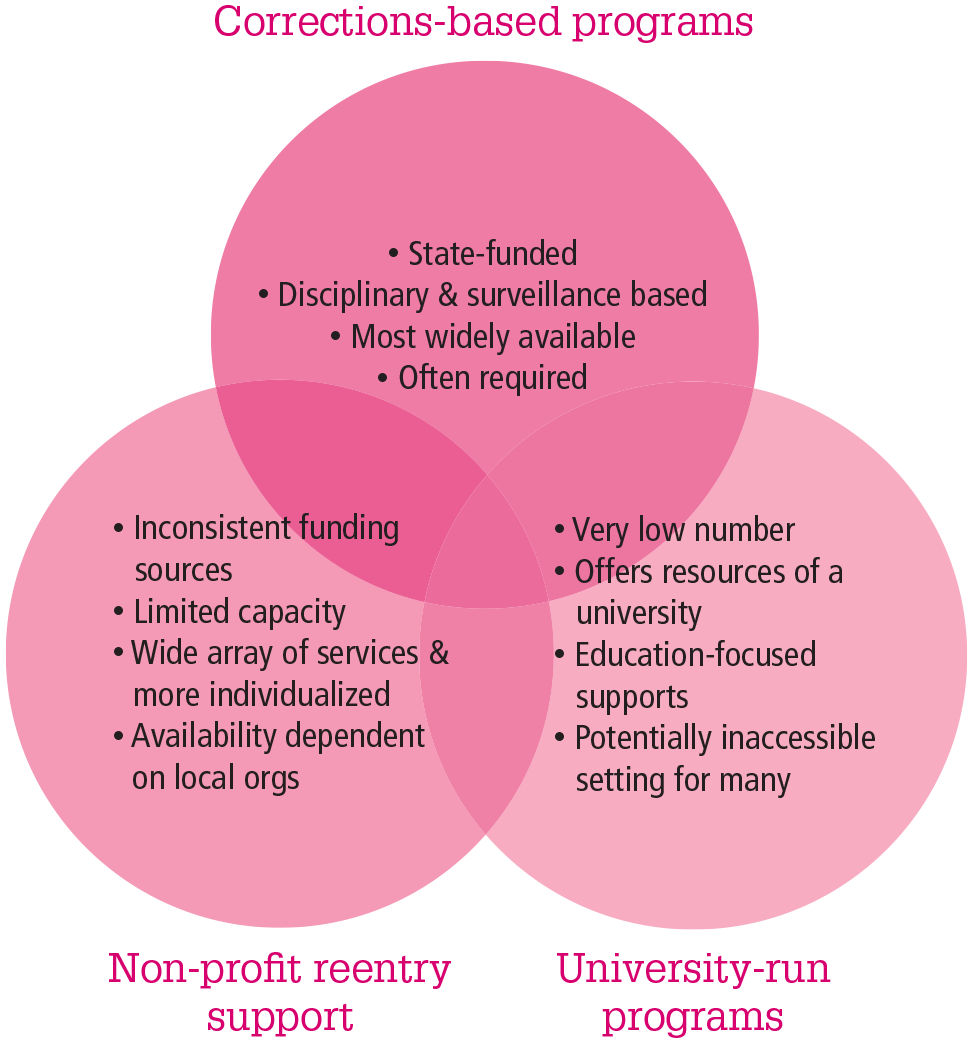
Accordingly, our research of reentry programs shows that the services formerly incarcerated students need do not fit neatly into what we map as one of three categories of existing reentry programs, but their relative benefits can provide guidance on how new programs could most impactfully support formerly incarcerated people’s holistic needs.
Corrections-based programs and services remain the sole support guaranteed by the state upon release, yet most formerly incarcerated individuals express serious dissatisfaction with the scope and quality of those programs. Parole and probation programs focus on prohibiting and surveilling behavior, rather than providing holistic support. People are left without essentials like an ID, housing, and education. Nonprofit organizations provide more individualized support, but their missions and scope of services vary, which may be limiting. Courts and parole boards may refer people to nonprofits, but they do not fund their services.
While more colleges and universities are offering in-prison education programs, few continue to offer courses to students upon release. University-run reentry programs provide the resources of an institution of higher education and an education-focused community, but they can be inaccessible to formerly incarcerated people for social and economic reasons. Additionally, some institutions are unwilling to support the same students on their home campus once they are released due to stigma and perceived safety threats.
The removal of the 1994 Crime Bill’s discriminatory ban on Pell Grants for incarcerated people is certainly something to celebrate, yet it should not cloud the serious hurdles that remain to make higher education truly accessible to system-impacted people. Our work in prison education and reentry shows that many institutional constraints will continue to plague incarcerated students well beyond their prison sentences, thereby reducing the likelihood that they will continue their academic pursuits.