



Abstract
William Beaver on four factors depressing higher ed enrollments.
The coronavirus pandemic has taken a toll on higher education in the United States. During the pandemic, enrollments declined by 9.4%, or approximately 1.4 million students. However, there are indications that other factors are also having an impact on enrollments.
Higher education has a difficult period ahead. Fewer high school graduates are pursuing four-year degrees due to costs, underemployment, the growing popularity of apprenticeships, and demographics.
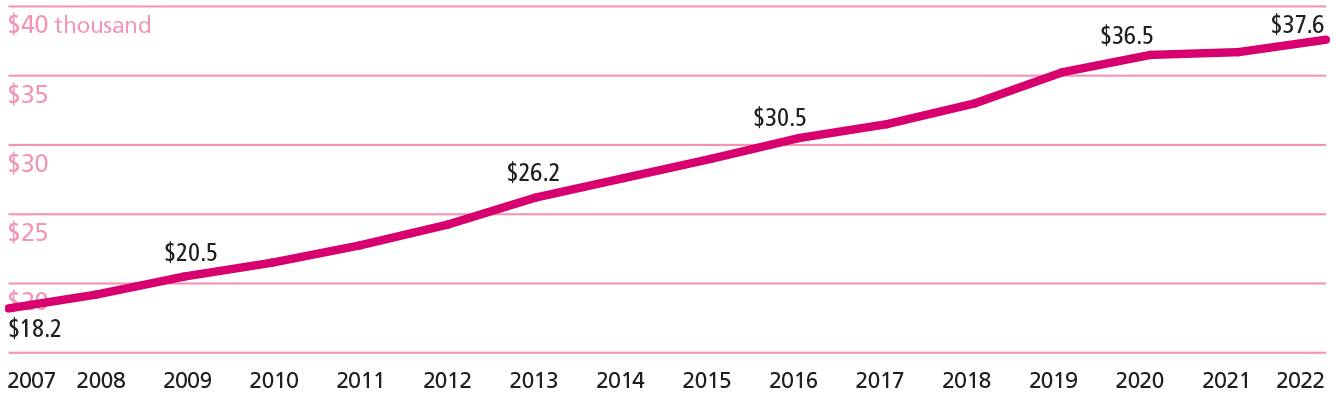
The debate over student loan forgiveness, for example, has raised public awareness about the costs of college. A recent Wall Street Journal-Norc poll found that 56% of those surveyed felt that college was not worth those costs, which have risen by an astonishing 124.2% at four-year schools over the past 20 years. Moreover, the average undergraduate student loan debt climbed to around $37,000 in 2020 (see top figure, p. 55). Eleven percent of borrowers will default in the first year, and 25% will default within the first five years. Default rates are highest for those who drop out of college—and keep in mind that only 40% of students will earn a degree in 4 years. The problem is particularly acute for low-income first-generation college students. Twenty-five percent of this group will drop out during their freshman year, and 89% will leave college without a degree within 6 years. Not only are they saddled with debt, but their employment prospects are usually limited to low-paying service jobs. Parents can become indebted by this system too, particularly if they take out “Plus Loans” to help pay for their child’s education. In 2023, the average balance for these loans was $29,234. Ten percent of parent borrowers will fall behind on their payments or default within two years, which is tied to the fact that 6 in 10 of these borrowers are low-income.
A skills-based path into a profession, a coveted white-collar apprenticeship can be as selective as some Ivy League schools.

The value of a degree is usually measured by the job it helps a graduate secure and what it pays. When college freshmen are asked why they have enrolled, 90% say “to get a good job,” a figure that has steadily risen since the 1970s. Unfortunately, not all graduates find a good job. According to the Federal Reserve Bank of New York, 41% of recent college graduates are underemployed. That is, they hold jobs that don’t require a college degree and, in fact, were once held by high school graduates. Why does this occur? Employers assume that degree holders are more capable, and if they are available, it only makes sense to hire them. On the other hand, recent graduates need an income to achieve some level of independence and start to pay off their student loans. A study conducted by Harvard Business School found that companies pay college graduates 11-30% more than non-degree holders. The system is inefficient because companies are paying more than needed, while non-degree holders are being denied a chance to earn higher wages. Hence part of the pay gap between college and high school graduates—which is around $33,000 a year—occurs because high school graduates are forced into lower-paying jobs.
Historical average federal student loan debt
Source: Federal Student Aid, EducationData.org
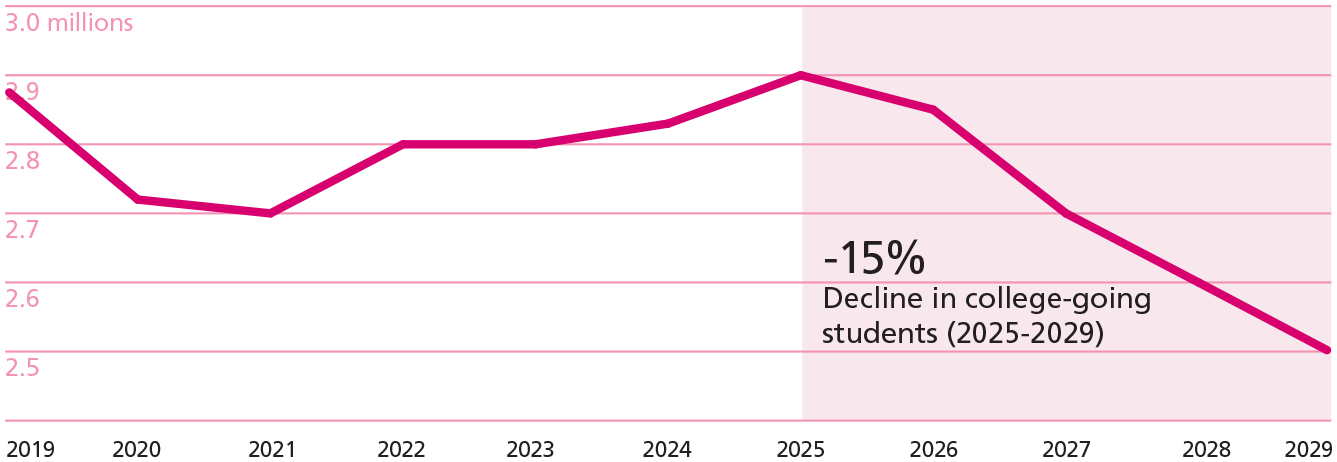
Enrollment projected to drop sharply after 2025
Forecasted number of college going students in the U.S., by year of high school graduation
Source: EAB, Based on projections from Nathan Grawe’s Higher Education Demand Index
What a job pays is strongly related to college majors. STEM degrees (science, technology, engineering, and math), along with certain business and medical degrees, have a much better chance of securing a job within their major along with higher wages. Research conducted at Georgetown University found that STEM graduates earn 50% more over a lifetime than liberal arts graduates. Not surprisingly then, between 2012 and 2022, the number of students pursing a liberal arts degree dropped by 25%. Conversely, students pursing business degrees increased by 60% over the last 20 years, and the number of medical and health majors tripled. Some researchers attribute the decline of liberal arts degrees to the economic hard times produced by the recession of 2008. The thinking is that people became less willing to take risks, hence students pursued degrees associated with better-paid jobs. Other researchers feel the stereotype that liberal arts graduates end up with lousy jobs that don’t pay well has had a negative impact. The public is seemingly unaware of the fact that holders of liberal arts degrees still make $20,000 more a year than high school graduates. That said, almost no one predicts the trend away from liberal arts degrees will end anytime soon. For higher education, this means a continued drop in liberal arts majors—and a bleak future for current faculty and for anyone hoping to teach in these disciplines.
The value of a college degree may be further diminished by an emerging trend that would drop degree requirements for certain jobs. A number of states, including Alaska, Georgia, Pennsylvania, and Utah, have announced they will no longer require degrees for many state jobs. For instance, in Pennsylvania, 92% of state jobs will no longer require a four-year degree. In these places, hiring criteria will shift away from degrees and toward skills. This trend has support from both Republicans and Democrats, including former President Obama and President Biden, who hope that dropping degree requirements will help Democrats win back the working-class vote.
The trend of hiring more non-degree holders is not limited to state governments. For instance, Kenneth Frazier, CEO of Merck, has stated that people without a four-year degree should be given a chance to improve their lives. Frazier urged companies to hire workers without degrees and to provide training, enabling them to do jobs performed by college graduates. Along these lines, IBM initiated a program to train non-degree holders for entry-level positions that have, in the past, required a college degree. The company discovered that, with training, the non-degree workers performed as well, if not better than, those hired with degrees. Besides Merck and IBM, companies like Apple and Google also place more emphasis now on skills than educational credentials.
Those arguing against “credentialism,” or the use of educational degrees as proxies for individual competence, say that degree-based hiring is out-of-date. Political philosopher Michael Sandel has argued that credentialism is the last accepted prejudice. It has had a corrosive effect on American society by devaluing the contributions of those without degrees and increasing prejudice toward them. Beginning in the late 19th century, it was assumed that those with college degrees possessed the cognitive and verbal abilities which made them more attractive to employers. For more than a hundred years, credentialism has played a dominant role in American higher education—and its dramatic growth. If skills, rather than credentials, become the major criteria for employment, fewer people will pursue college degrees, saving money and avoiding indebtedness while potentially shrinking our system of higher education.
Reinforcing the trend toward skills-based hiring is the popularity of apprenticeships, which are no longer reserved for the construction trades. A growing number of apprenticeships are in white-collar areas like banking, healthcare, information technology, and management. Apprentices are trained for a specific job at no cost to them—in fact, they often draw a salary. This is clearly inviting: According to the U.S. Department of Labor, the number of registered apprentices has increased by 64% since 2014. Their appeal is evidenced by the fact that some white-collar apprenticeships are now as selective as certain Ivy League schools. Apprenticeships are particularly attractive to students on the margins—those who cannot afford to put in four years of college and emerge with student loan debt.
Auguste Comte, a foundational sociologist, coined the phrase “Demography is Destiny,” and in 2025 higher education will face what has been termed the “Demographic Cliff.” Starting that year, there will be a 15% decline in the number of traditional college-aged students over five years, a drop that is attributed to the recession of 2008 and the attendant decline in birth rates (see second figure above). Regional colleges and universities (both public and private) in the Midwest and Northeast will be particularly hard hit. Some have predicted that half of all colleges will either be forced to merge or close. This may be an exaggeration, but there is little doubt that some schools will find themselves fighting for survival. Further, as schools attempt to keep the students they have and appeal to the declining number of potential new students available, it’s likely that they will lower admissions standards and begin to offer more vocational degrees. At the same time, the value of certain degrees may increase due to declining numbers of graduates in high-demand fields.
Higher education has a difficult period ahead. Fewer high school graduates are pursuing four-year degrees due to costs, underemployment, the growing popularity of apprenticeships, and demographics. Besides more vocational degrees, colleges will likely attempt to recruit more international and non-traditional students and offer a variety of instructional modes, including on-line and hybrid courses. On a more positive note, these trends indicate that the two-thirds of the population without a bachelor’s degree will likely have more opportunities to improve their quality of life.