



Abstract
David Burley on prioritizing cures over causes.
Major League Baseball (MLB) has just finished up its Big Show, the World Series, which, as it has for a number of years, featured a short break in play for a moment of silence. Everyone in attendance was encouraged to remember those lost to cancer, and some somberly held up placards scrawled with the names of loved ones lost as well as those still “battling.” They took a symbolic oath to fight cancer by finding a cure. And how exactly could everyone fight this insatiable disease? By spending money… on their credit cards. Mastercard, Inc., a major sponsor of the Stand Up to Cancer (SU2C) campaign has our back, America (oh, and the rest of the world, too—or maybe just the rich countries).
Before I get too far into this ball-game, I should let you know about my tour through the big leagues. I am 52 years old, and I have had cancer three times. I had Hodgkin’s Lymphoma in 1984 and 1986 and colon cancer in 2015. Since developing colon cancer, I have had numerous complications, including Pure Red Cell Asplasia (PRCA), a rare, chronic form of anemia. How I got all of this, no one seems to know. But as an environmental sociologist and, frankly, as a human being, I often think about how capitalism is implicated in the causes of cancer and other diseases at a societal level.
As an environmental sociologist, I often think about how capitalism is implicated in the causes of cancer at a societal level.
Getting back to the starting lineup, SU2C is a part of Mastercard’s huge financial investment in finding a cure. Corporations like Mastercard sink a lot of financial resources into sponsoring these programs. General Mills’ Yoplait Yogurt, as another example, stood up to cancer by teaming up with the now-tainted behemoth Breast Cancer Research Foundation (BCRF, formerly the Susan G. Komen Foundation) and its ubiquitous pink ribbon campaign. That relationship no longer exists, but major cosmetic brands that, according to the Environmental Working Group in 2020, tend to use carcinogens in their products are now major sponsors of SU2C. Regarding yogurt, author and University of California-Berkeley professor Michael Pollan calls most brands “glorified desserts” because of their high sugar content and indirect link to cancer (in 2016, researchers at MD Anderson found a direct link between refined sugar intake and breast cancer, and so the evidence is mounting that sugar is a contributory cause of cancer).
BCRF, the American Cancer Society, and all other major cancer foundations that I could find focus resources on finding a cure. Giving money, going on a sponsored run, walk, or roll in a wheelchair (if you’re too sick to walk or run), buying t-shirts and pink ribbon car magnets, and watching NFL players wear pink ribbons on their jerseys (thanking their god and their moms) are all just a few of the ways we can help to “fight” cancer. It’s a battle folks, a war that only unfettered capitalism can fix!
Okay, you’re thinking, “Gee, this guy is cynical—and rambling!”
Maybe—but is this the best we can do? Spending money, feeling virtuous about going into debt while relying on large philanthropic foundations that have such power that they shape federal policy? None of these organizations utters a word about eliminating the structural causes of cancer—and we know the causes. We know enough about sugar, for instance (not only its links to cancer, but its triggering of biological responses that render the whole “just don’t eat it” argument silly on its face) that we should be regulating it sharply.
Then there are fossil fuels. The cultural conversation around fossil fuel is consumed by its climatic effects, but it also causes cancer at the ground level, coming out of our tailpipes and gas stoves, to say nothing of the communities it decimates where it is produced. Anyone ever heard of Cancer Alley in southern Louisiana? It’s not just fossil fuels that are refined here, but the numerous petrochemicals manufactured for all the stuff we use (and buy with our credit cards to help find a cure for cancer). In 2022, the EPA finally called out Louisiana for doing little over the decades to regulate these companies and the wave of misery and death they have spread to mostly poor Black communities. Yet, these corporations are called our heroic “job creators.”
A baseball fan joins in a “placard moment,” holding up a triple-branded SU2C sign during a 2020 World Series game.
AP Photo/Tony Gutierrez
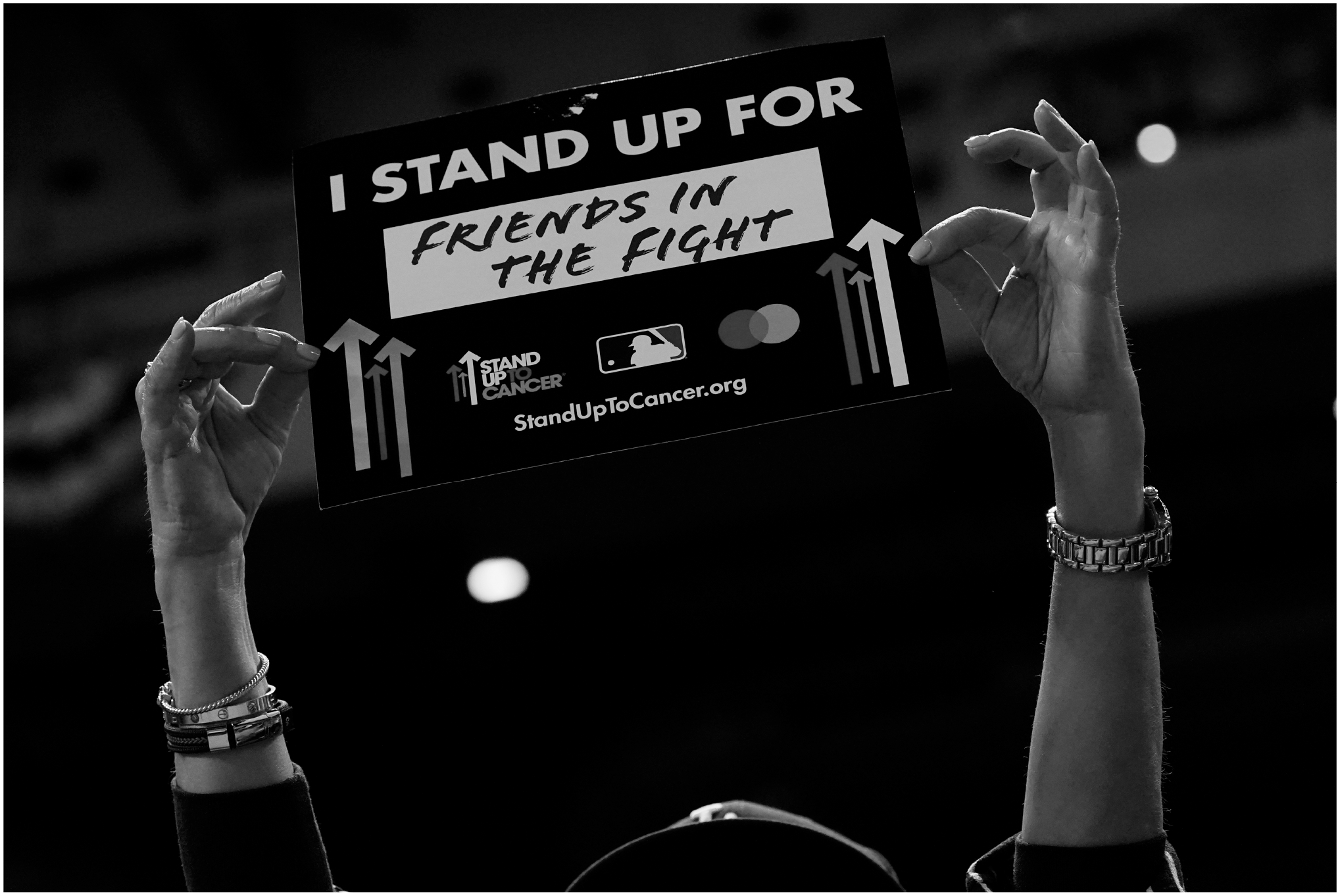
While the food system, fossil fuels, and chemical production are large causes, likely altering our DNA and making us more susceptible to cancer, according to research published in Oxford Academic, we individualize the disease. We ask questions like “Did anyone in your family have cancer?” that reproduce the widely held notion that cancer is primarily genetic. Here, we would do well to recall biologist Sandra Steingraber’s groundbreaking 1997 book, Living Downstream, in which she connects breast cancer to genetic and environmental causes. Why wasn’t she, instead of Yoplait, asked to be the spokesperson for BCRF?
But it’s us “everyday people” that I find most frustrating. We hold this near-inexplicable cognitive dissonance about cancer. Most people are at least vaguely aware of the causes. We hear stories about Johnson and Johnson’s talc Baby Powder, Roundup and other weed killers, forever chemicals in our water, microplastics in our blood and lungs, and on and on. However, we then reflexively default to cancer being a personalized disease with individualized causes, if there are any causes at all. You just “get” cancer because… we’re living longer, right? This is what research, most often cited by the foundations, tells us. But, wait a second, are we to believe that there are thousands of new carcinogenic chemicals that never existed before, but there is no more cancer than there was 200 years ago? Talk about cognitive dissonance! Or maybe there are so many causes that it’s just too overwhelming for us to contemplate. False consciousness is rarely a one-way street.
Mass media seems only to reinforce this debilitating ambiguity, making it understandable that we take refuge in the “find a cure” consumerist narrative. And this is exactly where those big philanthropies fail us. They are silent, and they are thereby complicit in not raising our collective consciousness. They could be marshaling us to end the causes of cancer. What if SU2C and MLB asked everyone in attendance and those watching on TV to email their congresspeople to please pass laws to stop the manufacturing of carcinogenic chemicals? Just stop making them. How’s that for a campaign?
Here, I am reminded of the labor campaigns of the Coalition of Immokalee Workers (CIW). The CIW figured out that greater success was to be had by protesting the Chipotles, McDonald’s, and WalMarts of the world rather than the relatively invisible Florida farms where they toiled in enslaved-like conditions, exposed to carcinogenic pesticides. This focus on the endpoint of their labor brought the CIW’s fight before the public, shaming the corporations that bought produce from their employers. In this way, naming, shaming, and blaming Home Depot and the like for selling Roundup could yield results.
Or maybe we can borrow a page from the organic movement and its fraught struggle for a healthier and ecologically sustainable agriculture. While activist farmers’ eventual compromise for a legal definition of “organic” has its pros and cons, scholar Brian Obach argued in 2017 that the movement would have had far less success had they focused on getting specific synthetic chemicals out of agriculture. Instead, their focus on an overarching idea about food changed the entire culture. In fighting the causes of cancer, this could mean a focus on sustainable food production with slogans like “Eat organic, don’t get cancer,” and shifting subsidies away from the fossil fuel industry toward small and midsized sustainable, regenerative farms. We could also alter some of the narrative about fossil fuels so that it’s understood that they cause climate change and cancer. As many evolutionary biologists have pointed out, natural selection just hasn’t prepared us to deal with long-term problems effectively. Cancer is more tangible, more personal, and easier for our lizard brains to grasp than our abstract conceptualization of climate change.
There is a lot of money in finding a cure, only hellish pain in fighting the causes and those who profit from those causes.
Some activist groups are earning significant gains using this strategy. For instance, 3M, facing a lawsuit by the Southern District of Florida that the corporation knew about the dangers of these chemicals for decades, has promised to stop making forever chemicals; outdoor retailer REI has committed to eliminating them from all of their products; and Bayer/Monsanto has promised to stop selling residential Roundup containing glyphosate (however, their replacement chemicals appear to also be toxic, according to the non-profit Beyond Pesticides). But these big wins seem unseen by the general public, while Big Philanthropy’s “find a cure” charity narrative remains part of the milieu of our daily lives.
The large philanthropic organizations will never target Home Depot or say anything at all about causes because it would be biting the hand that feeds them. Plus, it would haul them into a needless war, as they see it, distracting from their mission of raising money to find a cure.
My experiences with cancer are, unfortunately, common. I grew up in southeast Louisiana, where any number of things could have caused my cancer and its residual effects. My father worked at the Shell Refinery in Norco, LA. He was a draftsman and repeatedly came home with his old, white, rusty Rambler coated in black soot. Before I was born, he worked more on the refinery side. Was his DNA affected and passed on to me in his sperm? Maybe. I also grew up on a dead-end street in middle-class suburbia near a sewage canal—my pals and I played around it all the time, often falling in. I am sure that what flowed through this canal was minimally regulated, if at all. The 1970s and ‘80s also saw the messianic rise of ultra-processed food. I can’t tell you how many King Dons, Lucky Charms, Pizza Rolls, and cups of Kool Aid I consumed. I also grew up in a physically and emotionally violent home; perhaps the stress, fear, and sadness weakened my body’s ability to ward off the cancer. Did any one of these things cause the cancer? Did they all form a symbiotic relationship? Society and biology are messy. There are no linear, causal relationships.
But as a society, we do know the causes. So, I will never be joining the throngs of people who stand up and put on a somber face so we can find a cure. At every cash register where I am asked to donate to fight cancer, I refuse. I won’t spend any money to “fight” cancer. Like Pacific Islander and climate activist Brianna Fruean said, I don’t owe anyone my trauma. What I will do instead is step up to bat for small organizations, like the Louisiana Bucket Brigade, which, alongside community organizations like Rise St. James, fights the corporations that cause cancer. And I will have these discussions in all of my classes. There is a lot of money in finding a cure, only hellish pain in fighting the causes and those who profit from those causes. I’m in for hellish pain. I know it well.