



Abstract
Who has the right to claim color? Through three chromatic cases—International Klein Blue, Vantablack, and Pullman, or UPS Brown—the authors explore the social significance of and commercial demands upon the vividly colorful world we all share.
Note: To see this article’s images in color, visit ctx.sagepub.com.
Can You Own A Color?
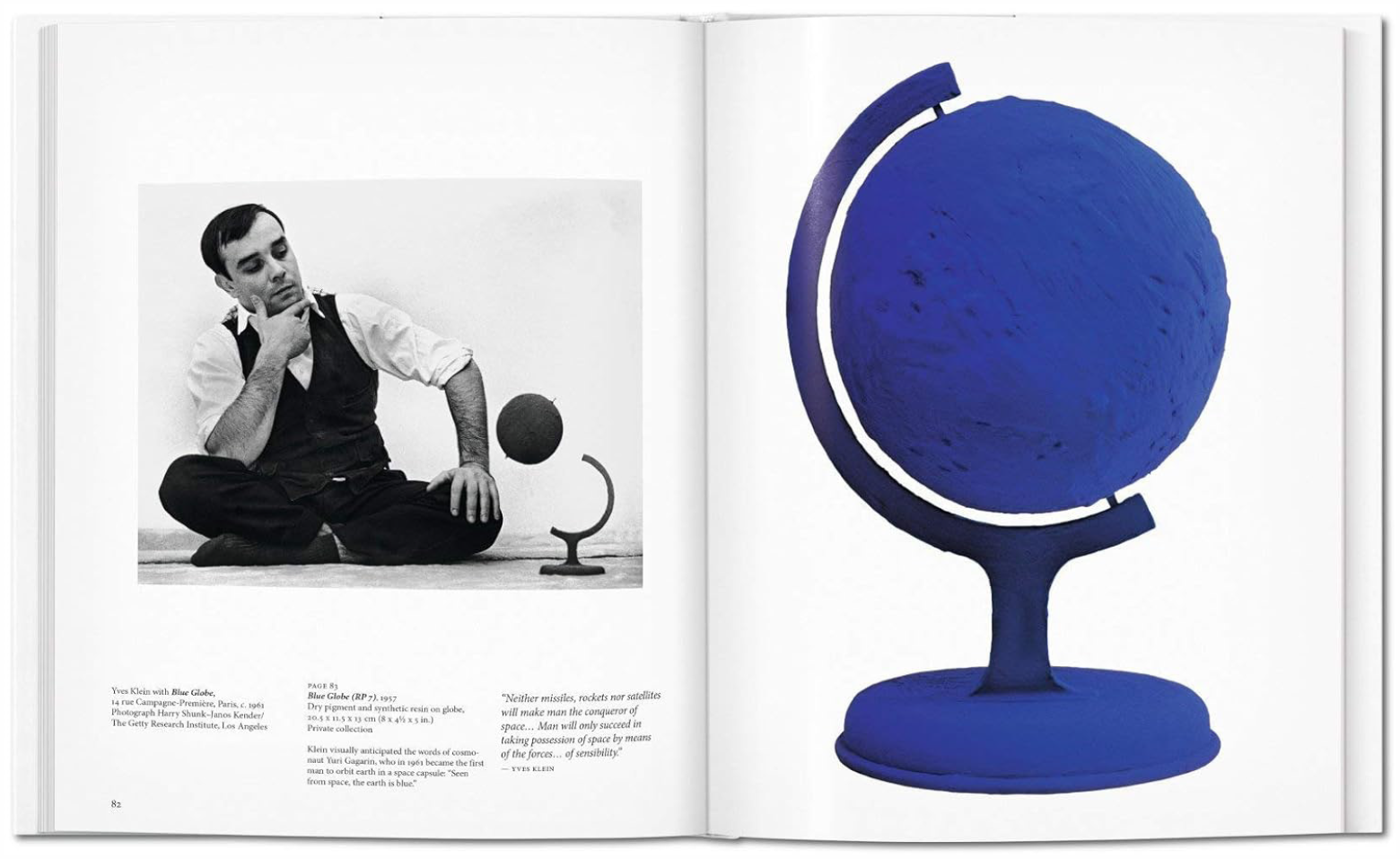
In May 1960, the prominent French artist Yves Klein registered a distinctive paint formula under the name “International Klein Blue” or IKB. The color was to be his, although technically it was the manufacturing process that made the color unique, with the pigment suspended in a clear synthetic resin and petroleum. The bright, insistent blue, with its ultramarine hue, reflected the vastness of space, which he proclaimed to be “a Blue in itself, disengaged from all functional justification.” Perhaps we might say that the artist hoped to “own” the sky. Klein, a major influence on minimalism and founder of the Nouveau Realisme movement, had been painting monochrome canvases for nearly a decade. In time, he focused on his favored blue, rolling his unique pigment on nearly two hundred canvases that pull us in with their vivid blueness. Under French law, Klein could pre-patent the color for use in France, and objects he adorned were issued as reprints and merchandise. However, before the patent could be made permanent, Klein suffered a heart attack at the Cannes Film Festival and died soon after. His iconic paintings now sell for tens of millions of dollars. But the true legacy of the artist is the permanent attachment of his name to his blue—and the broader question of whether a person or an organization can ever own and control a color.
It is this reality on which we focus: the materiality and the commercialization of color—which might be seen as part of nature but belongs instead to our socially formed sight-scape. Increasingly, sociologists emphasize that culture is known through its objects, and researchers have used various strategies to address the societal implications of color. But they have had less to say about the social properties of color. Is access to color something to which we all have a right? Is color part of nature or part of commerce, and how should we distinguish between the two? Images can be copyrighted, processes can be patented, but do hues belong to either?
In this essay, we focus on the “ownership” of color. Although often perceived as natural, color should properly be treated as a social object embedded in webs of authority, part of an institutional context in which law determines the boundaries of popular use. A quarter-century ago, Gary and a group of collaborators identified the wide diversity of meanings and practices that arise with and through color. Subsequently, Fiona described a controversial effort to reconstruct Greek and Roman marble sculptures using the authentic, bright colors with which they were allegedly adorned in antiquity (these exhibits eventually reached New York’s Metropolitan Museum of Art). We examined questions of expertise, interpretation, and changes in the meaning of color within varied domains, but what we did not describe is the economic control of color within a market, aesthetic or commercial.
No contemporary sociologist must be persuaded that color is a prominent topic of study for understanding racial stratification and caste-based discrimination. These systems try to stabilize the natural range of human pigmentation with color classifications that are marked with political, moral, and economic value. Even within races, skin color conveys status, such as benefits given to Black people whose lighter complexion was once defined as “high yellow,” a term some now consider a pejorative example of colorism. However, we find that color can “discriminate” among objects (or persons), leading to immediate identification. Having an identifiable color is inevitably the product of cultural as well as political norms and practices that potentially create value. Many societies give greater moral standing to those entitled to wear particular hues: the purple garments of kings, or the scarlet of the robes of Catholic cardinals. The rejection of identifiable color highlights the same norms at work, as seen in the recent backlash against the requirement that competitors in the renowned Wimbledon tennis tournament wear only white clothing.
Yves Klein, pictured in author Hannah Weitemeier’s 2017 book for Taschen, registered his “International Klein Blue,” a vivid ultramarine, in 1960.
Taschen via Amazon.com
Color is known through its representation in objects. Seeing color as characteristic of objects helps us understand how color develops collective meaning and promotes the desire for ownership. A second fundamental point, then, is that color is crucial to a sense of belonging. We always “see” socially, not personally. Thus, the meanings that we attribute to color are not uniform but, rather, are varied and often contradictory. Blue can stand for blue bloods and blue collars, blue movies and blue noses. Red can be the color of love but also anger, war, and the festivities of Christmas. “Black tie” is code for formal dress, yet the black leather of Hell’s Angels and teen Goths signify vastly different spaces. Social movements often mark their communal commitment with a shared color: red cloaks became the symbol of abortion rights protesters around the world, in a nod toward the dystopian imagery of Margaret Atwood’s The Handmaid’s Tale. We similarly find collective representation in other colorful symbols such as the new LGBTQIA+ Pride flag, incorporating the colors of both the Rainbow and Trans Flags. The banner indicates, by its multiple stripes, the diverse sexual and gender identities possible. But here, too, color expresses resistance: “pinkwashing” is a criticism of performative support for privileged identities within the banner. Color is a multivalent symbol, always embedded in societal understandings. Color is part of our cultural tool kit, or, better still, our mental Crayola box.
Color is part of our cultural tool kit, or, better still, our mental Crayola box.
The ownership of color goes deeper, to the heart of patriotism. The state, in a symbolic way, can be said to own a color or a combination of colors (the Red, White, and Blue) that stirs a sense of nationalism. The “Red Scare” was a fear of communism, yet in a different context, red is the color of the dominant conservative party in the United States. As sociologist Karen Cerulo insightfully notes in her 1995 examination of national symbols, color is not randomly selected for flags, but is correlated with ideology and centrality in the world system. Color becomes a mnemonic for one’s place in a global system of nation-states. The absence of green and black in the flags of core nations is striking. Green and black, in contrast, are well represented in the national flags of many African and Middle Eastern nations. In creating their national systems, states pay close attention to hues. The newly democratic South Africa designed a six-color flag that incorporated the colors of core nations and those of African regimes but excluded the orange of the apartheid regime. And even beyond flags, color identifies the nation through sporting uniforms, such as the distinct orange jerseys of Dutch footballers that swell pride in Amsterdam.
Sociologists have carefully examined the histories and practices that have constructed colors as signifiers of groups. But we’ve generally sidestepped questions of why certain colors are not used and who determines their applications. Because of the meaning of color and its ability to shape responses and move viewers, there is often contention over who has the “right” to use particular colors. Or, to be more precise, who has the right to use the manufactured form of colors? As we described, this is the dispute for which Yves Klein is best remembered today, but his legacy is far from unique. Businesses, institutions, and designers who rely on color as part of their branding are also in the mix. The materiality of color as tied to economic rights is a crucial link between culture and economics. Color is not only a property of objects, but also a property in society. To control a color is potentially to own a market share.
Sociologist Meredith Hall labels this linkage “propertization.” In her book project, Properties of Color: How Corporations Came to Own the Visible Spectrum, the term helps explain how something that was once treated as unownable becomes a form of property. This is done through a combination of law and moral justification. Color, in this sense, is comparable to the “air rights” that builders often claim, relying on the labor of construction. Hall focuses on the system of color devised by art professor Albert Munsell in the late 19th century. Munsell’s system divides color into value, hue, and chroma, and explains how the three work together to create an aesthetic experience for viewers. The system was originally aimed at experts, principally artists and designers seeking to gather an audience, who needed to use color in their work. However, this model, with its seeming scientific authority, quickly spread to other professions and businesses. How, Hall wonders, did something as timeless and natural as color come to be treated as something that could belong to an individual or an organization? A variety of studies have examined how particular paints or dyes were developed by industrial means—not from nature but from a laboratory. Transforming colors that are observed in our natural world into a rationalized, industrial system required converting “color perception into scientific knowledge.” Once that happened, expert information was treated as intellectual property, providing the conditions for color to be treated as an economic asset. With the framework in place to make color (or at least paint) a form of property, International Klein Blue becomes thinkable.
Art professor Albert Munsell’s system, devised in the 19th century, divides color into value, hue, and chroma, and explains how the three work together to create an aesthetic experience for viewers.
Mark Fairchild, CC-BY-SA-3.0 via Wikimedia Commons

Beyond the account of the now iconic IKB, we discuss two additional instances in which the “rights to color” have entered the public sphere. In each controversy, the issue is ownership. We first turn to the attempt by prominent British contemporary sculptor Anish Kapoor to control rights to a particularly intense shade of black. To the ire of many, Kapoor believes that “color”—or at least its material form as manufactured—is an ownable commodity. Then we examine the successful attempt of the United Parcel Service to trademark a particular shade of brown, long associated with the company. Together, these cases demonstrate that, given legal and social structures, color is a commodity embedded in power, privilege, and perception.
Vantablack and the Commitment to an Aesthetic Community
The process of turning color into property is perhaps most explicit in the attempt of British-Indian artist Anish Kapoor to gain exclusive rights to use a particularly intense shade of black called Vantablack. Kapoor, the 1991 recipient of the Turner Prize for outstanding British visual artist, created the celebrated sculpture “Cloud Gate” located in Chicago’s Millennium Park, widely known and beloved as “The Bean.” Throughout his career, Kapoor has emphasized the intensity and immersion of color. And, like Klein, Kapoor has made his reputation through the provocative uses of particular colors.
Vantablack is, technically speaking, a pigment coating developed in 2014 by the UK-based Surrey NanoSystems. It has been described as the “world’s blackest black” because it absorbs over 99.965% of all visible light, creating an image of complete flatness. The creative possibilities of applying Vantablack to sculpture quickly appealed to Kapoor. In 2016, after Surrey NanoSystems had developed a sprayable version of the substance, the company granted Kapoor’s request for exclusive rights to its use in creating sculptural objects. The artist argued that this was a collaboration between himself and the company and that Vantablack was not different in kind from other technologies used by sculptors. However, the licensing of this paint unleashed a strong reaction from fellow creators, who claimed that Kapoor was “stealing from the artistic community.” British artist Shanti Panchal objected, “I have not known of anything so absurd. In the creative world, nobody should have a monopoly.”
Again, strictly speaking, Vantablack is a technology rather than a color. What Kapoor was given was the right to use the specific arrangement of carbon nanotubes that serve as a molecular trap for light. This permits color to be owned: not as property as such, but as the ability to create material objects denied to others. Hall emphasizes the expert labor and technical experimentation that is highlighted and “performed” in color property cases. In a similar vein, what Klein sought to copyright was the binding agent that he created to fix blue pigment in a particular color. But restricting access to Vantablack was especially fraught because of the emotional reactions to what was, at the time, described as the “blackest black,” a stark depiction of the absence of light. The monopoly was also seen as a violation of the spirit of art-making, which espouses creativity as a shared pursuit. Kapoor’s moral justification backfired, in other words, because he effectively prevented other artists from developing their own expertise in Vantablack. In protest, another artist, Stuart Semple, created and sold what he sarcastically described as “the pinkest pink” and chose to make it available to every artist in the world except Kapoor. Kapoor eventually obtained the pigment and applied it to his extended middle figure. The controversy increased the prominence of both artists in a performative market, but the lasting takeaway is that Kapoor’s attempt to control Vantablack infringed on the perceived social nature of color as a collective resource.
Kapoor’s attempt to control Vantablack infringed on the perceived social nature of color as a collective resource.
Vantablack, described as “the world’s blackest black,” was created by Surrey Nanosystems. This photo, in which it is painted on a piece of wrinkled tinfoil, shows how the pigment visually flattens texture.
Surrey NanoSystems, CC BY-SA 3.0 via Wikimedia Commons

UPS Brown and the Trademarking of Corporate Identity
In a competitive corporate world, it is understandable that companies would wish to stand out with a distinctive “look,” and one way to achieve it is through the association with a particular color. Sticky images matter. Think Coca-Cola red, John Deere green, and IBM blue—not just the hue, but its particular tone, tint, or shade makes each company immediately recognizable in the marketplace.
Color, that is, has value in marketing. In some cases, the linkage is so tight—and often tied to advertising campaigns—that the U.S. Patent and Trademark Office has permitted companies effectively to own their color. This prevents direct competitors, or other companies in the same market segment, from using the identical color. The first trademarking of color was in 1985 by Owens Corning, a company known for its distinctive (and now trademarked) fiberglass insulation and Pink Panther mascot. A few other companies, including Tiffany (known for a distinctive aqua tint), have followed suit.
Among the best known of these is UPS, the United Parcel Service. UPS was founded in 1907 as a local messenger service, subsequently expanding to a global delivery company. At first, its delivery vehicles—Model T Fords—were painted an assortment of colors. But in 1916, over a century ago, Charles Soderstrom, an inventive and successful Swedish-American delivery man, joined the company leadership and decided that their corporate color should be brown. Specifically, Soderstrom chose what was known as Pullman Brown, the color of the interior of Pullman railway cars with their deep, rich woods and fabrics. It would, he believed, capture the public’s association with elegance and luxury, and it would do well at hiding the dirt kicked up by trucks traveling unpaved roads. By the late 1920s, UPS trucks and driver uniforms had all been converted to the now-iconic color. Over time, the company became so known for this color that an early 2000s ad campaign would ask, “What Can Brown Do For You?” Perhaps brown no longer conveys the same elegance, but it makes the company immediately recognizable and is, therefore, a corporate asset. UPS argued that their specific brown should be trademarked, and in 1998 it was, making UPS only the third U.S. company to trademark its branding color. If the color is not precisely owned by the company, its use nonetheless exemplifies its role as corporate property within a fiercely competitive shipping and logistics industry.
Color shapes shared meanings in numerous realms: institutional orders, stratification systems, and displays of identity. Societies develop collective representations of color: what belongs, to whom, where, when, and with which meanings. But those meanings are inevitably displayed on objects: the color of the object speaks the meaning and, simultaneously, defines the color itself. In turn, the quality of the material object rubs off on the color, making color not merely an attribute or an experience, but an object in itself. This permits color to be considered property.
The conventional meanings of color do not emerge out of the blue; they are not white noise. Rather, group members who are in specific social arrangements act, in effect, as “color entrepreneurs,” actively attempting to control the use of color, crafting rights and privileges from what might seem to be the purely visual. Although the linkage of color to salient segments of the social world carries the possibility of meaning, those meanings must be validated through power and then extended into other realms. Color is not simply a quality that things have, in other words, but it contributes directly to the very issue of how things are to be judged and even owned.
Pullman brown, UPS’s signature color, is so recognizable that for many year’s the company’s ad slogan was simply, “What can brown do for you?”
Courtesy UPS

Our sketch of how color is controlled through contracts and law by no means exhausts the topic, but it does point to the many ways we can productively engage our thinking about something that people mistakenly think has nothing to do at all with sociology. Just look around. Any detailed treatment of color reveals mighty contradictions within our own culture. Further, a cross-cultural perspective explores the extent to which color symbolism is expansive, even global, as opposed to being locally determined. Every color reveals a rich spectrum of meanings, often in opposition. The “true meaning,” if such there is, is inevitably found in context. Is color ours, or is it theirs? Color, so visible in our daily lives, has often been eclipsed from the light of our more serious thoughts. We deserve more from the shades that shape our world.