



Abstract
Zachary P. Neal and Jennifer Watling Neal on preferences and perceptions.
The U.S. fertility rate has fallen 20% from nearly 70 births per 1,000 women in 2007 to 55.8 in 2020. Although there are many forces responsible for this demographic trend, one is the growth of the “childfree” population (also known as “voluntarily childless” or “childless by choice”). Childfree adults do not have, and do not want, children. As Amy Blackstone described in a 2014 Contexts trends article, childfree adults differ from childless adults who wanted children but could not or did not have them.
It remains an understudied population in part because it is difficult to identify using data commonly collected by demographers; being childfree is not about one’s ability to have children, but about one’s desire to have children. However, as we wrote in Scientific Reports last year, we have recently estimated that one-in-five Michigan adults are childfree. This means that if you’re not childfree, at least some of your neighbors probably are.
So, where do the childfree fit into neighborhood life? Maybe they don’t. Discussions of place-building often focus on the need for family-friendly places. Indeed, in a 2013 article, urban planning scholars Mildred E. Warner and Joseph Rukus report that nearly half of planners work in communities that explicitly brand themselves as family-friendly.
There also seems to be bipartisan political support to make towns and cities more family-friendly. Writing in the right-leaning City Journal in 2013, Ali Modarres and Joel Kotkin suggest communities must “find a way to welcome back families,” while in the left-leaning The Atlantic in 2019, Derek Thompson agrees that “downtown areas can be made more family-friendly” and insists “Mayors can be more aggressive” in those efforts.
How? The title of Tim Gill’s 2021 book, Urban Playground: How Child-friendly Planning and Design Can Save Cities, offers one strategy. But it also highlights how, in these discussions, “family-friendly” is usually code for child-and parent-friendly, potentially leaving the childfree out of the idea of “family” entirely.
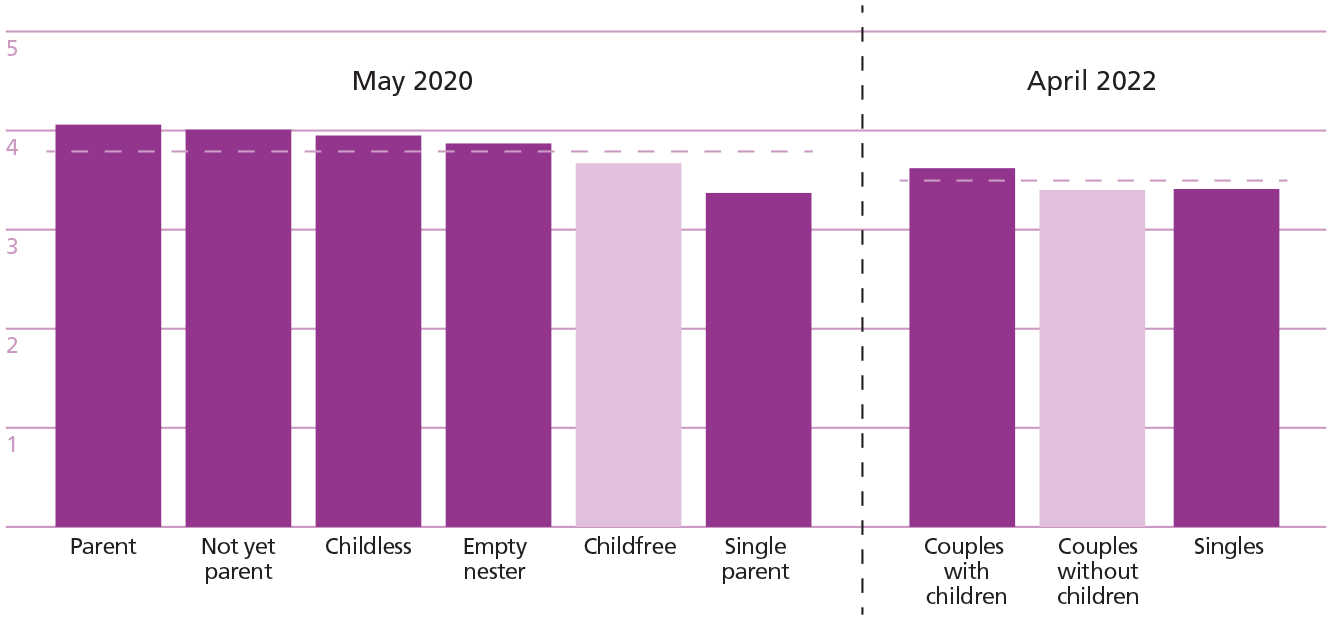
In May 2020, to find out how child-free adults’ experiences of their neighborhood compare to others, we asked a representative sample of Michigan adults how satisfied they were with their neighborhoods (see figure below). We divided the sample into several groups by their reproductive and household characteristics. Controlling for demographics, COVID-19, and life satisfaction, we noted in our 2022 PLOS One paper that childfree adults were less satisfied with their neighborhoods than the average respondent (horizontal dashed line), and they were significantly less satisfied than parents and those planning to become parents.
Roughly two years later, in April 2022, we collected a new sample, this time dividing it into larger groups to focus on two we suspected might be marginalized: couples without children and singles. Again, controlling for demographics, we observed that couples without children were less satisfied with their neighborhoods than the average respondent, and they were significantly less satisfied than couples with children.
Why might childfree adults and couples without children be less satisfied with their neighborhoods? The data point to two possible explanations for this satisfaction gap. At the micro-sociological level, the gap may be related to differential feelings of interpersonal warmth and sociability, while at the macro-sociological level it may be related to differential prioritization of groups’ needs.
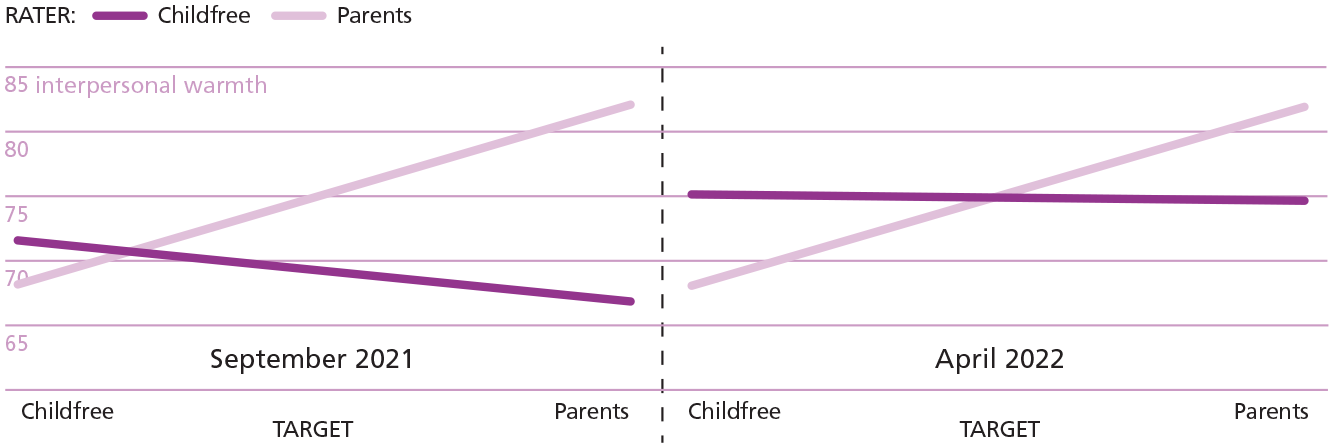
To understand how parents—the group with the highest neighborhood satisfaction—and childfree adults feel toward one another, we used a “feelings thermometer” question to measure interpersonal warmth (top figure, this page). In a representative sample of Michigan adults collected in September 2021, childfree adults reported feeling similar levels of warmth toward parents and toward other childfree adults. However, parents reported feeling significantly warmer toward other parents than toward childfree adults. Interestingly, the same pattern emerged in the new sample of Michigan adults collected in April 2022. While observing in-group favoritism wasn’t surprising, the fact that we found it among parents but not among childfree adults was.
Michigan Adults: Taking everything into account, how satisfied are you with your neighborhood as a place to live?
Michigan Adults: On a scale of 0 (very cold) to 100 (very warm), how do you <rater> feel toward <target>?
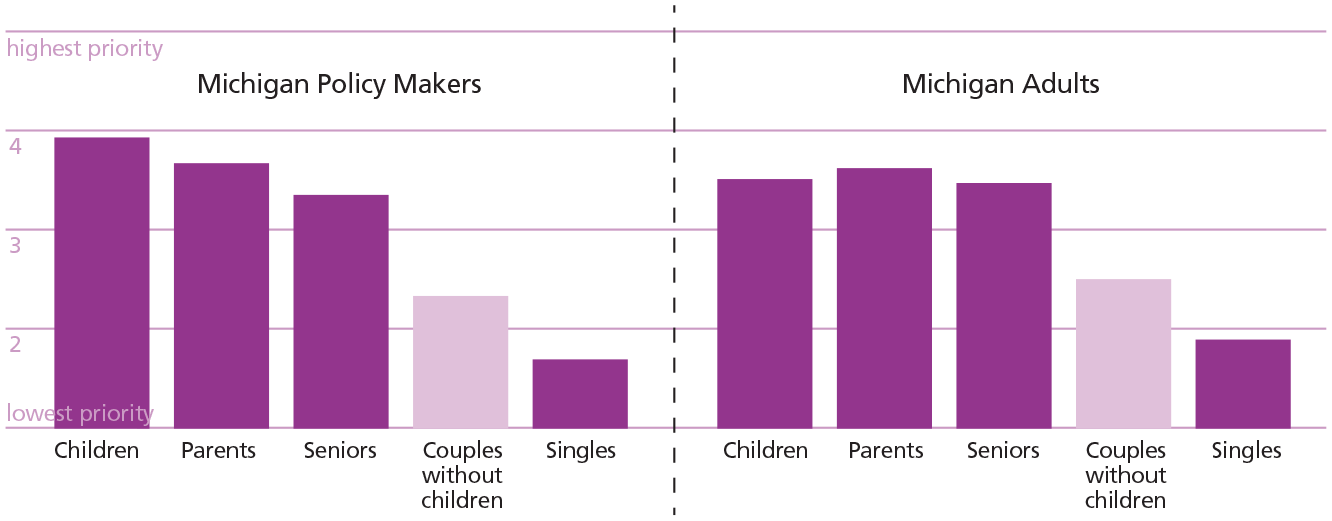
April 2022: Whose needs and preferences should be prioritized when neighborhoods are designed?
These stable patterns of interpersonal warmth do not suggest that parents dislike childfree adults. Instead, they indicate that parents feel much closer to other parents, perhaps due to their many shared experiences. Such strong in-group favoritism could limit opportunities for out-group members (here, childfree adults) to participate in neighborhood life. For example, parents’ warmth toward each other may lead to relatively closed neighborhood friendship circles. Likewise, to the extent that neighborhood events are planned by parents, for children, or at the local school, childfree residents could wind up being or feeling left out.
While the structure of local social networks may lead to differences in neighborhood satisfaction, larger political and policy forces may also be at play. Designing new neighborhoods and maintaining existing ones requires considering the needs and preferences of many stakeholder groups. It may be necessary to prioritize among competing demands. Thus, in April 2022, we asked a sample of Michigan policy makers (elected officials, staffers, lobbyists, etc.) whose needs and preferences should be prioritized (see second figure, this page). The policymakers had an unambiguous order of priority: children come first, then parents, then seniors. Only after these groups should the needs of couples without children, or singles, come into play.
When we asked a representative sample of Michigan adults the same question, we noted that adults in general didn’t distinguish between the needs of children, parents, and seniors. They all registered as important. But, this group agreed with the policymakers that the needs of couples without children and singles should come last.
These beliefs about who matters for neighborhoods are largely consistent with the broader rhetorical focus on family-friendly neighborhoods, where “family” refers to parents and their children, but not necessarily to other family types. Such a strong ordering of priority reveals that designing neighborhoods to be child-friendly and parent-friendly could risk ignoring the needs and preferences of others who also live there.
Taken together, initial trends suggest that the childfree population is large, and that its members are less satisfied with their neighborhoods than those choosing more traditional reproductive paths. This dissatisfaction may be driven, in part, by parents’ preference for interacting with other parents, or by policymakers’ preference for prioritizing the needs of children and parents over other community members.
In the context of neighborhoods, little is known about the kinds of neighborhoods where childfree adults live or the types of neighborhood amenities they might desire. So, as a seemingly marginalized but significant demographic group (and one that is likely growing), the childfree population requires more study. To facilitate future research on the child-free population, data from the samples described above and the code necessary to reproduce these findings are available at osf.io/5zxcg/.
Footnotes
Correction (August 2023):
This article has been updated to correct the affiliation of the authors to the Department of Psychology.