



Abstract
By adhering to a hierarchy of environmentalism, we lose the chance to understand others’ relationships with the environment and build solidarity in fighting climate change.
Keywords

Do people who drive trucks care about the environment? Lexi, a 21-year-old college student who describes herself as politically liberal, doesn’t think so. When interviewing Lexi, co-author Emily asked her what environmental problems she had experienced. Rather than discuss poor water quality, forest fires, or other acute or chronic environmental issues, Lexi talked about people who drive trucks. “You know what really pisses me off?” she asked. Then, without pausing for a response, “When you’re driving around and you get these big freaking diesel trucks, like regular people driving big trucks.” Lexi elaborated, “Their exhaust is black, and I’ve always got my sunroof open in nice weather, and it just comes in, and, it’s like, I’m just breathing this in. I’m like ‘Ugh!’“
To Lexi, choosing to drive a truck like this is morally wrong. As she says, “I know you’re just one person but, like, everybody combined together, all of the people that have those trucks that have that black exhaust that’s coming out, that’s terrible!” Lexi feels a visceral aversion, explaining: “It makes me so sick to my stomach because I know that it’s terrible… these people obviously drive that truck because they don’t care about what it’s doing to the environment.” To her, people like this are environmental problems: “Everything was fine until you,” Lexi asserts, pointing the finger at the specter of a truck-driving anti-environmentalist.
In this article, we suggest that Lexi’s sentiments are more than a simple aversion to big trucks and the people who drive them. Rather, we argue that in making these comments, Lexi is inadvertently policing a socially constructed hierarchy of environmentalism. At the top of the hierarchy are people who effortlessly integrate iconic sustainable consumption choices into their everyday lives. At the bottom are those who not only fail to adopt culturally significant eco-friendly practices, like driving smaller hybrid or electric vehicles and buying organic food, but who also challenge the efficacy of these practices.
Ultimately, we want to convince readers—and Lexi—that one of the most important things we can do to protect the environment is to recognize that we play a role in reproducing a hierarchy of environmentalism and to challenge ourselves to think differently. People who drive big trucks care about the environment, too.
Shopping for Status While Saving the Environment
Although our tastes may feel very much our own, sociological research has demonstrated the ways in which our consumption choices are shaped by social class. Back in the 1970s, the French social theorist Pierre Bourdieu used extensive survey research to show how upper- and lower-class people consumed. Bourdieu described the tastes of the upper class as “tastes of freedom,” referring to their freedom from economic constraint. In the realm of food, an upper-class person would prefer light fare, presented aesthetically, such as fish in a complex sauce served with artfully arranged vegetables. Perhaps an analogous vehicle would be a sleek, minimalist electric car. In contrast, Bourdieu characterized lower-class consumer preferences as “tastes of necessity.” Here, an ideal working-class meal would be filling and large, like a hearty stew. An equivalent vehicle may well be the sort of diesel truck Lexi abhors. Importantly, our taste preferences not only reflect our place in the class hierarchy, they also communicate that position to others.
Current sociologists studying consumer tastes have shown how integral morality has become to many domains of consumption. They explain that our consumer choices are not only guided by our wallets, but also by a desire for goods that have aesthetic qualities. Our sense of what is sophisticated or aesthetically pleasing is increasingly shaped by the extent to which we see a good as reflecting how we think the world ought to be. This insight from the sociology of consumption helps us to make sense of why those with cultural and economic capital would prefer to buy a small, electric sedan over a flashy, full-size SUV. Assuming the prices of the cars are roughly equal, the shift in preference demonstrates how middle- and upper-class consumers incorporate concerns about environmental impacts into their purchases. One unintended consequence of this shift is an increased tendency to make moral judgments of people based on whether their consumption choices are “pro-environmental.”
Let’s pause to reflect on what it looks like to make moral judgment of someone else’s consumption choices (beyond Lexi’s assessment of truck drivers). Think back to a time when you were in line at the grocery store. Imagine the person ahead of you in line is unloading heavily packaged processed foods and lots of meat. They ask for plastic bags to carry their purchases out of the store—maybe even requesting their goods be double-bagged. What assumptions might you be making about them? What sort of person do you imagine this shopper to be? Now imagine the person behind you has a cart brimming with organic produce and minimally packaged goods—and they’ve brought their own cloth bags. Who do you think this person is? What sorts of things do they care about? What might you glean about their social status?
The Hierarchy of Environmentalism
When Emily interviewed 63 residents of Washington State for her book, Eco-Types: Five Ways of Caring about the Environment, she asked people these sorts of questions, inviting them to comment on how someone’s environmental impact would shape their judgments of that person. Her findings show how the incorporation of moral criteria into our judgments of what others buy and own has enabled the emergence of a social hierarchy that differentiates high- and low-status relationships to the environment. In other words, a hierarchy of environmentalism.
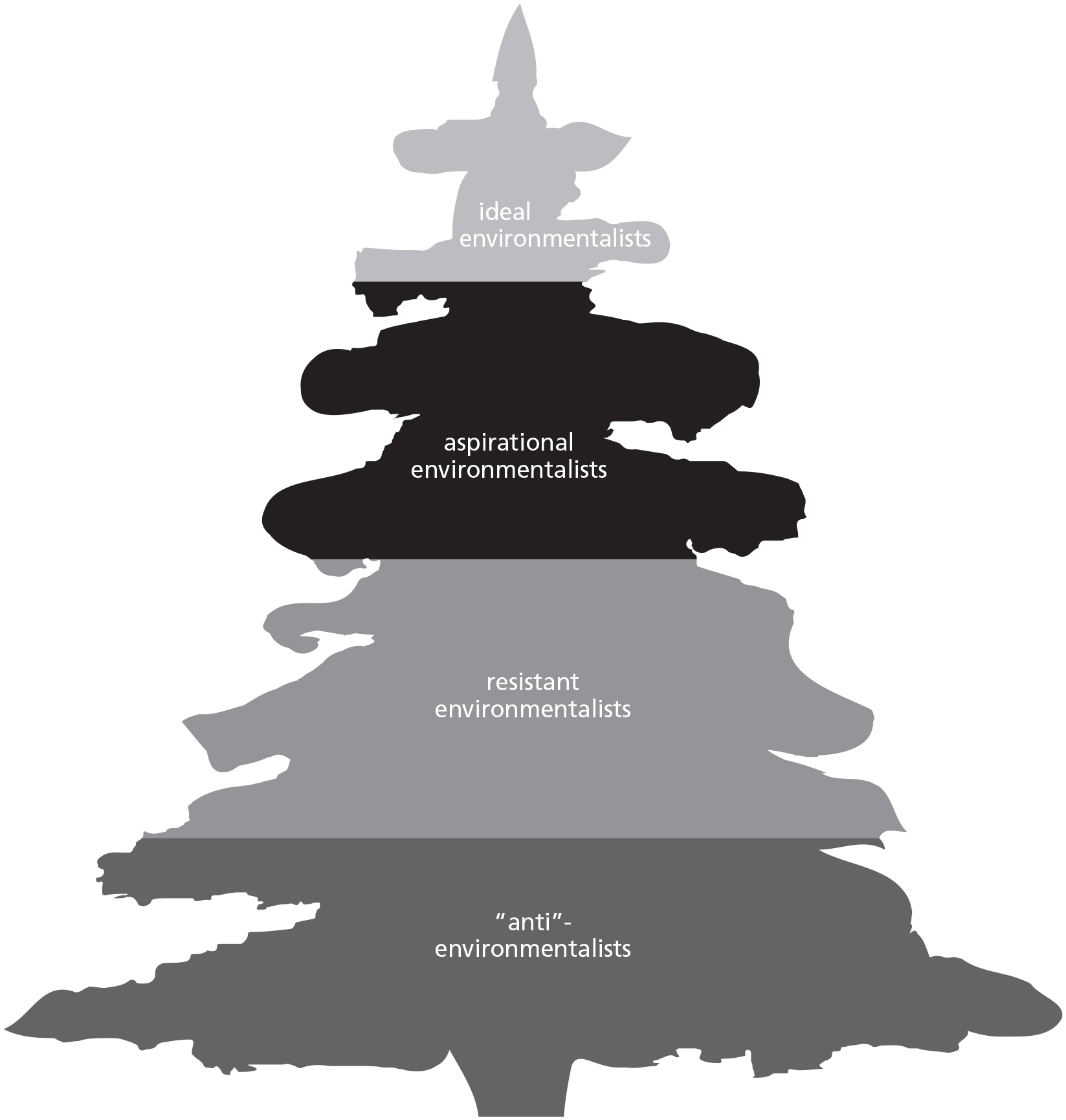
Emily’s interviewees’ answers regarding grocery carts and environmental impacts revealed two themes. First, people assume that the shopper with organic produce and someone with a small ecological footprint (a measure of a person’s impact on the environment) are superior to others. Second, people assume that this sort of person looks down on others. These themes speak to the presence of a hierarchy structuring our judgments of people’s relationships with the environment. Those at the top have a “taste” for sustainability, while those at the bottom instead defy the logic of the hierarchy. Interview participants’ comments illuminate how those in each strata perceive the hierarchy of environmentalism and their place in it.
The ideal environmentalist. The ideal environmentalist doesn’t think twice about composting and recycling their waste, would shudder at the thought of using a disposable, plastic water bottle, and seems to effortlessly buy green consumer products. One woman in the study, Annie, described how choosing sustainable products, to her, “feels like a broadening of awareness.” An upper-class woman and self-described political liberal, Annie used an analogy to describe her feelings about those who don’t care about the environment the way she does: “It’s kind of like if you’re seeing someone who just eats a lot of packaged foods; that’s their sense of how food can taste.” Annie idealizes her own practices and preferences, describing them as superior to “conventional” tastes.
Members of the Boone and Crockett hunting club are committed to wildlife conservation and management, and the group is staunchly pro-environment.
boone-crockett.org

Annie’s comments suggest she sees other human-environment relationships as inferior to her own. She asks us to imagine the difference between someone who knows, “how to put together an amazing, delicious meal from whole foods and understands how food can taste” and a person who buys, “lots and lots of packaged foods.” These sorts of purchases signal to Annie that the person has “no thought for how much plastic runs through the household” and probably “drives a gigantic, behemoth car or truck.” Pityingly, she says, “I feel a little bit sad for them because they haven’t found this new sort of deliciousness.” In her pity, we can see how an effortless preference for eco-friendly products is woven into moral judgments and the hierarchy of environmentalism.
The aspirational environmentalist. The aspirational environmentalist admires the ideal environmentalists’ commitment to green consumption and sees them as embodying the best relationship with the environment. Yet they know their shopping habits aren’t fully reflective of the ideal and comparing themselves to it incites a sense of guilt. For example, Brian, a middle-class liberal participant, described what he knows he should do to improve his relationship with the environment: “I know that making greener choices is the right thing to do, buying recycled plastic, choosing to not drive, using less water, less power, less resources in general.” However, Brian is critical of himself in this regard, saying, “I don’t always do a good job” of making “greener choices.”
If the aspirational environmentalists themselves don’t think they do enough to protect the environment, why are they located in a relatively privileged position in the hierarchy? Because they accept the logic of the hierarchy and their place in it. By policing the hierarchy, that is, sanctioning people who defy the value of eco-friendly practices (think of Lexi and her anger at those who flaunt their consumption of fossil fuels by driving large trucks), the aspirational environmentalist makes clear that they assent to the structure of the hierarchy of environmentalism. By communicating their guilt about not aligning with the ideal, they accept their place in the hierarchy and in doing so, earn the respect of the ideal environmentalists.
The resistant environmentalist. Resistant environmentalists don’t engage in green consumption, but accept the logic of the hierarchy. They are aware of an association between social status and green consumption, but they feel too distant from these practices (and perhaps even from high status more generally) to articulate opposition to the hierarchy. Resistant environmentalists admire the ideal environmentalists’ practices of buying organic, gardening, and cycling, but these lifestyle markers feel deeply unfamiliar and out-of-reach. For instance, Charles, a working-class liberal, admires a woman he knows who spent a lot of money to landscape her yard with native plants. As he explains, this woman is also a vegan and is “very thoughtful” about reducing her impact on the environment. He says he knows people with a small ecological footprint who live “below the poverty line,” but suggests it is their income rather than their environmental values that drive their relationship with the environment. Charles makes an effort to reduce his impact by purchasing food in bulk, but he has resigned himself to not feeling satisfied that his actions make a positive difference. As he says, “I don’t carry anxiety about it, because it’s like the rain… or lack of rain. You have to accept it. You can fight it, you can yell about it, you can do whatever you want, but it won’t change.” Charles doesn’t convey guilt in regard to his relationship with the environment, he conveys resignation.
Resistant environmentalists admire the ideal environmentalists’ practices, but these feel deeply unfamiliar and out-of-reach.
Despite accepting their own low level of engagement in eco-friendly practices, many resistant environmentalists sense that people look down on them because of how they spend their money. As Louise, a working-class conservative woman, said, “[Buying green products is] fine if you have the money to spend like that, but you can’t look down on the people that can’t afford that.” Resistant environmentalists don’t express guilt over their relationship with the environment and tend to see corporations as far more culpable than individuals for environmental problems. But they are aware that their relationship with the environment results in people looking down on them.
To many, an electric Hummer is the very image of environmental dissonance.
iStockPhoto.com / Brandon Woyshnis

The “anti”-environmentalist. We put the label “anti” in scare quotes because we argue that no one is truly against the environment. What unites people in this stratum is their opposition to the ideal environmentalist, not the environment. The anti-environmentalist views the hierarchy of environmentalism with disdain. They perceive the ideal environmentalist to be hypocritical and self-righteous and resent that they enjoy the cultural privilege that comes with having a lifestyle that reflects the best relationship with the environment. Bill, a middle-class conservative man, argues that he “should be considered an environmentalist” because of how much he knows about nature and how much he values spending time outside. He spends a considerable sum on hunting and fishing licenses, the proceeds of which go toward funding state parks and protected areas. And he deeply resents the way people like his politically liberal sister think theirs is the only legitimate relationship with the environment. He explains that when his sister visits him, she “preaches all these environmental things,” scolding him and his wife for buying plastic water bottles and not recycling. When Emily asks if he feels like she is judging him, he says, “Oh yeah. It’s like, she’s up here and I’m down here, right?” Anti-environmentalists sense the hierarchy of environmentalism. Unlike the aspirational environmentalist and the resistant environmentalist, however, they defy the logic of the hierarchy.
Part of what drives the anti-environmentalists’ opposition to the ideal is their frustration at not having their own relationship to the environment recognized and valued. Put differently, if anti-environmentalists didn’t see caring about the environment as positive and valuable, they wouldn’t bother challenging the logic of the hierarchy. Resisting a hierarchy that establishes an unfamiliar set of practices and beliefs as the ideal human-environment relationship is a precise reflection of how much the anti-environmentalist cares about the environment. But resisting the hierarchy places anti-environmentalists on its lowest tier.
To make sense of why defying the logic of a hierarchy would relegate a group to its lowest tier, we turn to one of sociology’s most important scholars on the subject of status: Cecilia Ridgeway. One of the mysteries Ridgeway confronted in her research was why those at the bottom of a hierarchy assent to their position. This is a perennial question in sociology, echoing Karl Marx’s efforts to puzzle through the absence of a proletariat revolution back in the 1800s. Ridgeway and co-author Sandra Nakagawa offer an important answer: one reason people accept their position at the bottom of a status hierarchy is because doing so earns approval and acceptance from those at the top. This helps explain why the aspirational environmentalists occupy a relatively privileged place in the hierarchy. In contrast, when lower-status people in a group challenge the hierarchy, others see them as unreasonable and as a result, the challengers, like the anti-environmentalists, risk being banished from the group. Anti-environmentalists perceive being excluded from the group and react with hostility to those who they see as passing judgment on them.
Part of what drives the anti-environmentalists’ opposition to the ideal is their frustration at not having their own relationship to the environment recognized and valued.
The reusable canvas grocery bag is an iconic image of environmentalism in action.
iStockPhoto.com / Anna Gorbacheva

Why We Should Dismantle the Hierarchy of Environmentalism
Political ideology is, of course, an integral piece of the puzzle in our story. Participants in the eco-types study said they imagine the ideal environmentalist to be politically liberal and the anti-environmentalist to be conservative. Part of overcoming the social divisiveness and political polarization that characterizes contemporary environmental politics is recognizing and challenging the hierarchy of environmentalism.
This is what we want to underscore: because this hierarchy of environmentalism is organized not only by social class but also by political ideals, it drives both social divisiveness and political polarization over the environment. This is imperative to consider when we think of the importance of climate legislation. Our ability to act decisively against climate change requires consensus. When we make moral judgments of an individual’s environmental beliefs or consumption choices, we contribute to the resentment and subordination that those lower on the status hierarchy feel. Resentment acts as a barrier to consensus and solidarity.
Every time we find ourselves admiring or disdaining someone with cloth tote bags full of produce from the farmers’ market, feeling angered or disgusted by a person driving a massive pick-up truck, or thinking something along the lines of, “people who don’t believe in climate change are ignorant,” we lose the chance to understand another’s relationship to the environment. And in doing so, we are contributing to divisiveness over urgent environmental issues like climate change. Rather than judge or condemn others’ environmental practices, we should each try to grant respect and recognition to people who care about the environment in ways that feel unfamiliar and perhaps even suspect to us. Because otherwise, we fuel polarization and divisiveness at a time when we need a cohesive civil society in order to protect the planet we all care about.