



Abstract
Tom Einhorn and Catherine Corrigall-Brown on messes with a message.
For several months now, social media has buzzed with images and videos of activists defacing artwork to raise public awareness about the climate crisis. European eco-activists have glued their hands to priceless paintings by Picasso and Goya and thrown food at the Mona Lisa and Van Gogh’s Sunflowers, all while the world watched.
Social movement activists have long known that making a dramatic display can spur media coverage of their causes and events—as the saying goes, “if it bleeds, it leads.” But another famous dictum, this one from Marshall McLuhan, helpfully adds, “the medium is the message.” That is, when it comes to making a grand gesture, the structure of information is often far more determinative than the content. New media require that activists convey the message of a dramatic, pressing, and powerful protest in new ways. Accordingly, the movement from reading physical newspapers to watching the nightly news to our modern ways of accessing news online and often through social media clips has compelled activists to shift how they communicate with the public.
New media require that activists convey the message of a dramatic, pressing, and powerful protest in new ways.
In print media, longer manifestos are possible, but striking images are necessary to catch readers’ attention. For instance, a demonstration in which thousands of people lay “dead” on the Washington Mall or in front of the White House makes for a stark image that draws readers in—the shocking visual gets eyes on the cause. However, the same large demonstration makes for a much less compelling clip on social media, particularly on TikTok, a platform dedicated to fast-paced, high-energy videos. There, a single vibrant picture can bring attention, but it does not get the repeated clicks and views that TikTok’s algorithm rewards in the same way as quick, impactful, moving images.
Before and during this recent series of protests targeting art, activists with groups such as Extinction Rebellion, Last Generation, and Just Stop Oil had been engaged in many types of actions, without gaining major online traction. In the summer and early fall of 2022, these activists erected blockades on major roadways across Europe, from London to Berlin, Stockholm to Rome. They spray-painted landmark buildings such as the MI5 Headquarters in London, the Italian Senate Building in Rome, the Spanish Parliament building in Madrid, and La Scala Opera House in Milan. They targeted luxury goods retailers such as Rolex and high-end sportscar dealerships, smashing windows and graffitiing storefronts. They occupied gas stations and damaged gas pumps and oil delivery trucks. And they held large demonstrations, inviting clashes with police in major European cities. Certainly, these actions received a smattering of national and international headlines; none, however, became the viral sensation achieved by one can of tomato soup. In effect, they were simply not as good at breaking through TikTok’s algorithms.
TikTok’s home screen and main feed, the “For You” page, is almost entirely algorithmically generated. Unlike a Face-book, Twitter, or YouTube feed, where the content is at least partially related to the people or pages you select to follow, TikTok’s “For You” page offers up content the algorithm thinks you might like. TikTok’s selection is based on both how you reacted to previous videos and what is popular at the moment. Thus, to have an impact on TikTok, activists do not need to make videos that people will like and share, as they would need to do on Facebook or Twitter. Instead, they need to make videos that people will find interesting, will watch all the way through without skipping, and will want to go back and watch again. A video that starts with someone throwing food at a major work of art, it turns out, is very effective at keeping eyes on the screen.
This tactic is also controversial in ways that occupations of public space, for example, are not. Many commentators have challenged the efficacy of art attacks for championing the dire urgency of the climate crisis. They worry reporters might focus on the potential damage to priceless cultural heritage, pulling focus from the protests’ larger messages. Highly attuned activists took the challenges to heart. As they were developing this tactic, they worked to explicitly link the defacing of art to the issue of climate change, making both into conversations about what we, collectively, are at risk of losing. This is evident in their early choice of targets, which included the landscape paintings My Heart’s in the Highlands (Horatio McCulloch), Peach Trees in Blossom (Van Gogh), Thompson’s Aeolian Harp (J.M.W. Turner), and The Hay Wain (John Constable). All of these pieces were targeted by Just Stop Oil activists in the span of one week in the summer of 2022, with protestors explaining how the pastoral landscapes depicted in these paintings would be lost to humanity unless we stop climate change.
Just Stop Oil activists, having thrown tomato soup at Van Gogh’s Sunflowers, glue their hands to the wall of the National Gallery in London.
JustStopOil.org/news-press, promotional image
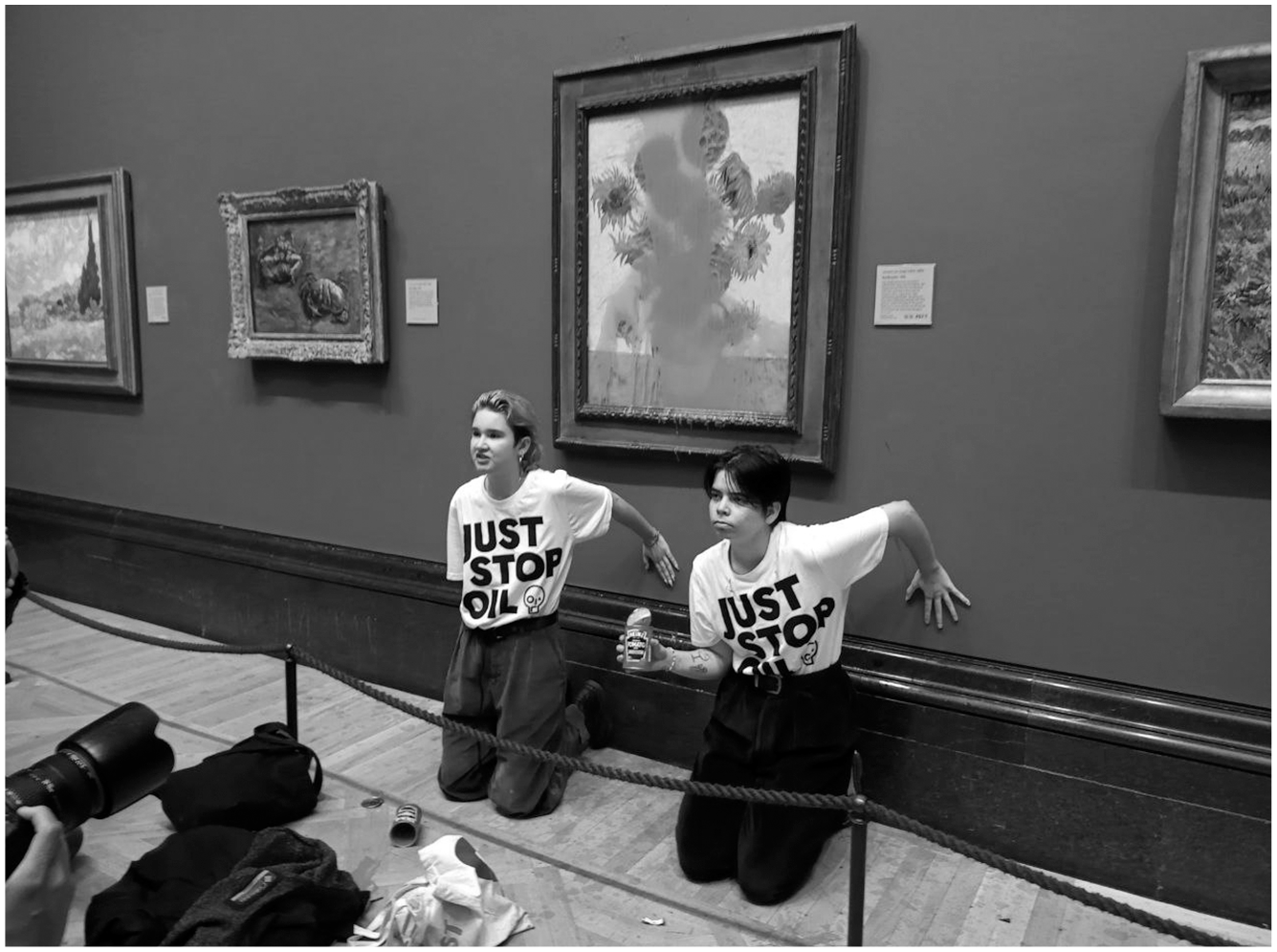
Subsequent media reports tended to bury the message in the rush to cover the defacement of priceless cultural works. So, when other activists reproduced these tactics, they adapted again: they adopted the elements that received traction in traditional and social media, particularly TikTok, and dropped those that did not. They moved away from the thematic link between the artwork targeted and their cause and gravitated toward iconic works of art such as Van Gogh’s Sunflowers and Munch’s The Scream. Through repetition, activists learned that art attacks held more viral potential and visual appeal when the targets were particularly well known.
It’s worth remembering that, though these tactics might seem new, they have deep historical roots. Throwing substances is a staple of the theatre of protest, with anti-war activists in the Vietnam War era throwing fake blood on draft cards, animal rights protesters lavishing fur coats with red paint, and LGBTQ activists dousing political opponents with glitter. Dramatic defacing borrows from these earlier protests, but with an innovative twist for the modern media landscape. Activists are now compressing these tactics into short, bite-sized dramatic videos to be shared on social media, particularly TikTok.
Art has also always been a critical part of the social movement activist repertoire. It has been used to rally people to a cause, drawing our eyes to racial injustice, the ravages of war, and the plight of those living in poverty. Even targeting art is not new in the social movement repertoire—suffragists throughout the world have, for example, slashed paintings to draw attention to their cause.
But to what extent is this protest tactic effective? It is rallying people to the cause or turning them away in anger?
By picking an arresting, visual, and active moment and drawing all eyes to it, activists have been able to draw hearts and minds to their cause. Phoebe Plummer, one of the protesters who threw tomato soup at Sunflowers (notably, like many other works, protected from major damage by a nearly invisible glass screen) made a dramatic display, and her video explaining the Just Stop Oil campaign was viewed 1.7 million times on TikTok and 7.1 million times on Twitter in just two days. Some of these viewers were certainly just drawn in by the shock of seeing priceless art apparently defaced. Others only watched the clips to see what their friends were talking about or because it appeared on their feed. Either way, using the media of TikTok and Twitter skillfully amplified the message in ways that allowed at least the possibility of maintaining viewer interest. Taking inspiration from the tactics of the past and adapting them to the modern technological era, climate activists appear well positioned to seize the moment.