



Abstract
Jessica Flanigan and Christopher Freiman on the undoing of unjust policy.
The United States government owes reparations to individuals and communities targeted by its war on drugs. The case for drug war reparations begins with the observation that drug prohibition is unjust. Those incarcerated for the use and sale of drugs are therefore incarcerated unjustly. When the state unjustly incarcerates someone, the victim is entitled to compensation—a principle that justifies distributing compensation to victims of drug prohibition.
Drug prohibition is unjust
In the United States many drugs are legally prohibited, meaning that people can be arrested and incarcerated for possessing and selling those substances. As we argued in a 2020 Res Philosophica article, this policy is unjust for three reasons. First, people who use or sell drugs are not liable to be arrested or punished for possessing or selling drugs, because it’s not wrong to use or sell drugs. People have rights to make decisions about their own bodies, including harmful decisions. After all, people may climb Mount Everest, refuse medication, or swim in the ocean even though these choices are potentially life threatening. One may concede this point but argue that people do not have the right to sell drugs, even if it is permissible to use them. But if selling drugs simply facilitates a choice that people are entitled to make, then it is not wrong to sell drugs either.
Given the destruction wrought by drug prohibition, drug war reparations ought to be a top policy priority.
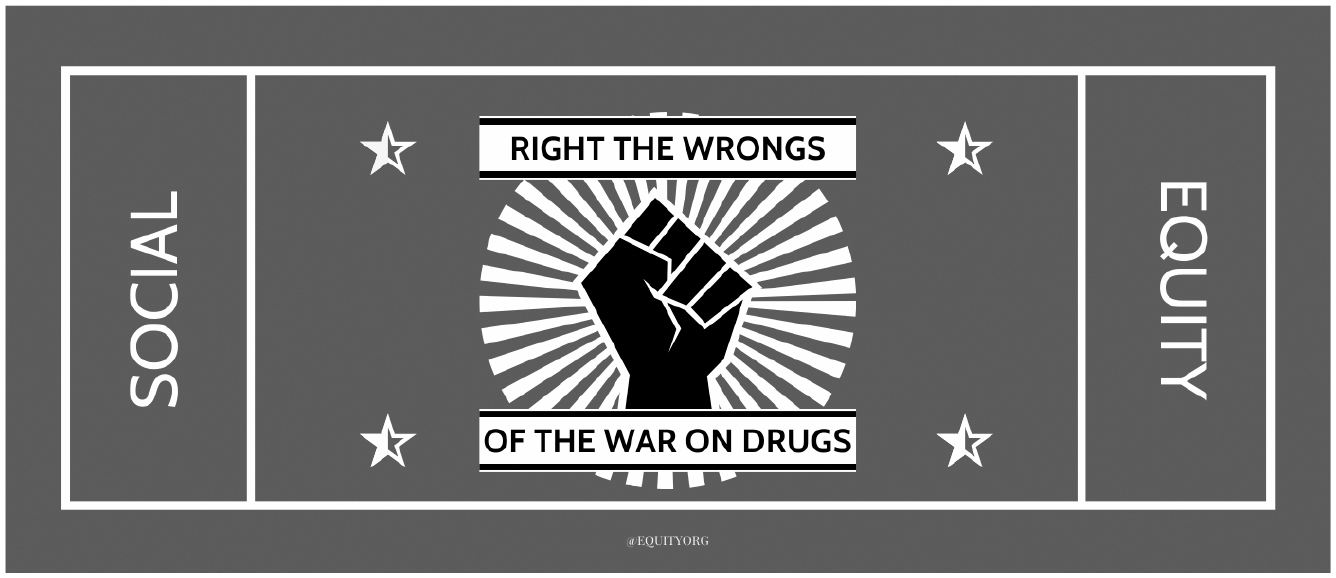
Organizations like The Last Prisoner Project and @equityorg seek pathways for former prisoners into cannabis entrepreneurship, arguing that those most affected by flawed policies must be the first to benefit from change.
@equityorg promotional image
Second, drug prohibition is typically ineffective at achieving its intended aim of promoting public health. As outlined in the Cato Institute’s 2017 report, “Four Decades and Counting,” prohibition drives users to take greater risks to obtain drugs and to consume riskier drugs. Further, incarceration neither promotes recovery nor prevents drug addiction, and it is especially harmful when drug users are denied medication-assisted recovery behind bars. Upon release from carceral settings, overdose deaths become a compounding harm, as documented in the journals Addiction (see Anne Bukten and colleagues’ 2017 piece) and The New England Journal of Medicine (see Ingrid A. Binswanger and colleague’s “Release from Prison—A High Risk of Death for Former Inmates”). People also lose access to therapeutics, including medical cannabis, psychedelics, and opioids as a result of drug prohibition. Consequently, public health advocates such as Joanne Csete generally reject drug prohibition in favor of harm-reduction policies regarding recreational drugs (Csete’s co-authored 2016 Lancet article is instructive).
Third, drug laws are regressive and can undermine efforts to promote social equality. The enforcement of prohibition disproportionately hurts those who are poor and otherwise socially marginalized. According to the ACLU, nearly two-thirds of nonviolent offenders serving life without parole in the United States in 2019 were Black. This results from the more frequent arrest and incarceration of Black versus White Americans on drug charges, as well as the harsher sentences accrued to Black defendants, as summarized by the Drug Policy Alliance and the United States Sentencing Commission.
Unjust enforcement and reparations
U.S. drug policy is unjust, so public officials who enforce drug laws treat people who are arrested and incarcerated for possessing or selling drugs unjustly. Drug users and dealers are not liable to be punished and deprived of liberty because it’s not wrong to use or sell drugs. To punish someone for a drug offense is analogous to punishing someone falsely accused of a burglary; both are forms of wrongful conviction because both involve punishing someone who is morally innocent.
A critic of drug war reparations may reply that punishing drug offenses is not analogous to punishing the falsely accused because drug offenders knowingly break the law, and it’s wrong to break the law. But even if breaking an unjust law were in some sense wrong, it would not be wrong in a way that justified arresting, incarcerating, disenfranchising, or otherwise punishing people who are morally innocent. For this reason, the wrongfulness of lawbreaking cannot on its own excuse the enforcement of unjust drug laws.
In general, when public officials unjustly incarcerate someone, the victim of unjust incarceration is entitled to compensation for the injuries they suffered due to officials’ moral and procedural mistakes. For example, it is the policy of the federal government’s to pay people who were wrongfully convicted of federal capital offenses $50,000-100,000 for each year spent on death row. Many states also offer money for wrongful conviction (federal and state statutes were helpfully summarized at CNN.com in March 2012).
The victims of America’s unjust drug war are victims of wrongful conviction. When drug laws are passed and enforced, officials are making moral and procedural mistakes. So, the victims of drug laws are entitled to compensation just like other victims of unjust law enforcement.
Policy options for reparations
Reparations for the drug war can take several forms. Cash payments to unjustly incarcerated people are the simplest form of reparations. This would align with other reparations proposals, such as those in a recent Brookings report authored by William “Sandy” Darity and Kirsten Mullen arguing for cash reparations for slavery and other anti-Black racial injustices. Alternatively, officials could provide education, loans, or job training to the victims of unjust drug policy enforcement. Where previously, a drug conviction rendered an applicant ineligible for federal student financial aid, those wrongfully convicted in this way might instead be prioritized or given preferential lending terms.
As drugs are legalized, officials could also prioritize victims of the drug war for licenses to legally sell drugs. Oakland, California’s “Cannabis Equity Program” provides a prime example. And finally, to the extent that drug policy had negative externalities that harmed entire communities, officials could invest in those communities by targeting the provision of public goods to those places.
It is worth noting that the case for drug war reparations applies to other policies. Many criminals have been wrongfully convicted because they have not performed any actions that violated others’ enforceable rights—examples include sex workers, immigrants, unlicensed hairdressers, and more. The criminal law, properly constrained and parsimoniously applied, would radically reduce criminal liability, as outlined by Douglas Husak in Overcriminalization: The Limits of Critical Law.
A policy of reparations would discourage public officials from passing unjust laws, prosecuting nonviolent offenders, and incarcerating innocent people.
Though it may be infeasible to compensate every victim of wrongful conviction, the prospect of compensation should deter officials’ excessive criminalization and regulation of citizens’ permissible choices. And given the destruction wrought by drug prohibition, drug war reparations ought to be a top policy priority.
Conclusion
People on the left and the right can find common ground on the issue of drug war reparations. For progressives, this proposal would result in a state-financed distribution of resources to disadvantaged communities, and it would promote social equality between formerly incarcerated people and their fellow citizens. For conservatives who tout the value of small business ownership, drug war reparations would provide economic support to entrepreneurs previously harmed by excessive governmental regulation. And for libertarians, the case for reparations begins by appealing to the moral importance of self-ownership and the conviction that public officials should be held morally accountable for unjust polices.
Today, there is little accountability for public officials who enforce unjust laws that destroy people’s lives through incarceration. The payment of reparations to drug offenders represents a promising first step on the path to real criminal justice reform, which requires publicly acknowledging and compensating for the harms associated with the drug war.