




Abstract
A discussion of major developments since the war on drugs launched in 1971 including mass incarceration, the overdose crisis, and the Mexican drug war. Challenges are described and solutions considered.
In a now infamous news conference on June 17, 1971, President Nixon declared drug abuse “public enemy number one.” Outlining the imperial, governmental, and cultural logics from which the new program would flourish, Nixon described a “worldwide offensive” against drug suppliers that would entail federally coordinated engagement and the creation of a domestic youth education program. Speaking to its far-reaching ambitions, he asserted the offensive would last longer than the American war in Vietnam. Now at the half-centennial, this prediction resonates as understated.
By 1973, the federal government created a new agency tasked with overseeing drug prohibition efforts: The Drug Enforcement Agency (D.E.A.) that today has an annual budget of nearly three billion dollars. Beyond the domestic sphere, the U.S. partnered with the U.N. to establish a global prohibition regime that by the end of the twentieth century was supported across the political spectrum by nearly every country on earth. Enforced by local police and military personnel, the war on drugs facilitated their material expansion and broad reach into civilian life.
Harm reduction activists in Philadelphia hold a press conference demanding a Safe Consumption/ Overdose Prevention site in the city on September 5, 2019. Preliminary evidence shows safe consumption sites reduce fatal overdose and the transmission of HIV and Hepatitis C.
Joe Piette, Flickr
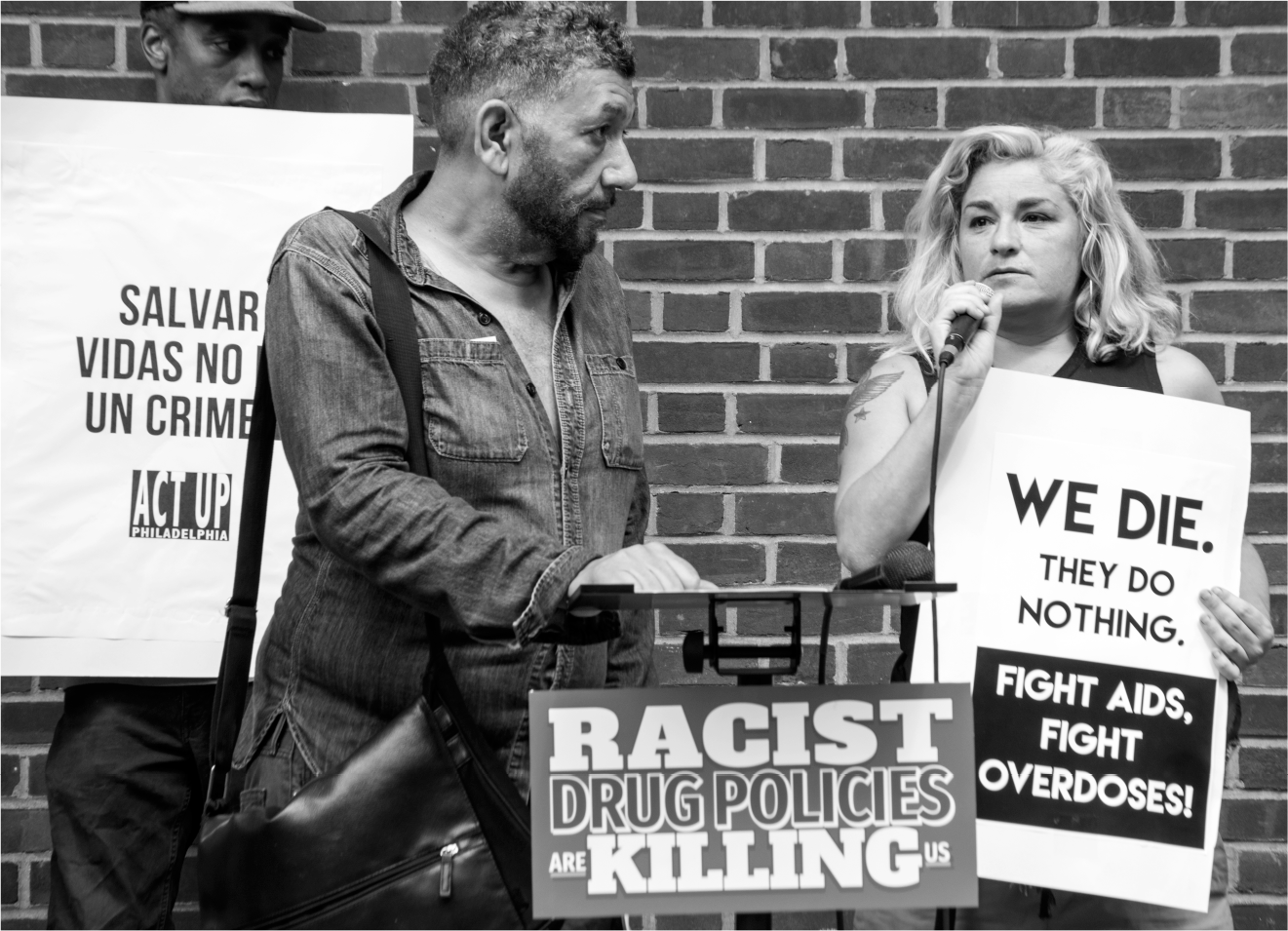
A contaminated drug supply coupled with criminalization is a fatal mix.
A Brutal System of Racial Control: Mass Incarceration
Though earlier iterations of prohibition as a form of highly racialized social control are present in American history, such as the linking of opium to the Chinese in the 19th century, cocaine to Black Americans in the 1910s, and marijuana to Mexicans in the 1930s, there is perhaps no more emblematic a case of racial-ized moral panic on drug use than the crack epidemic of the 1980s. The use of crack in America's deindustrialized urban centers, especially by Black Americans, was highly publicized in racist, morally charged terms facilitating the rapid expansion of the carceral state.
Today, more than half of American prisoners are incarcerated for nonviolent drug offenses. As the Movement for Black Lives has made widely known, the criminal justice system is marred by racial injustice. Black men are incarcerated for drug-related offenses at a rate of 13 times that of white men, though drug-use patterns show little differentiation, a study by Human Rights Watch revealed. Prisons and jails host conditions considered cruel, inhumane, and degrading. Solitary confinement is widely used, including for minors, despite calls by the U. N. Special Rapporteur on Torture and Other Cruel, Inhuman or Degrading Treatment or Punishment to ban its use globally.
For those struggling with addiction while incarcerated, help is elusive. Few incarcerated persons receive any care during withdrawal—a painful process that entails severe physical and psychological symptoms. In terms of rehabilitation or addiction treatment, the most successful forms, such as medically assisted treatment (M.A.T.), are rarely accessible. Lack of treatment causes major vulnerability, and those leaving prison or jail suffer risk of fatal overdose at rates 10 to 40 times higher than the general population.
Even after people have “served their time,” formerly incarcerated persons must bear the mark of a felony conviction for life, impeding job-training opportunities, access to social welfare, and voting rights. The common practice of reporting felony convictions on job, rental, and college applications also facilitates legal discrimination. Mass incarceration has meant damaged kin ties and loss of household income for families and communities.
Deadly Markets: The American Overdose Crisis
Still an unfolding American nightmare, compounded by the multiple ills of COVID-19, more than a million people have died from a drug overdose in the U.S. since 2000. Prohibition has led to a cheaper, more potent drug supply as Daniel Ciccarone has demonstrated. For people who use opioids, whack-a-mole drug-control efforts have shifted illicit markets from pharmaceutical opioids to heroin to fentanyl. Fentanyl—a synthetic opioid 50 to 100 times more potent than morphine—has contaminated the illicit drug supply and is now frequently found in heroin, cocaine, MDMA, and counterfeit prescription pills.
Imagine going to a bar and ordering a drink without knowing its strength— whether the glass in your hand is filled with beer that's five percent alcohol or bathtub gin that's 80 percent alcohol or higher. This type of uncertainty plagues people who use drugs. Though fentanyl test strips are available to some, most use without full knowledge of what they are consuming.
A contaminated drug supply coupled with criminalization is a fatal mix. Due to the expansion of overdose-induced homicide laws, people are less likely to call 911 in the presence of an overdose for fear of criminal charges. This encourages people to use alone or out of sight—a tragic reality when a fatal fentanyl overdose can happen in less than five minutes.
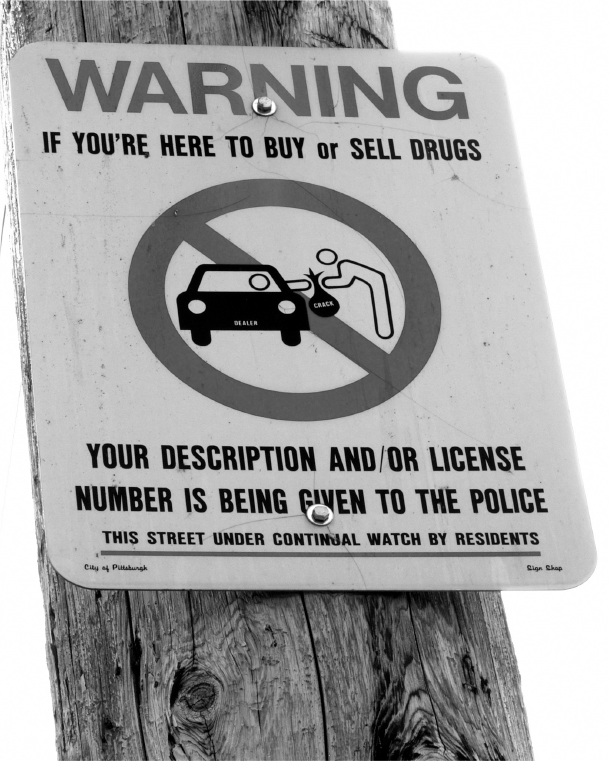
A street sign in Pittsburg, Pennsylvania warning passersby that drug-related activity will be watched and policed.
Christopher Amrich, Flickr
The Mexican Drug War
Though prohibitionist approaches to drugs have been present in Mexico since the 1940s, the U.S. consistently applied pressure to further criminalize drugs and their use. Since the late 1980s, illicit drug-market routes shifted to pass through Mexico on their way to American buyers, who consume more illicit drugs than any country on earth, spending an estimated 150 billion dollars on illicit drugs annually.
Mexico's prohibition approach turned increasingly militarized, reaching a totalizing nature with the war against narco-traffickers launched by President Felipe Calderon in 2006. Bolstered by the Merida Initiative Security Partnership, for which the U.S. allocated 2.8 billion dollars between 2008 and 2018, the war brought violence and led to a deteriorating security situation with widespread reports of torture, arbitrary detention, and extrajudicial killings by police and military forces.
Even after people have “served their time,” formerly incarcerated persons must bear the mark of a felony conviction for life, impeding job-training opportunities, access to social welfare, and voting rights.
Since 2006, 250,000 people have been killed, and 62,000 forcibly disappeared. Victims, often civilians, are frequently labeled criminals involved in the drug trade, though evidence is rarely pursued or provided. Violence continues to undermine the promise of healthy democracy through attacks against the press and a general climate of impunity. For regions where trafficking and militarized drug control efforts collide, an estimated 280,000 people have been displaced, many of whom are indigenous peoples losing the land of their ancestors. More recently, violence transmuted into a homicide crisis. The security situation remains tenuous in spite of shifts to a nominally softer approach led by current President Andrés Manuel Lópsez Obrador.
End the Drug War
From an overdose crisis and mass incarceration in the U.S. to displacement and human-rights abuses in Mexico and beyond, this expansive policy has ravaged families and communities for decades. It is time to end the war and begin to rebuild.
Several recent benchmark changes signal a new way is afoot. These include the removal of marijuana from the list of Schedule IV drugs by the U.N., the federal decriminalization of marijuana by Mexico, and the decriminalization of all drugs in the U.S. state of Oregon. The passing of the MORE Act by U.S. Congress, which still needs the support of the Senate, would decriminalize marijuana federally and take steps to reinvest in communities most harmed by the war on drugs.
What about a safe, regulated drug supply? Global outliers like Portugal and the U.K. provide noteworthy case studies. A legal, regulated drug market takes the guesswork out of consumption and empowers people who use drugs to know what they are using. This, rolled out with education, needle exchanges, safer consumption sites, and universal access to treatment that works—namely medically assisted treatment (M. A. T.) like methadone maintenance therapy (M. M. T.) and buprenorphine—could be transformative.
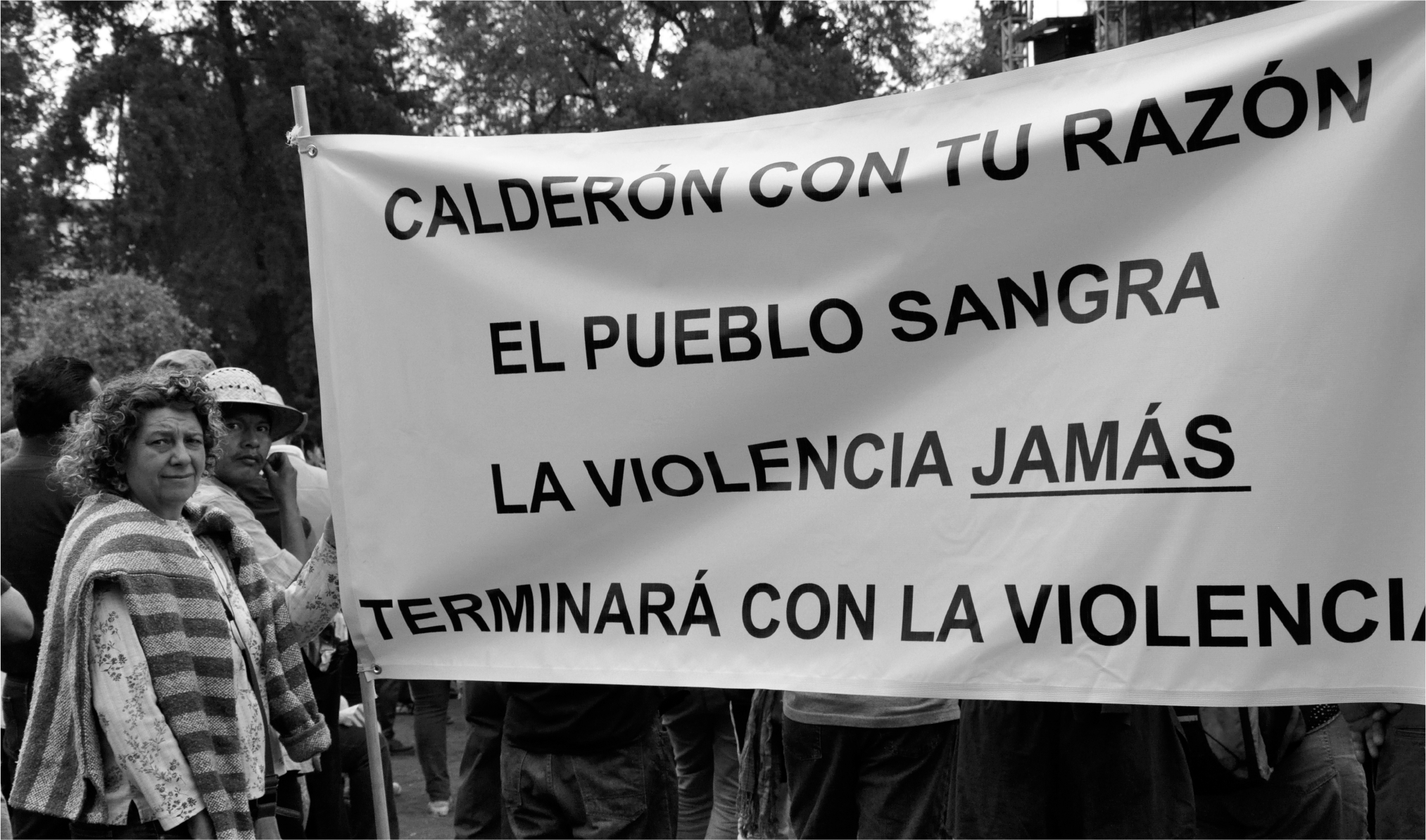
A woman stands with a sign reading, “Calderon, with your logic, the people bleed. Violence will never end violence” during the national march against the war on drugs in Mexico City on May 7, 2011.
Kara Newhouse, Flickr
Ending the war on drugs, whose fruit has been overdose, mass incarceration, and displacement should be a priority to all who value public health, human rights, and racial justice. This will necessitate resource reallocation for expanded treatment, the regulation of a safe drug supply, support for community healing as prisoners’ records are expunged, and the establishment of transitional justice processes. These efforts must center on and prioritize the communities most impacted. It’s time leaders and communities join forces to repair and rebuild, bringing half a century of devastation to a close.