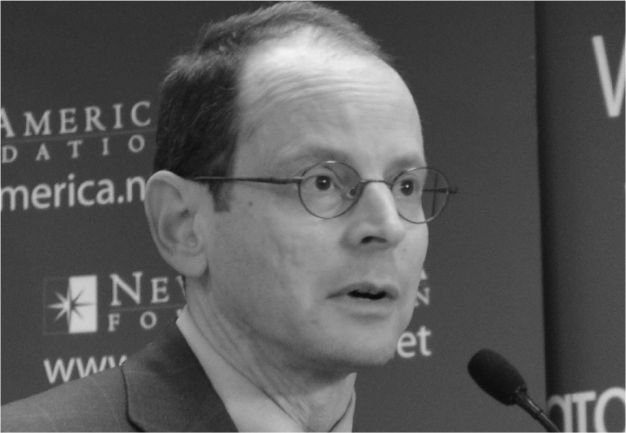
Jonathan Rauch is a senior fellow at the Brookings Institute in the Governance Studies program and the author of eight books and many articles on public policy, culture, and government. He recently sat down with Contexts Co-Editor Fabio Rojas and Production Editor Alisha Kirchoff to discuss his latest book, The Constitution of Knowledge: A Defense of Truth (2021), his past work including a selection of his other books, social change, and what the academy can do to protect liberal democracies and free speech.
Jonathan Rauch is a senior fellow at the Brookings Institute in the Governance Studies program and the author of eight books and many articles on public policy, culture, and government. He recently sat down with Contexts Co-Editor Fabio Rojas and Production Editor Alisha Kirchoff to discuss his latest book, The Constitution of Knowledge: A Defense of Truth (2021), his past work including a selection of his other books, social change, and what the academy can do to protect liberal democracies and free speech.
Jonathan Rauch
New America via Wikimedia Commons, cc
FR: You’ve written on a wide range of topics, “demosclerosis,” gay marriage, free speech, happiness research, and more, but is there a theme that connects these things or a common goal that you’re pursuing?
JR: There are two common themes but the one that links them is trying to understand how to keep liberal societies and institutions functioning; trying to understand the maladies and how to fix them. I’m a journalist by training. When I graduated from Yale in 1982, I went to work for a newspaper, then a magazine in Washington and became fascinated with how Washington was and wasn’t working. I started perceiving problems with how liberal democracy was working in the late 80s and early 90s, and the pressure on free speech and science in the same period. That became the uniting thread of my two strands of work: What’s going wrong here and how can we fix it?
FR: Now when you said liberal institutions, in your opinion, what are core examples of liberal institutions?
JR: Liberal systems that define the modern age and they’re free-market economies or market-based economies. They are liberal political regimes, liberal democracy, and what I called in 1993, liberal science. I now call it the “constitution of knowledge from reality.” It’s a community and they concern themselves with the allocation of resources, power, and knowledge, and they have in common that they’re all rules-based and require interchangeability of persons. So basically, everyone is supposed to follow the same rules regardless of status. They’re all heavily dependent on institutions and norms that are hard to sustain and inculcate. These systems work very well when they’re well-maintained societies that support the rules they are based on.
FR: Is it safe to say that your work in both Kindly Inquisitors and Constitution of Knowledge is an experience-based critique of other ways of organizing society?
JR: That’s a very fair summary. I won the trifecta: I am an atheist, homosexual Jew. I understood myself to be those things in an unchangeable way from a very early age, long before I had labels for them. I tried to believe in God. I couldn’t. I tried to be straight. I couldn’t. I just understood myself to be part of this very old community of Jews that made us outsiders to the Christian world, and I am now married to a man. Something I never expected to see. I spent almost 20 years as an activist using the liberal principles of speaking out, using persuasion, and confronting our opponents at every turn. If there’s one thing that breaks my heart, it’s the notion that minorities are too fragile to be argued with; that we need people to agree with us because we’re weak and will melt if we’re confronted with offensive ideas. This is the opposite of the truth. We won because we confronted bad ideas. We confronted ignorance and fear and hate. So, it breaks my heart to see minorities living with free speech as their enemy. Open debate and free speech have been the great engine of egalitarian progress for the last 300 years. Nothing else even comes close.
FR: You’re talking about a kind of modern activist who is worried that confronting minorities or arguing with minorities will injure them. Is that a good way of talking about liberal exceptionalism?
JR: Yes, all these systems are about structured conflict, because the alternative of unstructured conflict is basically destructive. And the trick is, can you create incentives so that you pit people’s biases against each other? Or put their preferences against each other in ways that force people to work out their differences in a relatively non-coercive way? If you can do that you’ve got magic in a bottle. James Madison’s great genius was to understand the result of that is not to just split the difference. You get a whole, dynamic system out of that because people are incentivized to persuade each other that they’re right. That requires some evidence and arguments. The incentive to respond to criticism is to get credentialed and to really learn the subject. Others will then do the same, and as they engage in a structured conflict over the truth, the result of that is this fantastically rapid development of knowledge.
FR: I talk to students about how sometimes social change can happen in a way you never expect. I’m shocked by the swiftness of social change in this domain of same sex marriage. Compared to other large-scale social movements it’s remarkable in a lot of ways.
JR: But overall, these movements are astonishing. The abolition of slavery is a remarkable thing, and it arises out of liberal culture. It is value placed on the individual and equality before the law. Slavery was basically a constant in human civilization until the liberal revolution came along. The same is true of women’s rights, gay rights. Each one happens a bit faster than the last, but…If you look at illiberal societies over time, you’ll see oppression and ignorance kind of wax and wane. Sometimes they get better, sometimes they get worse. You could run the tape of those societies forward, backwards and you wouldn’t really be sure which was which. In a liberal society, you can always tell which way the tape ran. If what you’re seeing is moral progress, then the tape is this running forward because that’s what liberal societies do.
AK: There was a lot of mobilizing power behind the movement for same sex marriage. Given this, I’m wondering what you see as the next big issue for social transformation.
JR: I think we are already seeing what’s coming next, which is a different kind of conversation around race in America. That change in the tone of debate, the urgency of it and the nature of the ideas being floated, has happened very, very quickly Now we’ve got huge national arguments over the 1619 project and so-called critical race theory, which has become a term of abuse. We have anti-racism. No one knew what that was a couple years ago and now everyone knows what it is. We have states passing laws against the teaching of critical race theory and on and on. I think we’re in the early stages of another wave of something. I don’t know where it goes to. It’s not as policy focused as the gay marriage debate or the women suffrage debate or the end of slavery, but I think we’re looking at a moment of inflection where we’re going to see some change and it’s going to be hard for a lot of people to swallow on both sides, for different reasons of course.
AK: Can you please reflect on your career and how public discourse has changed with the advent of the Internet? Specifically, the concept of there being multiple truths or multiple possible truths. How are we to understand that when we’re talking about the Constitution of Knowledge?
JR: The spirit of the Constitution of Knowledge basically says there can be many viewpoints. In fact, there must be. Intellectual pluralism is essential, but we are all working on the same project of building a common reality. I argue there are two core rules of liberal science: one is that there’s no final say. No one gets to end an argument conclusively and say you’re not allowed to ask a question. Following that gives us both free speech and a never-ending quest for knowledge. The second is that there is no personal authority. No one is entitled to claim special privileges. So, I can’t say, as a Jew, I know that this is true and you can’t question it. Subjectivism is ruled out. You can certainly bring your experience, which I do all the time. But I do that just as a source of information, not to say others can’t participate in the conversation. Subjectivism is one thing and it’s against the rules and unfortunately, it’s been far too widely embraced as a shortcut to having the difficult arguments we need. I think of digital media as a different kind of challenge because it can heighten all the existing challenges. It becomes an accelerant for subjectivism, it makes it easier for people to split off into their alternative reality.
One thing to remember is that research suggests that social media is only the third biggest propagator of conspiracy theories and fake news. Number two is cable TV and radio talk shows, and number one is good old-fashioned politicians. We should care about social media and spend a good amount of energy trying to figure out how to straighten out the perverse incentives that are causing so many problems, but we shouldn’t think of it as the only problem.
FR: Are there any final thoughts you wanted to share with us that we did not cover yet today?
JR: There is one thing that I wanted to touch on. One of the themes in my book is my intense worry about the decline of viewpoint diversity in academia and specifically in the social sciences and humanities. Whenever I go to a university and talk about it, I tend to hear that sociology is ground zero for this. It’s very hard to find a sociologist who might have voted for Mitt Romney much less Donald Trump. I think you all have seen the numbers that suggest there are very few people who are right of center in your field and that’s intensely worrisome. Without conservatives, libertarians, or people who are religious raising hard questions and challenging progressive assumptions you are going to make a lot of mistakes. You are going to lose credibility with the broader public and I think that has started to happen. I’m quite focused on hoping that academics in the social sciences will begin to refocus on viewpoint diversity as every bit of equal importance as ethnic and racial diversity and begin looking for and dismantling discrimination against conservatives in an active way. I am increasingly worried that your discipline will basically look to the public like left wing indoctrination and that would be tragic because sociology has so much to teach us.
Footnotes
Fabio Rojas is professor of sociology at Indiana University and co-editor of Contexts.Alisha Kirchoff is a PhD candidate in sociology at Indiana University and the Production Editor of Contexts.