



Abstract
This policy brief critically examines the Housing First turn in U.S. homeless policy. Housing First is a popular model of homeless services that rehouses people experiencing chronic homelessness without preconditions like sobriety, treatment, or employment. The Department of Housing and Urban Development promotes Housing First as an evidence-based practice that grantees should adopt. While I laud this as a step in the right direction, this paper identifies three shortcomings of Housing First that limit its ability to end chronic homelessness. I then discuss two supply-side interventions (i.e., tax credit expansion and integrated public housing) that can compensate for these shortcomings.
This policy brief critically examines the Housing First turn in U.S. homeless policy. Housing First is a popular model of homeless services that rehouses people experiencing chronic homeless-ness without preconditions like sobriety, treatment, or employment. The Department of Housing and Urban Development (HUD), which provides the bulk of funding for homeless services across the USA, promotes Housing First as an evidence-based practice that grantees should adopt. While I laud this as a step in the right direction, this paper identities three shortcomings of Housing First that limit its ability to end chronic home- lessness. I then discuss two supply-side interventions (i.e., tax credit expansion and integrated public housing) that can compensate for these shortcomings.
Despite its advantages over Treatment First approaches, Housing First is still a reactive demand-side intervention that accommodates supply-side inequities that have contributed to America’s homelessness problem.
Homeless Management in the Neoliberal Era
Neoliberalism has helped make street homelessness an enduring characteristic of American cities. This development in part reflects macrostructural changes that drained municipalities of capital investment, middle-class jobs, and federal tax revenue. Competition for mobile capital has pressured local governments to slash corporate taxes, finance private development, and gentrify poor neighborhoods. The prioritization of growth coincided with welfare cuts at the very moment low-skilled workers struggled to find jobs that afforded apartment rents inflated by neighborhood revitalization. This has made housing insecurity a defining feature of neoliberal urbanism. In 2019, more than 9.4 out of every 1,000 residents in major U.S. cities became homeless. At that time, Asians were 3.15, Blacks 5.12, and Native Americans 6.81 times more likely than whites to become homeless. Hence, the impact of neoliberalism on homelessness is unevenly distributed across status groups.
The normalization of street home-lessness has hindered local governments from adapting to macrostructural change. Visible homelessness impedes economic growth by tarnishing a city’s reputation, discouraging capital investment, and deterring middle-class consumption. U.S. cities have used different methods to hide homelessness. Punitive interventions use repressive force to remove homeless individuals from prime spaces of economic development. Involuntary care beneficently coerces the homeless to accept rehabilitative services in secluded places where they won’t stymie growth. Discipline transforms homeless service recipients into market participants who facilitate revitalization by voluntarily removing themselves from prime spaces. Recent scholarship shows how governing coalitions pragmatically coordinate these interventions to hide the iniquity of neoliberal urbanism. This means coalition members use a shared logic of governance that defines the ends pursued through different means of homeless management.
The Housing First Turn in Homeless Governance
Housing First is a disciplinary intervention that promotes self-sufficiency by placing homeless individuals in permanent supportive housing without preconditions. Pathways to Housing, a nonprofit organization from NYC, created the philosophy of Housing First in the early 1990s. That organization challenged a cultural binary (e.g., deserving vs. undeserving poor) by defining housing as a human right. In doing so, Pathways to Housing defended the moral worth of homeless individuals by asserting their entitlement to public assistance that secures desired lodging outside of an institutional setting. Unlike paternalistic case management, which advances the will of institutional authorities through coercion, Housing First endorses “client-directed” interventions that advance goals identified by service recipients. Case managers use harm reduction to work with clients at different stages of change. This in part helps service-resistant clients remain housed while using drugs and/or experiencing psychosis. Housing First thus separates housing from clinical services so service recipients can recover at their own pace.
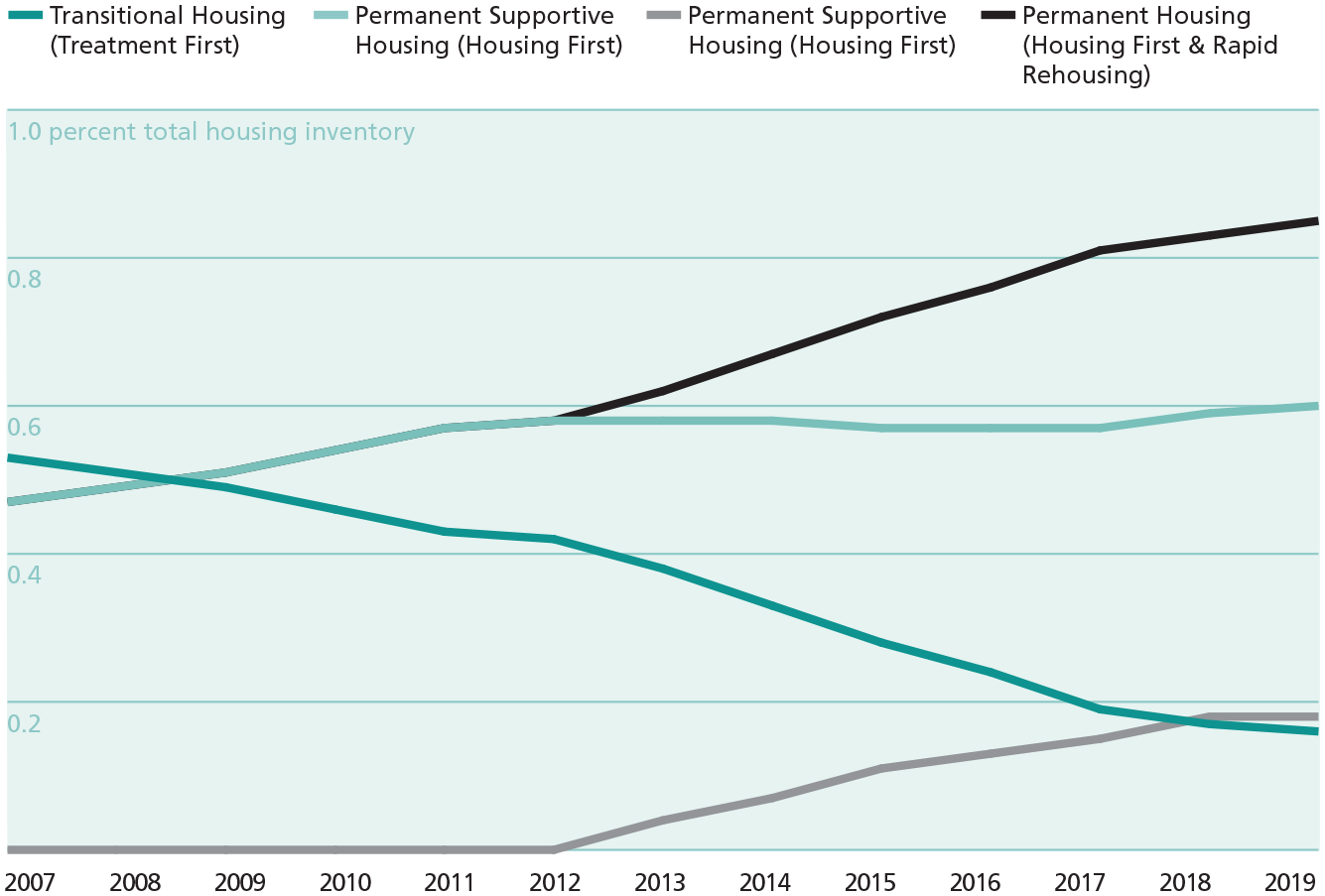
Homeless advocates have praised the U.S. Government’s adoption of Housing First as a progressive step toward ending homelessness. Throughout the late 90s and early 2000s, HUD primarily financed transitional housing programs that eased service recipients into permanent accommodation through a stairstep service model (i.e., Treatment First) that rendered them “housing ready.” Pathways to Housing produced a compendium of research that showed permanent supportive housing (i.e., Housing First) outperforms transitional housing (i.e., Treatment First) as a cost-effective way to reduce chronic homelessness. Research by Pathways to Housing appealed to U.S. lawmakers who wanted to reduce spending on emergency services. Figure 1 shows how, over a short period of time, HUD shifted funding from transitional to permanent housing programs. This marks the triumph of Housing First over Treatment First approaches to homeless services.
The Housing First turn in federal housing policy has transformed the nature of homeless governance in American cities. The U.S. government now contracts service providers to quickly transition the homeless into private rental markets and discipline them to be responsible tenants. In this regard, Housing First partly functions as a publicly subsidized property management service whose caseworkers are contracted to minimize transaction costs for private landlords by ensuring lease compliance. This indirectly helps local governments reduce expenditures on emergency services and stabilize an important source of revenue (i.e., property taxes) that they increasingly need to stimulate economic growth. Thus, in addition to helping people escape homelessness, Housing First is a tool that urban boosters can use to free up capital for, reduce the impact of homelessness on, and access vital resources for development.
Tents line the sidewalk in front of Union Station in Washington, D.C.
Provided by the author

Three Limitations of Housing First
Although Housing First has many advantages over Treatment First models, it has three limitations that reduce its ability to end chronic homelessness. To begin, Housing First individualizes social cause(s) of homelessness. While it defines housing as a human right, Housing First medicalizes “root” causes of homeless-ness and prescribes wraparound services to fix the urban poor. The immediate placement of service recipients in permanent supportive housing is viewed as an essential first step to rehabilitating “sick” people who, if given the right treatment, can become independent market participants. This ignores macrostructural changes like deindustrialization, suburbanization, welfare retrenchment, gen-trification, and spatial mismatch that facilitate chronic homelessness. Housing First therefore redirects advocacy from challenging social injustices to disciplining the poor. In doing so, it implicitly blames marginalized people and helps perpetuate market and administrative failures that have made chronic home-lessness a feature of neoliberal urbanism.
Second, Housing First can fortify spatial inequities that facilitate (non-) chronic homelessness. The U.S. Government used housing policy to segregate cities in the 20th century. This generally concentrated advantage in White communities and disadvantage in communities of color. Racial minorities are consequently at greater risk of home-lessness than Whites. Housing First is a demand-side intervention that accommodates residential segregation. HUD allocates permanent housing subsidies at 40 percent of area median rent. In segregated housing markets, where affordable units are often located in distressed neighborhoods, Housing First tenants get concentrated in poverty because their rent subsidy cannot access better areas. Moreover, institutional authorities pressure service providers to rehouse Housing First recipients within 60 days of becoming eligible for assistance. This hinders Housing First recipients, who often confront landlord discrimination, from accessing accommodation in low-poverty neighborhoods. Reproducing segregation can put service recipients at risk of homelessness by exposing them to environmental stressors that weaken tenant sustainability and ends one person’s chronic homelessness by putting somebody else at risk of homelessness in the future.
Third, Housing First is a reactive intervention that comes far too late. To access permanent supportive housing, HUD requires someone to be “chronically” homeless. A person is chronically homeless if they live in a place that isn’t meant for human habitation, a Safe Haven, or an emergency shelter with a disability for at least 12 consecutive or episodic months. At that point, most individuals have accumulated a lifetime of disadvantage that will not be reversed by Housing First caseworkers. To the extent that a local housing stock lacks affordable options in low-poverty neighborhoods, Housing First cannot be implemented without reproducing a market structure that facilitates chronic homeless-ness. Moreover, chronic homelessness exposes people to protracted stress that can undermine their ability to thrive once they get rehoused. This problem can be partly addressed by loosening eligibility criteria so service recipients can avoid trauma; however, the dependency of service recipients on units in high-poverty neighborhoods perpetuates their exposure to chronic stress. Forcing the homeless to suffer prolonged trauma to get permanently housed is a political decision that the richest country in the world does not have to make.
America Needs Preventative Interventions
While it is a step in the right direction, Housing First is not enough. It is a reactive demand-side intervention that relies on affordable stocks. To the extent that a local housing stock lacks affordable options in low-poverty neighborhoods, Housing First cannot be implemented without reproducing material conditions that facilitate homelessness. This will ensure marginalized groups stay at higher risk of experiencing chronic homelessness and place Housing First tenants at risk of repeated homelessness. The benefits of Housing First can be enhanced if policymakers coupled it with supply-side interventions that prevent homelessness by integrating urban housing markets. Low-Income Housing Tax Credits (LIHTC) are the federal government’s primary engine of affordable housing development. The U.S. Department of Treasury annually grants LIHTC to States who selectively finance affordable housing development each year during competitive allocation cycles. At least three factors hinder LIHTC from preventing homelessness.
HUD has defunded transitional housing throughout the USA (2007-2019)
Source: U.S. Department of Housing and Urban Development Housing Inventory Counts
First, the U.S. Treasury allocates LIHTC according to State population size rather than affordable housing shortage. Population size does not measure the ability of an affordable housing stock to meet local demand. A portion of LIHTC is therefore inequitably allocated by federal authorities. This perpetuates affordable housing shortages in extremely tight rental markets, thereby increasing the risk of homelessness amongst poor households. Policy reforms are needed so LIHTC can flexibly respond to annual fluctuations in the country’s affordable housing stock.
Second, LIHTC has been used to segregate poor households. States have disproportionately sited LIHTC developments in high-poverty neighborhoods. Although this strategy may increase property values in extremely poor communities over time, it does not immediately change spatial inequalities that limit the life chances of poor households. Furthermore, LIHTC allows developers to target subpopulation(s) for different projects. This can facilitate access to low-poverty neighborhoods for “deserving” LIHTC tenants like senior citizens while relegating “undeserving” ones like homeless individuals to distressed areas. Reforms are therefore needed to ensure LIHTC developments challenge residential segregation while providing affordable units to stigmatized subgroups in well-resourced neighborhoods where they can circumvent exclusions that facilitate homelessness.
Finally, LITHC requires developers keep rents “affordable” at 30 percent of area median income for 15 years. A developer can reprice units at market rate once they meet this threshold. Research shows for-profit developers are more likely than nonprofit organizations to increase rent beyond year 15 and most LIHTC units are being built by for-profit firms. This means LIHTC units must be continually built to sustain affordable housing stocks that poor households need to avoid homeless-ness. Federal authorities can address this problem by either increasing outlays for LIHTC to continually expand construction and/or creating incentives to guarantee units are kept affordable over time.
That said, LIHTC should be complemented by investment in integrated public housing. Two integral components of LIHTC limit its ability to prevent homelessness. LIHTC is a public-private partnership that must be profitable to developers. The Tax Cuts and Jobs Act of 2017 has reduced the value of LIHTCs by slashing corporate taxes. This stymies affordable housing construction by devaluing LIHTCs. In addition, LIHTC construction requires multiple stakeholders and a burdensome application process that increases construction time and reduces participation. This delays affordable housing development that America’s urban poor can no longer tolerate. Integrated public housing could circumvent these barriers through a single-payer system that streamlines development. Federal, state, and/or local governments can deconcentrate poverty by building mixed-tenure developments that house public and private units as well as mixed-income public housing developments in low-poverty communities. Pursuing these strategies would require federal lawmakers to repeal the Faircloth Amendment which prohibits HUD from financing public housing construction. Housing advocates can meanwhile lobby state and local governments to invest in integrated public housing developments.
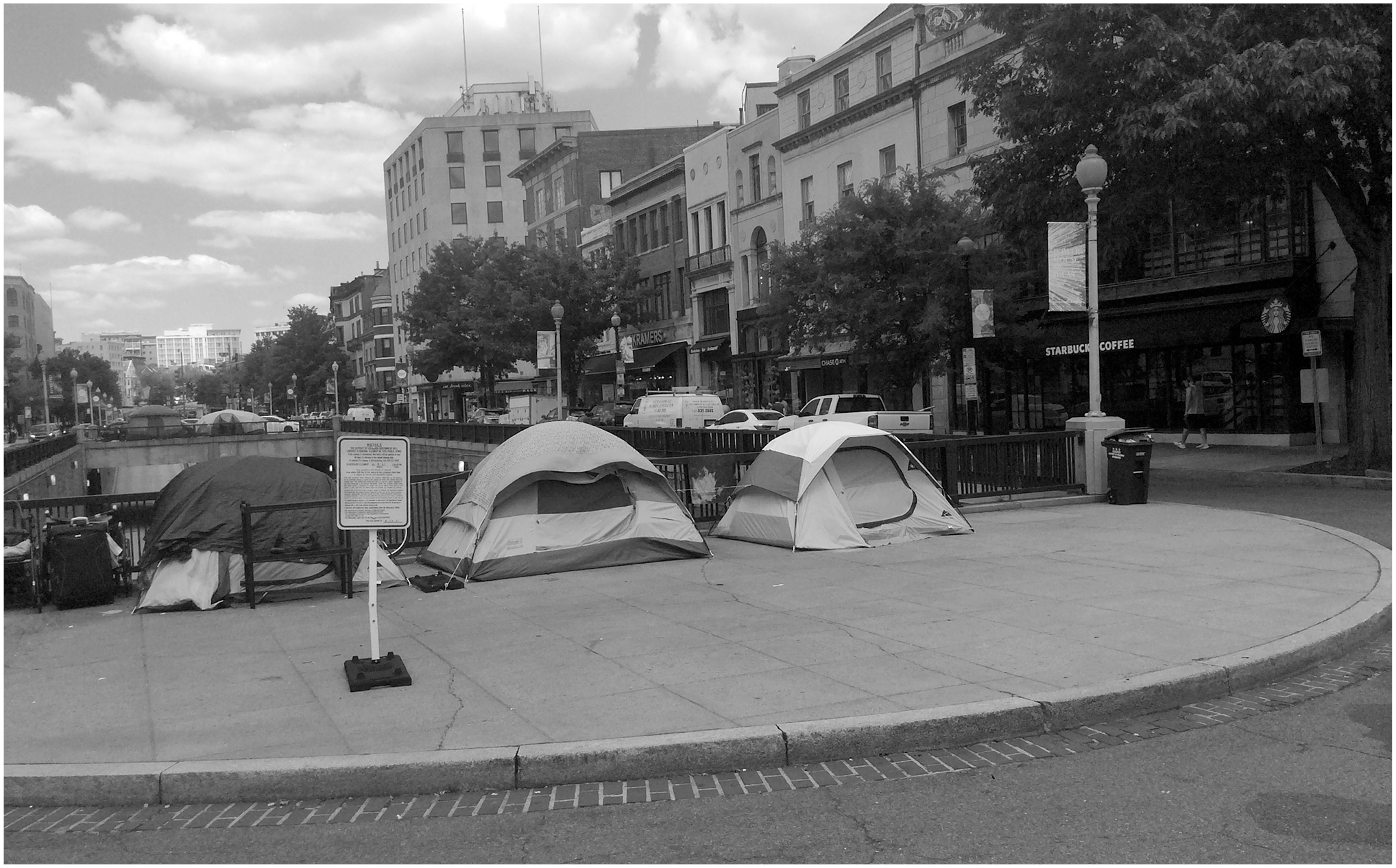
Unhoused residents of D.C. living in tents in one of the city’s most expensive neighborhoods.
Provided by the author
Conclusion
In sum, Housing First is a notable improvement to homeless systems in the USA. Despite its advantages over Treatment First approaches, Housing First is still a reactive demand-side intervention that accommodates supply-side inequities that have contributed to America’s homelessness problem. Acknowledging this fact does not mean Housing First is inherently flawed. It is a good way to clean up the mess that has been created by neoliberalism. The argument in this paper is that Housing First can be enhanced by supply-side interventions that expand the country’s supply of integrated affordable housing. Rather than merely react to homelessness, integrated affordable housing can help prevent homelessness by mitigating a structural inequality that creates housing insecurity In the 1980s, the U.S. Government began stimulating affordable housing construction through private markets. The organization of these public-private partnerships can thwart new construction. An alternative is integrated public housing. This approach would avoid coordination problems that LIHTC developers often confront. While NIMBYism would remain an issue, there is little reason to believe resistance to integrated public housing would be greater than LIHTC building. Applied sociologists can play a crucial role in helping housing advocates strategize responses to NIMBYism. This is a critical area of research that still needs to be developed.