




Abstract
Homelessness presents numerous challenges for youth, including physical health issues, mental health problems, substance use, victimization, legal issues, and dropping out of school. Despite these challenges, youth display significant resilience. Using data from a randomized controlled trial on Housing First for Youth, this study examines qualitative narratives delving into the process of resilience (i.e., stressors, coping, and positive adaptation) among 21 youth over one year. Stressors varied among participants, with childhood abuse and instability being the most prominent. Coping mechanisms included creating barriers with unhealthy relationships, rebuilding relationships, and reframing their circumstances. The findings provide an exploration of the resilience process for youth experiencing homelessness, emphasizing the importance of understanding how youth respond to stressors and adapt to their environment. Additionally, this study highlights the significance of community and relationship-based coping strategies alongside individual approaches, thus displaying the pivotal role of community support in fostering resilience among homeless youth.
Everyone who was homeless [had] either family issues, job issues, or money issues. But at the end of the day, there’s always a story behind it and every story’s different. (Cisgender girl, 17 years old at baseline)
The period of youth and young adulthood, spanning from 15 to 24 years old, is a crucial and challenging stage of development. During this time, support is needed to acquire the essential skills for transitioning into adulthood (Wood et al. 2017). However, not all youth receive the necessary assistance, especially those who are homeless or at risk of homelessness (Wayne Osgood et al. 2010). Homelessness is associated with a range of issues for these young people, including physical health problems (Bender et al. 2018; Chelvakumar et al. 2017), mental health challenges (Kidd et al. 2021), substance use (Dawson-Rose et al. 2020; Smith et al. 2017), the risk of becoming victims of crime (Tyler and Schmitz 2018), involvement in the criminal justice system (Wolff and Baglivio 2017), and experiencing school dropout (Gaetz et al. 2016).
Moreover, the negative consequences of homelessness for many youth are supplemented by the lasting effects of adverse childhood experiences (ACE) that can include physical, sexual, and/or emotional abuse, parental substance abuse, and parental incarceration which have been associated with a range of health and social difficulties in adulthood (Felitti et al. 1998). ACEs have been found to be highly prevalent amongst this population (Bender et al. 2015). Despite the well-documented difficulties associated with homelessness and unstable living conditions among this population, researchers acknowledge the inherent capabilities and resilience that youth possess to overcome the challenges and adversities linked to these experiences (Greenfield et al. 2021; Miller and Bowen 2020; Shankar et al. 2019; Thompson et al. 2016; Toolis and Hammack 2015).
Resilience and Coping
Resilience has become increasingly popular in scholarship and practice, yet the definitions remain complex and multifaceted (McCleary and Figley 2017; Stainton et al. 2019). It is well-accepted that resilience holds two key dimensions: experiencing significant adversity and responding with positive adaptation (Masten 2001; Stainton et al. 2019). In line with the definition proposed by Masten (2001), good outcomes despite serious threats to adaptation or development, we define resilience as a dynamic process and focus on the progression youth display from stressors to coping to resilience, with facets of resilience including resourcefulness, strength in character, flexibility, and ego resilience (Fletcher and Sarkar 2013).
How people cope with stress may be an important element in the process of becoming resilient (Leipold and Greve 2009). We define coping using the transactional theory of coping which posits that a person’s capacity to cope with challenges is a result of the dynamic interactions between the individual and their environment (Lazarus and Folkman 1984). Types of coping that we will focus on are problem-, emotion-, and relationship-focused coping (Lazarus and Folkman 1984; O’Brien and DeLongis 1996).
As defined by Lazarus and Folkman (1984), problem-focused coping strategies encompass handling a situation or stressor head-on and are geared toward changing the situation. Emotion-focused coping strategies aim to manage negative emotions and regulate feelings and emotional responses to a problem. Researchers O’Brien and DeLongis (1996) define relationship-focused coping as managing, regulating, or preserving relationships. Relationship-focused coping emphasizes protecting or rebuilding social relationships when stressors occur, particularly in relational contexts.
Resilience among Youth Experiencing Homelessness
The population of youth experiencing homelessness has been identified as highly resilient despite high levels of victimization and adversity because of their resourcefulness, ability to stand up for themselves, and survival skills (e.g., making money, finding a place to stay, finding food; Greenfield et al. 2021; Kolar, Erickson, and Stewart 2012; Roebuck and Roebuck 2016; Shankar et al. 2019; Thompson et al. 2016). Thompson and colleagues (2016) propose that experiencing adversity can contribute to the development of resilience, as youth develop effective coping strategies in response to this adversity that leads to positive adaptation.
In their recent systematic review, Cronley and Evans (2017) investigated the factors contributing to both risk and resilience among young people who are homeless. Their goal was to deepen our understanding of how resilience manifests in this population, with implications for future research, policy, and practical interventions. Through their review, Cronley and Evans (2017) delved into empirical findings on resilience in homeless youth, underscoring the importance of understanding how these individuals navigate extremely challenging circumstances.
One key finding from the studies they examined was the recurring theme of reliance on social networks as a protective factor (Cronley and Evans 2017). When traditional support systems, like family, are absent, youth may turn to behaviors often seen as deviant, such as theft or drug selling. In these situations, they often depend heavily on friendships and relationships formed on the streets to meet their basic needs. These findings are consistent with work by Masten, Monn, and Supkoff (2011) who discuss the various factors linked to resilience. Masten and colleagues (2011) suggest that human and social capital are necessary to support the development of resilience in children and youth. On one hand, human capital encompasses the individual skills and productive knowledge that one has (Xu et al. 2022). For example, problem-solving is found to be critical in the development of resilience. On the other hand, social capital are the connections in the community (e.g., supportive parents, friendships, and community services) the extended resources or support to an individual.
Coping with adverse environments
Given the findings from Cronley and Evans (2017), exploring how youth cope with their past and present environment and stressors and how this relates to resilience is critical. This may take the form of building social networks, rebuilding natural supports, becoming self-reliant, and building protective behaviors.
Many youth experiencing or at risk of homelessness rely on social networks for housing, day-to-day survival, and emotional support (Fulginiti et al. 2022; Joly and Connolly 2019; Kidd and Shahar 2008; Miller and Bowen 2020; Nuñez, Beal, and Jacquez 2021). Experiences of homelessness and housing instability may have a substantial impact on their relationships and natural supports (e.g., family); therefore, they must build a diverse social network. These relationships can play an essential role in fostering recovery and growth, increasing well-being and social-emotional development, and promoting resilience and social integration (Kurtz et al. 2000; Massinga and Pecora 2004; Munson et al. 2017). Finding acceptance, social support, and collaboration with other youth experiencing homelessness helps them deal with stressors and the challenges they face (Joly and Connolly 2019; Kidd 2003; Stewart and Townley 2020).
In addition, researchers highlight that many youth who are experiencing or at risk of homelessness develop a sense of self-reliance and resist focusing on trauma or unstable situations by creating a dialogue of redemption from their past experiences that helps them regain a sense of power (Shelton et al. 2018; Thompson et al. 2016; Toolis and Hammack 2015). Identifying positive aspects of their lives, such as having freedom and autonomy, allows youth to find comfort in their present situation as homeless or unstably housed people.
The Current Study
There is growing attention to understanding youths’ strengths and resilience. Researchers emphasize that youth experiencing homelessness are not passive to their experiences but display personal agency and offer intelligent and articulate explanations of their lives (Jackson 2021). The focus on how resilience protects against adverse outcomes of homelessness for youth has been gaining more attention in the literature (e.g., Grattan et al. 2022; Ungar et al. 2024); however, minimal studies have examined how youth develop resilience.
The present study uses interviews from a randomized controlled trial for Housing First for Youth (HF4Y), known as Making the Shift (MtS). The MtS demonstration project is a multi-site, 24-month trial conducted in two major Canadian Cities, Ottawa and Toronto (see Gaetz et al. 2023). MtS is a federally funded, mixed methods, randomized controlled trial (RCT) conducted by the Canadian Observatory on Homelessness through York University and A Way Home Canada. It started in 2017 and aimed to implement and evaluate HF4Y and compare it to youth receiving Treatment as Usual (TAU).
HF4Y is an adapted model of Housing First built on the preconceived understandings of the developmental, social, and legal needs of youth that are distinct from an adult population (Gaetz 2014; Gaetz et al., 2021). Youth were provided a housing subsidy for the duration of the study (four years; (Gaetz et al. 2023, 2021), with a range of housing options available, including private rentals, public housing where available, and transitional housing. There were no treatment preconditions, and participants were offered support services related to their housing, health and well-being, income and employment, education, and social inclusion. These support services included peer support.
Building on the core HF principles (see Tsemberis 2015) and considerations of youth development, the HF4Y initiative clearly distinguishes core principles, goals, and outcomes. It is more ascribed to their developmental and social needs. The principles of Housing First for Youth (HF4Y) include (1) a right to housing with no preconditions, (2) youth choice and self-determination in their choice of housing and support, (3) positive youth development and wellness orientation that supports recovery, (4) individualized client-centered supports, and (5) social inclusion and community integration (Gaetz et al. 2021).
Building on the definition of resilience, our goal is to understand how youth who have experienced homelessness talk about stressful events and experiences, how they have coped with these experiences, and if they, in turn, display facets of perceived resilience. We will follow a social constructivist model of resilience (Ungar 2004), stressing the importance of recognizing agency, avoiding labeling behavior as unidimensional (e.g., failure, deviant behavior), and questioning normative assumptions.
The present study responded to three research questions: (1) What stressors related to homelessness do youth who are, have experienced, or have been at risk of homelessness face? (2) What coping behaviors do youth report using in response to these stressors related to their experiences of homelessness? (a) To what extent can coping behaviors be described as active coping, avoidant coping, or neutral? (b) Are there any coping strategies that remain consistent over time? (3) To what extent do youth characterize or describe outcomes of their coping behaviors as resilient and adaptive? (a) Is there greater resilience described over time?
Methodology
Participants and Data Collection
Participants were recruited between February 2018 and March 2020 from social services for youth experiencing homelessness and associated sectors (e.g., child protection, youth mental health and addictions, enforcement and corrections, and education). All MtS participants were between the ages of 17 and 24 at the time of recruitment and were experiencing homelessness, including being at risk of homelessness or living in precarious housing. In the larger RCT, 148 participants were randomized to either the intervention group receiving HF4Y services (n = 73) or the control group receiving TAU services (n = 75). All participants provided informed consent, and the Office of Research Ethics at York University approved the study.
In the qualitative portion of the trial, a total of 43 youth ages 17 to 23 who have experienced homelessness in Ottawa (n = 22) and Toronto (n = 21) participated in semi-structured interviews at six months (T1), and 37 youth were interviewed at 18 months (T2; nOttawa = 17; nToronto = 20). Interviews were completed in person and over the phone and took on average 55 minutes to complete. The 21 youth who completed T1 and T2 interviews were included in this study (nOttawa = 12; nToronto = 9). Of the 21 participants, 11 received the HF4Y intervention, and 10 received TAU. Given that the interviews took place at six months in the trial, all participants in the Housing First condition had received services related to this intervention.
Purposeful sampling was used to have a diverse and representative group of voices. The sample was intended to be representative of priority populations identified in the National Youth Homelessness Survey (Kidd et al. 2021), which indicated that roughly 30 percent of youth identify as having one or more marginalized identities, including LGBTQ2S+ (34 percent), indigenous (32 percent), or a member of racialized communities (28 percent). See Table 1 for participant demographics.
Demographic Characteristics of Participants.
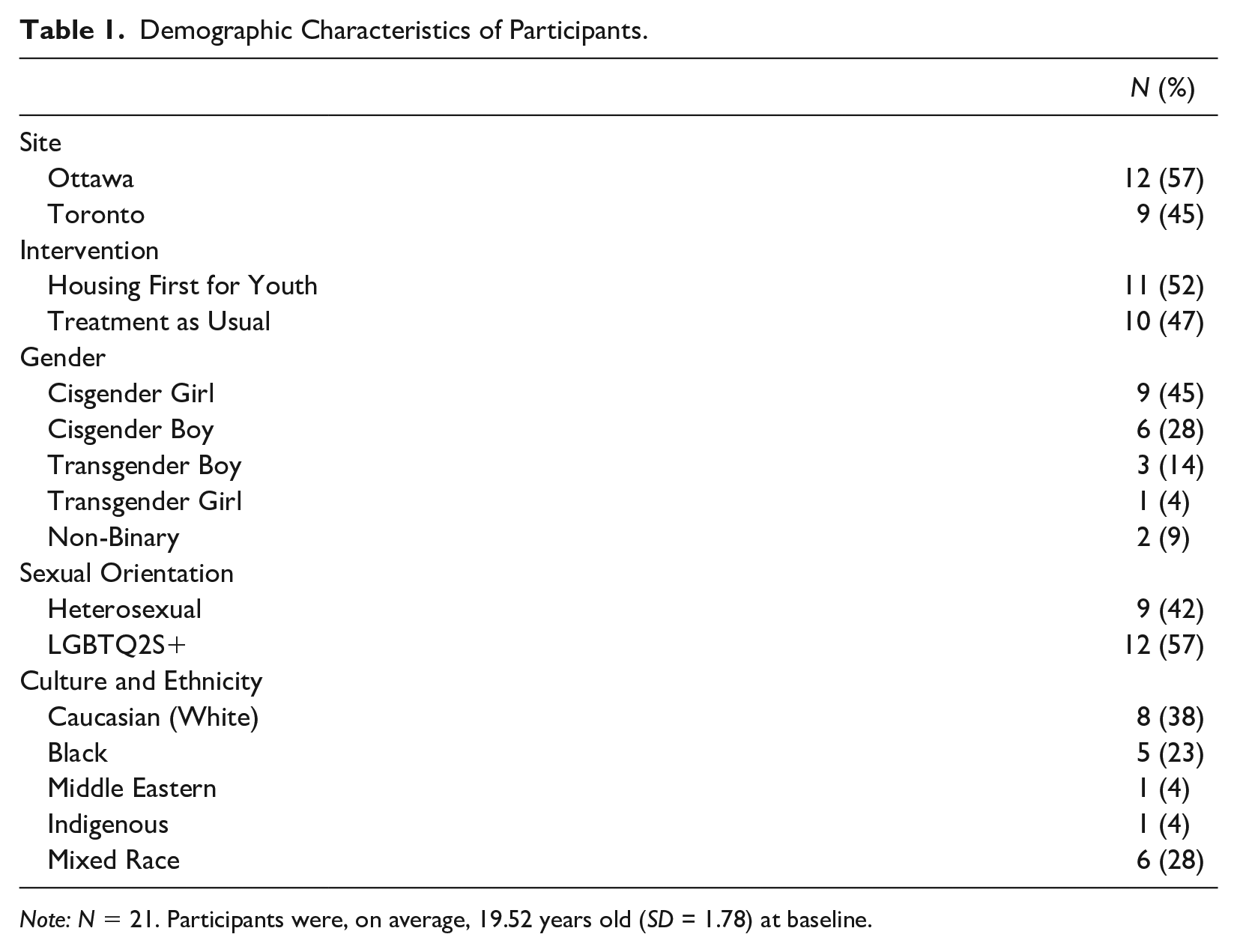
Note: N = 21. Participants were, on average, 19.52 years old (SD = 1.78) at baseline.
Data Analysis
All interviews were transcribed verbatim and were analyzed in their entirety using NVivo 14. Two series of interviews completed one year apart with the same participants were analyzed in two phases following Saldaña’s (2003) guide for longitudinal data analysis. Exploring narratives discussing two-time points serves as time triangulation to support the observation of chronological change (Saldaña, 2003).
The data analysis used a deductive approach using a priori codes. In order to capture the resilience and adaptive change to youths’ experiences of homelessness, the coding scheme was composed of three parts: (1) stressors (individual level, relational level, and environment and systems level; Bronfenbrenner 1979), (2) coping behaviors (problem-focused, emotion-focused, and relationship-focused; Lazarus and Folkman 1984; O’Brien and DeLongis 1996), and (3) resilience and adaptive change. Within each of the major coding themes of stressors and coping behaviors, we focused on ecological divisions (Bronfenbrenner 1979) of individual, relational (i.e., microsystem), and community (i.e., macrosystem) level factors. Furthermore, coping behaviors were coded as active (behaviors and strategies where an individual tries to actively manage the stressor; Gaudreau 2018), avoidant (trying to circumvent stressors rather than dealing with them; Suls and Fletcher 1985), or neutral.
Throughout the methodology described below, we aimed to ensure rigor in part to acknowledge the researchers’ social placement and how our understandings may impact the research. The researchers on this project have extensive experience both in practice and research working with vulnerable populations and youth. Throughout the coding and analysis process, we used reflexive journaling and memoing to document and reduce researcher biases and stay true to participant narratives. The coders (SMM and AD) approached the data by attempting to set aside preconceived notions of what coping may be considered adaptive or maladaptive to a situation.
Phase I
Phase one of the data analysis was completed using first and second-cycle coding of the analysis of baseline interviews (T1) guided by Miles et al. (2014). In the first cycle of coding, transcripts were reviewed line-by-line. The lead author and AD coded the same interviews (n = 2) until their coding matched and reflected the coding scheme. When the coding was consistent, interviews were coded by a primary coder and reviewed by the second coder as a validity check to ensure completeness, consistency, and accuracy. Coders met to review any disagreements in the codes and came to a mutual decision of whether the code was or was not accurately representative.
In the second cycle of coding, participant summaries were developed to further bridge and group the data from the analytic matrix into categories (Miles et al. 2014). First, the lead author developed individual case summaries populated with the three coding categories: stressors, coping strategies, and perceived resilience. The case summaries were reviewed by AD. A cross-case matrix was developed, where cross-case summaries were written for the main categories: stressors, problem-focused coping, emotion-focused coping, relationship-focused coping, and traits of resilience: self-awareness, personal and emotional growth, finding purpose, tolerance affect, and sustained competence under stress. The cross-case summaries facilitated the reflection of dominant and divergent views across participants.
Phase II
For phase two, we examined changes in stressors and coping after one year. The initial in vivo coding scheme was applied to the second set of interviews (T2). First and second cycle coding was completed as described in Phase I. Data were analyzed case by case (first cycle) and then across cases (second cycle). To explore themes within participants, individual participant summaries were completed on prevailing details of stressors, coping, and resilience factors from T1 and were compared with information from T2 to see any aspects of behavior change.
Results
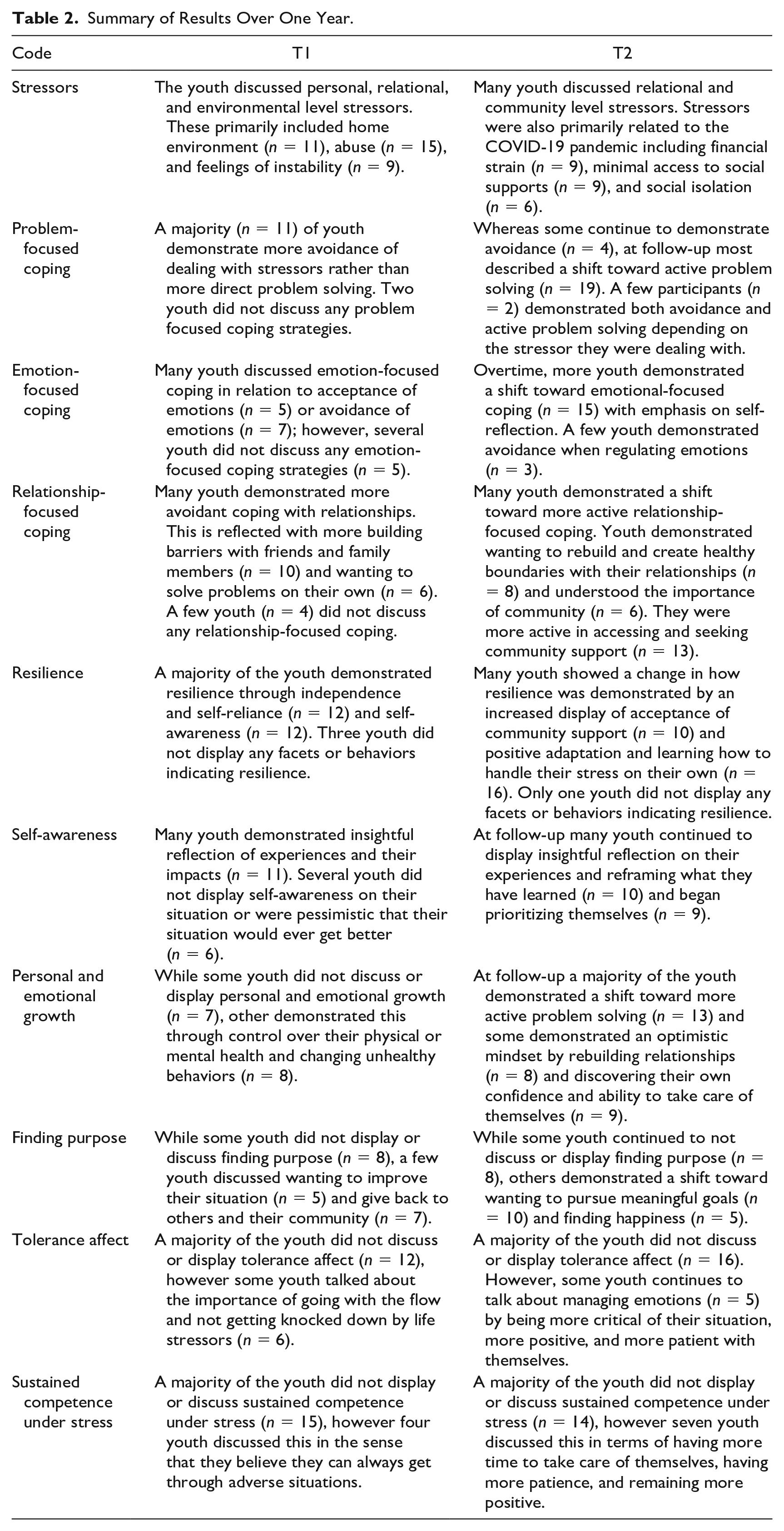
The narratives from all of the youth provide an overview of the development and change of resilience over time (see Table 2). These youth have encountered homelessness (i.e., couch surfing, shelters, sleeping rough) and problematic family relations. At T1, common coping behaviors observed involved creating barriers, reflecting on their current experiences, and solving problems. At T2, they exhibit approaches such as rebuilding relationships, reframing their circumstances in a more positive light, and adjusting their mindset to better cope with challenges. They also heavily engaged with community services as a form of coping at both time points. These behaviors suggest that youth demonstrate positive adaptation and personal growth when dealing with stressful situations. This section will explore the process of resilience development, stressors, coping mechanisms, and positive adaptation for 19 youth and the differences over time.
Summary of Results Over One Year.
Identified Stressors Over One Year
The stressors described by youth at both time points were related to feelings of uncertainty in different parts of their lives. At T1, the main stressors that the youth described were related to home of origin, including home environment, abuse, and feelings of displacement. In contrast, at T2, stressors of the COVID-19 pandemic pertaining to finances, isolation, lack of support, and difficulty accessing support services took precedence (see Table 2).
Stressors at time one
“I always have [a] fear of going home”: Family context and abuse
The majority of the youth described abuse in the home as one of the most prominent stressors that they experienced. As one youth stated, “I grew up in an abusive home. Physical, emotional, sexual, all of the above” (Cisgender girl, T1, 20 years old at baseline). This quote describes the compounded experiences of abuse spanning from emotional, physical, and sexual abuse, and child neglect, with almost all youth indicating experiencing more than one type of abuse.
Abuse was most often reported occurring in early childhood, and youth described it as a complex experience for them to understand. Moreover, growing up, they recognized that these experiences are not what children should deal with at this age:
I was still very young. So, a lot of these concepts that I was seeing didn’t make any sense to me because I was only, like, five or four [. . .] So, when I see domestic abuse and, like, alcohol abuse and stuff like that, it’s not fear I’m feeling; it’s curiosity [. . .] and I shouldn’t have been introduced to at that age. (Cisgender boy, T1, 18 years old at baseline)
Abuse remained an experience until they chose to or were forced to leave home. Abuse and neglect in the home are critical experiences and have a lasting impact on youth as they experience and try to exit homelessness.
“I feel like it just effects your whole life”: Feelings of instability
Youth experienced instability early on, moving between shelters, transitional housing, and foster care. Despite the varied places they found shelter, the consistent theme was displacement and uncertainty, impacting their overall lives. This instability greatly affected their mental health, creating uncertainty about basic needs like food, shelter, and education or employment. One youth described the challenge: “[the] biggest struggle about being unhoused is not knowing how much money you are going to have or where your food is going to come from” (Cisgender boy, T1, 18 years old). Overall, the sense of displacement left the youth with a “[f]eeling that they are always one step behind, in relationships and school, the feeling of starting over at each new housing” (Cisgender girl, T1, 18 years old at baseline).
Stressors at time two
One year after the initial interviews, the youth in this sample found themselves confronting the stressful and distressing challenges brought about by the COVID-19 pandemic. The change in stressors from T1 was related to an unpredictable external event rather than the housing intervention. One youth compared the stress of the pandemic to their experience of homelessness and stated: “Personally, even compared to homelessness, I feel like this whole world pandemic is like, it’s like the worst thing that’s ever happened to me, or like the world actually” (Cisgender boy, T2, 18 years old at baseline). As the youth described, the pandemic “made everything a hundred times worse” (Cisgender girl, T2, 19 years old at baseline). They faced accumulating stressors, including losing their job, difficulty getting in contact and seeing their service workers, delaying legal and medical matters or appointments, and, like many, the uncertainty of when the pandemic would end. Of the aforementioned stressors, the financial strain and stress of relationships and isolation were most prominently discussed.
“But you don’t have any money for yourself”: Financial strain of the pandemic
Under the context of the COVID-19 pandemic, many youth discussed losing their employment due to closures and having a significant impact on their financial situation. Youth discussed not having enough money for their basic needs, but what was more emphasized was not being able to have funds to cover unexpected expenses. Moreover, youth felt they had lost their learned skills and behaviors in budgeting and being responsible with money.
“It’s still kind of lonely, and that’s hard”: Relationships and social isolation
In addition to the financial strain, the majority of the youth touched on lost social and community connections and how “the sense of community right now with this pandemic is pretty shit [and] it’s hard to focus on how [things] felt before [it] started” (Transgender boy, T2, 18 years old at baseline). Some youth coped with what they described as toxic environments by cutting out relationships with people who reminded them of the behaviors they were trying to stop, such as drugs and violence. In a time of isolation, this left them with little to no social support and relationships that they could lean on and no environment to build new relationships:
I ended up having to really let go of a lot of friendships for some other personal reasons. But because of having to let go of all those friends and it being Covid, I basically lost a bunch of relationships. And then didn’t really have adequate support. (Transgender boy, T2, 21 years old at baseline)
Youth Coping Behaviors Over One Year
Youth demonstrated coping behaviors in various forms, including problem-focused, emotion-focused, and relationship-focused, in both active and avoidant forms (see Table 2). Although similarities exist between the two time points, there are also notable differences in how youth construct barriers and rebuild relationships, rely on and engage with their community, reflect on and reframe their situation, and approach problem-solving and mindset adaptation.
“I kind of don’t want to be lonely”: Barrier building and rebuilding relationships
Across both time points, youth were proactive about how they responded to their relationships with family and friends, displaying problem-focused, emotion-focused, and relationship-focused coping strategies.
At T1, the way youth coped with relationships was divided between active and avoidant coping. Some expressed a reluctance to seek support from their relationships, preferring self-reliance over asking for help. They articulated a lack of trust stemming from past experiences, leading them to distance themselves from relationships as a form of coping. Many voiced a preference for resolving issues independently, citing a belief that they could only depend on themselves for support. For instance, one participant remarked, “I feel like right now I just want to be left alone kind of because I’m at the point where I don’t really trust anybody. I just don’t want to be hurt or nothing” (Cisgender girl, T1, 17 years old at baseline). This highlights the inclination toward self-sufficiency and a hesitancy to engage with others due to past relational experiences.
At T2, the youth demonstrated many instances of active relationship-focused coping. The majority of the youth recognize that there is some level of importance in reconnection and revisiting relationships. In contrast the behavior of cutting off relationships, youth shifted to revisiting and reopening doors to many relationships, including familial ones. It was also common for young people to try to put themselves in others’ shoes and try to understand where others were coming from: “With my mom, I feel like I understand her more. I feel like [I] understand where she comes from now. When I was younger, I used to think oh, my mom’s always wrong or whatever” (Cisgender girl, T2, 18 years old at baseline). Overall, most youth talk about how they want a better relationship with their family.
“It was a lot of outside help”: Reliance and engagement with their community
At T1, a few youth discussed the importance of community support. Those youth who talked about community support at T1 highlighted that they would not have been able to overcome many challenges (e.g., finding housing and dealing with family tension) without the support they received from community workers. Said one: “It was a lot of outside help. I don’t think I would have been able to deal with any of that on my own” (Cisgender girl, T1, 20 years old at baseline). Many youth who talked about community support at T1 highlighted that this was the support that complemented what they could do on their own and gave them that extra sense of guidance.
At T2, almost all the youth talked about relying on and engaging with community support and recognizing that these services are there to help them. In comparison to T1, youth became more proactive about finding support when they are in need and recognized that this can be beneficial for them. Workers have also been critical in providing tangible support in helping youth with housing and dealing with landlords. Overall, at T2, youth are more open and engaged with the support that the community has to offer them. They seek and accept help versus trying to solve all their problems independently and not trusting people providing support.
“I push myself, but I don’t break myself”: Reflection and reframing
At both time points, youth were very insightful in self-reflection of their experiences and actively coped by reframing how they could approach life stressors. Youth discussed instances of problem-focused and emotion-focused coping when changing how they would approach their situation. They expressed many sentiments about hope: “Just being able to live with the hope keeps you alive” (Cisgender girl, T1, 18 years old at baseline); freedom: “I feel like I’m more emancipated, so like my freedom is like more mine than it was ever so I feel better about myself and like my environment” (Cisgender boy, T1, 18 years old at baseline); happiness: “Happiness is always there, it’s just a matter of realizing that it never left, you know” (Cisman, T2, 18 years old at baseline); and independence: “Finally I don’t need 24/7 support from workers” (Cisgender girl, T2, 21 years old at baseline). Most prominent are the reflections on happiness and reframing of their future.
Almost all the youth discuss the importance of finding moments of happiness by doing activities that may uplift their mood. For example, at T1, one youth shares that they “try to do something that sparks some sort of joy. [. . .] Give myself a little bit of distance from what’s ever happening, and when I’m in a bit of a better space, then I can . . . deal with the issue” (Cisgender girl, T1, 20 years old at baseline). Some youth used examples of playing an instrument, listening to music, going on a walk or run, or going outside. At T2, this sentiment remained amongst a majority of the youth. Moreover, they reflect on and discuss the importance of looking at the future as an opportunity for change. This is a feeling that remained persistent over time. It is clear that the youth want an opportunity for change and to better their situation, and they are finding opportunities to do this. They talk about change with a desire for stability, independence, and freedom.
“When I can’t find a solution to it, I just give up”: Problem solving and mindset
Problem-focused coping emerged as a prevalent theme among youth, notably showcasing a shift in problem avoidance to active problem solving and mindset adjustment. At T1, the youth discussed problem-solving in a more avoidant or neutral form alongside emotion-focused coping. Many youth adopted a more avoidant approach and harbored a pessimistic mindset. As one shares, “I often don’t see myself solving situations I’m in. I know I do, but I don’t see it that way. It just kind of happens” (Transgender boy, T1, 18 years old at baseline). Many other youth share that they choose to bottle up emotions or avoid the situations they are in. Another youth shares that they “don’t really deal with stuff, [they] just let it go” (Cisgender girl, T1, 18 years old at baseline). At T2, this is not as often discussed. Aligned with problem-solving, there is a noticeable shift in the mindset of youth regarding their ability to overcome challenges. Youth at T2 were more likely to take the time to consider their situation and try to find the source of the problem and a way to solve it: “I want to sit down and think about it first. You know, how that’s gonna affect me. What did I do wrong? How can I make this better?” (Cisgender boy, T2, 18 years old at baseline).
Resilience among Youth Over One Year
The youth demonstrated immense strength and positive adaptation based on the stressors and coping mechanisms they used. They displayed elements of resilience such as independence, accessing community support, personal growth, and positive adaptation with an increased presence of perceived and demonstrated resilience at timepoint two (see breakdown in Table 2).
“It’s going to start with you”: Independence
Almost all participants discussed independence and self-reliance as a form of positive adaptation and resilience at T1. Youth attributed change to having to be independent as one says, “It’s got to start with you, though, always. No one can change—for you to change, it’s only up to you” (Cisgender boy, T1, 18 years old at baseline). With all the stressors they have dealt with and overcome, many feel that protecting their well-being and having freedom is the best way to adapt to their situation: “Yeah, my serenity and peace, that’s one thing, like, I valued since I was younger, to never throw away for anybody” (Cisgender boy, T1, 18 years old at baseline). This sense of independence remained prominent at T2, where youth expressed that they felt most happy when they could support themselves: “Whenever I was the most happy was whenever I was, like, there for myself [. . .] I didn’t put myself down, I was always—like, I had a good mindset. That’s the most important thing” (Cisgender girl, T2, 18 years old at baseline).
“Through community we achieve purpose”: Community support
Having a network of people who they could trust, whether family, friends, or service providers, and embracing community support was a source of resilience for almost all participants. Many youth shared that having people who believed in them acted as a source of motivation: “[T]hey’re still here supporting me, even though like I went homeless, I had mental issues, [. . .] just knowing that someone believes in me, just knowing that I have family, yeah, it motivates me a lot” (Cisgender boy, T2, 18 years old at baseline). Many youth believe that they would not have been able to overcome their challenges without the support from their social workers and community.
“I didn’t like where my life was going”: Personal growth and positive adaptation
Many youth across both time points discussed the desire to change their lives and make changes to sustain themselves positively. While at T1, the willingness to change was prominently discussed, actionable change and differences were seen in T2. At T1, the majority of youth mention that they “didn’t like where [their] life was going, so [they] wanted to make something out of it” (Cisgender girl, T1, 18 years old at baseline). For example, one youth discussed that selling drugs was not the path that they wanted for themselves:
I was on the streets selling drugs cause I had no choice. I was selling weed on the street ‘cause I had no choice. I didn’t have like I didn’t know where to get a job. The only like option I had to make money was selling drugs. Then I got stopped and I was like oh no no, no I can’t do this anymore. I have to change. (Cisgender boy, T1, 21 years old at baseline)
Positive adaptation and change were more prominent one year from the first interview. Many youth discuss having a turning point over the last year that was critical in them changing their mindset and making actionable changes to improve their situation: “I’m just trying to improve myself. I can’t, like, recall exactly, like, what has happened over the last year. But, like, it’s just been me trying to improve myself” (Cisgender girl, T2, 18 years old at baseline). While many youth were working toward making positive change, other youth took time to recognize how far they have come and the changes they have been able to make for themselves: “I guess the best moment for me was actually pretty recent when I realized that supporting myself is possible” (Cisgender girl, T2, 20 years old at baseline). Youth in this study also emphasize being open to new experiences that bring them joy. At T2, almost all participants emphasize the desire to be happy and do things that bring them happiness. Happiness became a prominent part of positive adaptation that was not often seen in T1.
Discussion
Developing resilience, by adapting to and overcoming the stressors they face, enables youth and young adults to see a new beginning and brighter future for themselves. A large volume of research has been conducted on the process of resilience, including stress, coping, and adjustment (Kolar et al. 2012; Lazarus and Folkman 1984; Roebuck and Roebuck 2016; Ungar et al. 2008). However, minimal research has been done on the coping process implemented by youth experiencing homelessness. This study adds to the growing literature on resilience and coping among youth experiencing homelessness, offering insight on how we can best support this uniquely vulnerable population.
Participants’ descriptions of personal stressors were thoughtful and demonstrated immense reflection on their situation. The stressors stemmed from various individual, relational, and community factors. Participants described both external or environmental and internal or personal stressors, with personal stressors being more present at T1. This aligns with previous research, such as Tyler and Schmitz (2018), who found that individuals experiencing homelessness tended to emphasize immediate personal stressors more when their situation was new. Our study participants exhibited concerns ranging from pre-existing life challenges to the struggles of meeting basic needs like food and shelter. At the follow-up assessment (T2), conducted one year later, participants faced additional stressors exacerbated by the COVID-19 pandemic. These included financial strain, job loss, relationship difficulties, and feelings of loneliness, which aligns with previously documented stressors during the COVID-19 pandemic amongst this population (Rew et al. 2021; Silliman and Bosk 2020).
The research findings expand upon prior limited studies examining how young people experiencing homelessness manage their challenges and stressors. Current research primarily focuses on individual-level coping strategies, such as using substances like drugs and alcohol, solitary reflection, and engaging in hobbies like music, writing, and reading (Kidd 2003; Thompson et al. 2016). However, there has been little exploration of community-based problem-solving coping strategies, such as spending time with friends (Kidd 2003), and seeking support from others who share similar life experiences (Matulič-Domadzič et al. 2020). In our study, while we observed individual coping strategies like reflection, reframing experiences, and problem-solving, participants emphasized the vital role of community and relationships in coping. The youth in our sample stressed the importance of establishing healthy boundaries in relationships to avoid further trauma, rebuilding connections with family members, and accessing community support.
While resilience among youth experiencing homelessness is a growing topic in scholarly literature (Cleverley and Kidd 2011; Cronley and Evans 2017; Grattan et al. 2022), the personal displays of resilience are not widely covered. This study expands the literature on resilience amongst youth experiencing homelessness and offers evidence for the multisystem model of resilience presented by Liu and colleagues (2020). The multisystem model of resilience represents an evolving capacity to respond to challenges and trauma over time, highlighting internal and external resilience. Internal resilience refers to an individual’s ability to adapt and address their needs by leveraging their available resources. This encompasses coping skills, pursuits, and goal-setting strategies that empower individuals to navigate challenges effectively. External resilience encompasses socio-ecological factors such as access to healthcare and support services, which further bolster an individual’s resilience. While youth demonstrated significant internal resilience, they also displayed strong external resilient behaviors by acknowledging if and when they needed support from their community.
Coping and resilience are notably interconnected. Only a small number of youth in this sample demonstrated this lack of coping behavior at T1. Often, the youth who lacked coping behavior discussed that their situation could not be improved and that nothing was going to change; there was a strong sense of hopelessness. Moreover, it is well documented that high levels of coping are linked with better adjustment (Dalton and Pakenham 2002).
Given this, service providers should consider integrating programs that support learning and developing coping behaviors. This has the potential to support an increased development of resilience, allowing youth to adapt positively in the face of adversity and providing them with more resources to handle their situations. One program that can be implemented is a cognitive behavior therapy (CBT) based approach using the coping intervention course (CIC; Clarke et al. 1999). The CIC is an eight-week class which teaches adolescents social skills, relaxation techniques, cognitive restructuring, communication, and problem-solving. While this is a structured class, there are modified versions of the course designed for incarcerated youth, which shortens the sessions, reduces the amount and complexity of homework, and implements a points system for reinforcing behavior (Rohde et al. 2004). This course has been found to have positive effects on adolescents with depression and incarcerated adolescents.
Recent research suggests that social-contextual factors play a crucial role in promoting community integration and fostering resilience among youth (Grattan et al. 2022; Manoni-Millar et al. 2023; Stewart and Townley 2020). Stewart and Townley (2020) emphasize the significance of factors such as the sense of community, social support, and empowerment in enhancing individual well-being. Consistent with findings in this study, Stewart and Townley (2020) found that social support was significantly related to well-being, showing that developing peer friendships is important to youth as friends may be a primary source of support, especially if youth are disconnected from family. Peer support programs are one intervention that could support the development and ties with the community while leveraging benefits from shared experiences. Having support from others with similar experiences can be invaluable for youth who may feel ostracized (Kidd et al. 2019; Stewart and Townley, 2020). This may also support youth in learning how to cope with stressors from people who may have overcome similar challenges.
Limitations and Future Directions
Though offering many strengths and critical findings, this study is not without limitations. This study had a small sample size given that it excluded participants who only completed interviews at one time point. It took a novel approach to analyzing youth’s experiences qualitatively from a longitudinal perspective. Minimal qualitative studies use a longitudinal format. This study added value as it offered an understanding of change over time and how youth adapt to their environment and experiences. Even though not explicitly asked about the pandemic, the time two findings can be linked to the COVID-19 pandemic, an unpredicted external event when planning the randomized controlled trial. While analyzing the data case by case and cross-case, we did not gain an in-depth understanding of each case. It would be interesting to examine the sample of youth more intimately, looking at case studies on their resilience process and how this changed over time.
LGBTQ2S+ and racial minorities make up a disproportionate number of the homeless youth population in North America (Henry et al. 2021; Kidd et al. 2021). The 2019 National Youth Homelessness Survey (NYHS; Kidd et al. 2021) identified 17 percent of youth as transgender, non-binary, two-spirit, or a gender other than cisgender boy or girl. In terms of racial minorities, 28 percent identified as being part of a racialized community (i.e., all people that are non-Caucasian in race or non-white in color, excluding indigenous; Kidd et al. 2021). Though it did not fit the scope of this paper, there was some mention of identity as a stressor among LGBTQ2S+ and racial minority youth. Youth discussed the discrimination that triggered or impacted their experiences of homelessness or inhibited obtaining housing. More specifically, some youth left home or were kicked out of their home due to their transgender or queer identity. Future research should focus on minority populations and see if they demonstrate distinct forms of coping and resilience.
Resilience is a critical process for youth experiencing homelessness to develop as it will support overcoming past traumas and daily stressors. The results of this study have several implications for service providers. It is suspected that programs and services aimed at coping and community integration will positively impact youth in developing increased resilience. As aforementioned, interventions could include the coping intervention course and peer support programs, which will foster a sense of empowerment, sense of belonging, and problem-solving; found to be critical in developing and displaying resilience in this population.
Conclusion
The development of resilience is a transformative process for youth facing significant adversity, enabling them to adapt and envision brighter futures. Youth experiencing homelessness demonstrate an ability to persevere and cope with the immense challenges that they are facing and that continue to impact them. This study represents an early exploration into the resilience process of youth experiencing homelessness, emphasizing the need to understand how they integrate and respond to stressors. The findings highlight the importance of community-based resources alongside individual approaches to coping. While existing literature primarily emphasizes individual coping behaviors, this study underscores the vital role of community support and relationships in resilience-building among homeless youth. It underscores the significance of external resilience factors, such as access to support services and healthcare, complementing individual-level coping behaviors.
Footnotes
Acknowledgements
The results published here are in whole or in part based on data obtained from the Making the Shift Youth Homelessness Social Innovation Lab, co-led by the Canadian Observatory on Homelessness at York University, and A Way Home Canada. The authors thank the site coordinators in Ottawa and Toronto, service and housing providers who have contributed to this project and research, and the many youth who shared their stories.
Declaration of Conflicting Interests
The author(s) declared no potential conflicts of interest with respect to the research, authorship, and/or publication of this article.
Funding
The author(s) disclosed receipt of the following financial support for the research, authorship, and/or publication of this article: The original trial (registered as ISRCTN10505930) was made possible through financial contribution provided by the Government of Canada, Youth Employment and Skills Strategy Program (YESS) of the Department of Employment and Social Development Canada (ESDC). The funding is being implemented through a partnership between A Way Home Canada, the Canadian Observatory on Homelessness who co-lead MtS, and local partner agencies.
