




Abstract
How do parents understand and navigate green living challenges? Parents harness a set of meanings (consciousness, connectedness, and wellbeing) to socialize their children into sustainable ways of living. Innovatively drawing on these meanings in their daily practices, parents overcome short-term challenges to bring about long-term intergenerational change.
A child hands a parent single use waste.
Photo courtesy of the authors

Introduction
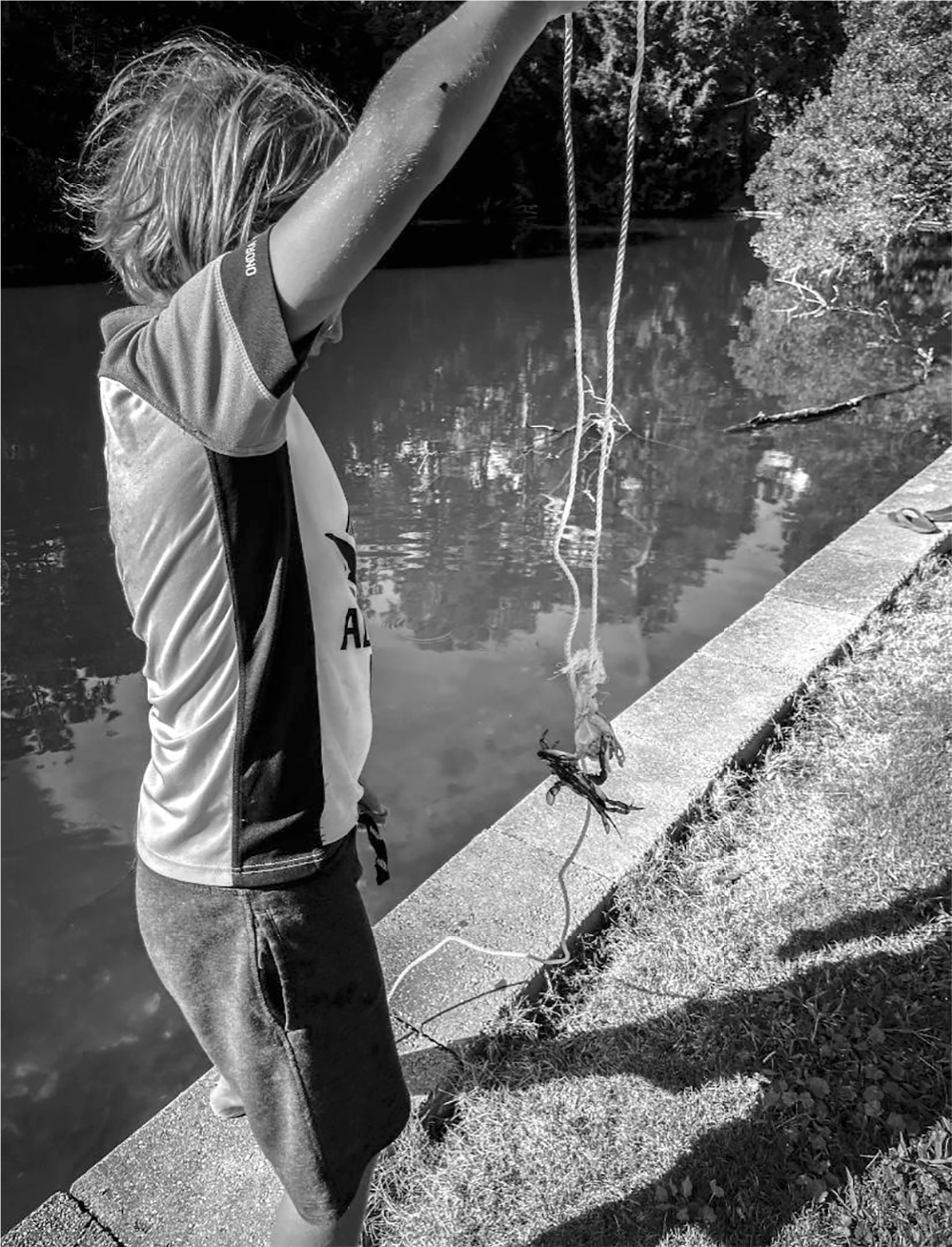
I have been studying environmental issues and living a green lifestyle for over 20 years. Despite my family’s commitment to green living, we were presented with new challenges when we welcomed our son into our lives in 2011. Like the individuals interviewed for this study, we see that, while our household faced short-term challenges, our family made progress with green living. Though we try to get single-use items, especially plastics, out of our home, they still manage to sneak their way in (short-term challenge). However, our 9-year-old child would choose crabbing in a local creek over playing on the iPad any day of the week (long-term success).
A boy chooses crabbing in a local pond over TV time after school.
Reusable jars hold food items and homemade dish soap.
Photos courtesy of the authors

Hiking on a nature trail in Lowcountry, South Carolina.
Photo courtesy of the authors

My challenges with juggling green living and motherhood led me to wonder, “What exactly does it mean to live a ‘green lifestyle’ and how do green lifestyles contribute to overall global sustainability?” These are the initial questions that led me to design a study focused on green parenting lifestyles. In sociological terms, a “lifestyle” is a set of social practices, or habits, encompassing both the activities and the meanings people hold. Lifestyles define how we connect and differentiate from others, and how we make decisions about everything from what to eat for dinner to how we travel to work. This way of life is an increasingly common response to high-consumption living. Several recent reports document that households make up a large proportion of global pollution and climate change. For instance, household consumption is responsible for 50-80 percent of natural resource use and 23 percent of total global energy use. Likewise, household-level behavior changes, like reducing food waste, eating a plant-rich diet, and adopting LED lighting, can dramatically reduce greenhouse emissions. Ninety-two percent of the respondents in this study indicated that they either eat a plant-based diet and/or make efforts to reduce food waste. All respondents indicated that they try to reduce energy use and waste by choosing LED bulbs, among many other green activities.
Context and Methods
This analysis began with 48 qualitative interviews conducted in 2016 with parents who identify as “green” and live in Lowcountry Charleston, South Carolina. The lead author constructed flyers and Facebook announcements recruiting for “green parents” and “parents engaged in sustainable lifestyles”. The resultant sample, which is largely female (96%), White (90%), and well-educated (43%), is limited in that it is not reflective of the Charleston area’s overall population. However, it does reflect findings that mainstream environmental ideals (as opposed to environmental justice ideals) are more likely to be held by White and well-educated segments of the population. It also reflects findings that women report higher levels of concern about environmental issues than men.
Green Parenting
This paper shows that green parents draw on holistic meanings to create their current lifestyles and to bring about intergenerational environmental change. Parents’ long-term focus is reflected in Germaine’s (mother, Black, 45, 3 children) comments: “What you instill in your children is gonna last generations ‘cause they’re gonna do it with their children and so on… They’re gonna be greener folks and know how to grow (food) and teach their kids how to do this because of what they were exposed to from a young age.” Parents rightly focus their green efforts on raising their children as research shows that when youth are exposed to pro-environmental behavior, it has long-term impacts.
Challenges to Green Parenting
Parents named several challenges to living sustainable lifestyles with children in the household. Key among them were culture, time, money, and green social media. Lowcountry parents faced both cultural advantages and challenges. Home to marshes, creeks, rivers, islands, public beaches, and sprawling parks, the Lowcountry offers endless opportunities for outdoor activities. Lowcountry living is steeped in a strong conservation culture that is partly a product of the region’s traditional emphasis on property and hunting rights. While this conservationism keeps strengthening, it occurs amid the historical context of the politically conservative South. Like most states with low per-capita incomes and Republican voting patterns, South Carolina is least likely to support strict environmental regulations. Parents revealed the unique challenges of living green in a red state. Interviewees, for instance, talked about how they avoided telling other people what to do (50%) and instead tried to be good examples (71%). This finding is especially interesting in that parents were not questioned about culture; they were only asked to discuss the challenges they faced.
Along with cultural navigation, most respondents indicated that finance and time limitations presented challenges to green living. For instance, Jane (mother, White, 45, 1 child), a single mom and schoolteacher, noted that time and money limited her everyday purchases of organic products and reduced her participation in recycling (her neighborhood does not offer curbside recycling). Finally, almost half of the respondents pointed to frustrations with green social media and expressed that it is overwhelming or insufficient. In the face of this mix of challenges, parents innovated their green practices by focusing on the long-term goal of socializing their children into a greener future.
Children as Motivators
Despite challenges, all parents pointed to their children as motivators for continuing their green lifestyles. Seventy-seven percent of parents stated that green living was no more difficult after the birth of a child than before. The explanation interviewees gave for their smooth transition into green parenting is that, while children demand more resources, they provide enormous motivation for living sustainable lifestyles. Hank (father, White, 34, 2 children) expressed that: “When you’re a parent… you have more responsibilities, very serious ones, someone’s wellbeing…. I don’t want chemicals in their bodies. I don’t want them going into puberty sooner than they should. I try to be sensitive about shampoos or conditioners. In terms of food too. I buy certain meats, (especially) with no steroids.” Roselyn (mother, White, 29, 1 child) explained that when she had her daughter she became “so much more green… “ even though her family had to temporarily give up a few green activities like food gardening (they didn’t have a fence and felt they couldn’t safely watch a toddler while gardening).
Green Parenting Goals
Analyses of interviewees’ narratives revealed three major goals to green parenting: the reduction of household footprint (100%); protection of families’ health, especially through diet (92%); and the socialization of children into green living (100%). This paper focuses on the third goal.
When talking about the importance of socializing her children, Cab (mother, White, 36, 2 children) noted that her family eats whole foods and walks places because they want their daughters to “see that it’s healthy and it’s good for the world. We wanna teach them. I think because we focus on our values it’s easier to be green.” Many interviewees pointed to how their own parents strongly impacted their current green lifestyles. Luna (mother, Latinx, 38, 2 children) recalled how her parents “. were always very natural. They had a farm (and we) got corn from there. Instead of putting mousse in your hair or gel, my mom used to put lemon, tomato, or flax. But we weren’t intentionally thinking that ‘oh, this is to save the environment.’ We just did it.”
Green Parenting Meanings
Parents’ innovative goal of socializing the next generation into green living was informed by a holistic mix of four meanings: conscious decision-making (85%), connection to nature (81%), connection to each other (67%), and cultivation of wellbeing (71%). Parents’ emphasis on these meanings often overlapped as they mentioned consciousness and wellbeing simultaneously.
Despite challenges, all parents pointed to their children as motivators for continuing their green lifestyles.
Parents exercised conscious decision-making regarding their own behaviors, which they can control, and also over larger environmental problems, which they are less able to control but still want to be knowledgeable about. For instance, when I asked Abby (mother, White, 31, 1 child) about what it means to be a green parent, she spoke simultaneously about her own food choices and about larger problematic systems of food production. “(Green parenting) is just being conscious of your environment and what you eat. It’s really important to have knowledge about your whole life…. Where’d this food come from? What did it take to get this food here…. It’s steak in a package…. Look at how much food and water was used to produce that one steak. What happens with all that cow manure? What about all the trees that they’re knocking down (for pasture)?”
Consciousness was often expressed as deliberate decision-making within constraints. In Ari’s (mother, White, 36, 3 children) comments below you see how, while she is not engaging 100% in green living due to finances and inadequate mass-transit infrastructure, she is thinking carefully about the environmental impacts of her choices. In her words, “I like to buy in bulk. I try to buy things that use less packaging. I would never use (single use) coffee (pods). We use a French press. We try to use less plastics. (Our) kids drink out of metal cups. We had to buy a minivan, but we would have bought a hybrid or any type of electric car if we could afford it. That’s really what we wanna do. I lived in Chicago for so many years, and I didn’t even own a car for a long time. We are 100% about public transportation.”
Parents’ conscious decision-making was informed by a critique of both consumerism and green consumerism. As Anne (mother, White, 32, 2 children) put it: “I think being green covers a lot more than the advertisements or the buzz that people put behind it. I think it is even just being conscious about your purchases, or not purchasing, just because it’s extra stuff.” This helps to explain why, while parents often expressed a desire to do more, only 8% of respondents mentioned guilt over not doing enough. They research behaviors, like purchasing a hybrid car or using cloth diapers. In Gaia’s (mother, White, 37, 2 children) words: “If it resonates with me okay. I don’t think about if this is a “green” choice. It’s just, this makes sense to me… We do (use) cloth diapers. I didn’t just go, ‘oh, cloth diapers, that’s the way to go because that’s the green thing’. I looked up the pros and cons of the washing, the water use. I’m a stay-at-home mom so time wasn’t a big issue…. For us it made sense.”
Parents balanced thoughtful decisions about their family’s wellbeing with attempts to leave a smaller environmental footprint. Sharice (mother, White, 38, 2 children), for instance, discussed how her family emphasized eating whole rather than processed foods but that sometimes there was not enough time to do the cooking and shopping. She explained: “I try to always remember that stress is bad for you too and if it’s between the two, I’ll go for the quick food.”
A majority of parents brought up the importance of connecting to both nature and other people. Kareena (mother, White, 34, 2 children) expressed her desire for both kinds of connections in the following way: “… I guess the thing that comes to mind is just the joy that I have with my daughters when we go to the park and layout on a blanket, open up some picture books, and start reading on a pretty day. I want that to always be an option for everybody. I know that’s kind of general, but I feel really strongly about… not taking the beauty that surrounds us for granted. And sharing that part of it with my daughters is my number one, hands down, the number one best thing in life. I don’t need to go to Hawaii, I don’t need to travel or get the coolest new gizmo or whatever. I’m happiest to be just outside with my daughters, enjoying it.”
While parents talked about the difficulties children posed to green living, none of them gave up the lifestyle.
Parents expressed that green living is fundamentally about cultivating holistic wellbeing. For Keenan, (father, White, 32, 1 child) green parenting is about “the environment, what goes in our bodies, and what I put out in the world. I’m at a point in my life where I feel completely tied to what’s around me. What’s around me is tied to me and we all affect each other. Whether it’s people, or a place, or an ecosystem, or nature, or animals. I’m just going to do what’s best for it all and it will do what’s best for me.”
A child enjoys meeting Addie, a miniature horse, at a local farm.
Photo courtesy of the authors

At first, seeking “connection” or “wellbeing” might not appear to be about environmental change. However, when we look at change as something that not only happens from the top-down, and not only from the bottom-up, but also from the “inside-out”, then we see that parents can impact society by simply instilling in children the joy of connecting to nature.
Green Parenting as Long-Term Positive Change
While parents talked about the difficulties children posed to green living, none of them gave up the lifestyle. In fact, 50% of the interviewees noted that they picked up new green activities because of their children. Peach (mother, White, 40, 1 child) talked about how she paid a lot more attention to food sourcing and preparation when she had her child. In her words: “When I found I was cooking for him, I couldn’t cut corners any more”. Although parents dropped some green habits with the birth of a child, 63% of families mentioned they reintroduced green activities when their children were ready. Parents also pointed to how green living is an evolving process and one habit can sometimes positively spillover into additional habits. April (mother, Black, 33, 1 child), who declared, “I’m not an environmentalist recalled that her green habits originally started with her efforts to save money while in graduate school. Many of her later green practices evolved out of her attempts at “financial literacy”. Then, when her son was born, she became “more thoughtful about products and things in the house that would go in his body.” This thoughtfulness about products led to “… trying to not spoil him with a lot of new stuff all the time. I’m being conscious about, I guess, how I want to raise him with stuff, right. I just want him to play.”
For parents, the birth of an infant brought opportunities for intensified green activities over the long-term into the next generation.
Discussion and Conclusions
This study shows how parents innovatively drew on a holistic set of meanings to carve out green lifestyles despite impediments such as culture, money, time, and green social media. While challenges limited their practices, the key life-course change of having a child motivated parents to continue, and sometimes increase green living. They innovated long-term pro-environmental and inter-generational change by leading by example, and especially by socializing their children. Michelle (mother, White, 39, 2 children) sums up the long-term mission of green parenting this way: “(It is) for my kids to grow up in a world that is conscious about the world around them and to want to protect the earth so it’s around forever (where) they can actually enjoy it and not pollute the air and the water. I hope their kids and their kid’s kids will be able to enjoy it and move forward”.
Green parents are not alone in their holistic efforts to live more meaningful and sustainable lives. Many studies have documented other green communities that value consciousness, connectedness, and wellbeing. We feel cautiously hopeful that green parents, and possibly other like-minded people, are working around challenges to innovate long-term solutions to sustainability.