



Abstract
This article examines the representation of sustainability on the online lifestyle site Goop as a case study of how promotional media deal with environmental and social concerns. Specifically, the paper presents how promotional intermediaries address or conceal a tension between (1) the promotion of conspicuous consumption and (2) the advocacy of sustainable living. The paper contributes to cultural intermediary scholarship by showing how promotional intermediaries attempt to reconcile this tension, advocating consumerism favorable to them while still enhancing critical cultural citizenship. By presenting sustainable brands and environmental advocates, and different—at times, incommensurable—narratives on the relationship between sustainability and consumption, promotional intermediaries signal that sustainability is important while promoting actions that can be considered to contradict the idea of sustainability, such as excessive consumption. In this way they produce a safe space for brands and consumers but arrive at a sustainability paradox.
Keywords
Introduction
The diversity of sources of information about sustainable lifestyles has been well-recognized, as legacy media as well as bloggers, social networks, advocacy groups, and commercial brands communicate about social and environmental issues and diverse ways to respond to them. Commercial media and lifestyle media have shown an increased interest in sustainability, as represented by practices that seek to avoid causing social and environmental harm (Joy, 2022; Keinan et al., 2020). Regardless of the known commercial interests, these types of media are trusted sources of information to many (Maares and Hanusch, 2020). However, the co-occurring functions of information dissemination about sustainability issues and the promotion of conspicuous consumption that seeks to convey status and distinction (Keinan et al., 2020; Veblen, 1899) bring about tensions that modern promotional intermediaries currently need to solve.
Since the cultural intermediary concept was introduced by Pierre Bourdieu in 1984, it has been applied to a wide variety of communicators, ranging from media industry workers to advertisers and product sellers (Smith Maguire and Matthews, 2012), who basically have very different communicative aims: cultural workers in media such as editors, journalists, and reviewers (Bourdieu, 1984; Jaakkola, 2015; Maguire and Matthews, 2010), communicators in the social web such as bloggers (Joosse and Brydges, 2018) and social media influencers (Colucci and Pedroni, 2021; O’Neill, 2020). Some scholars argue that if non-commercial and commercial cultural intermediaries are discussed under the same label, the concept loses on its explanatory potential (Davis, 2013; Jaakkola, 2022). In this study, we will thus focus on commercial actors that Davis (2013) calls “promotional intermediaries,” separating the commercial intermediary agents from agents that aim at creating critical distance towards the production. We define the cultural intermediary concept as an overarching term under which promotional intermediaries constitute a distinct subgroup. Promotional intermediaries are strongly involved in public sensemaking and meaning construction, but they operate in different conditions of production than cultural intermediaries whose primary task is to monitor and be critical of institutions (Smith Maguire and Matthews, 2010).
In this article, we will focus on the issue of sustainability and how it is addressed by the promotional intermediaries on the lifestyle site Goop. The site is active in contextual commerce, which integrates seemingly authentic recommendations and content that mimics journalistic content with seamless opportunities for consumption, or in particular the purchase of products (Colucci and Pedroni, 2021; Manzerolle and Daubs, 2021; O’Neill, 2020). Promotional intermediaries like Goop are currently confronted with conflicting functions to both legitimately address sustainability and to promote actions that basically contradict the idea of sustainability that is grounded on long-term solutions to global problems and living within the planetary boundaries (Rockstrom et al., 2009). Promotional intermediaries may also frame conspicuous consumption and sustainable living as perfectly compatible.
Most of the studies of the intermediary occupations have examined the professionalism of cultural intermediaries (Loacker and Sullivan, 2016; Moor, 2008; Smith Maguire, 2008): the cultural values, stereotypes, and norms that they shape (Doyle, 2016; Gurrieri et al., 2016; Lonergan et al., 2018; Piper, 2015); their influence (Glynn and Lounsbury, 2005; Rod et al., 2012); and forms of agency (Corciolani et al., 2020; Lane, 2019; Moor, 2012). Although some articles discussing commercial media have studied sustainability-related issues such as gender representations (Gurrieri et al., 2016) or veganism (Doyle, 2016), more empirical research is required to strengthen our understanding of how the promotional intermediary functions can be reconciled with the increasing demand for sustainability. Therefore, the present article aims at advancing the study of intermediaries in commercial and promotional contexts to complement our knowledge about the intermediary work.
Promotionalism is not only characteristic of promotional intermediaries. Journalistic intermediaries are increasingly exposed to promotional influences (Andersson and Wiik, 2013), which results in “market journalism,” the pursuit of profits at the cost of quality of content (Lacy and Sohn, 2011). Also, the characteristics of journalism can be used to increase legitimacy in edited content (Farkas and Neumayer, 2020). In the age of content confusion (Einstein, 2016), online genres are increasingly hybridized and intermixed, like in the cases of branded journalism or storytelling (Lascity, 2019), churnalism (Kristensen, 2018), and native advertising (Glasser et al., 2019). While the differences between the production environments between journalistic or “democratic” content and promotional or “biased” content production are often more or less clear, in practice the most crucial negotiations unfold in the rhetorical domain. Especially lifestyle journalism (Cheng and Chew, 2022; Lascity, 2019; Kristensen and From, 2011; Maares and Hanusch, 2020) has been regarded as a greyzone where journalistic and promotional ambitions meet. An online site embedded in structures of commerce but working on a societal issue with ethically sensitive implications like the case of sustainability makes an interesting case in this respect and can increase our understanding of how the intermediary work is performed at the cross-section between commercial and cultural intentions.
Promotional intermediaries and sustainability
On an online lifestyle site that is committed to promoting commodities and promotes some forms of sustainable consumption, a key question is how to achieve a balance between the public-good and promotional modes of address in an intent of giving sense to, and guiding people towards, sustainability.
Sustainability has become a major societal issue advanced by the United Nations, (2015) Sustainable Development Goals agenda that identifies 17 fields to advance sustainability, including sustainable consumption and production (SDG 12). The policy vision has been aligned with the implementation of policies in different sectors and framed by global organizations as a major educational issue for the world’s population (Grizzle et al., 2021; Whitby, 2019). The formation of a global consensus on sustainability contributes to an increased public understanding about its meaning and implications, at the same time providing a context for action that is regarded as desirable and prioritized.
For promotional intermediaries whose main function basically lies in promoting consumption and production, addressing sustainability means balancing their communicative act to convince audiences that they are contributing to the global goals. Consumption is necessary and unavoidable but not intrinsically unsustainable; instead, luxury consumption and sustainability have been argued to be incompatible (Keinan et al., 2020; Wong and Dhanesh, 2017) and sustainable fashion to be an oxymoron (Clark, 2008). It has also been argued that green consumerism, “the production, promotion, and preferential consumption of goods and services on the basis of their pro-environment claims,” has failed to promote sustainable consumption that would operate within planetary boundaries: despite the popularity of sustainable consumerism, consumption increases in an “unsustainable manner and pace” (Akenji, 2014: 13–14; Diprose et al., 2018).
Drawing on past research, we can broadly assume four distinct yet overlapping ways in which promotional intermediaries deal with sustainability. First, as marketers, promotional intermediaries are expected to function as agents of massification, to aim to predict and influence demand (Cherrier and Murray, 2004) and trends (Davis, 2013), as well as the products that are or will be created within the sustainability frame (Davis, 2013). Second, and concurrently, they can be expected to seek to influence the meaning of sustainability and, specifically, how it is connected to certain aesthetics, taste, style, or cultural code (Cherrier and Murray, 2004; Davis, 2013). Third, promotional intermediaries can be assumed to approach sustainability issues through personal narratives, seeking control over which personal and organizational voices are granted standing and agency to bring up preferred frames on the topic (Gamson, 2004). They are also expected to capitalize on the personal attributes of people according to commercial goals (Cherrier and Murray, 2004; Davis, 2013).
Recently, new developments have brought about new functions to promotional intermediaries, as companies have started to take visible and vocal stances on socio-political issues such as sustainability (Koch, 2020). These functions, often discussed under the labels of corporate activism or corporate advocacy, entail that firms can function as economic and moral actors, for example, by employing disruptive and mobilizing tactics, raising awareness, or closing existing governance gaps (Olkkonen and Jääskeläinen, 2019).
Goop as an influencer medium
A publishing and online retail site founded in 2008 by the American actress Gwyneth Paltrow, Goop has been described as a “quasi-religion” (Freeman, 2020), with 1.7 million Instagram followers and two Netflix documentary series. The site is centered upon Paltrow’s celebrity personality, who has become considered a LOHAS (“Lifestyles of Health and Sustainability”) icon (Emerich, 2011). Goop has been seen as a proprietary brand closely attached to the media personality Gwyneth Paltrow, but Paltrow has stated that she regards Goop as “its own stand-alone brand” and an “aspirational lifestyle site” (Yahoo, 2015). Here, she has expressed an intention to make Goop into an editorial service that, in accordance with journalistic lifestyle media, would cater to consumers’ aspirations and dreams by offering ideas, inspiration, and guidance in the spirit of the ideals of women’s magazine journalism (Gough-Yates, 2003), consumer journalism (Kristensen and From, 2011), and service journalism (Eide and Knight, 1999). Besides a web shop, the site involves an editorial department with thematic sections Beauty, Food and Home, Style, Travel, and Wellness, written by section-specific editors. According to the site’s editorial policy (Goop, 2021), “every issue --- features places, items, and concepts that we love and believe in, meaning that we believe they are worthy of your time, energy, and money.” Leaning on affiliate links, product collaborations, and sponsored issues, the site makes a promise to present and review products that are “perfect for our goop audience” (Goop, 2021).
At the time of the analysis, goop.com was noted to attract two million average monthly visits (Similarweb, 2022). Based on the visits and the social media followings, the commercial site forms an online public sphere drawing attention to the LOHAS trend. The company produces comparable promotional transmedia content on lifestyles of health and has appointed a “sustainability editor”—whose personal dispositions are presented in articles next to “shop the story” sections, where readers can buy her favorite products, from beauty products to stainless steel straws. The publication’s ethos is to “operate from a place of curiosity and nonjudgment, and (to) start hard conversations, crack open taboos, and look for connection and resonance everywhere we can find it” (Goop, 2021). As an agent of promotional lifestyle culture (Davis, 2013), the site is thus juggling between two persuasive aims: producing a consuming subject who feels affinity with the products that are on sale but, at the same time, identifies herself as and becomes an informed, a conscious and critical customer in command of her own individual life project.
Goop engages its personnel in promoting products with personal narratives in the site where purchase decisions are being made. It builds on the trust that its followers have on the ability of anyone at Goop to “make judgements on ‘legitimate’ culture” (Warner, 2013: 384). Thus, with the use of seemingly genuine endorsements that are accompanied with direct links to web shops, the company has succeeded in making the consumption experience effortless and “friction-free,” inspiring consumers to purchase the promoted lifestyle (Manzerolle and Daubs, 2021: 1279). The site thus offers a window into the culture that promotes sustainable production and consumption as part of consumer capitalism.
We position Goop as a distinct type of influencer media that performs promotional intermediary work at an organizational level in the similar way as social influencers at the individual level. Social influencers operate as promotional intermediaries by using individual capital to make opportunistic use of social relationships and by framing issues in a certain way that creates persuasive power (Langner et al., 2013). In the same fashion, the impact of the influencer medium Goop leans upon the trustful relationship that it manages to build between the editors and the audiences by framing the individual’s consumption in a preferable and acceptable way. Influencer media can thus be seen as organizations in the digital public sphere that cross and dissolve boundaries between public relations, advertising, and journalism (Borchers and Enke, 2022) and, like influencers, are successful in creating strong parasocial relationships with audiences based on “co-fabricated authenticity” (Colucci and Pedroni, 2021: 989).
Data and method
The present study inquires into the mediation of normative ideas related to sustainability by the lifestyle medium Goop as an agent of promotional intermediation. Our research question reads as follows. In general, how do promotional intermediaries conduct their intermediary role in mediating sustainability, or specifically, its connection to consumption and production?
A thematic analysis (see Guest et al., 2012) was conducted to understand how the concept of sustainability was constructed in articles published from July 2009 until July 2021 in Goop. The data for the analysis consisted of articles (N = 273) that explicitly mentioned “sustainable” or “sustainability.” One-quarter of the articles in the data (N = 65) were explicitly marked as sponsored content. The sustainability concept was used readily in the publication, compared to other similar concepts, such as “responsibility.”
The data was analyzed by coding the first-order categories (Gioia et al., 2012) that emerged from the data. We analyzed each text in terms of (1) media prominence, (2) media valence, and (3) the voices that are engaged to present their views on sustainability (Kiousis, 2004).
First, each article was coded by noting the prominence of sustainability in the text: whether it is portrayed as the overarching topic or mentioned briefly. Analyzing the media prominence gives insight into the importance of this topic in this culture (Kiousis, 2004). Presenting items as sustainable in Goop also signals prominence, as featured brands commonly utilize their visibility on the well-known site in their own marketing.
Second, the texts were also coded in terms of media valence (Kiousis, 2004). We directed our attention to any critical reflection that is presented in connection to sustainability. Media texts on sustainability can provide discursive openings and facilitate reflection (Boström et al., 2017; Christensen et al., 2015; Glozer and Morsing, 2020) or they can narrow the view of, for example, what constitutes environmentally responsible behavior or “who the polluter is” (Boström et al., 2017: 11–12). The analysis of critical reflection also facilitates an improved understanding of affective attributes, which have been shown to shape the salience of issues and objects (Kiousis, 2004). Locating the amount of critical reflection in the commercial context aids in understanding how promotional intermediaries mediate societal issues that challenge the way we have organized our societies and economies.
Third, we noted the voices that are engaged to advocate sustainability. This is particularly valuable in the context of contextual commerce, which typically draws on the perceived authenticity of people to promote commercial products (Colucci and Pedroni, 2021; Manzerolle and Daubs, 2021). Finally, we identified patterns and common themes in the data, abstracting the emerging first-order constructs to second-order theoretical constructs, which are presented next.
Findings
The findings of the study are presented in Figure 1 (in the structure suggested by Gioia et al., 2012). The first-order concepts present the categories that have been identified from the data. These categories are abstracted to theory-driven second-order themes. The analysis identified three ways in which promotional intermediaries deal with sustainability. Primarily, they capitalize on the positive connotations of sustainability and authenticity to sell products (Colucci and Pedroni, 2021; Cherrier and Murray, 2004). However, our analysis shows that the same site also presents and grants standing to people and groups that present activist-like stances on socio-political issues. Structure of central concepts in the data.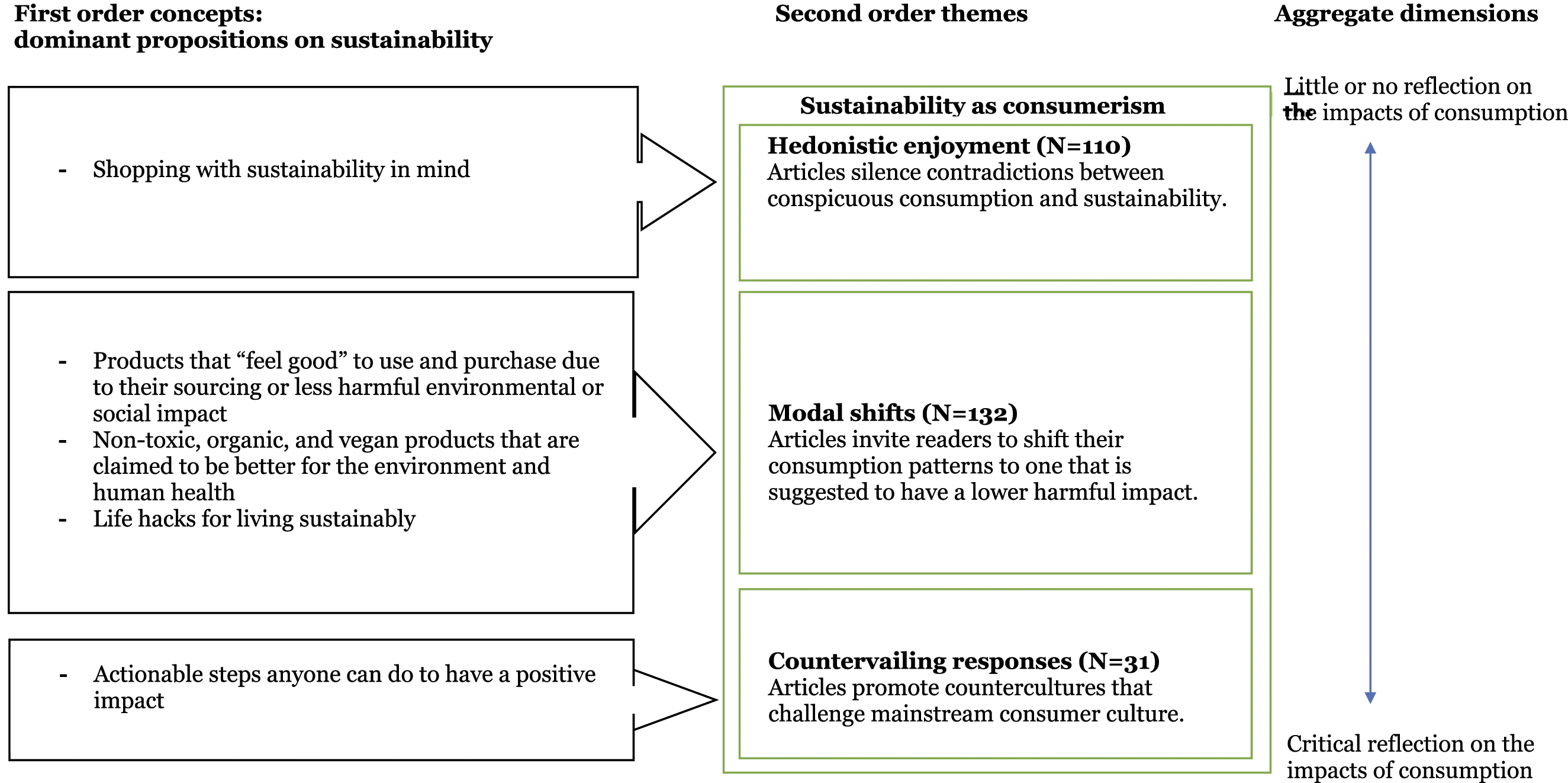
In total, one-fifth of the articles in the data (N = 54) had their focus solely on a sustainability-related topic or angle. The majority of them (N = 29) were published in 2018–2019. This time period saw an emphasis on sustainability topics such as climate change. A one-third (N = 88) of all the articles in the data presented some form of critical reflection in connection with presenting a brand or a practice as sustainable. The presented brands or people were not criticized, but the harmful practices in (their) industries, consumer behavior, and inadequate policies were.
Conflicting and coexisting sustainability arguments
Three thematic categories were found in the analysis. Although the articles present sustainability as consumerism by suggesting that “green (and socially conscious) consumption alone can bring sustainability” (Boström et al., 2017: 11), they differ in terms of the role of critical reflection.
In one-third of the articles (N = 110), sustainability is used as a signifier that justifies conspicuous consumption. Articles may also promote some modal shifts (Sandberg, 2021) in consumption behavior (N = 132) and include some critical reflection on the societal and environmental impact of consumption. However, they exclude reflection on structural and political issues and reinforce the idea that sustainability can be achieved by means of ethical, green, or sustainable consumption (Boström et al., 2017; Koskenniemi, 2021). Third, some articles present countervailing responses (N = 31) that attempt to reject mainstream consumer culture (Thompson and Coskuner-Balli, 2007). They include comparatively more reflection on the ways to find solutions to the sustainability crisis, but nevertheless address readers primarily as consumers. The results show that the more critical articles are written by, or present, specific actors, whose opinions are quoted: in this way the Goop brand remains untouched by the critical and at times contradictory claims.
Furthermore, a closer examination of the second-order themes shows how Goop simultaneously offers different narratives on the relationship between sustainability and consumption but also a curated space for brands and consumers. By connecting sustainability to “the self, creativity, politics, religion -- spaces that have been historically understood as ‘authentic’, positioned and understood as outside the crass realm of the market” (Banet-Weiser, 2012: 10), Goop becomes a branded, curated space “with an aura of authenticity” (Joy, 2022: 9). Similarly, by offering sponsored content such as advertorials as well as non-sponsored content, Goop dissolves borders between journalism, PR, and advertising (Borchers and Enke, 2022): in this context, distinctions between commercial and non-commercial messages are invisible, and perhaps irrelevant (Banet-Weiser, 2012) to the reader.
Next, we will discuss the discovered thematic categories as coexisting and conflicting approaches to sustainability, following the structure depicted in Figure 1. All quotes are accompanied with a reference to the source, as presented in Appendix I.
Hedonistic enjoyment
Goop articles are characterized by carefully crafted content to “make you instantly want to buy everything in order to achieve the same zen mode” (Lammertink, 2019). The articles that associate sustainability with indulgence and hedonistic enjoyment (N = 110) direct consumers to immediately purchase the promoted items (such as in “New Beauty Obsessions for May,” G.27). They invite the reader to construct a consumer identity that reflects the values and aesthetics of the imagined community (Hanna, 2013).
A clear majority of the articles (N = 97) promote sustainable products or the purchase of such products as sustainable without much further explanation or critical reflection, and thus amplify the function of goop.com as a commercial site and a source of inspiration. In this way, promotional intermediaries may at times arguably exaggerate the sustainability credentials of the promoted products. The articles are typically written by “goop,” without identifying the writers, or include short recommendations from different Goop employees, which share their personal thoughts and anecdotes from their personal lives for the readers. They do not suggest to incite positive change, but rather present items that can be purchased to build a “sustainability-minded” style. These articles refer to sustainability in a brief and nonchalant way.
Typically, Goop editors present and recommend products, which consumers can purchase directly via the Web site. The articles are found under the headline “Things We’re Talking About,” are crafted as gift guides or framed as “essentials.” They may include multiple recommendations, of which one highlights sustainability credentials. In this way, they capitalize on the positive connotations of the concept. To illustrate, in “The Ultimate White T-shirt Guide” an editor writes: “In a drawer full of white tees, Ninety Percent’s sustainably sourced organic cotton shirt is the one I wear time and time again. It fits just as a perfect tee shirt should: Slouchy, but not messy, and it looks like I borrowed it from my fiancé.” (G.12)
Sustainability is commonly presented as an essential part of hedonistic experiences. For example, the article “Four Incredible Restaurants – to Stay the Night” (G.09), which starts with “Food pilgrimages have become their own category of travel—a single restaurant can draw culinary obsessives from around the world,” presents a “sustainable-minded” vineyard and a Michelin-starred British inn that visitors from all over the world travel to visit “for a quintessential experience.” The articles emphasize hedonism and connect sustainability with a bourgeois orientation (Carfagna et al., 2014).
Thus, although “luxury and sustainability are often perceived as incompatible and contradictory” (Keinan et al., 2020: 301), the promotional intermediaries resolve this tension by connecting luxury with quality and durability, craftsmanship, authenticity, and provenance. They simultaneously accentuate indulgence and aesthetics. The article “What goop Staffers Want for their Homes” states that, “Have nothing in your home you don’t believe to be beautiful or useful,” textile designer William Morris once said. Well, our thoughts exactly (though we may lean toward the former) (G.08).
Modal shifts
Of the articles that mention sustainability in Goop, most (N = 132) direct readers to purchase products that are positioned as environmentally and socially superior alternatives to conventional products (e.g., as exemplified by “The Feel-Good Fashion Brand You Should Know About,” G.29). Nearly half (N = 53) of the articles present the views of specific editors. They promote modal shifts “from one mode of consumption to one that has a lower environmental impact” instead of absolute reductions in consumption (Sandberg, 2021: 5). Compared to the articles that align sustainability with hedonistic enjoyment (1), the articles in this category include more critical reflection on the impacts of consumption. They direct attention to exploitative practices, negative environmental impacts, and greenwashing. The majority of criticism in this theme is presented towards industry practices: In a greenwashing-prone industry of “natural” this and “eco-friendly” that, New York–based Irish designer Maria McManus’s calling card is transparency (G.29).
The articles also reflect on consumption behavior, accompanied with suggestions regarding how to “consume right”: If I did order in, it would be from places I knew embraced responsible to-go packaging to offset any single-use plastic panic attacks (Sustainability editor Andrea Arria-Devoe in Goop, G.26).
Typically, however, the offered superior consumption patterns still entail the purchase of new products. Therefore the promotion of seemingly superior alternatives to conventional products may serve to obfuscate rather than enlighten a way forward for a more sustainable future (Boström et al., 2017). For example, the articles often present the promoted items as “essentials,” thus framing consumption desires as real needs (Carrington et al., 2016). The article “Creating a Yoga Sanctuary in Your Living Room” suggests eight different items as must-haves, from cork yoga blocks to candles that “infuse the air with a meditative energy” (G.16). Accordingly, the article “9 Home Items to Help You Live More Sustainably” (G.11) states that What these home items can do, however, is remind you of the habits you want to make a more consistent part of your life. Because just having the right tools goes a long way toward a healthier, more sustainable life. We will go so far as to guarantee that if these simple, crucial items are within arm’s reach, you will be more inclined to go to the farmers’ market, shop the bulk bin, and forgo the plastic (G.11).
Most of the articles that promote modal shifts in consumption present products that “feel good” to use and purchase due to their sourcing or less harmful environmental or social impact. They present brands that “you should know about” (G.29), “we love” (G.05), or the editors are “obsessed with” (G.21) and describe aspirations to “do good,” such as to reduce plastic consumption and support ethical labor practices.
Several articles in Goop promote “clean beauty,” most typically referring to non-toxic, organic, and vegan products that are claimed to be better for the environment and human health. They promote a specific beauty brand or brands. The recommendations appear as authentic recommendations: This super nourishing, shine-inducing combination is the obsession of every single editor on the goop beauty team (and we represent pretty much every hair type there is). Made with ingredients that are wildly grown, hand-processed, and sustainably sourced from the Amazon (G.04).
The persuasive arguments in these articles often refer to nature as a magical and healing source for well-being. For example, Goop editors may refer to “the mysterious, mystical, ineffable benefits that pure botanical extracts and essentials confer upon the wearer” (G.22), describe how “every product is supercharged with protective extracts” (G.19), or how a brand founder “focuses on vibrational qualities within ingredients” (G.01). The articles appear to follow the New Age tradition that seeks “healing” properties in nature and natural products (Emerich, 2011; O’Neill, 2020).
On the other hand, many of the articles that promote modal shifts in consumption reflect on the possibilities to consume sustainably and describe feelings of uncertainty and guilt, characterized, for example, as “packaging remorse” (G.26) or “guesswork that often comes with buying” (G.10). These articles include relatively more contemplation on problematic practices related to production and consumption, instead of simply accentuating the feel-good aspects of ecological or socially conscious consumption. For example, the following excerpt of an interview with an environmental advocate directly challenges the prominent angle that advocates ecological lifestyles by promoting certain items as “essential.” “The zero-waste world can tend to focus on matchy Mason jars and stainless steel containers. And I think that can be a barrier for some people. It shouldn’t matter what you have. Using what you have on hand is more important.” (G.25)
Countervailing responses
Many Goop articles (N = 31) present countervailing responses (3), which promote countercultures that oppose mainstream consumer culture (Thompson and Coskuner-Balli, 2007). This category is characterized by the voices of individual advocates that call for substantial changes in current practices (as exemplified by “Transforming the Apparel Industry into a Force for Sustainable Good,” G.14).
While it represents only one-tenth of all articles in the data, it reveals how promotional intermediaries that actively promote commerce may simultaneously also criticize current mainstream market practices. Specifically, industries, such as the fashion and cosmetics industries, are criticized for greenwashing and corporate wrongdoing, as in the following passage: Greenwashing—the practice of falsely marketing products as sustainable—is rampant in the industry. Fast fashion manufacturing is closely linked to labor rights violations, women’s subjugation, and child labor (G.28).
Nearly all of the criticisms of current mainstream market practices are brought forward by individual advocates, such as interviewees (N = 15), external contributors (N = 5), or a specific Goop editor (N = 5). Persuasive arguments emphasize urgency, with appeals such as “we have no chance of saving the planet if individuals don’t make the very individual decision to live differently” (G.15), and “it takes all of us to save the planet” (G.23).
The majority (N = 19) of the articles that present countervailing responses to consumerist culture dedicated the article to actionable steps anyone can do to have a positive impact or to information about the state of our planet. Readers are strongly encouraged to “take steps to prevent further climate change”: If people don’t know what the ocean holds, they can’t care; but if they do know about the creatures and their ecosystems, they just might (G.07). “We have to do something.” It’s the phrase that seems to be on the tip of everyone’s tongue these days, the unofficial slogan of our moment. And yet almost no one does anything beyond reiterating the need to do something—as if complaining about our leaders’ inaction were itself an action (G.15).
Consumers are also at times portrayed as victims of the capitalistic system (Cherrier and Murray, 2004). Some articles (N = 6) address inadequate policies and regulations, shifting responsibility away from the individual consumer: I don’t think that it should be on each one of us to figure out which pair of jeans was produced with the least water. It should be up to companies to take more responsibility for the supply chain and adopt practices to dramatically reduce the amount of water they use. (G.02) For example, under current rules, climate pollution is essentially free...Until these overarching policies are changed, individual morality cannot make much of a difference. (G.03)
The articles that include comparatively more reflection on the impact of current market practices, and the responsibility of different actors to minimize negative environmental and social impacts, may first appear to offer an alternative discourse to those that promote market-friendly conceptions of sustainability. However, they do not radically question the traditional logic of markets and marketing and their underlying assumptions of growth or the idea of the (ethical) consumer as a central actor with the power to change the system (Boström et al., 2017; Carrington et al., 2016).
Each article on Goop either presents the views of one single actor on one topic or present closely aligned views of different actors. By interviewing selected environmental advocates, the promotional intermediaries grant standing to them—simultaneously detaching themselves from the presented criticism. By aligning with the interviewees or external contributors, the promotional medium positions itself as a moral actor, while keeping silent on issues that are inconvenient to them.
Dealing with the sustainability paradox
Lifestyle media are typically market-driven commercial media (Cheng and Tandoc, 2022) and are often criticized for their promotional function (Cheng and Chew, 2022; Kristensen and From, 2011; Lascity, 2019; Maares and Hanusch, 2020). Online lifestyle sites couple lifestyle-oriented edited content and content production with direct links to web shops, where readers can instantly purchase the promoted products. They are thus expected to convert interests into consumable products (Manzerolle and Daubs, 2021) but also to address the megatrend of sustainability to maintain legitimacy and distance themselves from a strict marketer position.
To examine how promotional intermediaries mediate sustainability, we study claims expressed in Goop, an online lifestyle site which integrates seemingly authentic recommendations with commercials in the same fashion as influencers on social media (Colucci and Pedroni, 2021; Manzerolle and Daubs, 2021; O’Neill, 2020). Specifically, we inquired into the attempts to reconcile tensions between two conflicting persuasive aims: promoting material prosperity and sustainable living. Primarily, as perhaps expected, the promotional intermediaries take advantage of the positive connotations of sustainability to vie for control of the market (Cherrier and Murray, 2004), by simply labeling promoted products or actions as “sustainable” (Koskenniemi, 2021). However, they also actively present and align with selected spokespersons, which take visible and vocal stances on socio-political issues such as sustainability. By associating themselves with sustainability activists and advocates, they come to be seen as moral actors, guaranteeing their position on the virtuous side.
The results thus show that Goop offers different and at times contradictory narratives about the relationship between sustainability and conspicuous consumption. By positioning itself as a lifestyle site rather than a marketplace, it manages to construct an identity of a cultural connoisseur that initiates and steers conversations but remains untouched by the presented commentaries. Accordingly, the influencer medium builds trust by appearing authentic (Banet-Weiser, 2012; Colucci and Pedroni, 2021), counterbalancing commercial messages with discourses that are historically seen as outside the realm of the market (Banet-Weiser, 2012), and claiming connoisseurship in the field and symbols of a bourgeois lifestyle that celebrates lifestyles of health and sustainability.
While appearing to “start hard conversations” (Goop, 2021), the featured speakers and brands are not challenged in this context but are presented in a positive light. The findings reveal that promotional intermediaries may seek to resolve tensions between conspicuous and excessive consumption and sustainability as ethical and restricted consumption by providing a “discursive closure” that hides complexity, contradictions, and double standards, and precludes discussion and critique (Christensen et al., 2015: 135). By offering heavily curated content, promotional intermediaries can provide a safe space for brands and consumers. This safe space is the outcome of the practical-rhetorical work that attempts to pre-empt the counteracting forces by proactive framing. Nevertheless, what it offers is a haven for consumption-driving actors to continue their action while not really offering an alternative to the sustainability postulate by putting sustainability into action and calling for a transformative change in consumer behavior. Integrating commerce with content creation based on conscious framing enables promotional intermediaries to offer a widely appealing approach to sustainability in which conspicuous or excessive consumption is not contradictory to sustainable living.
In generating a safe space that is necessary for successful communication, the lifestyle site arrives at a “sustainability paradox” similar to what has been identified in organizations that introduce a sustainability orientation but still focus on the continued economic performance that is, however, paradoxical to the planetary needs (Argento et al., 2022). The primary focus remains on the short-term actions of continued performance to prompt audiences to consume, ignoring the needs for adjusting consumption in the age of scarcity. The sustainability paradox might be overcome by integrating the analysis of social structures and individual behavior in the editorial content and consequently inquiring into the determinants of sustainability in daily life, but that would require more tolerance from stakeholders towards critical perspectives, and the distance-seeking may not be the preference of promotional intermediaries.
Conclusion
In this article, we built on literature on promotional intermediaries (Davis, 2013) such as lifestyle media and social influencers (Colucci and Pedroni, 2021; O’Neill, 2020) to understand how the lifestyle site Goop, combining content production with online retail, navigates possible tensions between the promotion of sustainable and conspicuous consumption. We found that the Goop editors explain what “they love” about items offered as sustainable, frame certain items as superior alternatives to conventional (i.e., unsustainable) products, and show curiosity advocates of environmental and social justice.
We suggested that, in the same manner as social influencers (Arnesson, 2022; Langner et al., 2013), the “influencer medium” Goop conducts a balancing act by counterbalancing commercial messages with seemingly authentic messages about topics that are typically positioned outside the realm of the market (Banet-Weiser, 2012). Promoted items are connected with qualities such as durability, craftsmanship, authenticity and provenance, and aspirations to “do good.”
However, we do not find conversation about a radical shift in consumption and production or suggestions to consume and produce less. Here, sustainability, in fact, is framed as a reason to purchase the promoted items (Johnstone and Lindh, 2022). The site under study functions as a space where affinity to consumership can be nurtured with good conscience; sustainability creates a tool for individuals bridging harmful and beneficial identities of being a consumer. It shows how promotional intermediaries need to find a balance in the extremes of being a “bad” (consumerist) and “good” (conscious) consumer: advocating consumerism favorable to them while still enhancing critical cultural citizenship.
We argued that by generating a safe space for brands and consumers, the lifestyle site arrives at a sustainability paradox: promoting brands and items as sustainable, but continuing performance that is contrary to planetary needs (Argento et al., 2022). Although the promotion of strong sustainability is not an established function of promotional intermediaries, we suggest that intermediaries such as lifestyle media could drive positive change by, for example, stating the calculated environmental impact of practices, requiring accountability and transparency from stakeholders such as commercial partners, and promoting less resource-intensive actions and practices.
The concept of sustainability is open to different meanings and interpretations and should be further studied in different contexts of communication and consumption. Our study indicates it is often used to signal to consumers what they can feel good about, but it can also provide a window into critical examination and deliberation. Although media generally tend to envisage change towards sustainability with focus on the lifestyles of private consumers (Diprose et al., 2018), it is evident that political and regulatory intervention is required to tackle greenwashing and corporate hypocrisy and to ensure a shift towards consumption and production patterns that are in line with planetary needs.
Footnotes
Declaration of Conflicting Interests
The author(s) declared no potential conflicts of interest with respect to the research, authorship, and/or publication of this article.
Funding
The author(s) disclosed receipt of the following financial support for the research, authorship, and/or publication of this article: This work was supported by the Foundation for Economic Education (22-12458).

Appendix