




Abstract
BLM activism brought academic discussions of systemic racism outside the walls of the university and into the mainstream. For the white parents in our study, this was a radically new way of thinking about race in the United States. However, as public conversations about racial inequality gained greater visibility, parents began to question their racial beliefs and practices. This article explores how white parents navigate their new understandings of race that challenged previous color-blind perspectives. Parents came to endorse new strategies of action with respect to the racial socialization of their children.
Meet Sarah: a 39-year- old, white mother of two whose family resides in the small mountain city of Asheville, North Carolina (pop. 92,000). Sarah self-identifies as a middle-class, political and social progressive in the early stages of her “racial journey.” Like most of the 105 white parents we interviewed between 2013-2019, Sarah was born and raised in a majority-white community, where she knew “maybe three or four Black people growing up.” As a child, Sarah rarely thought about race: “my parents never spoke to me about it—they thought talking about race was racist, so much so that they would whisper ‘Black’ or ‘Asian’ when identifying people. That influenced me.” Sarah describes herself as “late bloomer” with respect to issues of race and racism in the United States. As she explained, “I’m embarrassed to say this, but I only started thinking about race a few years ago and that only happened because of the increased visibility of anti-Black police violence and BLM [Black Lives Matter] activism in the news.”
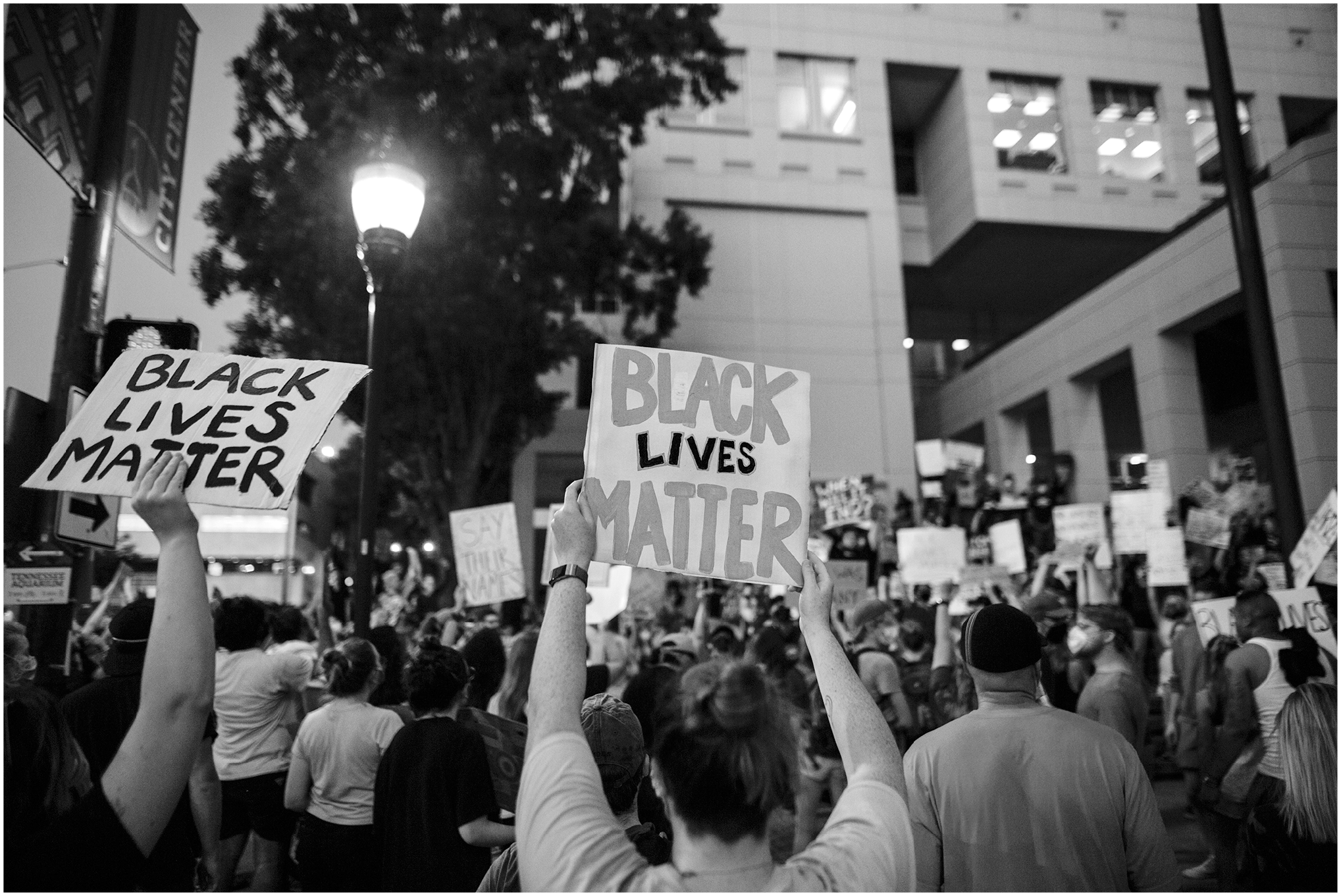
The “awokening” of white parents is attributed in part to the efforts of BLM to promote racial justice.
Kelly L, Pexels cc
This interview, one of 50 conducted in 2019 with middleclass, liberal white parents, focused on how parents approached the subject of race and racism with their white children. The first author, Megan Underhill, began investigating this topic in 2013, the year after she became a parent and the year before Michael Brown’s death and the Ferguson protests. When she started this project in 2013, there was little research or public dialogue about white parents and race. As a white woman and a new parent, this research gap troubled her. Like many of this projects’ interviewees, she wanted advice about how to approach the subject of race and racism with her child. When none was forthcoming, she studied the question herself. Initial interviews focused on 55 white parents in Cincinnati, Ohio, and whether they spoke with their children about race, racism, whiteness, and the activism animating the Ferguson protests. Despite the extensive media coverage of Ferguson, Underhill found that few parents spoke with their children about any of the aforementioned subjects.
After 2015, police killings of unarmed Black men and women continued; Freddie Gray, Walter Scott, Sandra Bland, Alton Sterling, and Philando Castile were a few of the individuals whose lives were cut short by police violence. As issues of racial inequality gained greater visibility during the Trump administration, Underhill wondered whether these public conversations about race and racism were filtering down into the white home—particularly among white parents who identified as liberal. To answer this question, she interviewed another 50 white parents in 2019, in Asheville, North Carolina, a city with a regional reputation as a liberal bastion in southern Appalachia.
Like Sarah, the majority of the white parents (94 percent) Underhill interviewed in 2019 were political and social progressives, who described how BLM activism opened their eyes to racial inequality and altered how they approached the subject of race with their white children. Additionally, these liberal, white parents described how BLM activism inspired them to embark upon a frenetic racial re-education. They enrolled in racial equity trainings and fervently—borderline religiously—consumed race-related podcasts, books, news articles, and blogs examining the impacts of racism and white supremacy on people of all races, including whites.
What they learned from their BLM-inspired racial re-socialization efforts altered their racial socialization practices in three distinct ways. First, they proactively spoke with their children about race and racism and initiated these discussions during early childhood (ages 2-6), critiquing or rejecting their inclination to create a “protected childhood” for their children. Next, they centered whiteness and racial privilege in their discussions with their children rather than blackness and disadvantage. Finally, they stressed the importance of being an ally, though parents were not always sure how to translate that intention into practice.
These findings shed light on the vocal minority of socially and politically progressive white parents who comprise “the great awokening”—a term coined by journalist Matthew Yglesias to describe the dramatic shift in racial attitudes among white Democrats over the past five years. For example, survey data from the Pew Research Center reveals that white Democrats in 2020 were more likely to endorse a systemic rather than an individual conceptualization of racism; to believe that racism circumscribes the experiences and outcomes of Americans of color; and to “strongly support” Black Lives Matter activism—up from 29 percent in 2016 to 92 percent in June of 2020.
White parents have been reaching out to and reading more work by racial activists.
Karolina Grabowska, Pexels cc

Despite the sea change in the racial perceptions of liberal, white Americans, most research on white racial socialization focuses on the silent or colorblind majority of white parents who refrain from speaking with their children about race and racial inequality. We know little about the vocal minority of color-conscious white parents like Sarah who proactively speak with their children about racial inequality and white supremacy. Sarah’s story, and the story of other color-conscious white parents is an important one because it highlights the reach and power of BLM activism in affecting social, cultural and political change—including within the white home.
BLM activism brought academic discussions of systemic racism outside the walls of the university and into the mainstream.
The Influence of BLM Activism on Parents’ Racial Thinking
BLM activism brought academic discussions of systemic racism outside the walls of the university and into the mainstream. For the white parents in our study, this was a radically new way of thinking about race in the United States. Before BLM activism, participants reported subscribing to a color-blind ideology, wherein race “didn’t matter” and all people, irrespective of differences in skin tone, “were created equal.” If, and when race emerged as a topic of conversation with their children, parents quickly minimized the discussion believing it best to accord as little attention as possible to a social category that should no longer matter.
However, as public conversations about racial inequality gained greater visibility, parents began to question their racial beliefs and practices. Most were college educated and drew upon established practices to respond to protesters’ claims that racism was pervasive and systemic. Namely, they sought out racial experts to learn more reading and following the work of Layla Saad, Nikole Hannah-Jones, Ijeoma Oluo, and Desiree Adaway, a local activist and racial equity consultant. During parents’ racial re-socialization efforts, they were exposed to information that challenged their color-blind stance. The experts they read or followed on social media viewed colorblindness as a flawed racial ideology that ignored the social, political, and economic importance of race in American society and downplayed the racial oppression experienced by BIPOC and the racial privileges afforded to white Americans. Parents came to endorse these perspectives and began implementing new strategies of action with respect to the racial socialization of their children.
The Shift from Color-Blind to Color-Conscious “Race Talk”
One consequence of parents’ racial re-socialization efforts was that they reported being more “intentional” about speaking with their children about race in a color-conscious rather than a colorblind manner. They spoke about race as a product of white supremacy and emphasized the systemic rather than the individual basis of racism in society. For example, Nadia, a city planner, revealed telling her daughter, age 6, that “racism is a regular feature of life in the United States,” explaining that she wanted to make sure that she “wasn’t focusing too much attention on individual racism versus the water we swim in that is inherently racist.” Andrea, a public-school teacher whose children were 8 and 10, elaborated further, noting that her goal was to ensure that her children “understand about the racist policies that have been instituted by our government. I want them to understand that that’s the foundation of our country.”
Many also introduced conversations about racism during early childhood (ages 2-6), eschewing the idea that discussions be “developmentally appropriate.” For example, Norah, whose children were 12 and 13, argued that “it is a privilege for us to be able to coddle our children. It is a privilege for us to be able to say “let’s decide what is developmentally appropriate.” My kids need to know things so that they can be a part of trying to create things that are better.”
In contrast, none of the Cincinnati parents Underhill interviewed during 2013-15 initiated these conversations during early childhood. Parents claimed their children did not “notice race”—a belief that pleased parents because it suggested their children “saw nothing wrong or different about Black people.” Ergo, they were “not racist.” Additionally, parents argued that discussions of racism were “developmentally inappropriate” for young children because they were “stressful” and “upsetting,” threatening the “protected,” worry-free childhood parents believed essential to raising a happy and well-adjusted youth.
As the visibility of police killings of Black people grew in the years following 2015, Asheville parents sought out Black voices to help them understand how Black people, and Black parents specifically, made sense of these events. From news and social media sources, they learned that Black parents could not opt-out of speaking with their children about difficult race-related topics because these conversations were designed to prepare and protect their Black children from future acts of white malevolence. This insight helped Asheville parents recognize the deeply racialized nature of their desire to create a protected childhood for their children. They came to understand that parents of all races want their children to grow up in a safe and affirming environment but that not all parents have that ability due to the persistence of racism in American society. Parents also came to empathize with Black parents and reasoned that if Black parents were forced to speak with their children about racism, then white parents should too.
Notably, Asheville parents were careful not to reduce their analysis of racism to a discussion of blackness and disadvantage. Parents reported having candid discussions with their children about the power and privileges associated with whiteness. For example, Frank described telling his sons, ages 8 and 11, that white Americans “have privilege and advantage that we didn’t earn, and BIPOC have disadvantage and hardship they don’t deserve. Both emerged from generations of white supremacist culture.” Parents also discussed how they, as white Americans, contributed to white supremacy—intentionally or not. Reese, a teaching assistant at a local elementary school, recalled how she approached the topic with her children, ages 5 and 8: “I talk about the fact that white people have re-written history, and whether they do it actively or inactively, they maintain the status quo and white supremacy.”
Before BLM activism, participants reported subscribing to a color-blind ideology, wherein race “didn’t matter” and all people, irrespective of differences in skin tone, “were created equal.”
Color-Conscious Actions
In addition to speaking with their children about race and racism, Asheville parents also tried to hone their children’s racial, critical thinking skills, encouraging them to become more observant about race and racial bias. Rebecca, a mother of two children, ages 7 and 10, explained: “I think helping them be critical of the implicit messages we are receiving all the time is a gift I wish I had been given earlier.” To refine this skill, parents asked their children pointed questions about the racial representation of the shows they watched and challenged them to reflect on the characters and contexts in which people of color were featured: “why are all the characters in Sophia the First white? Why aren’t there characters of color on this show? Why are all the Black people in this film prisoners?” Blythe, a daycare provider and mother of a son, age 6, explains that “questions are an important part of how I parent. They allow me to hear his experience and what he’s noticing. I don’t want to skew what he sees but I do want to encourage him to see more.”
Part of helping their children “see more” meant cultivating their awareness of the whiteness of their social world. Asheville parents assumed their children noticed race, and that they, like all Americans, were positively biased towards whiteness. One of their primary objectives was to make their children aware of this bias and the pro-white bias of society at large.
Parents attempted to temper their children’s racial bias by highlighting the uneven and unequal representation of people of color in their children’s school curriculum as well as in the media and government. Additionally, many parents made explicit efforts to “decenter whiteness” in their children’s lives by “center[ing] the voices and stories of people of color.” For parents with children younger than ten, this translated into parents introducing their children to books, films and shows about “heroes and sheroes of color” during slavery, Native American removal, and the civil rights movement. Parents’ goal was two-fold: to make their children aware of America’s white supremacist history and to highlight the bravery and resilience of BIPOC who agitated for sweeping social and political reforms despite the violent and vitriolic response they received from white America. Parents with older children also spoke to them about racially punitive events their children observed at school or that were featured in the local or national news. Then, they invited them to consider whether a white person would face similar disciplinary action for engaging in the same behavior.
One consequence of parents’ racial re-socialization efforts was that they reported being more ‘intentional’ about speaking with their children about race in a color-conscious rather than a colorblind manner.
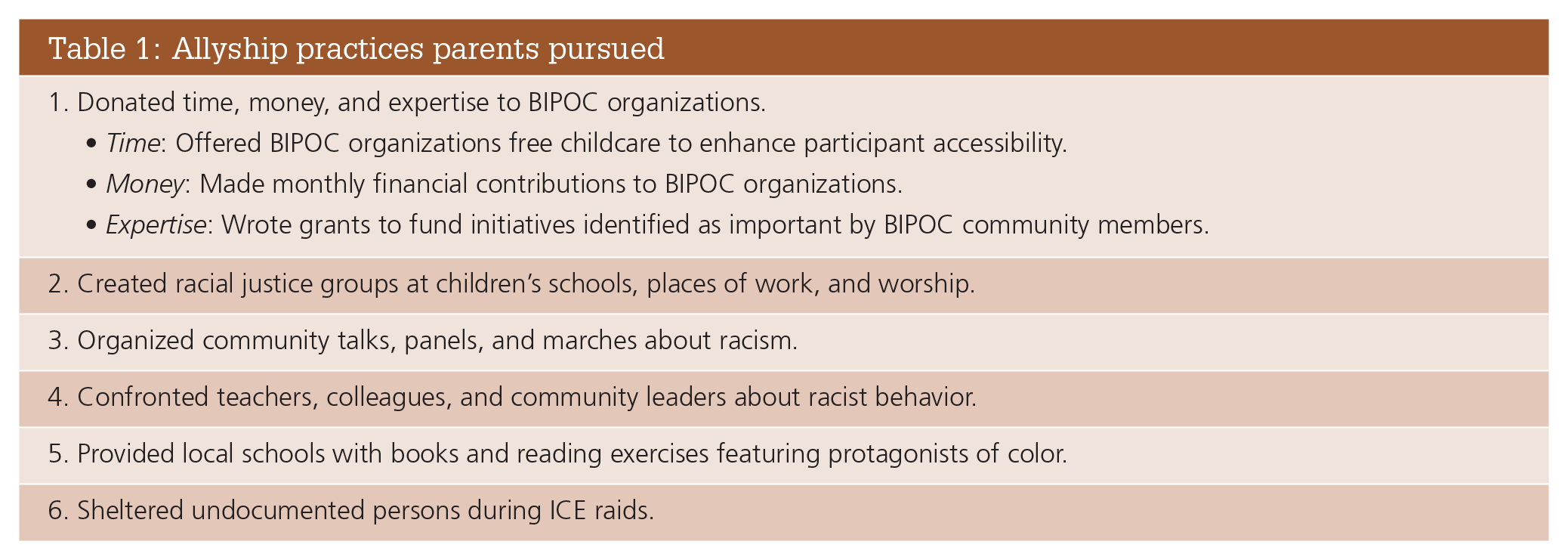
Many parents also tried to model for their children what it meant to be an ally, a role Susan, a mother of one, described as requiring white people to “acknowledge the damage white supremacy has inflicted on people of color and then use your privilege to walk alongside—not to do for—but to walk alongside people of color in the struggle for equal rights.” How parents went about modeling allyship for their children varied (See Table 1 for examples). Some parents enrolled their children in local child-centered social justice leagues or purposefully brought their children with them to racial-justice marches and community organizing events, explaining that they wanted their children “to feel a sense of purpose, like, ‘I can be an ally. I can be an accomplice when I’m invited in without taking over space—not being a white savior.” Other parents acted in their religious community or at their children’s school—starting faith or school-based racial equity groups, supplying teachers with diverse books for their classrooms, and confronting administrators when their child returned home with a report of a person of color being treated in a discriminatory way by classmates, teachers or administrators.
Allyship practices parents pursued
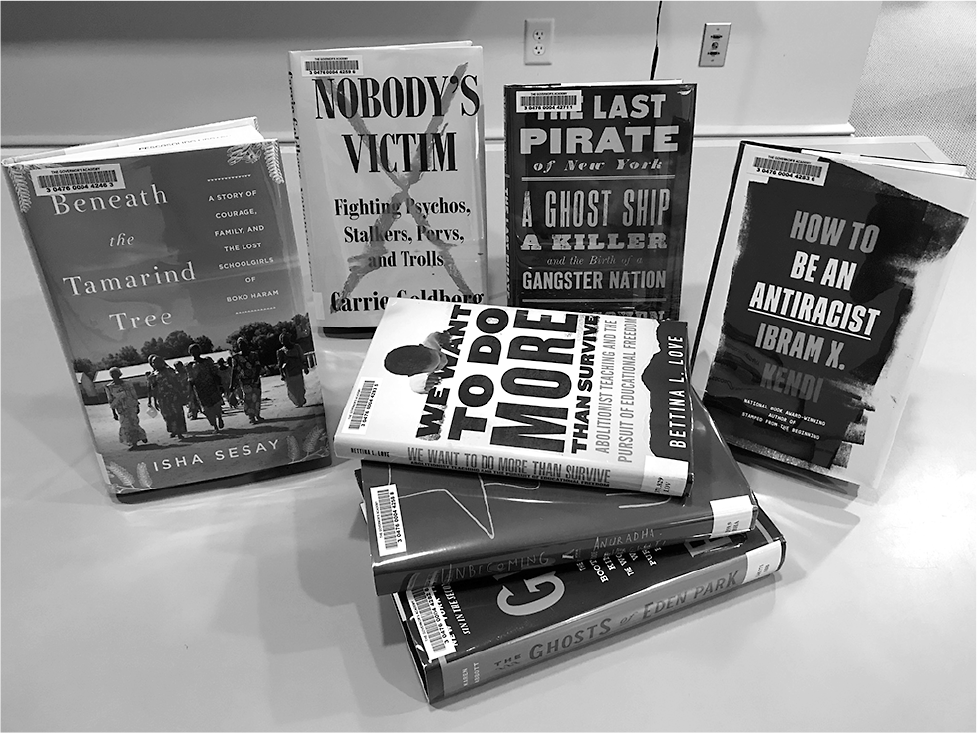
An example of the type of antiracist reading materials that white parents are turning to in an effort to examine their own racial views and practices in light of current events.
Pesky Librarians, Flickr cc
Fundamentally, color-conscious parents wanted their children to develop a sense of responsibility to act as an ally—an identity parents lacked before their BLM-inspired racial re-education efforts. That said, not all parents felt like they knew how to show up as one. Few reported having friends, neighbors, or associates of color, a circumstance parents described as “sad” and “unfortunate,” and that most attributed to socio-economic disparities between white and Black residents and parents’ discomfort negotiating racial and class differences. Given that most white Americans live, learn, work, and socialize in majority white environments, parents lack of racial contact was not surprising but it was certainly racially limiting. Amanda, whose two children attend a multiracial, public elementary school, describes her allyship conundrum:
I want to show up more for people of color in my community, but sometimes it feels really awkward. I worry about looking ignorant or over-eager and white savior-ish. I know I’m still learning but I wish I had a better sense of the right thing to say or do.
While Black parents have long reported having “the talk” about race with their children at a tender age, white parents are beginning to introduce discussions and topics of race in conversation with their children in new ways and earlier than they have before.
Mary Taylor, Pexels cc

Candace, a community organizer and mother of three, offers a different perspective. She acknowledges that “it’s normal to feel uncomfortable when you’re starting on this journey” but encourages people to move beyond their discomfort so they “don’t get stuck, feel overwhelmed and throw in the towel. That’s dangerous. It sends kids the message that racial justice work is too hard to pursue.” When queried further, Candace explained that “we all need to start where we are. All of our organizations are riddled with inequality. Pick the one you know best and begin showing up, listening to people of color, and following their lead.”
Conclusion
BLM activism compelled the nation to confront and reckon with racism in America, inspiring public dialogue, reflection, and action among Americans of color and white liberals. The liberal white parents featured in this article credited BLM activism with transforming their beliefs about race and racism and, most importantly, their parenting practices.
Parents like Sarah—discussed in the opening paragraph— are movement allies who viewed their color-conscious racial socialization efforts as a political act that allows them to demonstrate their support for BLM activism. They recognize that talk—devoid of action—will not dismantle white supremacy in the United States but they view their racial discussions with their white children as a logical and necessary place to start, particularly given the heightened visibility of racist rhetoric and activism during President Trump’s tenure in office. Given the paucity of race-related discussions among the majority of white families in the United States, parents’ color-conscious efforts are encouraging. However, if BLM activists are to achieve their goal of eradicating systemic racism in the United States, much more than talk will be required of white parents.
Many Asheville parents understood this and modeled for their children what it meant to be an ally—contributing time, money, resources, and expertise to racial justice efforts in their community. While the examples listed in Table 1 are instructive, they are not exhaustive. There are many ways white parents can show up as allies in their community. Identifying how to be an ally requires all of us to take stock of our lives, and in the words of Candace, “to start where we are.”