




Abstract
In this article, we consider how youth ages 14 to 24 years from diverse backgrounds understand and experience race. Through an analysis of open-ended survey questions collected as part of the national MyVoice Project, we explore youths’ views on the role race plays in their own lives and contemporary society more broadly. Our results highlight clear patterns by race/ethnicity linked to commonly held racial stereotypes that affect youth in distinct ways, but also a broadly shared desire to take action to address racism and racial injustice.
Among the many challenges and inequities that the past year has laid bare, the nationwide Black Lives Matter protests of summer 2020 underscore the urgency of confronting systemic racism and standing up for racial justice. Youth today are coming of age in a post-Civil Rights society marked by the gradual dismantling of equal rights protections, entrenched racial segregation in housing and education, and emboldened white supremacist and far-right extremist groups. At the same time, they are members of the most racially diverse generation to date, and the 2020 Census is projected to show that no single race now accounts for the majority among the ages 18 years and younger. Members of “Gen Z” are already demonstrating their political clout, leadership, and commitment to activism. In the 2020 US presidential election, increased levels of young voter turnout overall, and among young voters of color especially, were instrumental to securing President Biden’s victory in closely contested states, including Arizona and Georgia.
In this moment of “racial reckoning,” what do youth think, feel, and believe about race? As Eduardo Bonilla-Silva notes in his recent ASA presidential address, “the racial subject emerges because people experience, learn about, and interpret racialized relationships not just practically but emotionally.” Perceptions of how others perceive one’s race—and the weight of history and political struggle that entails-can profoundly shape outlooks and opportunities. Here, we focus on young people’s appraisal of what others think about their racial/ethnic group, how these appraisals affect them, and their reactions to racial discrimination.
To better grasp how youth understand and experience race, we analyzed data from a particular module of the MyVoice Project. Managed by the University of Michigan Health System, MyVoice involves a youth-centered interactive platform that sends weekly surveys via text messages to a national sample of youth ages 14 to 24 years (mean = 18.7 years) recruited to meet the American Community Survey benchmarks. For more information regarding the MyVoice study design, data availability, and results from other topical modules, see https://hearmyvoicenow.org.
MyVoice is not a nationally representative sample, but this unique data source provides insight into the thoughts and experiences of youth from various backgrounds. Responses were collected from 32 different states and 447 zip codes, although one-sixth of respondents lived in Ann Arbor, MI. MyVoice participants reported higher education levels than the national young adult population. Among respondents ages 19 and older, 97% had completed high school, and 82% had at least some postsecondary experience, compared to national high school completion and college attendance rates of 87% and 69%, respectively.
During the week of March 15, 2019, responses were collected from more than 700 youth to open-ended questions about the role race plays in their own lives and contemporary society more broadly. The research team coded these survey responses, ranging in length from a few words to several sentences, into primary and secondary themes over multiple rounds of coding and deliberation. The following sections show how youths of different racial/ethnic backgrounds view and experience race by highlighting illustrative responses and results from a statistical analysis. These figures display predictive margins (adjusted percentages) from multinomial logit models that control for the socio-demographic characteristics listed in Table 1.
MyVoice Sample Characteristics (n=603)
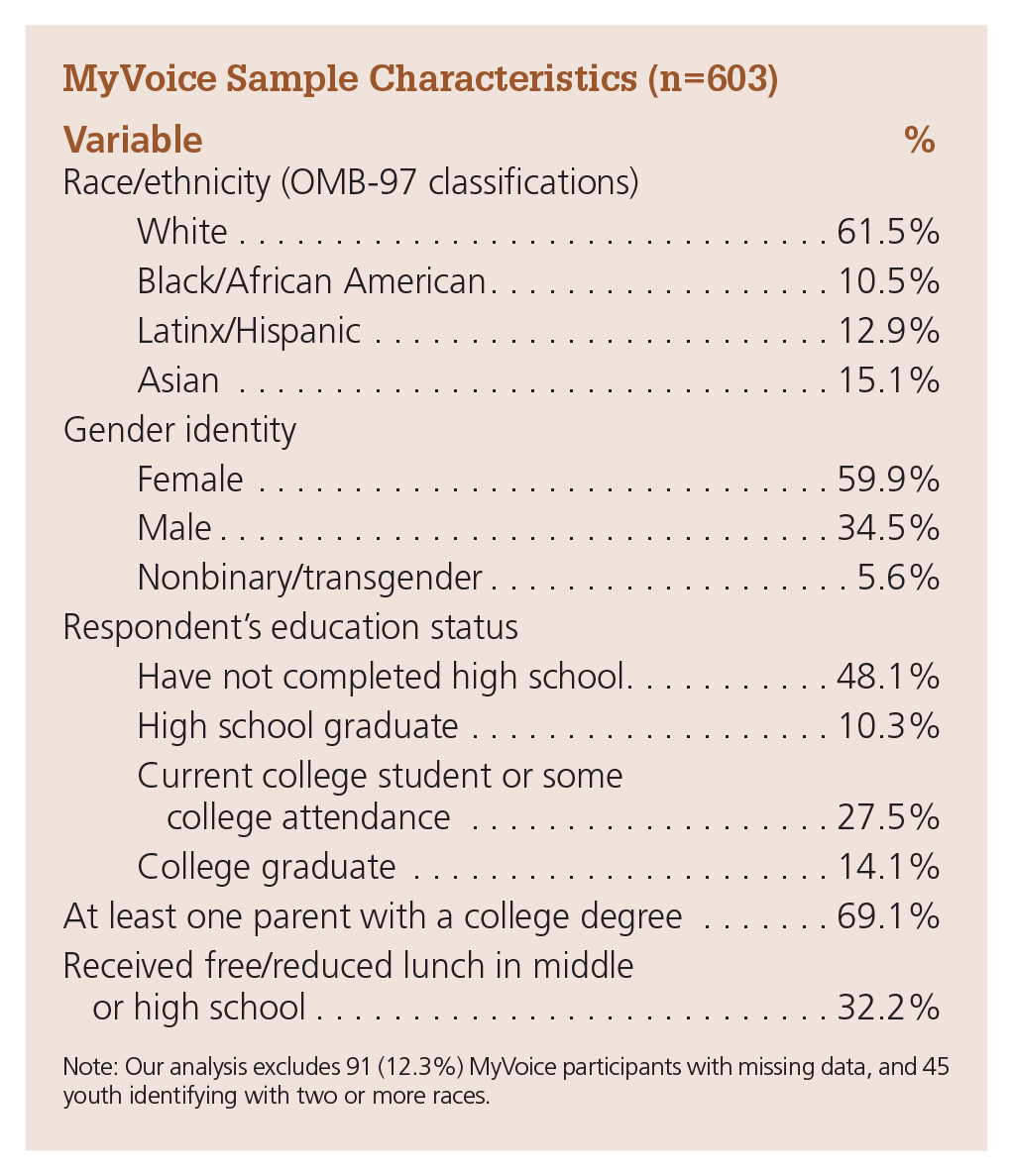
Note: Our analysis excludes 91 (12.3%) MyVoice participants with missing data, and 45 youth identifying with two or more races.
Overall, youths’ responses reveal stark differences by race/ ethnicity in their experiences, perceptions, and sense of how their identities are situated within the culture at large. Youth of color are more likely than white youth to report that they are negatively affected by racial stereotypes and report much more frequent and intense experiences of racism. Although white youth tend to downplay the role of race in their own lives, many recognize that white privilege disadvantages other groups. More than a year before the murder of George Floyd by Minneapolis police officers, youth from all racial/ethnic groups voice a broadly shared desire to take action to address racial inequality. However, there was far from a consensus regarding the most appropriate or effective actions to lead to change.
A group of students working on a project together.
StockSnap, Pixabay cc

As Lawrence Bobo explains, there “is an intrinsically collective or group-based dimension to racial prejudice” connected to normative ideas about the social order and “proprietary claims or ideas about rights, statuses, and resources.” Stereotypes are powerful tools dominant groups use to portray subordinate groups as different, inferior, and threatening. In this way, rather than merely reflecting individual prejudice, negative stereotypes of racial and ethnic minorities play a central role in maintaining a racialized social order by reinforcing symbolic boundaries and affective distinctions between whites and nonwhites.
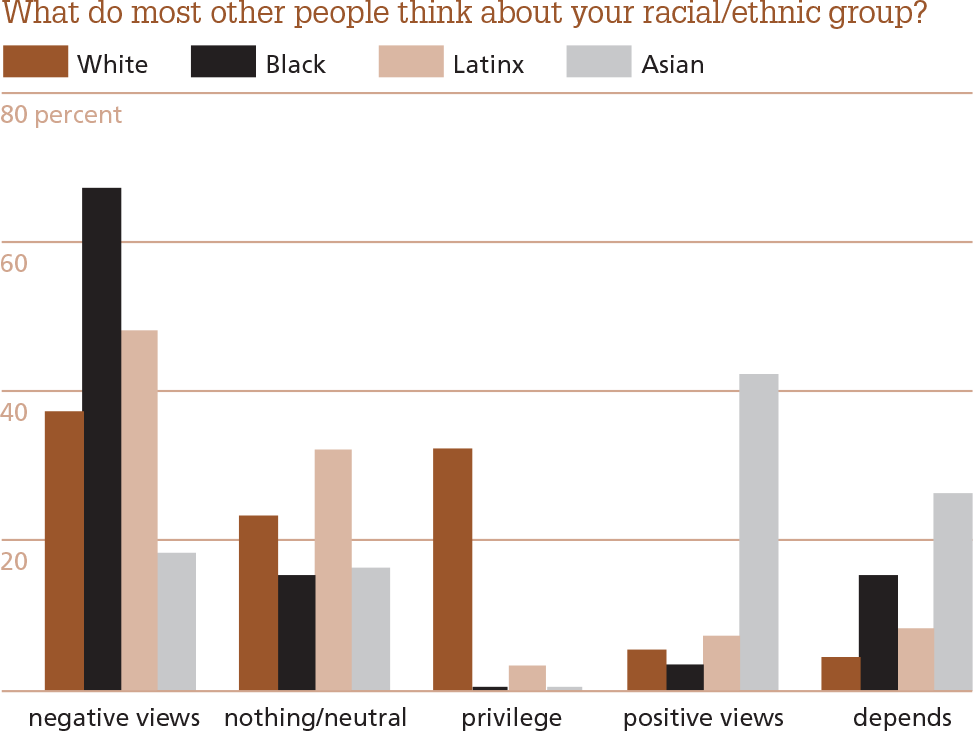
The Black and Latinx youth in our study were more likely to report that most other people viewed their group negatively. These negative perceptions were often linked to notions of criminality or illegality. For instance, a Black youth (18, nonbinary) stated that “most people think Blacks are violent, crude, and loud.” Compared to Black youth, Latinxs were slightly more likely to report positive or neutral stereotypes often related to culture. A response from a Latinx youth (15, female) highlights a range of polarizing and ambivalent stereotypes and observes that people usually think, “bad things. Drug dealers, criminals, and illegal immigrants. Positively, nothing or that we have a beautiful culture.”
In Myth of the Model Minority, Rosalind Chou and Joe Feagin explain how Asian Americans experience double racialization by being simultaneously subjected to stereotypes of uniformly high levels of educational and economic success and to racial stereotypes that emasculate men and exoticize women. While the Asian youth in our study were more likely to report positive perceptions of their group by other people, their responses underscore widespread and pernicious “model minority” stereotypes that essentialize Asians as high-achieving, passive, quiet, and socially awkward. Most youths pointed to more benign stereotypes such as, “there are a lot of stereotypes, such as ‘All Asians are smart,’ ‘All Asians know how to play piano and do martial arts” (17, female). Asian youth were also more likely to report mixed perceptions by others, such as a “Model minority, good at math, weak at sports, can’t speak English” (22, male), to more assertive statements that highlight views of Asians as foreign or outsiders, such as, “unhygienic and gross. Also, nerdy computer scientists or doctors. Most white people do not appreciate my racial group as they associate it with being backward” (22, female).
Many white youths also reported negative stereotypes, noting that others perceive whites as racists. Additionally, about one-third of white youth commented that their race was linked to notions of privilege. These responses ranged from neutral or superficial comments, such as, “I think most people assume my racial/ethnic group is very privileged” (19, female), to observations that conveyed stronger negative connotations of white privilege. For instance, a white youth (17, female) responded that most other people “feel that white people have too much-unearned privilege, and are in some way at fault for the crimes of our ancestors.”
These commonly held racial stereotypes and views affected youth in notable ways, with varying emotional and material consequences. Youth of color were far more likely than white youth to report that they were negatively affected by others’ views of their race. For example, a Latinx youth (23, female) describes longstanding feelings of inferiority stemming from disparaging perceptions of her racial group:
It has affected me since childhood. Being told I was never going to amount to anything, in essence, since childhood, by strangers, has led me to have low confidence. I constantly doubted myself in college and in grad school. My failures were magnified in my mind because it seemed to prove that I was as worthless as people originally thought.
Other Black and Latinx youth describe feeling less safe or secure in public settings due to negative stereotypes that cast them as intellectually inferior or prone to crime. As a Black youth (21, male) explains, “It can make life more dangerous because people make assumptions, and they can lead to them reacting negatively in situations without cause.” Typical responses from Asian youth emphasize the pressure to live up to the model minority stereotype. For example, “it puts pressure on the individuals of the community to maintain that model status. I felt pressured to do well in school and to ensure that I have a well-paying career so that I can represent my community in a good light” (23, female).
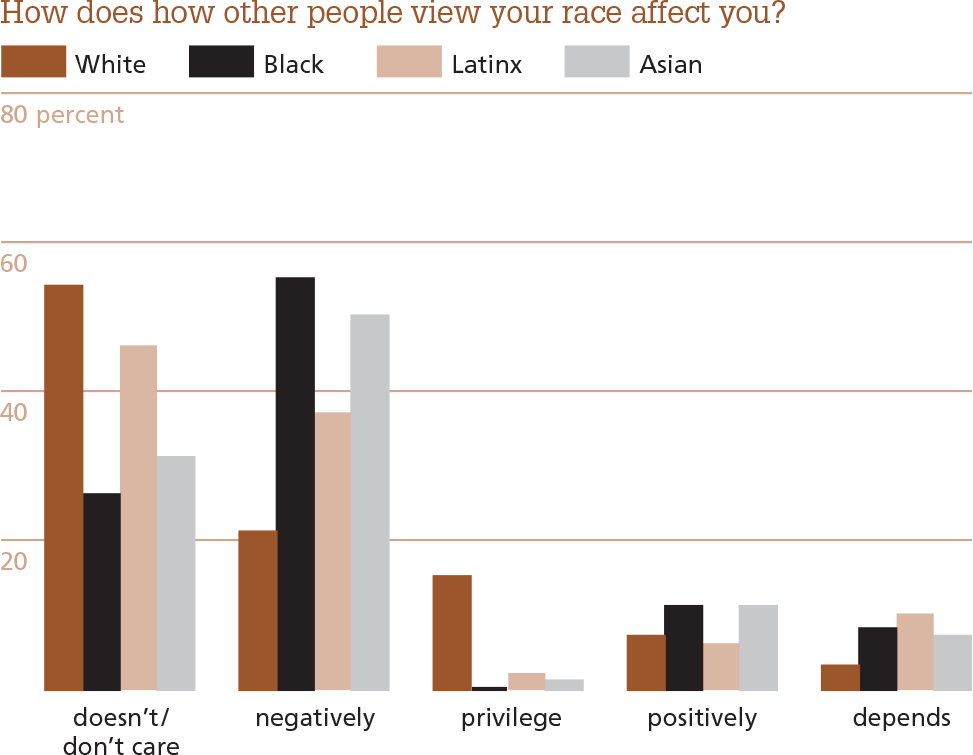
In contrast, stereotypes of whites as racist did not have the same tangible consequences on white youths’ everyday lives. Most white youths conveyed that they were not affected by others’ perceptions of their race, and many white youths recognized the perks and advantages of white privilege in their lives. For example, It affects me in that it gives me privilege. I am a white American and I look like it. I can’t pinpoint the exact moments, because I think that’s exactly what privilege is. It’s getting things that you don’t even realize you’re getting, which may not be given to someone else as easily. When you are privileged, it’s difficult or impossible to know all the little privileges you have been afforded. (23, female).
Some white youth tied others’ perceptions of whites as privileged as a source of “reverse discrimination” that blocks access to certain opportunities or resources. As one white youth puts it, “It has affected my ability to get certain jobs and get into certain schools since affirmative action doesn’t apply to me” (21, male). As Angelina Castagno observes in Educated in Whiteness, direct and open discussions of race are often silenced in school settings, perpetuating narratives of colorblindness and an individualized understanding of racism. Without the tools necessary to interrogate the structural components of race and power, white youth are primed to respond to critiques of white privilege as “reverse racism” or to connect issues of race and racism with psychologized notions of personal responsibility, blame, and guilt.
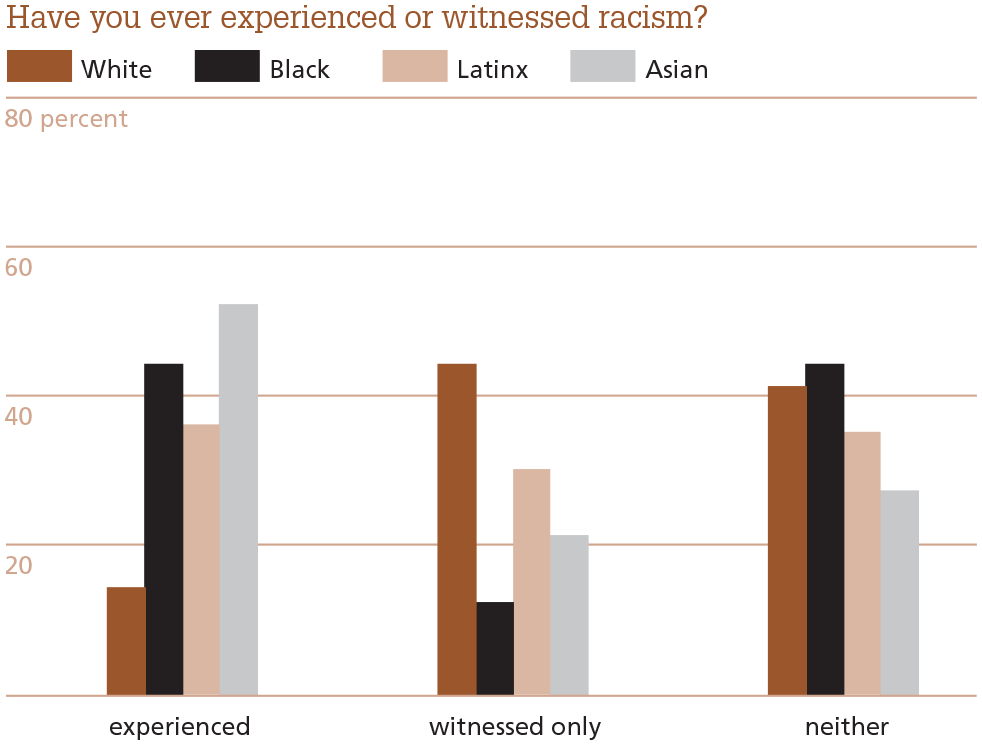
Nonwhites continue to experience acts of racism routinely in their daily lives, from prejudicial treatment to verbal and physical attacks and micro-aggressions. Youth of color regularly experience discrimination in schools and other public spaces, exacting a toll on health and well-being. Indeed, there were stark group differences in the reporting of experiences of racism. Youth of color were far more likely to have experienced racism than were white youth, with abuse such as racial slurs and invectives being the most common form of racism reported.
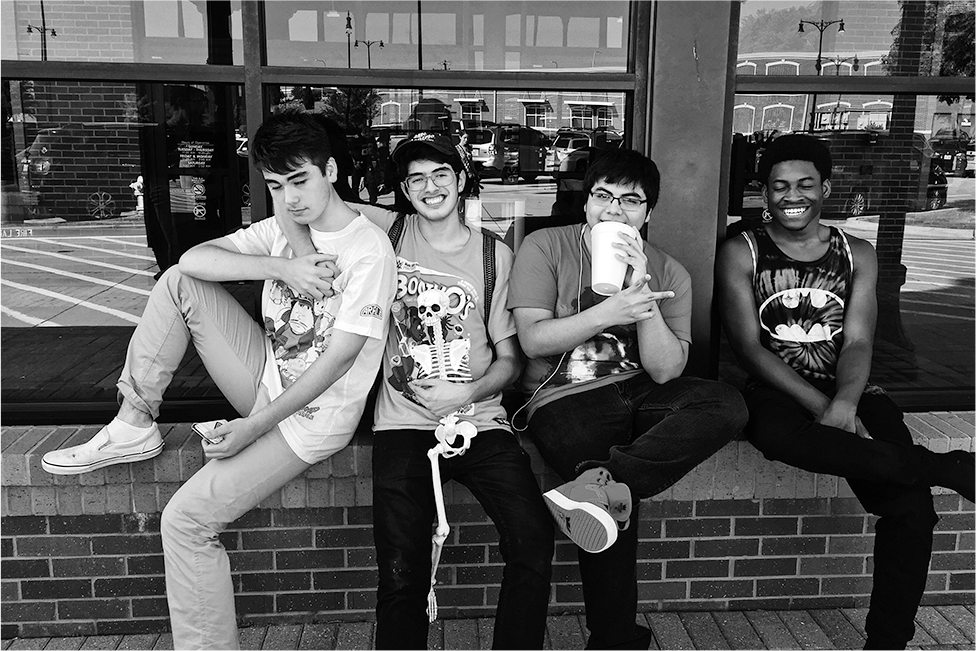
Teens hanging out together.
Kat Wilcox, Pexels cc
Other responses from Black and Latinx youth connected these experiences to negative stereotypes, such as assumptions of criminality, illegality, or receiving undeserved benefits. As a Black youth (17, female) exclaims, “YES! Of course. Many times. From people assuming I was stealing because of my race to people blatantly saying my good grades were only due to affirmative action (what? um maybe studying actually).” As Victor Rios illustrates in Punished: Policing the Lives of Black and Latino Boys, youth of color are routinely “criminalized” by authority figures, such as teachers and law enforcement, through punitive policing, constant surveillance, and other forms of stigmatization.
Although white youth tend to downplay the role of race in their own lives, many recognize that white privilege disadvantages other groups.
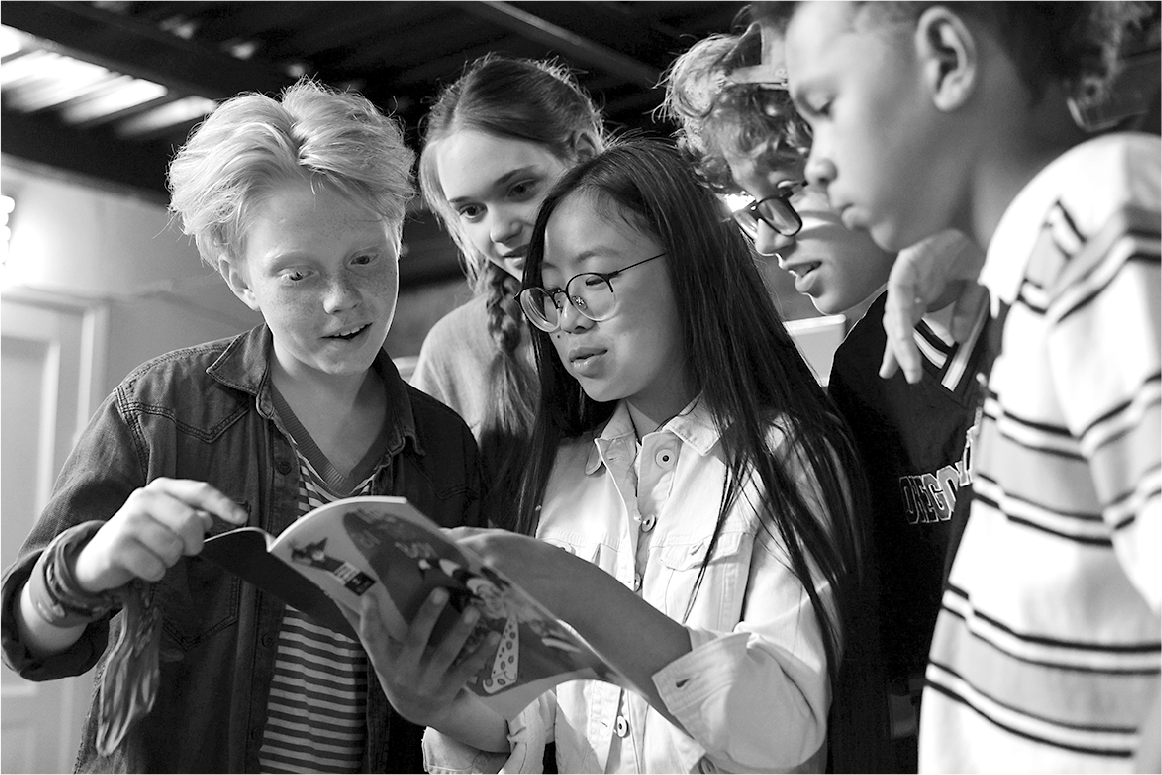
A mixed-race group of kids looking at a zine together.
Cottonbro, Pexels cc
Reports of discrimination among Latinx and Asian youth highlight a “forever foreigner” stigma that makes them feel excluded as Americans. For example, an Asian youth (22, male) described experiencing discrimination “plenty of times—being called names, microaggressions, the ‘no, where are you really from,’ the ‘wow, you speak English so well,’ denied access because of race, etc.” A Latinx youth (22, female) recounts that “In 5th grade, I was told to go back where I came from. It still sits with me today, how that felt and how it made me feel like an outsider.” Notably, Asian youth were most likely to report experiences of racism even before the spike in hate crimes during the COVID-19 pandemic.
In contrast, white youth were more likely than youth from other racial/ethnic groups to have no direct experience with racism or to report that they only witnessed discrimination, often in the form of racial slurs or jokes directed at nonwhite peers. A white youth (18, female) stated that “I witness racism in a lot of ways. Comments, slurs, or even body language towards a POC [person of color] is enough to know racism is around us all the time” The relatively few white youths who reported experiencing racism tend to explain their experience as “reverse discrimination.” A white youth (21, male) stated, “I think affirmative action or diversity only application routes are racist, but not in the traditional sense.” Yet, white youths’ claims of “reverse discrimination” are challenged by the acknowledgment that it does not have the same impact in their lives as the racism experienced by nonwhites.
More than a year before the murder of George Floyd by Minneapolis police officers, youth
from all racial/ethnic groups voice a broadly shared desire to take action to address racial inequality.
Having reflected upon the impact of race and racism in their lives, the final question asked respondents to think about the future and how negative experiences could be countered. A recent survey conducted by CIRCLE found that more than 8 in 10 young adults felt that their generation has the power to change the country, although confronting racism was a top priority for youth of color but not for white youth. Due to their advantaged social position and early socialization experiences that stress colorblindness, white youth can typically avoid acknowledging the role “whiteness” plays in their lives, which past work has linked to greater ambivalence towards confronting systemic racism.
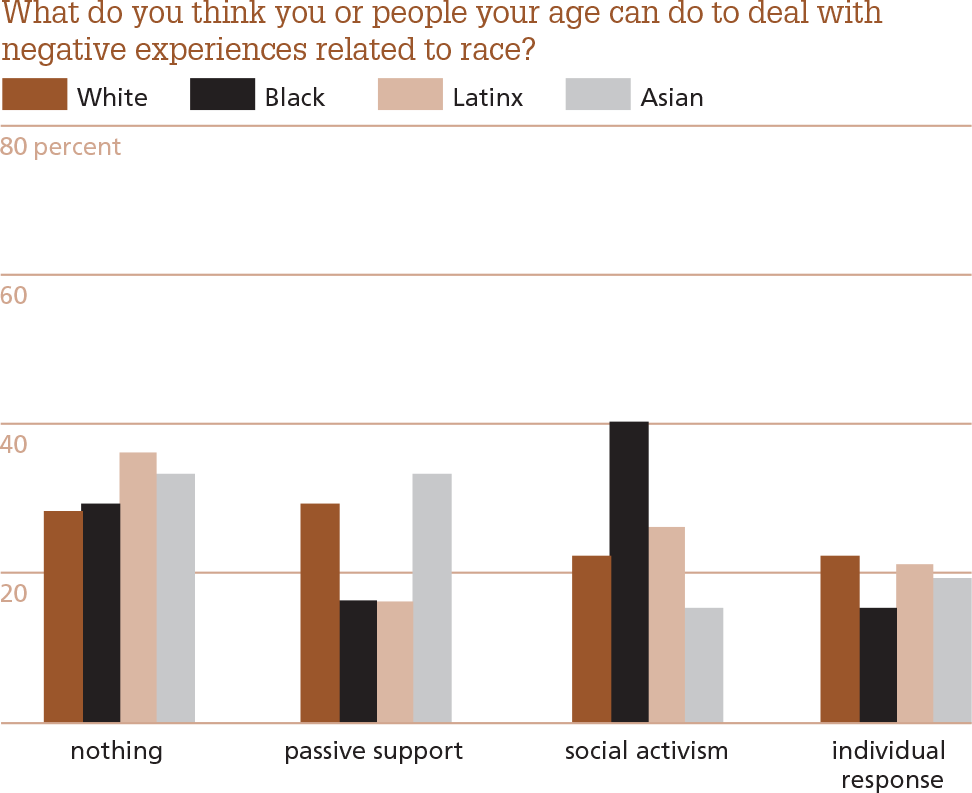
Again, our results revealed differences in how different racial groups respond to racism. Many youths say that social activism is needed to challenge racism. Their responses included individual confrontations and collective or organized responses such as protests. Roughly one-fifth of youth across racial/ethnic groups expressed support for non-confrontational or individual responses to racism, such as the need to educate oneself or others about racism or learn how to avoid racism. For example, a Latinx youth (22, female) explains that “I personally allow those experiences to help me realize problematic behaviors and guide me on avoiding microaggressions in my own day-today life and in my own thinking so I can be a better person and ally.” Others seek teachable moments that can make others realize their own bias, such as white youths (18, female) who suggested that “I think they can turn it into a learning experience and an opportunity to teach others about how to avoid these negative experiences and be mindful in what we say,” as long as the “tactic is to just disagree and point it out but not aggressively” (16, male).
In general, Black youth were most likely to argue that social activism was the most effective way to combat racism, while white and Asian youth were more likely to support passive or indirect means for confronting racism. While typical responses from white youth advocating indirect responses offered that one should report racism to authorities, youth of color were more likely to seek community support. For example, an Asian youth (22, female) suggests to “Talk about it with others who experienced similar things.” In contrast, a Black youth (18, nonbinary) suggests engaging with social media and to “[s]hare stories of what happened and why the experience was racist so others whom the experience may not victimize can see why others would be offended.”
A group of students walking down a hallway at school.
Cottonbro, Pexels cc

Still, a sizeable minority of youth, across racial/ethnic groups, expressed the view that nothing could be done against racism, so it should be ignored or were despondent in their ability to create change. Expanding on this sentiment, a white youth (18, male) asserted that one has to “realize that they can’t control the actions of others. Some people are just racist.”
Conclusion
Our study shows that youth in the United States experience race in distinct ways. Racism and racial prejudice play a significant role in the lives of youth by informing how they believe they must act in the world, either to uphold positive stereotypes and not let down their communities or to defy negative ones. For white youth, being raised in colorblind environments that silence racial discourses personalizes any experience in which race is made evident or centered. In contrast, youth of color were far more likely to have experienced discrimination and negative impacts of racism, and long-held racial stereotypes fueling racism remain highly salient in the lives of youth of color (e.g., Asian as the “model minority,” “Black criminality,” and “Latinx illegality”).
The survey data also revealed some contrasting results, particularly among white youth. Most white youth expressed some recognition of white privilege and the advantages that it afforded them. They were more likely to report negative perceptions of their group, while at the same time less likely to report experiences of racism or the damaging impact of racism relative to other racial/ethnic groups. While some white youth felt aggrieved by the belief that their failure to get into certain colleges or not receive promotions at work was due to affirmative action policies or “reverse discrimination,” more common were expressions of colorblind ideology that frame combating racism in individual rather than collective terms and were less critical of systemic racial inequality. Socialized into systems of meritocracy and raised to believe in their inherent and naturally derived individual worth, white youths’ racial attitudes do not stray far from their parents’ views on race.
Youth in the United States are as aware of race and ethnicity as ever before. Though there are divides among youth on how best to respond to racist or oppressive behavior, most respondents across racial groups think that they can make a difference. Yet, many youths shied away from confronting racism directly and forcefully. Their responses implied that one must learn to read the situation and deploy tactics accordingly. Many respondents, however, spoke passionately about social justice. These responses were far more proactive, community-based, and empowering, arguing that everyone has the responsibility and capacity to make a difference in their communities, friend-circles, or families. But this outlook was far more common among youth of color and highlights that white racial attitudes have improved but limitedly.