



Abstract
Coca came to Briceño, Colombia in the year 2000, allowing for upward mobility for farmers; however, the coca economy was also rooted in violence. This essay explores the hardships faced by farmers in the area.
Keywords
“This is where it all comes from,” says Eduardo, laughing as he pulls light-green oval-shaped leaves off a coca plant’s thin reddish stems. By “all” he means the drug cocaine, lucrative transnational trafficking rings, and - largely fueled by their profits - Colombia’s longstanding violent conflict. The coca economy in his village of Briceho, however, has disappeared. The bush is one of the few remaining on his farm, interspersed with the darker green of the coffee plants that now feed his family. In 2017, a coca substitution program written into the Revolutionary Armed Forces of Colombia’s (FARC) peace agreement came to Briceho. Overnight, farmers pulled out their coca plants, hoping to transition to a legal economy and leave years of violence behind. However, while Briceho’s mountainsides are no longer covered with coca, the crop continues to dominate much of rural Colombia. Indeed, even as the government invests millions of dollars on the drug problem, Colombia continues to produce record amounts of coca. The struggles of farmers like Eduardo to transition to legal crops help explain why coca persists.
Coca came to Briceño in 2000 when Eduardo was 20. He immediately started working for a coca farmer. Within a couple of years, nearly all in the area abandoned their coffee, sugar cane, and beans for coca.
“Why did it spread so quickly?” I ask.
“Traditional crops,” he says, “have really low prices. Also, you can put a kilo of coca base in a backpack and take off walking. To get that same amount of money from coffee, you need to transport and sell around 400 kilos.”
Unlike coffee, which in Briceño matures once a year, coca is harvested every two to three months, providing regular and relatively well-paid work. With the arrival of coca, the daily wage doubled immediately. By 2015, able pickers were making $40 a day.
In addition, coca allowed for upward mobility. A land tenure system developed in which landless peasants planted coca on another’s property in exchange for 10 percent of the earnings. In 2005, Eduardo began planting on rented land. By 2008, he had saved enough money to buy his own farm.
However, the coca economy was rooted in violence. While the FARC had been in Briceño since 1981, the arrival of coca attracted right-wing narco-paramilitaries. Locals were caught in the middle of a bloody territorial dispute. “I lived in war for 20 years,” Eduardo says, “where I had to see children mutilated by landmines and mourn friends who were shot.”
The Colombian military often supported paramilitaries in their violent attempts to control the local drug trade. In 2011, however, the army entered the hamlet and pulled out all the coca. “I lost 70,000 plants,” Eduardo says. Yet within seven months, locals had replanted and were again selling coca base.
Eduardo, however, also planted coffee, which has a standardized but variable price determined by the global market. When he planted, the price was relatively high, close to $4 a kilo. Many in the community followed his lead.
“That apogee,” he says, “didn’t last long.” The price of coffee quickly dropped to less than $2 a kilo, not even enough to cover costs. “They blamed me. And they pulled out their coffee to plant coca.”
By the time coca substitution came to Briceño, the luster of the illicit economy was fading. In addition to the violence, production costs for gasoline, chemicals, and fertilizers had skyrocketed, while the price of coca base hadn’t budged.
A farmer cuts weeds away from coffee plants on lands once covered with coca.
Alex Diamond
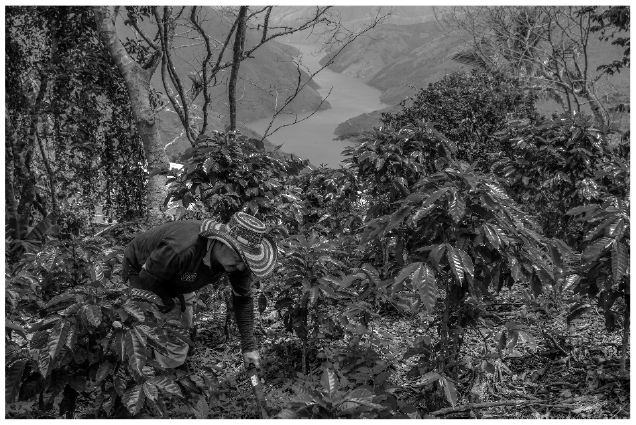
With his mature coffee plants, Edu-ardo was better prepared than most to transition to a legal economy. However, he is still a prisoner to fluctuations in coffee prices. In 2019, he sold much of his harvest at a price that barely covered his costs. “You’re not left with anything but your fatigue,” he says.
If the few coca plants that survive in his coffee fields are stragglers, Eduardo and his family are equally so. Of 100 families that once lived in his community, 65 have left, lacking economic opportunities. On a global level, the percentage of people living in rural areas has steadily diminished for decades, many facing similar economic challenges to those Eduardo describes. In Colombia, coca profits have forestalled some of this massive rural outmigration. Eduardo hopes the violence of the coca economy never returns to Briceño, but he knows the options for rural producers are limited. “What can you do?” he asks. “Just keep struggling.”
Overnight, farmers pulled out their coca plants, hoping to transition to a legal economy and leave years of violence behind.