



Abstract
In Cape Town, South Africa, some residents risk eviction and even arrest by participating in land occupation. However, occupying land for many residents happened out of necessity. This article follows South African residents and their fight for “adequate housing,” freedom from eviction, and a government that will progressively realize both of these goals.
Cape Town, South Africa.
Valerie Hinojosa, Flickr cc

It was a mild winter day in Cape Town, but it was still quite chilly in Thandiwe’s single-room shack. Beams of light filtered through the cracks between the warped wooden planks from which his home was assembled. No amount of sweeping could keep the sand out of the room; his shack was perched on the side of a rolling dune, dotted with clumps of grass. We both sat on his bed, with a couple of his neighbors seated on overturned buckets on the dusty floor. They passed a lit cigarette around the room.
Thandiwe built his shack a year prior to my visit. At the time, he staked out a plot with a few dozen others on this seemingly abandoned stretch of land. It was adjacent to a major route through one of Cape Town’s poorer townships, though it was located across the road from one of its wealthier areas. Wealth is all relative, of course—in the United States, this “wealthy” area would be seen as solidly working-class—but unlike the squatters across the way, most residents had formal homes with lawns and paved driveways.
Why did Thandiwe, now in his mid-40s, risk eviction and even arrest by participating in an occupation? For him, as with most residents, it was not about the principle so much as necessity. His last living situation was deemed legal, though it too began as a land occupation in the 1990s. Twenty years later, it was riven by a gang war that never seemed to subside. When he heard a group of neighbors discussing a move elsewhere, he decided to join them. Besides, he had nothing to lose. His current arrangements were too dangerous, and he had nowhere else to go.
As word of the occupation spread, dozens quickly turned into hundreds; some occupiers left behind precarious living situations. Others were stuck in overcrowded, government-provisioned houses and wanted a place of their own. Cape Town’s Anti-Land Invasion Unit, the section of the City’s Department of Human Settlements (DHS) tasked with monitoring new occupations, kept watch over the burgeoning community. Its agents were concerned that the occupation would pose a threat, but they could not legally evict the squatters until the landowners filed a motion requesting removal in court. The plot was owned by a sand mining company but did not appear to be actively in use. The company filed an injunction six months later, but it was too late: there were now over 2,600 structures on the field.
Competing Conceptions of Democracy
What was the City government doing with an Anti-Land Invasion Unit? Why was it evicting residents with nowhere else to go? This was supposed to be the “new South Africa,” a country whose government would remedy decades of apartheid removals and centuries of colonial dispossession. And indeed, the government does claim to do so. The post-apartheid Constitution, for example, guarantees residents “adequate housing,” freedom from eviction, and a government that will progressively realize both of these goals. This is not just rhetoric. Since the demise of apartheid in 1994, the government has delivered nearly 4 million homes. This project was central to the mandate of Nelson’s Mandela’s newly elected African National Congress (ANC) government, which was in power when the Constitution adopted language from the party’s 1955 Freedom Charter, demanding “the right to live where [people choose] and be decently housed.”
Considered in the context of the entirety of South Africa’s Bill of Rights, housing—along with employment, health care, and access to basic services—becomes a central component of the country’s democracy. This expanded conception of democracy includes these socio-economic rights along with more conventional political rights, such as protected speech, assembly, free exercise, and so forth. These too were enshrined in the Constitution. But the ANC consistently equated socio-economic rights with democracy more broadly. This means that if a program as major as housing delivery were perceived as a failure, it would also represent the failure of the democratic project itself, calling the government’s very legitimacy into question.
If a program as major as housing delivery were perceived as a failure, it would also represent the failure of the democratic project itself, calling the government’s very legitimacy into question.
Cape Town, South Africa.
Valerie Hinojosa, Flickr cc
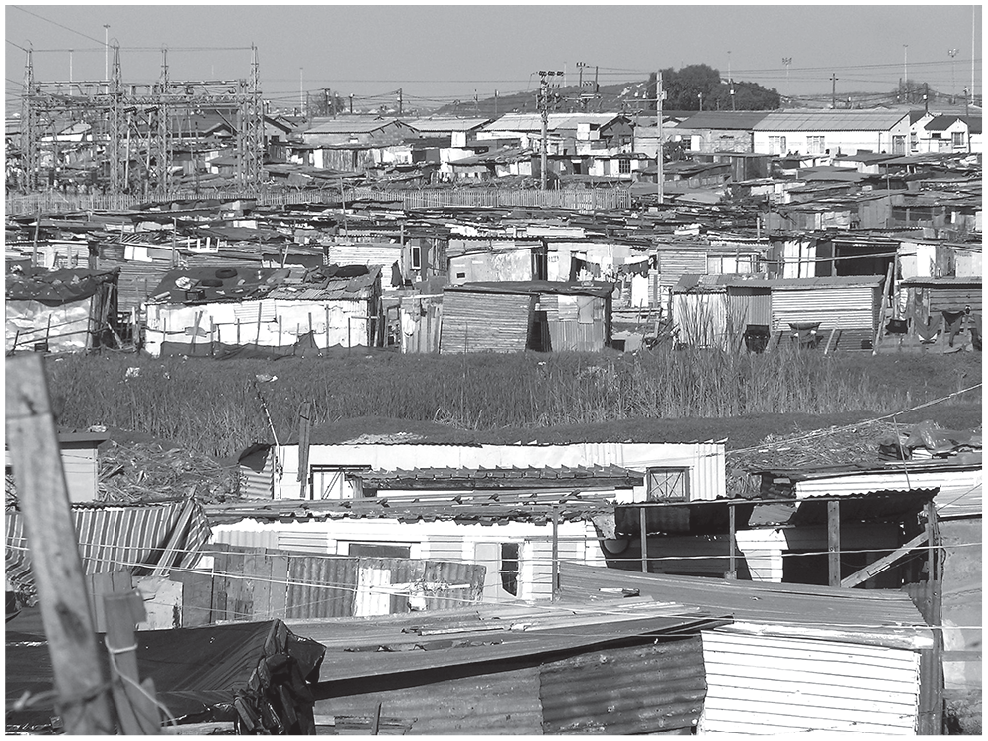
The problem is that on the ground, there are two competing conceptions of democracy. Residents want to be consulted when it comes to their housing. This is not just to feel as if they are participating in the process, though this certainly figures into the equation. It is also because consultation has real material effects. For example, what if someone were provided with formal housing but it was located even further from their workplace? It would increase the cost of their commute without providing any additional subsidies. Or what if a resident were perceived as gang-affiliated by virtue of their previous location and their new house abutted the territory of a rival gang? These were issues that could be easily addressed, but only if people were actually consulted. Housing is not the sort of thing that officials can simply figure out on their behalf. It instead requires participatory democracy.
The municipal government was quite aware of this problem, having adopted “integrated development planning” (IDP), an approach that consciously solicits residents’ input by convening listening sessions. However, for many, this proved insufficient. I attended an IDP consultation session in Bellville, a working-class suburb on the northeastern periphery of the Cape Flats. Seated next to me was Fundiswa, a Black resident of a mixed-race informal settlement about halfway between Bellville and the city center. She anxiously gathered the coarse, printed fabric from her dress in her fists, indignantly muttering to herself until she couldn’t take it anymore. She leapt to her feet and interrupted the speaker from the City: “Look,” Fundiswa shouted. “You don’t communicate with us. We want you to. The more the City communicates with us, the less we’ll go to service delivery protests!” She was referencing the frequent spontaneous uprisings in townships, typically about deficient access to essential services or housing. “The so-called IDP process is a complete mess,” she continued. “They say they communicate with us, but we never see them. We have no idea what’s going on, so we burn tires in the road. Why must we come to a crisis for information to be shared?”
In order to clear smaller occupations, politicians and bureaucrats sometimes bump occupiers to the top of the list, even when they want to be left alone. In so doing, government officials actually produce queue jumpers, who they subsequently identify as objects of their ire.
The government representatives present at the meeting were frustrated too. A White housing official immediately responded, but in a dismissive tone that did not go over very well. I had not met her before, but she introduced herself as from the City’s DHS. “Why are so many people coming to the cities?” she asked rhetorically. “It’s all about demand outstripping supply When there is so much demand, people are left to compete for supply.” At least she was honest, but from her perspective, total participation was an impossible task.
Cape Town, South Africa.
John Charalambous
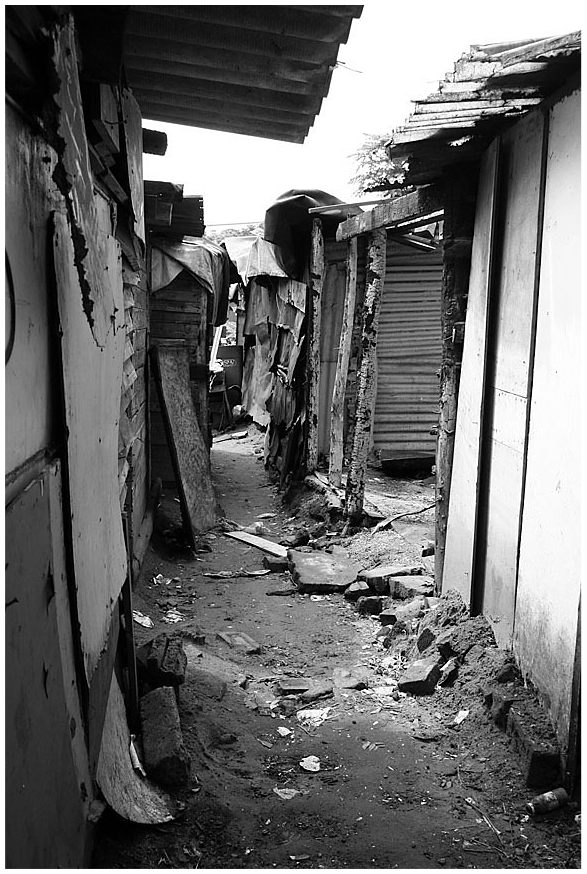
This impossibility is a direct consequence of the forced relocation of more than 3.5 million Black South Africans under apartheid. Relegated to underdeveloped rural areas with few job options, hundreds of thousands returned to cities once mobility controls were relaxed in the mid-1980s. This influx of residents continued long after 1994, leading to a nearly ten-fold increase in the number of informal settlements by the late 1990s. New residents had to live somewhere, after all—and it was not just rural-urban migrants. In addition, intraurban migrants left relatives’ overcrowded homes, but given the high rate of unemployment, they could not afford to rent one of their own. So instead, they built shacks. Were officials supposed to consult every single one of these residents? And how would they do so given their limited capacity? The national government certainly wasn’t increasing the DHS budget.
From housing officials’ perspective, this situation requires technocratic democracy. To ensure equitable distribution of housing stock, democracy must be efficiently administered by impartial bureaucrats in the Weberian mold. Democracy ensures that houses are not distributed through personal favors and that protests do not automatically translate into expedited delivery. Indeed, this is why many housing officials perceive participatory democracy as a threat: input is one thing, but if popular pressure translates into preferential treatment, disorder prevails, and it becomes impossible to deliver at scale, undermining the realization of the larger democratic project.
I encountered more than a whiff of nostalgia among housing officials for the rigid bureaucracy of apartheid. Usually, this was less about open racism than the ability to implement policy without having to face a legitimate popular challenge. That was the thing about apartheid: officials didn’t even need to pay lip service to participation. Also under apartheid, a waiting list for housing was created, and residents were supposed to patiently wait their turn. Brian Shelton was one of the list’s architects, a British South African in his early 80s, and when we spoke, he was managing the waiting list for the entire Western Cape, which he did until 2016. “The biggest headache right now,” he told me, “is the movement of ownership. Fifty percent of [government house] recipients move, so they are on the waiting list again after they sell. They get a house, but then they rent it out again [for a profit]…We used to have influx controls,” he continued, referring to apartheid-era restrictions on Black mobility. “But now we have none. The result was rapid urbanization. People came to the cities. This was true in India—in Brazil too. They have shanties there: favelas.”
He treated the phenomenon of Black urbanization as a problem that undermined the state’s capacity to close the housing backlog. Other officials were more forthright in their characterization. Alida Koetzee, an Afrikaner in her 50s, was the City DHS’s head of public housing. I sat with her and one of her colleagues, who was Colored, in a conference room on the sixth floor of Cape Town’s Civic Centre. In a South African context, “Colored” is an old apartheid category that describes the country’s creole population, the majority in Cape Town. “Black” is a more ambiguous word: in the 1970s and 80s, it was more akin to the British concept of “political blackness,” and included “Coloreds;” but today, “Black” is more likely to be used in place of the apartheid category “African,” which itself includes dozens of ethnicities speaking multiple languages.
I asked Koetzee why she viewed occupations as a problem, and she immediately responded, “You must know the nuances in the Cape. The Coloreds are in the Cape; the Blacks are invading the Cape. That’s history. Look at what’s happening: they’re moving from the Eastern Cape for the opportunity here.” Her Colored colleague nodded.
Stigmatizing Necessity
Neither of them understood rural-urban migration as the necessary corollary of racialized dispossession. Such an understanding would require the vantage point of participatory democracy: Black residents who were forcibly expelled to underdeveloped rural areas were voting with their feet. They wanted to come back to the city, where there was at least the prospect of employment and a halfway decent education. Most of them had longstanding ties to Cape Town, often predating apartheid.
However, from the standpoint of technocratic democracy, their value-laden demands appear unruly. Even when land occupations are predictable consequences of dispossession, housing officials view their participants as opportunists in search of a handout. They are not, in other words, evaluated in their proper historical context, nor are their demands taken into consideration; rather, they are reduced to contributors to a growing backlog, as if they seek to antagonize government officials.
This outlook was reflected in the words of Marlize Odendal, the DHS employee in charge of land acquisition for new housing. She was a middle-aged Afrikaner who came to municipal government from land finance. She invited me into her office, straightened her scarf, and as I was getting comfortable in my chair, she began speaking unprompted: “From my perspective, I think a lot of what is happening in terms of land invasion—it’s need-driven by all means. I mean, I understand that. But having said that, urbanization alone is a reality that we need to cope with, but I think a lot of it is politically motivated and purely aimed at embarrassing [us] and/or just jumping queue.” On the one hand, she was acknowledging that residents do not have other options, and so they occupy land because they have to live somewhere. But on the other, she thought that occupations were all about putting a thumb in the eye of the state. A technocratic democracy must remedy historical injustice, and these new occupations reproduced this injustice anew—or at least, a visible sign of this injustice.
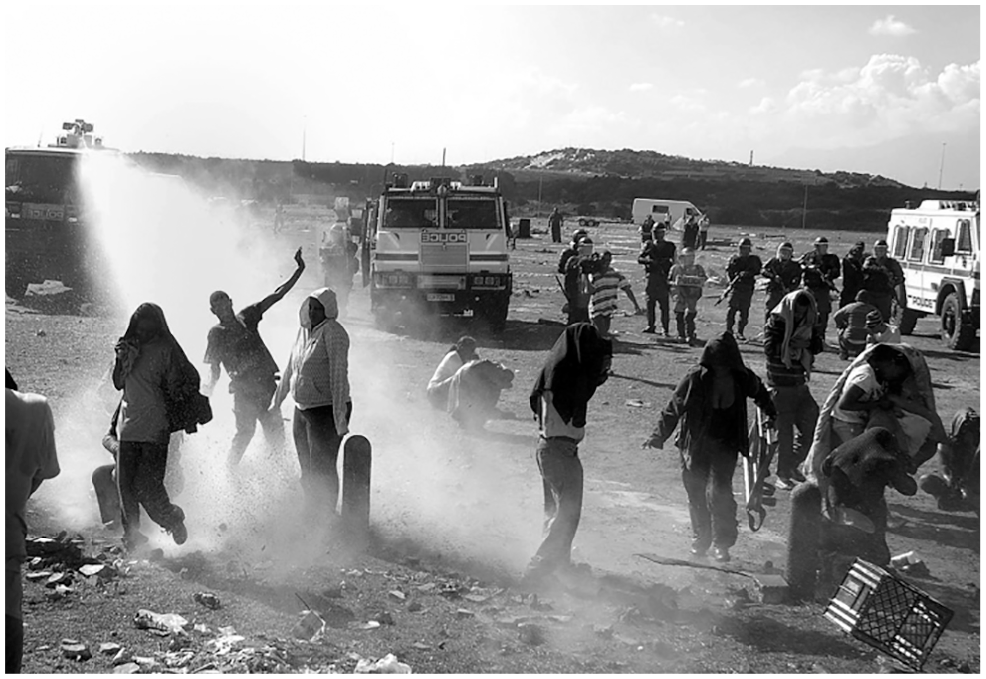
Police use water cannon and rubber bullets to disperse a land occupation in a Cape Town township.
Neil Baynes
From the perspective of participatory democracy, however, these occupations were a material expression of people’s needs. In practice, many of them had no other option; they occupied as a last resort. Thandiwe, mentioned above, had fled gang violence. As we chatted in his shack, two of his neighbors were there with him, sitting on overturned buckets. Zolani, who was slightly older than the others, was living in an established informal settlement with his parents, siblings, and some extended family members. At a certain point, he couldn’t take it anymore. Living in these cramped quarters afforded him no privacy whatsoever with his girlfriend. How was he ever supposed to raise a family of his own?
And then there was Mncedisi, who had been renting a space in someone’s backyard down the road. But she’d been out of work for nearly five years, and no matter how hard she tried, she couldn’t find a steady job in a place where the recorded unemployment rate was approaching 30 percent, with the real rate likely twice that number. Her landlord raised the rent, and she had already been having trouble making her monthly payments. After he threatened to have her evicted, Mncedisi grabbed her belongings and joined Zolani, Thandiwe, and others in an occupation down the road.
The last thing on any of their minds was “embarrassing” the municipality, as Odendal had put it. So what gave rise to this formulation? Why were residents viewed as opportunistic “queue jumpers” who were trying to obtain free government homes without waiting their turn? In most cases, they were actually trying to evade the gaze of the state.
These new occupations mean that the housing backlog —the number of those on the waiting list—is increasing, or at least remaining constant, over a period of decades. From housing officials’ perspective, this represents the failure of technocratic democracy, their very raison d’etre. In order to clear smaller occupations, politicians and bureaucrats sometimes bump occupiers to the top of the list, even when they want to be left alone. In so doing, government officials actually produce queue jumpers, who they subsequently identify as objects of their ire. They thereby misrecognize occupiers as a cause, rather than a consequence, of the state’s failure to deliver. In so doing, they never consider the perspective of participatory democracy: that residents usually know better than officials what they need in order to flourish, or at least to subsist. Land occupations are an attempt to realize these needs.
What Does it Mean to Wait Patiently?
An ideal entry on the waiting list is someone “who expressed a need and actually came forward to register like a good citizen should.” This is how Koetzee, one of the DHS officials mentioned above, responded when I asked her how people on the waiting list should comport themselves. It’s an interesting formulation precisely because it avoids the question. Most of the land occupiers I encountered had registered with DHS for a place on the waiting list—but it’s just that: a waiting list. Where were they supposed to wait in the meantime?
Housing officials tend to wrongly identify squatters as causes, rather than consequences, of the slow pace of delivery. They therefore typically criminalize them.
According to Stuart Wilson, director of the Johannesburg-based Socio-Economic Rights Institute, Cape Town’s average wait time is now roughly 60 years—longer than the UN’s estimated life expectancy for South Africa until 2015. And even if this were a relatively recent phenomenon, wait times had been decades for a while now. I was leaning against the wall in Fouzia’s living room. She’d just recently obtained a government house after fifteen years of living in an occupation. Despite rumors that Colored Capetonians were more likely to receive houses than their Black counterparts, this wasn’t the experience of any of the Colored squatters I encountered. And besides, the homes they did receive were already falling apart. According to the government’s own figures, the majority of government structures were identified as at “high risk,” and more than a half million needed to be demolished and rebuilt altogether.
Fouzia was already thinking about selling the place and finding somewhere else to live. The bricks deteriorated at the barest touch, and she wasn’t sure they were going to hold up her roof for very long. The ground was finished with the same sandy substance, and I could easily discern people’s footprints depressed into her living room floor. Her neighbors were gathered to figure out how to respond collectively to the municipal government and demand decent housing rather than these substandard units.
“I waited 24 years for this house, and this is what I get?” one woman asked.
In response, the other residents began to call out how long they had been on the waiting list: “30!” “9!” “7!” An alarming number of people who registered under apartheid remain on the waiting list today, more than a quarter century after the transition.
Many of them have registered with the DHS and are on the waiting list, but what are they supposed to do in the meantime? This isn’t a matter of coping for a year or two, but more likely, for decades. This is why people occupy land. Certainly there are exceptions: party-orchestrated occupations do occur, bringing supporters of one party into rival territory. But these are exceptional.
The unfortunate irony is that this situation reveals just how considerably proponents of technocratic democracy actually rely upon their participatory democratic adversaries to self-provision in the meanwhile. But rather than acknowledge this fact, housing officials tend to wrongly identify squatters as causes, rather than consequences, of the slow pace of delivery. They therefore typically criminalize them.
Yet it would be equally shortsighted to valorize participatory democracy without its technocratic counterpart. The benefit of land occupations is that they often express the collective locational preference of people in need of housing. This is crucial for any housing delivery program, as location can determine the availability of employment, transportation costs, educational access, and so forth. Likewise, struggling for access to a decent location should never be criminalized. Indeed, many occupiers understand their actions as the self-realization of the Constitutional guarantee to housing, a promise seemingly unkept by the slow pace of delivery. But the fact remains that no one wants to live on a field in a shack, and even if this increases locational viability, it’s far from an ideal solution. Only in conjunction with the technocratic delivery apparatus can participatory democracy be realized in this respect. But the crucial precondition for this to happen is for government employees to stop criminalizing squatters. After all, what is occupying land other than waiting patiently?