



Abstract
This essay explores the Gaana and Carnatic music tradition of the southern Indian city of Chennai.
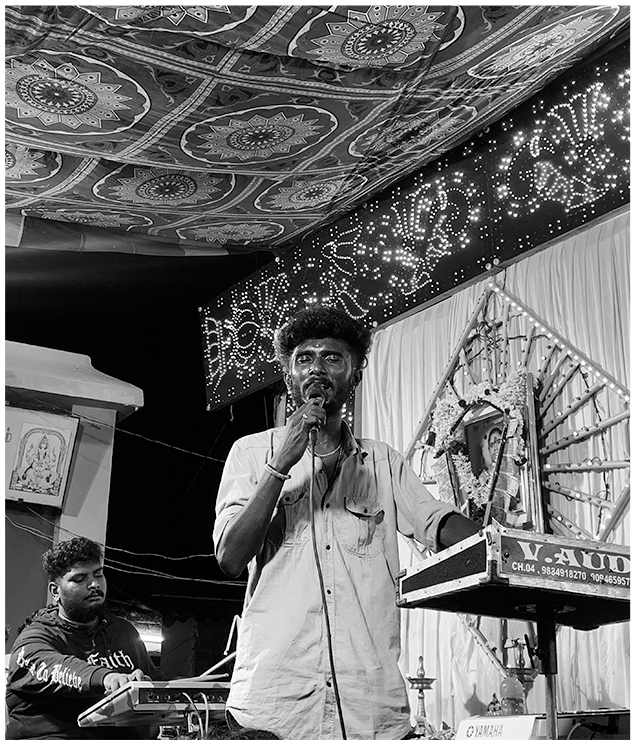
It is 8 p.m. on an October evening in the southern Indian city of Chennai. A Gaana music concert is to take place tonight to commemorate the 16th day since the death of a community member here at Ambedkar Colony, colloquially called a “slum” area by its residents, neighbors, and police. Gaana originated as a funeral music in the informal settlements of early 20th century Chennai and gained increasing popularity with the arrival of the cassette, CD, Bluetooth, and YouTube. This music continues to play an important role in community events of the city’s “slums”—funerals, weddings, and temple festivals. At the same time that young men sing Gaana at funerals, they also use Gaana as a medium for self-expression, asserting Dalit and north Chennai style, and commenting on friendships and their surroundings with humor to express solidarity in the face of discrimination that they experience owing to their caste, class, and address.
The Gaana concert at Ambedkar Colony finally commences only at 10 p.m. after a water provision truck maneuvers its way out of the narrow street where the makeshift stage is erected. Earlier, community members had secured a “noise” permit from the local police to avoid complaints from more affluent neighbors about the “noise” from the “slum.” At the concert, down-tempo and mournful numbers are interspersed with humorous, teasing, and upbeat Gaana standards intended “to make people laugh and forget their grief.” Children and men dance by the stage. The concert lasts well past 2 a.m. and dinner is the musicians’ only compensation. Some Gaana singers refuse monetary compensation from grieving families if they cannot afford to pay for the funerary concert because, “everyone deserves to go with dignity”, and other young Gaana musicians collect proceeds from the funerary performance to create YouTube music videos which receive up to 70 million views. Gaana’s digital presence is about disseminating local information, storytelling, challenging discrimination, and it is sometimes fused with hip-hop, all with the intended effect of creating a “cool” image.
Gaana singer, Athiredi Saran.
Pranathi Diwakar
A few months later, exclusive music halls host the 4,000 concerts comprising Chennai’s annual month-long Carnatic music in December. When you enter the Music Academy, just a five-minute drive from Ambedkar Colony, the difference between the two spaces could not be more stark. Unlike Gaana singers and their patrons, who mostly happen to be from Dalit backgrounds and live in “slum” areas, Carnatic musicians and connoisseurs are almost entirely “upper” caste and Brahmin, living in elite residential areas. Families are gathered in the foyer of the impressive music hall that can seat a thousand people, and women are attired in expensive, heirloom silk saris. Many of these families know each other from over generations. Some have flown in from around the world, particularly North America, to be at the festival and socialize their children into the art form. The “premium” seats are for families with lifetime membership only, and the waitlist to become a premium member is interminably long. A large clock reminds people to take their seats because, as the secretary of the institution once boasted, “concerts at the Music Academy never start even a minute late.”
If Gaana music is about lyrical improvisation and this-worldly concerns, then Carnatic claims “classical music” status for its codified structure of melodic improvisation and 17th-19th century religious compositions. Whereas Gaana is intended to bring people to their feet and get their bodies moving, appreciation for Carnatic music is shown in restrained and codified ways such as nodding or keeping time with a pattern of hand movements, and the music is sometimes fused with other high-status Western styles like jazz. While Carnatic musicians publicly disavow any political concerns, despite musical or spoken endorsements of the reigning Hindu majoritarian political regime, Gaana musicians are often overtly political in their lyrics and style. They seek and demand social legitimacy for an art form that has long been stigmatized in the city for its social origins. The practitioners and participants in Gaana and Carnatic worlds are not only separated by divisions of caste, class, and address in the city, but the aesthetic sensibilities of these art forms serve as parameters for symbolic boundaries that fortify existing social boundaries. These are the boundaries that Gaana musicians subvert in proudly proclaiming their social and spatial origins by embracing Gaana’s unique style and sensibility, in a bid to demand dignity for the aesthetics, representation, and politics of marginalized urban residents.