



Abstract
In this essay, the author explores the culture of bribes in India. Drawing on ethnographic data collected over seventeen months (2017-2019) in Hyderabad, the author turns the spotlight away from corruption as a “problem” to glean insight into how corruption is perceived and interpreted by citizens who navigate the literal and metaphorical mazes of Indian bureaucracy.
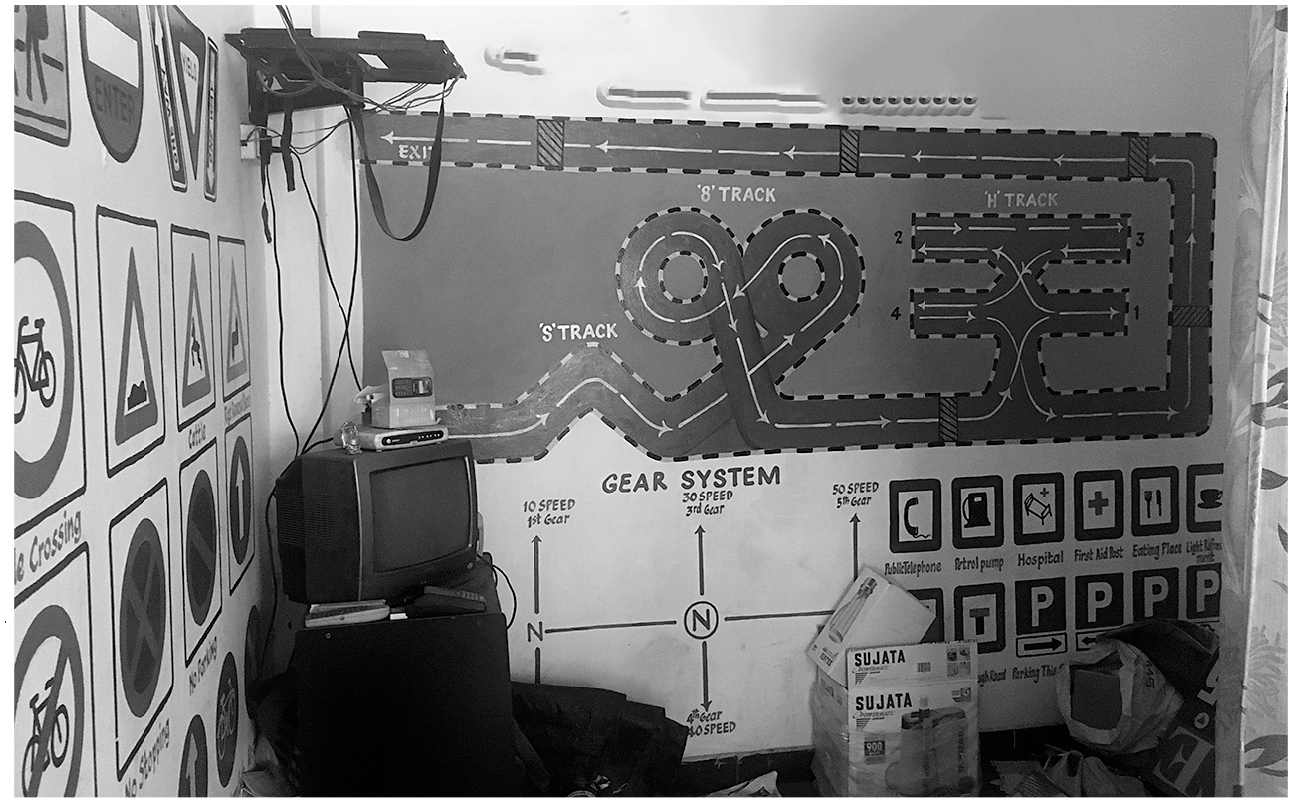
I first heard the phrase “guaranteed license” at Luxury Motor Driving School in the midst of conducting ethnographic research on local driving culture in the southern city of Hyderabad, India. To embrace the participant rather than merely the observer role, I signed up for driving lessons to learn more about how new drivers were socialized into driving, and the kinds of narratives that accompany such an initiation. Squeezed in between a kirana shop (think corner store) and a beauty salon in a bustling middle-class neighborhood, Luxury had been recommended to me by several of my younger interlocutors as one of the most popular driving schools in the city. This is how, on a sunny April morning in 2018, I met with Rajesh, the owner and “star instructor” (his words) of the school.
Surprised that a “modern woman” like me did not know how to drive, Rajesh asked why it had taken so long for me to learn to drive. I told him that I had always been quite afraid of the complexities of driving. In reply, he let out a loud laugh. “Driving? Difficult? Madam, most uneducated people in the country drive—and you, studying in America, are saying driving is hard?! It is so simple.” He added, “Plus, if you go through us, your license is guaranteed! Guaranteed license. Definitely, you will get.” I assumed this was an enthusiastic sales pitch aimed to alleviate my fears and convince me that his driving pedagogy was impeccable. I quickly realized I misunderstood when he said, “Just sign up for our ‘premium’ package. It includes the broker fee and license fee. Full combo pack! After all, what is the point of learning to drive if you don’t get a license at the end of the day? Our brokers at the RTO (Regional Transport Office; India’s DMV) will make sure you get it. Think of it like investment. One-time payment, but full-time benefit.” As he flashed a smile at the end of this pitch, it dawned on me that Rajesh was advising me to pay for the services of a broker—an extralegal intermediary who greases the wheel for citizens navigating state agencies like the RTO.
The point of the broker is not necessarily to eliminate the due process of sitting for a theoretical and practical examination. Instead, the point is to ensure that no matter what happens during the test—whether someone can drive or not—the client would have a driver’s license in hand. What Rajesh was saying, in other words, was that if I made an extralegal payment, I would definitely be the proud owner of a driver’s license at the end of the day no matter how I actually performed on the driver’s tests because a broker would bribe officials at the licensing office. Rajesh charged me Rs 3000 ($50) for three weeks of classes and another Rs 3000 ($50) for the “guaranteed license.” I knew—and he knew—that the official cost of the license is Rs 700 ($12). The surplus—Rs 2300—was going to be split between Rajesh and the broker.
Having grown up in India, where the corruption of RTOs is openly acknowledged what Rajesh offered to me was not particularly surprising. That Rajesh told me how this bribery works despite knowing that I was a U.S. based researcher shows the normalization of this extralegal activity. Like Luxury, most driving schools in the city have contacts with a set of brokers who, in exchange for a commission, assist with the paperwork involved in applying for a driver’s license and making sure that their clients get their licenses. As Rajesh put it, “one-time payment, but full-time benefit.” It is widely known that brokers, in turn, maintain long-term relationships with state officials at the RTO—machinery regularly greased with petty bribery and a dollop of unctuousness. During my fieldwork, almost everyone I interviewed had gotten a driver’s license using a broker—sometimes via a driving school, sometimes independently. In fact, the current Union Minister of Road Transport and Highways recently declared the RTO to be “the most corrupt organization in the country” and went on to compare state officials at the RTO to the infamous dacoits of Chambal valley. While it is tempting to dismiss the comparison drawn between corruption at a public office to organized banditry as oratorial ostentation, I argue that this statement by the political leader running the RTO shows how much of an open secret the corruption at RTOs is. And, so, while getting a driver’s license is—in theory—supposed to be difficult that a potential driver studies and prepares for, it is hardly a surprise India is known for the startling ease of getting a driver’s license. The prime reason for this “ease” is the system of brokerage that keeps corruption going.
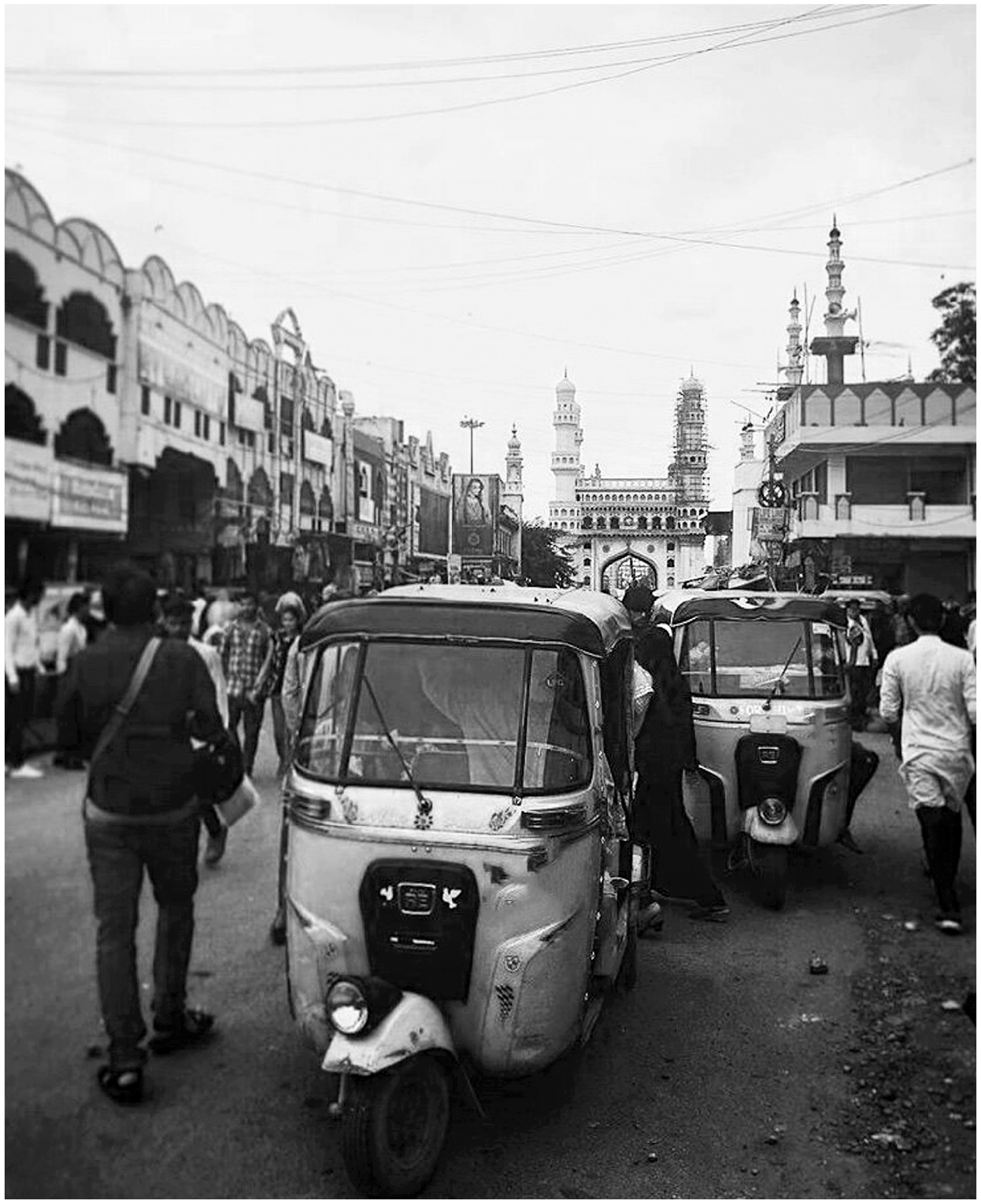
Autorickshaws outside the iconic Charminar in Hyderabad.
Sneha Annavarapu
A look inside of a luxury driving school.
Sneha Annavarapu
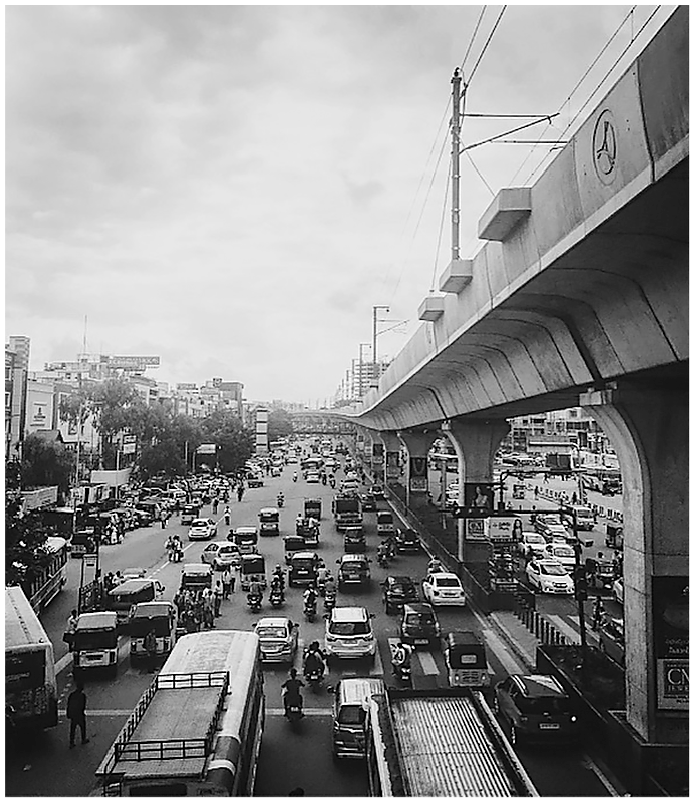
A view of one of the busiest roads in Hyderabad.
Sneha Annavarapu
Road safety experts and activists argue that brokerage puts the legitimacy of the license system into question and is one of the key explanatory factors for India to be a world leader in the number of road crashes each year. According to Sameer Paul, the founder of a road safety NGO, “Since anyone can get licenses whether or not they have ever looked at traffic rules and regulations, they do not actually certify anything! These licenses have no real meaning. They are just pieces of paper.” The contention is that licenses procured via corruption are not real attestations to a driver’s skill or training. As Gunjan, an anti-corruption activist in the city once griped to me, “We all know how it works. Pay a broker, get a license. Basically, licenses are for sale—like bloody onions at a grocery store.”
Corruption as Problem
While corruption is a quotidian social fact that animates everyday conversations around governance in India, there is citizen opposition to the practice. An anti-corruption agenda has been central to middle-class activism in India, resulting in one of the largest cross-country political mobilizations in 2011. In Hyderabad, sting operations done by local journalists and anti-corruption activists sporadically rupture the public discourse, flooding news media with sensational images of bundles of cash attached to state documents, turning the otherwise staid RTO offices into scandalous spectacles. These episodic exposés are usually followed up with typically middle-class moral outrage that provokes a state response. In the past, public pressure has resulted in temporary suspensions of complicit officials along with panopticon installation of CCTV cameras at public offices and, more recently, reliance on online operations intended to remove human error and avarice from the transaction. And yet, the fact that Rajesh offers brokers’ services and that brokers often solicit customers at the premises of the RTOs—sometimes right under banners that declare the use of brokers to be illegal—points to the tenacity of corruption in India.
And, so, while getting a driver’s license is—in theory—supposed to be difficult that a potential driver studies and prepares for, it is hardly a surprise India is known for the startling ease of getting a driver’s license. The prime reason for this “ease” is the system of brokerage that keeps corruption going.
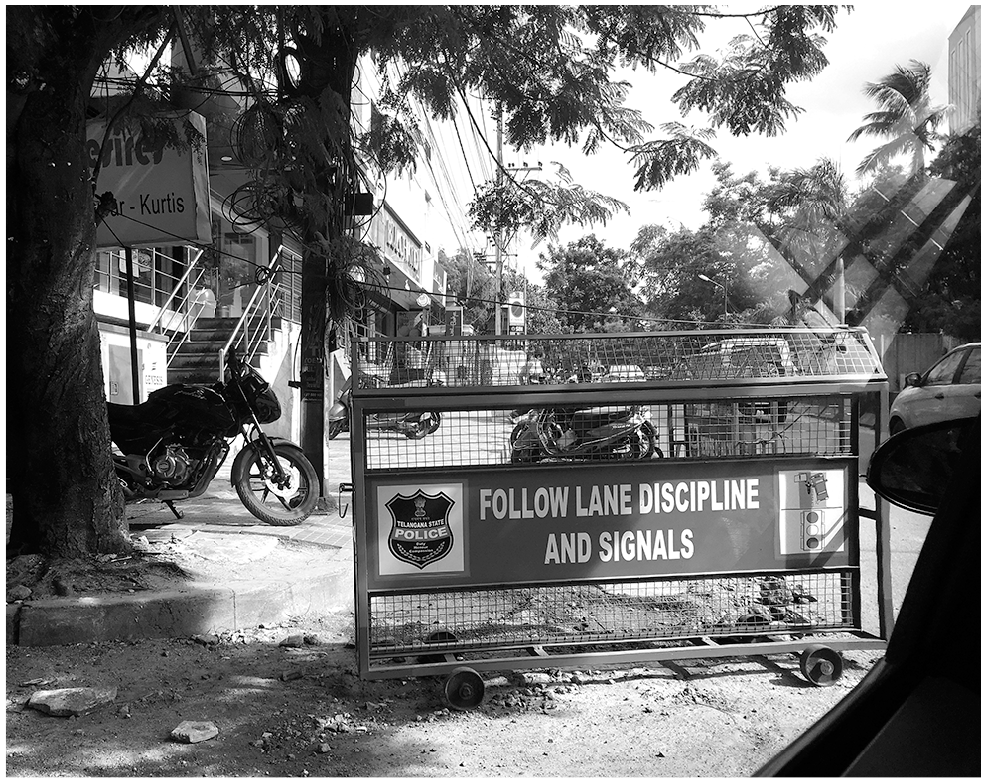
Metal barricades bearing road safety advice are ubiquitous in the city.
Sneha Annavarapu
Existing scholarship, public policy, and popular wisdom around corruption tend to understand it as a malaise or a problem in governments, especially those in the Global South. This approach has galvanized transnational organizing against corruption by positing that corruption slows down economic growth, produces “dysfunctional institutions,” and distorts resource allocation. Here, corruption appears as a black hole threatening state capacity or a tear in the silken fabric of bureaucratic efficiency. But this approach tells us little about why corruption persists and, all too often, tends to render citizens as non-agentive victims of bad governance. Broadly put, this approach neglects to take seriously the logics that citizens operate with while paying bribes. The narratives around corruption give it the kind of spectacular banality typical in Global South societies.
In other words, corruption at the RTO is not seen as the problem but the solution to a series of governance problems. It is seen as an efficacious buffer or insurance against a state perceived as incapable of being objective, just, efficient, or—depending on one’s social class—a combination of all three.
In this essay, I then explore what might seem like a naive question: why do citizens engage brokers to get their driving licenses? In doing so, I follow the lead of emerging anthropological research in treating corruption not as a black hole but as an aperture that allows for careful consideration of how citizens relate to the state in everyday life. Drawing on ethnographic data collected over seventeen months (2017-2019) in Hyderabad, I turn the spotlight away from corruption as a “problem” to glean insight into how corruption is perceived and interpreted by citizens who navigate the literal and metaphorical mazes of Indian bureaucracy I argue that corruption at RTOs persists for two primary reasons: one, citizens across all social classes articulate their complicity in corruption as an understandable response to a set of conditions that offer no other alternative—that is, one has little choice in the matter; and two, that corruption can circumstantially work to the benefit of the underprivileged by acting as a leveler of an uneven playing field and easing an arduous process. In other words, corruption at the RTO is not seen as the problem but the solution to a series of governance problems. It is seen as an efficacious buffer or insurance against a state perceived as incapable of being objective, just, efficient, or—depending on one’s social class—a combination of all three. While a reductive romanticization of corruption is not what I am arguing for, I do suggest that an ethnographic view of the social life of corruption necessitates that we take seriously why systems of brokerage are not just difficult to disentangle and eviscerate, but why they are put up with—and sometimes actively desired—by citizens.
Corruption as Solution
I first met Pranith, an employee at a software company in the city, through mutual friends in 2018, and upon hearing that I was in the city researching driving culture, he cracked up and quipped, “Nobody here knows anything about traffic rules. That is the culture—ignorance and apathy”. Pranith moved back to Hyderabad after finishing a master’s program in the U.S., lives in a gated community in the relatively elite part of the city and drives a sedan—a comfortable member of the “new middle class.” I asked where he thought the problem lay. He was quick to reply. “Driving tests are not really a thing here.” Comparing his experience in the United States to his experience in Hyderabad, he shook his head and said, “Here, everyone just hires a broker. In the U.S., I had to learn the rules and take the test. Here? No way anyone does that. Why would anyone feel the need to when a shortcut is there? Before you can even enter the RTO, some broker will catch you and start offering his services.”
I asked him directly if he had hired a broker to get his license in India. Pranith sheepishly grinned, betraying his own complicity:
Look, the first time I tried getting a license, I did not hire a broker. I practiced the theory tests online and, of course, I passed. I was happy and I even told everyone that ‘see, I did this without a broker’. Now, since I know how to drive, the practical driving test was a breeze. But the driving inspector said I had not used the indicator. First of all, I had totally used the damn indicator, but the worst part was that I saw people who were doing everything wrong but were getting passed. Then I realized it’s because they had brokers. The brokers were making sure that no matter what their clients did, they got their licenses! So, what was the point of my moral high ground when the system favors the cheating? The second time I went for my license, obviously, I hired a broker. The system makes you take shortcuts. It only rewards dishonesty. This is India for you!
Pranith’s experience at the RTO shaped and, perhaps, validated something that he had known before—that bribery was the best, if not the only, way out. And he was hardly alone in his deep suspicion of the state. For many middle-class motorists I spoke with during fieldwork, using a broker was a matter of solving the problem of the arbitrary discretion of state driving examiners. The question was often about legitimacy: state officials were not perceived as objective examiners. There was an overarching conviction amongst my interlocutors that preparing for the driving test and giving it an honest shot are not sufficient to get a driver’s license. A broker was framed as a solution to the avaricious tendencies of the state. In his declaration, “this is India for you!”, Pranith underscores a grudging acceptance of the status quo.
Similarly, when I asked Prakash, a taxicab driver in his late 30s, why he had used a broker to get his license, he said:
Why you are asking me as if you don’t know what happens in India? (laughs). See, if you don’t pay the broker, even if you drive perfectly, who knows whether you will get license? If you don’t use a broker who will give them some money to give you a license, they will find some reason to fail you. Who does not want some extra money?
While road safety activism in the country stressed the removal of the broker, which seemed to be more of a concern amongst my interlocutors was the state itself. The lack of conviction that state officials will follow protocol and be fair was linked to an understanding that they “just cannot be trusted.” This deeply rooted suspicion of the avaricious and extractive Indian state is often the very rationalization for why citizens must engage in corruption. The irony of this self-fulfilling prophecy— that the solution to corruption is corruption—makes paying a bribe seem less like an act laden with immorality and more a necessary rite of passage.
Brokers as bureaucracy buffers
For lower-income drivers of autorickshaw drivers, taxicabs, minivans who are sometimes unable to, as anthropologist Francis Cody puts it, “master the conventions of bureaucratic documentation,” brokers function as insurance against systemic exclusions. They become what I call here “bureaucracy buffers” in preventing a direct encounter with the state. It was an extremely common perception amongst low-income drivers that the less money you have, the more likely a greedy and unethical state official will take advantage of their illiteracy, and a broker, in this context, was deemed indispensable. As Yajulu, an autorickshaw driver put it, “If we go without a broker, the government official will play with us and delay our work endlessly. Brokers get work done—unlike the government.” Sociologist Javier Auyero has argued that states often use waiting or as a mode of exercising power. Yajulu, in bringing up the capacity of the state to make him wait recognizes this mode of state oppression but simultaneously points—rather glibly, if I may add—to brokers as the palatable solution.
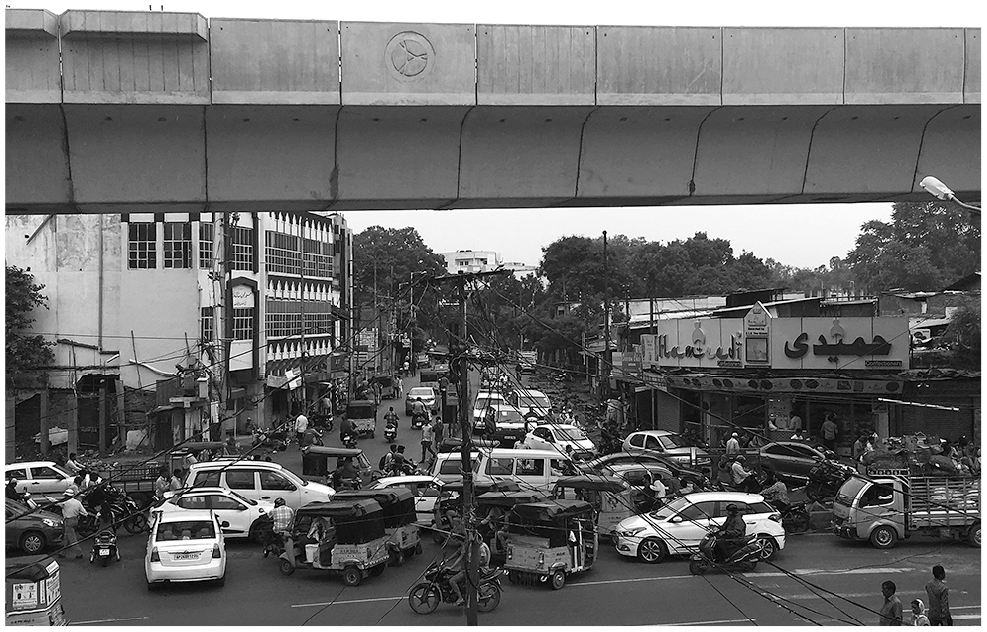
Entangled: a busy traffic junction in the city.
Sneha Annavarapu
But the other, more curious, reason for low-income drivers to pay brokers was an overarching conviction that state officials would impede them unfair and incomprehensible paperwork. Take the case of Azmath, an autorickshaw driver in his 40s who moved to Hyderabad from the village of Mahboobnagar. When Azmath moved to the city, he took up multiple jobs in the informal economy. He mopped the floors of a local restaurant, he worked as a security guard at a housing colony, and even set up his own fruit stall briefly. When he was desperate for consistent work, his friend suggested he drive a rented autorickshaw until something better came along. He drove without a driver’s license until he was caught by the traffic police. While he managed to bribe them and get away without a greater penalty, he decided to apply for a license and a “badge number.” However, to get the license, he needed to produce proof of having studied until the eighth grade—a completion certificate. However, Azmath did not have such certification because he had not attended school beyond the fifth grade. Financial precarity led him to withdraw from his school at the age of twelve when he started accompanying one of his uncles as a cleaner on an interstate truck. Azmath realized then that while he had been driving for a while, he could not even apply for a legitimate license since he had not studied up to eighth grade.
Azmath approached a broker through his contacts in the city. Within a few days, the broker procured a fake certificate of completion and managed to push Azmath’s file through the serpentine system of Indian bureaucracy. Azmath did not remember taking any driving tests either. As he told me the story, he eagerly clarified his stance on brokers:
Everyone thinks that brokers are taking people’s money. In the news also there is always something or the other about how brokers should not be used, but they are actually helping people like me get licenses. If these brokers didn’t exist, most of us would not be able to get all the paperwork done. I need to make a living somehow, no? That education rule does not make any sense. If I wasn’t poor, I would have also attended school. Why till eighth grade? I would have attended till college—like you, I would have also gone to America (laughs). If I was so educated, why would I be driving an autorickshaw? I would do something else, something that would make me rich.
Like Azmath, other autorickshaw drivers also told me that they depended on brokers for “taking care” of rules that “did not make sense”. These drivers had not finished school or did not have the required documents. They were convinced that state officials would take advantage of their illiteracy and paper-less existence—and that brokers were the more reliable solution against an unreliable (and unreasonable) state. That in June 2019, the minimum educational qualification was removed as a requirement in order to attract more commercial drivers to meet the increasing demands for transportation and mobility in the country shows the mutability of these rules. But, arguably, it also legitimizes what the brokers were, perhaps inadvertently, already doing—finding a way around a rule that was unrealistic to begin with.
Disclaimer: the names of all interlocutors mentioned in this essay have been anonymized for confidentiality.