




Abstract
This book review explores Psychobilly: Subcultural Survival by Kimberly Kattari, which describes psychobilly as a subculture based around the music genre of the same name.
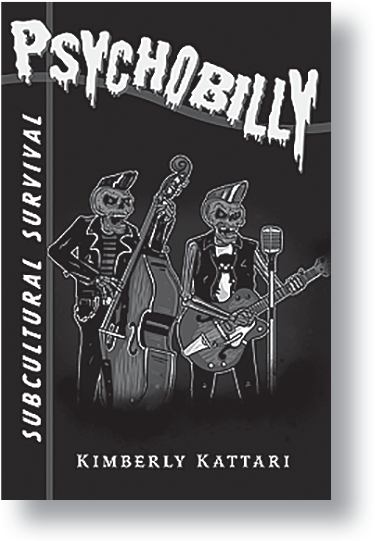
I struggle to find a place to start with Kim Kattari’s Psychobilly: Surviving Subculturally. Kattari describes psychobilly as a subculture based around the music genre of the same name, which is “[l]oud, fast music with some rockabilly and some punk that has a sense of humor, rejects politics, and embraces gore and horror in a tongue-in-cheek way” (p. 206). The book is an in-depth ethnographic analysis of the psychobilly subculture, examining the formation and maintenance of a community based around the music and how involvement shapes identity and serves as something akin to a coping mechanism for the outside world. The subculture has its own norms and aesthetics (think 1950s rockabilly mixed with punk) and is filled with people who regularly find themselves frustrated not only by the sounds and styles of “mainstream” punk and rock music but also those who are socially and economically marginalized. As a result, the subculture becomes a partial solution to addressing the problems of the misfits who find comfort in it. However, beyond this loose definition of what constitutes psychobilly, things become more difficult.
I found part of myself in the local psychobilly scene at the tail end of my undergraduate years and have been connected to the scene ever since. Psychobilly helped me come out of my shell and deal with much of the stress and isolation that had accumulated up until then. Since graduating, I have been perpetually fighting the reality of growing up and apart as new work demands set in. Just as much as I am a psychobilly, I am also an academic—and a political sociologist at that. This is a surprising contrast for a subculture where the Meteors, a founding band, coined the phrase, “fuck politics, fuck religion, dance with a chainsaw,” something that would not be received well if said at a sociology conference. However, psychobilly allows me to break free of my work. Discussing it is all but forbidden, preventing politics from consuming my whole psyche, giving me room to breathe, and all the songs about B-movie monsters I could ask for. As a result, I come to this book looking at it both with the eyes of a psychobilly and a sociologist.
Kattari’s work starts with the sub-culture’s origins in the U.K. during the 1980s. Psychobilly finds its roots in the rejection of the cultural, social, and political norms of Thatcher-era political culture and the repetitive and bland rockabilly scene. There was a need to look forward and create a space devoid of politics and filled with new music. Thus, psychobilly emerged. Most psychobillies, including myself, would instinctually reject calling anything tied to the subculture “political.” However, there is clearly an element of resistance in a subculture that brandishes itself as a politics-free zone. With its rejection of politics psychobilly highlights the importance of fun within subcultures. Because psychobilly is first and foremost fun, people join and stay to further build the subculture.
This history sets up the trajectory not only for the rest of the book, but also shows how the mentality behind an entire subculture that chooses to embrace madness, openness, and crudeness while eschewing politics can develop a community in search of both schlock and a sense of self. As scholars have continually looked toward post-subcultural theories, Kattari’s book exemplifies that subcultures still survive by helping their members survive. By de-emphasizing politics and placing the emphasis on fun, the subculture has established itself as a long-standing, albeit niche place throughout the world. This is not to say that psychobillies are always apolitical. Many fans and musicians are vocal about their political beliefs and call for action against racism, sexism, homophobia, and police brutality. However, politics generally stays out of song lyrics and shows, creating a clear buffer. Overtly political songs are regularly met with disapproval. This is not simply a rejection: it is an active and intentional effort to walk away from the horrors of the real world, replacing them with the horrors of the silver screen.
With the avoidance of politics being foundational to the scene, the subculture becomes a place to recharge and deal with the outside world. However in order to get that benefit, there also needs to be something that “clicks.” In this case, it is both the need to resist and the hedonistic pleasure from the music and participation. In this sense, psychobilly very much does become a way to subvert some degree of the power structures that people engage with in society. Returning to the idea of intentional resistance, Kattari paints the subculture as a place where the norms and restrictions of the outside world are disavowed, allowing for exploration beyond them. Through these moments of resistance, members of the community recollect themselves making it a tool for recovery needed to function when dealing with the outside world (to embrace the old cliché, a psychotherapy of sorts).
As I read Kattari’s book, I had two thoughts. First, “yes, this is me. I see myself in this book.” Kattari captures my emotional ties to the subculture and reminds me of blasting the Koffin Kats in my parent’s basement, seeing large bands like the Guana Batz and the Quakes, and local ones like Nothing to Gain and Fran-kensexxxy. The further I read, the more I find Kattari successfully linking the feelings of stress, isolation, and frustration that got me involved with the subculture in the first place and the wild music and friends that keep me coming back.
Second, while it most certainly is a privilege to have opportunities to engage in apolitical spaces, it is something that should be embraced. Subcultures like psychobilly help relieve stress and build a sense of belonging, but there is not necessarily equal access to “apolitical” spaces. By exemplifying their benefits, Kattari’s book shows the need to create a larger variety of realms of life where this is possible. Not to completely turn a blind eye, but to find temporary freedom from the stresses and pains in the rest of the world. The importance of rest and relaxation has been highlighted before, but Kattari’s analysis uncovers the depth of what makes these spaces important, with a side of songs about zombies to sing along to.
Kattari also challenges me and the subculture in this book. While the psychobilly subculture actively opposes many social structures for the purpose of escapism, it does not completely abandon them when it comes to gender. Not only is there the issue of sexist behavior among fans, viewing women-led bands differently, but many of the songs, while played for comedy, do have violent elements. Negotiating these dynamics are not experiences I can speak to but reading about how women in the subculture negotiate both the assumptions within the subculture as well as the often graphic lyrics allows me to look at psychobilly more critically. It gives me a better understanding of how some people choose to navigate these contradictions and tests the limit of how far the argument “it’s only a song” can go.
If there is one shortcoming in Kattari’s work, it is the absence of race. While psychobilly is overwhelmingly white, there are people of color within the scene, and an analysis of their participation would add another layer of depth. Kattari has covered this to some degree in other works, but it deserves greater levels of analysis. As a result, the picture Kattari wishes to paint remains partially unfulfilled and very much open to discussion.
For better or worse, all of these elements are embraced by a global community. In an ideal world, it would be completely open and welcome. Yet, there is a tremendous amount of gatekeeping, particularly over authenticity. Those who do not have the right look or do not like the right bands find themselves scrutinized. Kattari acknowledges that this gatekeeping grounded in authenticity is understandable. At the same time, she highlights that it is also a clear contradiction to much of the subcultures origins of rejecting traditional conventions and frustration with dominant trends in music. As societies evolve, so too must their subcultures if they wish to survive. Sounds and styles are continuously reimagined, and psychobilly cannot be the exception.
The subculture provides tremendous camaraderie and support. Kattari shows the power psychobilly has for the lives of those involved. The most memorable example is the story of someone hospitalized during a major festival, leaving them unable to attend. Fans and bands took time out of their schedule to make a visit and even played music in the hospital. While Kattari doesn’t make the link, this too shows the power of a community that promotes some level of temporary escapism, taking one’s mind off the crises that could ruin what should be the high point of someone’s year and having a community to help you do it.
This book may upset some psycho-billies. Kattari’s book is geared toward academics and does not shy away from being critical of the subculture. An analysis of this sort is also somewhat contradictory to what psychobilly is about. I feel comfortable saying that I see parts of myself in this book, and I think other psychobillies will as well. From the thrill of shows, to the community, and most importantly, the significance of escapism, Kattari shows the world what psychobilly is and why it matters. The book would make an excellent addition to any course covering culture, media, or the self and society. It will not resonate with everyone, but I firmly believe the book is both academically important and does the subculture justice.
A Review Score
I regularly found a handful of psychobilly songs coming to mind while reading Kattari’s book (some are mentioned in the book, others are not). This “score” is by no means a “best of” list, nor does it paint a complete picture of the sounds psychobilly has to offer, but I’ve compiled a list to accompany this review, as I believe these songs will enhance the reading experience.
As Diabatz, “Nightmares in Red”
The Sharks, “Take a Razor to your Head”
Frenzy, “Don’t Give Up”
The Meteors, “My Daddy is a Vampire” (also check out the Highliners’ cover)
Blue Cats, “Gotta Go”
Norm and the Nightmarez, “Psychobilly DNA”
Mad Heads, “Psychollela”
Sick City Daggers, “Zombies”
Nocturnal Teds, “Graveyard Party”
Koffin Kats, “Graveyard Tree Zero”
Guana Batz, “King Rat”
The Quakes, “Psychobilly Jekyll and Mr.Hyde”