




Abstract
This book review explores The Privileged Poor: How Elite Colleges are Failing Disadvantaged Students by Anthony Abraham Jack, which offers a fascinating look at the diverse experiences of low-income students at an elite university.
Keywords
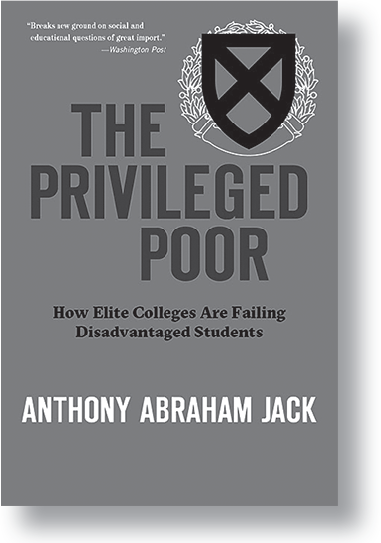
Sociological research on the experiences of low-income, first generation, and working-class students in higher education is flourishing. Over the past decade, we have learned a great deal about how these students access higher education, the contours of their experiences on campus, and the factors that influence their retention and graduation. But is our understanding of socioeconomically disadvantaged students too monolithic? Anthony Abraham Jack suggests that it is. His well-researched and beautifully written book, The Privileged Poor, offers a fascinating look at the diverse experiences of low-income students at an elite university pseudonymously referred to as “Renowned.”
This book draws analytical leverage from a comparative study of three groups of students: the Upper Income, the Privileged Poor, and the Doubly Disadvantaged. While upper-income individuals are well represented at elite universities like Renowned, those from less socioeconomically advantaged backgrounds are often underrepresented and marginal on these campuses. Jack distinguishes students who grew up in poor families and attended under-resourced public schools (the Doubly Disadvantaged) from those who were born into similar socioeconomic circumstances but through lotteries, scholarships, or other means were able to attend private preparatory high schools (the Privileged Poor). In these settings, the Privileged Poor acquired social and cultural capital that carried with them into higher education similar to their peers from upper socioeconomic positions.
The differences between the Privileged Poor and the Doubly Disadvantaged are notable from the beginning of the book as Jack’s first substantive chapter sets out to explore students’ sense of belonging at Renowned, especially related to their engagement with peers. In the world of elite higher education, owning the right pair of rain boots or being able to partake in a “cheap” $30 lobster dinner shapes interactions with peers. While most low-income students lacked the finances to engage as full members in the campus social scene, it was the capacity to anticipate and deal with these experiences that distinguished the Privileged Poor from the Doubly Disadvantaged. While students who attended elite high schools had previously learned to manage peer engagement in affluent social circles with limited economic resources, those without such experiences struggled to find a place at Renowned. Readers will hear the pain in the voices of the Doubly Disadvantaged as they recount the emotive experiences of being poor in the midst of a campus of material excess.
However, feeling a sense of belonging in college is not only about what happens on campus. This book shows that students’ connections with families are likewise influential. With a keen eye for the interplay between home and school, Jack illuminates the impact of home communities on students’ first-year transitions. It is here that he finds notable similarities between the Privileged Poor and the Doubly Disadvantaged, observing that “Students do not stop being poor or lose all connection to their background when they enroll in college. Although the Privileged Poor faced fewer stresses associated with their college experiences, they shared stresses from home with other low-income students” (p. 77). These family struggles can further undermine inclusion in college.
In the second chapter, Jack shifts focus from how students navigate belonging at Renowned to the ways they engage faculty and leverage university resources. It opens with a glimpse into an illustrative moment where Marie, an upper-income student, displays ease in approaching and conversing with a professor at an off-campus event. Jack shows us how this interaction is representative of the broader sense of comfort that some students possessed when engaging with college faculty and staff. What readers may initially recognize as a disparity between the wealthy and their less affluent peers turns out to be more complex. Jack documents the ways having (or lacking) ease relates not just to the cultural resources bestowed by one’s family but also to resources acquired in formal educational settings. In doing so, he shines light on differences between the Doubly Disadvantaged and the Privileged Poor in how they engage with authority figures. Having experienced resource abundance, attentive staff, and structured opportunities for teacher-student engagement in high school, the Privileged Poor arrive at Renowned prepared to draw from university resources similar to their more affluent peers. Meanwhile, the Doubly Disadvantaged struggle to feel comfortable seeking help from university resources and occasionally misunderstand the purpose of opportunities such as faculty office hours, which Jack explains some students may interpret as a time for faculty to work uninterrupted.
These first two chapters go a long way in illuminating heterogeneity among low-income students that many previous studies overlook or minimize. However, readers of these initial chapters may find themselves wishing for more direct comparisons between the Privileged Poor and upper-income students. Following Jack’s skillful exploration of the myriad contrasts in the experiences of the Privileged Poor and the Doubly Disadvantaged, sociologists might likewise be curious about differences between students who inherited social and cultural resources from their families during childhood and students who acquired them during adolescence in elite schools. Jack offers a few clues that there may be more to unpack here. For instance, in concluding chapter 2, he notes that “Students from upper-income families see faculty as partners along their academic journey, while the Privileged Poor come to see them as facilitators of their advancement” (p. 126). This observation raises interesting questions about what it means to see faculty as guides on a path toward upward mobility as opposed to “partners” in academic development. Additionally, one might wonder: Are there qualitative differences in the campus social ties of these two groups of students? Are their displays of cultural capital equally effective? By helping his readers to see important diversity in the experiences of low-income students, Jack has paved the way for future research exploring how the age and setting in which youth acquire social and cultural resources matter for their success in college.
In chapter 3, Jack treats his readers to several insights that will be appreciated not just by academics, but also by the policy makers and practitioners—student affairs personnel and other postsecondary administrators—who read his book. Here Jack leverages his data to uncover the unintended consequences of three practices at elite universities: (1) employing students as custodial staff, (2) creating separate lines for low-income students to access programs free of charge, and (3) closing campus dining halls during spring break. These practices gave rise to situations where low-income students from both groups were marginalized as the cultural and social resources of the Privileged Poor were unable to make up for disparities in economic resources. Some of these practices were actually generated by efforts to foster inclusion. The Scholarship Plus program, designed by Renowned to remove financial barriers to participating in campus life, provides a clear example. Jack invites his readers to a scene that unfolded during his observations of an event at the university theater As most students purchased tickets from a table near the main entrance, Scholarship Plus students were required to pick up tickets from a separate table “next to the scuffed-up back door, which leads to an alley full of broken-down cardboard boxes,” before “enter[ing] the theater through a small side door” (p. 157-158). In this way, a program designed to facilitate inclusion had the opposite effect, amplifying the salience of economic disparities. Regardless of differences in their pre-college educational experiences, low-income students found themselves pushed to the margins of college life by these programs and policies.
Readers will hear the pain in the voices of the Doubly Disadvantaged as they recount the emotive experiences of being poor in the midst of a campus of material excess.
The findings presented in The Privileged Poor are heartrending to say the least, and yet, Jack manages to conclude the book on an uplifting note. Rather than speculating about vague changes to policy and practice, Jack gives readers an account of concrete revisions to university procedures that his own advocacy helped to bring about. The book describes how Jack employed specific research findings to campaign for change. Meetings with administrators and deans at Renowned—and other institutions—led the university to alter marginalizing practices, working toward greater inclusion. It is not often that we see applied sociology of this scale highlighted in ethnographic research. Jack’s candor about the challenges and opportunities involved in this work (featured throughout the book and in an insightful methodological appendix) offers an inspiring road map that new and experienced researchers alike will find valuable.
Finally, teachers will appreciate the opportunity to draw from this book in classes on education, culture, and social stratification to name a few. With an accessible writing style, The Privileged Poor will work well for both undergraduate and graduate courses. I especially look forward to incorporating this book in my Culture and Social Inequality seminar, where students often raise questions about inclusion and exclusion in different types of educational settings. Jack provides openings for a range of conversations about patterns, policies, and practices that reproduce inequality. Moreover, by sharing strategies for reducing inequality, Jack illuminates the potential of sociology to create meaningful change.