Abstract
How racism is enacted, sanctuary cities, and bias within contraceptive counseling. New research from the journals.
In their recent article in Sociological Theory, Timmermans and Tavory use key insights from race scholarship and C.S. Peirce’s “pragmatist semiotic” framework to examine how racism is enacted and countered in social interaction through generalization and specification. Prag-matist semiotics focuses on how people achieve signification in ongoing social interaction. There are three elements of meaning-making from this perspective: “signs” which stand for, denote, or represent an object; “objects’’ which are any entity about which a sign points to meaning; and “interpretants” which refer to the effects of objects and the signs attached to them on actors engaged in the process of meaning-making. In micro-level interaction, racism is often enacted through generalization—the use of specific phenotypic markers or “signs’’ of identity, behavior, or experience to construct imagined groups organized hierarchically based on presumed superiority or inferiority. The reverse process is called specification and involves personalization meant to combat generalization and negotiate toward more favorable meanings.
Timmermans and Tavory analyzed a convenience sample of published ethnographic studies and publicly available videos of racist encounters. They found that those enacting racism in these interactions engage in “upshifting” to achieving generalization. This involves making assumptions about the person of color in the interaction based on racialized signs followed by escalating those signs from the individual level to the group level to make negative assessments of the person based on racist beliefs about the group. In contrast, people of color engage in “downshifting” to counter and resist racist generalization through personalization of events, actions, or emotions in order to achieve a respecification of meaning in the interaction. The authors observed that this usually involved downplaying race in favor of other social categories or characteristics in order to disrupt the meaning-making process and humanize the target of racist generalization.
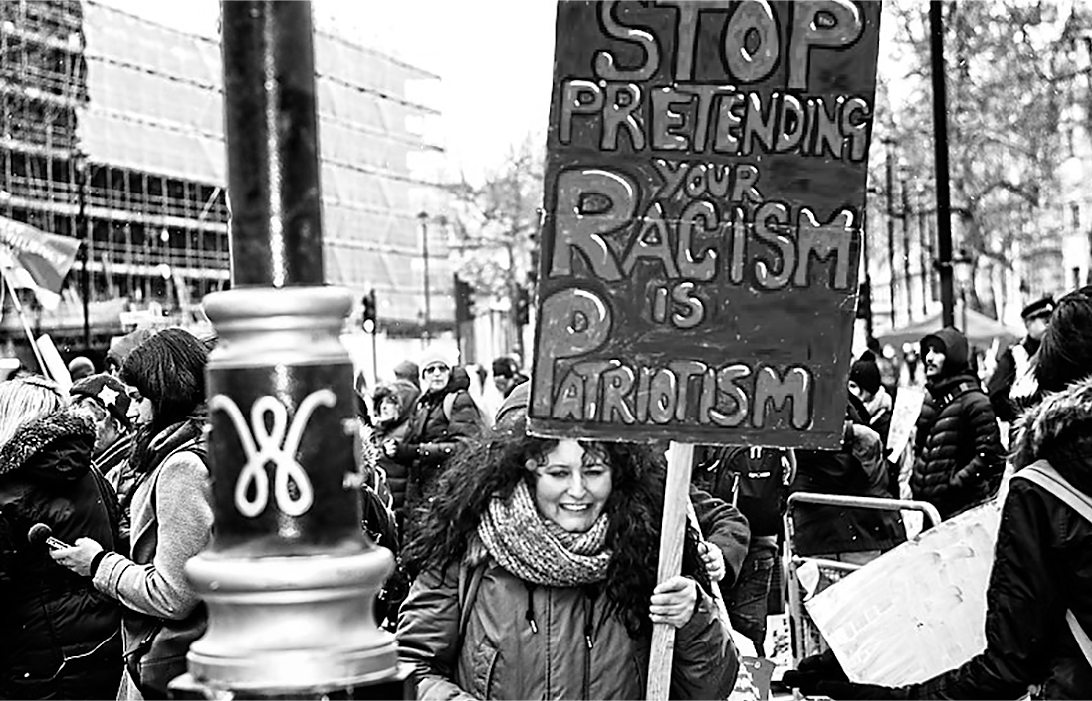
A woman holds an anti-racism sign at a 2018 Stand Up to Racism march in London.
Garry Knight, cc
Overall, the authors advance two primary arguments based on their pragmatist semiotic analysis of racist encounters. First, they assert that taking a semiotic approach allows for the examination of how racism is generated through social interaction. Second, they argue that insights from race scholarship supplement this approach in two important ways. First, their inclusion allows for a deeper examination of how specification of the symbols and traits used by those who engage in generalization is an approach to counter racism. Second, it provides greater attention to the role of institutional power dynamics in these interactions that can be missed when using a strictly micro-level approach.
Sanctuary Cities are a Public Safety Issue
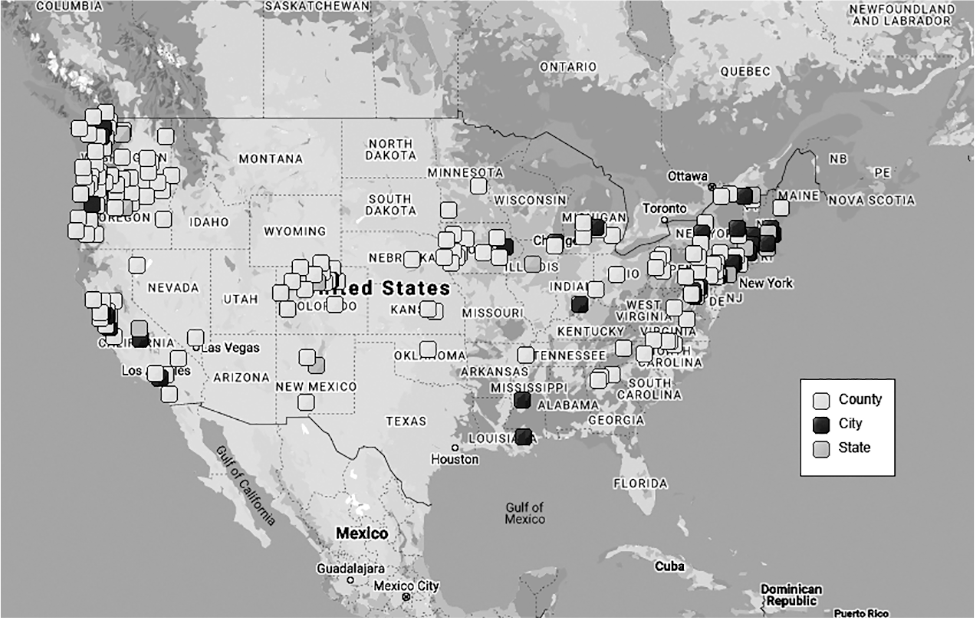
Sanctuary jurisdictions, which limit the effort to enforce immigration policy, have existed in the United States since the 1980s. However, in recent years they have become a point of controversy on the political stage. Critics argue that sanctuary jurisdictions threaten public safety by increasing crime and undercutting national efforts to enforce immigration policy. Yet, advocates argue that sanctuary status actually enhances public safety by increasing the chances that members of immigrant communities will report crimes.
In the American Sociological Review, Ricardo D. Martfnez-Schuldt and Daniel E. Martfnez explore this ongoing debate, focusing on how crime-reporting behavior varies across immigrant sanctuary contexts. They chose to focus on this relationship, noting that there is no empirical evidence supporting the position that sanctuary status increases crime. Further, federal immigration enforcement efforts often decrease the likelihood that immigrants seek help after becoming the victim of a crime, as they are often hesitant to engage with social institutions.
A map highlighting sanctuary cities around the United States.
Center for Immigration Studies
Using data from the National Crime Victimization Survey and the National Immigration Law Center, the authors conducted multilevel logistic regressions to assess patterns in victims’ crime-reporting behavior over time and across cities and metropolitan areas. Martfnez-Schuldt and Martfnez explore the relationship between race and crime-reporting before and after an immigrant sanctuary policy goes into effect. They find that Latinx victims are significantly more likely to report violent crime to the police after a sanctuary policy is adopted in the city or metropolitan area where they live. The authors imply that the adoption of sanctuary policies could shift the nature of help-seeking experiences for Latinx victims and eliminate some of the barriers that undermine their willingness to call the police and seek justice. They conclude that increases in crime-reporting benefit public safety.
Bias within Contraceptive Counseling
Extensive research has identified bias within the American healthcare system, but little is known about how bias works in medical encounters. In an article from the Journal of Health and Social Behavior, Jamie Manzer and Ann Bell use in-depth interviews with health care providers to explore how bias operates in the context of contraceptive counseling, a context chosen because of the highly raced, classed, and gendered nature of these interactions. Researchers interviewed a racially diverse sample of health care providers that specialize in contraceptive counseling, focusing on the provider’s history in the medical field, their patterns surrounding prescribing contraception, and how they discuss contraception with patients. Analysis of interview transcripts revealed four primary strategies employed by providers to manage bias in contraceptive decision-making and counseling: (1) using scientific rationale, (2) employing “safe” biases, (3) standardizing counseling, and (4) implementing patient-centered care. Rather than reducing bias in interactions, however, the authors find that these strategies have the potential to worsen bias in contraceptive counseling.
A Mirena IUD, a form of long-lasting, reversible birth control.
Sarahmirk, cc

Rather than prioritizing patient preferences or side effects, providers use public health data about presumed pregnancy risk and knowledge of the most effective contraceptive methods to alter their contraceptive counseling. Additionally, providers justify differences in counseling by employing “safe biases,” or coded terms that convey multiple layers of meaning and target a specific group to express biased views about patients. Even when claiming to offer standard care across patients, biased sentiments persist. When providers believe they are offering patient-centered care, they may not confront their personally held biases with implications for their counseling services.
Providers believe their approaches to contraceptive counseling are unbiased because they expect to be uninfluenced by the demographic characteristics of patients. Rather than denying the existence of bias in their practice, the researchers recommend providers acknowledge biases and identify strategies to challenge stereotypes.
Innovative Diapering, Inventive Mothering
Intensive mothering ideologies assume that children’s basic needs are met.
Nanagyei, cc

Popular notions of effective parenting remain predicated on an ideology of intensive mothering, in which child-centered, time-consuming, and self-sacrificing parenting approaches are leveraged to promote children’s upward mobility. However, intensive mothering ideologies assume that children’s basic needs are met and implicitly privilege the parenting strategies of more affluent, White mothers. As such, intensive mothering ideologies render invisible the equally, if not more intensive, carework of marginalized mothers.
In American Sociological Review, Jennifer Randles introduces inventive mothering to account for the effective, innovative, and agentic parenting strategies of poor mothers. In doing so, Randles reveals how parenting is deeply enmeshed in a sociopolitical context that stigmatizes poor mothers of color for needing public aid. Thus, inventive mothering shifts our attention towards analyses of how marginalized parents anticipate children’s needs and devise appropriately distinctive strategies to meet those needs. Randles identifies these strategies as poor mothers’ own creations, rather than simply low-cost adaptations of intensive mothering. Specifically, Randles draws from 70 in-depth, telephone interviews with low-income mothers who experienced diaper needs to examine their differential engagements in diaper work, a widely overlooked, yet essential component of inventive mothering.
Randles conceptualizes diaper work as the class-specific parenting labor entailed by managing children’s diaper needs. Specifically, Randles outlines three primary components of diaper work: 1) creatively meeting children’s basic needs via resourcefulness, 2) productively shielding children from the harms of poverty and racism, and 3) strategically presenting themselves as fit parents. Ultimately, Randles highlights how unequal and unsubsidized access to basic childcare needs, like diapers, mandates the inventive mothering strategies of poor mothers of color.
Sociology Textbooks and Slavery
African Burial Ground found in lower Manhattan, New York.
Carol M. Highsmith, cc

Collective memory regarding slavery in the United States is dominated with the idea that slavery was a “peculiar” southern institution, allowing the “deep north” to escape accountability for its instrumental part in upholding slavery and White supremacy. In Sociology of Race and Ethnicity, Pearce and Lee evaluate sociology textbooks’ framing of slavery as a “nationally embedded system with tentacles beyond” the southern United States. They find that textbooks absolve the north of its role in slavery. This is particularly troubling due to the implications this narrative has for addressing current systemic racism for which slavery laid the foundation. Textbooks have played an important role in shaping collective memory and “have continued to whitewash the unseemly sides of American history.” The authors chose to analyze sociology textbooks due to their importance as common educational materials and extensions of public sociology.
Using thirteen “Introduction to Sociology” textbooks and six textbooks on “Sociology of Race/Ethnicity,” Pearce and Lee found that current textbooks still largely ignore northern slavery. Though all of the introductory sociology textbooks disregard the narratives of slavery in the deep north, five of the six textbooks on race/ethnicity include mentions of northern slavery. Nonetheless, both types of textbooks continue to frame slavey as regionally bound and particular to the southern United States.
Simply put, while textbooks on Sociology of Race/Ethnicity might mention northern slavery, the emphasis is not necessarily shifted from southern slavery. While the authors do not want textbooks to ignore the specific brutality of slavery on southern plantations, they also challenge the idea of an innocent north. Recognizing the pervasiveness of slavery across the entire United States, including the north, helps to achieve complete national accountability for the legacies of slavery.
Locating Shade, Blurring Variation
Previous research has pointed to own-race and other-race bias to explain survey interviewers’ limited capacity to recognize skin tone variation between respondents who are outside of their own racial group. In line with the historic one-drop rule, these studies have highlighted the tendency for White interviewers, in comparison to Black interviewers, to homogenize the skin tones of Black survey respondents. In doing so, scholars have inadvertently minimized the persistence of White colorism, or tone-based discrimination enacted by White people.
In Social Psychology Quarterly, the authors replicate and challenge two widely cited studies that examined cross-race skin tone ratings. While findings from these studies affirmed that people are more likely to recognize skin tone variation within their own racial group than that of other races, a reexamination of the data reveals a number of overlooked methodological missteps. Through their study replication, the authors: highlight the importance of interview level rather than respondent level analyses, outline the pitfalls of measuring skin tone as an ordinal rather than interval-ratio variable, and provide a roadmap for disentangling confounding influences on interviewer skin tone assessments.
Ultimately, the authors challenge existing research and find that White interviewers actually perceive a greater variation in the skin tones of Black respondents than Black interviewers. These findings complicate assumptions that matching survey respondents and interviewers by race will produce more accurate skin tone measurements. Moreover, these findings reflect the ongoing legacy of White colorism, in which White people demonstrate vested interests in maintaining Black skin tone disparities.
Findings reflect the ongoing legacy of White colorism, in which White people demonstrate vested interests in maintaining Black skin tone disparities.
Shane Rounce, Unsplash