



Abstract
Over 16 million viewers tune in to listen to beauty influencer James Charles regularly. How did James Charles capture the attention of millions and turn his makeup hobby into a lucrative livelihood? In this article, the authors explore these questions and how influencers like Charles affect modern day consumerism through the lens of well-established sociological concepts such as conspicuous consumption, impression management, and reference groups.
“Hi sisters! James Charles here and welcome back to my YouTube channel. You guys I am very, very excited for this video.” Over 16 million viewers tune in to hear this practiced greeting and watch Charles share makeup tips and personal stories. How did James Charles capture the attention of millions and turn his makeup hobby into a lucrative livelihood? We consider these questions and how influencers like Charles affect modern day consumerism through the lens of well-established sociological concepts such as conspicuous consumption, impression management, and reference groups.
In 1999, long before YouTubers had followings, renowned sociologist Juliet Schor researched the relationship between conspicuous consumption and beauty products in her book The Overspent American. She found that women participated in conspicuous consumption by spending more money on luxury brands, on items like lipstick that are acceptable to be applied publicly compared to spending less money on drug store brands on items like face wash that are typically applied in the privacy of women’s homes. In line with Thorstein Veblen’s concept of conspicuous consumption, Schor argued that the public use of luxury lipstick brands was a quest for social status.
Over 20 years later, with the rise of social network sites (SNSs) and beauty vloggers like James Charles, the boundary between the public and private spheres has blurred. Some of these vloggers gain a fan following to the point they are considered influencers. As more influencers present their private selves to their viewers, how does this affect where and how people display their consumption? As influencers build a public persona on SNSs, share personal information with viewers, and review and endorse products, they portray themselves conspicuously consuming on this very public platform but often from the privacy of their own homes.
Indeed, YouTube and other SNSs are very public and very profitable platforms, and those features continue to grow. Jean Burgess and Joshua Green report in their widely cited book, YouTube: Online Video and Participatory Culture, that in 2016 there were 2000 YouTube channels with one million subscribers. However, Matthias Funk of Tubics, a YouTube search engine optimization company, reports that the number has grown eightfold since then, with 16,000 YouTube channels hitting the one million subscriber mark in 2019. In a recent Forbes article, Jeff Rose relays that the number of subscribership does not automatically translate into a lucrative income for YouTubers; however, it clearly contributes to the fortunes obtained by some of them.
For example, Forbes reports that the ten highest paid YouTubers made between 14 and 22 million dollars annually in 2018.
The beauty “how-to” channels on YouTube are wildly popular, and with over 45,000 beauty YouTube channels available, viewers can easily find “how-to” knowledge and conversational vlogs from their favorite beauty gurus. According to Amanda Per-elli of Business Insider, the 15 top beauty vloggers have between four million to over 23 million subscribers. Moreover, the YouTube videos of top beauty gurus, such as Jeffree Star, Yuya (Mariand Castrejon), and James Charles amass over 1 billion views each, as claimed by Upinfluence, a marketing company that purports to connect company brands to influences. As mentioned, having millions of subscribers does not guarantee a lucrative income for YouTubers, but it helps. Rose explains the strategy as involving a multi-platform approach of monetizing through advertisements, sponsored brand content, and merchandising. For these top beauty gurus, their exposure to viewers provides opportunities to showcase an array of beauty products—from lipsticks to face-wash—many times raising little awareness to the fact that these videos are in essence non-stop advertisements. In a 2018 Guardian article, Brodie Lancaster reports on this underside of YouTube, pointing out that for viewers to try and recreate the looks of many of their favorite “down to earth” beauty influencers would cost them hundreds of dollars.
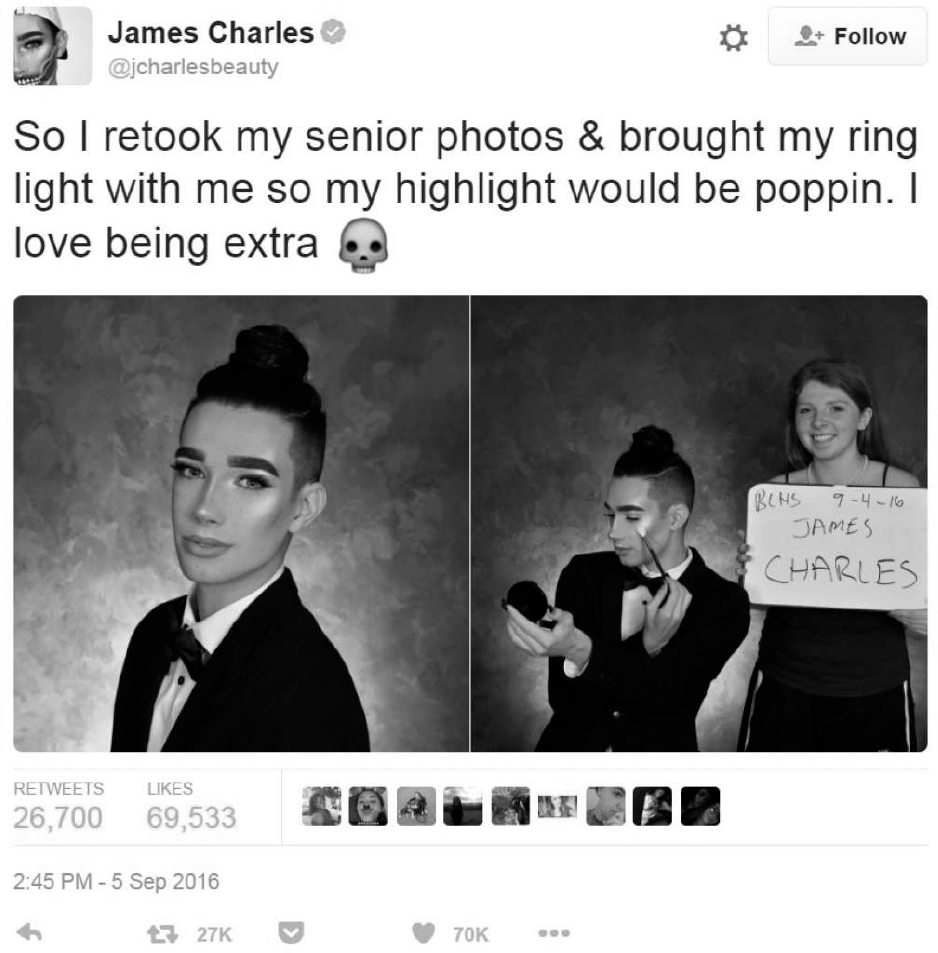
James Charles (@jamescharles) was catapulted into fame when his senior photo went viral.
James Charles, Twitter
James Charles is an example of one such beauty guru influencer, and we examined how influencers like him portray public and private personas, commodify themselves and develop a brand, and become powerful consumer reference groups. We watched his YouTube videos and analyzed his social media presence on sites such as Twitter, Snapchat, and Instagram. Others, such as Florencia Garcia-Rapp and Margaret Holland, in their 2016 respective articles, have also begun examining the features that give rise to macro-celebrities on YouTube and find that the mixture of authenticity, community, and commercial features are all essential components of successful YouTubers’ videos. Additionally, recent research by retail scholars addresses the power of these influencers to influence viewers’ buying intentions. We add to this burgeoning area of study by identifying additional features, and importantly, by showing how these influencers provide a new lens to connect modern day consuming to traditional sociological concepts.
Setting the Stage for Online Conspicuous Consumption
After greeting his audience, Charles leans conspiratorially towards the camera and says, “You know I am open and honest with what goes on in my life, and you all basically know everything.” Before the rise of SNSs, boundaries separated the public and private spheres, similar to what Erving Goffman called the front stage and backstage, respectively. On the front stage, people present their public selves and engage in ongoing impression management. The backstage self is reserved for family and close friends. Backstage, they reveal personal information and their inner thoughts. James Charles and others blur the boundary between the front stage and backstage by sharing personal information on various SNSs as a way to build trust with millions of viewers. These viewers are strangers, but they may feel that they are close friends with the influencers because they are privy to backstage information.
Influencers incorporate backstage information into their front stage persona through videos like Charles’s, “My Morning Routine,” where he takes his viewers through his morning skincare and makeup routine from start to finish. Charles starts off his video by letting his viewers know how he feels about his no-makeup morning face, “Asyou can see, I am looking a little bit different. I literally just woke up. I look like I got hit by a bus, but I am here and ready.” Charles strategically mixes his front stage persona with his relatable backstage persona throughout the video by commenting on where his viewers can purchase his outfit and by brushing his teeth on camera. Videos like this one provide an avenue for viewing both front stage and backstage consumption, expanding how much consumption viewers can observe.
“For today’s brand-new video, we are doing the one thing that you guys have been requesting for literal months.” Charles smiles and opens his front door to continue the video, “My House Tour!” Building a loyal fan base by interacting with viewers is a cornerstone of a successful career as an influencer. Once an influencer like Charles builds a loyal fan base, he becomes part of a new reference group by establishing himself as a trustworthy source of consumption habits. Charles and other influencers make sure their viewers know what they are wearing and where the items can be purchased. Indeed, these influencers affect viewers’ intention to purchase the products endorsed by them, as reported by scholars Karina Sokolova and Hajer Kefi, and Riadh Ladhari and colleagues. In today’s world, people aspire to keep up with those in the Vloggersphere more than with the Joneses.
The Rise of Charles’ Online Identity
In a video entitled “Reacting to and Recreating my First Makeup Look,” posted on September 21, 2018, Charles tells his viewers that his three-year anniversary as a vlogger is approaching. “I literally cannot believe that this has been my job for 3 years now. I pinch myself every day.” Throughout the video, Charles makes fun of how he did his makeup when he posted his first YouTube video. Charles shares how his online persona has grown and changed by telling his viewers that he has “gotten way more comfortable on camera,” and that his makeup skills have improved dramatically. By sharing his perception of his growth as an influencer, Charles reveals how he constructed his online identity. To understand Charles’ success as an influencer, we first examine his rise to fame.
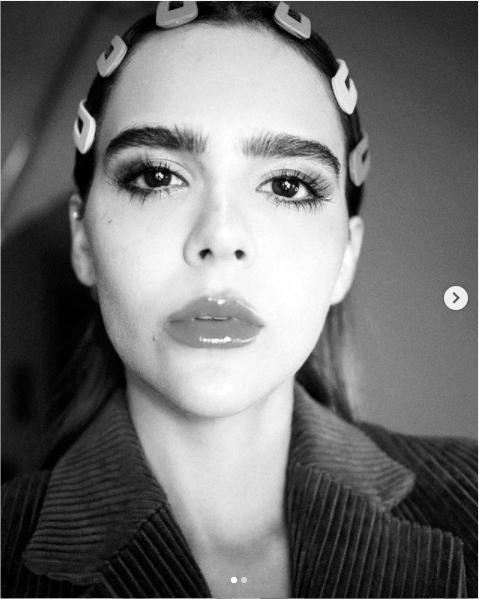
Mariand Castrejon, an influencer, can be found on Instagram @yuyacst.
Mariand Castrejón, Instagram
James Charles began his career in the beauty industry by doing his friends’ hair for special occasions. On one occasion, he applied a friend’s makeup per her request. She posted a picture of his work on Instagram and received positive feedback. After this initial success, Charles started posting makeup looks on his personal Instagram page. Charles amassed over 400,000 followers in just one year because of his makeup skills. Followers asked him to start a YouTube channel to post tutorials for his popular makeup looks. Charles obliged and posted his first YouTube video on December 1st, 2015. Charles was catapulted into fame when his senior photo went viral because he claimed to retake it with a ring light to make sure that he looked his best. Just one month after this photo went viral, James Charles became the first male CoverGirl model.
Influencers’ online identity creation fits well with Erving Goffman’s ideas of impression management, in particular managing the “front stage self.” The front stage refers to the public self that people portray, often reflecting how we want others to perceive us. SNSs provide a front stage platform to advertise one’s status with each post by posting pictures on vacation or displaying certain brand name products. Influencers portray themselves online consuming goods, ideas, and styles they hope their viewers will emulate. However, to achieve influencer status, they balance their more “polished” front stage persona by also building a backstage presence through “authenticity narratives.”
Authenticity Narratives
Charles creates an authentic narrative on social media by sharing personal information with his viewers on SNSs. In a “Chit Chat Get Ready With Me” video, Charles addresses the emotional toll of being an influencer. “I feel like a lot of people don’t like to talk about that and I definitely happen to talk about that a lot.” Charles goes on to share his personal struggles with being an influencer such as dealing with “hate comments” and the constant pressure to come up with new content. By broadcasting his inner thoughts, Charles encourages his viewers to perceive him as more authentic with each confession. Charles reinforces his authenticity by telling his viewers, “Now you guys know I am pretty much an open book, and I am so open and honest with everything that goes on in my life. You all basically know every single aspect of it.” This authentic narrative ensures that viewers believe they are supporting the “real” James Charles, not just a front stage version. Charles is not the only influencer to capitalize on authenticity narratives. In 2018, Brooke Erin Duffy and Jefferson Pooley identified this theme of authenticity in bios found on Twitter and Instagram as a way for influencers to ensure their viewers that their “performed selves aligned with who they really are.” In other words, influencers try to assure their viewers that who they see on the front stage and backstage are one and the same.
Because the stigma associated with noncustodial parenthood is so great, in large part because of the assumption that the issue originated and is most common in Black families, any non-custodial parent involved in the child support system might be swept up by the consequences originally meant for Black men.
According to Goffman, people only reveal their backstage self to a select group of people they trust. Influencers like Charles reveal backstage information to gain trust and loyalty from their viewers. Psychologists, such as Mark Leary and Robin Kowalski, might suggest that influencers use these tactics as part of their impression management to gain social (“likes”) and material (“money”) outcomes. To this point, Duffy and Pooley found that authenticity and self-promotion co-mingled for influencers. We agree. However, we argue that influencers use the backstage as part of constructing their self-presentations. While fascination with the private lives of celebrities is not a new phenomenon, the implosion of time and space with constant access to creating and viewing SNS content provides influencers a platform to portray a version of their backstage selves on the front stage. They reveal aspects of this backstage self by sharing “supposed” secrets, feelings, or images of themselves typically reserved for backstage friends. More authentic presentations of oneself appear to be a good thing, and indeed, many viewers buy into the influencers’ portrayals as authentic. However, as Sokolova and Kefi found in 2020, these seemingly authentic, or paraso-cial, interactions increase the likelihood that the conspicuous consumption undertaken by influencers affects viewers’ buying intentions. Next, the influencers move on to commodifying their identity to earn a livelihood from their viewers’ approval.
Commodification of Self
“Never in a million years would I have ever imagined to be here... It’s crazy to see how much I’ve improved and grown as both a person and an artist.” In a 2016 interview with ABC News, Charles expressed his gratitude and surprise at his rise to fame. Endorsements, follower count, and numbers of subscribers all contribute to influencers’ livelihoods. From their beginnings as makeup artists, personal assistants, and other professions, influencers may rise to dizzying heights of fame and wealth. First, though, these “normal” people must turn themselves into a marketable commodity. The commodification of self includes marketing elements of both front-stage online identity and backstage authenticity to viewers.
As Charles’ fame grew, he commodified his online identity and authentic backstage self with intention. Through careful editing, trend tracking, and associating with the right people while avoiding the wrong ones, Charles’ commodified himself as a blend between authenticity and perfection. In a video tutorial on how to use the photo editing app “Facetune,” Charles tells his viewers, “Newsflash for you guys. Almost every single influencer or celebrity who you see posting a photo, has probably Facetuned it.” By posting videos where he outlines his editing process, typically a backstage event, he gains his followers trust by appearing more authentic. Both his polished front stage self and his authenticity can be turned into a product and “sold” to viewers.
James Charles successfully commodified his online identity by creating an authentic narrative that appealed to his viewers. Charles worked tirelessly to commodify his online identity into something that he could market to companies. His videos always begin with the same greeting, “Hi Sisters!” which became an important catchphrase sold to his viewers. To add to his authentic narrative, his later videos also included non-makeup based content, such as “How much Money Beauty Gurus *Really* Make! Honest Q&A,” where Charles answers fan questions in lieu of filming a makeup tutorial. These videos tend to be more conversational and reveal more backstage information. In a dissertation entitled The Commodification of YouTube Vloggers, Zoe Glatt argues that influencers like Charles establish a consistent personality that viewers invest in. By commodifying their words, actions, and personalities, influencers turn themselves into marketable products.
The online commodification of self bridges the gap between impression management and conspicuous consumption. When SNS influencers manage their impressions through their online identities and authenticity narratives, they begin conspicuously consuming (and reviewing) products, ideas, and trends to gain status in the eyes of their followers. Indeed, in 2020, Ladhardi and colleagues found that both emotional attachment to influ-encers and their popularity affected viewers’ intentions to buy the endorsed products. As influencers commodify their front stage and backstage identities, they are seen as trusted friends to give advice about product selection, and even more so when branding occurs.
Jeffree Star, an influencer and beauty entrepreneur, can be found on Instagram @jeffreestar.
Jeffree Star, Instagram

Branding
In a video released on November 2, 2018, entitled “James Charles X Morphe Reveal,” James Charles is wearing one of his “sisters” sweatshirts as he addresses his 11 million viewers. He smiles as he tells his viewers, “Today is the grand reveal of my sister collection with Morphe.” Charles’ first makeup pallet with Morphe sold out in just 10 minutes. As Paul Fischer and colleagues discovered, branding is powerful as children as young as three years of age recognize logos and associate them with their respective brands. Branding is more than simple recognition, it is the process of associating various characteristics with a company or a specific good. Because influencers like Charles commodify themselves, their “brands” include their personalities as well as the goods they review and produce. In fact, Duffy and Pooley identify this group of influencers as “idols of promotion” for their success at interweaving their personal narratives with promoting their own selves and wares.
Like many influencers, Charles first commodified his online personality and then branded it with the help of endorsements. In 2016, he became the first male CoverGirl spokesmodel and gained many brand sponsorships. To gain these endorsements and turn his YouTube channel into a livelihood, he needed to sell his identity to these companies as a product. Charles proved that his online identity was profitable because of his growing loyal fan base. CoverGirl’s official statement reflected Charles’ success in transitioning his commodification to brand when they praised him by saying “One year ago, he boldly chose to launch his Instagram to the world, using transformative, dynamic makeup looks to showcase the many facets of his personality, serving as an inspiration to anyone who might have been afraid to do the same.” But, CoverGirl was just the first of many that capitalized on the Charles brand. In 2018, he created a makeup line with Morphe Cosmetics called “sister,” and he sells merchandise emblazoned with his catchphrases. Because his fans trust him and his authentic identity, they trust the brands he endorses. Indeed, Perelli reports in Business Insider that it is not just the fans that bank on the influencers’ authenticity as she reports about advice to companies that recommends that they connect with influencers who “authentically align with” and endorse their brand. When Charles recommends a brand, his fans interpret it as advice from a friend and do not question his motives.
Combining their fame with successful impression management, influencers exemplify a new realm of conspicuous consumption and reference group formation through the creation and promotion of their self brand. How reference groups, or peers, family, and important others, shape consumption is a longstanding consideration in sociology and other consumer studies. As we have argued, influencers are a powerful new reference group, and we have examined James Charles’ rise to influencer as one such example of this new group. Influencers shape viewers’ wants and desires because they present themselves on both front stage and backstage, thus extending the portrayal of conspicuous consumption to include both public and private displays. As reported by Sokolova and Kefi, Business Insider anticipates a 5-10 billion dollar investment by companies in influencers like Charles by the year 2022; it appears that the influencers’ brands are paying off.
Scandals: A Peek into the “Real” Backstage and Final Thoughts
In a now-deleted James Charles video, “Tati,” a disheveled-looking Charles addresses the camera. “I’m sorry for everything that is going on and everything I’ve put you through.” Charles posted this video in response to fellow YouTuber, Tati Westbrook’s video entitled, “BYE SISTER,” where Tati revealed Charles’ real backstage self by claiming that he was lying to his fans about his brand partnership with SugarBearHair, a beauty supplement company, and that he was dishonest in his personal life. Tati supported her allegations with screenshots of texts from Charles.
The dark side of turning oneself into a commodity is that one must be willing to sell one’s product at any time.
We have argued that these influencers portray their “backstage” selves on front stage SNSs as a means to commodify and brand themselves. However, upon deeper analysis, we suggest that the backstage has not disappeared, it has just been repackaged to include “new front stage” performances cloaked as the private backstage. Scandals like the one with Charles, reveal that an offline backstage still exists and tend to call the character of the influencer into question. However, the character that is being questioned is the commodified version. The dark side of turning oneself into a commodity is that one must be willing to sell one’s product at any time. In the case of influencers, their public and seemingly private interactions must meet their viewers’ expectations. When an influencer strays from their viewers’ expectations, they face scandals, which in turn can jeopardize their brand. For example, Charles’ fans reacted to news of the scandal by unfollowing him on Instagram, unsubscribing to his YouTube channel, and posting videos of themselves burning his merchandise. Fans were enraged when faced with the “real” backstage self of Charles that clashed with his online identity and authenticity narrative.
SNS influencers provide a 21st century lens to rethink concepts like Veblen’s conspicuous consumption, Goffman’s impression management, and reference groups. Influencers present “behind the scenes” looks into their “private” consumption routines, increasing the realm of conspicuous consumption by showing viewers the “right” products to use in the privacy of their own homes. We have provided a way to categorize how these influencers bridge impression management and conspicuous consumption and become powerful reference groups. With the ubiquity of SNSs as part of many people’s everyday lives, understanding how these influencers affect consumption is ripe for continued investigation.
Footnotes
Acknowledgements
The authors would like to thank Jill Kiecolt, Emerita in the Virginia Tech Department of Sociology, and Carrie Kroehler with the Virginia Tech Center for Communicating Science, for their invaluable feedback and suggestions on earlier drafts of this article.