



Abstract
Same-sex parents, how police harassment affects adolescent mental health, and unequal distribution of household labor. New research from the journals.
Black and Indigenous health disparities have been untethered from their historical contexts in the COVID-19 pandemic.
Anna Shvets, Pexels

In Sociology of Race & Ethnicity, Eduardo Bonilla-Silva extends upon his earlier efforts at exposing and criticizing color-blind racism by making a lens of the ongoing COVID-19 pandemic through which rapidly-shifting racial ideology is revealed. The author initially employs ideology in a Marxist sense, describing it as a ruling demographic’s total efforts toward establishing its aims as universal. However, he swiftly acknowledges Marx’s failure to contend with race, updating the framework of ideology to fill this gap and to prime it for conversations on the racialized context of COVID-19.
The author’s methodology, too, is informed by ideology and its construction, with public discourses such as the media narratives of focus in the current study playing a key role in stabilizing structures of power. Bonilla-Silva engages in what could be described as a content analysis of coronavirus-related public announcements by corporations, health institutions, non-profits, and officials. Three representations, in particular, are addressed: 1) the worker as society’s hero, 2) the non-profit industrial complex’s incomplete response to a mounting hunger crisis, and 3) the deliberate omission of histories of systemic racism in discussions of disproportionate COVID casualties. Somewhat paradoxically, the blanketing character of these patterns individualizes what are truly social phenomena. Workers are reduced to their labor contributions, the donation is portrayed as hunger’s cure, and Black & Indigenous health disparities are untethered from their historical contexts.
The conglomerating nature of color-blind ideology conveniently (and consciously) sidesteps the race question, thus re-affirming racial inequalities as detached from systemic segregation and violence. Even in an era of heightened (racial) sociopolitical conflict, color-blindness parades the horrors of the pandemic as impartially applied and experienced. The white supremacist state of things remains not only undisrupted but reinforced by color-blindness and the racial ideology it serves, a fact made all the clearer in pandemic times.
Hegemonic Masculinity and Social Change
In Sociological Theory, Yuchen Yang attempts to address theoretical critiques of Connell’s concept of hegemonic masculinity. Though the concept has been foundational to gender and masculinity scholarship, it has been subject to critique. First, most people understand the concept to be dependent on the legitimization of the patriarchy. Therefore, hegemonic masculinity exists beside multiple other subordinate masculinities and in direct comparison to femininity. Second, scholars often overemphasize the individual-level of hegemonic masculinity instead of the concepts’ structural components. The application of hegemonic masculinity in the literature raises the question about opportunities to examine and articulate gender equity and a feminist revolution.
Yang uses Gramsci’s theory of hegemony and cultural domination to address the critiques of hegemonic masculinity and reframe it in a way that better allows for social change. Yang conceptualizes hegemony as a combination of force used by the oppressive class and consent given by the oppressed. In this regard, hegemony operates among social groups and has divergent mechanisms where subordination occurs. Yang argues this approach allows scholars to avoid understanding hegemonic masculinity as subjectively positive or negative, and instead understand it as a structural force that places other masculinities into subordinate positions.
Instead of destroying hegemonic masculinity, Yang argues that change can be accomplished by promoting more masculinities to be considered hegemonic. This diluting of hegemonic masculinity occurs besides the dilution of hegemonic femininity, as both are working together to uphold a broader gender hierarchy. This approach allows us to separate hegemonic masculinity from specific traits and instead understand it as promoting a gender hierarchy on a structural level, which allows more space for social change.
When Multiracial Meets Ethnoracial
The United States’ growing multiracial and immigrant populations have ushered in unprecedented demographic shifts that may influence the course of U.S. race relations and politics. Despite the wealth of scholarship exploring multiracial and immigrant experiences, few studies move beyond treating these groups as mutually exclusive. Consequently, little is known about those who are both multiracial and have an immigrant background. In Sociology of Race and Ethnicity, Alyssa Newman bridges multiracial and immigration scholarship to examine multiracial identity construction for the children of immigrants.
Drawing from semi-structured interviews with 26 multiracial adults who have at least one immigrant parent, Newman unpacks respondents’ tensions with and motivations for asserting a distinctly multiracial identity. Further, Newman compares the identity construction of respondents who are part-white to those who are not to complicate the use of multiracial identity claims as indicators of assimilation or the blurring of racial boundaries. Findings suggest that multiracial identity assertion serves as a mechanism for respondents’ to demonstrate connection and belonging to their multiple ethnoracial groups as opposed to distancing themselves from their immigrant heritage(s). However, the factors informing part-white and non-white multiracial identity claims remain significantly varied.
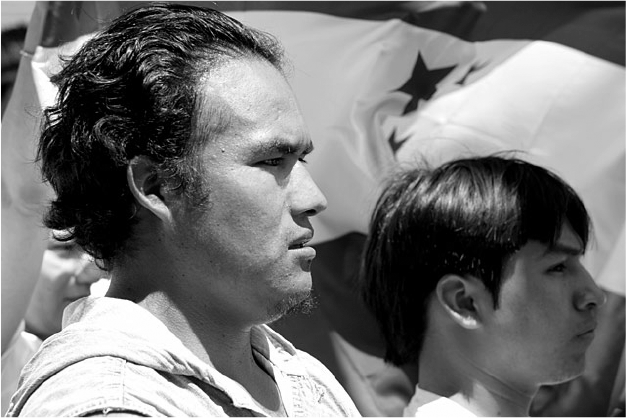
Growing multiracial and immigrant populations have ushered in demographic shifts that may influence the course of U.S. race relations and politics.
Larry Schwartz, Flickr cc
For part-white multiracial adults with one immigrant parent, Newman finds that claiming a multiracial identity acts as a means to disidentify with whiteness or recognize the inauthenticity of identifying solely with whiteness relative to one’s racialized experience. In contrast, non-white multiracial adults with immigrant parents asserted their multiracial identities due to a perceived obligation to preserve, represent, and transmit the cultural inheritance received from their multiple ethnoracial communities. Ultimately, Newman argues that rather than conceptualizing multiracial identity as a transitive, temporary response to marginality, as traditionally observed in race and assimilation paradigms, we must move to understand multiraciality as a stable, constant, and collective identity and experience.
Unequal Distribution of Household Labor
Research has shown that despite growing support for gender egalitarianism, i.e., equality between men and women, women do almost twice as much housework as men. The effects of macro-structural forces such as inadequate childcare are well-known. However, little is known about how couples who believe in egalitarianism justify the unequal distribution of household labor (both mental and physical). Using 64 in-depth, semi-structured interviews of 32 different-sex couples, Allison Daminger in the American Sociological Review discusses perceptions and attitudes through which college-educated, middle- and upper-middle class men and women justify women disproportionately undertaking more feminized tasks such as caring for children and cooking.
The analysis of the interviews reveals a mismatch between intentions and actions. Couples claimed that their ideal was a 50-50 distribution of tasks within the household but in reality, they were not devoted to the idea of equality for its own sake. Instead, they preferred efficiency which they claimed was at odds with this idea of equality. Interviewees frequently relied on explanations that involve “shallow de-gendering.” These are processes that do not outwardly seem gendered but are entrenched in a gendered ideology. Couples used explanations of “personality traits/types” to justify why an individual (usually the woman) would prefer cognitive tasks such as planning. They also use the language of constraints (usually posed by the husband’s job) to explain why their behavior differed from their ideal. This de-gendering also helped couples to preserve marital harmony and peaceful cohabitation.
According to recent research, women still do almost twice as much housework as men.
Jenny Turner, Flickr cc

Although this data is not generaliz-able to the U.S. population, these are highly educated, majority white, and well-off couples. As a result, they are arguably the least constrained and most ideologically committed to the idea of equality and to explain their struggle. How would couples with fewer resources explain their struggles?
Are Same-Sex Parents’ Kids All Right?
Concerns about the well-being of children have been central to debates surrounding the rights of same-sex families. These same concerns were front and center of the 2015 Obergefell v. Hodges Supreme Court case, where opponents of marriage equality argued that same-sex marriage would undermine family as an institution and harm children. To date, there is little evidence to suggest that children’s outcomes are worse when raised by same-sex parents. However, research on these outcomes has largely relied on small selective samples and cross-sectional studies, both of which are limited in scope. Deni Mazrekaj, Kristof De Witte, and Sofie Cabus seek to address this limitation by using unique administrative longitudinal data from the Netherlands—the first country to legalize same-sex marriage.
In American Sociological Review, the authors use administrative records based on municipal population registers that cover the entire Dutch population annually from 1995 to 2019. Since people must register their children after birth and courts provide information on adopted children to municipalities, the authors are able to identify the children of same-sex and different-sex parents in these administrative records. The authors examine the educational outcomes for 2,971 children with same-sex parents and over a million children with different-sex parents followed from birth.
Contrary to consequentialist arguments made by opponents of marriage equality, the authors find no evidence that children with same-sex parents fare worse than children with different-sex parents. Rather, the authors find that children raised by same-sex parents from birth actually perform better than children raised by different-sex parents in both primary and secondary education. For example, the authors’ results suggest that children raised by same-sex parents from birth are more likely to graduate than children with different-sex parents. One question remains though: Why? One possible explanation is that same-sex parents might compensate for their unique stressors by investing more time and energy into their children. No matter the explanation, one thing is certain: the kids are all right.
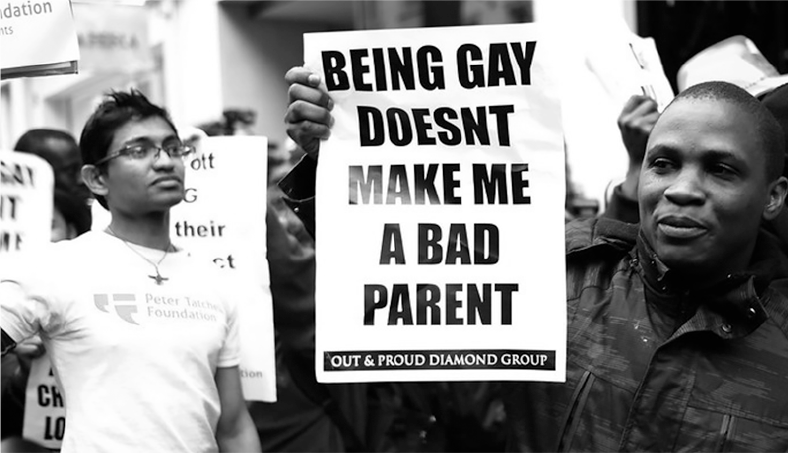
About sixty people protested outside Dolce and Gabbana’s flagship store in London because of designer Dolce’s criticism of gay parents.
Alisdare Hickson, Flickr cc
Critique of Title IX and Universities
In their Teaching Sociology article, Amina Zarrugh and colleagues assess the effectiveness of students learning about Title IX by exploring their own university’s enforcement of the policy. Conducted in three phases, the study included an undergraduate class focused on Title IX, focus groups composed mostly of women participants aimed at understanding what they gained from the class, and a follow-up survey with members of the class. At the beginning of the undergraduate class, students were asked what they knew prior to the class about the Title IX policy. Answers ranged from general knowledge around gender discrimination to knowing little about the policy. Each week, the class was led by student discussion leaders. The focus groups revealed the student-led structure of the class promoted student interaction and critique of the policy.
The authors discovered that students found Title IX to be “complex” and difficult to understand. Because of this, it was hard for the students to access Title IX resources in general. Additionally, students found the disconnect between narrow state law and broad Title IX policy definitions of sexual assault to be problematic. Students discovered the discrepancies between expected sexual assault statistics on college campuses based on national data and the number of those actually reported by their own campus. They began to understand Title IX as a policy to protect the institution from liability of sexual assault. The students revealed that through exploring Title IX, they better understood the broader impact of gender-based violence and expressed a desire to take their new understanding “beyond [them]selves” to spread knowledge and inspire action regarding Title IX within the campus and the local community. The authors end the article by arguing that the campus-based teaching approach is a useful tool and could be used to interrogate other examples of inequality.
Police Harassment and Adolescent Mental Health
Can interactions with the police have a negative impact on mental health? In Society and Mental Health, Kristin Turney explores the impact of police contact on the mental health of adolescents, focusing on the experiences and self-rated depressive symptoms of 15-year-olds participating in the Fragile Families and Child Wellbeing Study. First, the author looked at whether the adolescents had personal or vicarious contact (i.e., witnessing police interactions, hearing stories from someone they know) and how that impacted depressive symptoms. Second, for those who indicated they had personal contact with police, the author investigates the relationship between depressive symptoms and the intrusiveness of the stop. Turney classified intrusiveness as officers using abusive language, racial slurs or threats, and whether the stop included frisking or searching of bags or physical force. Finally, the study looked at how these variations in interactions affected depressive symptoms across race, gender and poverty status.
Turney finds that both personal and vicarious contact is associated with greater depressive symptoms compared to those who had no experience with the police. Although both intrusive and nonintrusive police interactions were associated with depressive symptoms, higher levels of intrusiveness were associated with increases in depressive symptoms. Finally, the association between police contact and depressive symptoms is concentrated among girls (compared to boys) and among Black adolescents (compared to Whites and Hispanics).
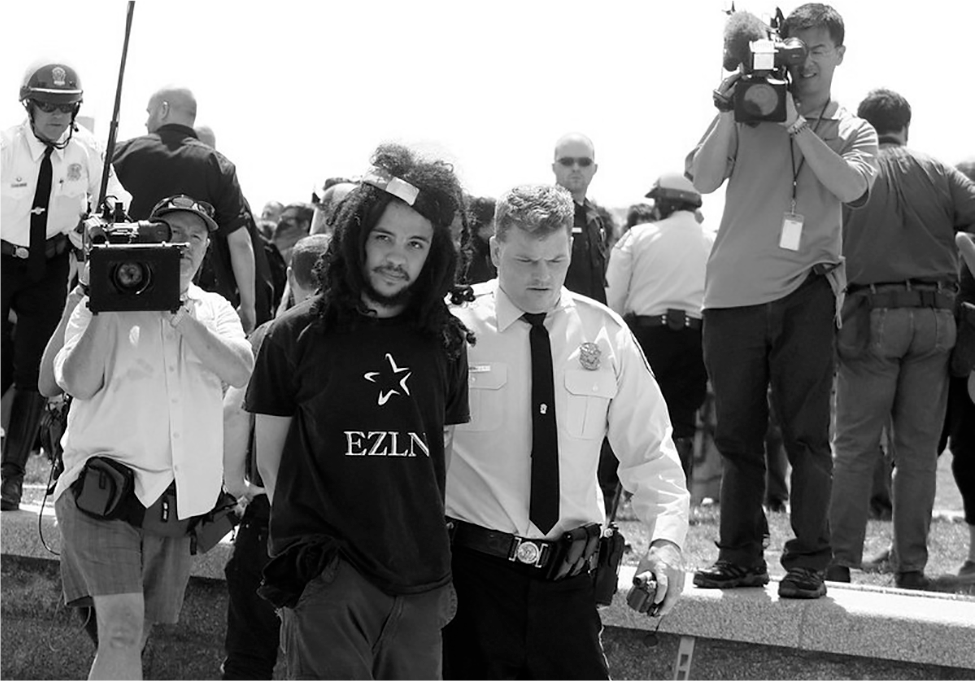
Black adolescents are three times more likely than Whites, and twice as likely than Hispanics, to experience a stop with a frisk.
Elvert Barnes, Flickr cc
These findings suggest that personal police contact can be traumatic and can trigger anxiety about future contact. Black adolescents were three times more likely than Whites, and twice as likely than Hispanics, to experience a stop with a frisk. Turney argues that given the concentration of police contact among already vulnerable adolescents living in highly surveilled and disadvantaged neighborhoods, that police contact may exacerbate population health disparities, especially among adolescents.